America Is Hard to See | Art & Artists

May 1–Sept 27, 2015


Exhibition works

23 total
Threat and Sanctuary
Read more

Threat and Sanctuary
Floor 5

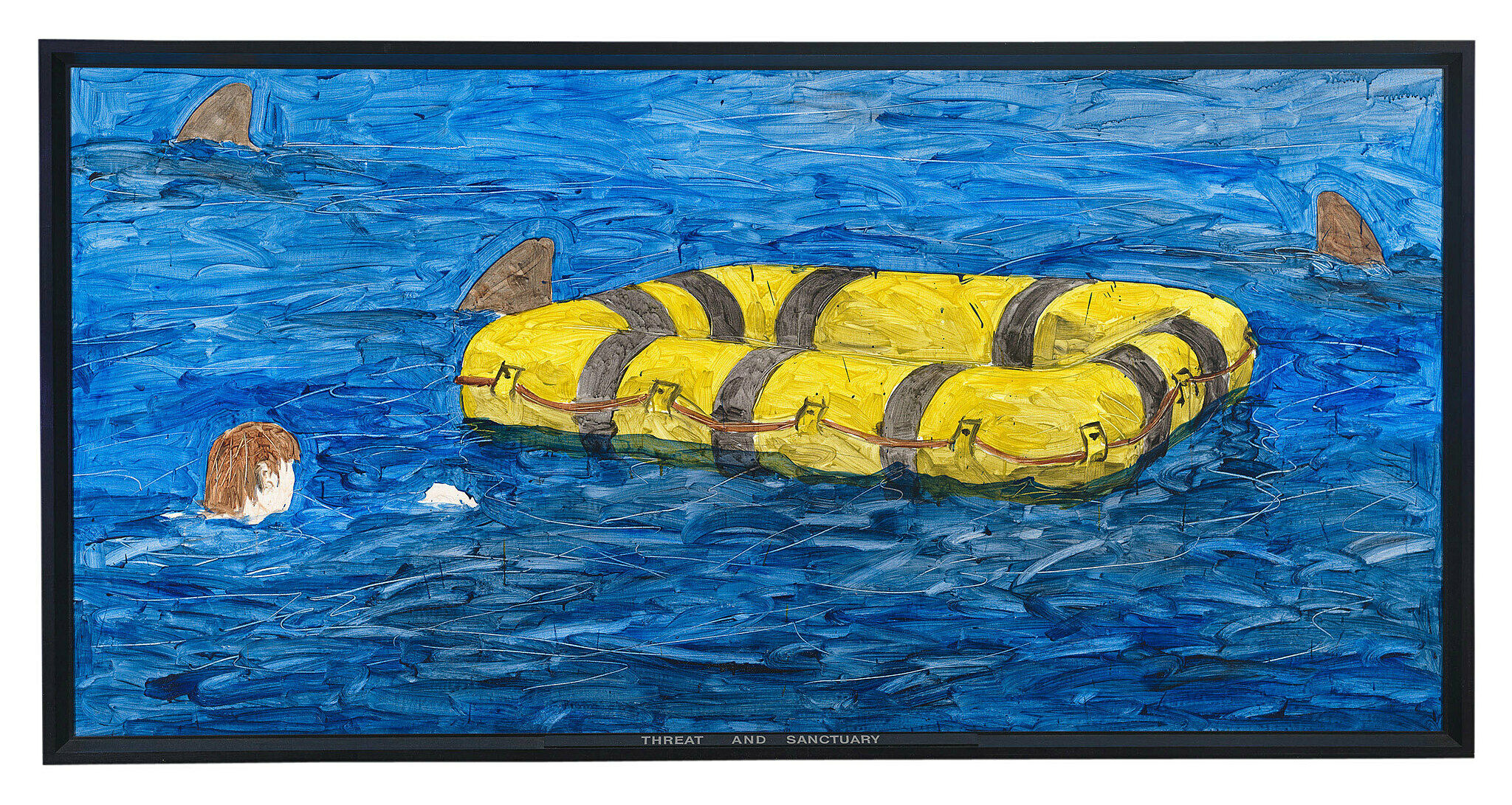
A painting of a person swimming to a life raft surrounded by three shark fins.

Neil Jenney, Threat and Sanctuary, 1969. Oil on canvas, with wood frame, 61 × 123 1/4 × 3 1/4 in. (154.9 × 313.1 × 8.3 cm). Whitney Museum of American Art, New York; gift from the Emily Fisher Landau Collection  2012.175a–b © Neil Jenney 

Threat and Sanctuary
Floor 5

Although long considered the most important modern art form, painting fell out of fashion in the contemporary art world of the late 1960s. Regarded by many as outmoded, even dying, the medium was challenged, on the one hand, by the forceful presence and novel processes of Minimal and Post-Minimal sculpture and, on the other, by Conceptual art’s emphasis on language and photography. Yet it was precisely painting’s diminished status that made it ripe for reinvention—a space to play not only with paint itself but also with critical taboos like figuration and bad taste.

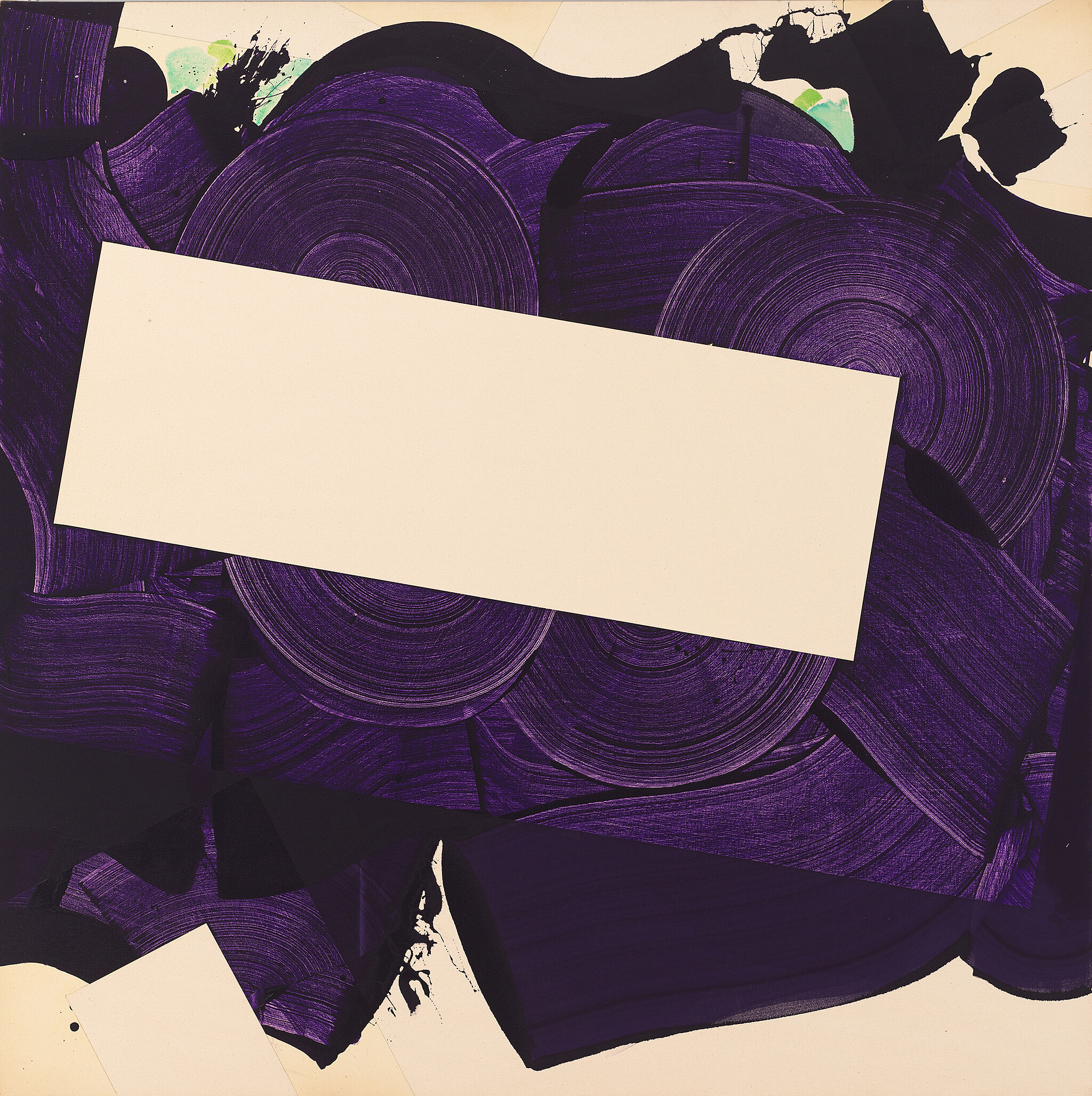
The paintings on view in this chapter represent a variety of experimental approaches to the medium from the late 1960s through the 1970s. Some, such as Robert Reed’s and Jack Whitten’s canvases, involve almost sculptural processes, such as pouring, smearing, and layering, while Elizabeth Murray’s painting toys with eccentric graphic forms and jarring high-key colors. Having abandoned his Abstract Expressionist style for cartoonish symbols in the late 1960s, Philip Guston paved the way for younger artists reengaging the figure within psychologically charged tableaus. Several of them appeared under the mantle of New Image Painting, a provocative 1978 Whitney exhibition that included the work of Neil Jenney and Susan Rothenberg. These artists rejected both abstraction and the smoothly rendered images of Pop in order to pursue oblique imagined narratives—whether comic or foreboding—within loosely painted fields. The freedom they espoused in their handwork, symbolism, and humor revivified a medium that some left for dead and continues to inspire younger generations of painters today.

Below is a selection of works from this chapter.

0:00

Chuck Close, Phil, 1969

0:00

Narrator: Chuck Close has used the photograph this painting is based on many times over the years. It is of the artist’s friend, Philip Glass. But the painting, from 1969, was his first portrait of Glass, who later became one of America’s best-known composers. 

Philip Glass: My reaction to the picture? I never really think of me as the picture, in fact it’s always just been an image, I don’t feel attached to it at all. Though other people might say, there’s Phil, but I never say that. I don’t think, when Monet was doing haystacks, the haystacks thought, hey I’m the haystack, it’s just another haystack [LAUGHS].I don’t think it was a portrait in the sense that when Rembrandt did a portrait or when Van Gogh did a portrait those portraits were partly to reveal some character of the person, the portraits were about the person. If these are portraits at all and I don’t think they are they’re not about revealing the portrait of the person they’re about revealing the artist.

Narrator: To hear Glass describe sitting for the photograph that Close used to make the painting, please tap the button to continue. 

Chuck Close, Phil, 1969

In America Is Hard to See

CHUCK CLOSE (B. 1940), PHIL, 1969

Chuck Close made his inaugural series of works–eight large-scale, black and white paintings of faces—between 1968 and 1970. In this and other early “heads” (as the artist calls them), Close sets each frontally-depicted face against a neutral ground.

Phil is a portrait of Close’s long-time friend, composer Philip Glass. Despite his intimate relationship with the subject of the painting, Close created this work in a calculated, systematic manner. The artist took an 8 × 10-inch photograph of the sitter, overlaid it with a penciled grid, and then painted a vastly enlarged blowup of each square onto the canvas using airbrushes to create a photographic finish. As a result of this drastic enlargement, we see Glass at an uncomfortably close distance from which every mole, hair, and wrinkle is visible. With its cool, almost clinical detachment from its subject, the work functions more like a giant mug shot than a portrait.

0:00

Philip Guston, Cabal, 1977

0:00

Narrator: Artist Carroll Dunham talks about Philip Guston’s painting titled Cabal.

Carroll Dunham: It seems pretty grim. You know? Piles of heads in a very desolate setting. The fact that there's so much white used to delineate the shapes seems like it reinforces this idea of nocturnal atmosphere, and ghostliness. I really think that all his paintings, even the ones that appear to deal with the most particular subjects, are all about evoking a kind of mood space. You know, a psychological and emotional weather, that is carried by the methodology, as much as it is by the images.

Narrator: To hear Dunham talk about public reaction to Guston’s work and his influence on other artists, please tap the button to continue. 

Philip Guston, Cabal, 1977

In America Is Hard to See

PHILIP GUSTON (1913-1980), CABAL, 1977

In Philip Guston’s Cabal, a heap of disembodied eyeballs, ears, and heads huddle against an opaque black field, floating in what appears to be a sea of blood. It is cartoonish yet creepy, suggesting paranoia and latent threat. The title’s evocation of conspiracy would have been particularly poignant in the late 1970s, when the Watergate scandal was still a raw wound—one that Guston addressed in numerous contemptuous depictions of President Richard Nixon. Through the 1950s and 1960s, Guston had been one of the most lyrical of the Abstract Expressionists. The upheavals of 1960s, however, led him to doubt that abstraction could fully express the range of human experience. He reintroduced figurative imagery into his work, making paintings that imply both personal and political subtexts. The images they contain have precedents in Guston’s satirical social commentaries from the 1930s and 1940s.

A painting of a person swimming to a life raft surrounded by three shark fins.

Neil Jenney, Threat and Sanctuary, 1969. Oil on canvas, with wood frame, 61 × 123 1/4 × 3 1/4 in. (154.9 × 313.1 × 8.3 cm). Whitney Museum of American Art, New York; gift from the Emily Fisher Landau Collection  2012.175a–b © Neil Jenney 

NEIL JENNEY (B.1945), THREAT AND SANCTUARY, 1969

For Threat and Sanctuary, Neil Jenney used broad brushstrokes executed in thinly applied paint to depict a lone figure swimming through shark-filled waters toward an empty lifeboat. The title underscores the deadpan literalism of the scene. Threat and Sanctuary is part of a series in which each painting names two subjects that don’t logically belong together. Collectively, the works—all set in deep black frames constructed by Jenney and whose titles the artist hand-lettered—offer a backhanded testament to the power of painting, a medium whose persuasive power is so great that it can, at least momentarily, make a believable reality out of absurd juxtapositions.
Jenney wryly referred to his paintings as “good ideas done badly,” a description that anticipated the late 1970s categorization “Bad Painting.” As an artist who willingly defied conventional expectations, Jenney readily embraced the term.

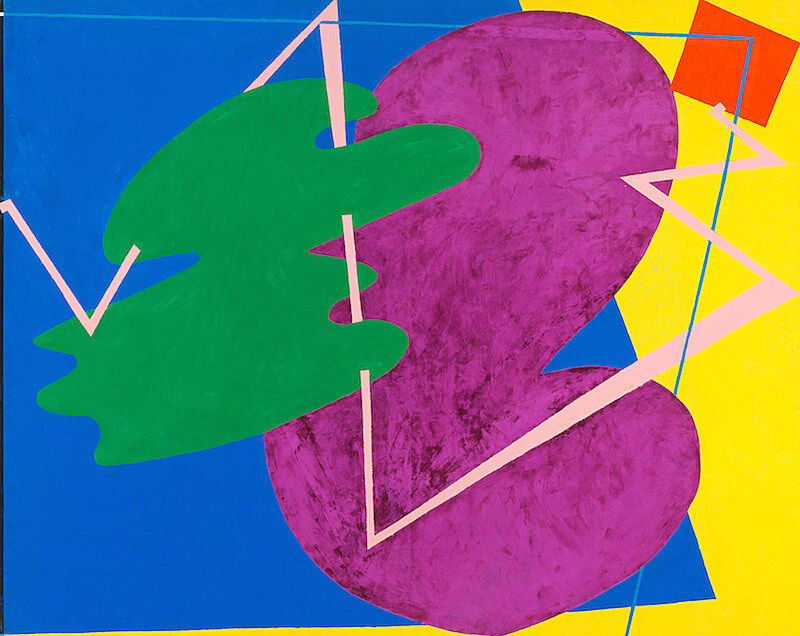
A painting of curvy shapes intersected by a zig zag line.

Elizabeth Murray, Children Meeting, 1978. Oil on canvas, 101 3/16 × 127 in. (257 × 322.6 cm). Whitney Museum of American Art, New York; purchase, with funds from the Louis and Bessie Adler Foundation, Inc., Seymour M. Klein, President 78.34 © 2015 The Murray-Holman Family Trust / Artists Rights Society (ARS), New York

ELIZABETH MURRAY (1940-2007), CHILDREN MEETING, 1978

In 1967 Elizabeth Murray left the Midwest and arrived in a New York art world dominated by the cool, spare, and cerebral modes of Minimalism and Conceptualism. Although she experimented in these veins, her preferred medium was painting, then under critical scrutiny and often disdained. Over the course of the next four decades, Murray pioneered a spirited pictorial practice that drew as much from popular art sources such as cartoons as from revered art-historical antecedents, including Cubism, Surrealism, and Abstract Expressionism. The distinction between figuration and abstraction was another divide with which Murray’s boldly expressive art readily dispensed, and it similarly ignored the prohibition on high art bearing personal, domestic, or biographical associations. Serious and sensuous at once, Murray’s lively, large-scale canvases took shape in a variety of formats, some contoured, layered, fractured, or multipanel.

Children Meeting was executed just as Murray was beginning to consolidate her signature style; in her words, the painting “grew out of a confidence about being able to lay down the colors and put in the goofy shapes that were beginning to emerge. . . . I’d never allowed myself to use that zany purple.” This vibrant violet strikes an uneasy balance with the adjacent emerald hue, in turn underscoring other unexpected harmonies—the conjunction of zigzags and rectilinear outlines, for example, or the meeting of hard-edged forms with organic shapes. Murray’s central biomorphs, while resolutely abstract, seem simultaneously to take on an embodied presence: perhaps they are the children of the painting’s title.

Excerpted from Whitney Museum of American Art: Handbook of the Collection (2015), p. 274. Published by the Whitney Museum of American Art, New York; distributed by Yale University Press.

Robert Reed (1938-2014), Plum Nellie, Sea Stone, 1972. Acrylic and pencil on canvas. Overall: 71 1/8 × 71 1/4 in. (180.7 × 181 cm). Whitney Museum of American Art, New York; Purchase, with funds from The Hament Corporation 73.26 © artist's estate

ROBERT REED (1938-2014), PLUM NELLIE, SEA STONE, 1972

An artwork by Susan Rothenburg

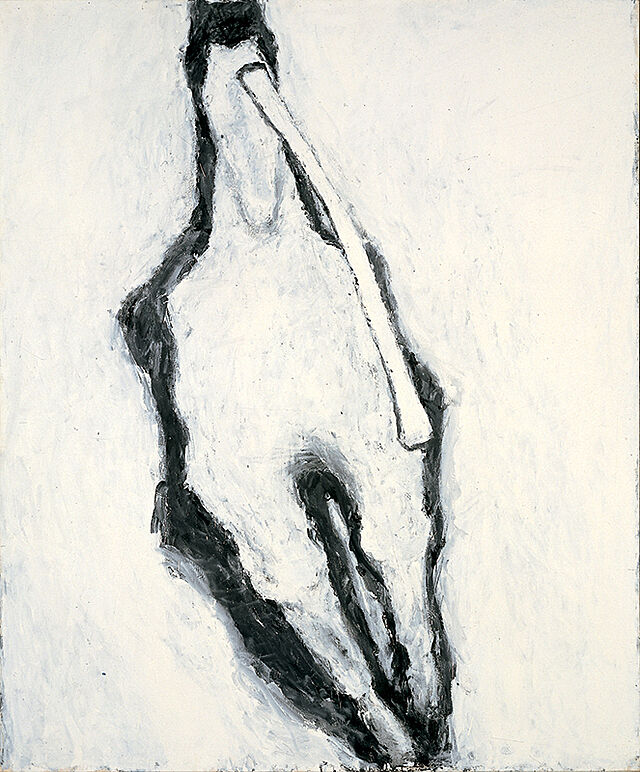
Susan Rothenberg, For the Light, 1978–79. Synthetic polymer and vinyl paint on canvas, 105 × 87 1/4 in. (266.7 × 221.6 cm). Whitney Museum of American Art, New York; purchase with funds from Peggy and Richard Danziger  79.23

© 2009 Susan Rothenberg/Artists Rights Society (ARS), New York

SUSAN ROTHENBERG (B. 1945), FOR THE LIGHT, 1978-79

While sketching on a canvas scrap in 1974, Susan Rothenberg intuitively drew a horse outlined in profile and bifurcated by a vertical line. Despite the lingering dominance of nonfigurative abstraction in painting, she was captivated by the animal form and went on to depict numerous horses—in side view and frontally, stationary and moving—during the following decade, rendering each composition by squeezing paint onto her brush and mixing colors directly on the canvas.

In For the Light, the beast charges toward the viewer. Rothenberg wedged a bonelike shape between its head and the picture plane, interrupting the sensation of the horse’s forward momentum. The artist did not differentiate between the figure and the ground on which it runs, a choice that allowed her to “stick to the philosophy of the day—keeping the painting flat and anti-illusionist,” as she recalled, even as she championed “this big, soft, heavy, strong, powerful form.”

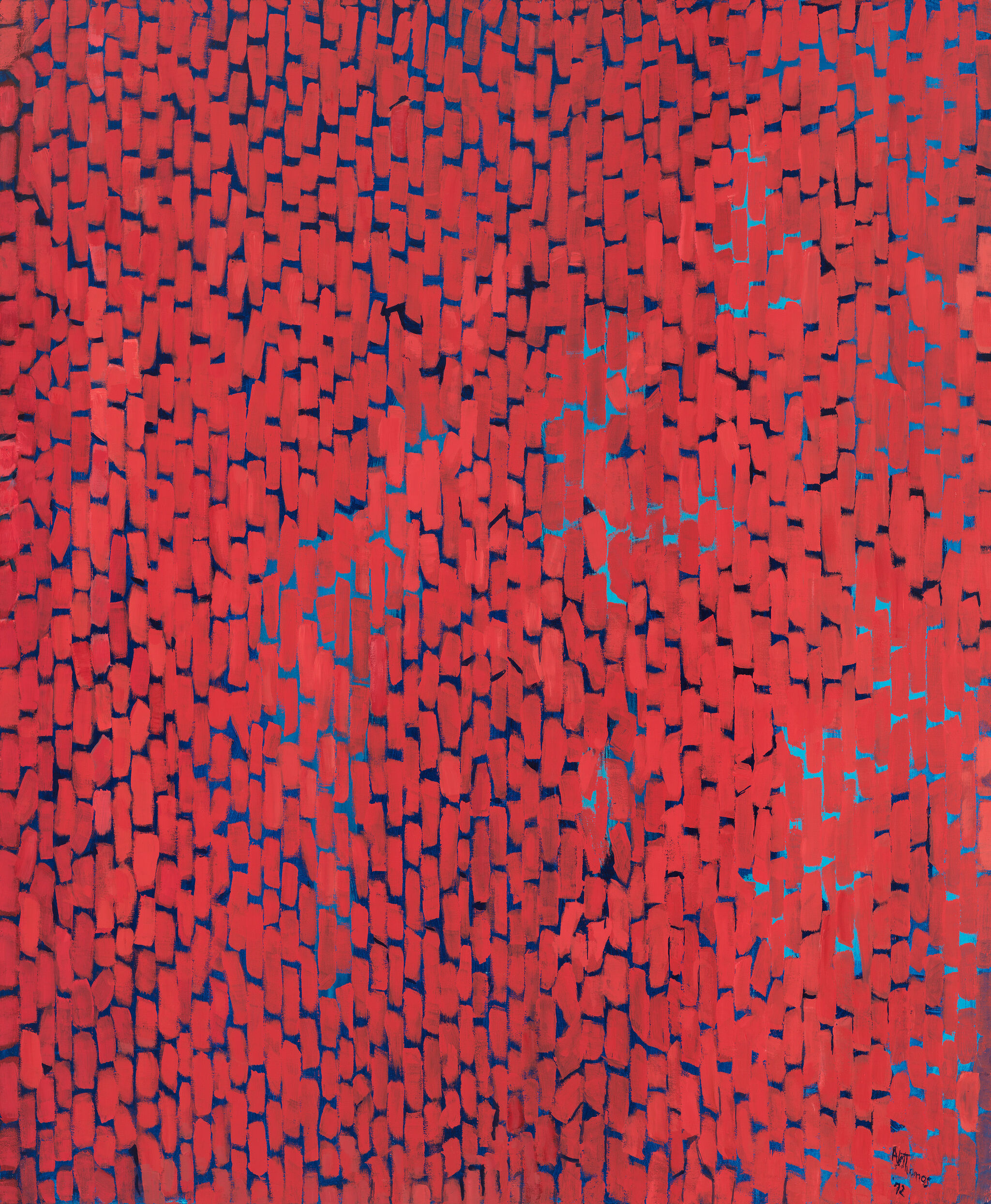
A collection of red acrylic paint is layered in quick strokes that resembles a collection of particles, like a body of sand.

Alma Thomas (1891–1978), Mars Dust, 1972. Acrylic on canvas, 69 1/4 × 57 1/8 in. (175.9 × 145.1 cm). Whitney Museum of American Art, New York; purchase, with funds from The Hament Corporation 72.58

ALMA THOMAS (1891-1978), MARS DUST, 1972

Alma Thomas’s abstract compositions are derived from observations of nature, both earthly and celestial. As this painting’s title suggests, the artist used the dust storms that occur on the red planet as the touchstone for the all-over composition of Mars Dust. These massive whirlwinds of iron-rich soil, which can envelop Mars for weeks or months, were first observed at close range during a 1971–72 NASAspace mission. Fascinated by television and newspaper reports of NASA’s unprecedented images, Thomas decided to render her own version. She used an elastic band to guide the size and spacing of each dappled red brushstroke. The cobalt blue underlayer, visible between strokes, creates a shimmering, otherworldly effect.

In 1972, the same year that she made Mars Dust, Thomas became the first African American woman to have a solo exhibition at the Whitney.

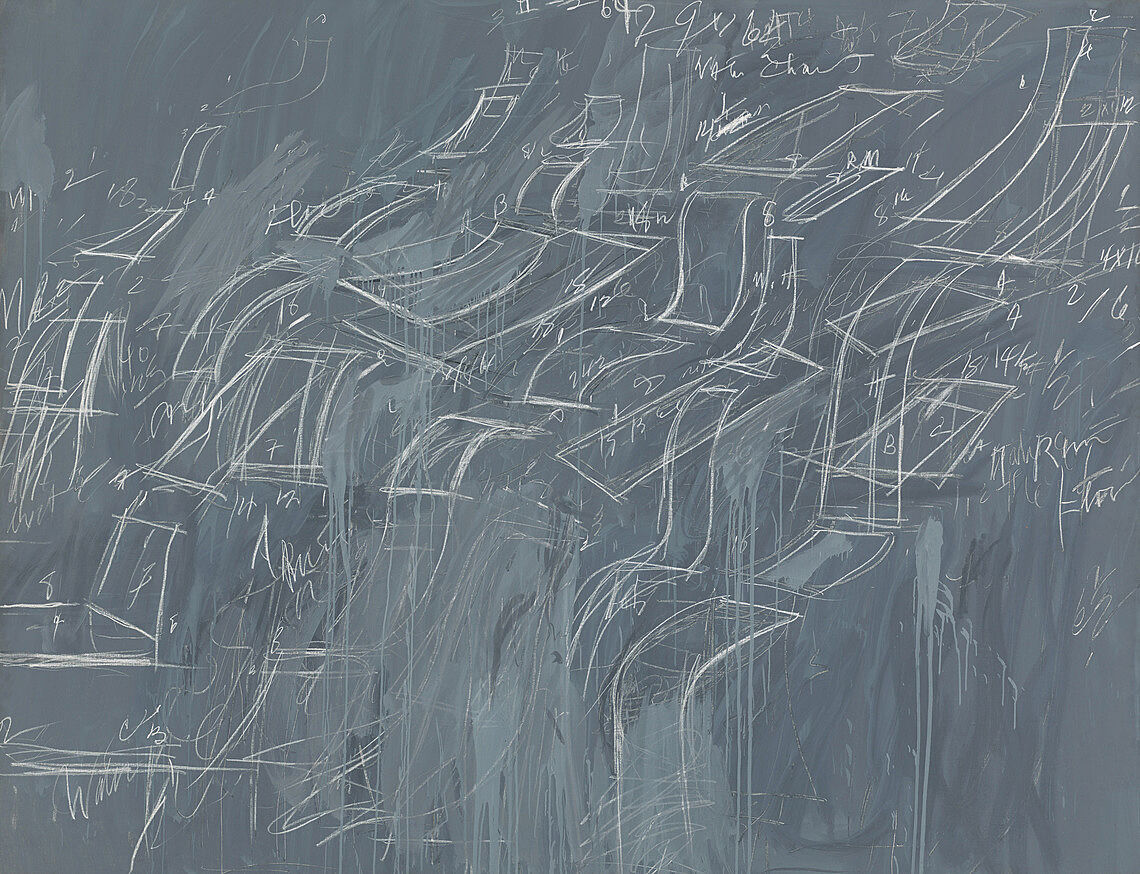
Cy Twombly (1928-2011), Untitled, 1968. Oil and crayon on canvas, 79 × 103 3/8 in. (200.7 × 262.6 cm). Whitney Museum of American Art, New York; purchase, with funds from Mr. and Mrs. Rudolph B. Schulhof 69.29 © Cy Twombly Foundation

CY TWOMBLY (1928-2011), UNTITLED, 1968

In 1966, Cy Twombly began a series of paintings, drawings, and collages that resembled chalkboards. To create the paintings in the series, including Untitled, he drew on wet gray paint with crayon, incising white, graffiti-like marks into the surface. The work’s gestural appearance relates to Abstract Expressionism, which dominated the art world when Twombly began developing his art in the 1950s. At the same time, the canvas’s austere surface evokes the Minimalist and Conceptual work being produced contemporaneously by fellow American artists. Here, Twombly’s cascade of lines, shapes, and notations resembles a diagram, but one that has been written over and reworked to create a layered depth and to suggest the passage of time. These diagrammatic markings may be attributed in part to the artist’s fascination with the drawings in Leonardo da Vinci’s notebooks—especially the sketches of maelstroms and water currents. The words “water chart” scrawled at the painting’s top right may refer to Leonardo’s drawings, as well as to the remains of the ancient aqueducts that surround the city of Rome, where Twombly moved in 1957.

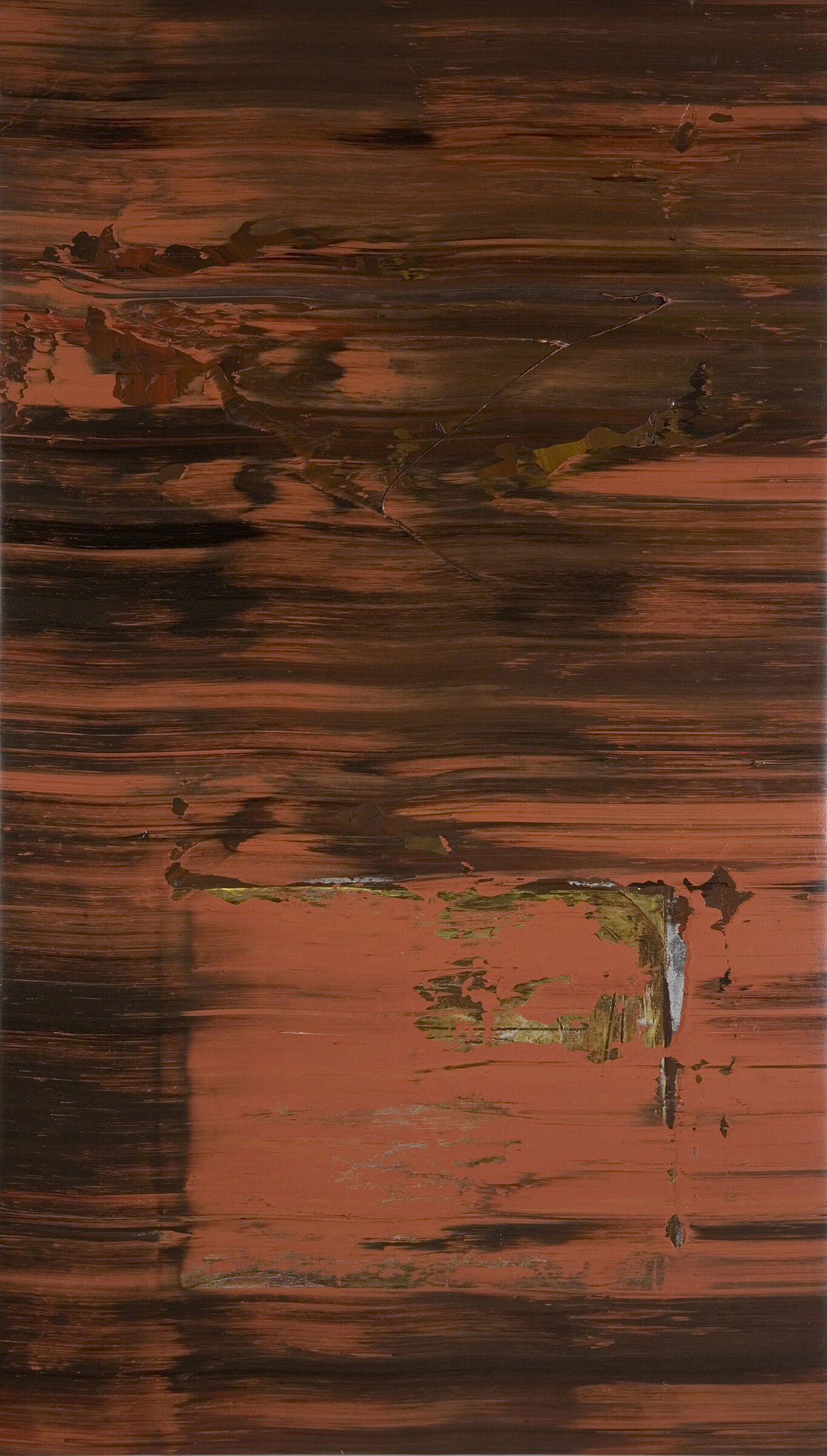
Jack Whitten (b. 1939). Sorcerer’s Apprentice, 1974. Acrylic on canvas with string, 88 1/4 × 51in. (224.2 × 129.5 cm). Whitney Museum of American Art, New York; purchase, with funds from the Painting and Sculpture Committee 2015.49 © 2015 Jack Whitten/Artist Rights Society (ARS) New York.  Image Courtesy Alexander Gray Associates, N.Y.

JACK WHITTEN (B. 1939), SORCERER’S APPRENTICE, 1974


Artists


Explore works from this exhibition
in the Whitney's collection

View 646 works

On the Hour

A 30-second online art project:
Frank WANG Yefeng, The Levitating Perils #2

Learn more about this project

Learn more at whitney.org/artport

On the Hour projects can contain motion and sound. To respect your accessibility settings autoplay is disabled.