America Is Hard to See | Art & Artists

May 1–Sept 27, 2015


Exhibition works

23 total
New York, N.Y., 1955
Read more

New York, N.Y., 1955
Floor 7

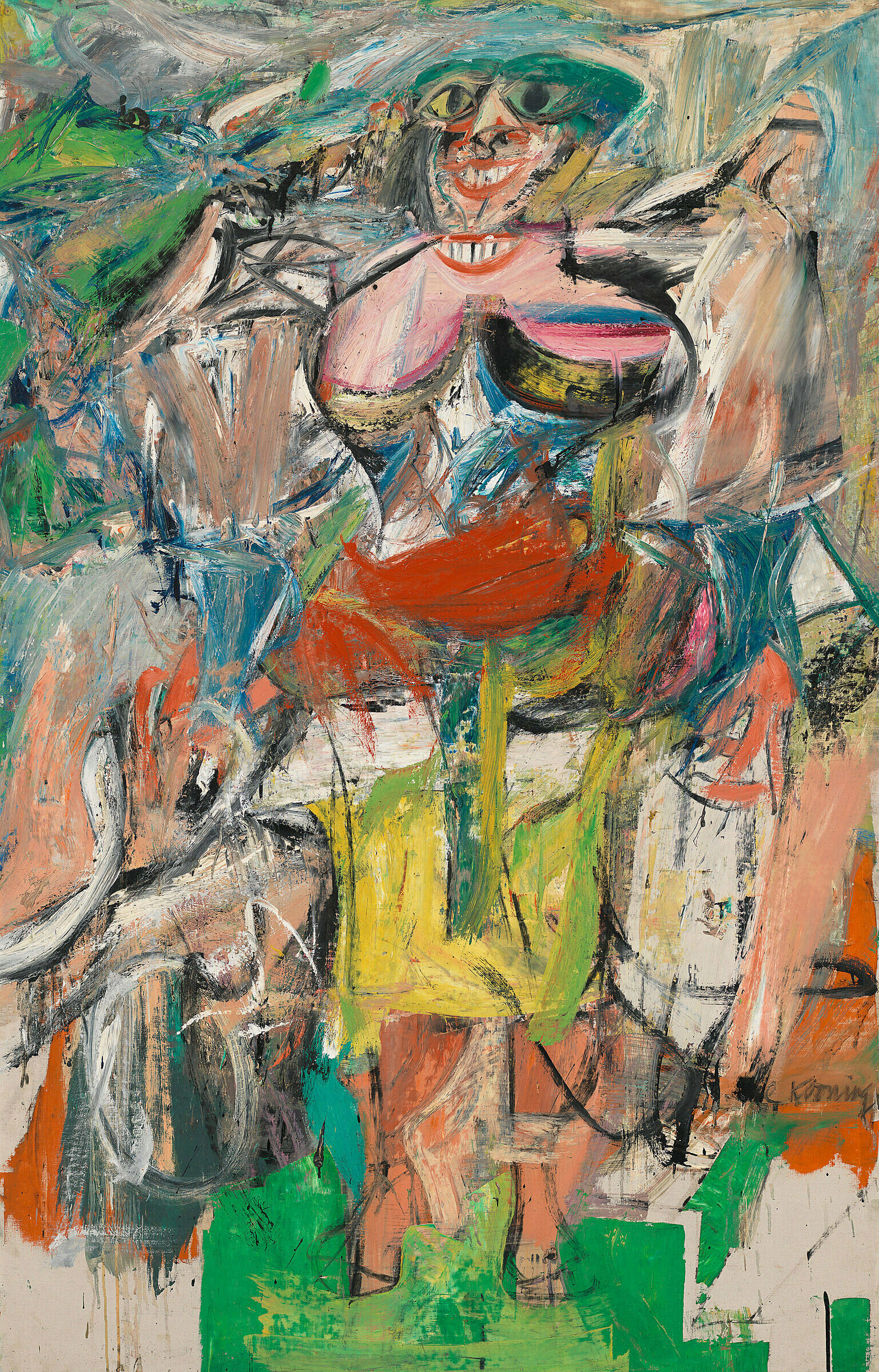
A work by Willem de Kooning. An abstract painting of a woman with a bicycle depicted in vivid colors

Willem de Kooning, Woman and Bicycle, 1952–53. Oil, enamel, and charcoal on linen, 76 1/2 × 49 1/8 in. (194.3 × 124.8 cm). Whitney Museum of American Art, New York; purchase 55.35. © The Willem de Kooning Foundation/Artists Rights Society (ARS), New York

New York, N.Y., 1955
Floor 7

In the aftermath of World War II, a number of artists experienced an existential crisis: How could art be meaningful in the wake of such tragedy? What visual language could describe inner and outer worlds so irrevocably transformed? Artists in the United States felt compelled to make art that was unmistakably new. In 1948, Barnett Newman wrote of himself and his peers: “We are freeing ourselves of the impediments of memory, association, nostalgia, legend, myth, or what have you, that have been the devices of Western European painting.” By largely abandoning European influences, they invented what came to be known as Abstract Expressionism, the first American art movement to gain international acclaim.

European Surrealism, nevertheless, offered crucial inspiration, especially its exploration of the psyche through automatic drawing, anthropomorphism, and personal symbolic languages—elements that can be seen in the work of Arshile Gorky, Lee Krasner, and Richard Pousette-Dart. Others, including Alfonso Ossorio and Jackson Pollock, focused on how the spontaneous interaction between materials and radical processes, such as spraying and pouring, might convey authenticity and immediacy. This art evinced an unprecedented sense of scale, tied not only to the size of the canvas but to the muscular strokes and broad fields of color that dominated it. Critic Edwin Denby recalled that for him and Willem de Kooning this expansiveness came from their culture and surroundings: “At the time we all talked a great deal about scale in New York, and about the difference of instinctive scale in signs, painted color, clothes, gestures, everyday expressions between Europe and America. We were happy to be in a city the beauty of which was unknown, uncozy, and not small scale.”

Below is a selection of works from this chapter.

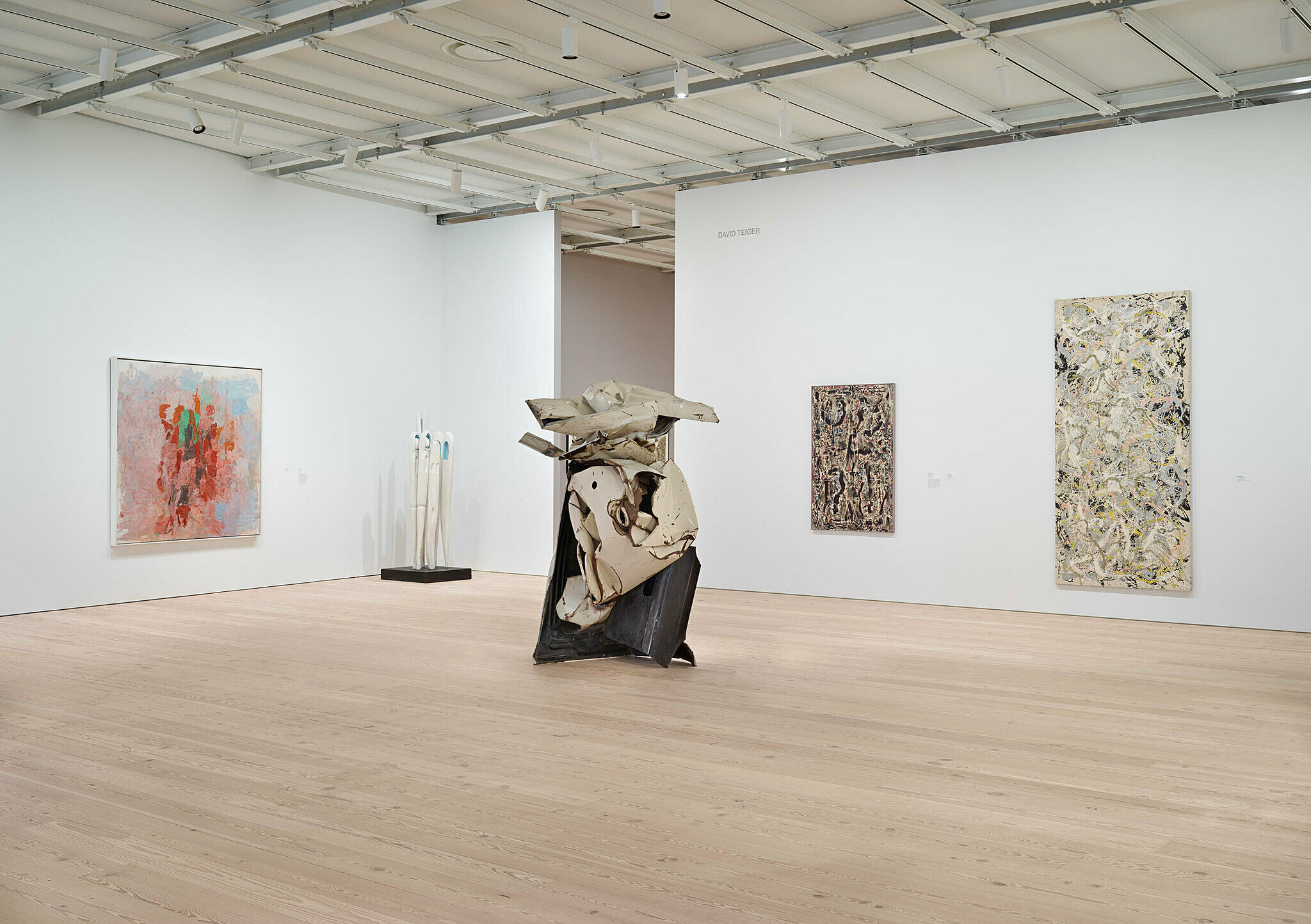
Installation view of America Is Hard to See (Whitney Museum of American Art, New York, May 1— September 27, 2015). From left to right: Philip Guston, Dial, 1956 (56.44); Louise Bourgeois, Quarantania, 1941 (77.80); John Chamberlain, Velvet White, 1962 (70.1579a-b); Alphonso Ossorio, Number 14-1953, 1953 (55.8); Jackson Pollock, Number 27, 1950, 1950 (53.12). Photography by Ronald Amstutz.

INSTALLATION VIEW

0:00

99 Objects: Alhena Katsof on Quarantania by Louise Bourgeois

0:00

99 Objects: Alhena Katsof on Quarantania by Louise Bourgeois

In 99 Objects

LOUISE BOURGEOIS (1911-2010), QUARANTANIA, 1941

After emigrating from Paris to New York in 1938, Louise Bourgeois made Quarantania, one of her earliest carved and painted sculptures. Comprised of five rough-hewn, upright wood forms on a low base, Quarantania resembles standing figures huddled together. Bourgeois’s three-dimensional works from this period, which she called “Personages,” offered her a way to reimagine people she had left behind in her native France. Specific echoes of her past appear here: the five elements might also evoke sewing needles or weaving shuttles, tools used in her family’s tapestry restoration trade. At the same time, the forms have a totemic quality that gives them a wider resonance, a reflection of efforts by Bourgeois and her contemporaries to develop abstract, universal languages that would transcend time and national boundaries.

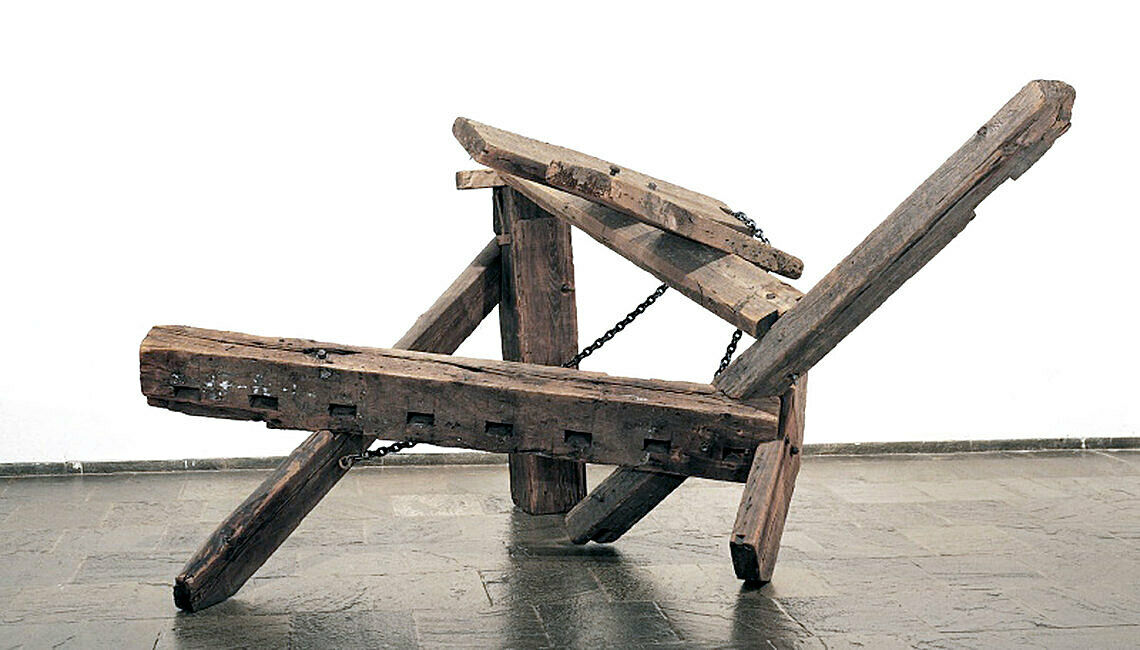
Mark di Suvero (b. 1933), Hankchampion, 1960. Wood, steel hardware and chains, 77 ½ x 152 × 109 3/16in. (196.9 × 386.1 × 277.3 cm). Whitney Museum of American Art, New York; Gift of Mr. and Mrs. Robert C. Scull 73.85a-I © 1960 Mark di Suvero

MARK DI SUVERO (B. 1933), HANKCHAMPION, 1960

Hankchampion was the centerpiece of the first major exhibition of Mark di Suvero’s sculptures. Named in honor of the artist’s younger brother, Hank, who had assisted di Suvero in his recovery from a near fatal accident in March 1960, the work reflects the sculptor’s attempt to “give an emotional charge to space.” He arranged eight massive, weathered timber beams and a long metal chain—material reclaimed from the artist’s downtown Manhattan neighborhood—into a bold, asymmetrical configuration that recalled the gestural brushstrokes of the Abstract Expressionist painters whom di Suvero particularly admired. The composition also represents a young artist’s response to the expected stability of traditional sculpture. Di Suvero torqued static horizontals and verticals into dramatic, surging diagonals that convey an impression of precarious tension rather than equilibrium.

A work by Willem de Kooning. An abstract painting of a woman with a bicycle depicted in vivid colors

Willem de Kooning, Woman and Bicycle, 1952–53. Oil, enamel, and charcoal on linen, 76 1/2 × 49 1/8 in. (194.3 × 124.8 cm). Whitney Museum of American Art, New York; purchase 55.35. © The Willem de Kooning Foundation/Artists Rights Society (ARS), New York

WILLEM DE KOONING (1904-1997), WOMAN AND BICYCLE, 1952-53

A large painting with a white background and large black lines crossing horizontally through the top and middle space.

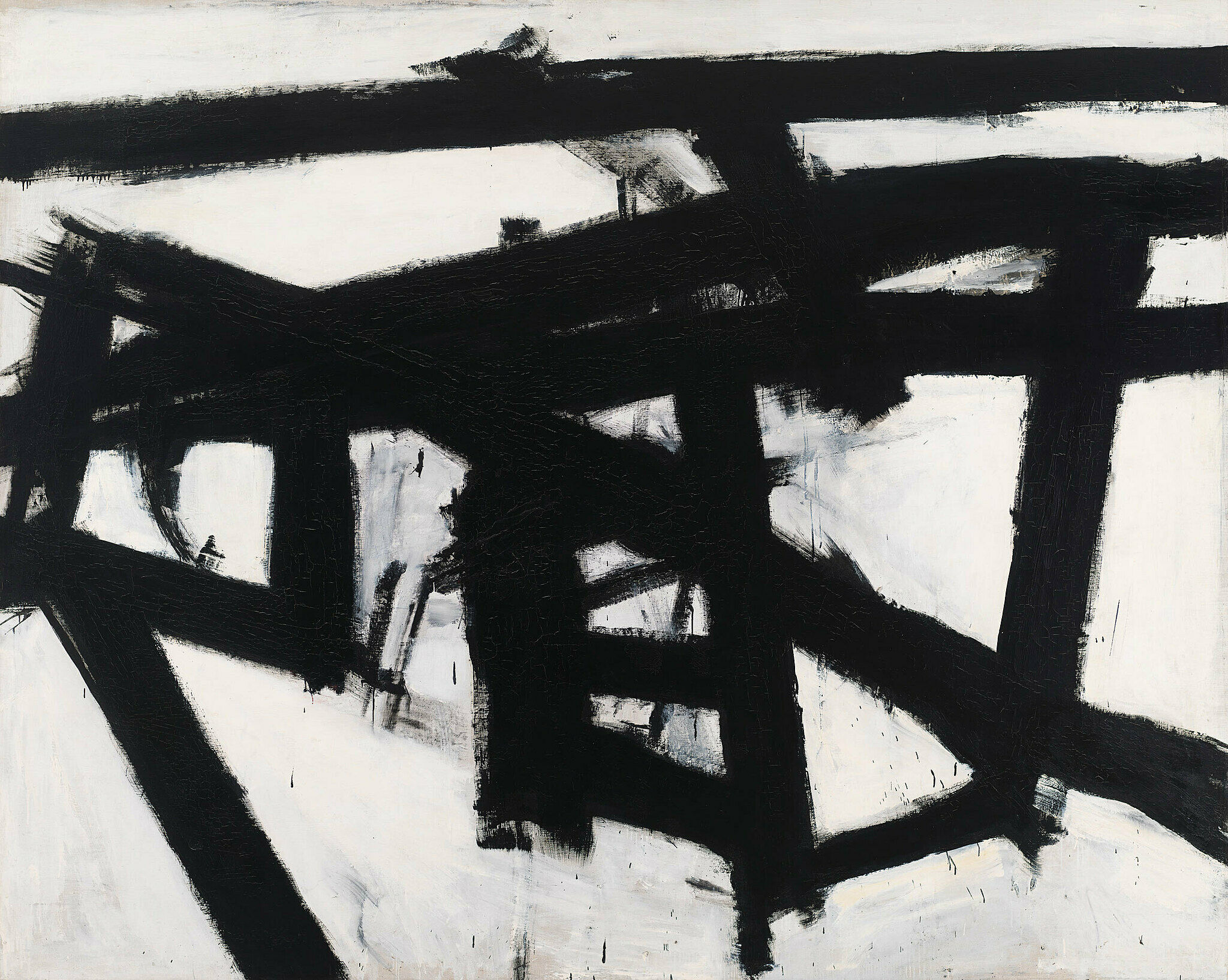
Franz Kline (1910-1962), Mahoning, 1956. Oil and paper on canvas, 80 3/8 × 100 1/2 in. (204.2 × 255.3 cm). Whitney Museum of American Art, New York; purchase, with funds from the Friends of the Whitney Museum of American Art 57.10 © 2015 The Franz Kline Estate/Artists Rights Society (ARS), New York

FRANZ KLINE (1910-1962), MAHONING, 1956

Mahoning, a monumental armature of bold black enamel strokes laid against a white background, seems to be a record of Franz Kline’s spontaneous gestures; its ragged brushwork and slashes of pigment suggest the free movement of the brush across the canvas. Despite this appearance of immediacy, however, the painting—like many of Kline’s abstractions—was deliberately planned. He based it on a small, preliminary drawing made on the page of a telephone book that was projected onto the canvas. Atypically, Kline incorporated collage elements, affixing sheets of paper to the canvas under layers of black paint. The composition’s strong internal structure plays against the frame of the canvas, with powerful diagonals that seem to break through the edges of the image. Although Kline’s paintings are not meant to represent landscapes, he titled a number of them, including this one, after towns near Wilkes-Barre, in the Pennsylvania coal country of his childhood.

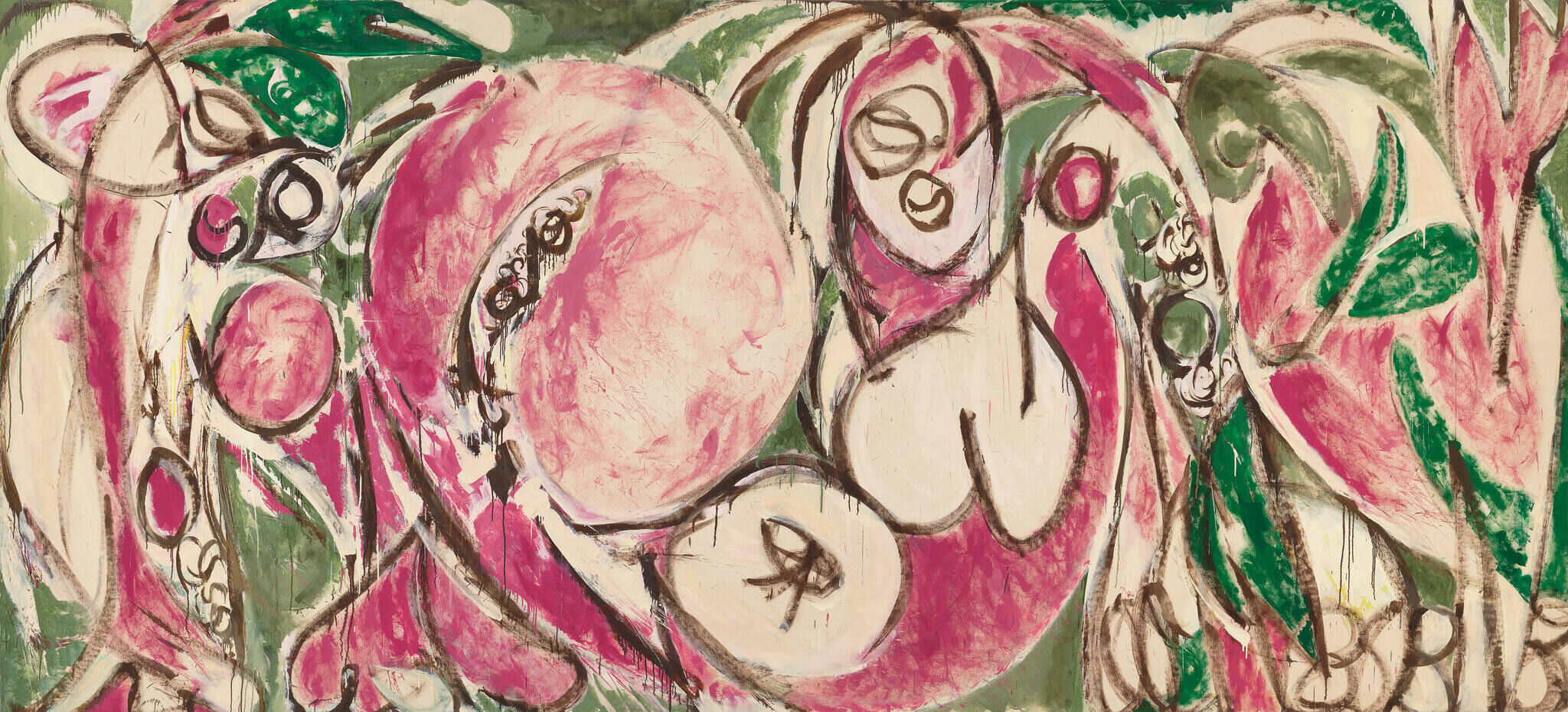
Fruits and abstract leaves in red and green.

Lee Krasner, The Seasons, 1957. Oil on canvas, 92 3/4 × 203 3/4 in. (235.59 x 517.53 cm). Whitney Museum of American Art, New York; purchase with funds from Frances and Sydney Lewis (by exchange), the Mrs. Percy Uris Purchase Fund and the Painting and Sculpture Committee 87.7. © 2011 The Pollock-Krasner Foundation/Artists Rights Society (ARS), New York

LEE KRASNER (1908-1984), THE SEASONS, 1957

In The Seasons, Lee Krasner combined a traditional subject with a modern pictorial form, the all-over composition. Historically, the subject of the four seasons has offered artists the opportunity for allegorical meditations on the life cycle. Krasner’s version exemplifies the regenerative portion of that cycle, with boldly, almost garishly colored plant forms that seem to morph into sexual organs.

This monumental painting offered Krasner an outlet during a time of deep personal sorrow. The year before, her husband, fellow artist Jackson Pollock, had died in a car accident. In the wake of this sudden loss, Krasner remarked about The Seasons, “the question came up whether one would continue painting at all, and I guess this was my answer.”

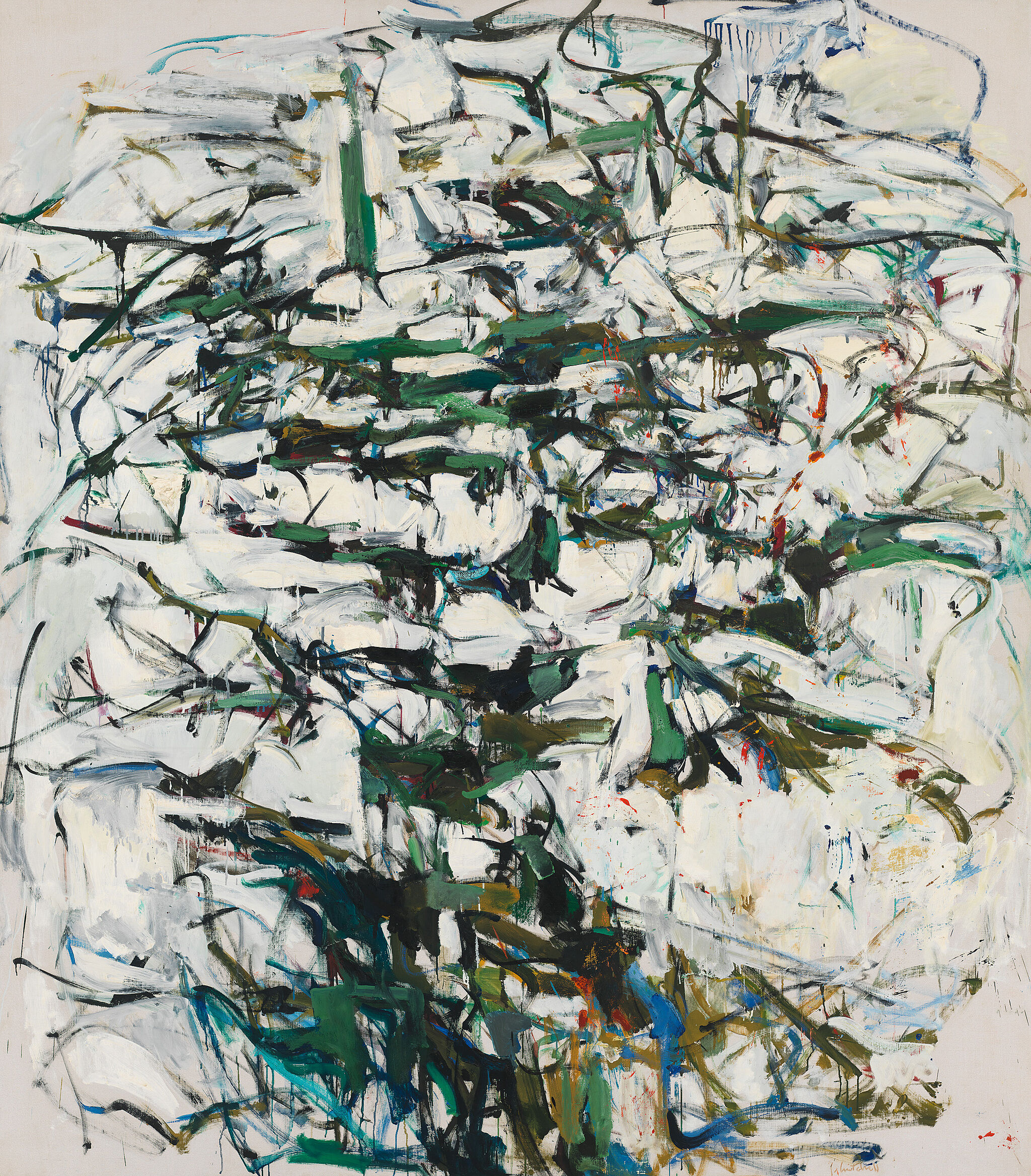
An abstract painting.

Joan Mitchell, Hemlock, 1956. Oil on canvas, 91 × 80 in. (231.1 × 203.2 cm). Whitney Museum of American Art, New York; purchase, with funds from the Friends of the Whitney Museum of American Art 58.20 © The Estate of Joan Mitchell

JOAN MITCHELL (1926-1992), HEMLOCK, 1956

Joan Mitchell evoked landscape environments in many of her paintings, usually by conjuring physical sensations such as light, sound, and movement. In Hemlock, the variations of short and long brushstrokes as well as the alteration between flashes of blue or green paint and larger areas of milky white create a sense of rhythm and movement. The white paint appears both behind and on top of the other colors, which blurs the definition of foreground and background—a stylistic hallmark of Mitchell’s work throughout her career. Although the horizontal green slashes in Hemlockmight bring to mind a hemlock tree, Mitchell titled the work after it was completed. The title derives from a passage in a 1916 Wallace Stevens poem, Domination of Black, which contains several references to hemlock, including: “Out of the window, / I saw how the planets gathered / Like the leaves themselves / Turning in the wind. / I saw how the night came, / Came striding like the color of the / heavy hemlocks. . .”

0:00

Mark Rothko, Four Darks in Red, 1958

0:00

A.M. Homes: And I think for me, looking at Mark Rothko paintings was, for lack of a better description, the first time I saw myself in art. 

Narrator: Novelist A.M. Homes.

A.M. Homes: I also think it’s an incredibly compressed field which always amazes me that he is able to take everything from horror and ecstasy and pure, sheer rage and the most sublime, delicate, wonderful experience and boil it all down and render it as indivisible. Each element is there and you can't even begin to break apart which one is which.

I think that he achieves in his paintings what I'm trying to achieve in fiction. Which is that expression of the things that go unseen and unsaid and unarticulated. And I'd never seen anything—color, gesture, texture—represent an emotional experience so fully. So that meant an incredible amount to me.

The story of me and Mark Rothko is that when I was a kid, my father, who's a painter, used to go every weekend and look at art in Washington. And every weekend, I would eventually go with him. Because in addition to being a lover of art, my father was also incredibly picky about what foods we ate and what we could have in the house. And he was a real health food fanatic early on. So we had no cookies, we had no cake, we had no twinkies or hohos. We also couldn’t have grapes that weren’t picked by union workers and no iceberg lettuce and no soda. But if you went with my father to look at art, at a certain point he could break down and he would take you to the cafeteria. And in addition to not allowing sweets he also kind of got overwhelmed in the cafeteria because I think it was his big moment as well and so you could pick out whatever you wanted. And you could usually pick out more than one thing. So you could have pie AND Jello which I think was almost anti-religious in our family. And I would go with him, and I would sit in museums all over Washington, looking at art for hours and hours and hours, and having this accidental art education where I would just stare at the painting sitting on benches waiting for him. And in the end it turned out it was really incredibly marvelous. And I discovered Mark Rothko among many other artists. And had very nice pie at the end of the day. And I think it's in a large part how I became who I became.

Mark Rothko, Four Darks in Red, 1958

In Where We Are and America Is Hard to See

MARK ROTHKO (1903-1970), FOUR DARKS IN RED, 1958

Four Darks in Red exemplifies Mark Rothko’s darker palette of the late 1950s, when he increasingly used red, maroon, and saturated black hues. When seen close up (as the artist intended), this nearly 10-footwide canvas engulfs the viewer in an atmosphere of color and intense visual sensations. The weightiest dark color is at the top of the canvas while a softer, roseate glow emanates from below, creating a reversal of visual gravity. Rothko believed that such abstract perceptual forces had the ability to summon what he called “the basic human emotions—tragedy, ecstasy, and doom.”

0:00

David Smith, Hudson River Landscape, 1951

0:00

Candida Smith: I am Candida Smith. I'm reading from a passage my father David Smith wrote on points of departure, in particular points of departure for the sculpture Hudson River Landscape.

"Hudson River Landscape started from drawings made on a train between Albany and Poughkeepsie. A synthesis of drawings from ten trips, going and coming over this seventy-five mile stretch. On this basis I started a drawing for a sculpture. As I began, I shook a quart bottle of India ink. It flew over my hand, it looked like my landscape. I placed my hand on the paper, and from the image this left, I traveled with the landscape to other landscapes and their objectives, with additions, deductions, directives which flashed past too fast to tabulate but whose elements are in the finished sculpture. No part is diminished reality. The total is a unity of symbolized reality, which to my mind is far greater reality than the river scene.

Is my work Hudson River Landscape, the Hudson River, or is it the travel, the vision, the ink spot? Does it matter? The sculpture exists on its own. It is the entity. The name is an affectionate designation of the point prior to travel. My objective was not these words or the Hudson River, but to create the existence of a sculpture. Your response may not travel down the Hudson River, but it may travel on any river, or on a higher level."

David Smith, Hudson River Landscape, 1951

In America Is Hard to See

DAVID SMITH (1906-1965), HUDSON RIVER LANDSCAPE, 1951

David Smith based Hudson River Landscape on drawings he made while looking out the window on train rides between New York City and his home in Bolton Landing in upstate New York. The open frame, which suggests a window, positions us to look at the sculpture head-on, viewing its thin contour lines as a drawing in space. Like the sculptures by Smith on view on the terrace, Hudson River Landscape is welded together. Smith liked welding—a modern industrial process invented in the late nineteenth century—in part because it freed sculpture from the historical burden of such traditional techniques as carving and casting.

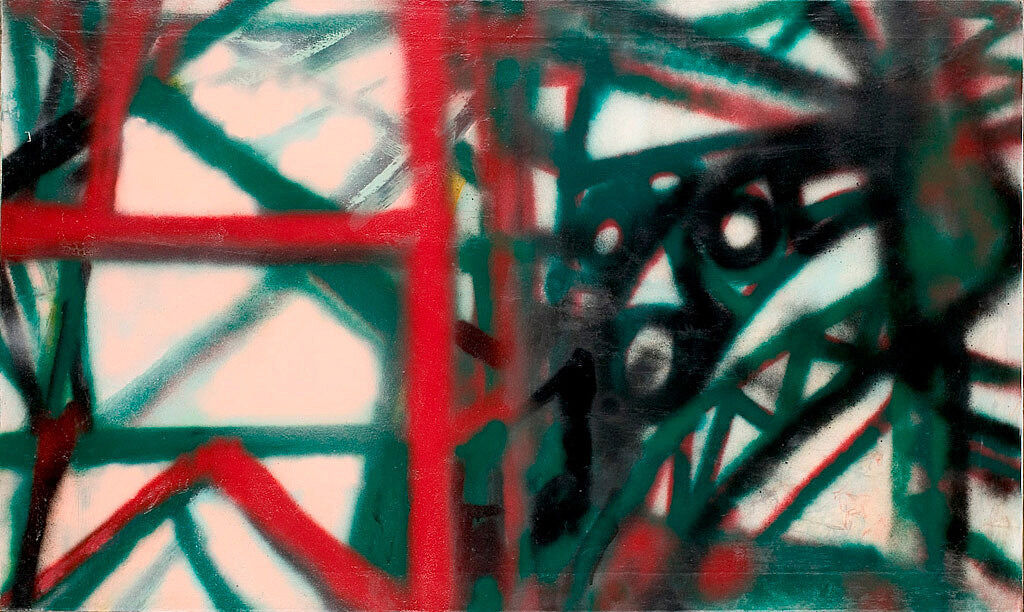
Hedda Sterne, New York, N.Y., 1955, 1955. Airbrush and enamel on canvas, 36 1/4 × 60 1/4 in. (92.1 × 153 cm). Whitney Museum of American Art, New York; gift of an anonymous donor 56.20 © 2015 Estate of Hedda Sterne/Artists Rights Society(ARS), New York

HEDDA STERNE (1910-2011), NEW YORK, N.Y., 1955, 1955

Hedda Sterne’s New York, N.Y. was inspired by the city’s bridges. Elements resembling beams, girders, and trusses emerge from overlapping lines. Sterne used an airbrush to apply green, black, and red pigment onto the surface of the canvas. This “speedy way of working,” she explained, best captured the constant motion of the urban landscape.

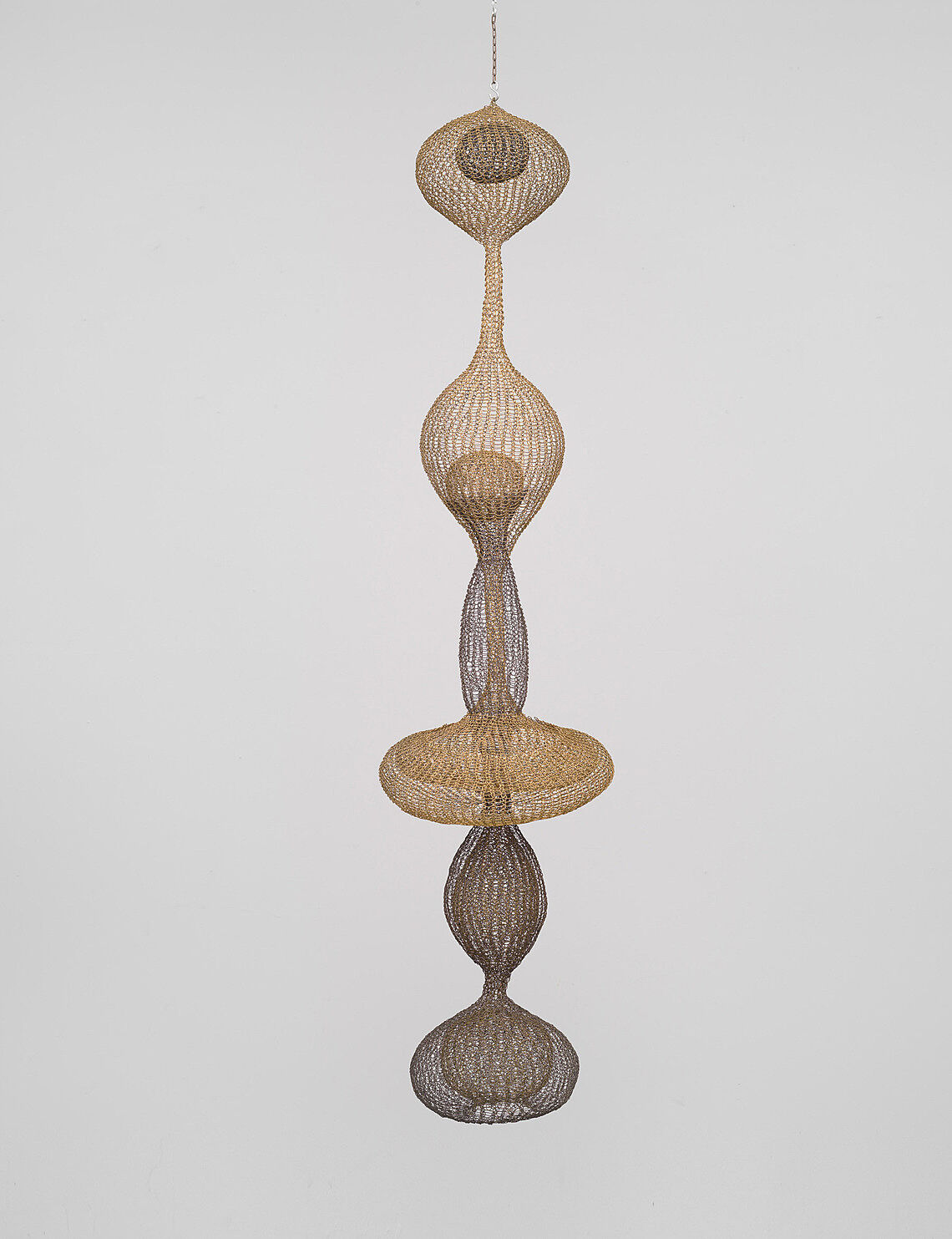
Mesh wires shaped into a long, fluid blob, like lava in a lava lamp.

Ruth Asawa, Untitled (S.270, Hanging Six-Lobed, Complex Interlocking Continuous Form within a Form with Two Interior Spheres), 1955, refabricated 1957–1958. Brass and steel wire, 63 7/8 × 14 15/16 × 14 15/16 in. (162.2 × 37.9 × 37.9 cm). Whitney Museum of American Art, New York; gift of Howard Lipman 63.38. © Estate of Ruth Asawa

RUTH ASAWA (1926-2013), NUMBER 1 – 1955, 1954, REFABRICATED 1958

As the child of Japanese immigrants living in California, Ruth Asawa was placed in an internment camp for several years during World War II. Because of lingering discrimination after the war and bleak job prospects, Asawa abandoned her pursuit of a teaching degree and in 1946 she enrolled instead at the experimental, non-accredited Black Mountain College in North Carolina. She planned to study painting and drawing with the influential artist Josef Albers, but the institution’s cross-disciplinary emphasis soon led her to sculpture. This nascent interest flourished after a summer in Toluca, Mexico, where she learned from the local craftspeople how to make the crocheted wire baskets she had admired. The crochet technique requires looping wire around a wooden dowel to produce what the artist described as “a string of e’s.” By repeating this one motion—with adjustments made for the weight of the material or the space between loops—Asawa created undulating, voluminous forms. “The shape comes out working with the wire,” she explained. “You don’t think ahead of time, this is what I want…You make the line, a two-dimensional line, then you go into space, and you have a three-dimensional piece.” 


Number 1–1955 (which the artist had to re-create in 1958 because of faulty metal in the original), like many of Asawa’s abstract wire sculptures, is comprised of an outer, vertical structure, inside of which she nestled smaller shapes, often of a differing metal. Suspended from the ceiling, the biomorphic, semitransparent structure creates a multidimensional play of interior and exterior spaces and a constellation of shadows on the wall. The work, according to Asawa, “does not hide anything . . . and inside and outside are connected. Everything is connected, continuous.”


Excerpted from Whitney Museum of American Art: Handbook of the Collection, (2015), p. 46. Published by the Whitney Museum of American Art, New York; distributed by Yale University Press.


Artists


Explore works from this exhibition
in the Whitney's collection

View 646 works

On the Hour

A 30-second online art project:
Frank WANG Yefeng, The Levitating Perils #2

Learn more about this project

Learn more at whitney.org/artport

On the Hour projects can contain motion and sound. To respect your accessibility settings autoplay is disabled.