America Is Hard to See | Art & Artists

May 1–Sept 27, 2015


Exhibition works

23 total
The Circus

Read more

The Circus

Floor 7

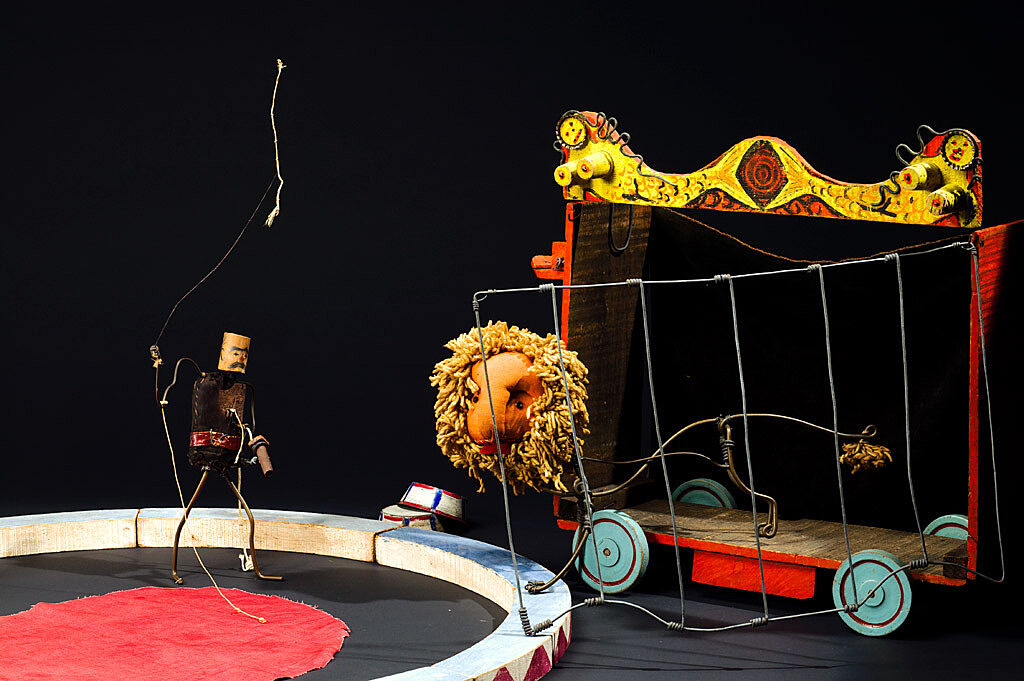
Alexander Calder (1898-1976), Lion Tamer, Lion and Cage from Calder’s Circus, 1926-31. Wire, wood, metal, cloth, yarn, paper, cardboard, leather, string, rubber tubing, corks, buttons, rhinestones, pipe cleaners, and bottle caps, 54 × 94 1/4 × 94 1/4 in. (137.2 × 239.4 × 239.4 cm). Whitney Museum of American Art, New York; purchase, with funds from a public fundraising campaign in May 1982. One half the funds were contributed by the Robert Wood Johnson Jr. Charitable Trust. Additional major donations were given by The Lauder Foundation; the Robert Lehman Foundation, Inc.; the Howard and Jean Lipman Foundation, Inc.; an anonymous donor; The T. M. Evans Foundation, Inc.; MacAndrews & Forbes Group, Incorporated; the DeWitt Wallace Fund, Inc.; Martin and Agneta Gruss; Anne Phillips; Mr. and Mrs. Laurance S. Rockefeller; the Simon Foundation, Inc.; Marylou Whitney; Bankers Trust Company; Mr. and Mrs. Kenneth N. Dayton; Joel and Anne Ehrenkranz; Irvin and Kenneth Feld; Flora Whitney Miller. More than 500 individuals from 26 states and abroad also contributed to the campaign. 83.36.34.1a-f © 2015 The Calder Foundation, New York / Artists Rights Society (ARS), New York

The Circus
Floor 7

The decade after the First World War brought the United States new material prosperity and unparalleled social freedom, fueling a massive appetite for entertainment that grew unabated throughout the mid-twentieth century. Cinemas and theaters opened at a rapid pace, tabloid newspapers exploded in circulation, and celebrity photographs and gossip columns became the common currency of a booming spectacle culture. “The celebrities in New York,” writer David Cort quipped in 1925, “outnumber the nonentities about 100,000 to one.”

Largely inspired by these mass amusements and their audiences, the works on view in this chapter play with the entwinement of voyeurism and exhibitionism, seeing and being seen. Nearly all are set in dim interiors or under the cloak of night, rendered in lurid colors or the high contrast lent by spotlights, signs, and the flashbulb’s glare. Some present striking portraits of great performers such as John Coltrane, Paul Robeson, and Jessica Tandy, while others depict ordinary people strutting and posing or caught unawares by one another and by us. Classes, races, and genders mix within an atmosphere of physical pleasure or menace. Photographs by Lisette Model and Weegee capture the underbelly of mainstream culture, presenting a world at once seductive and discomfiting. Alexander Calder combined live spectacle with sculpture in Calder’s Circus, a motley crew of daredevils, animal acts, and scantily clad dancers that the artist would personally bring to life to the delight of his rapt observers.

Below is a selection of works from this chapter.

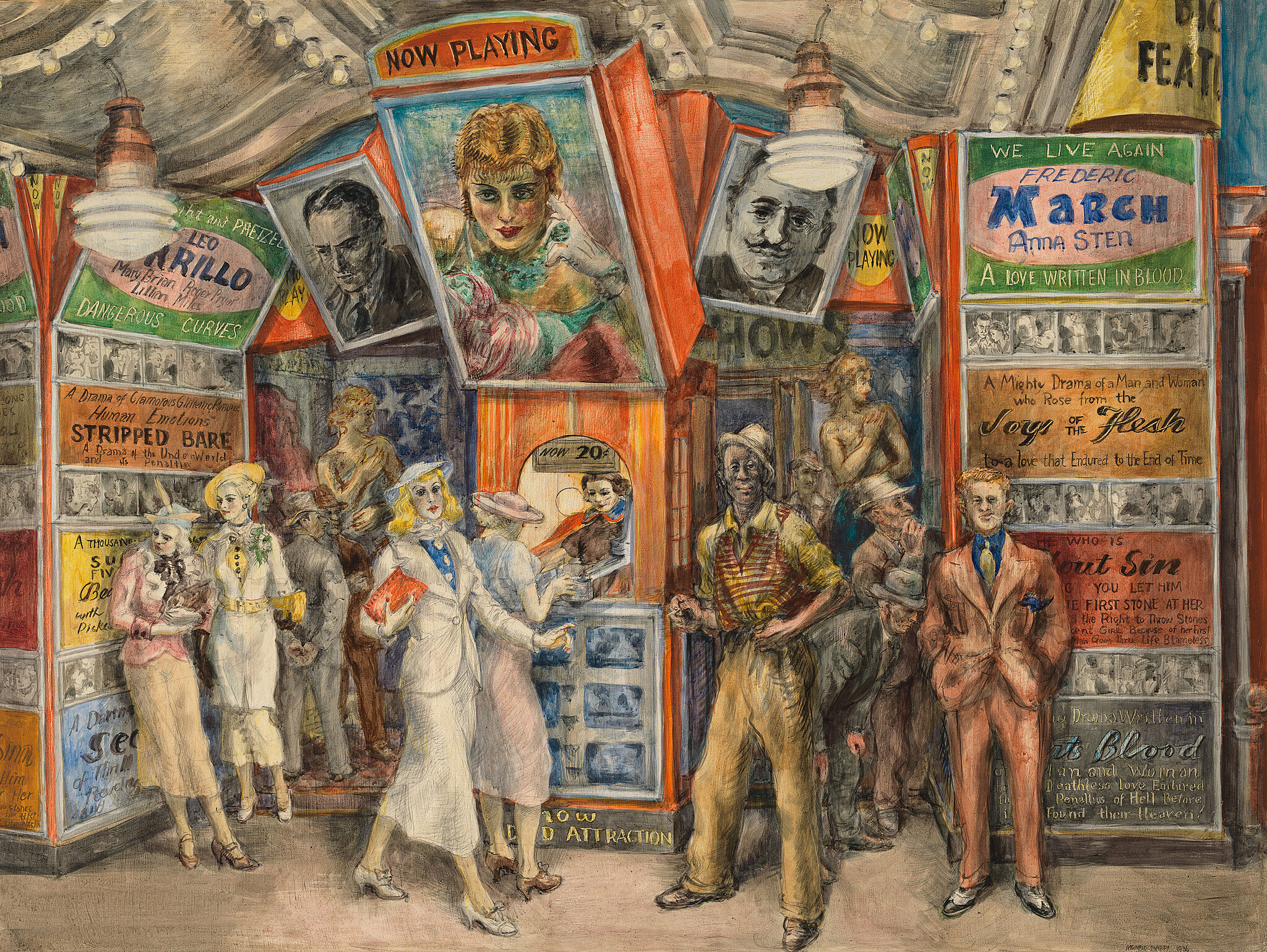
A painting of people standing outside of a movie theater covered in advertisements.

Reginald Marsh, Twenty Cent Movie, 1936. Carbon pencil, ink, and oil on composition board, 30 × 40 in. (76.2 × 101.6 cm). Whitney Museum of American Art, New York; purchase 37.43a-b © 2015 The Estate of Reginald Marsh/Art Students League, © 2015 Estate of Reginald Marsh/Art Students League, New York/Artists Rights Society (ARS), New York, NY

REGINALD MARSH (1898-1954), TWENTY CENT MOVIE, 1936

During the 1930s, when Reginald Marsh painted Twenty Cent Movie, more than half of all Americans went to the cinema every week. There audiences sought entertainment and distraction from the economic hardships of the Great Depression. Marsh emphasized the signage surrounding the theater, which trumpets the glamour and titillation that await inside: one poster on the right brazenly advertises “Joys of the Flesh.” At the same time, the painting also draws attention to the action unfolding in front of the movie house, with a cast of characters intent on putting on a show of their own.

0:00

George Bellows, Dempsey and Firpo, 1924

0:00

Narrator: In 1923, artist George Bellows’ attended a boxing match on assignment for the New York Evening Journal. He made several drawings, on which this painting is based. The late writer George Plimpton described the painting.

George Plimpton: It shows Firpo, the Argentinean boxer—quite untutored, almost an amateur—in what is considered one of the most dramatic moments in fistic history—namely knocking the champion, Jack Dempsey, through the ropes. Dempsey was destroying Firpo when Firpo hit him with this left, as you can see and knocked him through the ropes. Dempsey was a killer. He was referred to as the Manassa Mauler. and simply destroyed people in the ring with him. It's the sort of painting that I think photography really does it now. 

It's overdramatic, this picture, Dempsey was not a popular champion at all. He was famous for hitting low blows, hitting fighters when they were rising from the canvas. On this particular fight in the Polo Grounds everybody's sitting there—Babe Ruth, all these people, dignitaries. Great courses of booze. And I think they really wanted Firpo, this great amateur, to take him out. He was that unpopular, Dempsey was. Somewhat romanticized here, in Bellows' painting. Firpo looking like sort of a great god, looking indestructible tree-like limbs there, legs. And Dempsey of course looked like a beetle falling out of a tree here. But that wasn't the way it turned out, at all.

Narrator: The fight lasted only four minutes—and Dempsey was declared the winner. But the moment that became boxing legend was the one commemorated in this painting, when Firpo knocked Dempsey out of the ring.

George Bellows, Dempsey and Firpo, 1924

In America Is Hard to See

GEORGE BELLOWS (1882-1975), DEMPSEY AND FIRPO, 1924

Dempsey and Firpo captures a dramatic moment in the September 14, 1923, prizefight between American heavyweight champion Jack Dempsey and his Argentine rival Luis Angel Firpo. Looking up from this composition’s low vantage point, we find ourselves among the spectators—including the artist, George Bellows, who inserted his own likeness as the balding man at the far left. Although Dempsey was the eventual victor, the artist chose to represent Firpo knocking his opponent out of the ring with a tremendous blow to the jaw. Bellows heightened the excitement of the fight by bathing the boxers in a lurid light and capturing the dark, smoke-filled atmosphere around the ring.

0:00

Thomas Hart Benton, Poker Night (from A Streetcar Named Desire), 1948

0:00

Kathryn Potts: As you look at this painting by Thomas Hart Benton, I think you can't help but be aware of the incredible sense of artificiality.

Narrator: Kathryn Potts is Associate Director, Helena Rubinstein Chair of Education at the Whitney.

Kathryn Potts: However, the theatricality of the painting is totally appropriate because what we're looking at is a scene from the theatre and these are actors on a stage. The play is Tennessee Williams's Pulitzer Prize winning A Streetcar Named Desire, which would later become a movie. This painting was painted on commission. It was intended as a surprise gift for Irene Selznik, who was the producer of Streetcar.

What's really interesting about the story, however, is that Jessica Tandy, who plays the Blanche Du Bois character was incredibly offended by the way that Benton portrayed her. She looks actually like she 'd be the prize contestant in a wet T-shirt contest. Her dress reveals more than it covers up. What's also interesting is that you compare the painting, as presented by Benton, to photographs that were actually made of the stage version of the play, Jessica Tandy never wore a dress like this. She in fact wore these kind of flouncy costumes with ribbons and bows on them, and southern-lady type hats, and she wasn't at all somebody who would have tried to catch the attention of Stanley.

And Benton kind of creates his own interpretation. And it was really this reason that Tandy as an actress felt that it was very inappropriate, and the way we would probably describe this today was that she felt that Benton was blaming the victim.

Thomas Hart Benton, Poker Night (from A Streetcar Named Desire), 1948

In Where We Are and America Is Hard to See

THOMAS HART BENTON (1889-1975), POKER NIGHT (FROM A STREETCAR NAMED DESIRE), 1948

In 1947, Thomas Hart Benton was commissioned by Hollywood producer David O. Selznick to create an original painting based on a scene in the film version of Tennessee Williams’s Pulitzer Prize-winning play, A Streetcar Named Desire. The work was a gift for Selznick’s first wife, Irene, a theatrical producer responsible for bringing the play to Broadway in the same year. Poker Night captures the sexual tension and violent undertones in the relationships between Blanche DuBois, a down-and-out Southern belle (holding up a mirror), her sister, Stella (leaning over the armchair), and Stella’s husband, the hot-tempered, childlike Stanley Kowalski (wearing a white undershirt). It documents one of the play’s most dramatic and memorable moments, when Blanche taunts a drunk and angry Stanley with her petty provocations and refined airs.

0:00

Paul Cadmus, Sailors and Floosies, 1938

0:00

Paul Cadmus: Some of these sailors are rather sympathetic, as well as one of the girls, the one in the ridiculous hat. I don’t know where I invented that hat.

Narrator: Artist Paul Cadmus. He called this painting Sailors and Floosies. It’s set in Manhattan’s Riverside Park, near a monument called the Sailors and Soldiers Memorial. Art historian Richard Meyer.

Richard Meyer: One of the things that Cadmus did, which is quite amazing about this painting, is that he created a unique frame. . .And what he did in the painted frame is, he continued some of the graffiti that is depicted on. . .the [Sailors and Soldiers] Memorial, within the painting, that graffiti continues around the frame of the painting. So he’s sort of bringing a decorative element, but also, some part of the story, of the fiction of the painting, out onto the frame of the painting.

Narrator: Notice that the sailors here aren’t really paying attention to the floosies.

Richard Meyer: Cadmus, whenever there is heterosexual pairing in his paintings, something goes wrong. . .What he seems more interested in is a certain homoeroticism. . .

Narrator: Some critics were upset by this image when it was first shown. They called it tawdry— repulsive—unpatriotic. Ironically, it wasn’t the homoerotic content per se that caused the controversy. Rather, critics were offended by the depiction of Navy sailors drunk and carousing on the eve of World War II.  

Paul Cadmus: I replied to them, "I think the picture portrays an enjoyable side of Navy life. I think it would make a good recruiting poster. I will raise my prices."

Paul Cadmus, Sailors and Floosies, 1938

In America Is Hard to See

PAUL CADMUS (1904-1999), SAILORS AND FLOOSIES, 1938

In Sailors and Floosies, Paul Cadmus employed the technical virtuosity of Italian Renaissance painting while capturing a particularly seedy aspect of modern life. The highly muscled “floosie” in the foreground leers over a drunken sailor. Although he is wearing contemporary Navy whites, the sailor’s pose echoes that of a sleeping faun or other figure of classical art; this beautiful young man appears as an object of desire. Cadmus embraced both high and low, rendering the trash and graffiti covering New York’s Riverside Park as meticulously as he did the figures. By extending the graffiti to the painting’s frame, he established continuity between the space of the painting’s narrative and the viewer’s space.

Sailors and Floosies was controversial when it was first displayed in 1940, with the nation on the verge of war, and some found it unpatriotic to portray enlisted men behaving scandalously.

0:00

Alexander Calder, Calder’s Circus, 1926–31

0:00

Narrator: Actor Bill Irwin.

Bill Irwin: Welcome, ladies and gentlemen, mes dames et messieurs, to the circus. Beginning in 1926, Calder combined his fascination with movement, animals, and caricature into Le Cirque Calder

What you see here are a number of acts, each consisting of different characters—acrobats, a bearded lady, a lion tamer and his lion. When performed, Calder would manipulate the parts and figures before you—in one ring, one act at a time. 

He would make bleachers from wood crates and planks; erect two tall poles for the high wire and trapeze; hand out cymbals and other noisemakers; cue up records on his gramophone and give his guests a full evening’s entertainment. It was what could be described as the first instance of performance art. 

Through the Circus, Calder became good friends with an impressive list of artists, including Marcel Duchamp, Joan Miró, Fernand Léger, Edgar Varèse, Le Corbusier, and Piet Mondrian. These members of the Parisian avant-garde appreciated Calder’s love of play and spectacle—a performance of the Circus meant a very good time. But the artists were also drawn to the serious side of the Circus. Fun mixed with death and danger: the knife thrower aiming to hit a target perilously close to his favorite assistant sometimes missed—with tragic results. But Calder would use the same female figure in the next act, a clever touch his audiences appreciated.

In the first decades of the twentieth century, modernist artists across Europe were searching for ways to merge art and life, technology and design. As playful as Calder’s performance may seem, it beautifully exemplifies these avant-garde impulses. The fact that he put his objects in motion, the characteristic state of modernity, wouldn’t have been lost on any of his observers. And the individual acts were engineered with a great deal of technical skill.

Alexander Calder, Calder’s Circus, 1926–31

In The Whitney's Collection: Selections from 1900 to 1965 and America Is Hard to See

ALEXANDER CALDER (1898-1976), CALDER’S CIRCUS, 1926-31

Alexander Calder originally trained as a mechanical engineer, but he was an aspiring artist when he arrived in Paris in 1926. Working as a newspaper illustrator in New York the previous year, he had been sent to make sketches of the Ringling Bros. and Barnum & Bailey Circus, sparking a lifelong interest. In Paris he began Calder’s Circus, an ensemble work of dozens of small movable figures and props crafted from wire and found objects. Adding acts over several years and transporting the miniature circus in several suitcases, he gave performances in his studios and at the homes of friends—including artists such as Marcel Duchamp, Joan Miró, and Fernand Léger and art patrons in Paris and New York. Calder acted as both stagehand and impresario: he constructed makeshift bleachers from wood crates and planks, handed out cymbals and other noisemakers, and cued up records on his gramophone. Narrating the acts in English and French, he manipulated acrobats, a bearded lady, a lion tamer and his lion, and other figures.

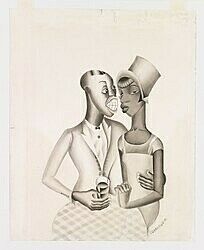
Miguel Covarrubias (1904-1957), _Scene: "The Last Jump". Cabaret on a Saturday Night_, from the series, Negro Drawings, 1924. Brush and ink, ink wash, and graphite pencil on paper. Sheet: 14 3/8 × 11 7/16 in. (36.5 × 29.1 cm). Whitney Museum of American Art, New York; Purchase, with funds from the Drawing Committee 2014.21 © artist or artist’s estate

MIGUEL COVARRUBIAS (1904-1957), SCENE: “THE LAST JUMP,” 1924

Mexican-born Miguel Covarrubias arrived in New York in 1924 and quickly became an important figure of the Jazz Age. He made hundreds of sketches of the Harlem nightclub scene, which formed the basis of caricatures that he published in Vanity Fair and the New Yorker. This one originally appeared in a Vanity Fair spread titled “Enter, The New Negro,” an introduction to the sophisticated world uptown for the magazine’s primarily white readership.

There are aspects of Covarrubias’s imagery that are troubling to contemporary eyes. The facial features share some qualities with the stereotyped racist imagery that had pervaded popular culture since the nineteenth century. Covarrubias deeply admired the cultural flowering he found in Harlem and did not intend his images to be derogatory; but in exaggerating his figures for humorous effect he inevitably drew on the limiting visual vocabulary of his day. Even at the time, however, some African American scholars, including W. E. B. Du Bois, were critical of Covarrubias’s work, convinced that images of black people ought to be explicitly ennobling. At the same time, writers such as Langston Hughes and Alain Locke saw in Covarrubias’s work a great love for Harlem’s vitality.

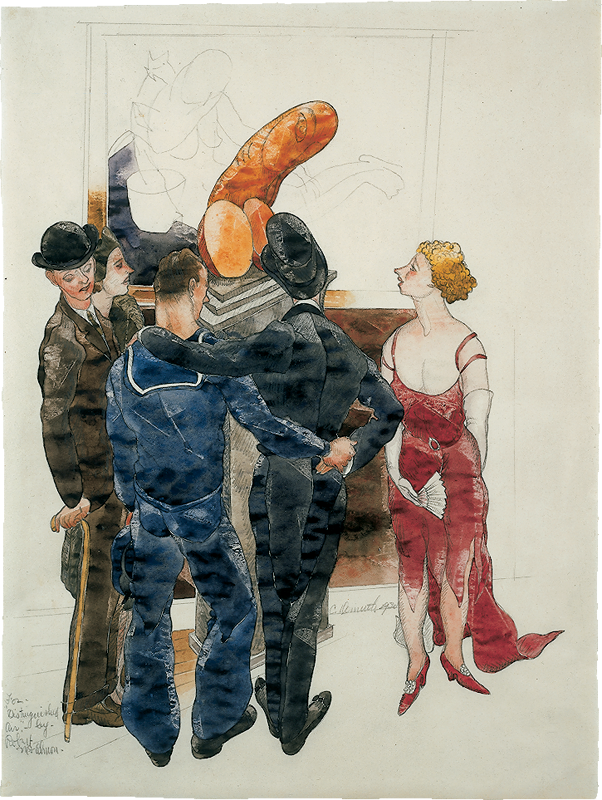
Artwork by Chares Demuth featuring people in a room.

Charles Demuth, Distinguished Air, 1930. Watercolor and graphite on paper, 16 1/4 × 12 3/16 in. (41.3 × 31 cm). Whitney Museum of American Art, New York; purchase with funds from the Friends of the Whitney Museum of American Art and Charles Simon  68.16

CHARLES DEMUTH (1883-1935), DISTINGUISHED AIR, 1930

This watercolor by Charles Demuth is based on a short story by Robert McAlmon, set in the decadent, sex and drugs-filled world of post-World War I Berlin. Demuth recasts a scene from the story, which took place in one of Berlin’s “queer cafes,” as the opening of an art exhibition where a provocative woman in evening dress, a male homosexual couple, and a heterosexual couple look at Constantin Brancusi’s famous sculpture, Princess X, (1915-16), whose overtly phallic form scandalized many contemporary viewers. The title Distinguished Air is derived from the narrator’s description of the protagonist, a worldly but dissolute American. Here, the gentleman carrying a cane seems to gaze at the crotch of the sailor, obliquely mirroring the infatuation of McAlmon’s protagonist with a handsome soldier. In the 1930s, Demuth’s watercolors often contained themes of underground sexual freedom and licentiousness, subjects which likely had personal resonance for the artist as a homosexual in a culture which was largely inhospitable.

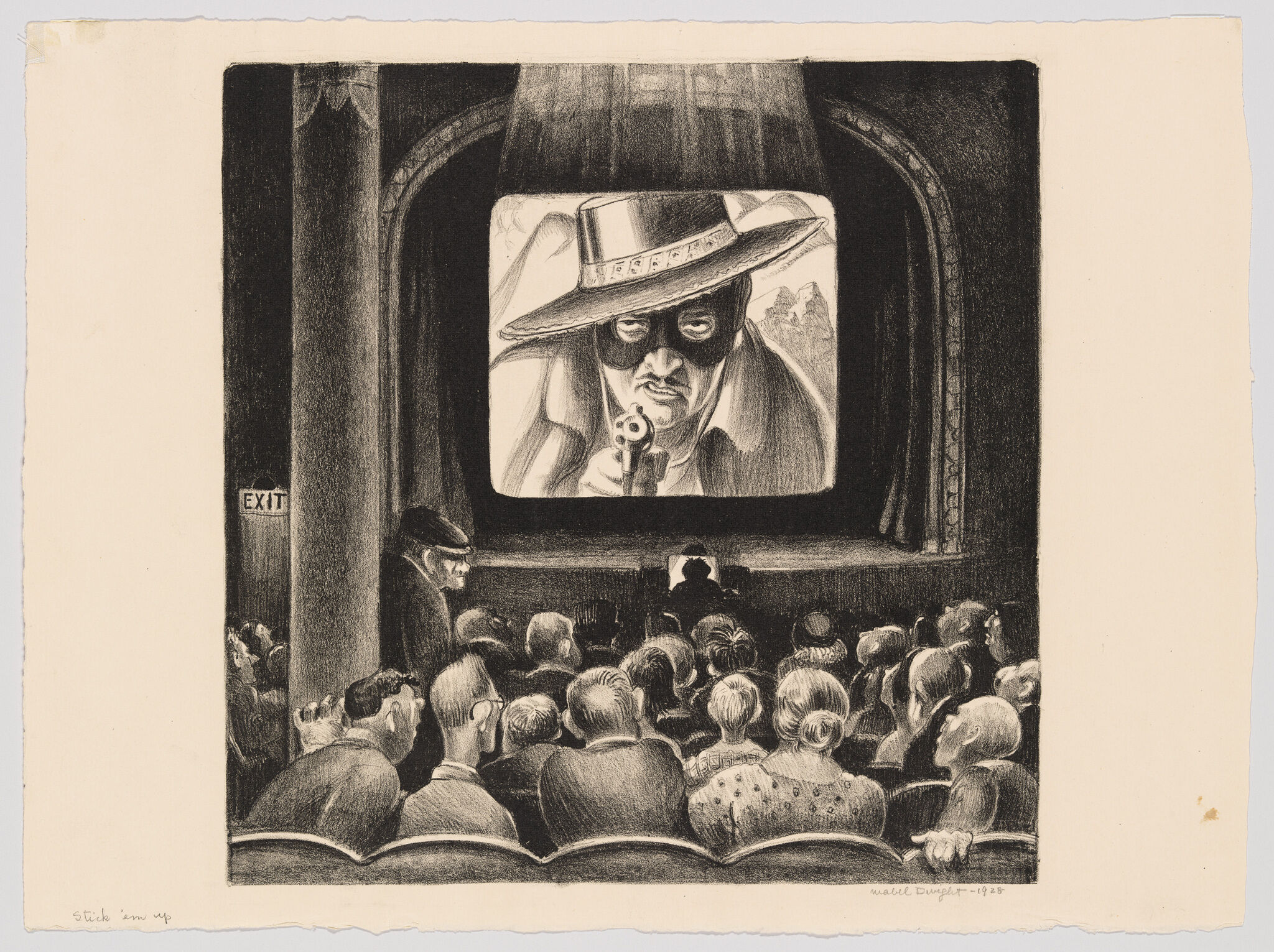
Mabel Dwight (1876-1955), Stick ’Em Up, 1928. Lithograph: sheet, 11 1/2 × 15 3/8 in. (29.2 × 39.1 cm); image, 10 5/16 × 10 1/4 in. (26.2 × 26 cm). Whitney Museum of American Art, New York; gift of Gertrude Vanderbilt Whitney 31.724

MABEL DWIGHT (1876-1955), STICK ’EM UP, 1928

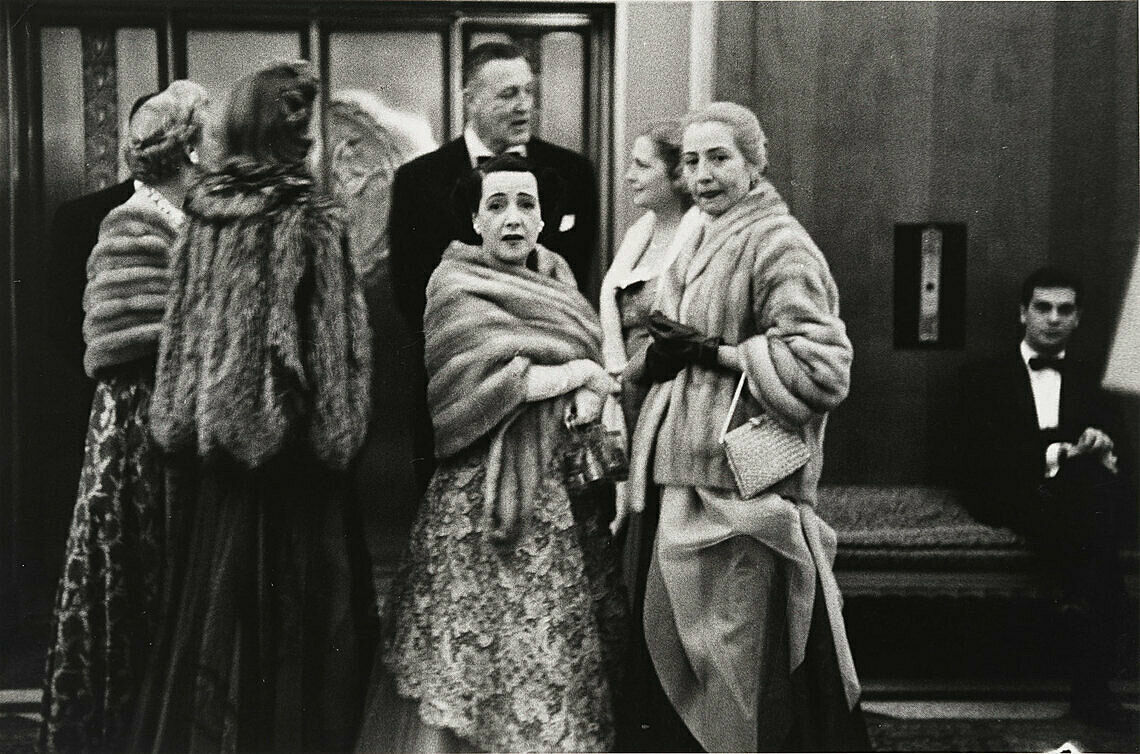
Robert Frank (b. 1924), Formal Reception , 1954. Gelatin silver print: 11 × 14in. (27.9 × 35.6 cm); Image, 8 15/16 × 13 1/2in. (22.7 × 34.3 cm). Whitney Museum of American Art, New York; purchase, with funds from the Photography Committee 98.12.5 © Robert Frank; courtesy Pace/MacGill Gallery, New York

ROBERT FRANK (B. 1924), FORMAL RECEPTION , 1954

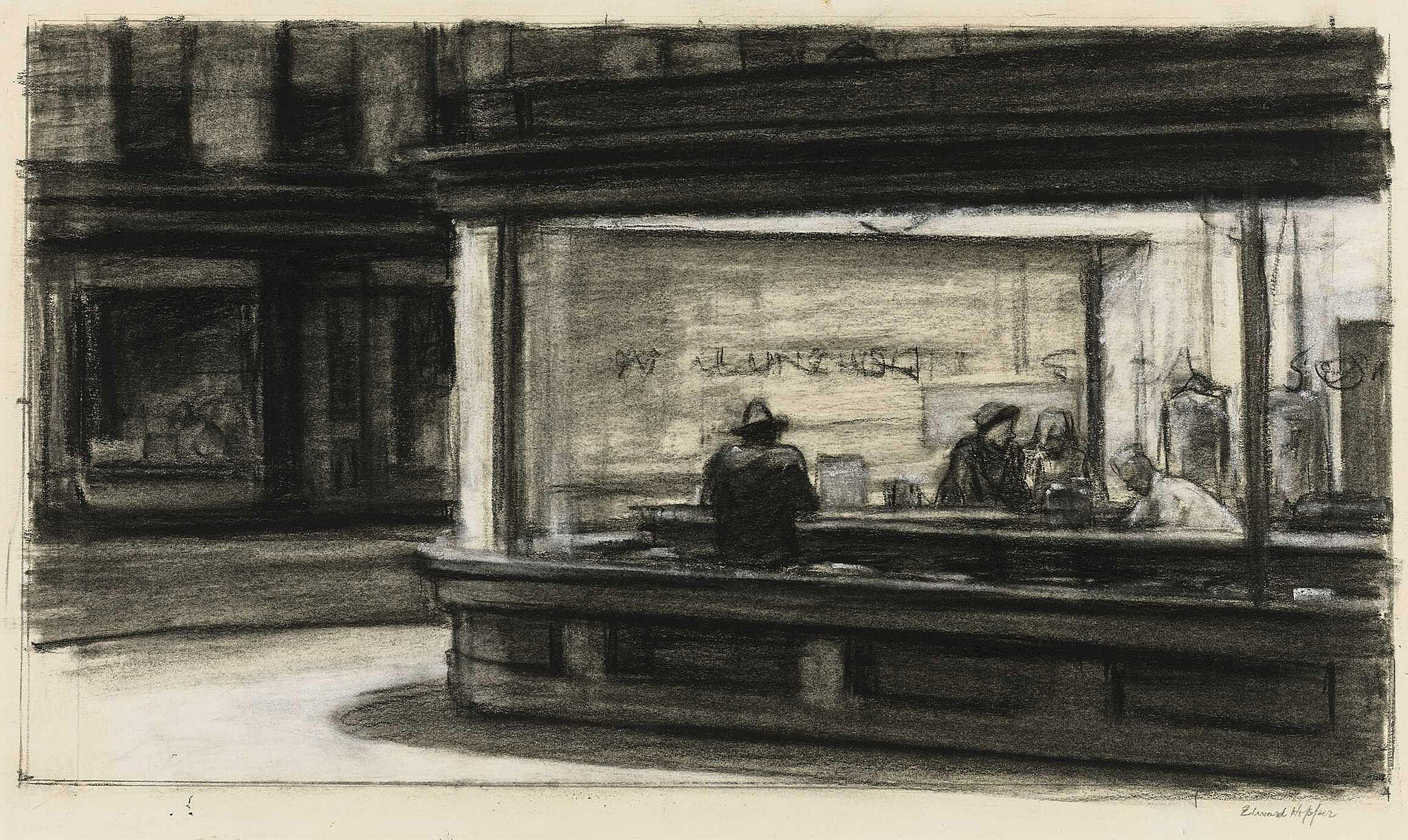
A drawing of a street corner cafe.

Edward Hopper, Study for Nighthawks, 1941 or 1942. Fabricated chalk and charcoal on paper; 11 1/8 × 15 in. (28.3 × 38.1 cm). Whitney Museum of American Art, New York; purchase and gift of Josephine N. Hopper by exchange  2011.65 © Heirs of Josephine N. Hopper/Licensed by VAGA, New York, NY

EDWARD HOPPER (1882-1967), STUDY FOR NIGHTHAWKS, 1941 OR 1942


Artists


Explore works from this exhibition
in the Whitney's collection

View 646 works

On the Hour

A 30-second online art project:
Frank WANG Yefeng, The Levitating Perils #2

Learn more about this project

Learn more at whitney.org/artport

On the Hour projects can contain motion and sound. To respect your accessibility settings autoplay is disabled.