America Is Hard to See | Art & Artists

May 1–Sept 27, 2015


Exhibition works

23 total
Large Trademark
Read more

Large Trademark

Floor 6

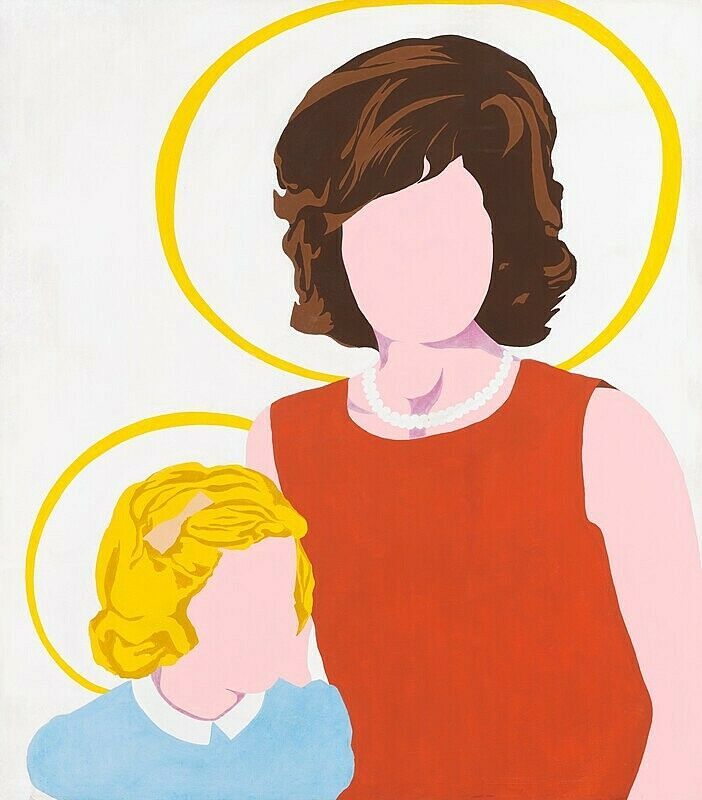
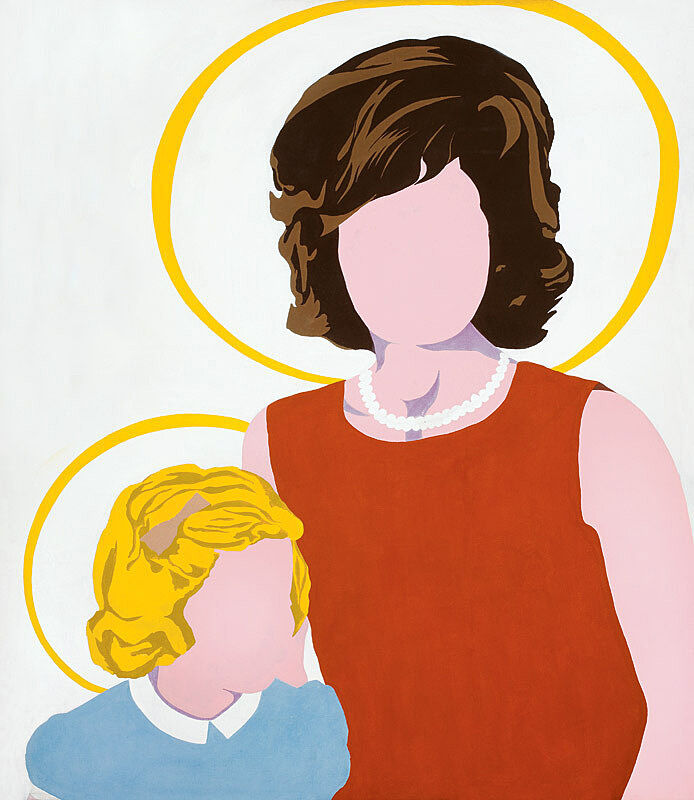
Allan D'Arcangelo (1930-1998), Madonna and Child, 1963. Acrylic and gesso on canvas, 68 1/2 × 60 1/8 in. (174 × 152.7 cm). Whitney Museum of American Art, New York; purchase with funds from the Painting and Sculpture Committee 2013.2. © Estate of Allan D'Arcangelo / Licensed by VAGA, New York

Large Trademark
Floor 6

In the early 1960s, Pop art challenged the gestures of Abstract Expressionism with an unflinching embrace of America’s exploding commercial and media culture. The sources of this new art were generally neither the artist’s imagination nor direct observation of the world, but rather images themselves—whether product packaging, print advertisements, newspaper photography, or comic books. Early in their careers, many of Pop’s protagonists worked as commercial artists; Andy Warhol was an illustrator and James Rosenquist a Billboard painter, while Ed Ruscha trained in graphic design. These commercial backgrounds yielded flat, boldly graphic, mechanical-looking, and impersonal surfaces that were sometimes marked by photographic and printing processes.

The works on view in this chapter present a range of attitudes toward consumer culture. Some feel upbeat and celebratory, such as Tom Wesselmann’s enormous sandwich or Wayne Thiebaud’s luscious cakes. Other works, however, seem to distort or critique the American dream by hinting at overindulgent materialism or the social turmoil of the 1960s. Marisol’s fractured figures present themselves as mutant mannequins, and in Warhol’s hands, plastic surgery and an endless display of Coca-Cola bottles offer a false promise of beauty and sustenance, a vision of branding and self-improvement run amok. Despite its bright colors and visual wallop, Pop art’s tone was often deadpan and chilly, closer to its banal sources than to traditional fine art. Fittingly, it incited a media sensation and charges of vulgarity, but the aftershocks of its revolutionary take on American culture can still be felt today.

Below is a selection of works from this chapter.

0:00

Marisol, Women and Dog, 1964

0:00

Narrator: The four figures in this group of lifesize sculptures by Marisol are self-portraits of the artist. Attached to the wooden head of the woman with the green skirt and pink blouse is a black and white photograph of the artist. The two women with revolving faces are plaster casts of the artist’s face.

Marisol: They’re a casting of my face. It’s plaster. They always come out different. But this is myself as a child, the small one.

Narrator: In addition to the wood, plaster, and the black and white photograph, Marisol used found objects—such as the little girl’s pink bow or the handbag of the woman on the far left.  And, of course, it’s hard to miss the taxidermed dog’s head.  She particularly enjoys working with wood and continues to create sculpture made out of pieces she buys or finds on the street.

Marisol: There’s no end to gluing and cutting and sanding. [Laughs] 

Marisol, Women and Dog, 1964

In America Is Hard to See

MARISOL (B. 1930), WOMEN AND DOG, 1963-64

Equal parts painting, collage, carving, and assemblage, Women and Dog was inspired by sources as diverse as its constituent materials. Marisol worked in New York during the emergence of Pop Art in the early 1960s and was one of few women associated with the movement. This sculpture reflects the fascination with everyday life that was fundamental to Pop, and yet its larger-than-life, totemic forms and the multi-faced profiles of the figures belie influences from Pre-Colombian and Native American folk art to analytic Cubism. The trio of females strolling with a child and a dog seem to suggest Marisol’s interest in social norms and conventions relating to women in society, but the composition is ambiguous. Elements of the women’s clothing are colorfully whimsical, yet they are literally “boxed in” by their garments, and their faces are marked by a deadpan impenetrability. The women, and perhaps the child too, are self-portraits—indeed, a photograph of the artist is applied directly onto the face of one of the figures—suggesting a fluid inhabitation of different female roles and identities.

Illustration of two stylized figures with halos, an adult in red and a child in blue, against a white background.

Allan D’Arcangelo (1930-1998), Madonna and Child, 1963. Acrylic on canvas, 68 5/8 × 60 3/8 in. (174.3 × 153.4 cm). Whitney Museum of American Art, New York; purchase, with funds from the Painting and Sculpture Committee 2013.2 Art© Estate of Allan D’Arcangelo, Licensed by VAGA, New York; courtesy the Estate of Allan D’Arcangelo and Garth Greenan Gallery, New York Art © D’Arcangelo Family Partnership/Licensed by VAGA, New York, NY

ALLAN D’ARCANGELO (1930-1998), MADONNA AND CHILD, 1963

Although Allan D’Arcangelo would become known primarily for his images of US highways, complete with road signs and billboards, he made a number of significant paintings of celebrities, including Marilyn Monroe and Jacqueline Kennedy, the latter pictured in Madonna and Child with her toddler daughter. D’Arcangelo worked from a contemporary portrait photograph of the First Lady and Caroline Kennedy to make this graphic take on an age-old religious art-historical subject. Mother and daughter are rendered in bold blocks of unmodulated color, their featureless faces ringed in bright yellow halos that elevate them to the status of contemporary icons and saviors of America.

D’Arcangelo highlights the Kennedys’ brand status in his use of the bold style and limited color palette of commercial design and advertising, epitomized in the subjects’ two-tone hair. The image trades on visual legibility: its sitters are recognizable merely by virtue of their signature hair and clothing, and Jackie’s string of pearls. With its graphic style and celebrity subjects, Madonna and Child relates to works by other Pop artists such as Andy Warhol. Like Warhol’s works, this painting points to the more sinister side of celebrity and consumer culture: despite their apparently heavenly status, Jackie and Caroline have been reduced to images to be consumed, devoid of depth, individuality, and voice. The tragic aura of the painting seems particularly poignant given the assassination of President Kennedy just a few months after D’Arcangelo completed this work.

Excerpted from Whitney Museum of American Art: Handbook of the Collection, (2015), p. 107. Published by the Whitney Museum of American Art, New York; distributed by Yale University Press.

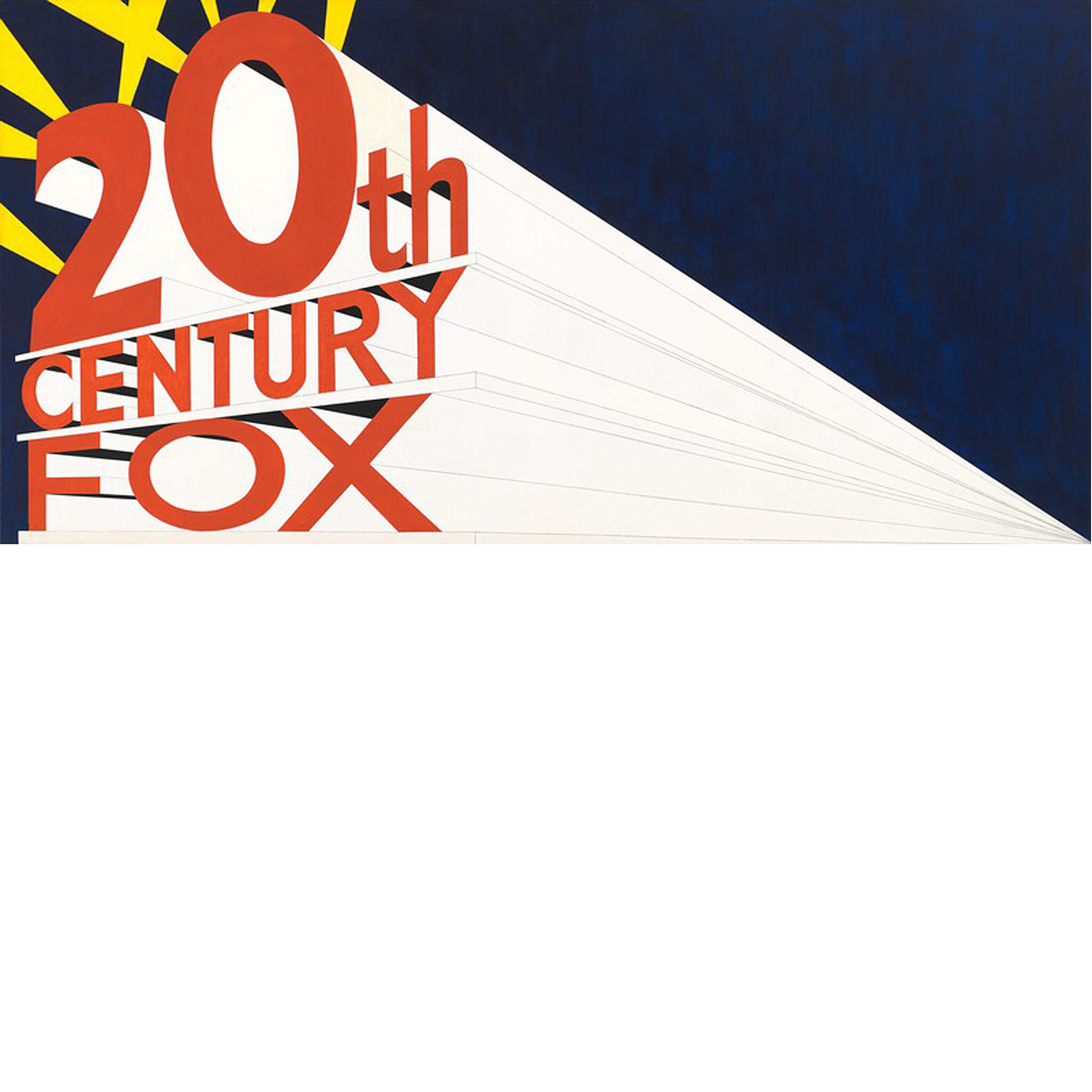
Twentieth Century Fox logo emanating from corner.

Edward Ruscha, Large Trademark with Eight Spotlights, 1962. Oil on canvas, 66 3/4 × 133 1/4 in. (169.6 × 338.5 cm). Whitney Museum of American Art, New York; purchase with funds from the Mrs. Percy Uris Purchase Fund 85.41. © Ed Ruscha

EDWARD RUSCHA (B. 1937), LARGE TRADEMARK WITH EIGHT SPOTLIGHTS, 1962

Ed Ruscha’s background in commercial illustration and advertising inspired paintings of vernacular subjects such as Large Trademark with Eight Spotlights of 1962. With its long horizontal format, the canvas evokes both movie screen and billboard. One of the Hollywood film industry’s best-known logos—Twentieth Century Fox—occupies the pictorial field like the opening credit of a movie, receding in sharp perspective and illuminated by yellow spotlights against the dark background of the night. The bold, three-dimensional letters and yellow klieg rays telegraph the dominance of the movie industry in Los Angeles while also gesturing to an increasing standardization of cultural icons (which have become, as Ruscha’s title suggests, simply “trademarks”). As in Andy Warhol’s work of this period, the pictorial strategies of graphic design and advertising have displaced the traditional compositional structures of painting.

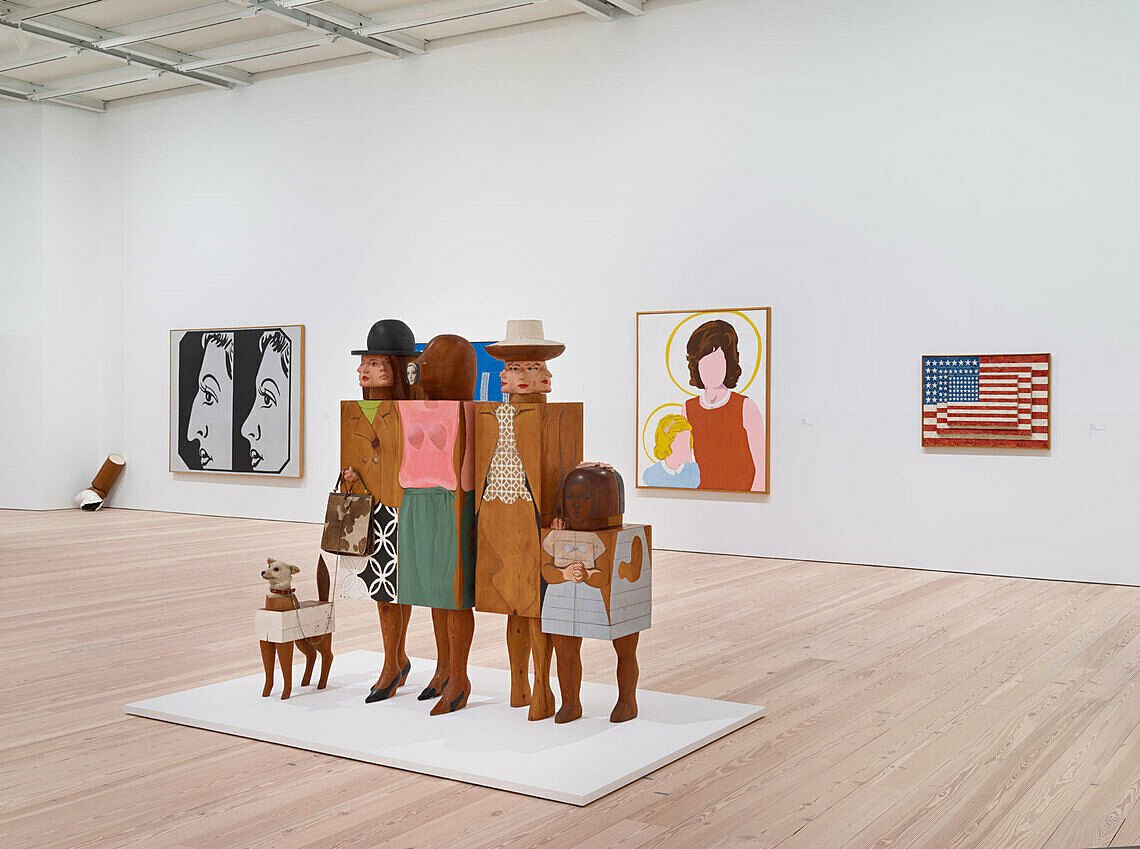
From left to right: Claes Oldenburg, Giant Fagends, 1967 (70.44a-o); Andy Warhol, Before and After, 4, 1962 (71.226); Marisol, Women and Dog, 1963-1964 (64.17a-i); Malcolm Bailey, Untitled, 1969, 1969 (69.77); Allan D’Arcangelo, Madonna and Child, 1963 (2013.2); Jasper Johns, Three Flags, 1958 (80.32). Photography by Ronald Amstutz.

INSTALLATION VIEW

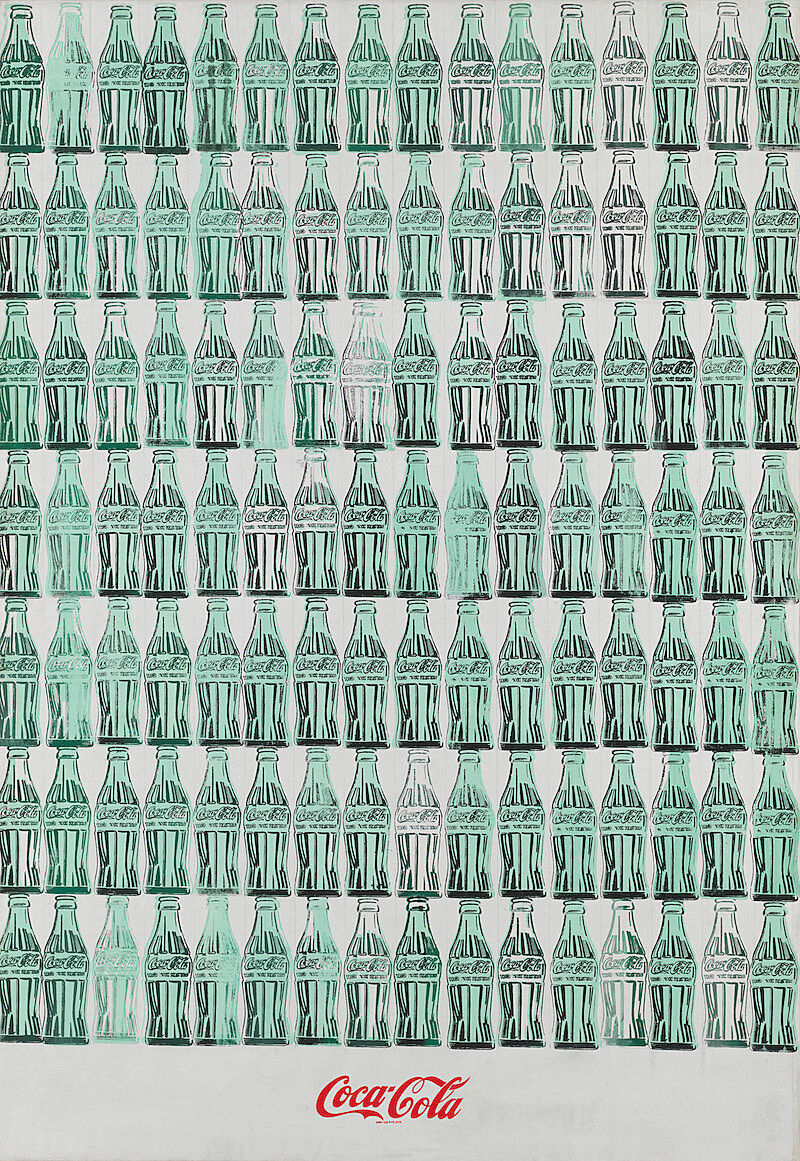
A print showing rows of Coca-Cola bottles with a logo at the bottom.

Andy Warhol, Green Coca-Cola Bottles, 1962. Silkscreen ink, acrylic, and graphite on canvas, 82 3/4 × 57 1/8 in. (210.2 × 145.1 cm). Whitney Museum of American Art, New York; purchase with funds from the Friends of the Whitney Museum of American Art 68.25. © 2018 The Andy Warhol Foundation for the Visual Arts, Inc. / Artists Rights Society (ARS), New York

ANDY WARHOL (1928-1987), GREEN COCA-COLA BOTTLES, 1962

In Andy Warhol’s Green Coca-Cola Bottles, the iconic form of a single bottle of Coca-Cola is duplicated in regular rows above the company’s logo. The repetitive imagery and gridded composition evoke the mass production of the emblematic Coca-Cola bottle as well as the mechanical printing processes used to advertise the brand. Warhol most likely made the 112 nearly identical bottles using a combination of hand painting and screenprinting. Since he used more or less paint and varying degrees of force for each impression, the work retains something of a handmade look. Later in the same year that he made this work, Warhol more fully developed his pioneering screenprinting technique, which led to a more mechanized process in his studio, which came to be referred to as The Factory.

Warhol saw Coca-Cola as a prime example of the democratic ideals at the heart of American consumer culture. “A Coke is a Coke,” he explained, “and no amount of money can get you a better Coke . . . . All the Cokes are the same and all the Cokes are good.”

A collage of air mail stickers.

Yayoi Kusama, Air Mail Stickers, 1962. Collaged paper on canvas, 71 7/8 × 67 7/8 in. (182.6 × 172.4 cm). Whitney Museum of American Art, New York; gift of Mr. Hanford Yang 64.34 © Yayoi Kusama

YAYOI KUSAMA (B. 1929), AIR MAIL STICKERS, 1962

Made a few short years after Yayoi Kusama moved from Japan to the United States, Air Mail Stickers is a collage of the titular stickers, which read “VIA AIR MAIL.” Pasted onto paper in overlapping rows that both allow for readability and suggest the result of a formal, ordering principle, the red, white, and blue stickers produce the effect of accumulation from close-range and total coverage from afar. In this, Air Mail Stickersrelates to the “allover” compositions of Kusama’s early abstract paintings, which were comprised of either dense polka-dot fields or infinitely expanding net forms.

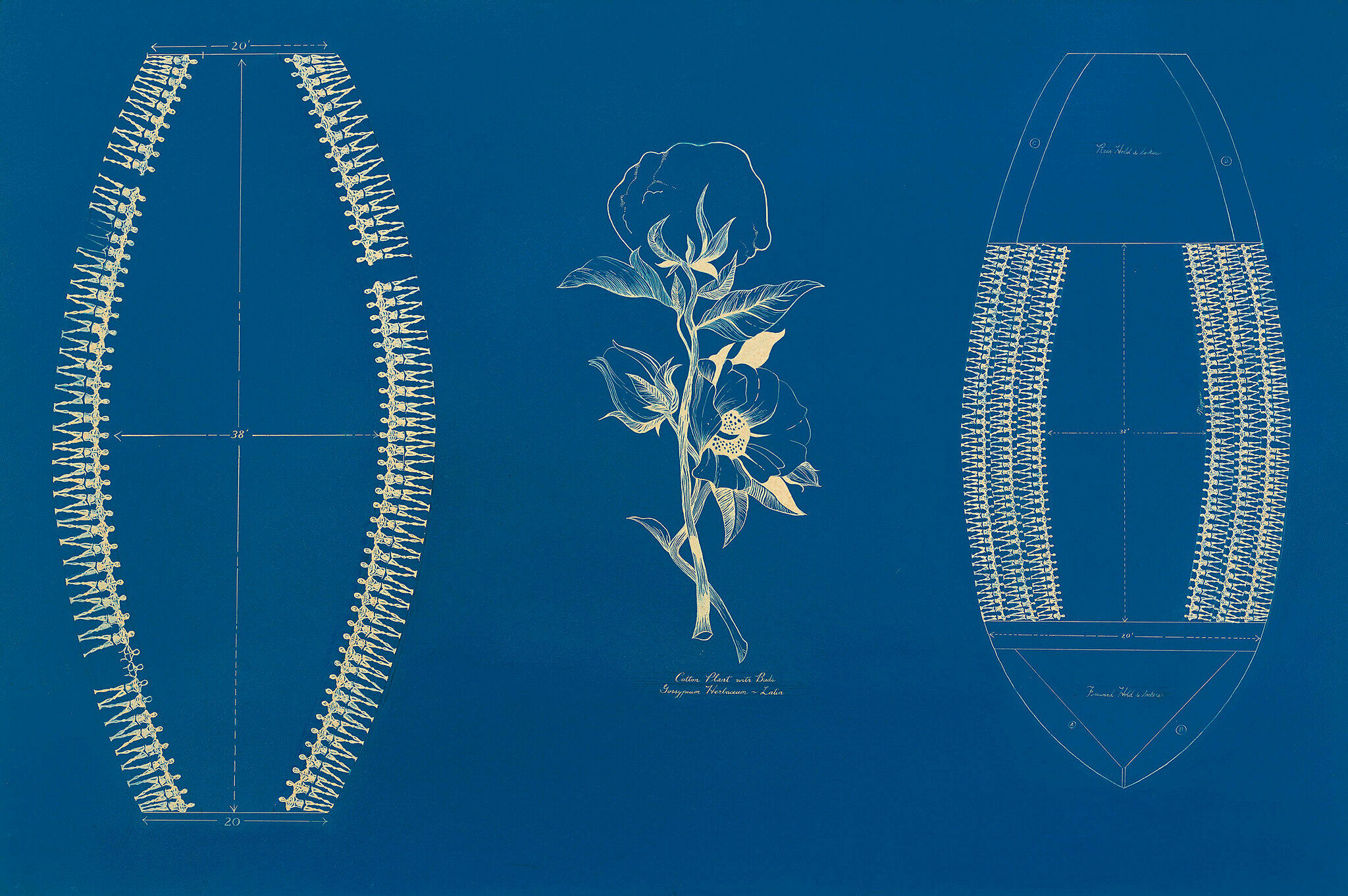
Malcolm Bailey. Untitled, 1969, 1969. Acrylic on composition board. Overall: 48 × 71 15/16 in. (121.9 × 182.7 cm). Whitney Museum of American Art, New York; Purchase, with funds from the Larry Aldrich Foundation Fund 69.77. © artist or artist’s estate

MALCOLM BAILEY (1947-2011), UNTITLED, 1969, 1969

Malcolm Bailey based this untitled painting on diagrams of a slave ship that had been published in 1780 by an English abolitionist group. The blue paint is reminiscent of blueprints, underscoring the careful engineering that was integral to the abduction and transportation of millions of Africans from their homelands. At the center of the image is a line drawing of a cotton plant, the basis of the economic system that fed on slave labor. For Bailey, this diagrammatic rendering makes its point more clearly than could simple naturalism. “An artist’s job,” he wrote, “should be more than one of just mirroring life; he must instead interpret life in a very subjective abstract way.”

0:00

John Baldessari, An Artist is Not Merely the Slavish Announcer, 1966–68

0:00

Narrator: The text at the bottom of this canvas came from an art book that proclaimed the superiority of painting to photography. The artist, John Baldessari.

John Baldessari: And it kind of bothered me that photography had one history and, and art had another history or, or more specifically painting. And to me it was all kind of the same. It was just different materials, photographic materials versus paint and canvas. And so I think that, it was that argument I was addressing.

Narrator: The photo in this piece is of an anonymous parking lot in San Diego, with a tree randomly dividing the picture in half.

John Baldessari: I was. . .trying to counter that I just would go around taking snapshots and trying to, to really violate rules of photography. And I thought, Well, what would be more violative of a photograph than just having this post come down in the middle of it, just splitting the image left and right? Some of them are just driving around in my VW bus and holding the camera out the window and shooting without even looking through the viewfinder. Basically I was just trying to avoid the conventional ideas of art. 

Narrator: Towards this end, Baldessari was trying to downplay the role of the artist, both in his non-choice of photographic subject matter and his mechanical, impersonal approach to painting this work. He hired a professional sign painter and had him print the featureless script on the canvas rather than paint it. Baldessari coated the canvas with emulsion—the chemical mixture used to make photo paper light sensitive—using a photographic process to develop a painting. By doing so, Baldessari ironically challenges the authority of the reproduced text, and its insistence that photography is somehow a less artistic and more mechanical medium than painting. 

John Baldessari, An Artist is Not Merely the Slavish Announcer, 1966–68

In America Is Hard to See

JOHN BALDESSARI (B. 1931), AN ARTIST IS NOT MERELY THE SLAVISH ANNOUNCER, 1966-68

For An Artist Is Not Merely the Slavish Announcer, John Baldessari commissioned a commercial sign painter to hand-letter a hackneyed statement taken from an art textbook. Above it, he printed a photograph of an ordinary suburban parking lot. The uppercase, sans serif lettering style presents the clichéd message of the text with a deadpan sense of factuality. Likewise, the photograph presents the banal scene as if it were a piece of forensic evidence. Even the work’s odd dimensions reflect the circumstantial: 59” x 45” is the size of the door of the van used to transport the work.

The combination of text and image raises narrative and allusive possibilities even while cancelling them out. Are we to look at the image for evidence that the photographer has not “slavishly announced” facts, but has created a carefully considered composition? Or do the text and image simply represent a random, meaningless juxtaposition? Baldessari has distanced himself as much as possible from making artistic decisions that would elicit clearly defined meanings. As he has said, “Seeing selectively means you screen out a lot of interesting things.” His works are open, and encourage, in his own words, “conceptual leaps people can make from one bit of information to another.”

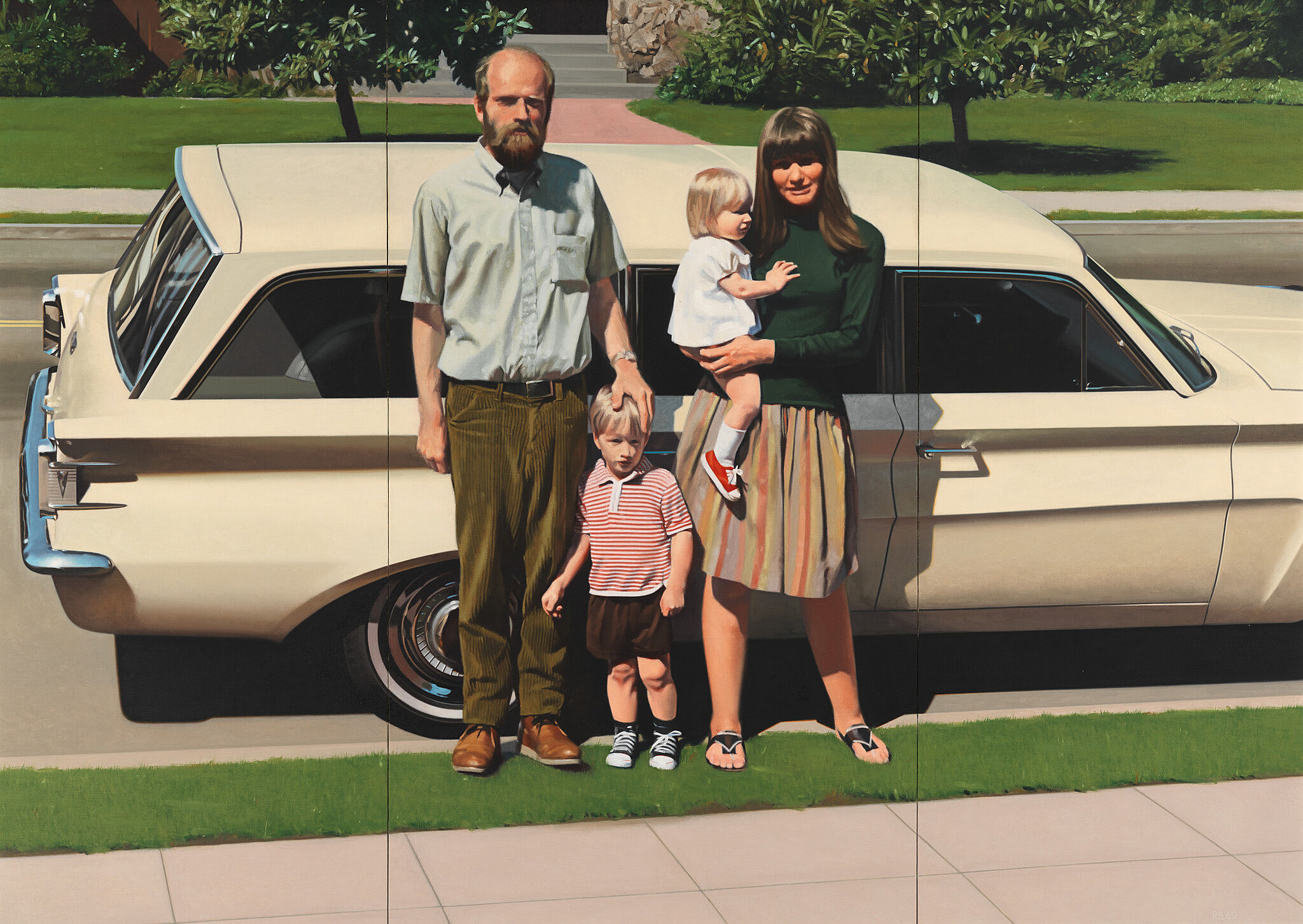
A photorealistic painting o a family standing in front of a car.

Robert Bechtle, ’61 Pontiac, 1968-69. Oil on canvas, 59 3/4 × 84 1/4 in. (151.8 × 214 cm). Whitney Museum of American Art, New York; purchase, with funds from the Richard and Dorothy Rodgers Fund 70.16 © Robert Bechtle

ROBERT BECHTLE (B. 1961), ’61 PONTIAC, 1968-69

Robert Bechtle’s ’61 Pontiac depicts a familiar scene in postwar America: a family (the artist’s own, in this case) in front of its car. Bechtle was consistently attracted to such ubiquitous, workaday subjects, often set in suburban locales. The “challenge,” he claimed, was “making art from such ordinary fare.” Bechtle’s style is intentionally evenhanded; he rendered the particular features of the car with the same hyperrealistic treatment that he applied to each family member’s facial features and clothing. Bechtle habitually used photographs as source material, and at nearly five feet tall, ’61 Pontiacmakes a monument out of an amateur snapshot. Yet where a photograph can be made, seen, and forgotten in an instant, the artist’s painstaking attention to detail in this painting allowed him—and, by extension, the viewer—to more thoroughly engage with a single moment.

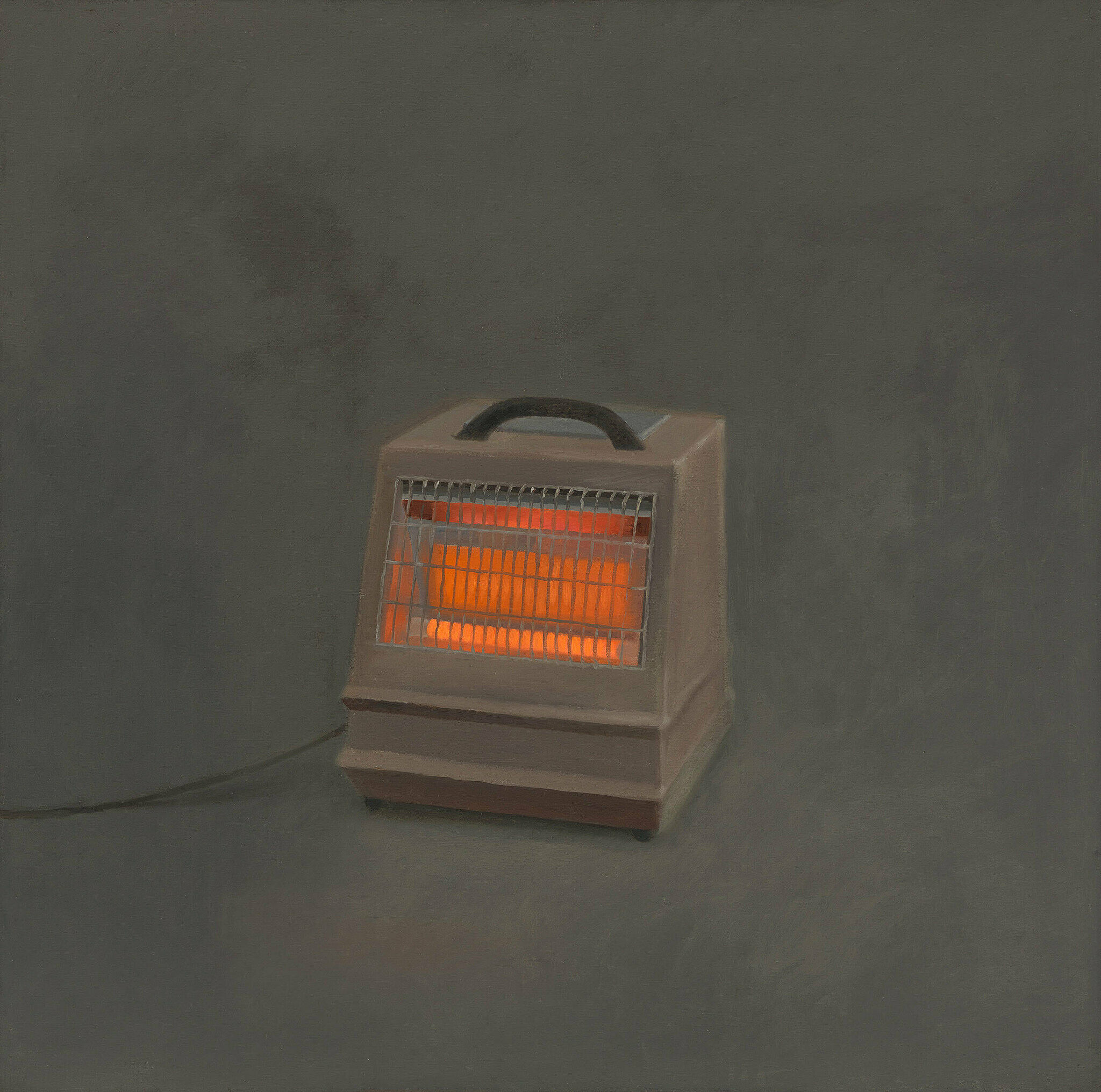
Vija Celmins (b. 1938), Heater, 1964. Oil on canvas, 47 9/16 × 48 in. (120.8 × 121.9 cm). Whitney Museum of American Art, New York; purchase, with funds from the Contemporary Painting and Sculpture Committee 95.19 © Vija Celmins

VIJA CELMINS (B. 1938), HEATER, 1964

Vija Celmins is known for her painstakingly rendered photorealist paintings and drawings, which examine such subjects as desert and ocean surfaces and nocturnal skies. The still lifes she made in the early 1960s, however, are among the artist’s most restrained and introspective works. In a series executed in 1964, while still a graduate student at the University of California, Los Angeles, Celmins painted domestic objects from her Venice, California, studio—a lamp, a hotplate, a fan, a knife resting on a saucer—as an exercise in close looking. Situating these everyday things that relate to the basic necessities of heat, food, and light within fields of gray or brown, she created muted grounds that spurned the slick finishes and bright Pop colors favored by other Southern California artists at that time.

In Heater, a characteristic work from this series, a small space heater emits a contained orange glow while its electrical cord trails out of the picture plane, suggesting a larger space beyond the otherwise flattened composition. A tension between the illusion of warmth that radiates from luminous coils of Heater and its physical absence from the canvas adds to the painting’s unnerving impact. While the subject of this work seems innocuous, its somber, shadowy rendering suggests something more ominous. Indeed, such darker subtexts appear in other, more pointedly political and austere works from this period. Celmins had begun looking to mass media—a Timemagazine cover depicting the 1965 Watts uprising in Los Angeles, and images of fighter planes on her television—for source material that reflected the turbulence of the 1960s.

Excerpted from Whitney Museum of American Art: Handbook of the Collection, (2015), p. 90. Published by the Whitney Museum of American Art, New York; distributed by Yale University Press.

0:00

Jasper Johns, Three Flags, 1958

0:00

Scott Rothkopf: A lot of people have debated whether this image is patriotic on the one hand or somehow critical of the American government, and part of its enduring appeal is that we just can’t decide. It’s interesting to think that seeing so many flags could recall parades, patriotism, a kind of festive embrace of American culture, and certainly this painting was made at a very interesting time in American history if we think of the triumphant feeling after World War II, as well as the fear of the Cold War, the repression of the 1950s era. In that way the flag could seem almost oppressive in this case, this kind of exaggerated image of American government, of patriotism, of jingoism, which sometimes stands for things that are not quite as positive as we would like them to be.

JASPER JOHNS (B. 1930), THREE FLAGS, 1958

In 1954, Jasper Johns began painting what would become one of his signature emblems: the American flag. As an iconic image—comparable to the targets, maps, and letters that he also has depicted—Johns realized that the flag was “seen and not looked at, not examined.” The execution and composition of Three Flags elicit close inspection by the viewer. The painting draws attention to the process of its making through Johns’s use of encaustic, a mixture of pigment suspended in warm wax that congeals as each stroke is applied; the resulting accumulation of discrete marks creates a sensuous, almost sculptural surface. The work’s structural arrangement adds to its complexity. The trio of flags—each successively diminished in scale by about twenty-five percent—projects outward, contradicting classical perspective, in which objects appear to recede from the viewer’s vantage point. By shifting the visual emphasis from the flag’s emblematic meaning to the geometric patterns and variegated texture of the picture surface and the canvas structure, Johns explores the boundary between abstraction and representation. As he remarked, this painting allowed him to “go beyond the limits of the flag, and to have different canvas space.”

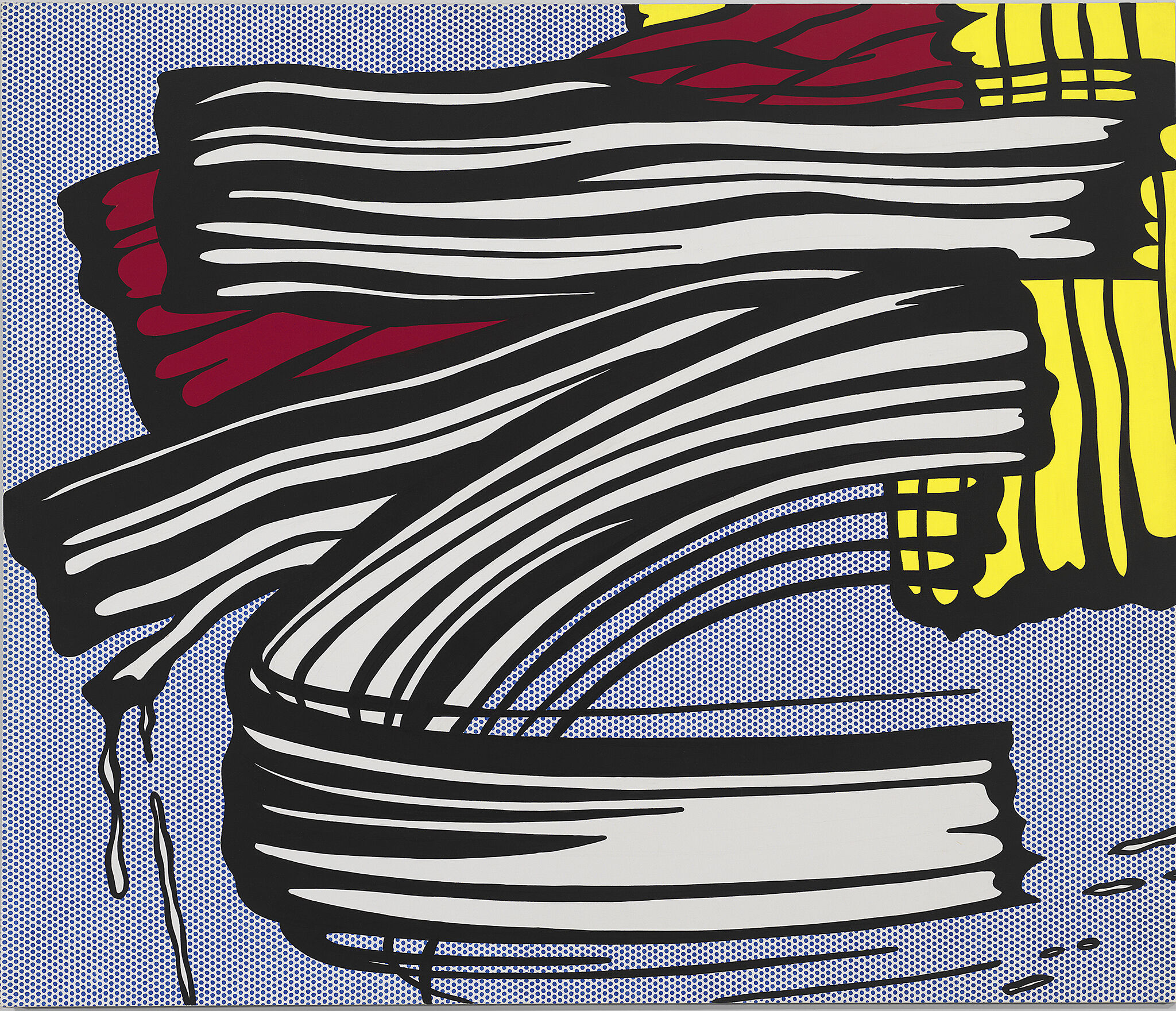
Photo of a pop art painting by Roy Lichtenstein, depicting bold brush strokes.

Roy Lichtenstein, Little Big Painting, 1965. Oil and acrylic on canvas, 68 × 80 in. (172.7 × 203.2 cm). Whitney Museum of American Art, New York; purchase with funds from the Friends of the Whitney Museum of American Art 66.2. © Estate of Roy Lichtenstein

ROY LICHTENSTEIN (1923-1997), LITTLE BIG PAINTING, 1965

With its depiction of large, dripping brushstrokes, Roy Lichtenstein’s Little Big Painting offers a wry commentary on the Abstract Expressionist paintings that dominated the New York art world in the 1940s and 1950s. Lichtenstein parodied his predecessors’ signature bold brushstrokes, rendering them flat and stylized, even mimicking the drips of paint that would have resulted from the artists’ sweeping, spontaneous gestures. While the Abstract Expressionists largely understood their work as standing in opposition to popular culture, Lichtenstein set his brushstrokes against a field of repeating Benday dots—a mechanical process for creating shades of color in commercial printing. Likewise, the thick black lines painted around bands of solid white, yellow, and red recall graphic devices used in comic strips. The result satirizes the supposedly improvisational and personal style of the previous generation’s “big paintings” and underscores the fact that they inevitably relied on mass media for their renown.


Artists


Explore works from this exhibition
in the Whitney's collection

View 646 works

On the Hour

A 30-second online art project:
Frank WANG Yefeng, The Levitating Perils #2

Learn more about this project

Learn more at whitney.org/artport

On the Hour projects can contain motion and sound. To respect your accessibility settings autoplay is disabled.