America Is Hard to See | Art & Artists

May 1–Sept 27, 2015


Exhibition works

23 total
Forms Abstracted
Read more

Forms Abstracted
Floor 8

An abstract painting with swirly and geometric lines.

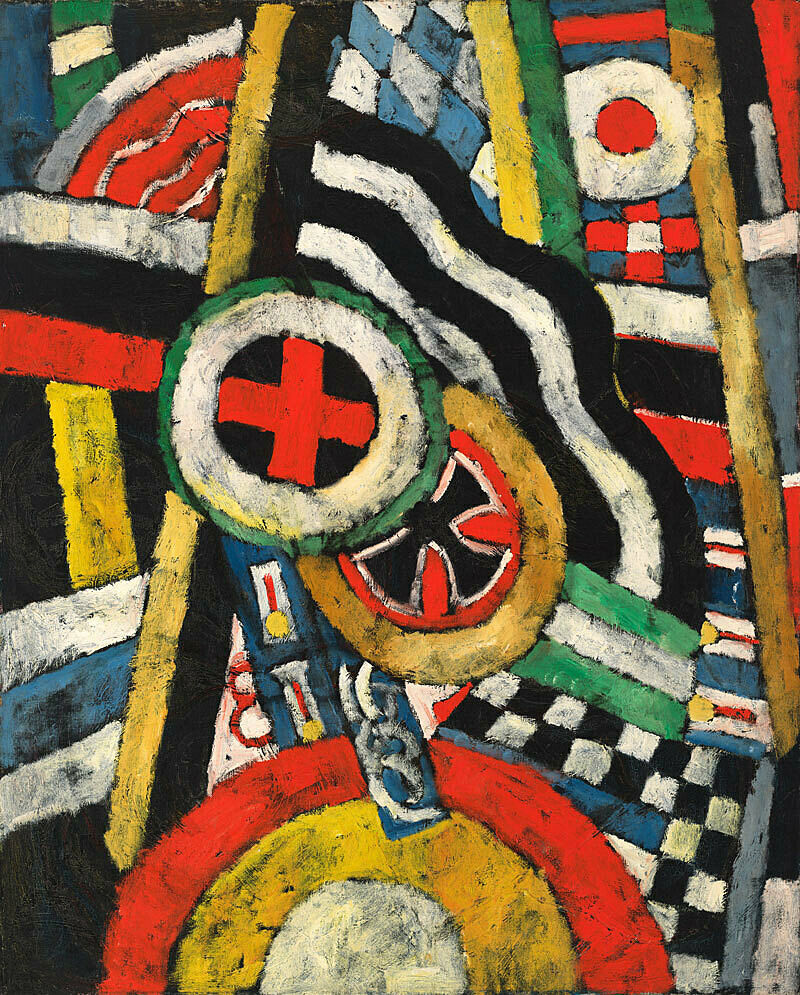
Marsden Hartley, Painting, Number 5, (1914 1915). Oil on linen, 39 1/4 × 32 in. (99.7 × 81.3 cm). Whitney Museum of American Art, New York; gift of an anonymous donor 58.65

Forms Abstracted
Floor 8

Please note: Floor 8 is no longer on view.

In 1913, the French avant-garde artist Francis Picabia proclaimed his admiration for New York: “You of New York should be quick to understand me and my fellow painters. Your New York is the cubist, the futurist city. It expresses its architecture, its life, its spirit, the modern thought. You have passed through all the old schools, and are futurists in your word and deed and thought.” Yet if Picabia saw New York— and the United States more broadly—as the great embodiment of modernity, the development of modern art was not so straightforward in a country still bound by more traditional aesthetic norms.

The European avant garde jolted American artists who encountered it through reproductions and exhibitions in New York or through travel to Paris and beyond. Some artists sought to emulate its stylistic advances, while others adapted European Modernism to images of America’s fast-changing culture and surroundings. In several of the works on view in this chapter, we see artists doing just what Picabia predicted—bending Cubism and Futurism to meet their own needs, including the depiction of such quintessentially American subjects as baseball and the cocktail. Other artists responded more philosophically to modernism by breaking away from the description of recognizable subjects to invent new abstract forms.

Below is a selection of works from this chapter.

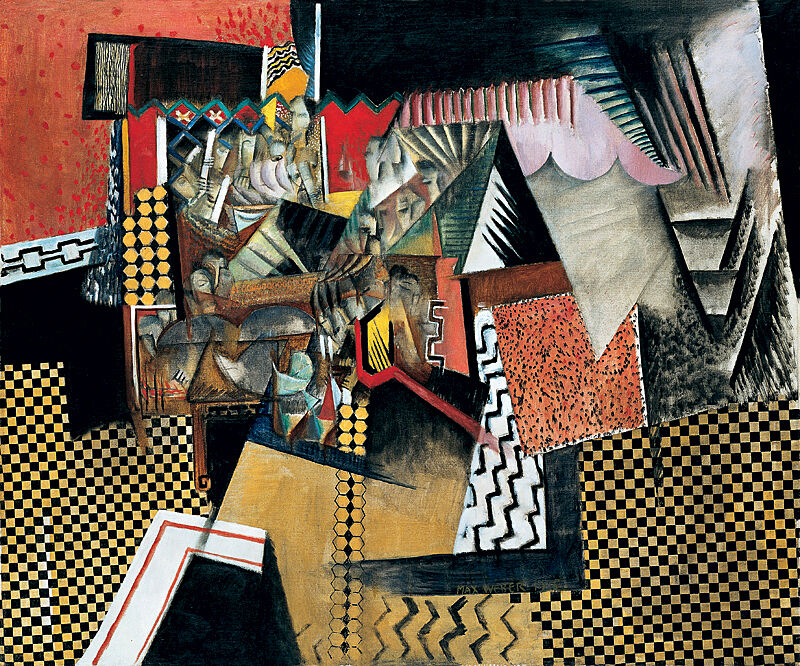
A cacophony of patterns, colors, and forms suggesting furniture and architectural details overlap and intermingle in a jostling cubist composition.

Max Weber, Chinese Restaurant, 1915. Oil, charcoal, and collaged paper on linen, 40 × 48 ⅛ in. 

Max Weber (1881-1961), Chinese Restaurant, 1915

In Chinese Restaurant, Max Weber adapted the Cubism of his contemporaries Pablo Picasso and Georges Braque, which he had first encountered in Paris, to capture the distinct atmosphere and energy of a New York interior. From within the painting’s dizzying planes and patterns emerge the fractured faces of patrons and servers, a scrolled table leg, red wallpaper, stippled tablecloths, and the gold-and-black tiles of a checkered floor.

Chinese restaurants were a new phenomenon in Manhattan at the turn of the century, a time when booming urban immigration brought various cultures into close proximity. In this painting Weber—who had himself emigrated from what is now Poland to New York at the age of ten—forged a new approach to modernist art by assimilating European forms with American subjects, while also highlighting the growing appetite for exotic tastes, whether in art or in food.

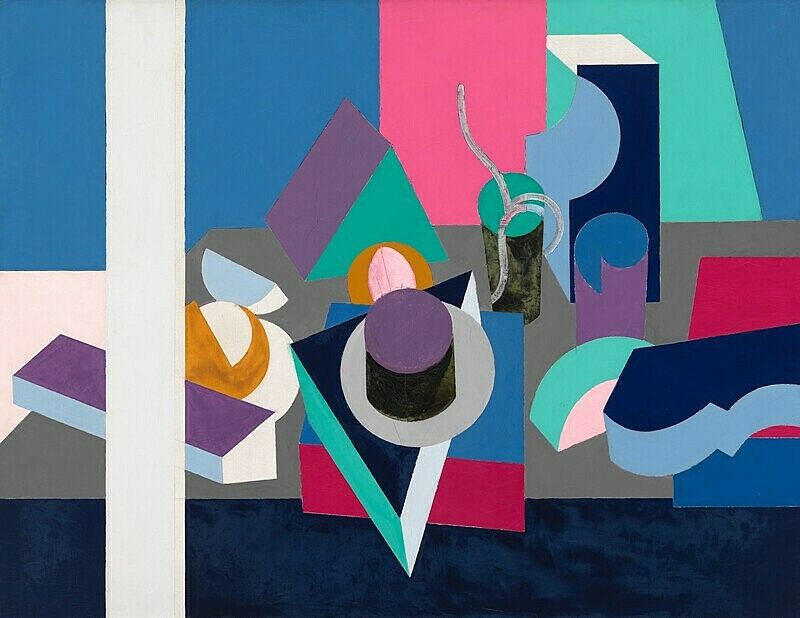
Patrick Henry Bruce (1881-1936), Painting, c. 1921-22. Oil on canvas, 35 × 45 3/4 in. (88.9 × 116.2 cm). Whitney Museum of American Art, New York; gift of an anonymous donor 54.20

Patrick Henry Bruce (1881-1936), Painting, c. 1921-22

In 1904, Virginia-born Patrick Henry Bruce moved to France, where he would reside for most of his life. Encountering the fractured forms of Cubism there and the color experiments of his friends the Orphist painters Sonia and Robert Delaunay, Bruce soon adopted bold hues and a geometric style. By 1912 he was painting abstracted still lifes, a genre that would occupy him for the rest of his career. Though he was one of the few American artists to be embraced by the Parisian avant-garde of the era, Bruce nonetheless became increasingly disillusioned and reclusive over the course of the 1920s and destroyed much of his work before committing suicide in 1936.

Painting is emblematic of the architectonic style that Bruce developed in his last series of still-life paintings, produced in the years following World War I. Like other works from this period, it focuses exclusively on objects from the private world of the artist’s apartment studio. The image is composed of quotidian objects—including a vase, a drinking glass, and a sliced orange—that have been organized into flat planes of color and geometric volumes, formed with the aid of mechanical drawing tools. The white vertical bar on the left-hand side—a device Bruce used frequently in this period—creates the illusion that the objects are set into a deep space, even as it simultaneously calls attention to the flatness of the canvas surface. With its sharply articulated forms and bold, unmodulated color, Painting anticipates the hard-edged geometric abstraction adopted by successive generations of American artists in the 1930s and again in the 1950s.

Excerpted from Whitney Museum of American Art: Handbook of the Collection (2015), p. 79. Published by the Whitney Museum of American Art, New York; distributed by Yale University Press.   

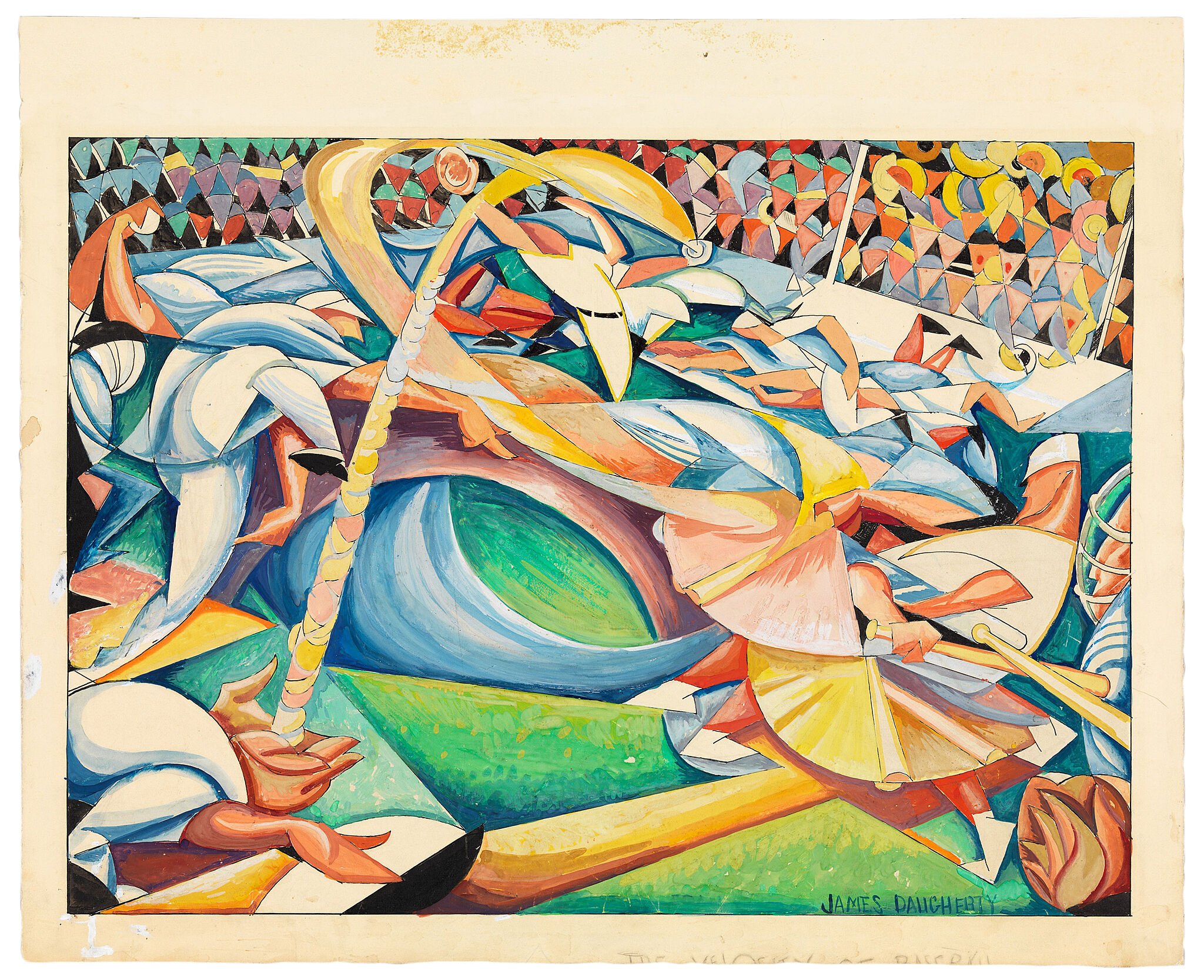
James Daugherty (1889-1974), Three Base Hit, 1914. Pen and ink and opaque watercolor on paper, 15 1/2 × 19 in. (39.4 × 48.3 cm). Whitney Museum of American Art, New York; purchase 77.40 Courtesy The Friends of James Daugherty Foundation, Inc.

James Daugherty (1889-1974), Three Base Hit, 1914

In Three Base Hit, James Daugherty collapsed sequential events into one continuous image to capture what he called “the various sensations of the onlooker.” A pitcher winds up for the throw; a batter swings; and a ball rockets to an infielder’s mitt. The artist deployed the stylistic devices of Futurism—a movement initiated in Italy in 1909—by merging figures and objects with their surroundings to suggest motion and speed. Daugherty’s avant-garde depiction of this popular pastime first appeared as a cartoon in the New York Herald, where he worked as an illustrator, demonstrating how artists were blurring the lines between mass culture and aesthetic innovation during the first decades of the twentieth century.

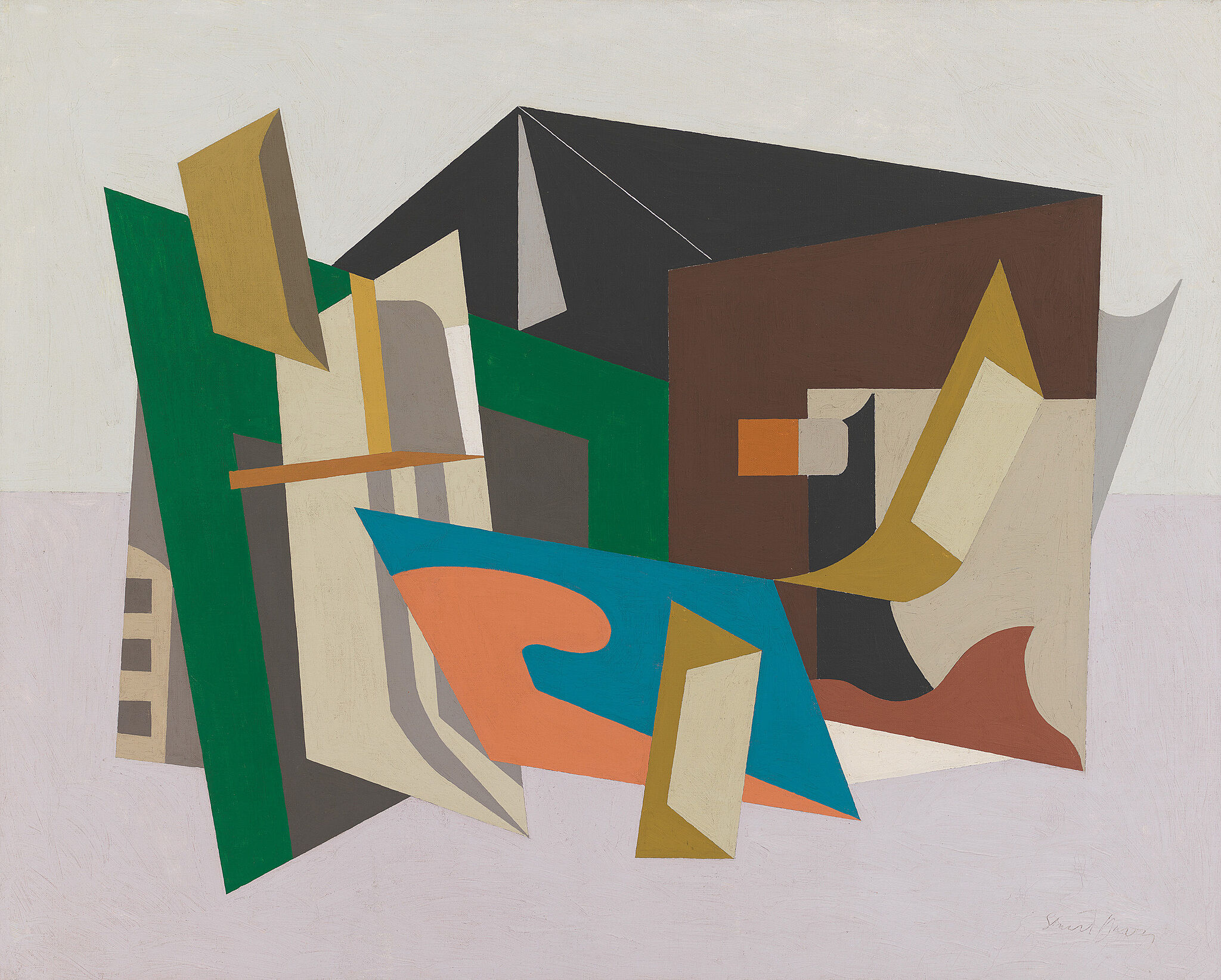
Stuart Davis (1892–1964), Egg Beater No. 1, 1927. Oil on linen, 29 3/16 x 36 3/16 in. (74.1 x 91.9 cm). Whitney Museum of American Art, New York; gift of Gertrude Vanderbilt Whitney 31.169. © Estate of Stuart Davis/Licensed by VAGA, New York

Stuart Davis (1892-1964), Egg Beater No. 1, 1927

In late 1927, Stuart Davis began work on the first in a series of four still lifes in which he transformed ordinary domestic items—an eggbeater, an electric fan, and a rubber glove—into sharp-edged abstractions. Davis deliberately chose banal subjects, and he worked with them exclusively for more than a year, until they lost their meaning to him as objects and became instead geometric planes in space. He affixed the items to a table in his studio and painted them over and over, eventually distilling them into a dynamic constellation of color and shape. “Gradually through this concentration,” he remarked, “I focused on the logical elements. . . . The immediate and accidental aspects of the still life took second place.”

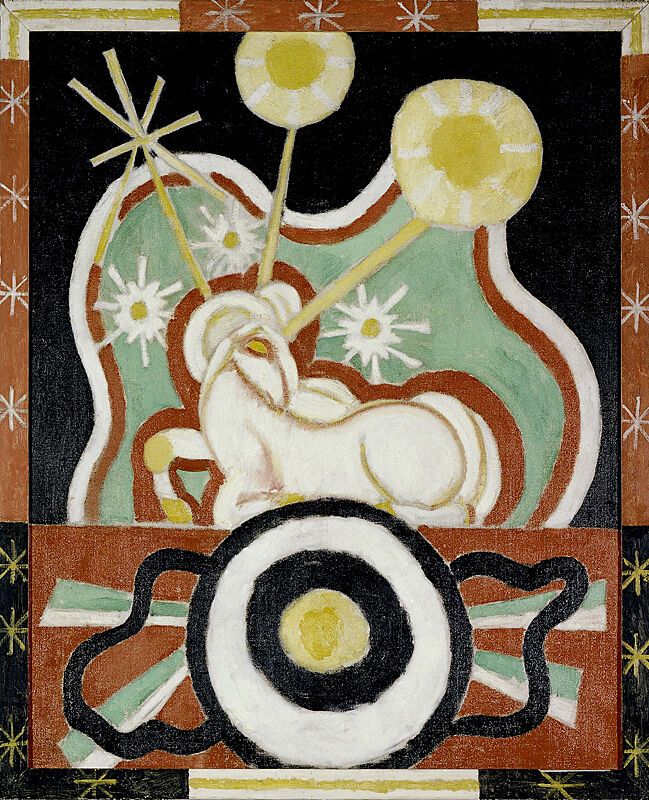
An animal sits at the center of an abstract artwork.

Marsden Hartley, Forms Abstracted, 1913. Oil on canvas, 39 1/2 × 31 3/4 in. (100.3 x 80.7 cm). Whitney Museum of American Art, New York; gift of Mr. and Mrs. Hudson D. Walker and exchange  52.37

Marsden Hartley (1877-1943), Forms Abstracted, 1913

In 1912, Marsden Hartley sailed for Europe, settling first in Paris and later in Berlin. The increasingly nationalist, militaristic atmosphere of the imperial German capital on the brink of war would soon inspire Hartley to turn to heraldic imagery as subject matter for his paintings. With its palette of black, red, and white and its flattened color planes with interlocking designs, Forms Abstracted begins to show this influence, anticipating the artist’s subsequent War Motif series. The composition also suggests the impact of Hartley’s encounters with the Munich-based Blaue Reiter artists Franz Marc and Wassily Kandinsky. Painted the year of his visit to Kandinsky’s studio, Forms Abstracted recalls the Blaue Reiter artists’ preoccupation with animals and religious folk-art subjects. Here, Hartley embraces a spiritual theme, depicting the Lamb of God surrounded by radiating orbs, with a painted frame concept borrowed from folk art sources.

0:00

Marsden Hartley, Painting, Number 5, 1914–15

0:00

Narrator: Adam Weinberg is Alice Pratt Brown Director of the Whitney Museum.

Adam Weinberg: Painting, Number Five, by Marsden Hartley, is an exuberant cacophony of color and pattern. Near the center of the canvas, two circles overlap—one contains the German Iron Cross, a medal of valor awarded to German soldiers for their courage in battle. The other contains a red cross. Look carefully and you can find references to flags, military insignia, and even an army uniform. The effect is like a collage, combining impressions of things Hartley encountered in Berlin, where he lived before the start of the First World War. 

What is the real subject of this painting? Think about how you recall things that have happened to you in the past. Often, it’s hard to conjure up a sense of something in its entirety. We remember a person or an event in the details—a gesture, a smell, a color. Hartley’s paintings function that way too; it’s actually a portrait, although the literal image of an actual person is altogether absent. The painting commemorates a young German officer, Karl von Freyburg, who died in the early months of World War I. Hartley was in love with von Freyburg, and he made this painting after learning of his death. 

Inspired by European avant-garde artists of the time, Hartley began to move away from direct representations of his subject matter toward more abstract, evocative imagery. Hartley once said that the artist’s challenge was to reveal what he called “the magic that is beneath the surface of what the eye sees.” In this painting, he captures a sense of an individual personality, and the emotional content of his relationship to Berlin and to von Freyburg. 

The semi-abstract style of Hartley’s painting means that we have to struggle a bit to decode its meaning. If you’d like to hear about it, please tap the button to continue. 

Marsden Hartley, Painting, Number 5, 1914–15

In Where We Are

Marsden Hartley (1877-1943), Painting, Number 5, 1914-15

Marsden Hartley began this work before the First World War during an extended stay in Berlin, where he was captivated by the city’s vitality and imperial Germany’s military pageantry. The painting is a memorial to Karl von Freyburg, a young German military officer whom Hartley loved and who was killed in battle soon after the war began. Combining the fragmented forms of Cubism with German Expressionism’s brilliant colors, Hartley broke apart and rearranged motifs derived from German flags and such military regalia as epaulets, brass buttons, and an Iron Cross medal (awarded for bravery), as well as a chessboard recalling von Freyburg’s favorite game. The result is both an exuberant portrait and a mournful reminder of the human cost of war.

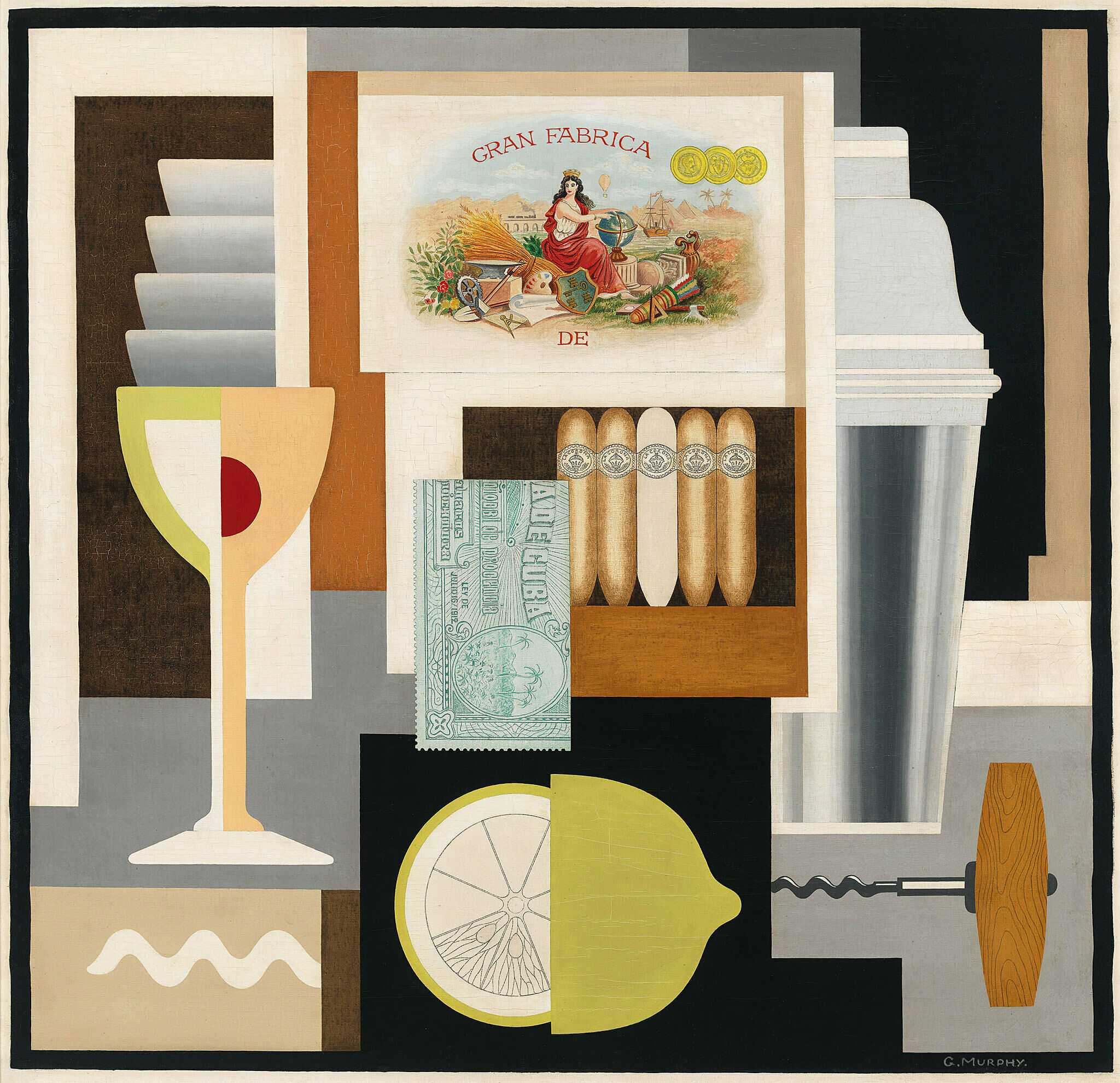
Gerald Murphy, (1888-1964) Cocktail, 1927. Oil and pencil on linen, 29 1/16 × 29 15/16 in. (73.8 × 76 cm). Whitney Museum of American Art, New York; purchase, with funds from Evelyn and Leonard A. Lauder, Thomas H. Lee, and the Modern Painting and Sculpture Committee 95.188. Art © Estate of Honoria Murphy Donnelly, Licensed by VAGA, New York

Gerald Murphy, (1888-1964) Cocktail, 1927

During his short, seven-year career as an artist, Gerald Murphy produced only about fourteen paintings. Key among them is Cocktail, a bold, stylized still life comprised of flattened geometric shapes, overlapping forms, and spatially illogical juxtapositions. A poignant memento of the urban, sophisticated lifestyle of the Jazz Age, the painting’s formal qualities are reminiscent of French Cubism as well as the industrial aesthetic of the American Precisionists. Yet Cocktail is also distinguished by its uniquely autobiographical approach. The depicted accoutrements of a typical 1920s bar tray were based on Murphy’s memory of his father’s bar accessories, and the five cigars represent the artist, his wife, and their three children. The illusionistic depiction of the box cover, which alone took four months to complete, shows a robed woman surrounded by items that allude to Murphy himself, including a boat (he was an avid sailor) and an artist’s palette. By celebrating a ritual that was forbidden during Prohibition in America, but which became a distinctive feature of European life during the 1920s, the painting also affirms Murphy’s status as a stylish and worldly expatriate.

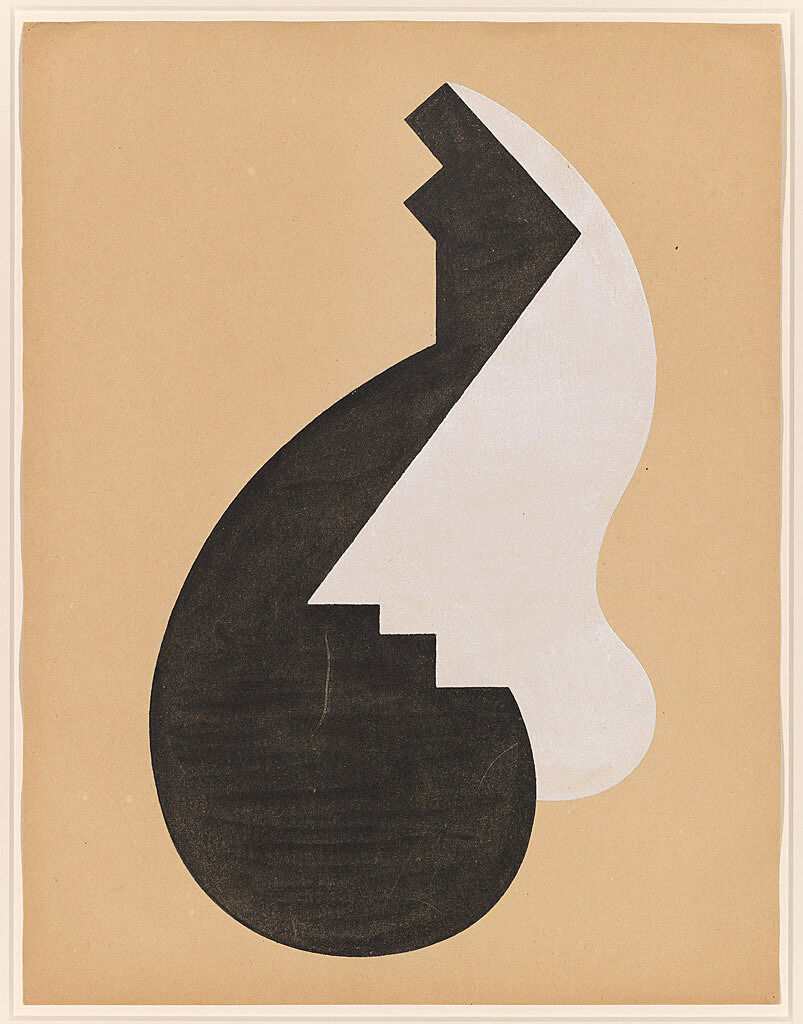
Isamu Noguchi (1904-1988), Paris Abstraction, 1927-28. Opaque watercolor and graphite pencil on paper, sheet: 25 1/2 × 19 3/4 in. (64.8 × 50.2 cm), Whitney Museum of American Art, New York; gift of The Isamu Noguchi Foundation, Inc. 94.33 © 2015 The Isamu Noguchi Foundation and Garden Museum, New York/Artists Rights Society (ARS), New York

Isamu Noguchi (1904-1988), Paris Abstraction, 1927-28

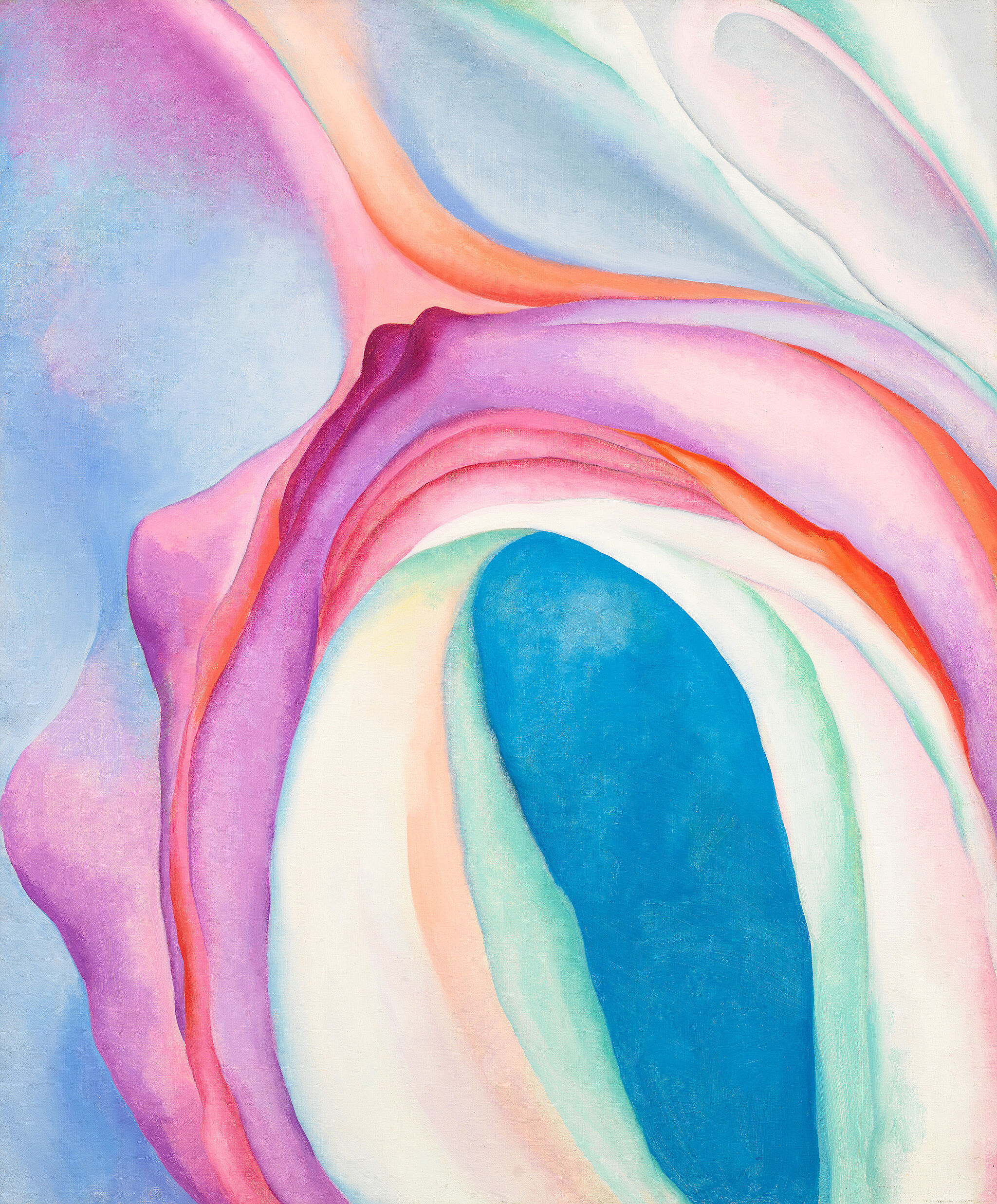
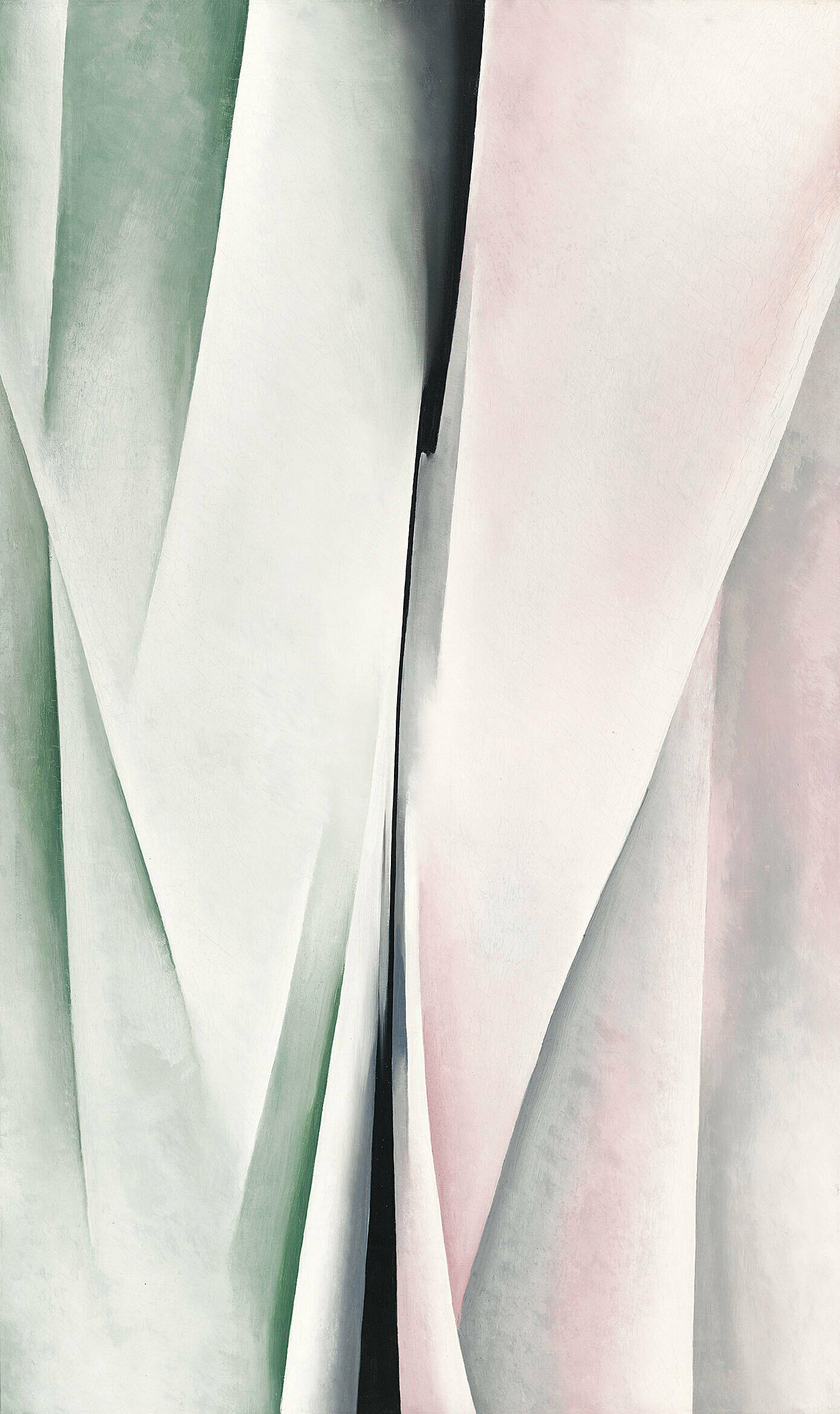
Georgia O’Keeffe (1887–1986), Abstraction, 1926. Oil on canvas, 30 3/16 × 18 1/4in. (76.7 × 46.4 cm). Whitney Museum of American Art, New York; purchase, with funds from Georgia O’Keeffe and by exchange 58.43. © The Georgia O’Keeffe Foundation/Artists Rights Society (ARS), New York

Georgia O’Keeffe (1887–1986), Abstraction, 1926

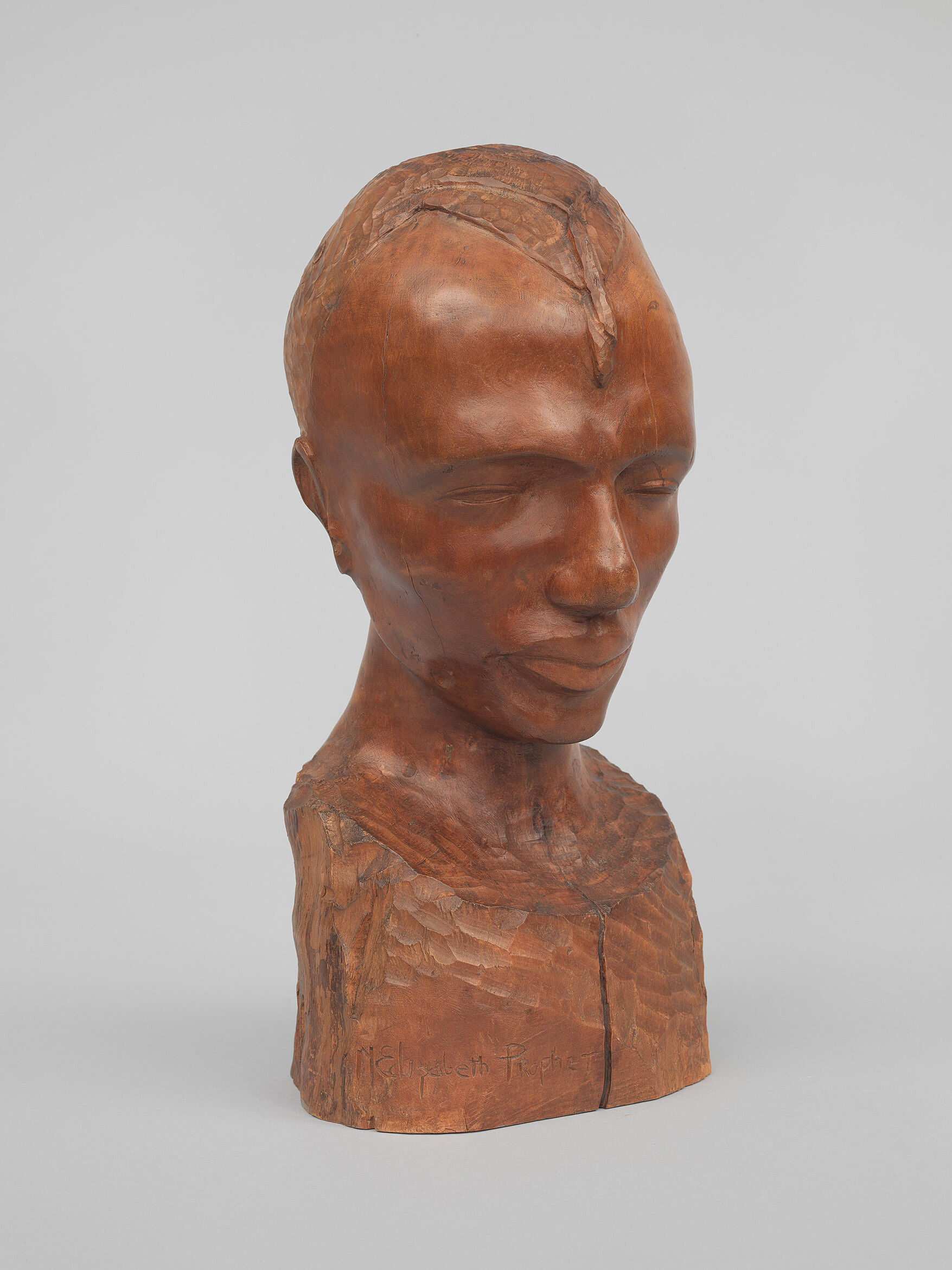
Nancy Elizabeth Prophet (1890-1960), Congolais, 1931. Cherry, 16 13/16 × 7 7/8 × 9 1/4 in. (42.7 × 20 × 23.5 cm). Whitney Museum of American Art, New York; purchase 32.83

Nancy Elizabeth Prophet (1890-1960), Congolais, 1931

Nancy Elizabeth Prophet carved Congolais at the height of the New Negro Movement of the 1920s and 1930s, when intellectuals like W. E. B. Du Bois and Alain Locke were encouraging fellow black artists to look to their African roots. This sculpture was inspired by African busts that Prophet saw in an exhibition in Paris, where she lived from 1922 to 1934. In a letter to her good friend Du Bois, she described them as “heads of thought and reflection, types of great beauty and dignity of carriage.” Rather than depicting a specific individual, Prophet streamlined the form to focus on its expressive power and sense of interior life. The contrasts between the smooth face, rough-hewn base, and areas of intact bark emphasize the sculptor’s process and her keen sensitivity to materials.

Gertrude Vanderbilt Whitney purchased Congolais in 1932, making it among the earliest works acquired for the Museum’s permanent collection.

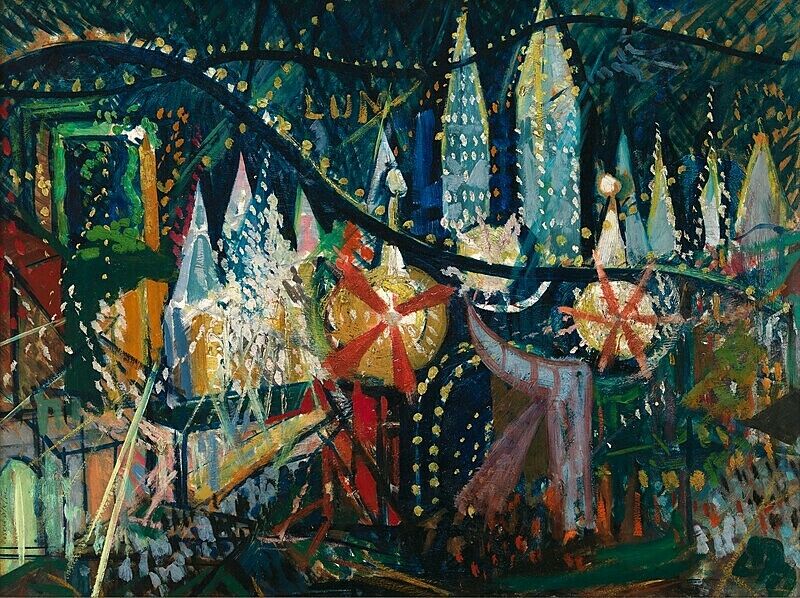
Joseph Stella (1877-1946), Luna Park, c. 1913. Oil on composition board, 17 1/2 × 23 1/2 in. (44.5 × 59.7 cm). Whitney Museum of American Art, New York; gift of Mrs. Charles A. Goldberg 72.147

Joseph Stella (1877-1946), Luna Park, c. 1913

Luna Park came as a revelation to Joseph Stella. A Coney Island amusement park glowing with thousands of lightbulbs at a time when electricity was still something of a novelty, it epitomized the excitement and commotion precipitated by modern technology. It also reminded Stella of the candlelit feast days honoring Catholic saints that he had celebrated as a boy in Muro Lucano, Italy, before immigrating to the United States when he was nineteen.

Prior to his encounter with Coney Island, Stella had admired the “hyperbolic chromatic wealth” of European modernism, which he had experienced firsthand on an extended trip to Italy and France in 1909. In the spectacle of Luna Park, Stella discovered a landscape that demanded a new visual language, and the rapid brushwork of this preparatory oil sketch vividly conveys the subject’s thrill and dazzle.


Artists


Explore works from this exhibition
in the Whitney's collection

View 646 works

On the Hour

A 30-second online art project:
Frank WANG Yefeng, The Levitating Perils #2

Learn more about this project

Learn more at whitney.org/artport

On the Hour projects can contain motion and sound. To respect your accessibility settings autoplay is disabled.