Human Interest: Portraits from the Whitney’s Collection | Art & Artists

Apr 2, 2016–Apr 2, 2017


Exhibition works

15 total
Entry Gallery, Floor 7
Read more

Entry Gallery, Floor 7

Floor 7

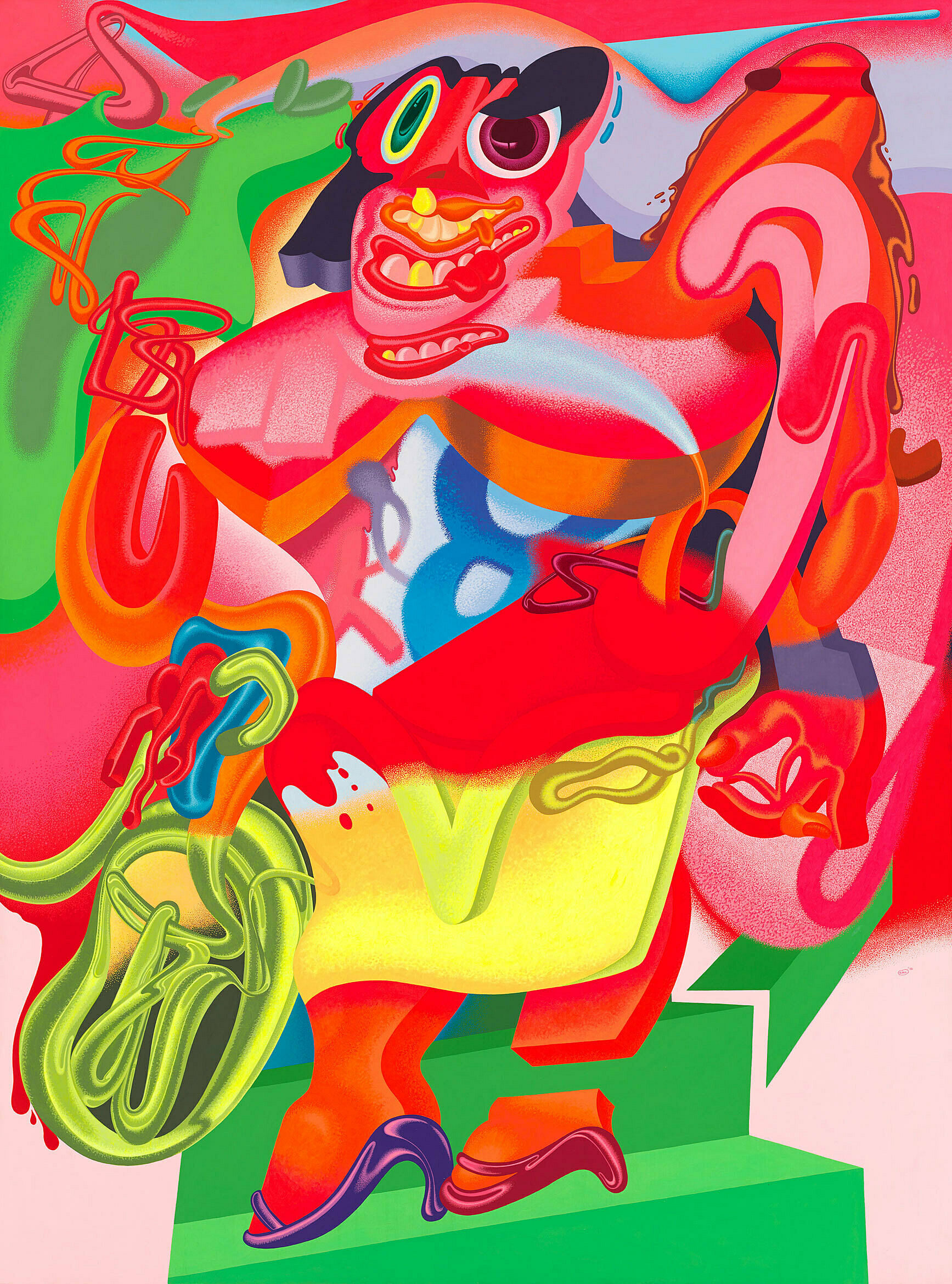
Peter Saul (b. 1934) de Kooning’s “Woman with Bicycle”, 1976. Acrylic on linen, 101 1/8 × 75 9/16in. (256.9 × 191.9 cm). Whitney Museum of American Art, New York; purchase with funds from the Sara Roby Foundation 84.49 © Peter Saul

Entry Gallery, Floor 7
Floor 7

Selected works from the seventh-floor entry gallery appear in this section.

0:00

Willem de Kooning, Woman and Bicycle, 1952–53

0:00

Elizabeth Murray: It’s a catastrophe, really. It’s a kind of catastrophe painting. 

Narrator: The late artist Elizabeth Murray described Willem de Kooning’s painting, Woman and Bicycle from the perspective of a fellow painter.

Elizabeth Murray:  The thing about this painting that’s so amazing is to see the woman form kind of emerge from underneath, almost as though she’s coming out of water, kind of emerging with the two mouths and the amazing eyes. And of course she’s a very strange woman. She probably has like a kind of evening dress on, and I think—I think it is like the Marilyn Monroe smile. And then there are these hands that can flail around inside of the painting. The hands are flailing. There is the bicycle in there somewhere which is torn apart and ripped apart. 

I think the thing that struck me the most about this painting was the intensity of the paint. You feel like he’s rubbing it and he’s stirring it up from the bottom, and he’s also pressing it back down. He takes newspaper and he presses it against the paint. Then he takes his knife, or anything, and scrapes the paint back up. And then he takes his brush, and pushes it into a kind of shape.  

So it’s all about this clear sexuality and exposure. And yet, like a lot of catastrophes, it comes together in this extremely positive way. And I think that’s what makes it such an amazing experience to look at it.

Willem de Kooning, Woman and Bicycle, 1952–53

In America Is Hard to See

Woman and Bicycle, 1952

In this work, one of a series depicting women that Willem de Kooning made between 1950 and 1953, a female figure at the painting’s center dissolves around the edges of the composition into a vigorous exploration of paint. "I’m not interested in 'abstracting,'" he later noted, "or taking things out or reducing painting to design, form, line, and color. I paint this way because I can keep putting more things in it–drama, anger, pain, love, a figure, a horse, my ideas about space."

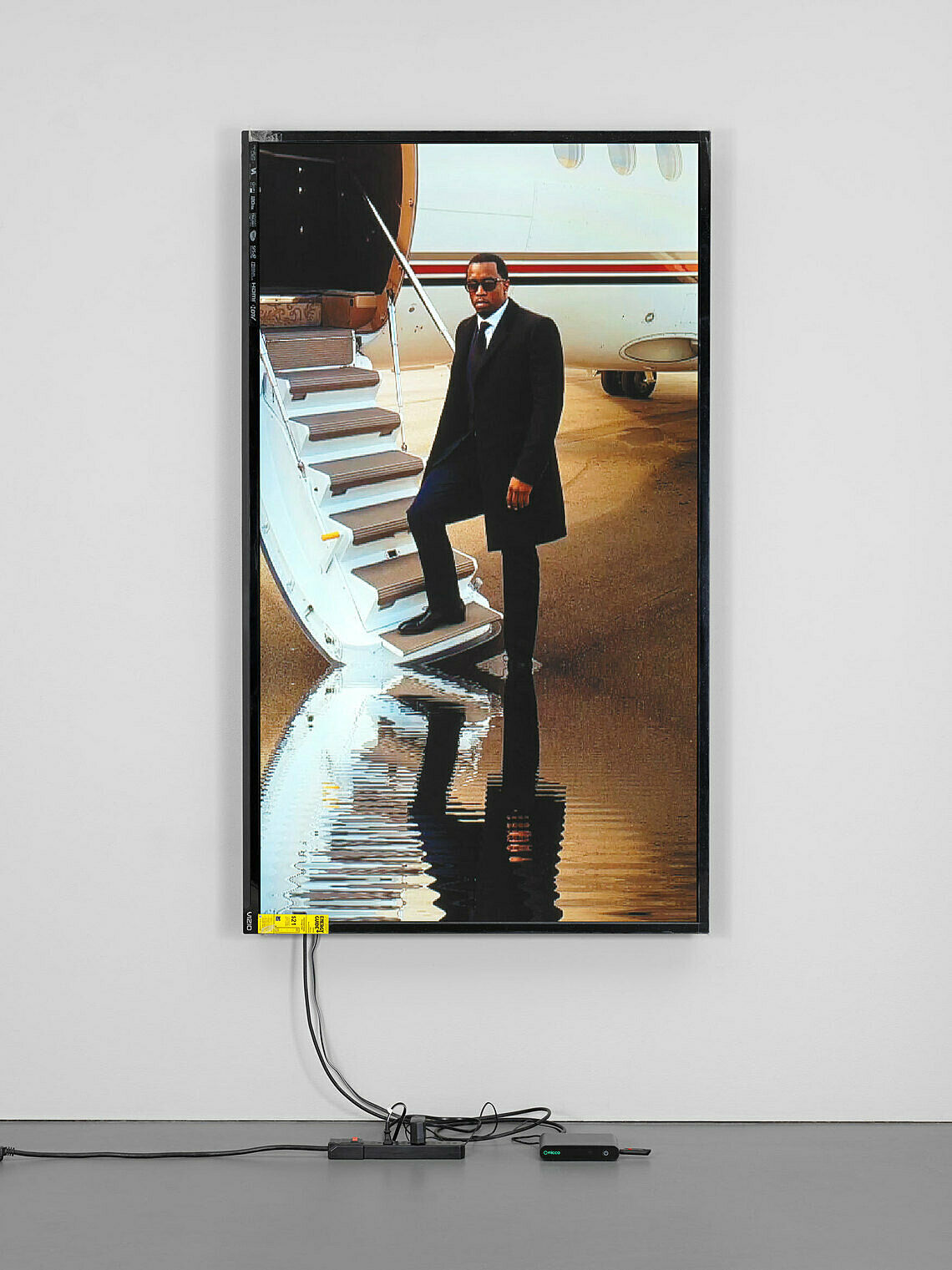
Cory Arcangel (b. 1978), Diddy / Lakes, 2013. Looped digital file, media player, seventy-inch flat-screen monitor, armature, and cables, 79 × 36 1/2 × 11 in. (200.7 × 92.7 × 27.9 cm). Whitney Museum of American Art, New York; promised gift of Hilary and Mo Koyfman P.2015.7 © Cory Arcangel

DIDDY / LAKES, 2013

Although this work was made in 2013, Cory Arcangel used a digital-animation tool from the 1990s (Java’s “lake” effect) to alter an image of recording artist Sean Combs–also known as Puff Daddy and Diddy–standing in front of a private jet. The first of a series of videos in which Arcangel applied this self-consciously “arty” look to photographs that might have been found on the web (others feature Hillary Clinton and Beyoncé and Jay Z), the work slyly registers the past. As in much of his art, here Arcangel manipulates outdated technology, connecting the obsolescence of this early-Internet graphic effect to the fleeting nature of celebrity.

Peter Saul (b. 1934) de Kooning’s “Woman with Bicycle”, 1976. Acrylic on linen, 101 1/8 × 75 9/16in. (256.9 × 191.9 cm). Whitney Museum of American Art, New York; purchase with funds from the Sara Roby Foundation 84.49 © Peter Saul

DE KOONING’S “WOMAN WITH BICYCLE”, 1976

In the mid-1970s, after skewering American political, social, and cultural mores in his work, Peter Saul took aim at the art world. He executed a number of parodic responses to Willem de Kooning’s famous works, including Woman and Bicycle (1952–53, also in this section). Here Saul spoofs de Kooning’s contorted female figure with distortions of his own, rendering the face as a grotesque cartoon and crowding the composition with lurid Day-Glo forms that both draw upon and satirize Surrealist and Pop styles. At once homage and attack, this painting challenges art history even while claiming Saul’s place within it.

0:00

Edward Hopper, Morning in a City, 1944, and A Woman in the Sun, 1961

0:00

Carter Foster: These two paintings, A Woman in the Sun from 1961 and Morning in a City from 1944 were done decades apart, but they are similar in many ways. And when hung together, we see how they seem to function as pendants, or almost like a series, where one is answering the other.

Narrator: The young woman in Morning in a City gazes out of a window onto an urban landscape, in a pose that recalls classical sculpture. She seems innocent in comparison to the older figure we see in A Woman in the Sun, unflatteringly described by Hopper to his wife Jo as a “wise tramp.”

Carter Foster: It's very interesting because the curtain billowing in, in A Woman in the Sun, pushed in by the air, is almost a continuation of the curtain in the earlier painting, Morning in a City.

We hang them together here to show how carefully Hopper thought of his paintings in tandem and how drawings probably played a function as the connective tissue when he's working the same theme across decades because Hopper would not have had this painting to refer to, the earlier painting, Morning in the City, when he was painting, A Woman in the Sun. But he did have the drawings that he made for that painting. 

Edward Hopper, Morning in a City, 1944, and A Woman in the Sun, 1961

In Hopper Drawing

A WOMAN IN THE SUN, 1961

Edward Hopper’s wife, Josephine Nivison Hopper, served as the model for the figure in A Woman in the Sun, as she did for many of the women depicted in his compositions. She was seventy-eight at the time this work was created; rather than faithfully adhering to realistic detail, Hopper transformed her appearance according to his own internal vision. Standing in the raking light that floods the room, her naked body meets the sun’s rays, yet her expression is enigmatic. The voyeuristic, almost cinematic scene invites the viewer to imagine a narrative—perhaps what happened the night before, and what the woman is thinking or feeling.

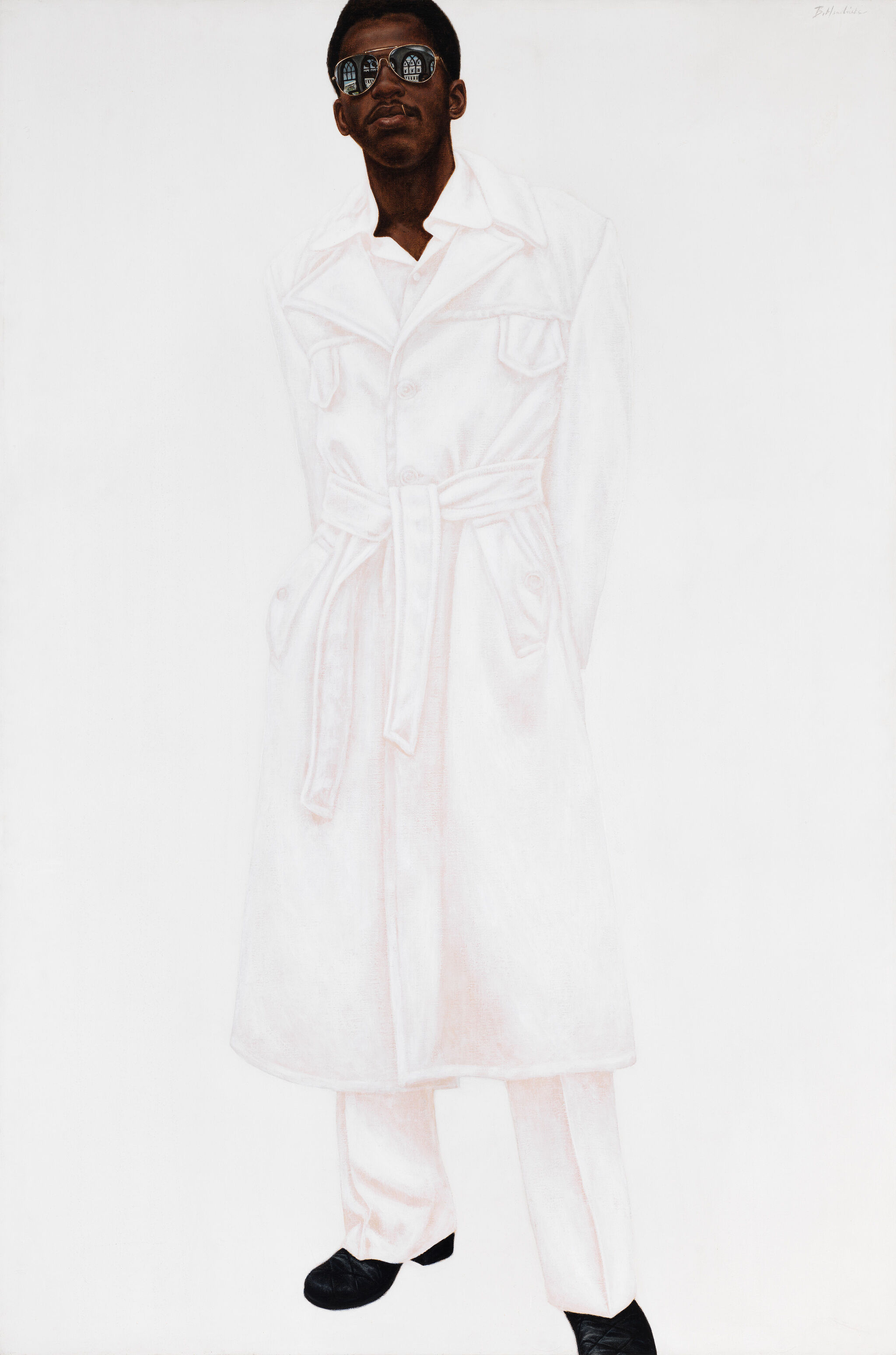
Barkley Hendricks, Steve, 1976. Acrylic and oil on linen, 72 x 48 in. (182.9 x 121.9 cm). Purchase and gift with funds from the Arthur M. Bullowa Bequest by exchange, the Jack E. Chachkes Endowed Purchase Fund, and the Wilfred P. and Rose J. Cohen Purchase Fund 2015.101

STEVE, 1976

Barkley L. Hendricks began making full-size portraits of his friends and neighbors in the late 1960s. Stevedepicts a young man he met on the street. Sharply dressed and striking a pose at once commanding and detached, the figure emerges from a flat white ground. Steve is the first of several portraits in which Hendricks used what he has described as a “limited palette” to purposefully contrast with the complexity of an individual sitter’s personality. Within the reflection of Steve’s sunglasses the viewer can discern the stained glass windows of Hendricks’s studio and the artist’s face, making this work a double portrait.

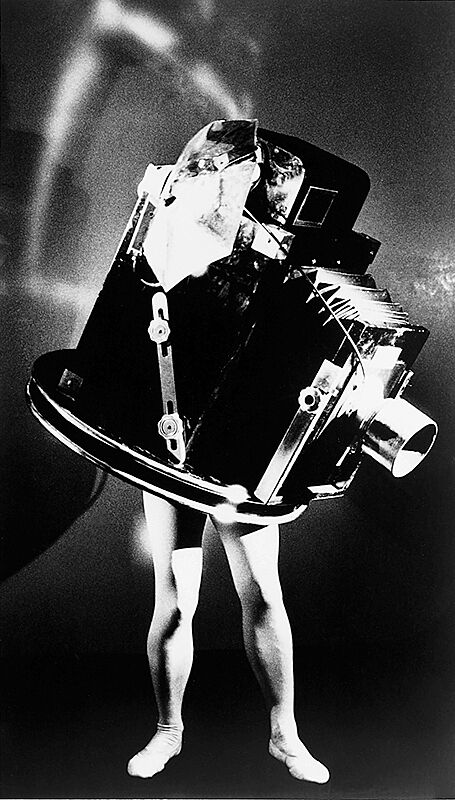
Old camera sitting on top of two legs.

Laurie Simmons (b. 1949), Walking Camera II (Jimmy the Camera), 1987. Gelatin silver print, Overall: 82 13/16 × 47 1/2in. (210.3 × 120.7cm). Whitney Museum of American Art, New York; purchase, with funds from the Photography Committee 94.107 © Laurie Simmons

WALKING CAMERA II (JIMMY THE CAMERA), 1987

This work had two inspirations: Laurie Simmons’s memory of 1950s-era commercials involving dancing cigarette boxes, and a giant camera costume featured in the 1978 movie The Wiz. Simmons borrowed the prop and photographed her mentor, the artist Jimmy DeSana, wearing it. One of her Walking Objects—staged tableaux of ordinary items on legs—the image conflates the animate and the inanimate, reality and artifice: the camera is anthropomorphized as a ballet dancer, and man becomes machine. Like much of Simmons’s art, this photograph explores through distortions of scale the misrepresentations of mass media. Equally important, it is a whimsical and humorous tribute to a photographer and friend.

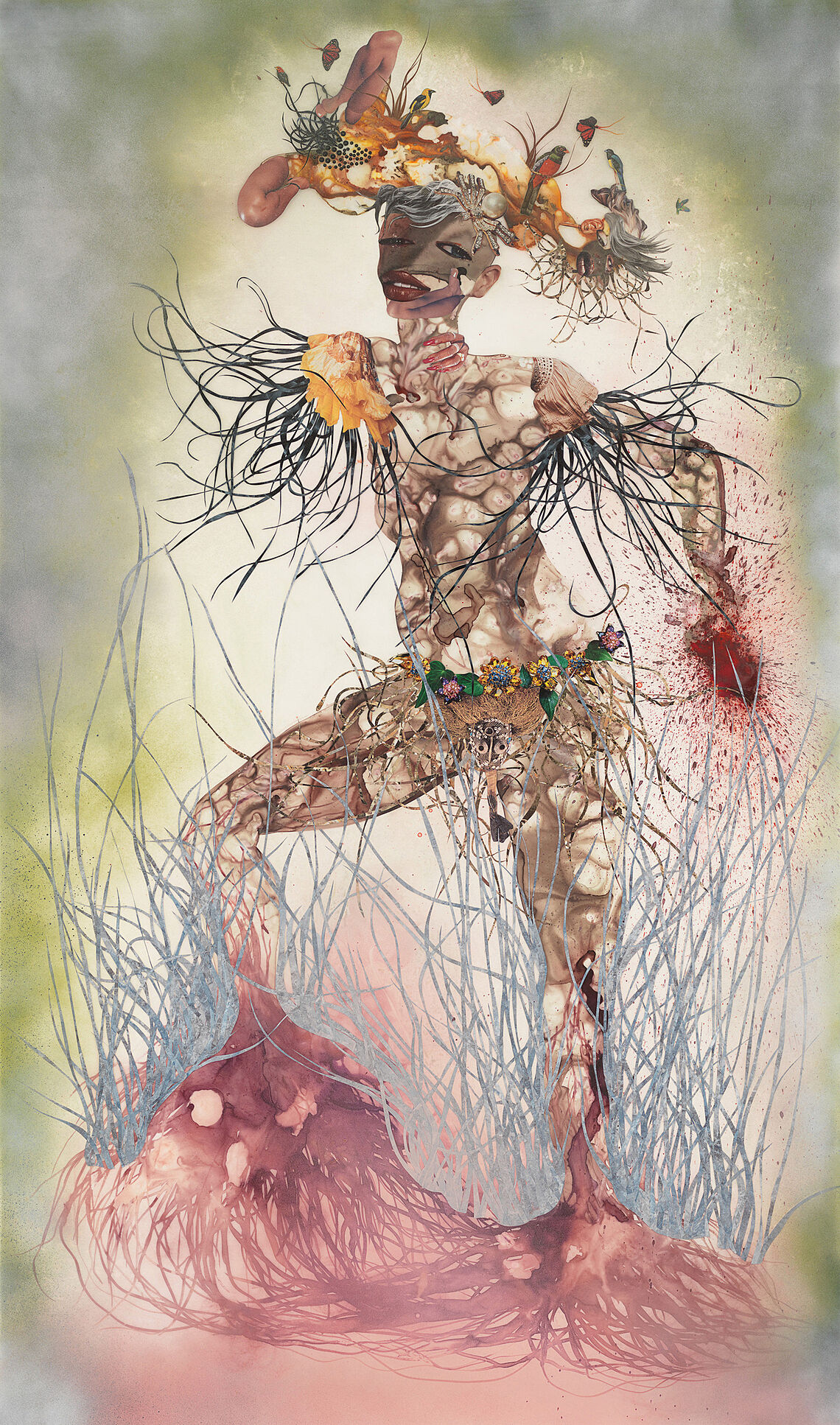
Wangechi Mutu (b. 1972), Me Carry My Head on My Home on My Head, 2005. Acrylic, brush and ink, collage, and sequins on plastic, 87 9/16 × 52 in. (222.4 × 132.1 cm). Whitney Museum of American Art, New York; gift of Nancy and Stanley Singer 2006.32

ME CARRY MY HEAD ON MY HOME ON MY HEAD, 2005

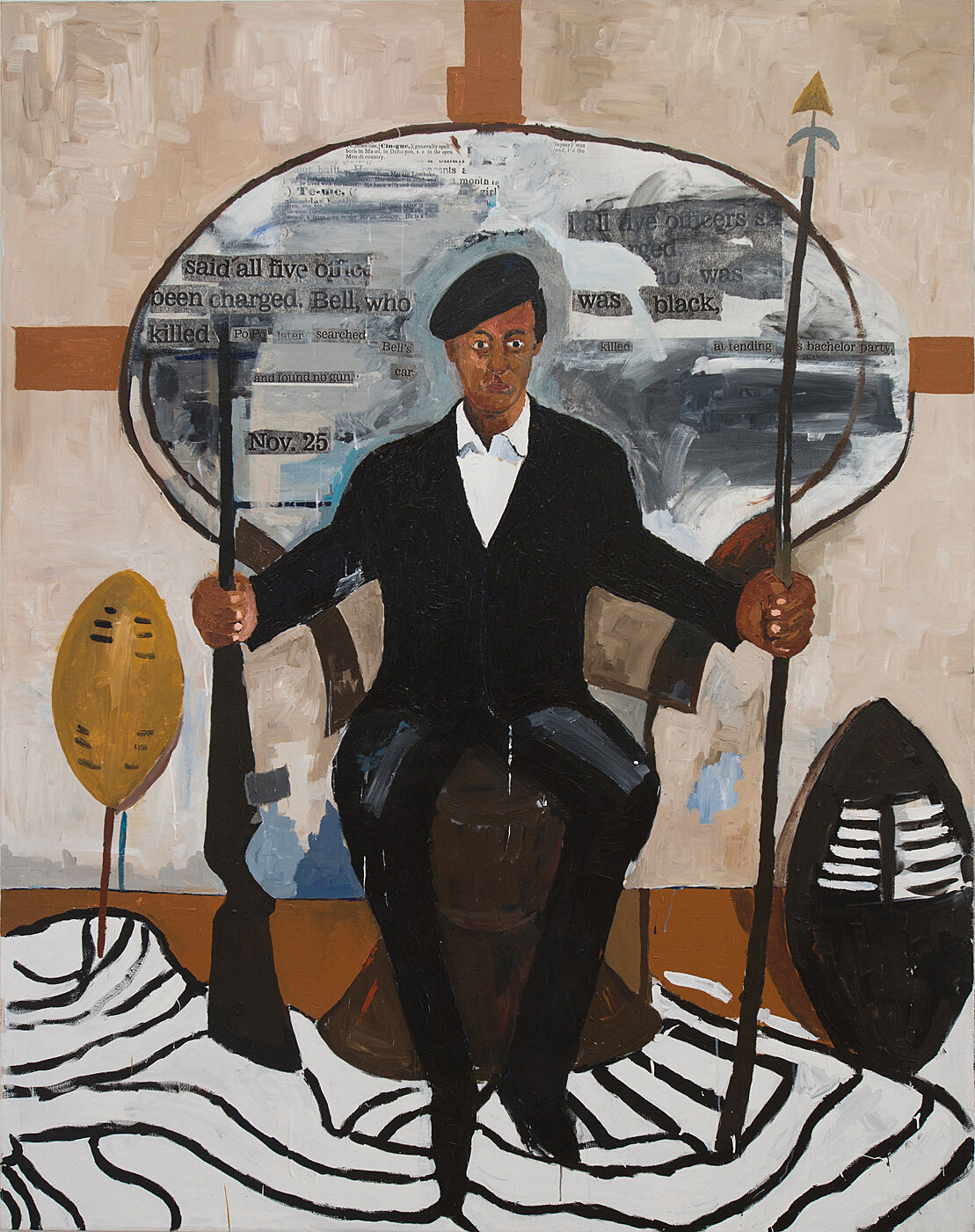
A Black man wearing a black beret, suit jacket, and slacks sits in a peacock chair. The back of his chair is various shades of grey and features glimpses of newspaper clippings throughout. He holds a spear in his left hand and a rifle in the other. The floor is rust colored with an irregularly shaped zebra print rug. The wall behind him is off-white with rust colored intersecting lines.

Henry Taylor (b. 1958), Huey Newton, 2007. Acrylic and collaged photocopies on canvas, 94 9/16 × 76 1/4 in. (240.2 × 193.7 cm). Whitney Museum of American Art, New York; gift of Martin and Rebecca Eisenberg in honor of Adam D. Weinberg 2016.86. © Henry Taylor

HUEY NEWTON, 2007

Henry Taylor’s subjects range from family and friends to preeminent African American figures. The artist based this painting on historical material, a 1967 photograph of Huey P. Newton, one of the founders of the Black Panther Party for Self-Defense. The source image first appeared in the Party’s newspaper, which disseminated the group’s call for a more militant response in the face of discrimination against black Americans than the nonviolent civil rights movement advocated.

Taylor’s composition includes collaged text fragments from news reports of the 2006 death of Sean Bell. Bell was an African American man who was shot and was fatally shot the eve of his wedding by plainclothes detectives in Queens, New York. Taylor’s reference to this incident—which sparked a public outcry that grew louder after all of the officers involved were acquitted of any crime—links the activist movement of the late 1960s with current patterns of police violence toward men of color.


Artists


Explore works from this exhibition
in the Whitney's collection

View 382 works

On the Hour

A 30-second online art project:
Frank WANG Yefeng, The Levitating Perils #2

Learn more about this project

Learn more at whitney.org/artport

On the Hour projects can contain motion and sound. To respect your accessibility settings autoplay is disabled.