Human Interest: Portraits from the Whitney’s Collection | Art & Artists

Apr 2, 2016–Apr 2, 2017


Exhibition works

15 total
Body Bared
Read more

Body Bared

Floor 6

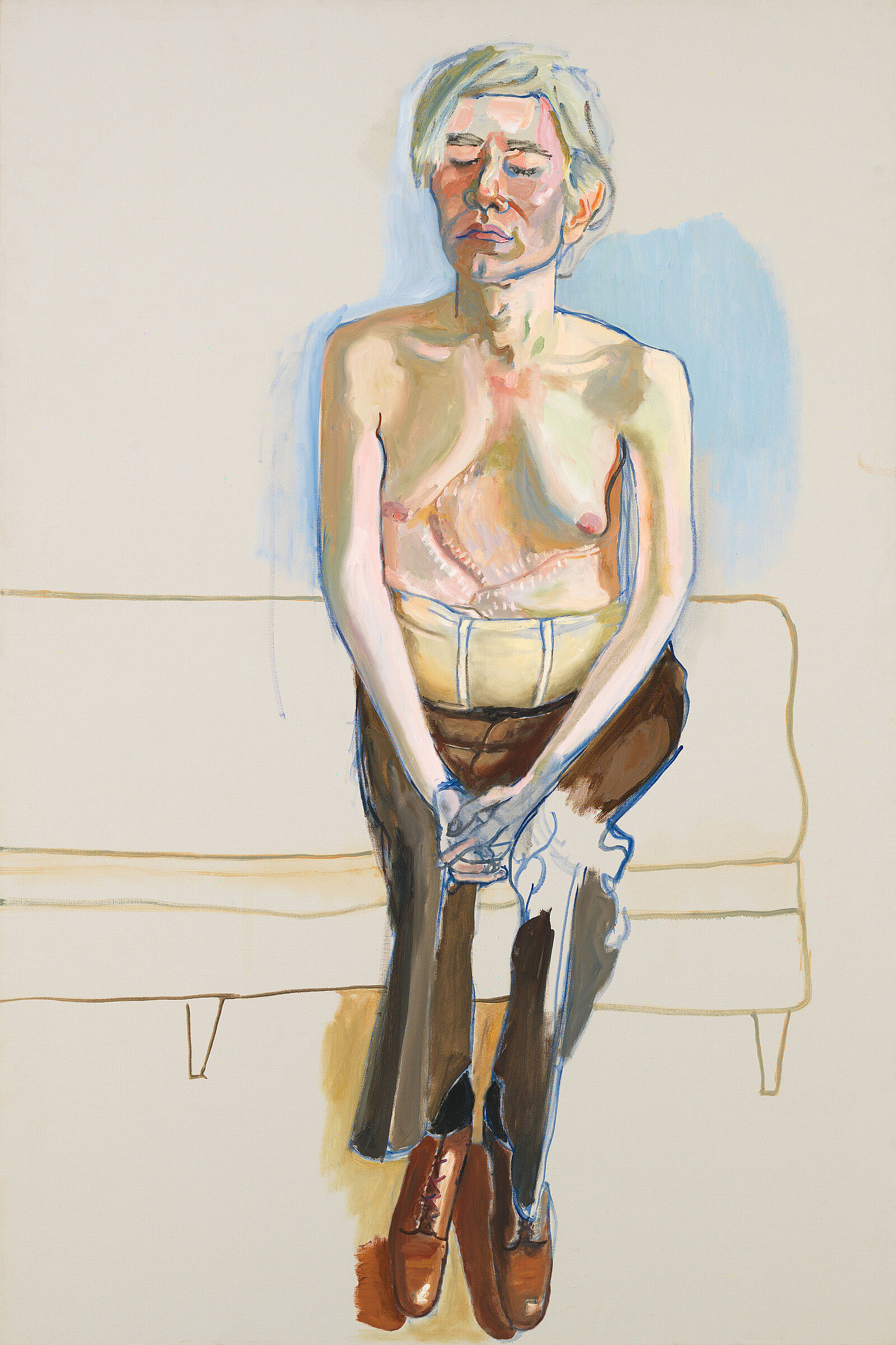
Alice Neel, Andy Warhol, 1970. Oil and acrylic on linen, 60 × 40 in. (152.4 × 101.6 cm). Whitney Museum of American Art, New York; gift of Timothy Collins 80.52 © The Estate of Alice Neel

Body Bared
Floor 6

The nude is one of the most time-honored subjects in Western art, but for centuries it was used to depict unnamed generic figures or mythological subjects rather than specific individuals. Since the turn of the twentieth century, however, artists have increasingly challenged this convention by producing frank, highly particular nudes, often with the sitters identified in the works’ titles. From Joan Semmel’s monumental self-portrait in bed with a lover to John Coplans’s unflinching document of his aging body, most of these works subvert expectations about how a nude should look, pose, and engage the viewer. Photographs by Katy Grannan, and Catherine Opie, among others, unabashedly question cultural assumptions about gender, beauty, and power, giving voice to groups and individuals who are often marginalized by both the traditions of portraiture and mainstream American culture. By transforming nudity from a classical ideal into something decidedly personal, contemporary, and idiosyncratic, these artists compel us to confront the complex and often contradictory feelings elicited by the human body: fascination and repulsion, pleasure and shame, freedom and inhibition.


Below is a selection of works from Body Bared.

0:00

Joan Semmel, Touch, 1975

0:00

Joan Semmel: I’m Joan Semmel. I’m an artist, and I live in SoHo.

Narrator: Semmel painted Touch in 1974.

Joan Semmel: It’s a representation of a male and female figure in a post or precoital situation. And I was at the time interested in showing the images from a female point of view. So I took photos of the couple—of myself and a partner—from my own point of view.

I was being confrontational, and I wanted the painting to confront the audience with an image that was different than the way they normally saw this subject. Our softcore porn pictures are essentially the same of images that are in the history of art, where the women are usually placed as a kind of seductive lure to the male eye as much as possible. Which, I don’t have any problem with, except that it doesn’t turn me on [laughs]. And I was interested in finding an erotic language that would be interesting for women. So for me the whole idea of the touch is very important, and one feels the flesh as the most important part of what’s happening.

Narrator: Semmel was part of an early generation of feminist artists, who wanted their art to have a personal and political impact on their contemporaries. To hear more from Semmel, please tap your screen.

Joan Semmel, Touch, 1975

In Human Interest

TOUCH, 1975

In the early 1970s, Joan Semmel began painting nude figures engaged in explicit sex acts, and soon she was incorporating her own body into her compositions. In Touch, Semmel depicts erotically charged imagery from her perspective as a participant. By painting herself next to her male lover, Semmel subverts the long accepted artistic tradition of presenting women’s passive bodies solely for the spectator’s enjoyment. Instead, she offers an image of intimacy and sexuality on her terms. Some feminist artists objected to her work; they argued that representations of overt sexual content objectify women, even when the images are made by women. In defiance of this criticism, Semmel joined an initiative called the Fight Censorship (FC) group. Founded by artist Anita Steckel in 1973, the collective described itself as “women artists who have done, will do, or do some form of sexually explicit art.”

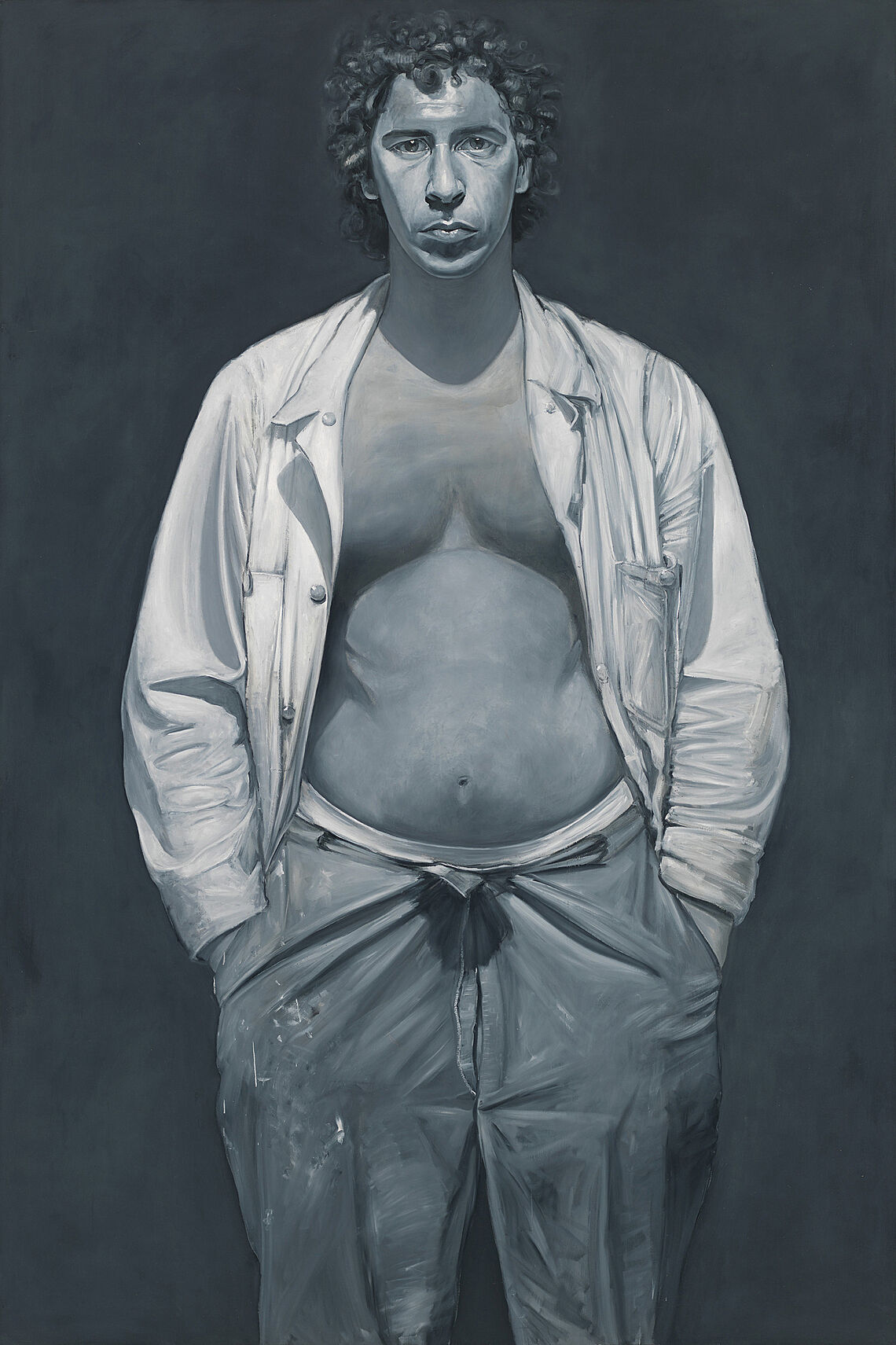
Alfred Leslie (b. 1927), Alfred Leslie/1966–67, 1966–67. Oil on canvas, 108 1/8 × 72 1/8 in. (274.6 × 183.2 cm). Whitney Museum of American Art, New York; purchase with funds from Friends of the Whitney Museum of American Art 67.30 © Alfred Leslie

ALFRED LESLIE/1966-67, 1966

0:00

Mary Kelly, Antepartum, 1973

0:00

Narrator: Antepartum is one of a group of works the artist Mary Kelly made that documents the experience of pregnancy and motherhood.

Mary Kelly: I was concerned with something that a lot of artists were at that time, which is the body as a site. I wanted this to be an extreme close-up, so it’s just the shot of the abdomen at a full term pregnancy, and you can see the movements, of the unborn child very subtly. And I just run my hand slowly over the surface, and there’s a kind of, I suppose, pre-linguistic, form of interaction between the mother and the child.

Narrator: Kelly looks back to 1973, the year she made Antepartum.

Mary Kelly: At that time, strangely enough, there was no work that focused on the woman, as mother. There’s plenty of painting in the past that would take that as their subject matter. But actually, very few women had approached this. And, it was, if you remember a period of, you know, the high modernist, masculine renunciation you could say, of anything that smacked of the feminine, so it seemed you know, an absolutely crucial thing to do at that time.

Mary Kelly, Antepartum, 1973

In Human Interest

ANTEPARTUM, 1973

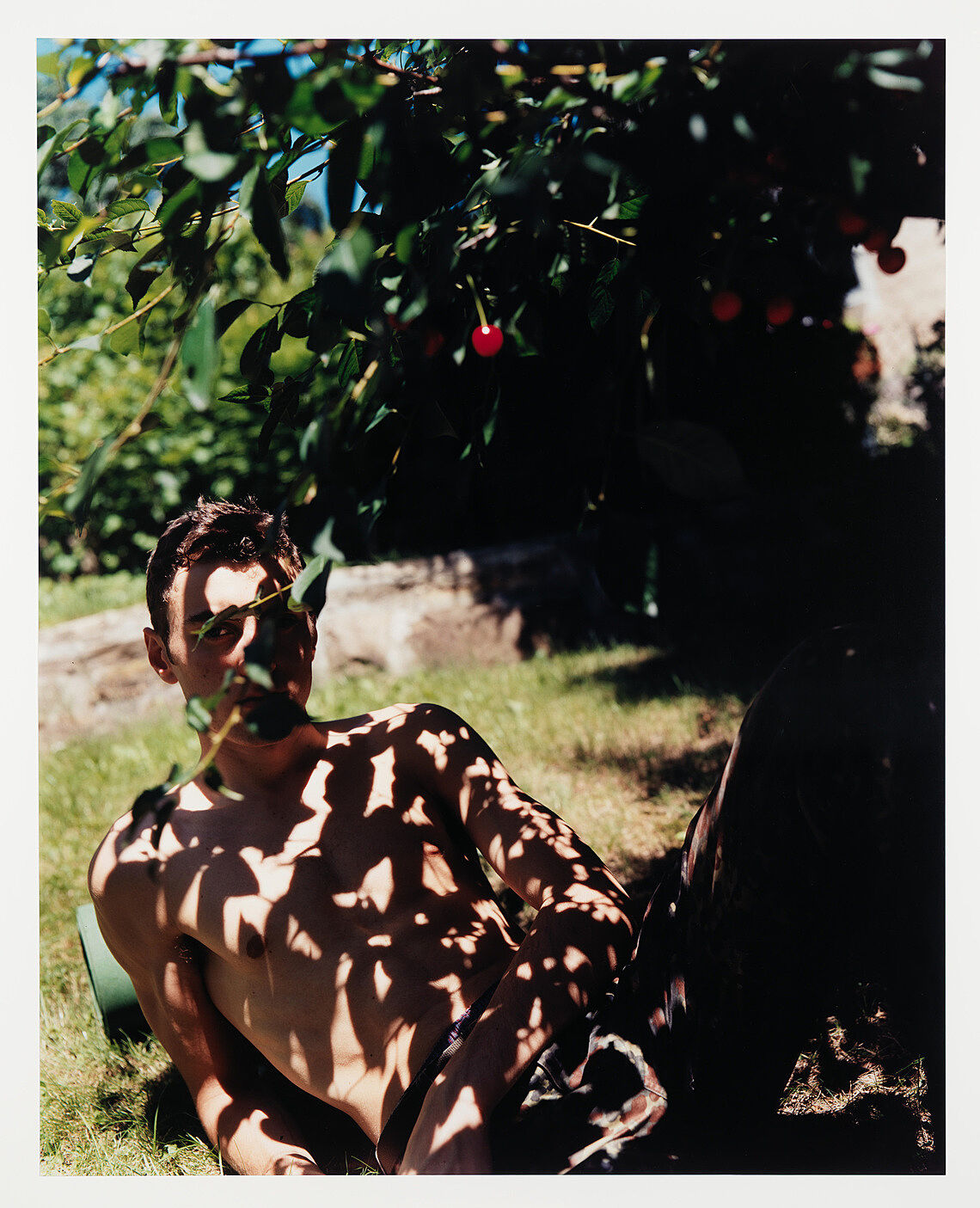
Collier Schorr (b. 1963), Herbert, Weekend Leave (A Conscript Rated T1), Kirschbaum, 2001, from the series Forests and Fields. Chromogenic print, sheet: 43 1/2 × 34 3/4 in. (110.5 × 88.3 cm); frame: 55 1/2 × 46 1/4 × 1 7/8 in. (141 × 117.5 × 4.8 cm). Whitney Museum of American Art, New York; purchase with funds from the Photography Committee 2002.105 © Collier Schorr; courtesy 303 Gallery, New York

HERBERT, WEEKEND LEAVE (A CONSCRIPT RATED T1), KIRSCHBAUM, 2001

Collier Schorr’s photographic portraits often explore facets of identity, including gender, sexuality, and nationality. Here the young subject’s apparent innocence is complemented by the pastoral German landscape and the Kirschbaum (cherry tree) that frames his adolescent body—but it is complicated by the military connotations of his camouflage pants, the pattern of which is mimicked on his face and upper body by the shadows from the leaves above. This complexity suggests Schorr’s interest in the relationship between contemporary Germany and the past atrocities of Nazism, and in the taboos that restrict the patriotic expressions of Germans today.

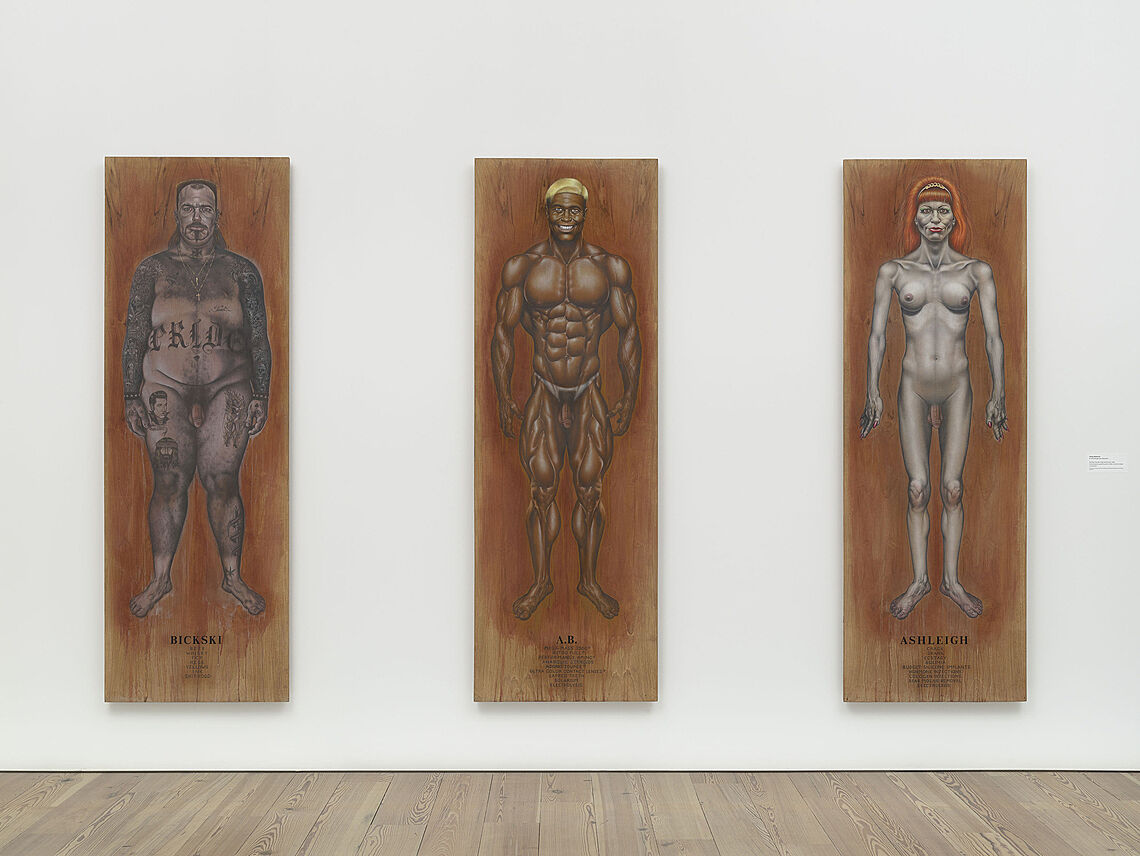
Ashley Bickerton (b. 1959), All That I Can Be: Triple Self Portrait, 1996. Colored pencil, graphite pencil, chalk, oil, and cut paper on plywood, 88 1/2 × 150 in. (224.8 × 381 cm). Whitney Museum of American Art, New York; purchase with funds from the Contemporary Painting and Sculpture Committee 96.176a-c. Courtesy the artist and Lehmann Maupin, New York and Hong Kong

ALL THAT I CAN BE: TRIPLE SELF PORTRAIT, 1996

0:00

Deana Lawson, The Garden, Gemena, DR Congo, 2015

0:00

Deana Lawson: I’m Deana Lawson. I’m a photo-based artist. This image is taken in D.R. Congo; it’s in a small town called Gemena.

We often think of countries in Africa, especially D.R. Congo as a site of crisis or a problematic place. I was interested in switching that dynamic. Instead of seeing it in terms of a place of crisis I wanted to imagine it as a paradise or Eden. Robert Farris Thompson talks about Congo being the center of the mother continent, almost like the veins coming out of Congo. The center of humanity, in general. And my idea with The Garden was that the subjects would pose as the first human beings on earth.

Narrator: Lawson modeled their poses after the images of Adam and Eve in Hieronymous Bosch’s sixteenth-century painting, The Garden of Earthly Delights.

Deana Lawson: I found the female subject, who worked at a local restaurant in Gemena, and the male subject was my taxi driver. So they’re not a real couple, but it’s completely staged to look as though they’re a couple.

The male subject has his hand on her belly. Often people ask if she’s pregnant; she’s not pregnant, but I don’t mind that being a possibility of the imagination.

I’m really looking at these two individuals and trying to imagine or put out an image in the world that represents a divine intimacy, which I think is needed right now, particularly when so many of popular culture images and media put forth a divisiveness, a lot of times, between black men and black women. So to me this is about asserting this, somewhat of a love story.

Deana Lawson, The Garden, Gemena, DR Congo, 2015

In Human Interest

THE GARDEN, GEMENA, DR CONGO, 2015

This work is one among Deana Lawson’s larger project of documenting global black cultures through portraits. She began the project over a decade ago in her Brooklyn neighborhood; more recently, it has taken her to Haiti, Jamaica, Ethiopia, and other countries. To make this photograph, the artist traveled to the Democratic Republic of the Congo, a nation rich in cultural history and natural resources, but one with a deeply troubled colonial and postcolonial past. Lawson hired locals she met in the town of Gemena to pose as though they were the first humans, modeling them after an image of Adam and Eve that appears in Hieronymus Bosch’s painting The Garden of Earthly Delights (1503–15). Lawson is purposefully working against conventional Western depictions of such biblical narratives. She explained the recuperative nature of her approach: “This image to me is reclaiming that power [of the Congo], the power of family and relationships, and of the black body.”

0:00

Catherine Opie, Ron Athey, 1994

0:00

Narrator: Catherine Opie took this photograph of the performance artist Ron Athey in 1994.

Catherine Opie: He's just a very incredibly amazing, giving, lovely person who has pushed the boundaries with his own body.

Narrator: This photograph came from a time when Opie had just started making studio portraits of her friends in the San Francisco leather community. She used brightly colored backdrops intended to recall the northern Renaissance painter Hans Holbein, who is known for the intense humanism of his portraits. Catherine Opie.

Catherine Opie: By using bright colored backgrounds, I was able to reference Hans Holbein as a painter and begin to create these very loving, political portraits at a time in which my community was decimated by AIDS, and really wanted to talk about the idea of identity politics in relationship to being an out queer person. I wanted to kind of redefine the notion of my own documentary practice, so that the site became the body.

Catherine Opie, Ron Athey, 1994

In Human Interest

RON ATHEY, 1994

Catherine Opie’s large-format photograph features her friend, Ron Athey, a queer performance artist known for pushing the physical limits of his own and fellow performers’ bodies during live events. Opie, who has participated in some of Athey’s works, made this image to celebrate what she has described as his commitment to “transforming his body for himself and art.” Opie first gained attention in the early 1990s for her portraits of transgender women and men, drag queens, and others who fall outside traditionally assigned gender roles. Her approach is documentary but also personal: “I try to present people with an extreme amount of dignity,” she has explained. Opie acknowledges that some of her subjects, particularly those who participate in such body modification as tattooing and piercing, are “always going to be stared at.” Her aim is “to make the portraits stare back.”

Katy Grannan (b. 1969), Nicole, Sunnydale Avenue (II), 2006 (printed 2007), from the series The Westerns. Pigmented inkjet print, 40 × 50 in. (101.6 × 127 cm). Whitney Museum of American Art, New York; purchase with funds from the Photography Committee 2008.20 © Katy Grannan; courtesy Fraenkel Gallery, San Francisco

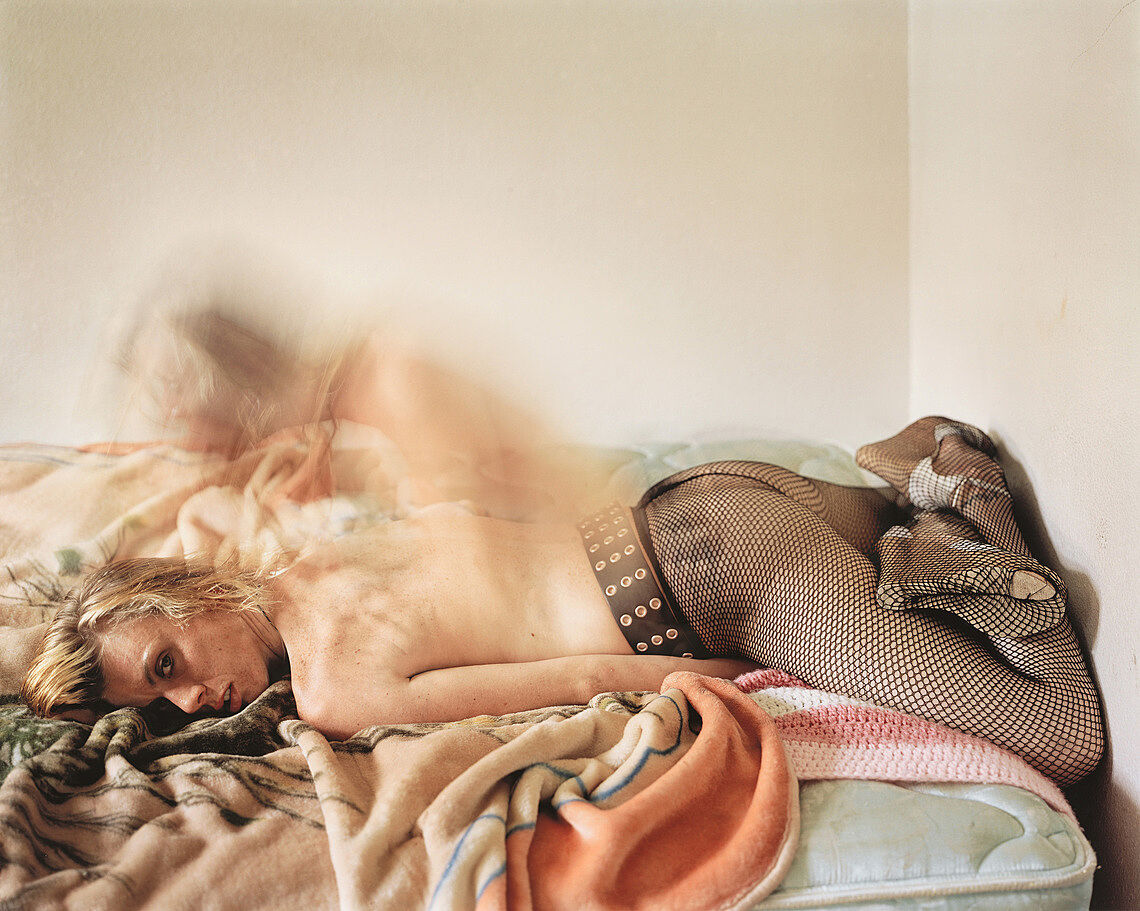
NICOLE, SUNNYDALE AVENUE (II), 2006

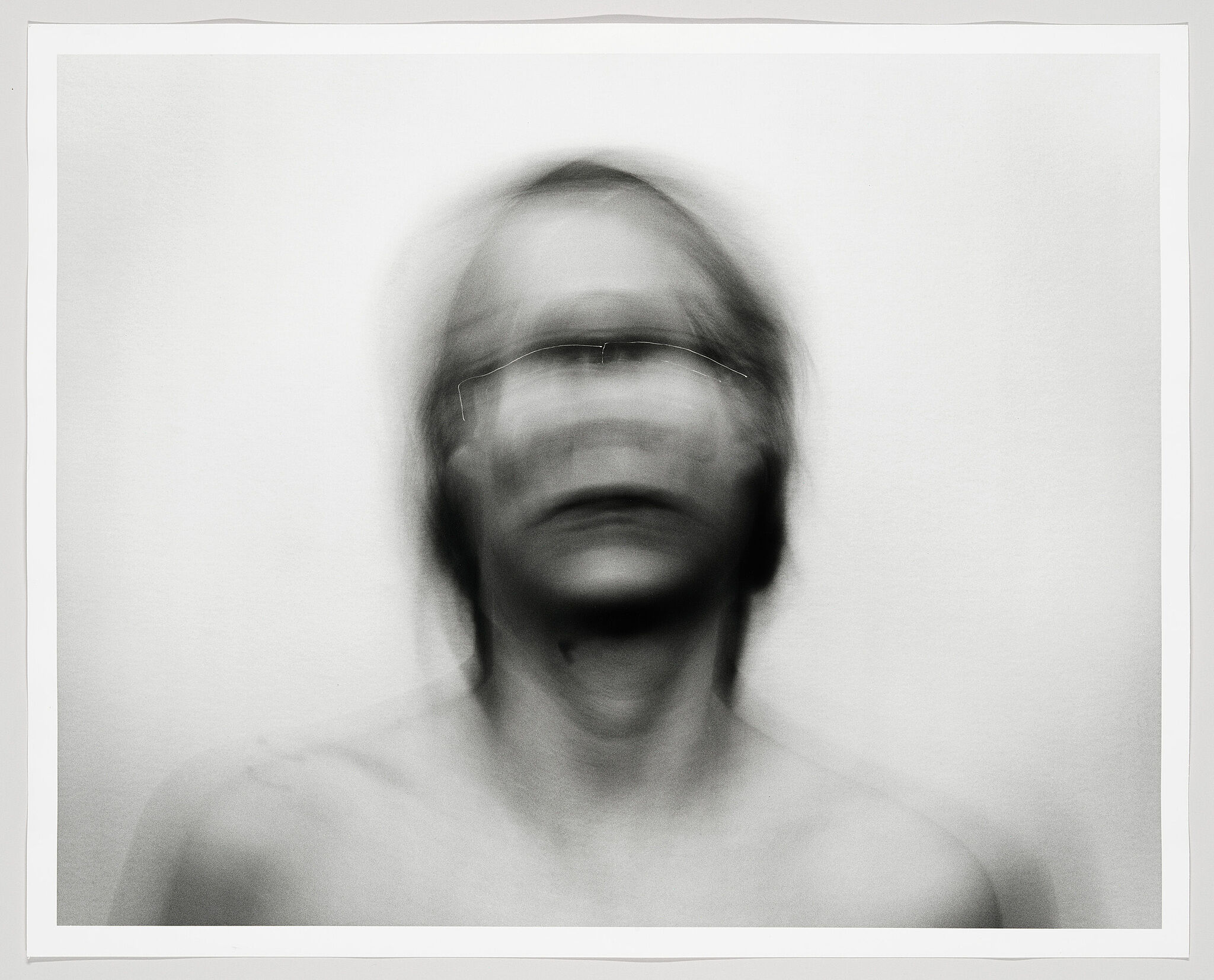
This work is part of Katy Grannan’s The Westerns, a series of photographs exploring the myth of California as a land of limitless sunshine and opportunity. After moving to San Francisco, Grannan sought out individuals who had come to the city to reinvent themselves and asked these “new pioneers,” as she called them, to model for her. Nicole, the subject of this image, modeled for Grannan for nearly three years in an array of costumes and guises. Here Nicole appears vulnerable, even wounded, the ghostly doubling of her body suggesting physical and emotional breakdown.

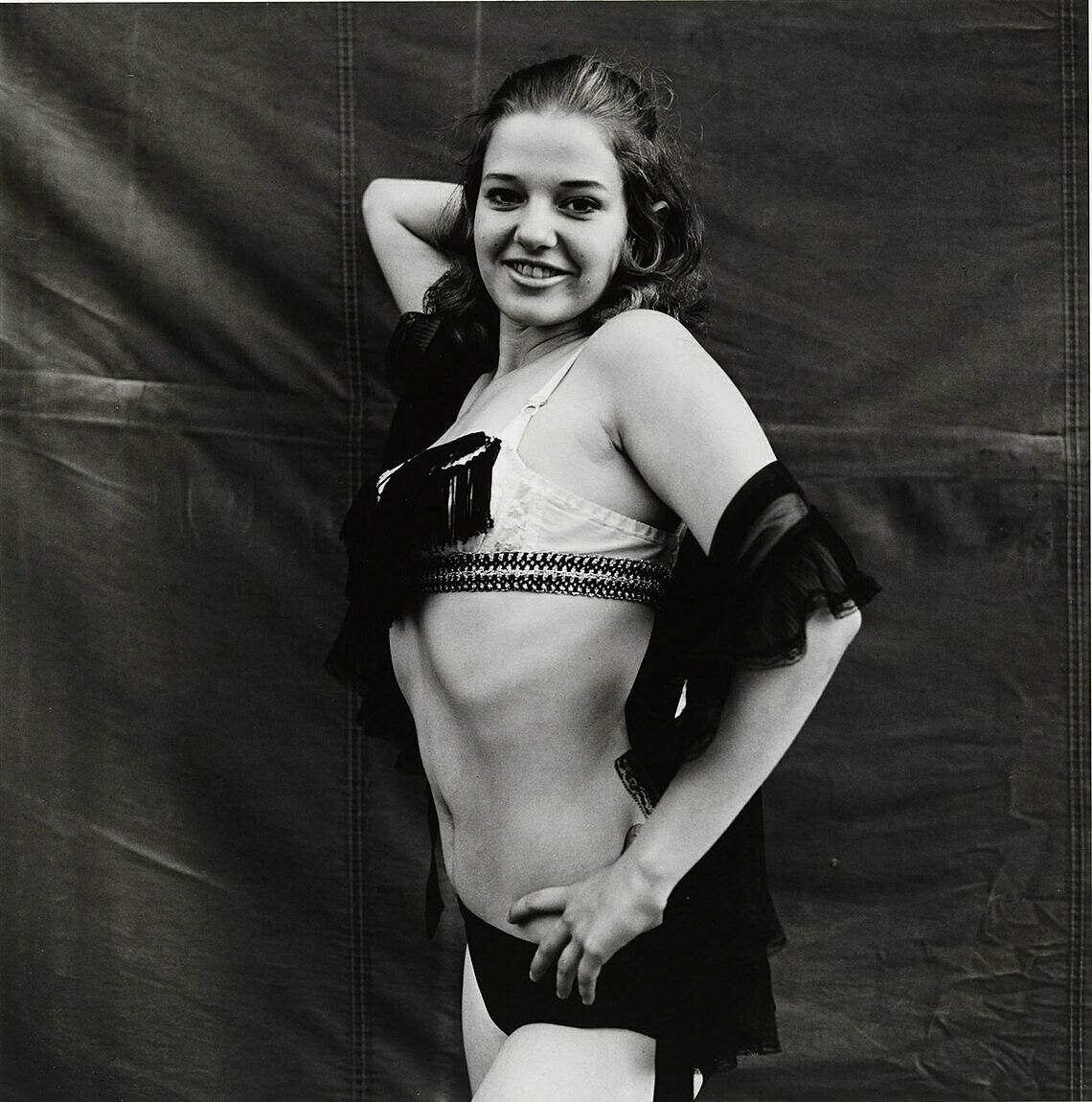
Susan Meiselas (b. 1948), Lena’s First Day, Tunbridge, Vermont, 1974, from the series Carnival Strippers. Gelatin silver print, sheet: 13 7/8 × 11 in. (35.2 × 27.9 cm) image: 7 15/16 × 7 7/8 in. (20.2 × 20 cm). Whitney Museum of American Art, New York; purchase with funds from the Photography Committee 2000.39 © Susan Meiselas, Magnum Photos

LENA’S FIRST DAY, 1974

0:00

Alvin Baltrop, Untitled, 1977

0:00

Narrator: Alvin Baltrop took this photograph in one of the warehouses on the Hudson Piers, during the 1970s. Until the mid-twentieth century, the piers had been the center of the largest port in the world. But by the time Baltrop took this picture, they had been largely abandoned. They became important sites for artists, and for gay men cruising for sex.

Jonathan Weinberg: In this photograph, probably taken in Pier 46, at the foot of Christopher Street, Baltrop focuses on a beautiful naked man stretching.
Narrator: Jonathan Weinberg is a painter, curator, and art historian.
Jonathan Weinberg: His lithe, muscular body and his pose on one foot suggest that he is a dancer, and therefore, like Baltrop, an artist, drawn to the dilapidated waterfront structures for their sublime beauty, but also the freedom they afford to spread out, to be brazenly naked, to escape the strictures of moral decorum.

Taken before the advent of the AIDS epidemic, such an image speaks for a time in the 1970s when expressing the homoerotic in such an uninhibited way was emblematic of the so-called sexual revolution, and the breaking down of political control and social repression. At the same time, Baltrop’s characteristic cityscape is in ruins, caused by profound economic displacements. The dancer’s freedom only exists in the midst of urban poverty and neglect, just a few blocks from some of the most real estate in the world.

As a queer man myself, who painted and sunbathed on the same pier at that time in my late teens, I look at Baltrop’s photograph with a great sense of nostalgia and wonder. Was there really such a time when we were so free? 

Alvin Baltrop, Untitled, 1977

In Human Interest

UNTITLED, 1977

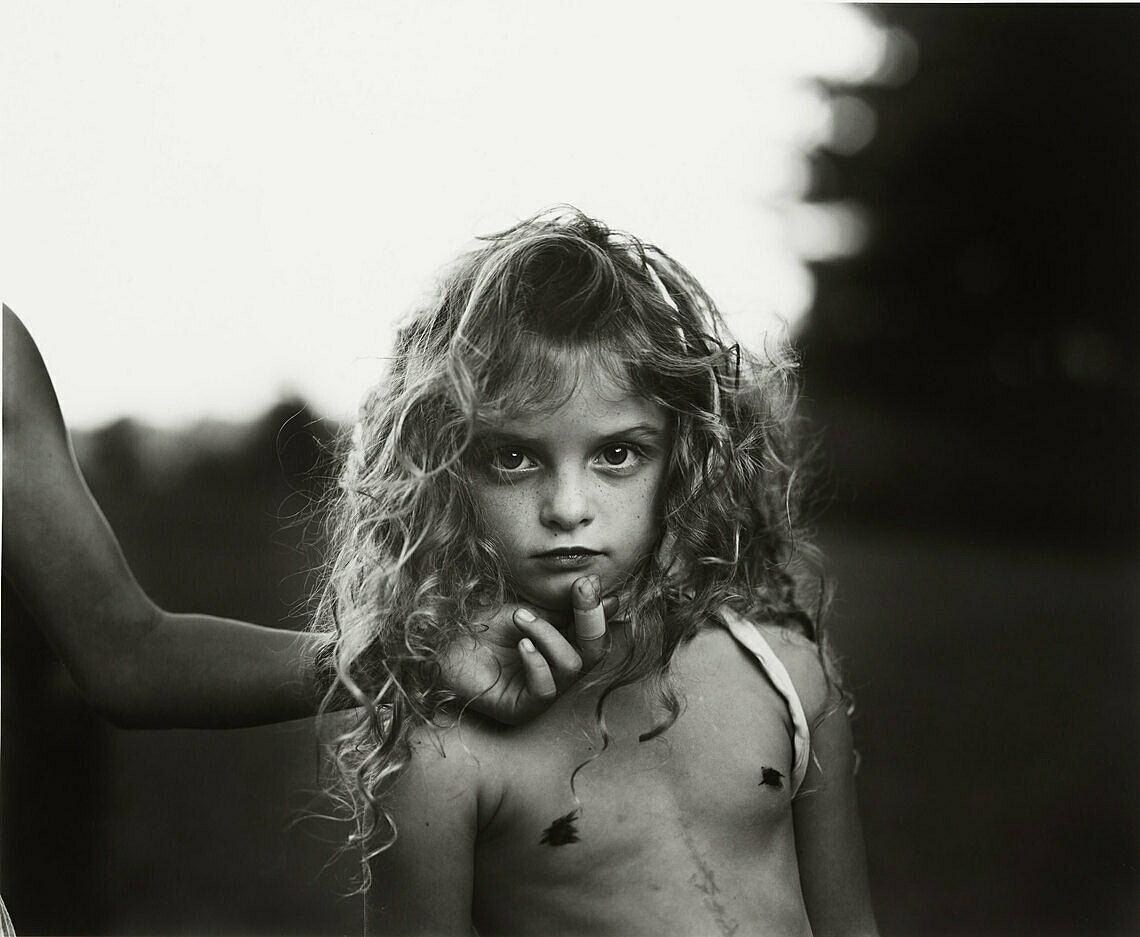
Sally Mann (b. 1951), Virginia at 5, 1990 (printed 1993). Gelatin silver print, sheet: 19 13/16 × 23 15/16 in. (50.3 × 60.8 cm). Whitney Museum of American Art, New York; purchase with funds from the Rosenstiel Foundation 93.45 © Sally Mann, Courtesy Edwynn Houk Gallery, New York

VIRGINIA AT 5, 1990

In this image, photographer Sally Mann’s daughter Virginia regards the viewer with a calm, assured gaze. Using an antique 8-by-10-inch view camera, Mann renders her subject in sharp focus while allowing the natural landscape to blur. Shot on the farm in Lexington, Virginia, where Mann spent much of her youth, this and several hundred other photographs of her three children playing, sometimes unclothed, capture the artist’s conviction “that [her] lens should remain open to the full scope of their childhood.”Virginia at 5 is one in a series called Immediate Family, published in book form in 1992. Its frank, complex presentation of Mann’s children proved controversial, though, as she wrote in a 2015 memoir, it was not her intention to provoke. “Part of the artist’s job is to make the commonplace singular, to project a different interpretation onto the conventional. With the family pictures, I may have done some of that. In particular I think they tapped into some below-the-surface cultural unease about what it is to be a child, bringing into the dialogue questions of innocence and threat and fear and sensuality.”

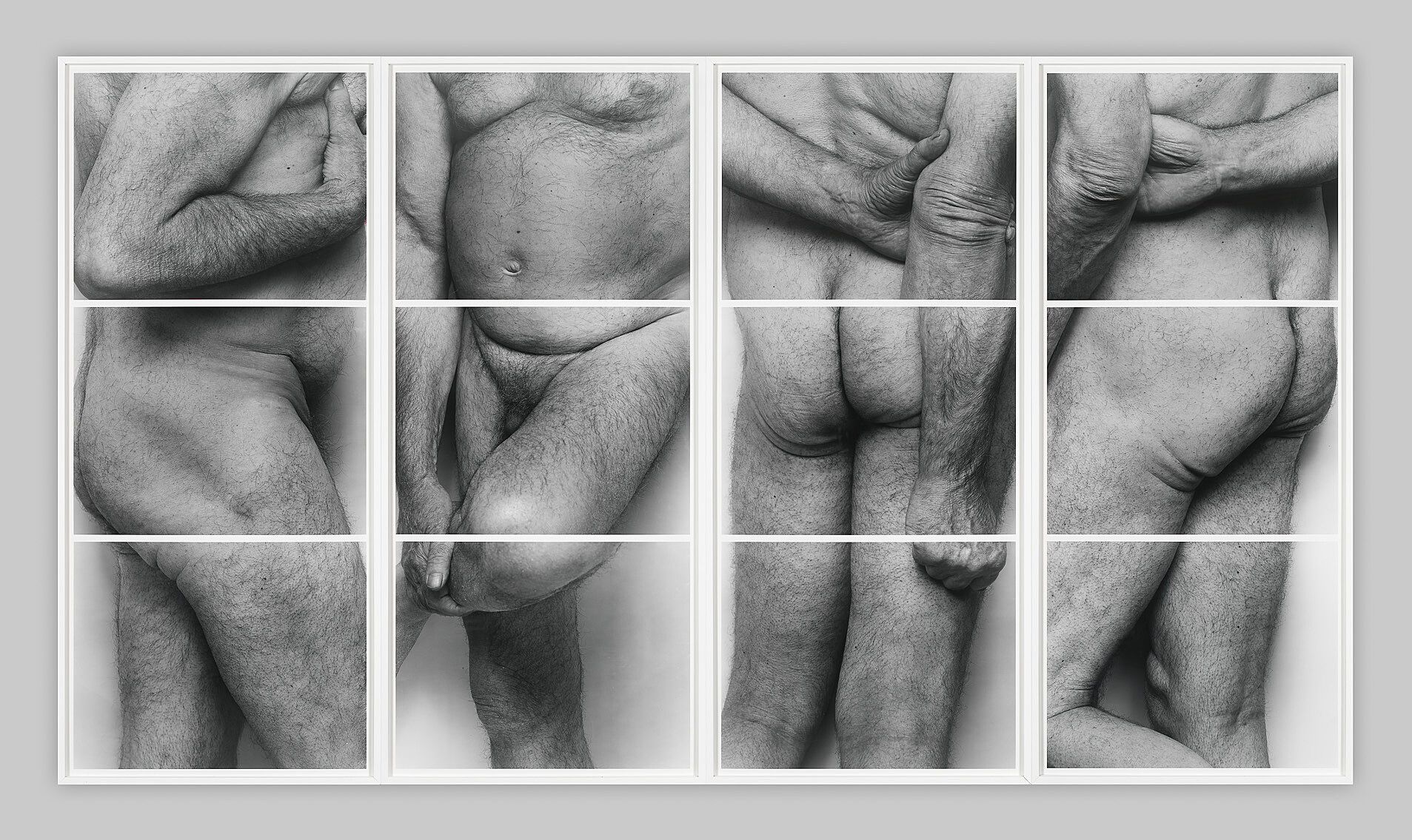
A photograph of 4 nude poses.

John Coplans, Frieze, No. 2, Four Panels, 1994. Four gelatin silver prints, 76 5/8 × 136 × 1 7/8 in. (194.6 × 345.4 × 4.8 cm). Whitney Museum of American Art, New York; purchase with funds from the Photography Committee and Steven and Ann Ames 2001.5 a–d © The John Coplans Trust

FRIEZE, NO. 2, FOUR PANELS, 1994

In Frieze, No. 2, Four Panels, John Coplans lays bare the physical markers of old age—including wrinkles and loosened skin—on a large scale. Despite the fact that aging is a shared human experience, images of its effects are far outnumbered by those that celebrate the appearance of youth. Coplans, who spent much of his professional life as an art critic, curator, and museum director, began in 1978 to take photographs in the evenings. By 1984, at age sixty-four, he had committed to being an artist and to using his own body as the exclusive subject of his work. “An old man’s body?” Coplans once explained. “There are millions of them. . . . I watch them, look at them, and I know it’s me.” Recognizing himself in others, Coplans offers his own aging physique to the viewer in defiance of cultural standards of beauty.

0:00

Alice Neel, Andy Warhol, 1970

0:00

Trevor Fairbrother: My name is Trevor Fairbrother. I’m an independent curator and writer.

Narrator: Fairbrother discusses Alice Neel’s 1970 portrait of Pop artist Andy Warhol.

Trevor Fairbrother: It’s an interesting year for both of these artists. Alice Neel was actually seventy years old when she painted it, and in a sense was just hitting her stride as an important American realist. She’d had an incredible career since the thirties, but she hadn’t really had much recognition until the wave of feminist interest in the arts in the sixties. And suddenly she was a forebear for a whole new generation of feminist artists and writers.

Narrator: The late sixties were much harder on Warhol. He’d been shot two years before Neel painted this portrait—an attempted assassination by a member of his artistic circle. In posing shirtless for Neel, he exposes the corset that he was required to wear for the rest of his life. He also bares his aging body, his chest sagging so that he almost appears to have breasts.

Trevor Fairbrother: She shows him—I think it’s this kind of essence of loneliness and vulnerability, but at the same time I think she knows that he knows that everybody is looking at him. He was very much invested in famous artists. He wanted to be a kind of brand-name Pop artist, and he certainly is that now, long after his death. He, Warhol, in a sense is rising to her challenge to sit for her, to be painted and to take his clothes off. And so in a sense he’s doing a brave thing, but he’s also―he’s getting through it by shutting his eyes and being very focused internally.

I think part of the soulfulness of this picture is the fact that it might seem unfinished. I wouldn’t say it’s unfinished. I think she decided she had what she needed, and she stopped where she was ready to stop. The picture doesn’t need more. 

Alice Neel, Andy Warhol, 1970

In Where We Are and Human Interest

ANDY WARHOL, 1970

In this painting of Andy Warhol, Alice Neel captures a vulnerability rarely glimpsed in her subject. Known for cloaking himself with throngs of followers and a variety of guises from wigs to makeup to sunglasses, Warhol once remarked, “Nudity is a threat to my existence.” Here, however, Neel depicts him with his shirt removed and his eyes closed, displaying his surgical scars and the corset he was forced to wear after being shot in 1968. In her hands, the artist famed for his cool detachment becomes human—wounded, isolated, and withdrawn.


Artists


Explore works from this exhibition
in the Whitney's collection

View 382 works

On the Hour

A 30-second online art project:
Frank WANG Yefeng, The Levitating Perils #2

Learn more about this project

Learn more at whitney.org/artport

On the Hour projects can contain motion and sound. To respect your accessibility settings autoplay is disabled.