Sixties Surreal | Art & Artists

Sept 24, 2025–Jan 19, 2026


Exhibition works

10 total
Show of Force
Read more

Show of Force


Painting of a head of man with red hair in a field of grass with grass coming out of his mouth.

T.C. Cannon, “Andrew Myrick - Let Em Eat Grass”, 1970. Acrylic on canvas, 46 × 40 in. (116.8 × 101.6 cm). United States Department of the Interior, Indian Arts and Crafts Board, Southern Plains Indian Museum, Anadarko, OK. © US Department of the Interior, Indian Arts and Crafts Board

Show of Force

In the 1960s television brought reports of political assassinations, the oppression of protests, and the escalation of the Vietnam War (1955–75) into the comfort of American living rooms. The works in this gallery illustrate the many ways in which the violence and oppression of the era were experienced, internalized, and expressed through art. Some artists drew on the visual and literary vocabulary of historic Surrealism, a movement that embraced and extolled revolutionary actions, to communicate the experience of racial or colonial oppression. Other artists manipulated the very material of mass media to excoriate the culture it portrayed—framing violence as a kind of rupture in the fabric of logic.

The jarring scene T. C. Cannon presents is based on the widely circulated, but possibly apocryphal, story of the nineteenth-century trader Andrew Myrick getting his mouth stuffed with grass after he was killed—retribution for his infamous comment: "If they are hungry, let them eat grass." Myrick reportedly said this in 1862 as crops failed and widespread starvation loomed in anticipation of the US–Dakota War, which resulted in mass death and the expulsion of the Dakota from their ancestral lands. Cannon, a Kiowa and Caddo man and Vietnam War veteran, was deeply conflicted about his experience in the army and used painting to reflect on the foundational, yet surreal, violence that war has perpetuated throughout American history.

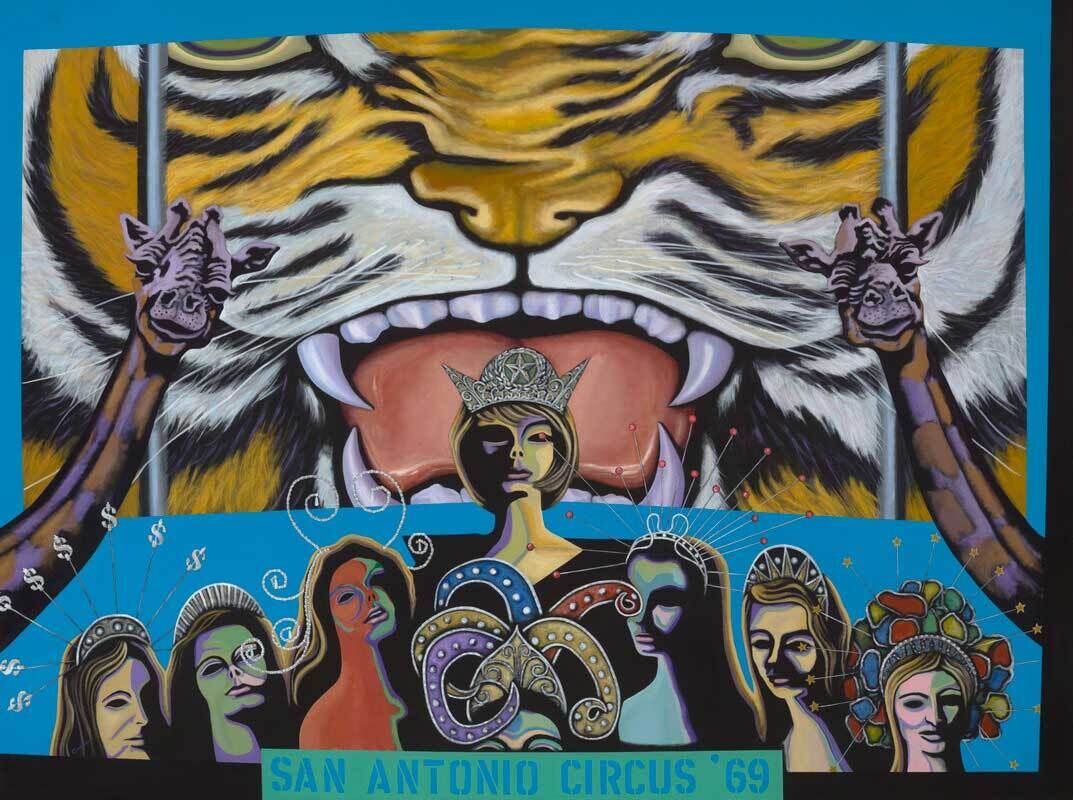
A large tiger with an open mouth is behind women in crowns and the text “San Antonio Circus ‘69.”

Mel Casas, Humanscape #56 (San Antonio Circus), 1969. Acrylic on canvas, 72 × 96 in. (182.9 × 243.8 cm). Mel Casas Family Trust. ©️ The Mel Casas Family Trust. Photograph by Ansen Seale
Mel Casas, Humanscape #56 (San Antonio Circus), 1969

Driving at night in San Antonio, Mel Casas was inspired by the distant sight of a drive-in movie theater screen. This scene led him to begin his Humanscape series, which explores different variations of this Americana iconography. Each painting includes a rectangular, screen-like image contrasted against a competing drama in the foreground, often parodying racist stereotypes of Latinx culture. Casas critiques Fiesta, San Antonio's annual festival commemorating the defeat of the Mexican army at the Battle of San Jacinto and the establishment of the Republic of Texas in 1836. Every year, the festival crowns a white Fiesta queen by the Order of the Alamo, a group that limits membership on the basis of race and class. Casas's painting asserts that the celebrated Texan revolution was actually an entrenchment of Latinx subjugation.

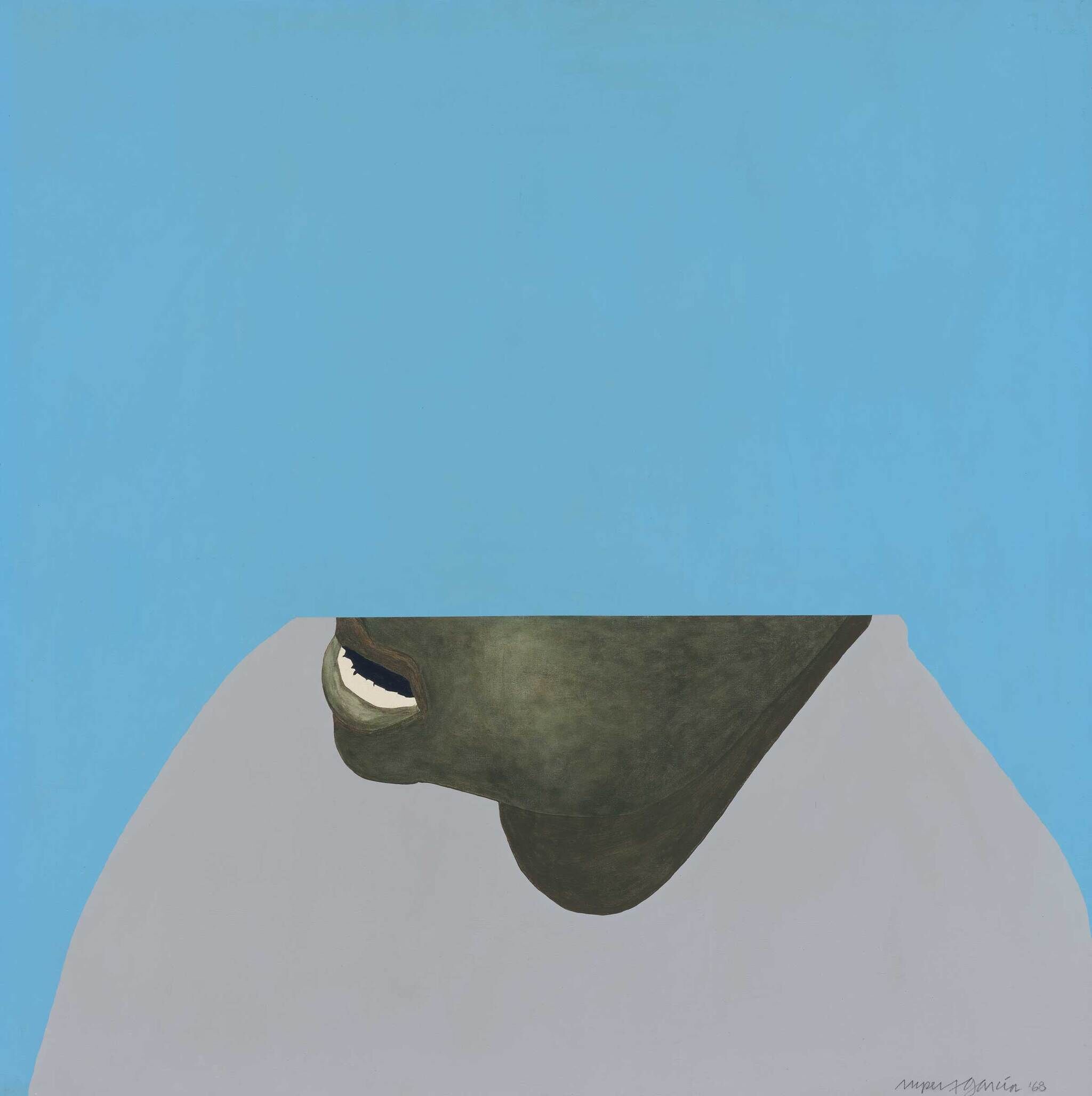
A person’s lower face and mouth are visible, with the upper head missing against a plain blue background.

Rupert Garcia, Unfinished Man, 1968. Acrylic on canvas, 48 × 48 in. (121.9 × 121.9 cm). Rena Bransten Gallery, San Francisco. © 2024 Rupert García. Photograph by John Janca

Rupert Garcia, Unfinished Man, 1968

Rupert Garcia's Unfinished Man relies on abstraction to capture the disorienting and jarring experience of a disillusioned soldier reintegrating into an American society roiling with anxiety. After serving in the Air Force during the Vietnam War, Garcia enrolled at San Francisco State College in 1966 to study art and sociology on the GI Bill. He initially focused on painting but, driven by his critical perspectives on the war and racial and economic inequality, eventually began a lifelong engagement with printmaking as a cheap and effective tool of protest after joining in the student strikes of 1968.

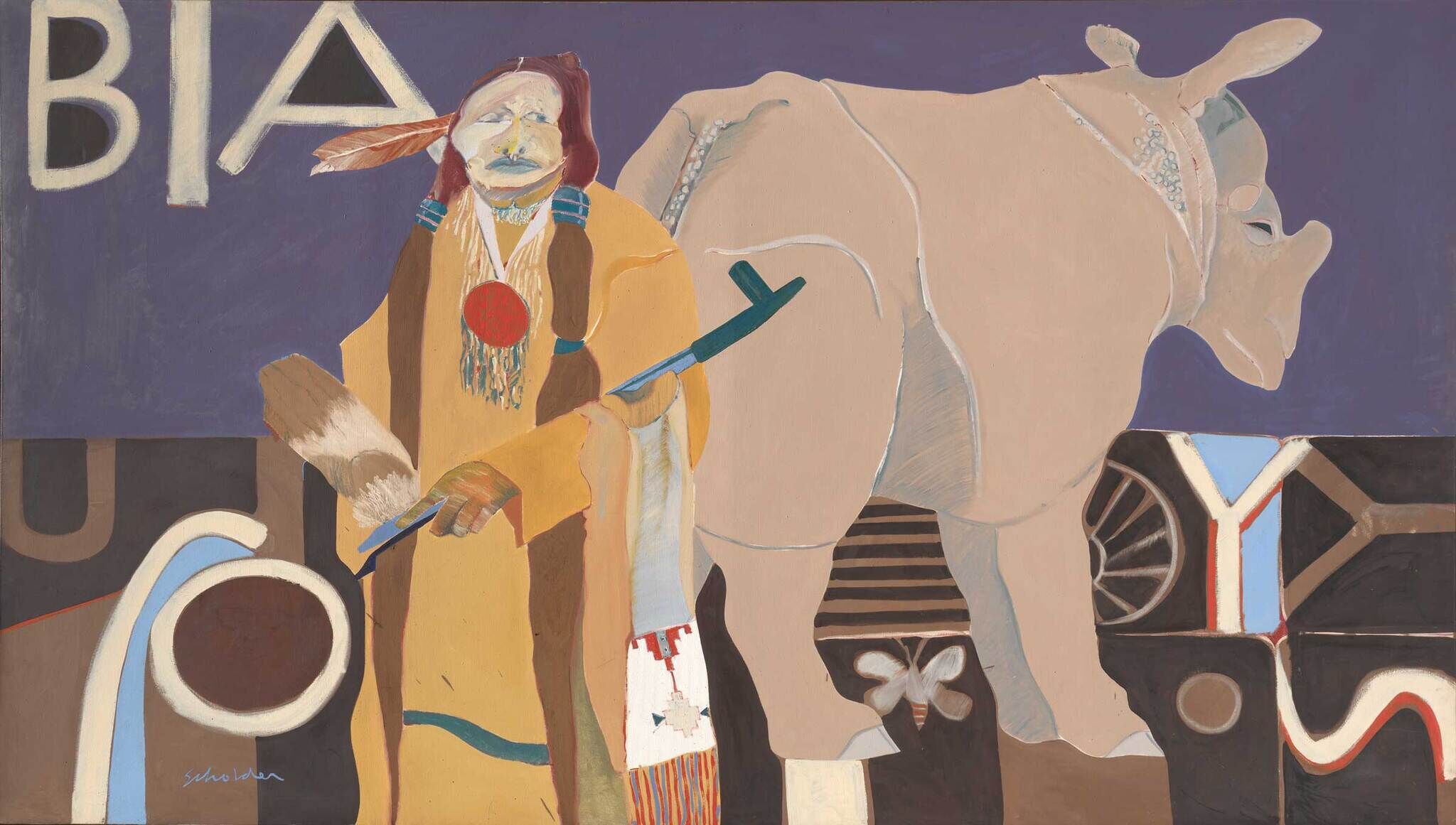
A person in traditional clothing stands beside a large rhinoceros, with the letters "BIA" in the background.

Fritz Scholder, Indian and Rhinoceros, 1968. Oil on canvas, 68 × 120 in. (172.7 × 304.8 cm). National Museum of the American Indian, New York; Smithsonian Institution; purchase 26/8066

Fritz Scholder, Indian and Rhinoceros, 1968

"My painting called Indian and Rhinoceros has an Indian in full dress with a peace pipe posing with an ungainly rhinoceros in front of the Bureau of Indian Affairs [BIA]. My point, I believe, is obvious." An enrolled member of the Luiseño tribe, Fritz Scholder's statement underscores the cruel absurdity of the US government's relationship with Native Americans. The BIA, an agency within the Department of the Interior, was responsible for enforcing decades of federal policies designed to terminate tribal authority and relocate and assimilate Indigenous people. Galvanized by the escalation of the Vietnam War, in which Native American men disproportionately served, and the 1968 founding of the American Indian Movement (AIM), an activist group focused on Native American civil rights, Scholder felt compelled to address the violence of American history and the mistreatment of Indigenous people for the first time in his work.

Ralph Arnold, Unfinished Collage, 1968

Unfinished Collage offers a totemic monument to the fallen leaders of the 1960s. Ralph Arnold layered images of John F. Kennedy, Robert F. Kennedy, and Martin Luther King Jr. in life and in death, with each figure occupying one of the rectangles that wrap around the sculpture. A fourth rectangle is painted white, creating dissonance in the work—an interruption that suggests the unfinished nature of history itself as well as the viewer's role in imagining such a future. As a Black, gay Korean War veteran in segregated Chicago, Arnold engaged actively with the nascent gay liberation movement, civil rights actions, and protests against the Vietnam War.

Nancy Spero, Female Bomb, 1966

Nancy Spero's War Series consists of antiwar manifestos or, as she called them, "a personal attempt at exorcism." The paintings feature American military weaponry, from helicopters to detonated bombs, reworked to resemble parasitic insects, reptiles, or male genitalia. Years before she created Female Bomb, Spero was living in Paris and witnessed the French police's violent response to protests against the Algerian War (1954–62). That experience, alongside the escalation of US involvement in the Vietnam War, led Spero to produce "angry works, often scatological, manifestos against a senseless, obscene war" and influenced her approach to antiwar activism.


Artists

On the Hour

A 30-second online art project:
Frank WANG Yefeng, The Levitating Perils #2

Learn more about this project

Learn more at whitney.org/artport

On the Hour projects can contain motion and sound. To respect your accessibility settings autoplay is disabled.