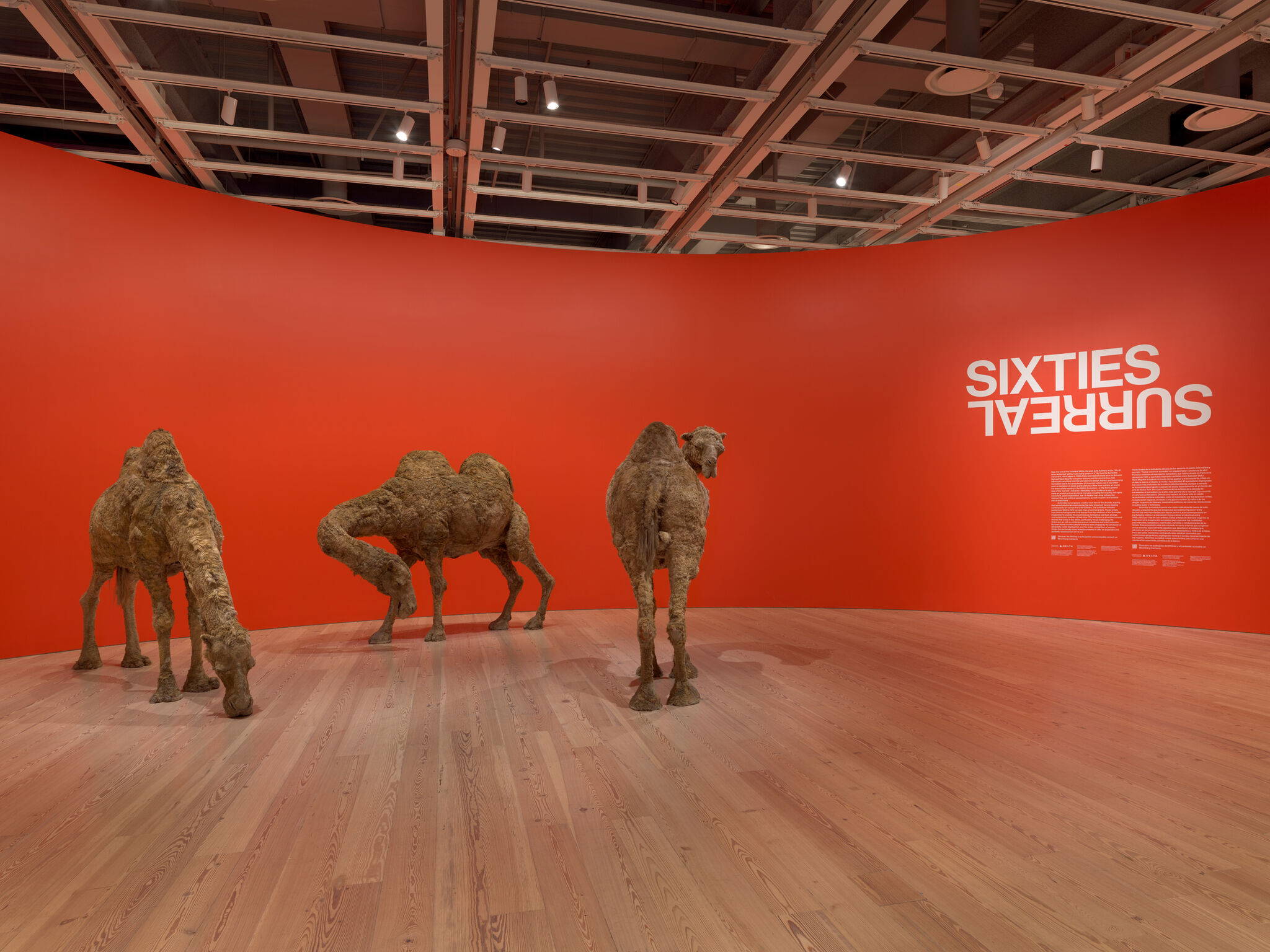
Sixties Surreal | Art & Artists

Sept 24, 2025–Jan 19, 2026


Exhibition works

10 total
Social Surreal
Read more

Social Surreal


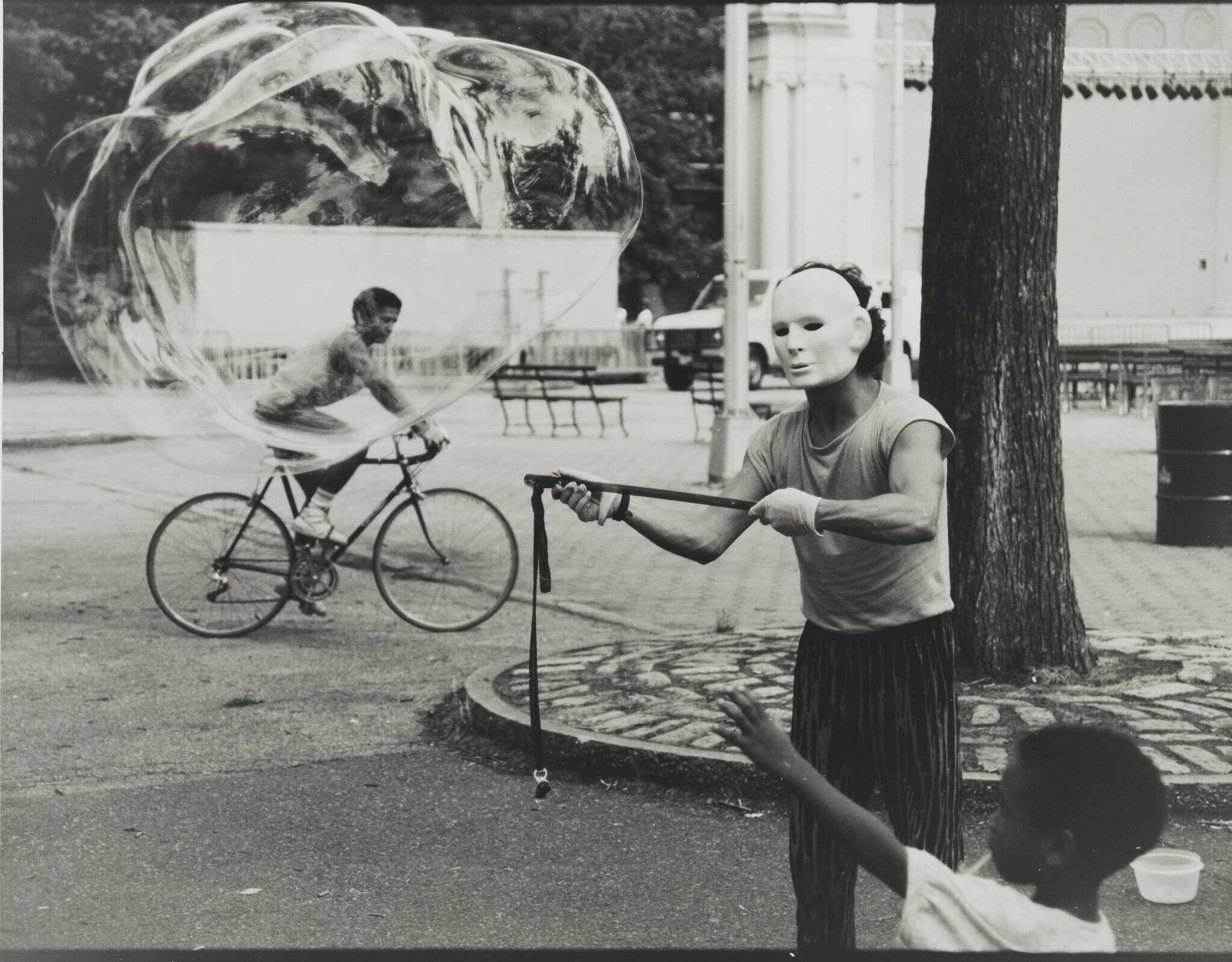
Person wearing a white mask creates a giant bubble while a child reaches out and a cyclist passes by.

Shawn Walker, Man with Bubble, Central Park (near Bandshell), c. 1960-79, printed 1989. Gelatin silver print, 8 x 10 in. (20.3 x 25.4 cm). Whitney Museum of American Art, New York; purchase with funds from the Photography Committee 2020.62. © Shawn Walker

Social Surreal

Many artists in the 1960s presented everyday American life as being off kilter, uncanny, or unexpected—in other words, surreal. This was particularly true of photographers, who increasingly found that if they looked at the world from a certain angle the disorientation of modern life became evident. The artist and filmmaker Stan Vanderbeek even suggested “the Social Surreal” as the title for a 1967 Museum of Modern Art exhibition, ultimately called New Documents, of young photographers who took this new documentary approach.

Images and videos capturing the strangeness of postwar American life became even more ubiquitous as television sets transmitted this novel visual language directly into American homes. Artists such as Lee Friedlander, Paul Thek, and Luis Jimenez were unnerved by television’s presence—the oddity of bringing this technology into a domestic space, an object that might confront you with images of Count Dracula one moment and the Vietnam War the next.

Shawn Walker's documentary-style photographs encapsulate a sense of latent strangeness in otherwise ordinary circumstances. As a founding member of the activist filmmaking collective Newsreel (founded 1967), Walker spent the 1960s focused on the cultural, social, and political change happening in the world and, importantly, right around him in Harlem. Along with the work of Ming Smith and Adger Cowans, his photographs also foreground the artists of the Kamoinge Workshop (founded 1963)—a collective of Black artists who primarily photographed Black communities—during a period in which their work was largely excluded from institutional exhibitions and conversations.

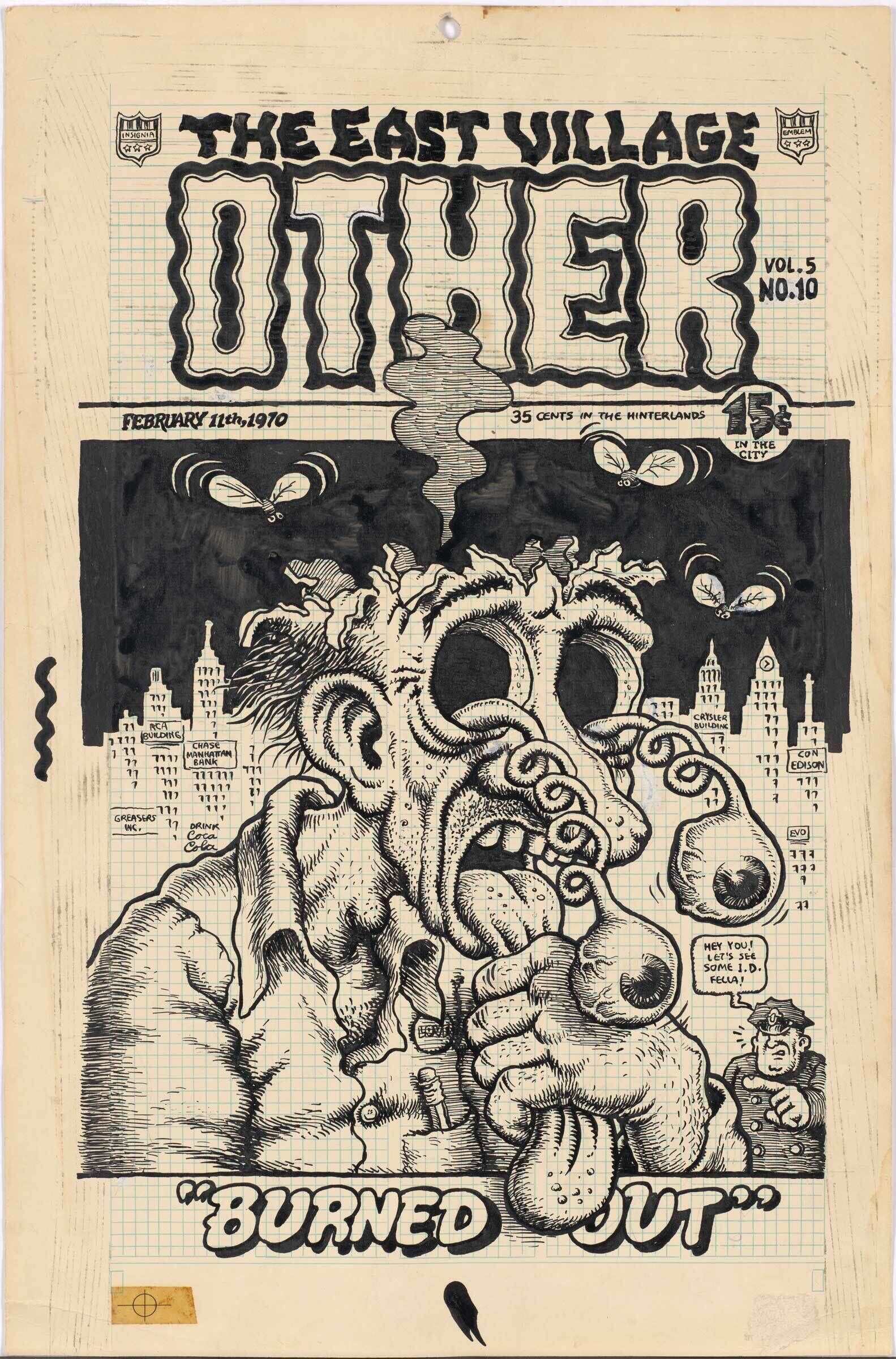
Cartoon man with bulging eyes and smoke from his head, titled "BURNED OUT," on a 1970 magazine cover.

Robert Crumb, Burned Out, Cover for The East Village Other 5, no. 10, 1970. Ink on paper, 16 × 10 in. (40.6 × 25.4 cm). Lucas Museum of Narrative Art, Los Angeles, CA. © Robert Crumb, 1970. Courtesy the artist, Paul Morris, and David Zwirner

Robert Crumb, Burned Out, cover of the "East Village Other" 5, no. 10, 1970

Created for the cover of the counterculture newspaper The East Village Other (1965–72), the flaming, eye-popping, and tongue-wrenching figure of Burned Out suggests a character whose internal panic is mirrored by an alarming physical transformation. Crumb describes this drawing as "the end of the 1960s" and a visual representation of a time when the psychedelic drug use and free love of the decade's counterculture movement crashed into the new reality of an increasingly conservative political environment. As a key figure in the underground comics movement of the late 1960s, Crumb's humorous—and often raunchily stylized—characters recognized the inscrutability of the world.

Mike Henderson, Dufus, 1970/73

In Dufus Mike Henderson explores the malleability of identity by performing a series of stereotypes: a weary janitor, a peace-loving hippie, a sex worker, a beatnik, a "Good-time Charlie" (a fur coat-clad, cigarette-smoking dandy), and a theatrical version of himself, an artist. Henderson shifts between these identities seamlessly but not without some torment, as evidenced by the characters' exaggerated erasure of what came before. This work, more conceptual and experimental than Henderson's "Protest Paintings" of the 1960s, points to the ever-shifting expectations of modern identity.

Ed Ruscha, Surrealism, 1966

This is a working drawing for Ed Ruscha's photograph Surrealism Soaped and Scrubbed (1966), which was on the cover of the September 1966 issue of the magazine Artforum (1962– ). This special issue included essays on Surrealism from historical, architectural, filmic, and personal perspectives, including those by critics Lucy Lippard and William Rubin. Using the pseudonym "Eddie Russia," Ruscha worked as a production designer and art director at the magazine from 1965 to 1969, a time when he was leaning into the use of typography and language in his art. This sudsing of surrealism exemplifies Ruscha's unique blend of Pop Art's lush stylization and Conceptual art's removed austerity, along with his deadpan humor.

Romare Bearden, Pittsburg Memory 2/6, 1964

"As a Negro, I do not need to go looking for 'happenings,' the absurd, or the surreal, because I have seen things out of my studio window on 125th Street that neither Dalí nor Beckett nor Ionesco could have thought possible." In this quote from 1964, Romare Bearden reflects on his experience being Black in America. Here he depicts not Harlem but Pittsburgh, where he briefly lived with his grandparents and spent time with steel workers. He represents the city by combining found images and enlarging the photographically, making photomontages that morph his memories of the city into spiritual and political rituals.


Artists

On the Hour

A 30-second online art project:
Frank WANG Yefeng, The Levitating Perils #2

Learn more about this project

Learn more at whitney.org/artport

On the Hour projects can contain motion and sound. To respect your accessibility settings autoplay is disabled.