Sixties Surreal | Art & Artists

Sept 24, 2025–Jan 19, 2026


Exhibition works

10 total
Body Ego
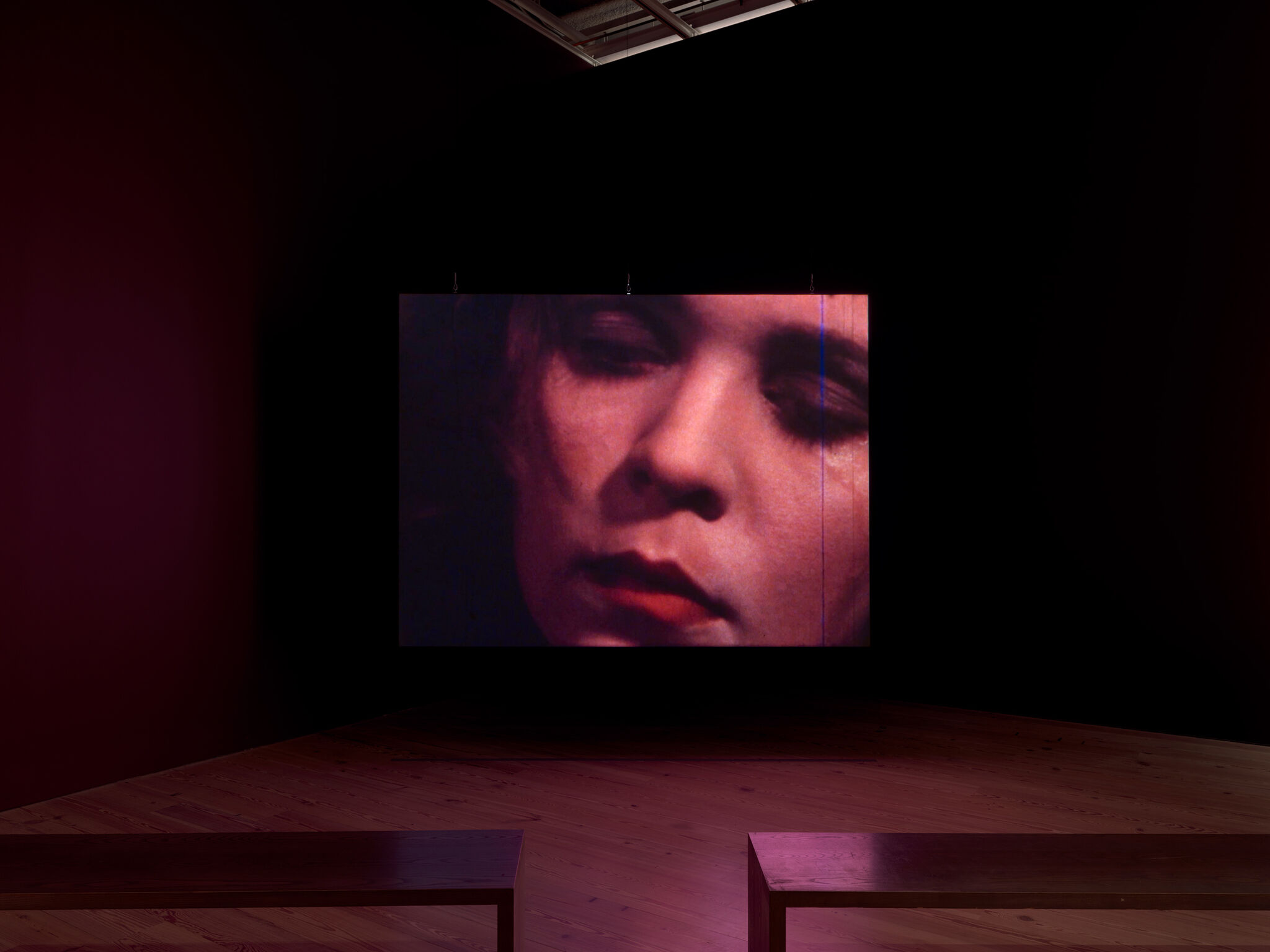
Read more

Body Ego


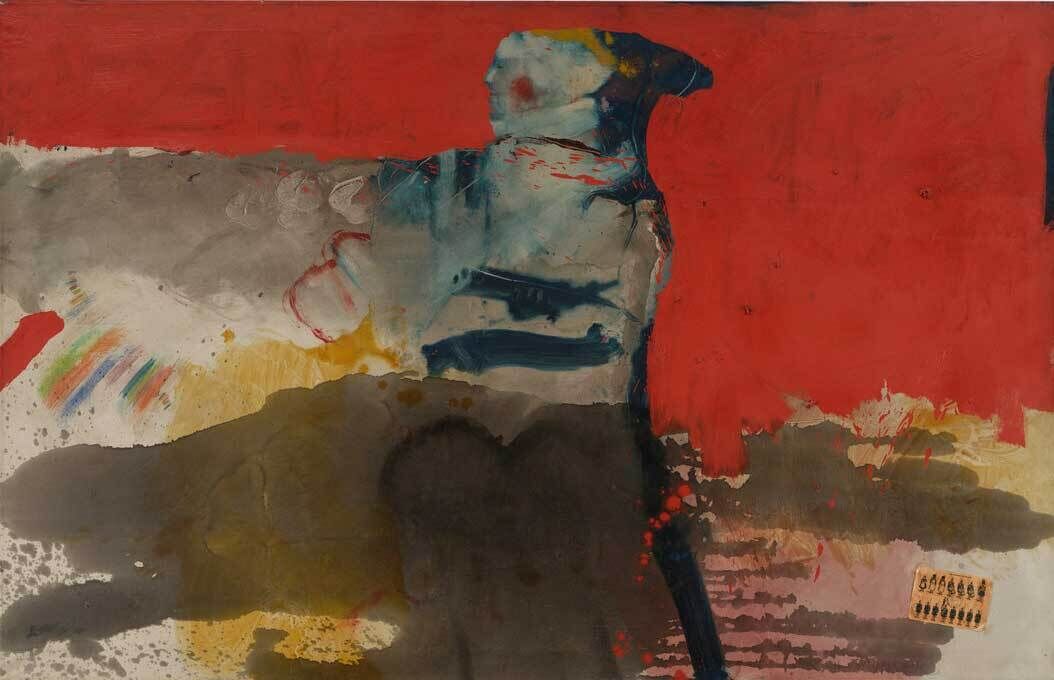
Abstract painting with bold red, gray, and blue areas, splashes of color, and a small grid of black shapes.

Raymond Saunders, Untitled, 1968. Oil on canvas with collage, 52 × 81 in. (132.1 × 205.7 cm). Courtesy the artist and Andrew Kreps Gallery, New York. ©️ Raymond Saunders. Photograph by Thomas Barratt
Body Ego

The works on view here are composed of forms and materials that evoke the sensual feelings of having and exploring a body of flesh and bones—from the erotic to the anxious. Many of the artists were featured in two 1967 exhibitions: Eccentric Abstraction in New York and Funk in Berkeley, California. Eccentric Abstraction, curated by Lucy Lippard, presented artists, including Bruce Nauman, Don Potts, Louise Bourgeois, and Eva Hesse, whose work was rigorously abstract yet retained a sensuous quality. The artists whose work was shown by the curator Peter Selz in Funk, among them Jeremy Anderson, Ken Price, and Franklin Williams, were more explicit in their references to guts, fingers, and anthropomorphic forms. The objects the Funk artists produced may seem innocuous at first glance, but the subtle protrusions and openings of works such as Ken Price’s S. L. Green (1963) or Franklin Williams’s Untitled (1966) evoke both the anxieties and the ecstasies of our physical being. Looking beyond these historic exhibitions, this gallery brings together artists from across the country who worked with unorthodox materials to create objects of embodied abstraction.

Combining painting with collage at a large scale, Raymond Saunders's imagery exists between abstraction and figuration. Here the artist transformed the central figure in Emmanual Leutze's monumental history painting Washington Crossing the Delaware (1851), surrounding the loosely rendered and ghostly likeness in bright red and pooling greys and browns. Saunders makes reference to the obscured soldiers by affixing a postcard depicting toy soldiers. Working in Northern California for many years, Saunders developed a collage-based painting mode that alluded to racial and social issues while maintaining a dreamy, elegiac atmosphere.

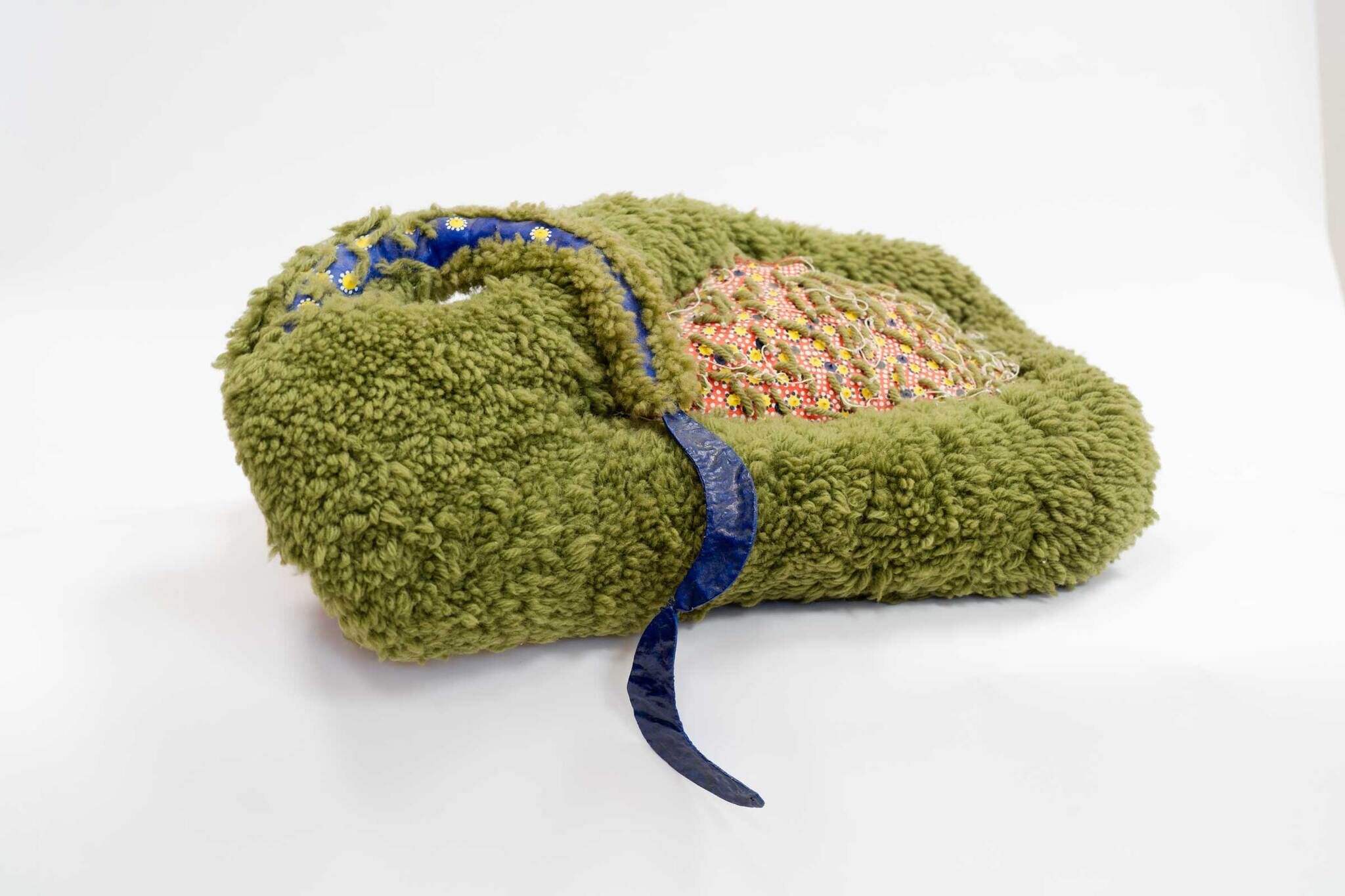
A soft, green, fuzzy object with a blue ribbon and a section of colorful beads and netting.

Franklin Williams, Untitled, 1967. Acrylic, crochet thread, and yarn on canvas stuffed with cotton batting, over wooden support, 20 × 20 × 9 in. (50.8 × 50.8 × 22.9 cm). Collection of Franklin Williams; courtesy Parker Gallery, Los Angeles, and Garth Greenan Gallery, New York. © Franklin Williams

Franklin Williams, Untitled and Untitled, 1966 and 1967

Franklin Williams used cast-off materials from a hospital in Oakland to create his painted, stitched, and crocheted sculptures. Somewhere between a pillow, a horseshoe crab, and an intestinal extraterrestrial, Williams's Untitled came from his lifelong engagement with craft and poetics. Williams grew up in Utah and was part of a family of prolific crafters, especially knitting, crocheting, and quilting—all of which Williams was well-versed in by the age of eight. In Oakland he developed a language that combined his skills and familial memories with the material-based work proliferating around him, an evolution that led to his inclusion in the 1967 exhibition Funk.

Jeremy Anderson, Riverrun, 1965

Made from redwood and pine found in the artist's Northern California backyard, Jeremy Anderson's Riverrun was inspired by his fascination with intestinal forms, medical school models, and the elongated figures in old comic books like Plastic Man (1941–56) and Powerhouse Pepper (1942–48). The tubular form at the center of this sculpture reflects Anderson's interest in combining the bodily and the geological, echoing his mystical interest in being one with nature. Anderson shares connections with many artists in this gallery: his work was included in the 1967 Funk exhibition, and his first New York exhibition was a two-person show with Louise Bourgeois in 1952.

Barbara Chase-Riboud, Confessions for Myself, 1972

The title of Barbara Chase-Riboud's bronze and wool sculpture suggests a self-portrait: the artist's figure is armored and draped in mourning black. This work relies on the artist's observations of textile, metalworking, and casting techniques she encountered in China, India, and Egypt. By combining hard and soft materials with references to her body in her sculptures from the 1960s and 1970s, Chase-Riboud created works that she described as "visually surrealistic." Curator Peter Selz—who organized the 1967 Funk exhibitioncommissioned this sculpture, which was featured in Chase-Riboud's first one-person exhibition at the University of California, Berkeley, Art Museum.

Bruce Nauman, Mold for a Modernized Slant Step, 1966

While exploring a Marin County salvage shop in 1965, Bruce Nauman (then a graduate student at the University of California, Davis) caught sight of a wooden step. It was covered in worn green linoleum and resembled a footstool with its riser set at an unusually low angle. Nauman encouraged his graduate advisor, William T. Wiley, to have a look himself, and Wiley purchased the step for fifty cents. Using the found item as a prompt, the artists collaborated to give biographical life to this secondhand footstool through object-making and performance, including the Mold for a Modernized Slant Step. The deadpan and surreal gesture led to a 1966 group exhibition in San Francisco dedicated to the step.


Artists

On the Hour

A 30-second online art project:
Frank WANG Yefeng, The Levitating Perils #2

Learn more about this project

Learn more at whitney.org/artport

On the Hour projects can contain motion and sound. To respect your accessibility settings autoplay is disabled.