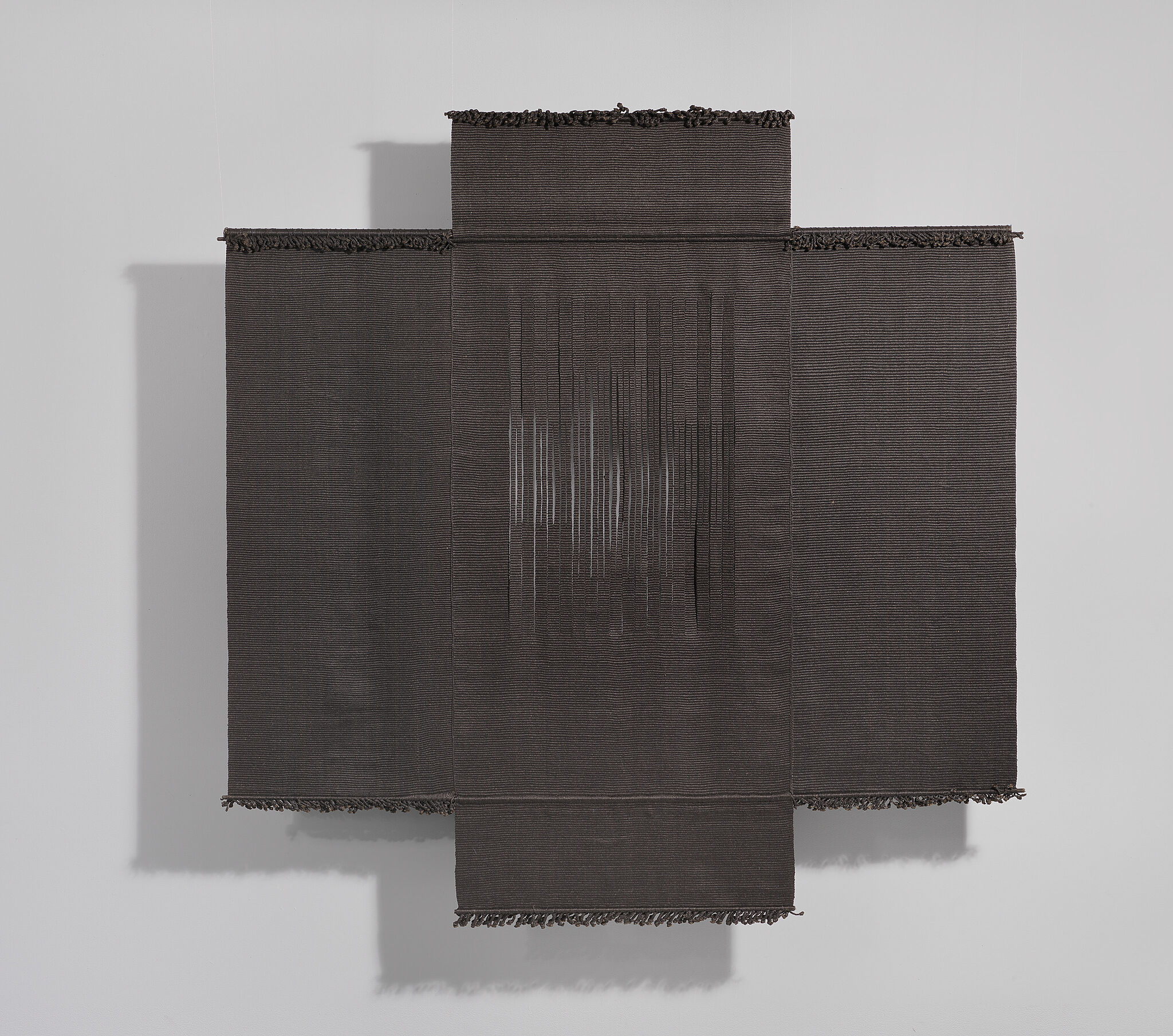
Ruth Asawa
1926–2013
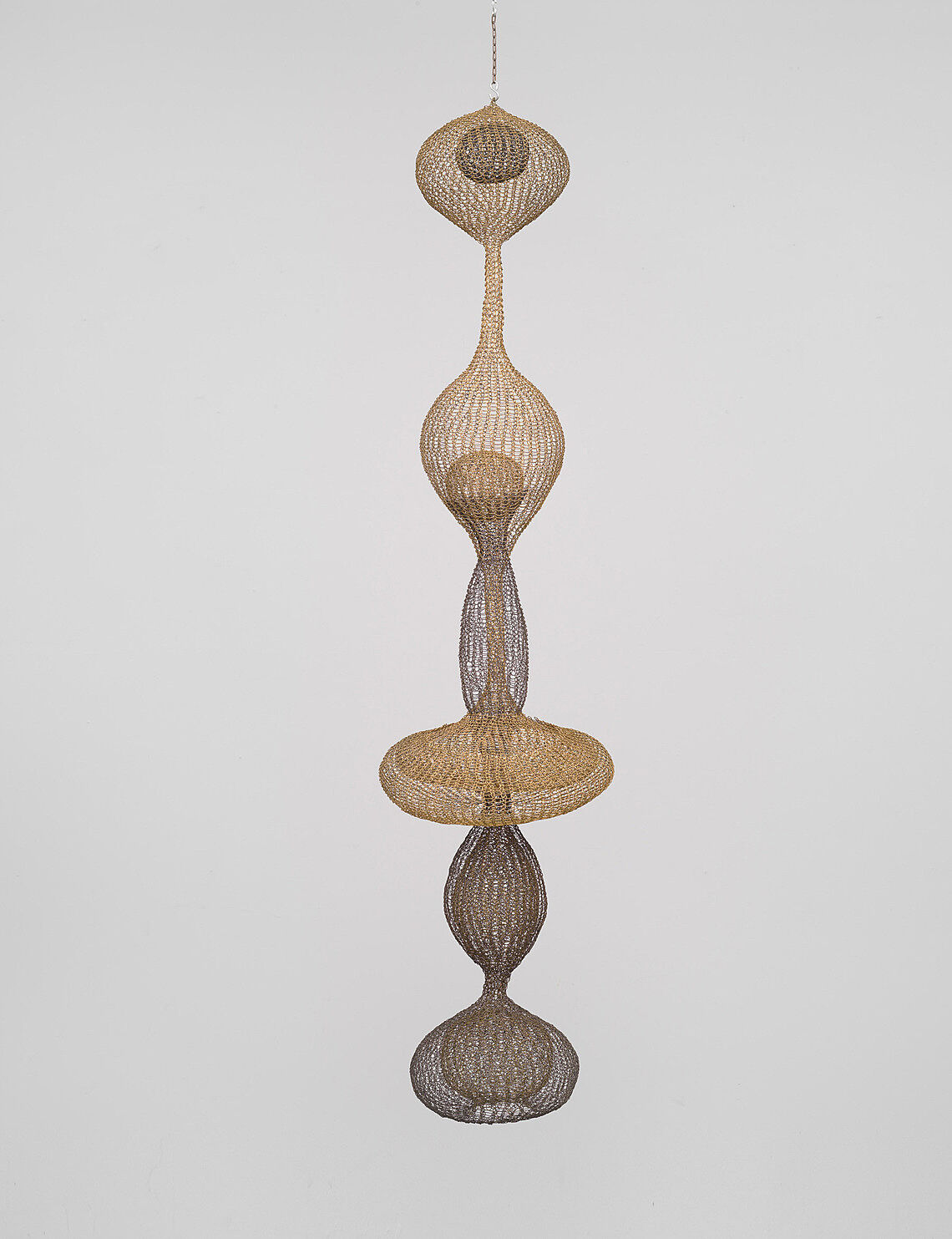
As the child of Japanese immigrants living in California, Ruth Asawa was placed in an internment camp for several years during World War II. Because of lingering discrimination after the war and bleak job prospects, Asawa abandoned her pursuit of a teaching degree and in 1946 she enrolled instead at the experimental, nonaccredited Black Mountain College in North Carolina. She planned to study painting and drawing with the influential artist Josef Albers, but the institution’s cross-disciplinary emphasis soon led her to sculpture. This nascent interest flourished after a summer in Toluca, Mexico, where she learned from the local craftspeople how to make the crocheted wire baskets she had admired. The crochet technique requires looping wire around a wooden dowel to produce what the artist described as “a string of e’s.” By repeating this one motion—with adjustments made for the weight of the material or the space between loops—Asawa created undulating, voluminous forms. “The shape comes out working with the wire,” she explained. “You don’t think ahead of time, this is what I want. . . . You make the line, a two-dimensional line, then you go into space, and you have a three-dimensional piece.”
Number 1 – 1955 (which the artist had to re-create in 1958 because of faulty metal in the original), like many of Asawa’s abstract wire sculptures, is comprised of an outer, vertical structure, inside of which she nestled smaller shapes, often of a differing metal. Suspended from the ceiling, the biomorphic, semitransparent structure creates a multidimensional play of interior and exterior spaces and a constellation of shadows on the wall. The work, according to Asawa, “does not hide anything . . . and inside and outside are connected. Everything is connected, continuous.”
Dana Miller and Adam D. Weinberg, Handbook of the Collection (New York: Whitney Museum of American Art, 2015), 46.
Introduction
Ruth Aiko Asawa (Japanese: 浅和 愛子, Hepburn: Asawa Aiko; January 24, 1926 – August 5, 2013) was an American modernist artist primarily known for her abstract looped-wire sculptures inspired by natural and organic forms. In addition to her three-dimensional work, Asawa created figurative and abstract drawings and prints influenced by nature, particularly flowers and plants.
Born in Norwalk, California in 1926 to Japanese immigrant parents, Asawa was the fourth of seven children and grew up on a truck farm. In 1942, her family was sent to different Japanese internment camps as a result of U.S. isolation policies during World War II. At the Rohwer War Relocation Center, Asawa learned to draw from illustrators interned there. In 1943, she left the camp to attend Milwaukee State Teachers College. Hoping to become a teacher, Asawa was ultimately unable to, as her Japanese ancestry prevented her from obtaining a teaching position in Wisconsin.
In 1946, Asawa joined the avant-garde artistic community at Black Mountain College, where she studied under German-American Bauhaus painter and color theorist Josef Albers, as well as the American architect and designer Buckminster Fuller. It was at Black Mountain College that Asawa began making looped-wire sculptures inspired by the basket crocheting technique she learned in 1947 on a trip to Mexico. In 1955, she held her first exhibition in New York. By the early 1960s, Asawa had achieved commercial and critical success and became an advocate for public art, saying, "art for everyone." Asawa was the driving force behind the creation of the San Francisco School of the Arts, which was renamed the Ruth Asawa San Francisco School of the Arts in 2010.
Her work is featured in collections at the Solomon R. Guggenheim Museum and the Whitney Museum of American Art in New York City. Fifteen of Asawa's wire sculptures are on permanent display in the tower of San Francisco's de Young Museum in Golden Gate Park, and several of her fountains are located in public places in San Francisco. In 2020, the U.S. Postal Service honored her work by producing a series of ten stamps that commemorate her well-known wire sculptures.
Wikidata identifier
Q7382874
Information from Wikipedia, made available under the Creative Commons Attribution-ShareAlike License . Accessed March 26, 2026.
Introduction
Best known for her woven-wire hanging sculptures. During WWII, she and her family were held in internment camps for Japanese Americans, first at the Santa Anita racetrack in Los Angeles, then in Rohwer Arkansas. After the war Asawa attended Black Mountain College where she met her husband, the architect Albert Lanier. She donated fifteen of her iconic wire pieces to the De Young Museum in San Francisco in 2005. She was known for her commitment to public art projects and advocacy of art education.
Country of birth
United States
Roles
Artist, graphic artist, sculptor
ULAN identifier
500077806
Names
Ruth Asawa, Ruth Asawa Lanier
Information from the Getty Research Institute's Union List of Artist Names ® (ULAN), made available under the ODC Attribution License. Accessed March 26, 2026.