Programmed: Rules, Codes, and Choreographies in Art, 1965–2018 | Art & Artists

Sept 28, 2018–Apr 14, 2019


Exhibition works

7 total
Rule, Instruction, Algorithm: Ideas as Form
Read more

Rule, Instruction, Algorithm: Ideas as Form

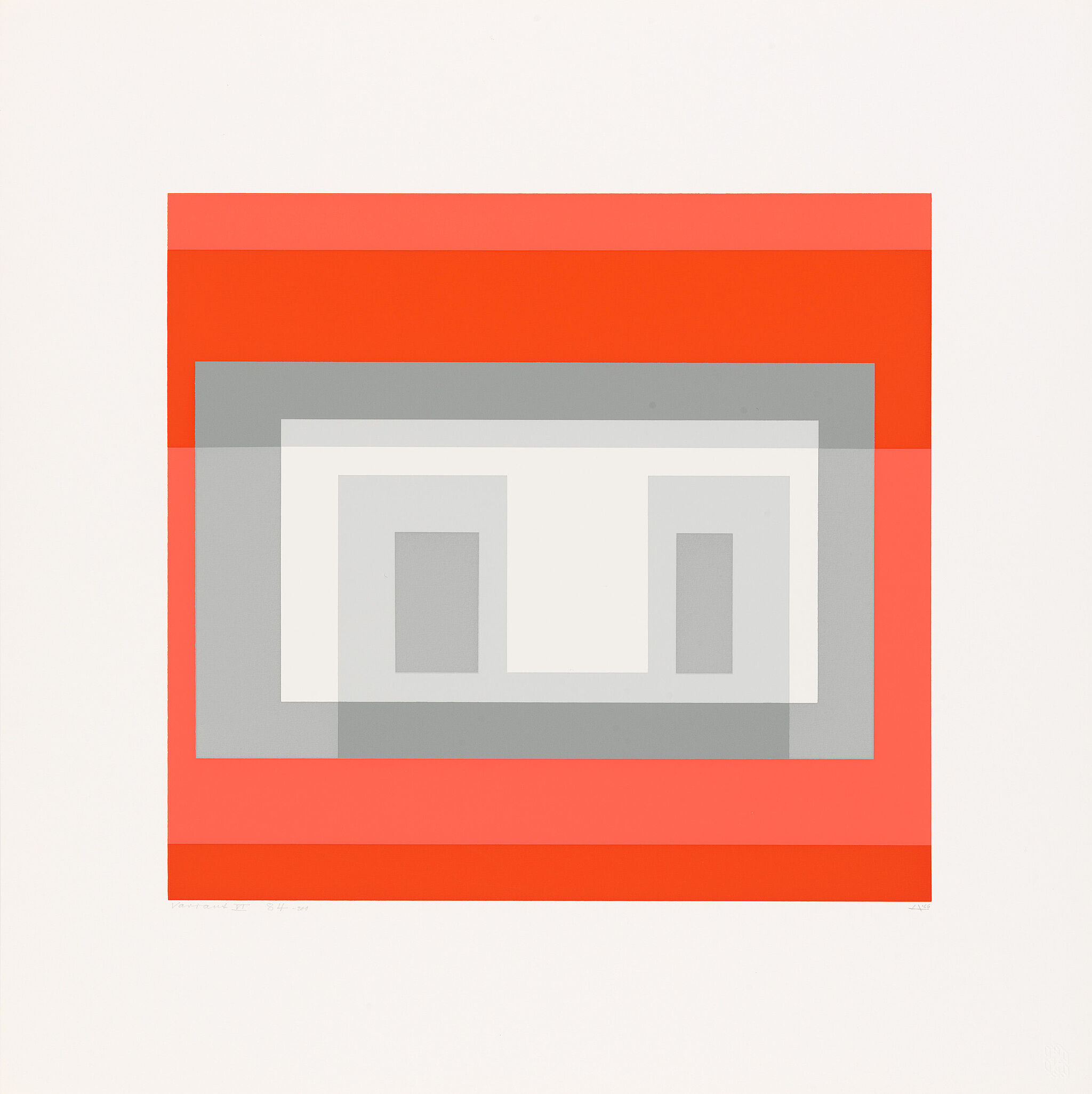
Shapes of various colors inside each other.

Josef Albers (1888-1976), Variant VI, 1966, from the portfolio Ten Variants. Screenprint: sheet, 17 x 17 in. (43.2 x 43.2 cm); image, 11 x 11 7/8 in. (27.9 x 30.2 cm). Whitney Museum of American Art, New York; gift of the artist 67.64.6. © 2018 The Josef and Anni Albers Foundation/Artists Rights Society (ARS), New York

Rule, Instruction, Algorithm:
Ideas as Form
Artists have long used instructions and abstract concepts to produce their work, employing mathematical principles, creating thought diagrams, or establishing rules for variations of color. Conceptual art—a movement that began in the late 1960s—went a step further, explicitly emphasizing the idea as the driving force behind the form of the work. In his “Paragraphs on Conceptual Art” (1967), Sol LeWitt wrote: “The plan would design the work. Some plans would require millions of variations, and some a limited number, but both are finite. Other plans imply infinity.” The works in this grouping—from Sol LeWitt’s large-scale wall drawing and Josef Albers’s series of nesting colored squares and rectangles to Lucinda Childs’s dances and Joan Truckenbrod’s computer drawings—all directly address the rules and instructions used in their creation. Essential to each is an underlying system that allows the artist to generate variable images and objects.

Shapes of various colors inside each other.

Josef Albers (1888-1976), Variant VI, 1966, from the portfolio Ten Variants. Screenprint: sheet, 17 x 17 in. (43.2 x 43.2 cm); image, 11 x 11 7/8 in. (27.9 x 30.2 cm). Whitney Museum of American Art, New York; gift of the artist 67.64.6. © 2018 The Josef and Anni Albers Foundation/Artists Rights Society (ARS), New York

Josef Albers, Variant VI, 1966*

*Installed as part of an earlier version of the exhibition.

Squares of various colors inside of each other.

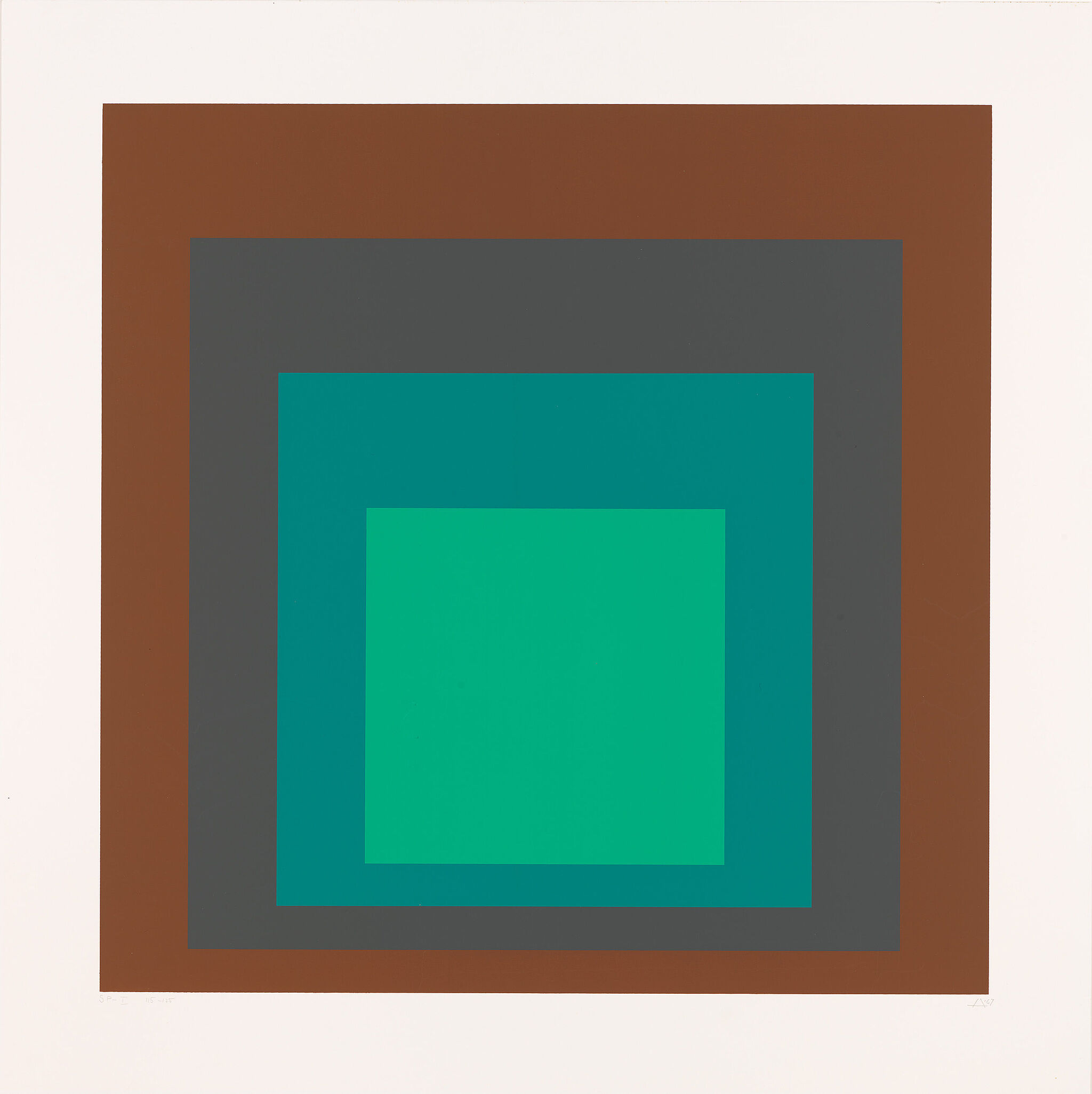
Josef Albers (1888-1976), Homage to the Square I, 1967, from the portfolio Homage to the Square. Screenprint on board: sheet, 24 3/16 × 24 3/16 in. (61.4 × 61.4 cm); image, 19 5/8 × 19 5/8 in. (49.9 × 49.9 cm). Whitney Museum of American Art, New York; gift of the artist 68.1.1. © 2018 The Josef and Anni Albers Foundation/Artists Rights Society (ARS), New York

Josef Albers, Homage to the Square I, 1967

Josef Albers began his Homage to the Square series in the summer of 1949 and made more than a thousand related works over the next twenty-five years. He developed four layouts, three composed of three squares each and the fourth composed of four squares. “The scheme of the Homages has no real aesthetic consequences by itself,” he explained. “There were hundreds of possibilities, but since my main problem is color . . . let’s have a scheme, a cooking pot that cooks for four people, and no more. Therefore, let the colors react in the prison in which I put them.” Like a composer writing variations on a single melodic theme, Albers created countless color combinations in which the effect of individual colors changes markedly from work to work, demonstrating the variability of our perception of color.

A software panel on a white board.

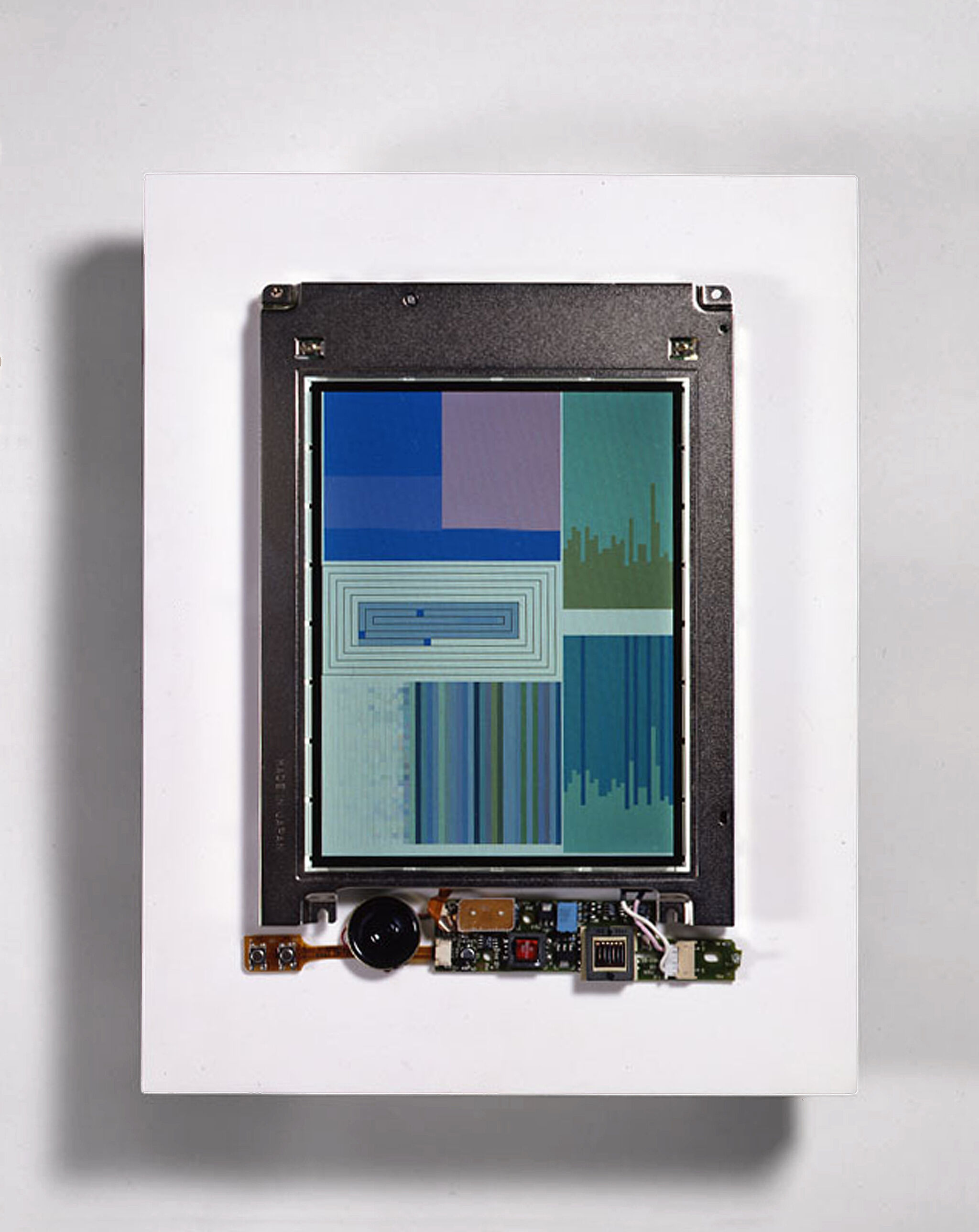
John F. Simon Jr., Color Panel v1.0, 1999. Software, altered Apple Macintosh Powerbook 280c, and plastic, 13 1/2 x 10 1/2 x 3 in. (34.3 x 26.7 x 7.6 cm). Whitney Museum of American Art, New York; purchase with funds from the Painting and Sculpture Committee 99.88a-c. © 1999 John F. Simon Jr.

John F. Simon Jr., Color Panel v1.0, 1999

Color Panel v1.0 is a piece of software art displayed on components of a laptop computer modified by the artist, John F. Simon Jr. The software “controls the screen, draws the composition, picks the colors, [and] moves the colors,” producing constantly evolving compositions of squares and rectangles that deliberately evoke early modernist geometric abstraction. Simon cites the influence of Josef Albers and Johannes Itten, who investigated the apparent changes in hue caused by placing different colors next to one another. Simon addresses the same principles through software that explores color mixing in motion and over time. In each section of the screen, the software chooses from groups of possible color combinations without specifying the exact color to be picked. The color composition is therefore variable and open to chance; its sequences never repeat, progressing over a time frame that approaches eternity.

A horizontal metal artwork hanging on the wall.

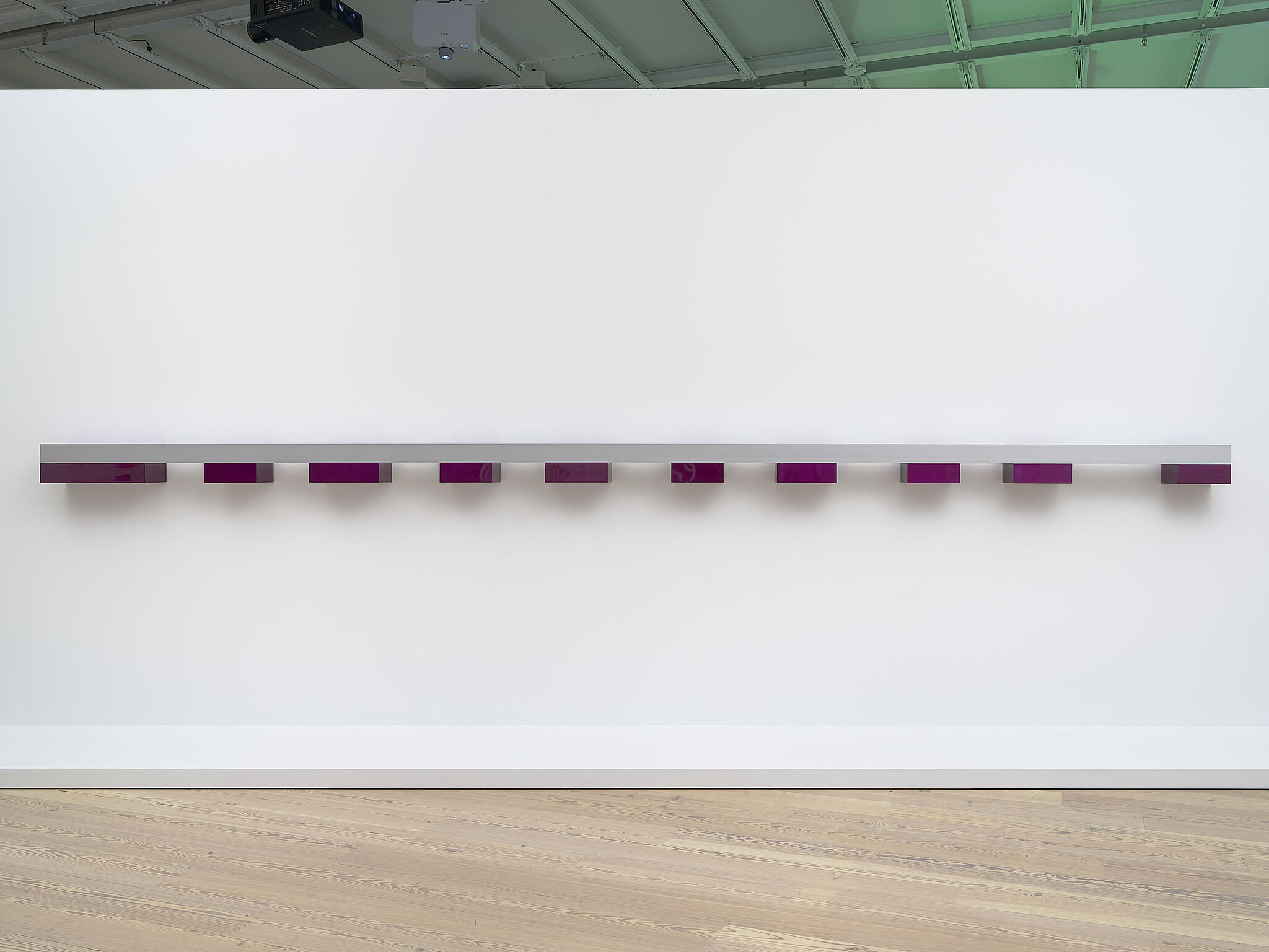
Installation view of Programmed: Rules, Codes, and Choreographies in Art, 1965–2018 (Whitney Museum of American Art, New York, September 28, 2018–April 14, 2019). Donald Judd, Untitled, 1965. Photograph by Ron Amstutz. © 2020 Judd Foundation / Artists Rights Society (ARS), New York

Donald Judd, Untitled, 1965

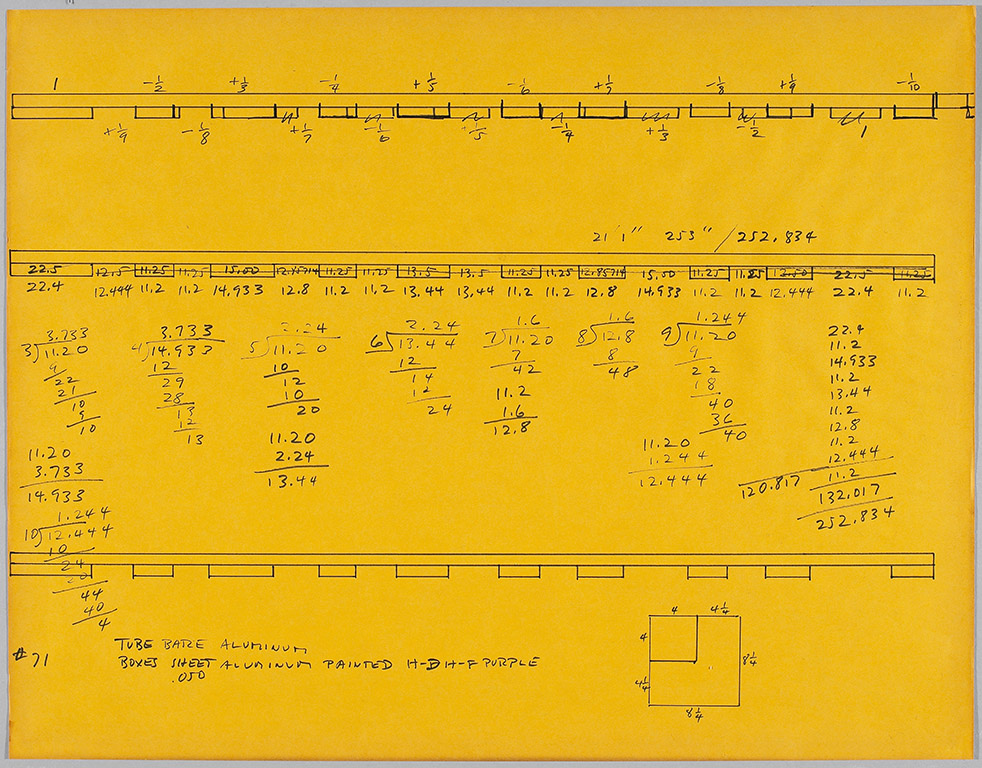
Donald Judd’s Untitled is a sequence of solids and voids that appears irregular but was conceived with mathematical exactitude. Beneath the solid horizontal form, the ten metal rectangles and the intervals between them progress following a predetermined system of proportions. Progressing from the left, the lengths of the individual rectangles are matched by the interval between boxes on the right. In the center of the work the lengths and intervals are exactly the same. Untitled presents a rich interplay of surface, mass, color, negative space, and shadow—a complexity that seems to refute the reductive Minimalism with which Judd’s work is routinely identified, pointing to the potential for combination inherent to the rule that the artist set up for the piece.

See a preliminary drawing for this artwork.

A black wall with white drawn lines.

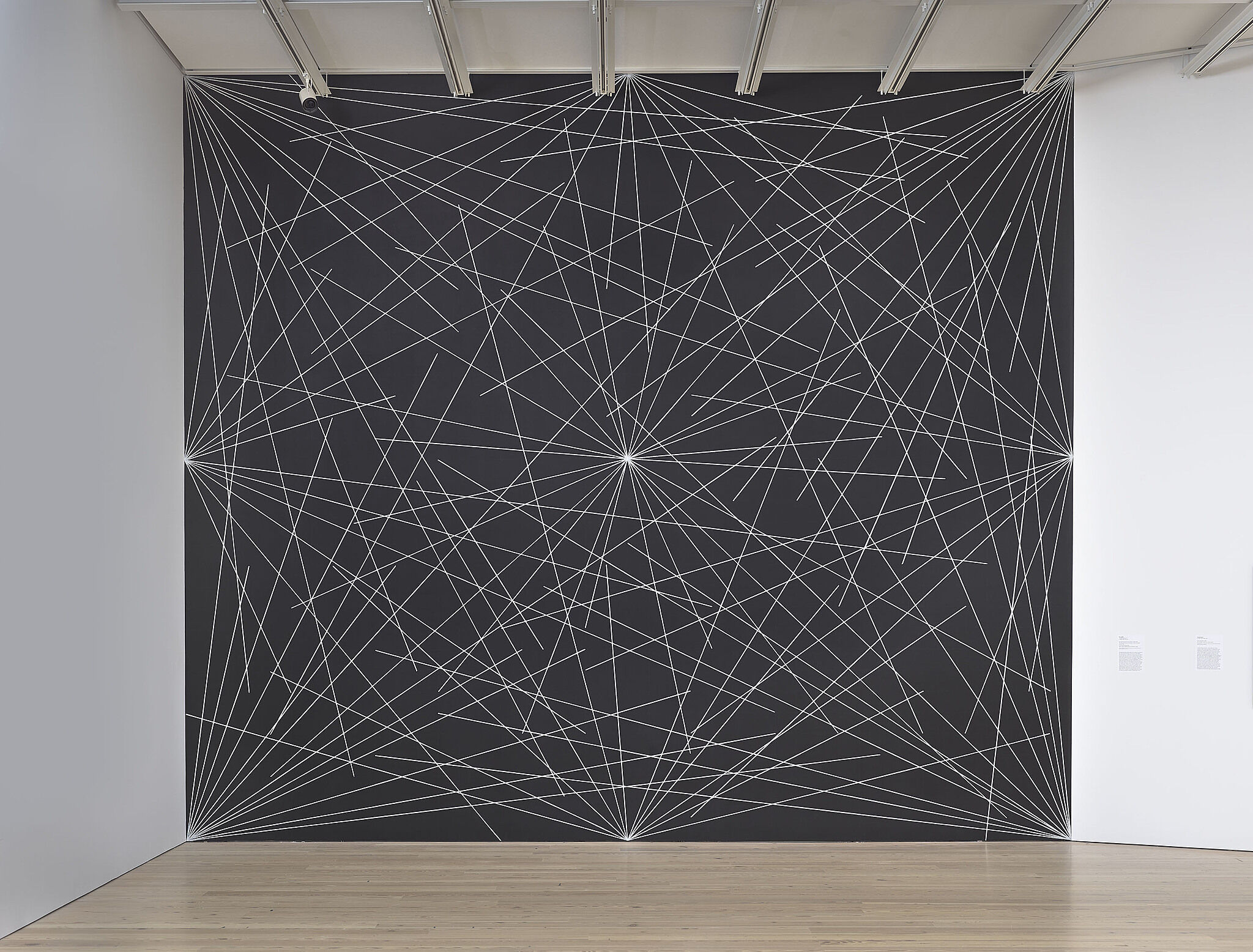
Sol LeWitt, 4th wall: 24 lines from the center, 12 lines from the midpoint of each of the sides, 12 lines from each corner, 1976, from Wall Drawing #289 (installation view, Programmed: Rules, Codes, and Choreographies in Art, 1965-2018, Whitney Museum of American Art, New York, September 28, 2018-April 14, 2019). Wax crayon, graphite pencil, and paint on wall, dimensions variable. Whitney Museum of American Art, New York; purchase with funds from the Gilman Foundation, Inc. 78.1.4. © Sol LeWitt/Artists Rights Society (ARS), New York. Photograph by Ron Amstutz

Sol LeWitt, Wall drawing #289, 1976

Encapsulating the artist’s idea that “the idea or concept is the most important aspect of the work,” Sol LeWitt’s wall drawings are actually sets of instructions that others execute when the work is to be exhibited. Wall Drawing #289, when implemented fully, covers four walls, of which only the fourth is on view here— a possibility LeWitt left open and that speaks to the work’s adaptability. The exact angle and length of the lines here—twenty-four from the center, twelve from the midpoint of each of the sides, and twelve from each corner—are determined by those who draw them, and the work may be adapted to fit a variety of architectural contexts. Consequently, the wall drawing is scalable and can differ significantly with each realization. Although it is executed by a human rather than a computer, its language-based instructions function as a program would in a digital work of art.

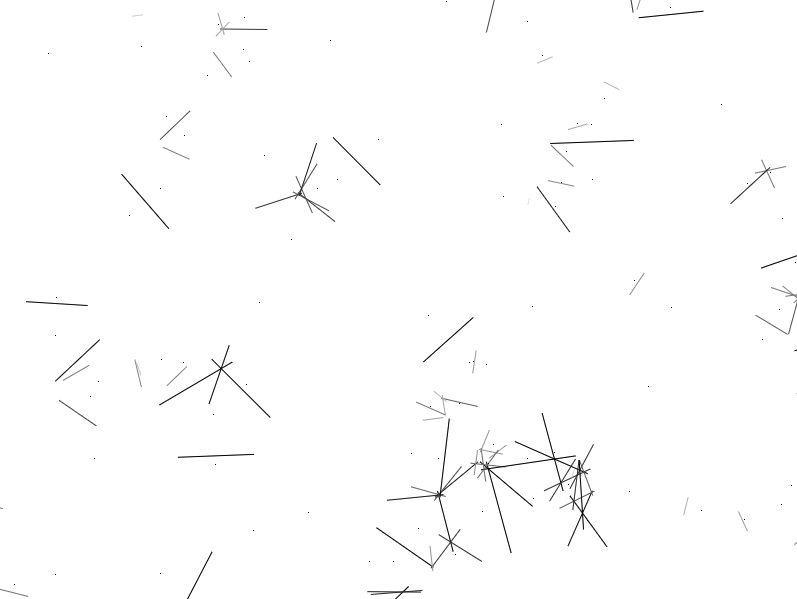
Black lines on white background.

Casey Reas (b. 1972), {Software} Structure #003 A, 2004 and 2016. JavaScript. Commissioned by the Whitney Museum of American Art for its artport website AP.2004.5

Casey Reas, {Software} Structure #003 A

Casey Reas responds to Sol LeWitt’s concept that the idea is “a machine that makes art” by demonstrating that it is always true for works of software art. Reas generates and executes the drawing through programming, but, as with LeWitt’s early wall drawings, starts with a description in natural language: 

A surface filled with one hundred medium to small circles. Each circle has a different size and direction, but moves at the same slow rate. Display: 

A. The instantaneous intersections of the circles 

B. The aggregate intersections of the circles

In Structure #003A, the points moving on the screen are the center of each circle, while the lines connect the intersections of overlapping circles. Structure #003B gives viewers a different view of the structure by compressing changes over time into the same visual space; it is created using a process similar to taking a long-exposure photograph of Structure #003A and is continually changing, erasing, and redrawing while never repeating.

See this live on artport, the Whitney’s portal to Internet art.

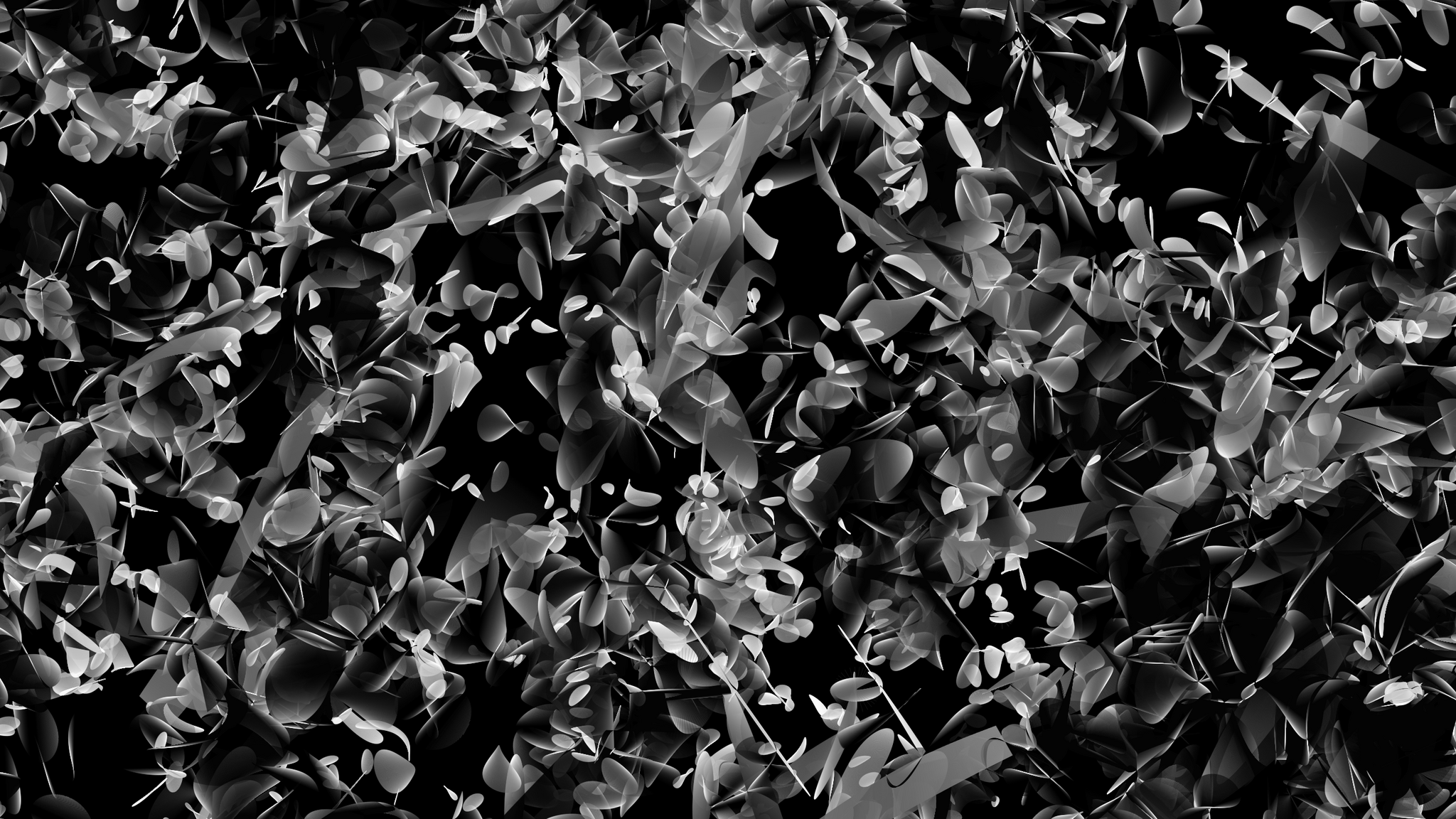
White computer generated forms on a black background.

Casey Reas, {Software} Structure #003 B, 2004 and 2016. JavaScript. Commissioned by the Whitney Museum of American Art for its artport website

Casey Reas, {Software} Structures #003 B, August 2004/2016

Casey Reas responds to Sol LeWitt’s concept that the idea is “a machine that makes art” by demonstrating that it is always true for works of software art. Reas generates and executes the drawing through programming, but, as with LeWitt’s early wall drawings, starts with a description in natural language: 

A surface filled with one hundred medium to small circles. Each circle has a different size and direction, but moves at the same slow rate. Display: 

A. The instantaneous intersections of the circles 

B. The aggregate intersections of the circles

In Structure #003A, the points moving on the screen are the center of each circle, while the lines connect the intersections of overlapping circles. Structure #003B gives viewers a different view of the structure by compressing changes over time into the same visual space; it is created using a process similar to taking a long-exposure photograph of Structure #003A and is continually changing, erasing, and redrawing while never repeating.

See this live on artport, the Whitney’s portal to Internet art.

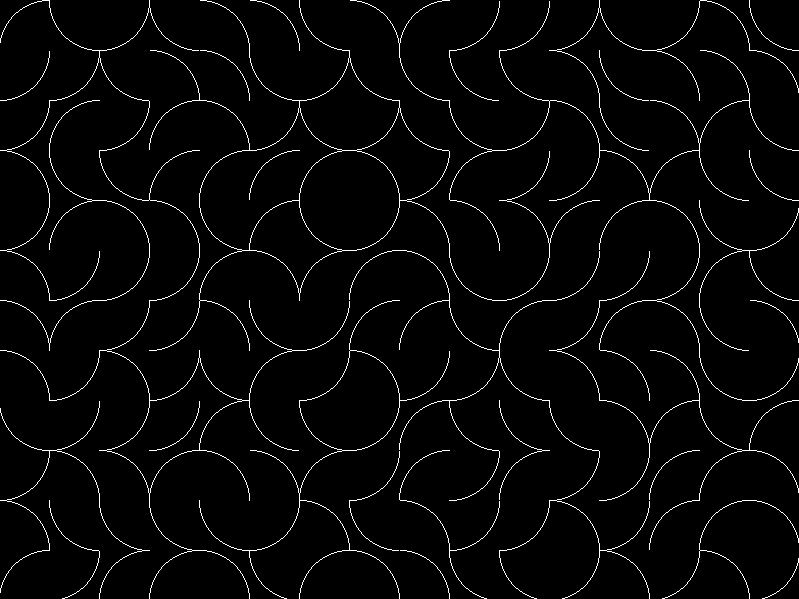
White circular lines on a black background.

Casey Reas (b. 1972), Sol LeWitt Wall Drawing #358, 2004 and 2016, from the series {Software} Structures. JavaScript. Commissioned by the Whitney Museum of American Art for its artport website AP.2004.5

Casey Reas, {Software} Structures, Sol LeWitt Wall Drawing #358, August 2004/2016

Casey Reas’s Sol LeWitt Wall Drawing #358, part of his {Software} Structures series, is a software modification of a 1981 work by LeWitt that is not in this exhibition but was inspired by LeWitt’s collaboration with Lucinda Childs and Philip Glass on Dance (1979), on view nearby. Reas’s program updates itself four times per second, displaying a randomly selected composition of arcs. The arc, which features prominently in Dance, also dominates LeWitt’s Wall Drawing #358 and becomes a formal connection between Childs, Reas, and LeWitt.

Lucinda Childs, Philip Glass, and Sol LeWitt, Dance, 1979 and 2014

In 1979, choreographer Lucinda Childs collaborated with artist Sol LeWitt and composer Philip Glass to create Dance. Childs, whose works are characterized by the repetitious precise movements of her dancers, choreographed the five-part dance to a score written by Glass. Her drawings, here projected on the floor, map out the movement of the dancers and are colored according to the lighting design for each part. When the dance is performed, as in the video shown here, LeWitt’s 35mm black-and-white film of Childs’s choreographies is projected onto a scrim, overlaying the live dancers with a grid traversed by their filmed counterparts. The project reveals the commonalities in the serial and rule-based approaches each artist explored in different disciplines.

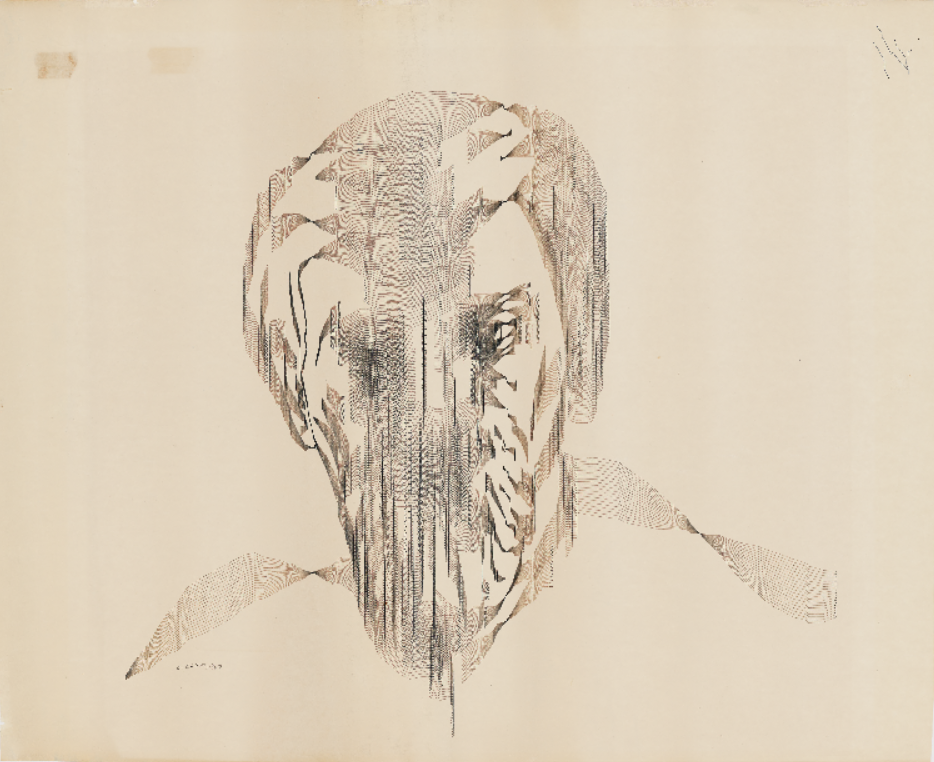
Drawing of a man with abstract face.

Charles Csuri (b. 1922), Sine Curve Man, 1967. Ink on paper, output from drum plotter, 41 × 41 in. (104.1 × 104.1 cm). Whitney Museum of American Art, New York; purchase with funds from the Digital Art Committee 2018.33. © Charles Csuri

Charles Csuri, Sine Curve Man, 1967*

In 1967, Charles “Chuck” Csuri’s Sine Curve Man, created at Ohio State University in collaboration with programmer James Shaffer, stood out as one of the most complex figurative computer-generated images. As Csuri and Shaffer explained, to make the work, “a picture of a man was placed in the memory of an IBM 7094. Mathematical strategies were then applied to the original data.” Csuri and Shaffer’s code transformed the line drawing of the man by repeatedly vertically shifting an X or Y value of the given curve and letting the resulting drawings accumulate on top of each other. Csuri felt that peer artists working with technology at the time had tended to place more emphasis on materials and technical processes than the underlying scientific concepts creating those products. For Csuri, the computer brought the artist closer to the scientist, allowing him to directly work with basic scientific concepts and examine the laws creating physical reality.

*Installed as part of an earlier version of the exhibition.

Text on white paper.

Frederick Hammersley (1919-2009), no title, 1969. Computer-generated drawings on paper, 77 sheets in total, 11 × 14 15/16 in. (27.9 × 37.9 cm) and 11 × 13 11/16 in. (27.9 × 34.8 cm). Whitney Museum of American Art, New York; gift of the Frederick Hammersley Foundation 2016.177. © Frederick Hammersley Foundation

Frederick Hammersley, no title, 1969*

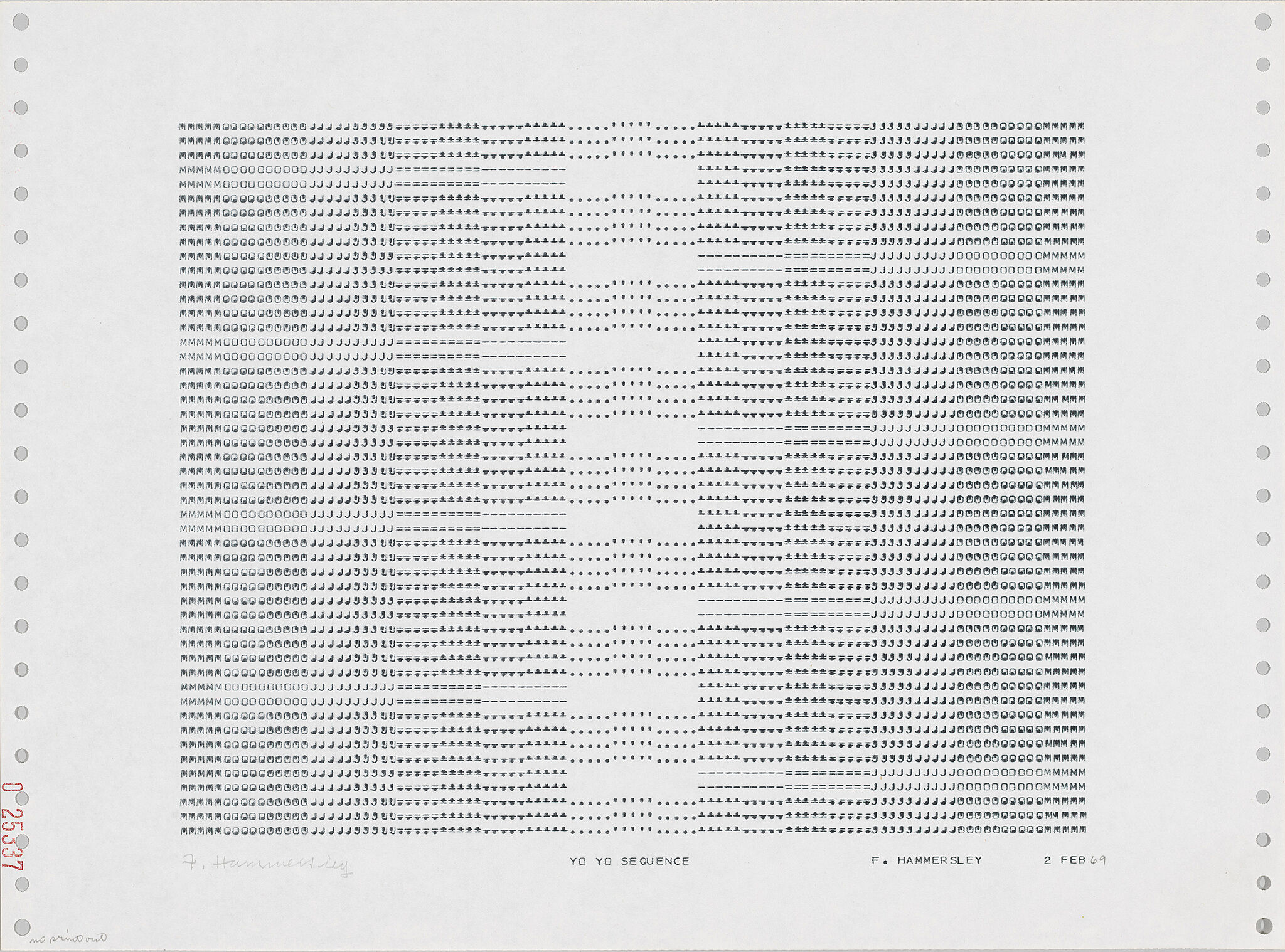
In 1968, Frederick Hammersley began using the University of New Mexico’s IBM mainframe computer to make images through an iterative process (repeated cycles of variations). He created these drawings using the computer program ART I, which was written in the programming language FORTRAN IV. The drawings use the 26 letters of the English alphabet and the 10 Arabic numerals along with 11 symbols within a working area 50 characters tall and 105 characters wide. The works demonstrate the connections between natural and programming languages by making the alphabet itself the material for generating visual patterns.

*Installed as part of an earlier version of the exhibition.

An abstract drawing on a piece of perforated paper.

Joan Truckenbrod, Coded Algorithmic Drawing (#45), 1975. Computer-generated drawing: ink on paper, 12 1/2 × 15 1/8 in. (31.8 × 38.4 cm). Whitney Museum of American Art, New York; purchase with funds from the Digital Art Committee 2018.52

Joan Truckenbrod, Coded Algorithmic Drawing (#45), 1975

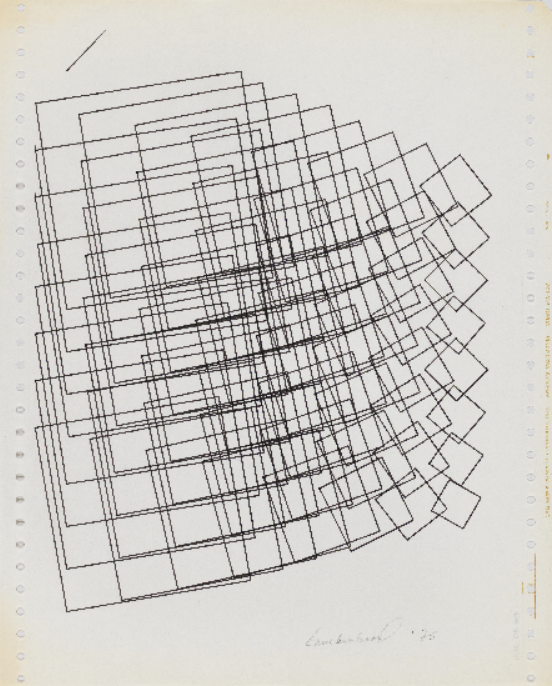
Joan Truckenbrod started making her computer drawings in the 1970s, using the programming language Fortran. She explains, “I saw that algorithms could be reconfigured, they were not a hard set of instructions but fluid, allowing me to transform ideas into new forms. There was a spontaneity that was related to this process, that then related back into the series of works.” Truckenbrod would frequently incorporate algorithms that described natural phenomena, such as light or sound waves, and give them physical substance through her projects. Unlike today, artists working on computer drawings at that time could not see the results of their code on a screen immediately after having written it. They had to work with a machine to punch their program onto a series of cards, which then communicated with the mainframe computer that guided plotters to draw the work. 

Abstract pink and purple shapes.

Joan Truckenbrod (b. 1945), Curvilinear Perspective, 1979. Heat-transfer print on fabric, 35 × 36 1/4 in. (88.9 × 92.1 cm). Whitney Museum of American Art, New York; purchase with funds from the Digital Art Committee 2018.48

Joan Truckenbrod, Curvilinear Perspective, 1979

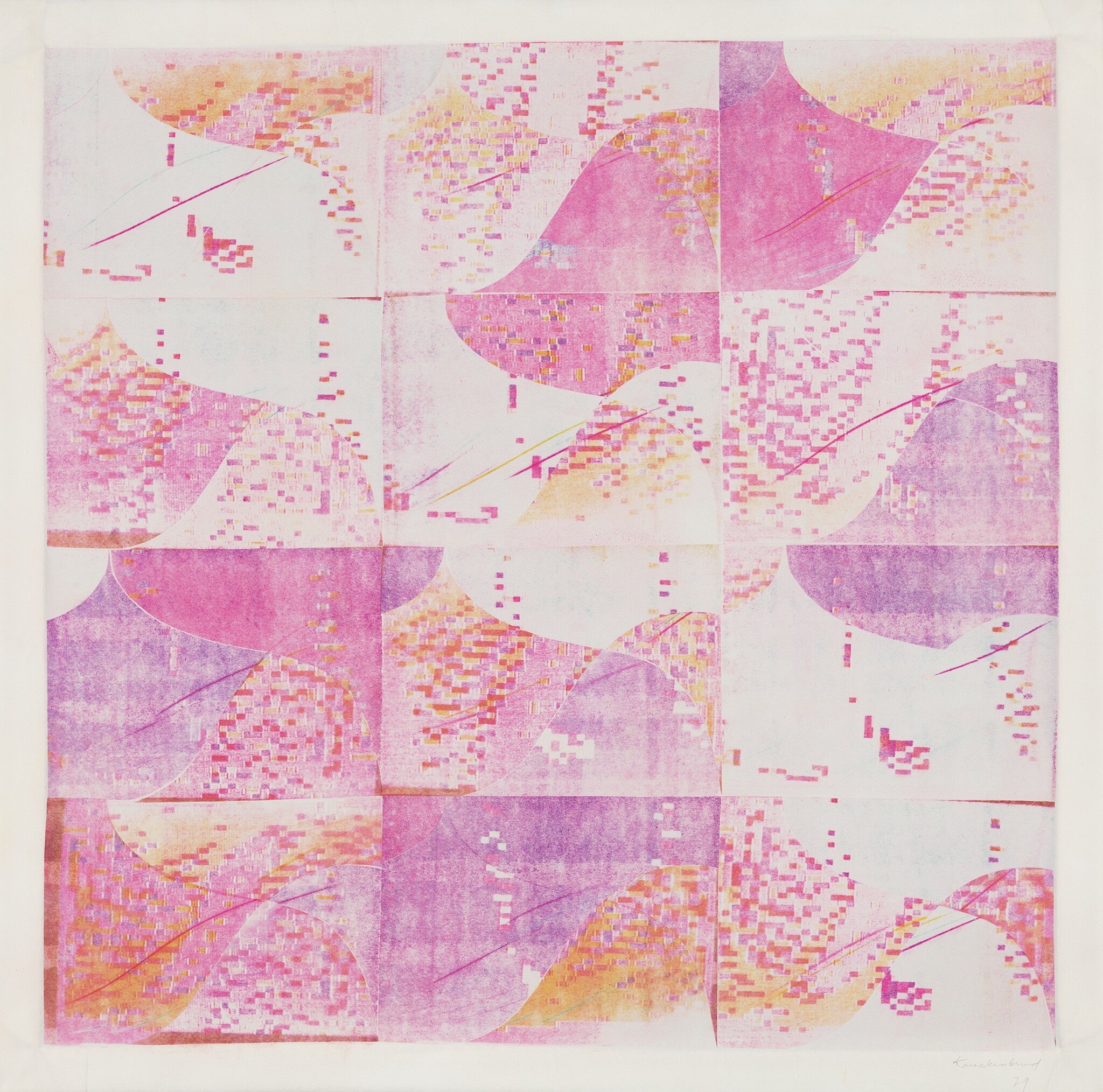
To make her patchwork textiles, Joan Truckenbrod implemented algorithms depicting natural phenomena in the programming language BASIC to create a series of abstract sequential images. She then turned the monitor of the computer, an Apple IIe, upside down on a 3M Color-in-Color copier and printed the images on heat-transfer material. After superimposing a curved pattern and reconfiguring the image components, she hand-ironed them onto polyester fiber to create the composition. The textile work is shown suspended so that its display becomes fluid—affected by light and air movement—and part of the “natural” world. Truckenbrod’s digital fabrics connect early computational art with the feminist textile art practice of the 1970s that challenged the relegation of techniques such as quilting, sewing, and weaving to the realm of “women’s crafts.”

Binary letters in black on white background.

Tauba Auerbach, Binary Uppercase/Lowercase, 2005. Ink, opaque watercolor, and graphite pencil on paper, 22 5/16 × 23 3/4 in. (56.7 × 60.3 cm). Whitney Museum of American Art, New York; purchase with funds from the Drawing Committee 2010.79. © Tauba Auerbach

Tauba Auerbach, Binary Uppercase/Lowercase, 2005

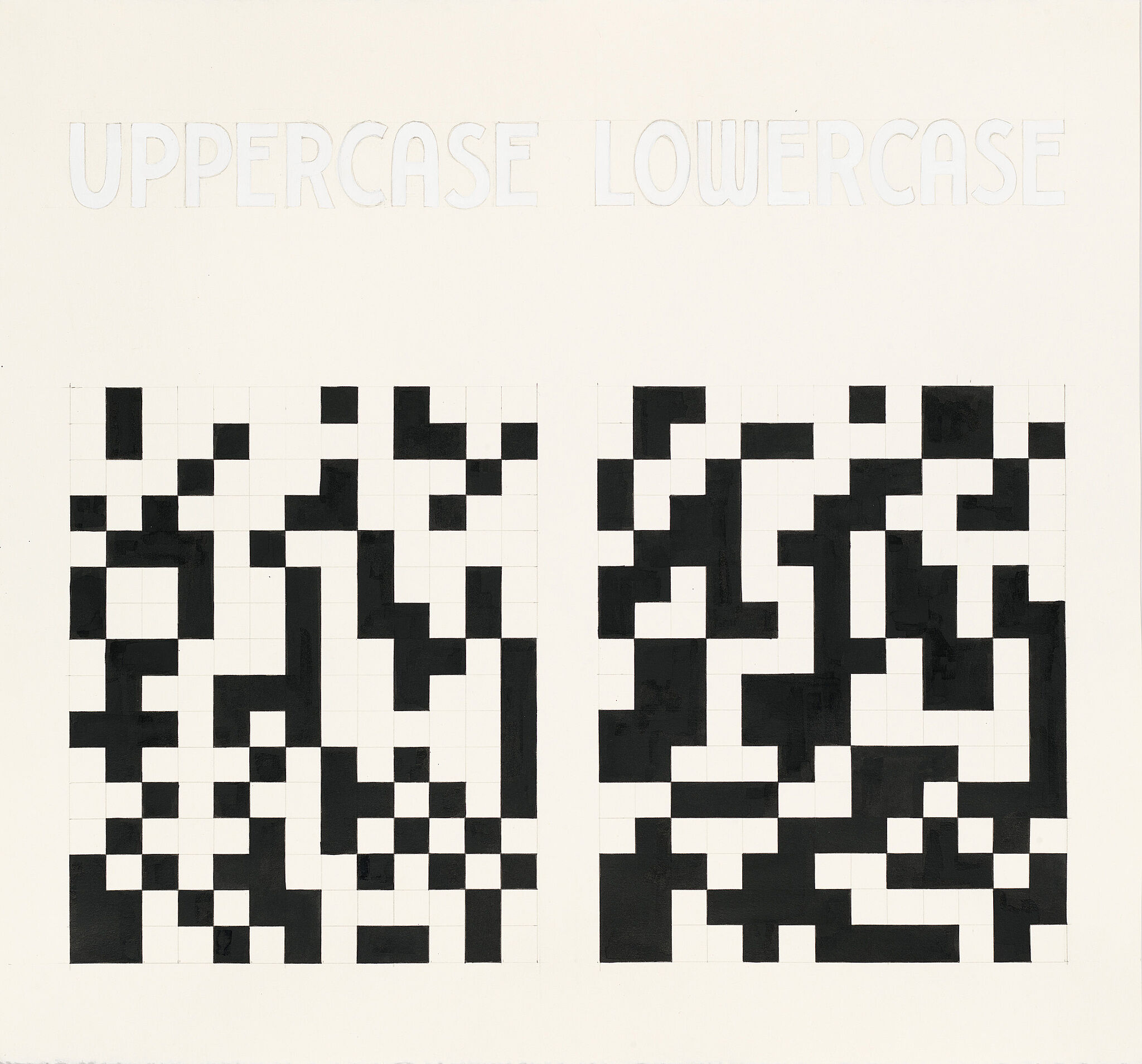
Tauba Auerbach’s Binary Uppercase/Lowercase is part of a larger project in which the artist investigated the lack of ambiguity implicit in the digital language of binary code. Binary is used to encode computing and telecommunications data, and employs the digits 0 and 1 to represent text or instructions. To make this work, Auerbach translated the English alphabet into binary, spelled in uppercase on the left side and lowercase on the right side with black squares representing 1 and white squares standing in for 0. In so doing, Auerbach explores how the computing language reduces information to a two-symbol system using black-and-white categories to convey nuanced or complex information. 

Pick lowercase and uppercase characters of the alphabet from this Binary Character Table and input them into a Binary Image Creator to recreate Auerbach's image.

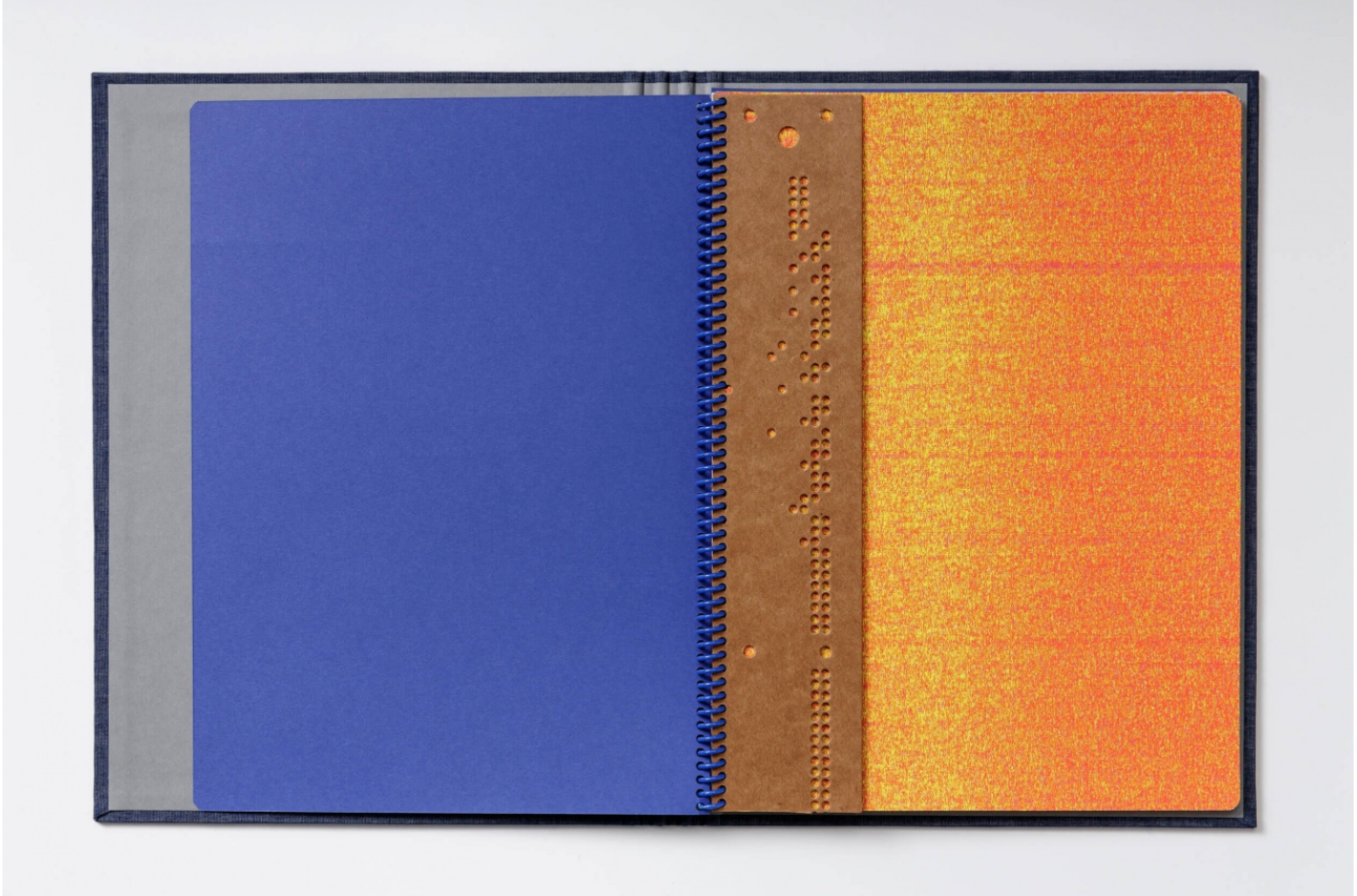
A book with a blue page on the left and an orange page on the right with perforated circles.

Mika Tajima (b. 1975), Negative Entropy, Vol. 5, 2015. Book of punched cards and digital spectrogram prints, with plastic-coil binding. Whitney Museum of American Art, New York; Frances Mulhall Achilles Library, Special Collections

Mika Tajima, Negative Entropy, Vol. 5, 2015

Negative Entropy is a series of abstract “portraits” by Mika Tajima that draws connections between weaving and the history of computing. Her subjects are sites of computer data centers that provide the framework for the information economy and factories that employ industrial Jacquard weaving looms—invented by Joseph Marie Jacquard in 1804—that, like early computing, used punched cards for information storing. The portrait shown here is that of the New York University Central Data Center, the global hub and infrastructure for the university’s information technology. The distribution of photography of the center is prohibited so the site is represented here as a Jacquard punched card that was translated from a digital photo taken of the site. Tajima also made audio recordings at the data center; she then used linguistic audio software to translate the sound frequencies into what is known as a digital spectrogram image, which is shown here interleaved with the punched card. The portrait both represents the data center and is a physical record of the data creating this representation.

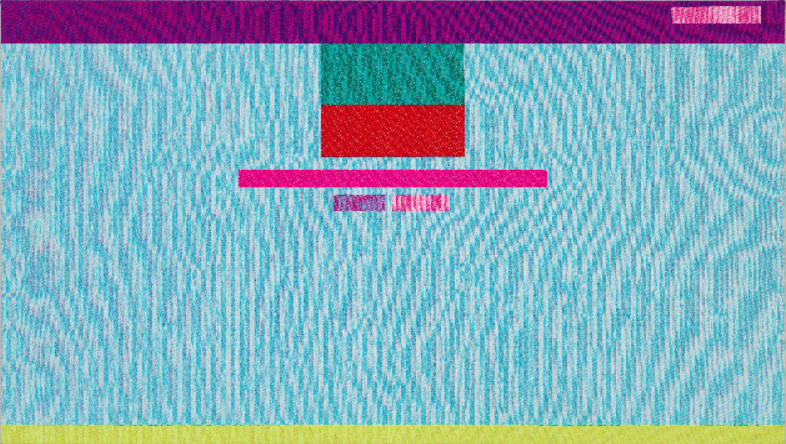
Tapestry of brightly colored shapes.

Rafaël Rozendaal (b. 1980), Abstract Browsing 17 03 05 (Google), 2017.  Weaving, output from rapier loom machine, 56 15/16 × 100 1/4 in. (144.6 × 254.6 cm). Whitney Museum of American Art, New York; purchase with funds from the Director’s Discretionary Funds and the Robert D. Bielecki Foundation 2018.55. © Rafaël Rozendaal

Rafaël Rozendaal, Abstract Browsing 17 03 05 (Google), 2017*

*Installed as part of an earlier version of the exhibition.

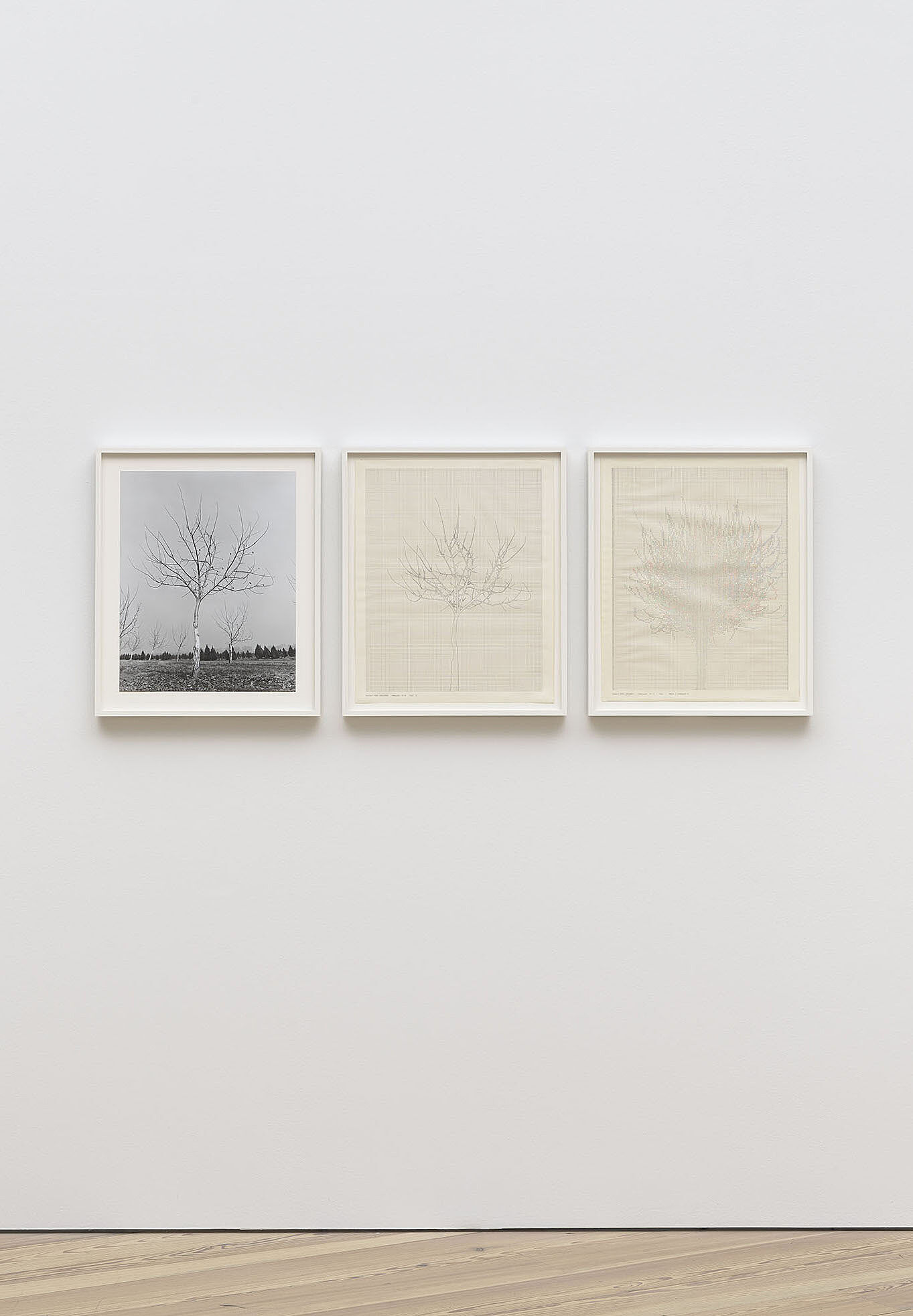
Installation view of Programmed: Rules, Codes, and Choreographies in Art.

Installation view of Programmed: Rules, Codes, and Choreographies in Art, 1965-2018 (Whitney Museum of American Art, New York, September 28, 2018-April 14, 2019). From left to right: Charles Gaines, Walnut Tree Orchard: M1, M2, M3, 1977. Photograph by Ron Amstutz

Charles Gaines, Walnut Tree Orchard: M1, M2, M3, 1977

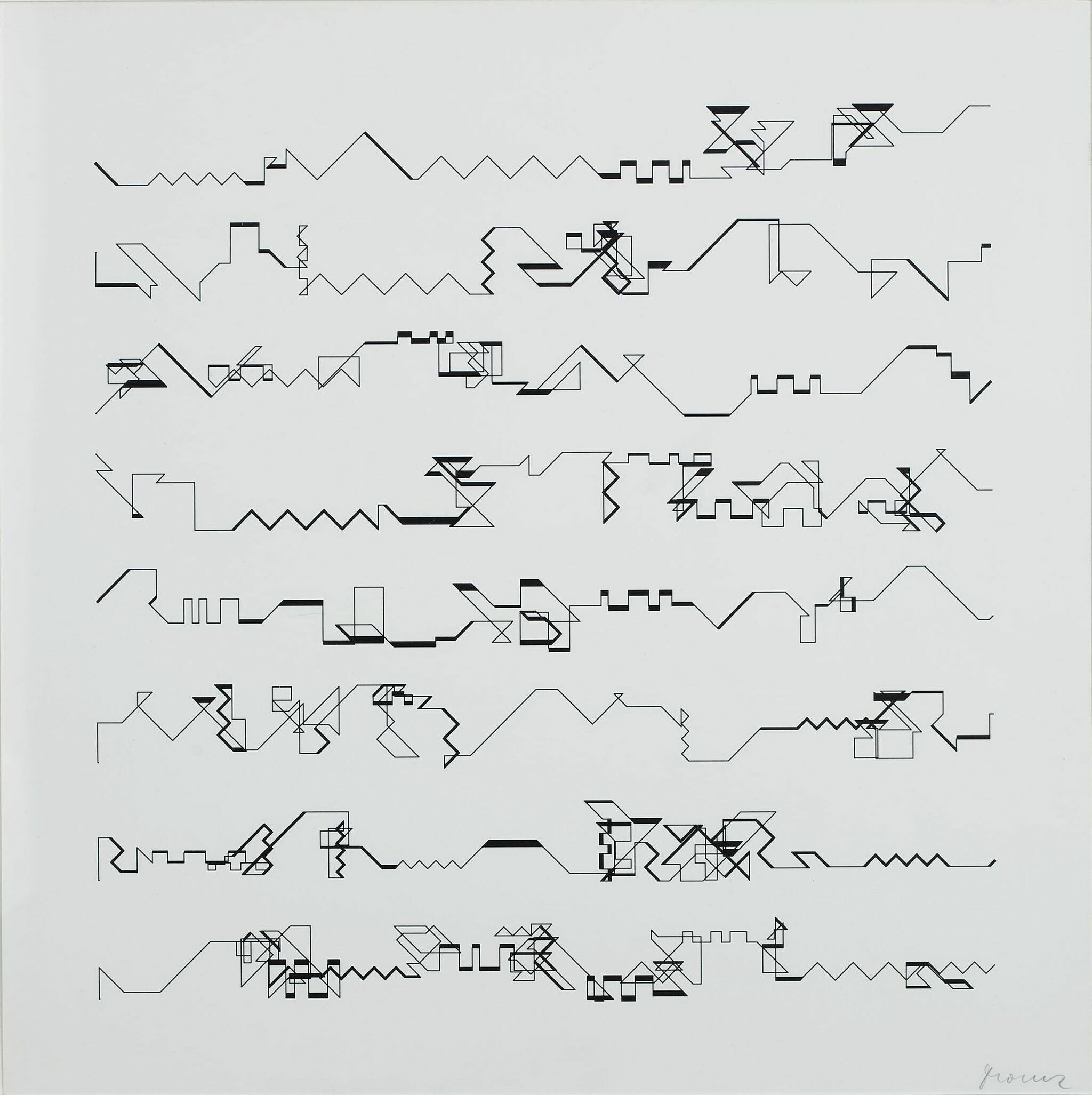
Geometric abstract shapes on white paper.

Manfred Mohr, Band Structures P-021-U, 1970–1983. Ink on paper, output from plotter, Overall: 22 1/2 x 22 1/2in. (57.2 x 57.2 cm). Collection of the artist; courtesy bitforms gallery, New York

Manfred Mohr, Band Structures P-021-U, 1970–1983

Folded papers with a geometric drawing on them.

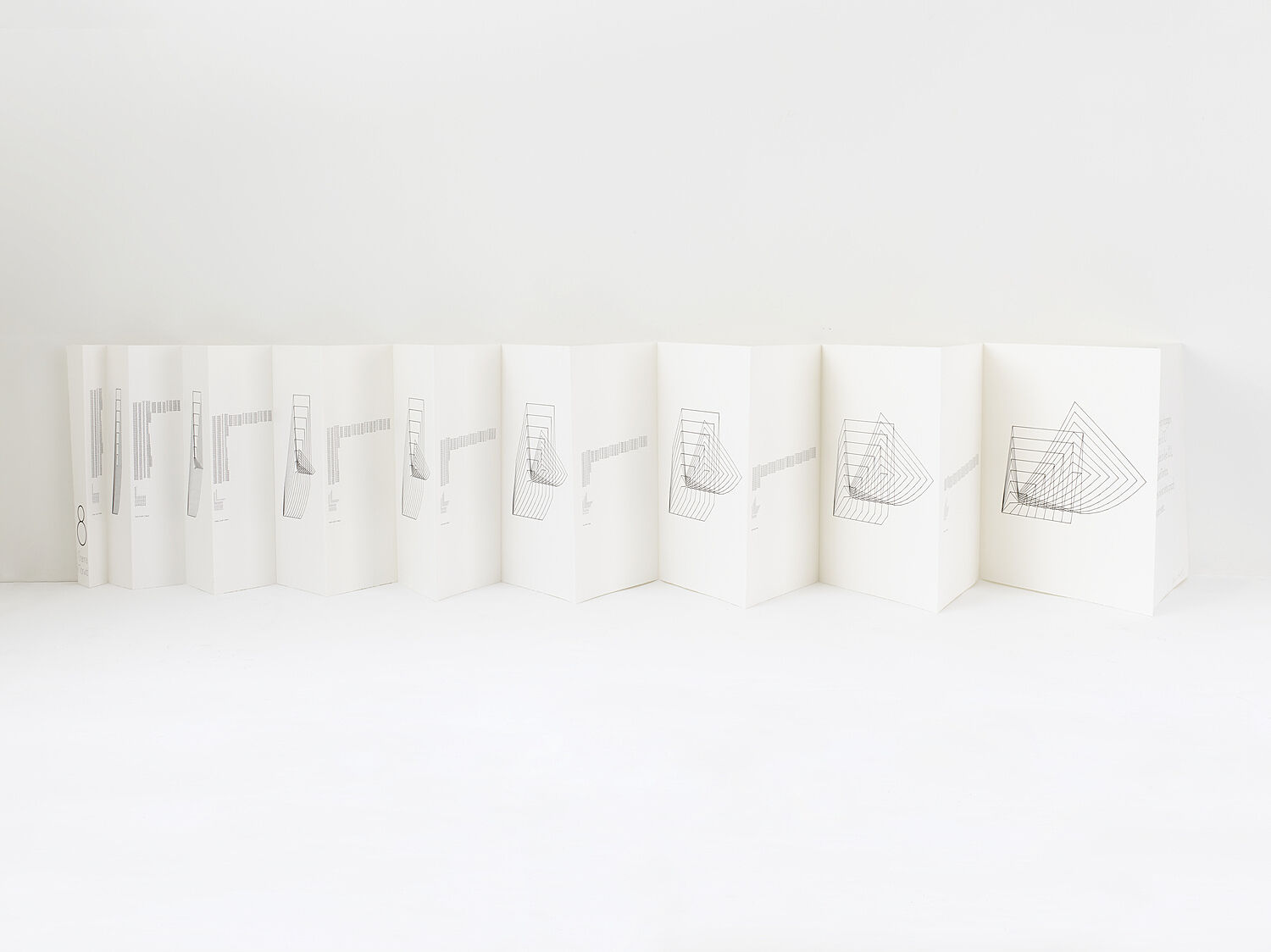
Channa Horwitz, Suite 8, 1979. Accordion-fold book with lithograph, 22 x 20 1/2 in. (55.9 x 52 cm), closed; 22 x 200 in. (55.9 x 508 cm), open. Purchase, with funds from the Print Committee.  2018.176

Channa Horwitz, Suite 8, 1979


Artists


Explore works from this exhibition
in the Whitney's collection

View 67 works

On the Hour

A 30-second online art project:
Frank WANG Yefeng, The Levitating Perils #2

Learn more about this project

Learn more at whitney.org/artport

On the Hour projects can contain motion and sound. To respect your accessibility settings autoplay is disabled.