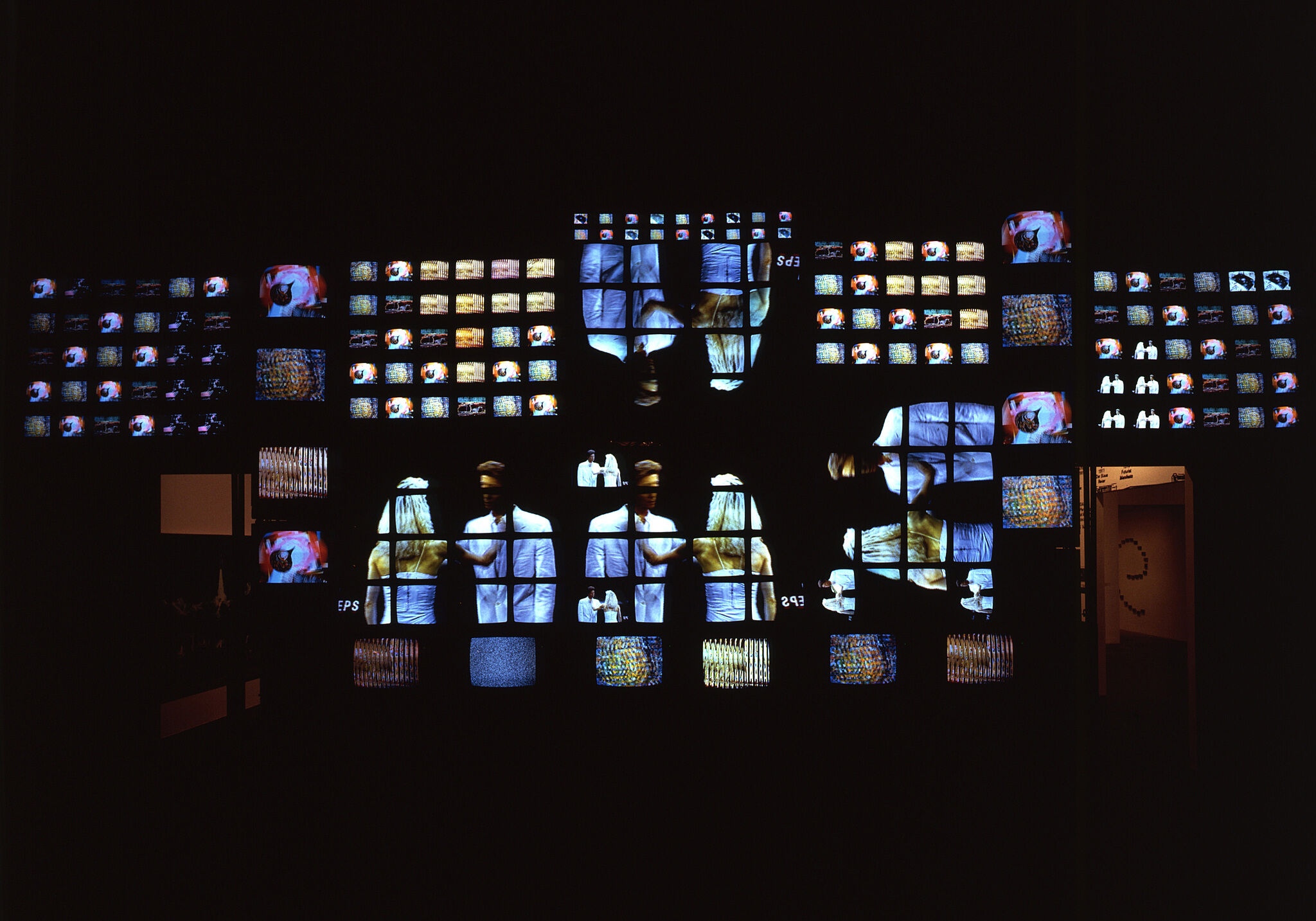
Several of the “programmed” works here reflect on how rules and code are used to rearrange images. Nam June Paik’s massive wall of televisions, Fin de Siècle II, for example, choreographs music videos and “dissolves” the television program into combinations of dancing patterns, providing a different framework to understand broadcasting. Other works resequence images while engaging with such varied subject matter as image processing, interactive storytelling, and political commentary. Steina’s multichannel video installation Mynd investigates the aesthetic effects of software processing, while Lynn Hershman Leeson’s interactive installation Lorna prompts visitors to navigate a branching narrative with multiple endings and the two works from Barbara Lattanzi’s series C-Span x 4 annotate news reportage with subtitles borrowed from a political sci-fi film or karaoke-format song lyrics.
To create the monumental Fin de Siècle II, Nam June Paik edited and reconfigured sequences from previously broadcast television programs and art videos, drawing out formal commonalities and patterns in seemingly disparate images. He thus liberates the moving images, which include close-up footage of David Bowie’s face and choreography performed by both a human dancer and the schematic outline of one, from their original contexts. Paik used televised programs as his medium but also programmed the work itself to arrange the image sequences in a predetermined composition. Fin de Siècle II reflects how programming saturates and shapes our world, both through media content and through the underlying technological mechanisms that structure and transmit such content.
Paik made this work for Image World: Art and Media Culture, a 1989 Whitney Museum exhibition. Restored with partial replacement of its televisions and processor, Fin de Siècle II is presented in this exhibition at full scale for the first time since then.
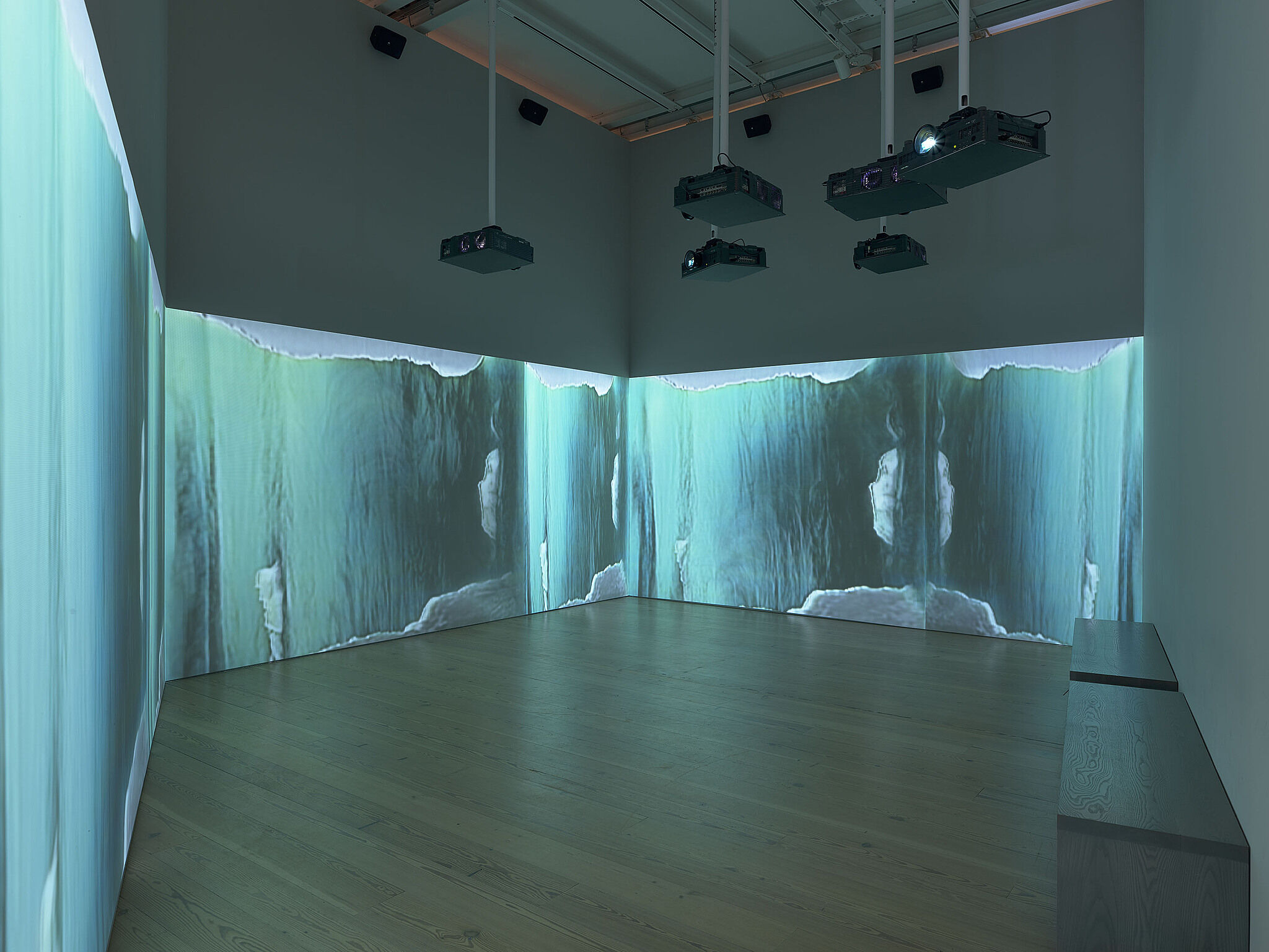
Installation view of Programmed: Rules, Codes, and Choreographies in Art, 1965–2018 (Whitney Museum of American Art, New York, September 28, 2018–April 14, 2019). Steina, Mynd, 2000. Photograph by Ron Amstutz
Steina, Mynd, 2000
To create this immersive video installation, Steina used Image/ine, a video-editing software for Macintosh computers that she co-developed in 1996 to process video footage in real time. Unlike other video-editing programs, Image/ine allows for the immediate manipulation of source material. For this work, Steina’s base footage includes Icelandic landscapes, horses grazing, and images of the Atlantic Ocean. The programming language’s “time-warp” function edits the source material as horizontal or vertical lines traveling through the frame, while the “slit-scan” function freezes a single line in the frame, capturing it as a stream of running images. In this work, the two different kinds of processing appear projected next to each other, juxtaposing the two different processes of image manipulation.
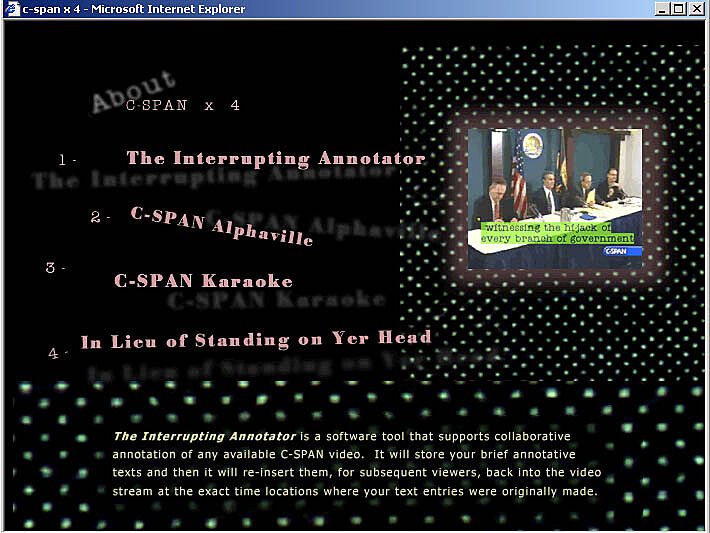
Barbara Lattanzi (b. 1950), C-SPAN Karaoke and C-Span Alphaville, 2005, from the series C-SPAN x 4. Video documentation of real-time software (RealPlayer, Shockwave, QuickTime). Commissioned by the Whitney Museum of American Art for its artport website AP.2005.1
Barbara Lattanzi, C-SPAN Karaoke, C-SPAN Alphaville (from C-SPAN x 4 series), 2005
Barbara Lattanzi created C-SPAN x 4 as a series of four online software tools that allowed visitors to the website of the Cable-Satellite Public Affairs Network (C-SPAN) to select video clips and manipulate and remix them. Since the original software is not functional anymore, two of the tools—C-SPAN Karaoke and C-SPAN Alphaville—are documented here through screen captures. In C-SPAN Alphaville, the video clips are subtitled with dialogue from the English-language version of Jean-Luc Godard’s 1965 film Alphaville, in which a dystopian society is controlled by a central computer. C-SPAN Karaoke overlays prerecorded tracks from a karaoke machine onto selected videos, inviting people to sing along. Although humorous, these annotations nonetheless raise serious questions about authority and projections of state power within the online media environment.
Watch video demos for C-SPAN Karaoke and C-SPAN Alphaville (from C-SPAN x 4 series) on the Whitney’s artport site.
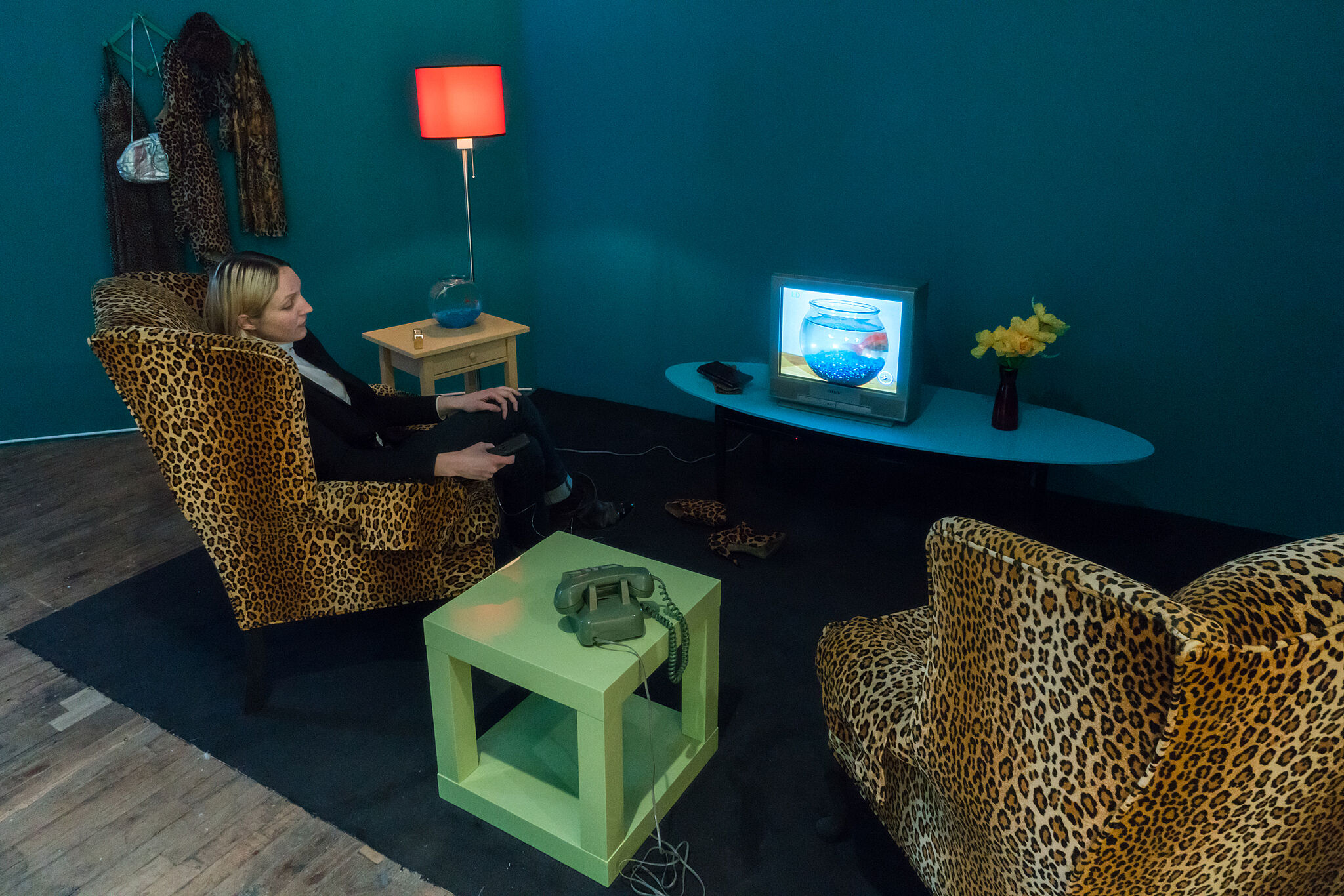
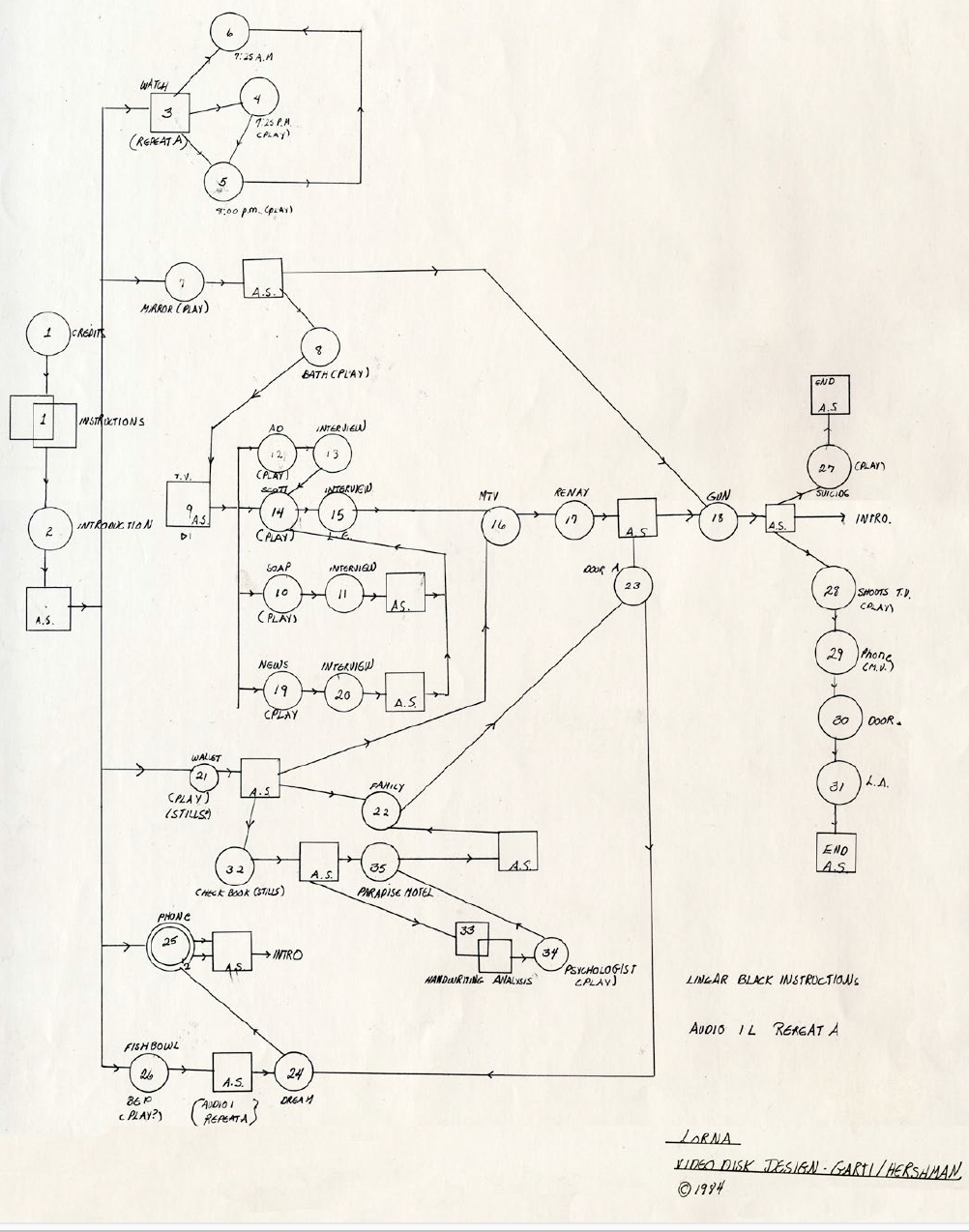
Lynn Hershman Leeson’s Lorna is one of the earliest examples of interactive art of the 1970s to explore nonlinear storytelling. It is also the first interactive artwork on LaserDisc, a now obsolete digital-storage technology that was introduced commercially in the late 1970s. The project invites visitors to use a remote control to navigate Lorna’s branching story, which unfolds on the television screen. The installation mirrors the environment that Lorna, an agoraphobic fearful of leaving her apartment, inhabits in the TV set. Depending on the path chosen, there are three possible endings to the narrative: death, escape, or the destruction of the TV. The work addresses the role of women in mediated society, with its interaction mechanism serving as a metaphor for the ways in which Lorna is “remote controlled” by society and her televised existence.
See Lynn Hershamn Leeson’s diagram of pathways through Lorna’s narrative.
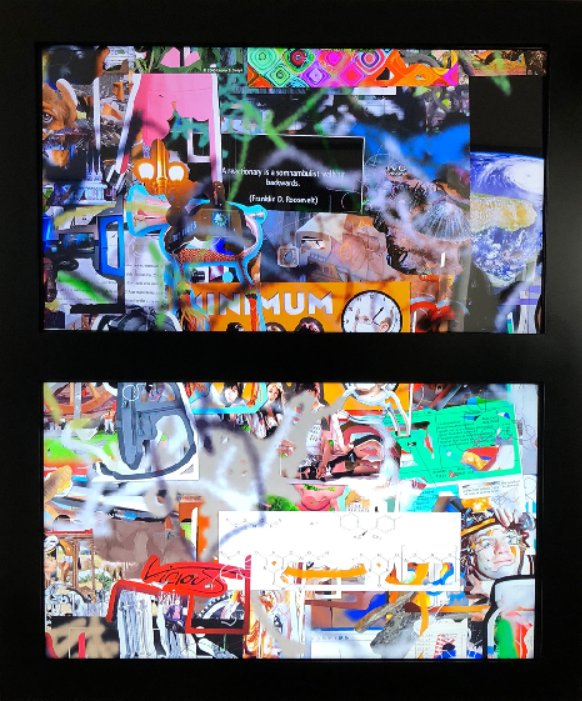
Siebren Versteeg (b. 1971), New York Double Hung, 2008. Digital collage, output from internet-connected computer program with two touch screens, 60 × 42 × 7 in. (152.4 × 106.7 × 17.8 cm). Whitney Museum of American Art, New York; gift of Robert D. Bielecki 2017.241
Siebren Versteeg, New York Double Hung, 2008
New York Double Hung is a diptych of horizontal touchscreens—which visitors are invited to operate— that shows an ever-changing collage of images compiled from a combination of internet sources. The collage is always larger than the frame of the screen, and the areas extending beyond the frame are updated and revised continuously with new information. By touching the screen and dragging the collage, in the same way one might drag an image on Google maps, the viewer can bring the newly created sections into view but other areas are simultaneously being redrawn. Siebren Versteeg’s programming “hand” is a persistent presence working just outside of what is visible, thereby pointing to the algorithms driving the internet beyond the small window of information we encounter on our screens.
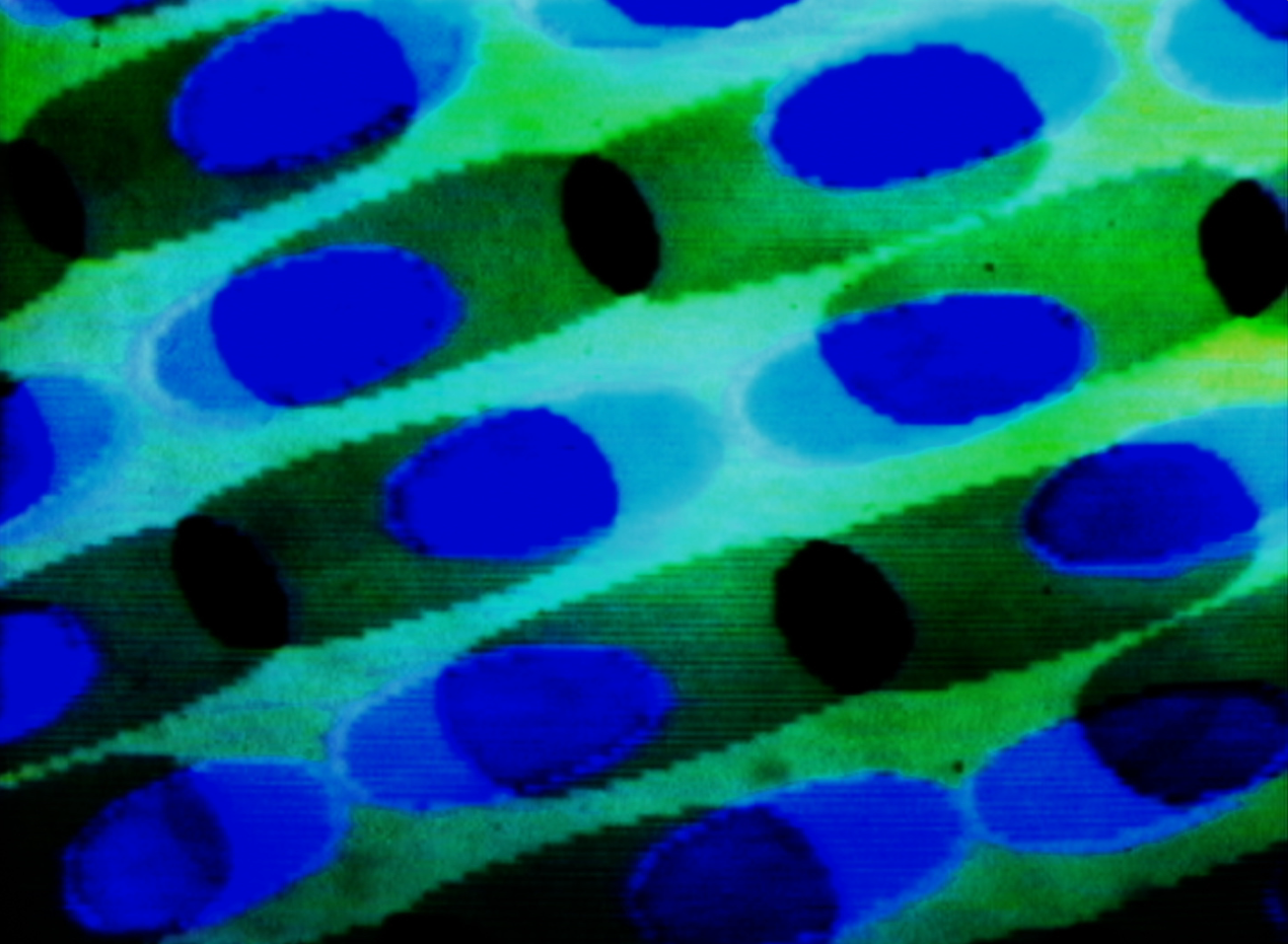
Lillian Schwartz made these pioneering computer generated films at AT&T Bell Laboratories, where she was artist-in-residence from 1969 to 2002.
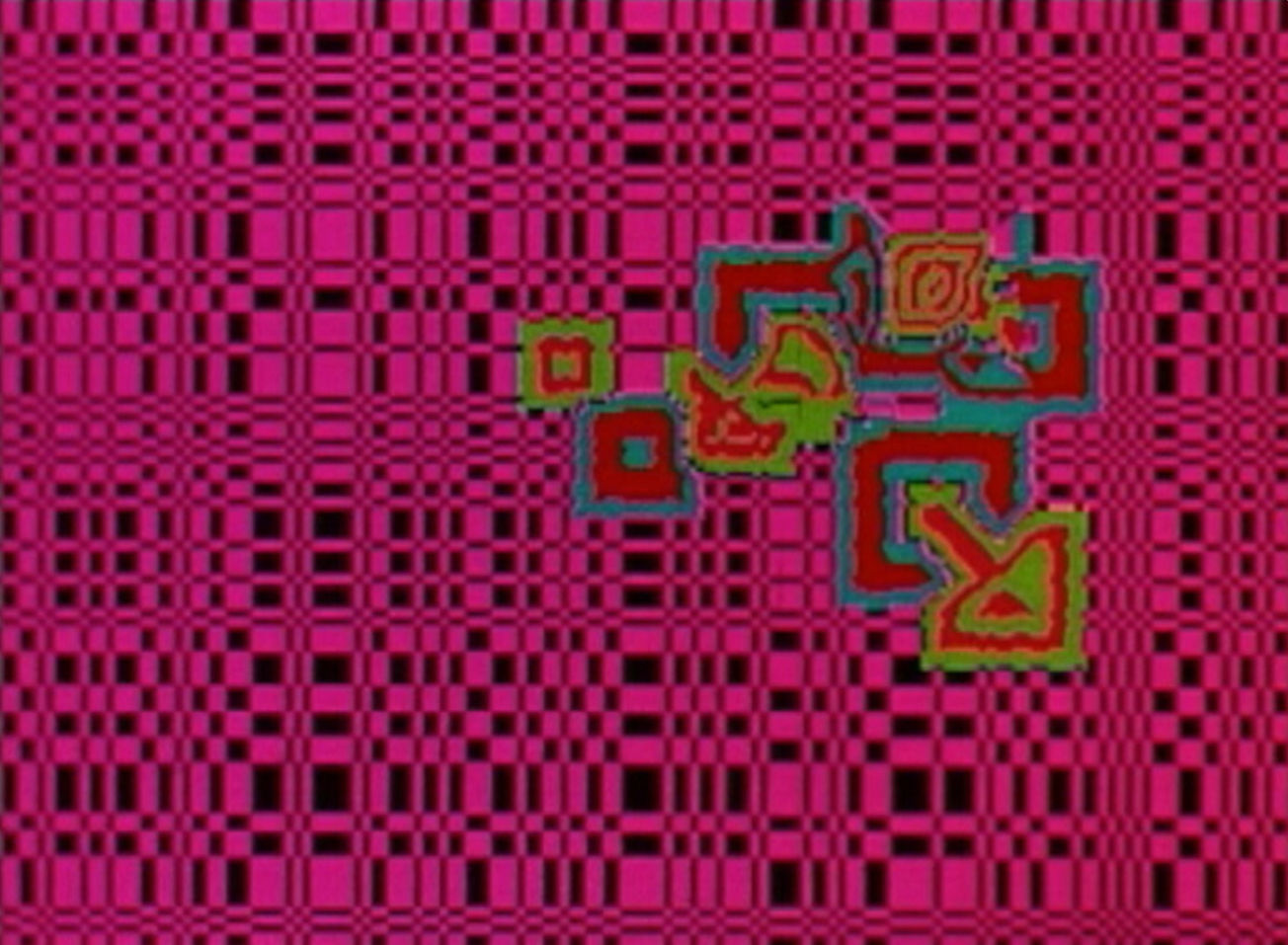
In Newtonian I Lillian Schwartz draws upon mathematical systems to create the illusion of three-dimensional images. Schwartz was interested in the unpredictability of the macro language systems used to create this films, which generated unexpected forms by randomly selecting the areas and shapes into which they would grow.
Lillian Schwartz made these pioneering computer generated films at AT&T Bell Laboratories, where she was artist-in-residence from 1969 to 2002.
To create Enigma, Schwartz used EXPLOR, a programming macro language (a program that specifies an output sequence based on a defined input) written in Fortran that divides the screen into a grid of pixels and generates images as patterns of dots that form in randomly generated areas. The film rapidly shifts between black and white rectangular forms, creating the perception of strobing color. In the second half, Schwartz hand-colored the film to explore chromatic interactions.