Stuart Davis: In Full Swing | Art & Artists

June 10–Sept 25, 2016


Exhibition works

7 total
The 1930s
Read more

The 1930s


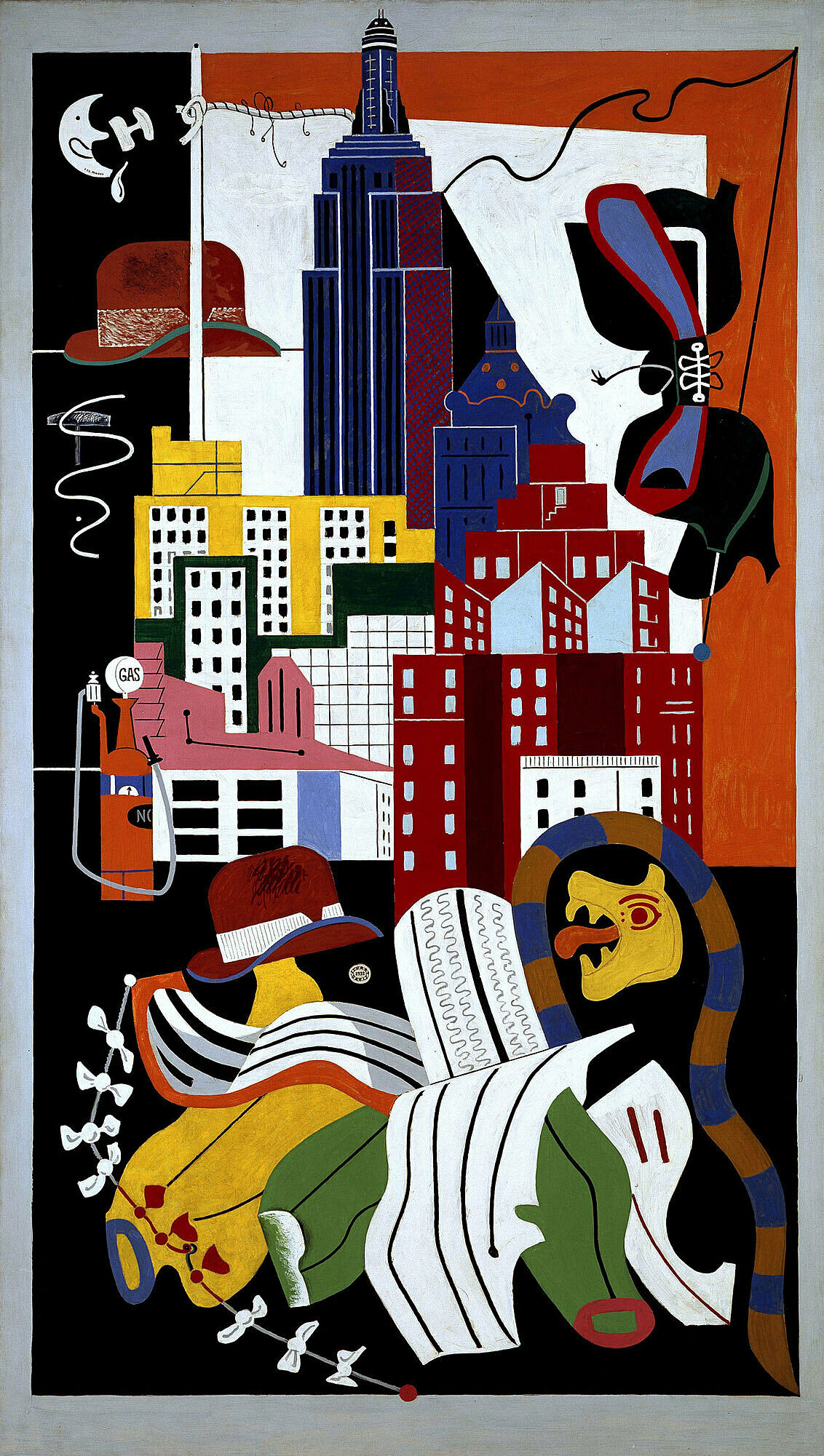
An abstract painting of the cityscape.

Stuart Davis, New York Mural, 1932. Oil on canvas, 84 × 48 in. (213.4 × 122 cm). Norton Museum of Art, West Palm Beach, Florida; purchase, R. H. Norton Trust. © Estate of Stuart Davis/Licensed by VAGA, New York

The 1930s

Davis's finances, which were always precarious, plummeted after the 1929 stock market crash. Like many others in similar circumstances, he turned to collective action, throwing himself into political activism on behalf of artists' economic rights and freedom of expression. Between 1934 and 1940, he served as a leading member of the Unemployed Artists Group and the Artists' Committee of Action, vice president of the Artists Union, editor of the left-wing journal Art Front, and vice president and ultimately president of the American Artists' Congress. Combined with his prolific writing, his activism left little time for painting. He later described the period as "meetings, articles, picket lines, internal squabbles. Everything was hectic. Lots of work done but little painting."

Davis's aesthetic output during this period was primarily murals, an art form that enjoyed widespread popularity during the Great Depression thanks to the various government agencies established under President Franklin Delano Roosevelt to provide financial support to artists by commissioning murals for public buildings. Working against the realistic depictions of daily life and historical events that characterized most government-funded murals, Davis pushed toward greater abstraction in the five murals he made in the 1930s. By treating the space between objects as flat planes of vibrant color and overlapping the forms in his compositions so that they became fragmented shapes, he channeled the kaleidoscopic sensations of modern life into an animated equilibrium.

Below is a selection of works from The 1930s.

0:00

Stuart Davis, New York Mural, 1932

0:00

Barbara Haskell: Davis made New York Mural in response to a call from the Museum of Modern Art for a show they were doing of murals by painters and sculptors. So it was the largest painting he'd made to date. It shows New York City, but in a sense it's also an object portrait of Al Smith who was the four term governor of New York who had lost the bid for the presidency in 1928.

Narrator: Davis with a big fan of Smith, a populist who—crucially, from Davis’s perspective—opposed the Prohibition. Davis pictures objects associated with the governor: derby hats and the Empire State Building, for example. In the upper left corner, the moon throws back a glass of champagne. And a tiger with a serpent’s tail alludes to Tamany Hall, the Democratic political machine that dominated New York City Politics.

Murals were perhaps the definitive art form of the Great Depression, as government agencies hired artists to adorn public buildings and inspire a downtrodden public. Most of them portrayed grand figures in a classical style. Modernist works like this one were out of favor. Davis painted relatively little through much of the 30s. During this time he became very active in left-wing politics, especially labor organizing for artists.

Stuart Davis, New York Mural, 1932

In Stuart Davis: In Full Swing

New York Mural, 1932

0:00

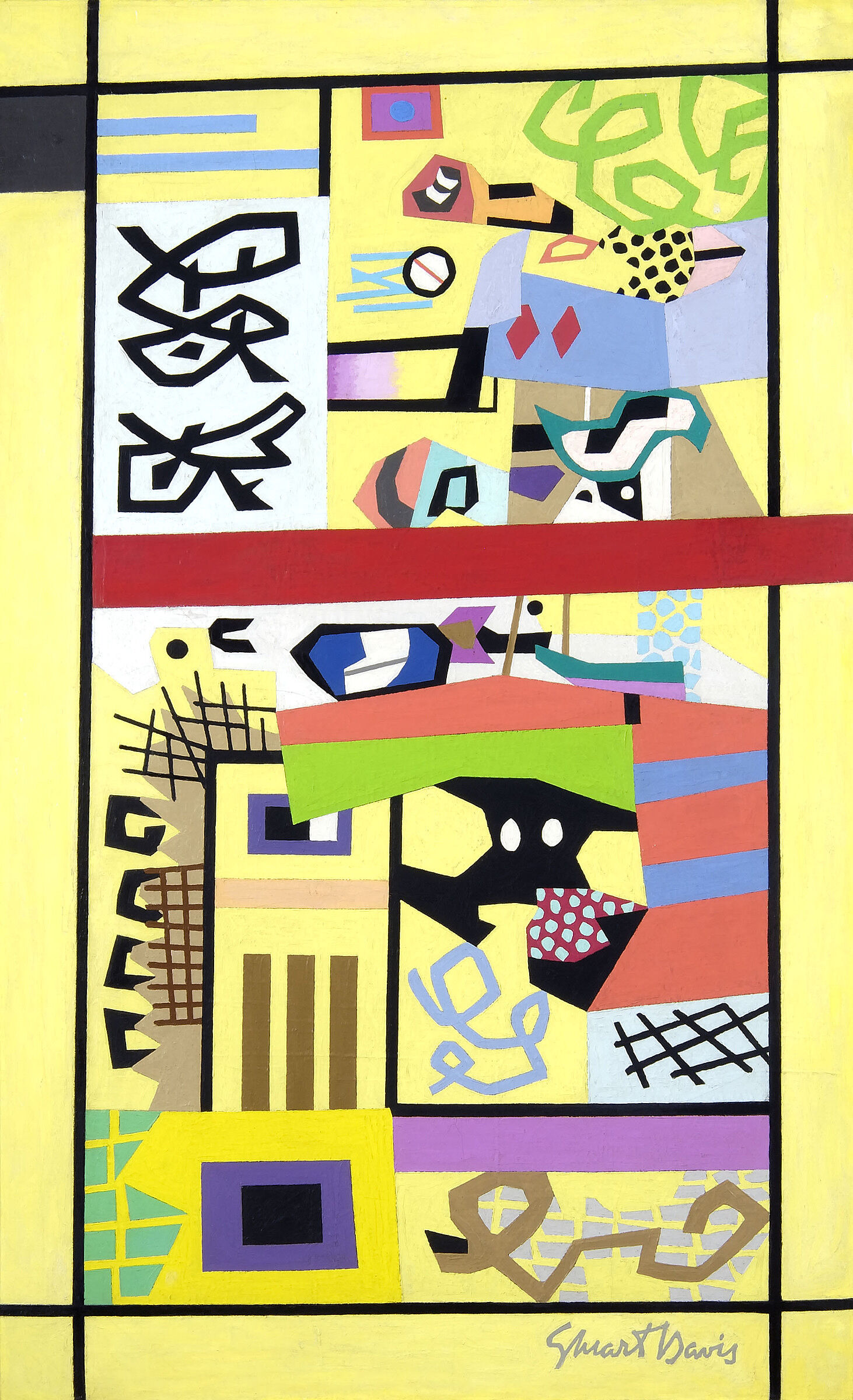
Stuart Davis, Swing Landscape, 1938

0:00

Stuart Davis: I must say that in the major part of my career, when I wanted inspiration from American art, I went to jazz music.

Narrator: In Swing Landscape, Davis openly declared one of his greatest loves, jazz. The composition is vibrant and rhythmic, patterns seeming to dance across its surface. Davis did depict some identifiable objects, most of them inspired by the fishing boats around Gloucester, Massachusetts—one of his favorite subjects. But he painted the spaces between the objects using equally intense hues. As a result, the individual parts play into the whole like instruments in big band jazz.

If you’d like to hear more of what Davis had to say about jazz, please tap the button on your screen.

Stuart Davis, Swing Landscape, 1938

In Stuart Davis: In Full Swing

Swing Landscape, 1938

Burgoyne Diller, the abstract painter who headed the New York mural division of the WPA’s Federal Art Project, convinced officials in charge of a low-income housing project in Williamsburg, Brooklyn, to commission abstract murals for twelve of the complex’s basement meeting rooms. Swing Landscape was Davis’s contribution. Using sketches he made of the waterfront in Gloucester, Massachusetts, he transformed masts, rigging, lobster traps, ladders, and striped poles into a vocabulary of overlapping, brightly colored shapes, all of equal intensity. To Davis, the result portrayed the “new materials, new spaces, new speeds, new time relations, new lights, and new colors” of modern America. The work garnered an enthusiastic response from critics and other artists, one of whom, John Graham, called it the “greatest American painting.” But as with several other abstract murals commissioned for the housing project, Swing Landscape was never installed. Instead, it was put in storage until 1942, when the government transferred its ownership to Indiana University.

0:00

Stuart Davis, Mural for Studio B, WNYC, Municipal Broadcasting Company, 1939

0:00

Harry Cooper: What are we looking at? [laughs] Again, the title and the context give us a few hints. This is about radio broadcasting. We're before the age of television. It's WNYC radio station, very important station, broadcasting all kinds of things, including jazz, including the music that Davis loved.

The saxophone, if we follow it to the right, gets linked to this central gray area, with what looks like a bit of sky, maybe a mast and some rigging. 

His art is based in large part on sharp contrast. He loved contrast. He did not want to blend, he didn't want to meld, it's in his technique and in his composition. We see it very clearly here, putting things next to each other that may be very different, not only in subject, but in treatment.

The centerpiece here is largely about line. There's not so much color. There's gray, black, a little bit of blue and orange. The saxophone area is all about color, color shapes, not so much about line.

He's put them next to each other. The saxophone is on top of, or entering into, the other space. There's a spark that happens that he's interested in when compositions don't all fit together. Many of his paintings, we see a half and half structure almost aligned down the middle, two separate halves.

We see that in other paintings in the exhibition. Here you don't quite have that, but you have distinct areas which then raise these questions about how they are, or are not, related.

Stuart Davis, Mural for Studio B, WNYC, Municipal Broadcasting Company, 1939

In Stuart Davis: In Full Swing

Mural for Studio B, WNYC, Municipal Broadcasting Company, 1939

Several months after Davis completed Swing Landscape for the Federal Art Project, the agency commissioned him to create a mural for the broadcasting room of New York’s public radio station, WNYC. Again Davis drew upon his sketches of the Gloucester harbor, mixing marine images with those of musical instruments and radio-transmission technology. For him, the juxtaposition of seemingly unrelated imagery reflected the way he imagined people remember scenes or events: “Certain aspects of it are exaggerated and others are suppressed. The scene is rearranged and recomposed according to the importance and meaning which the different elements had for the spectator.”

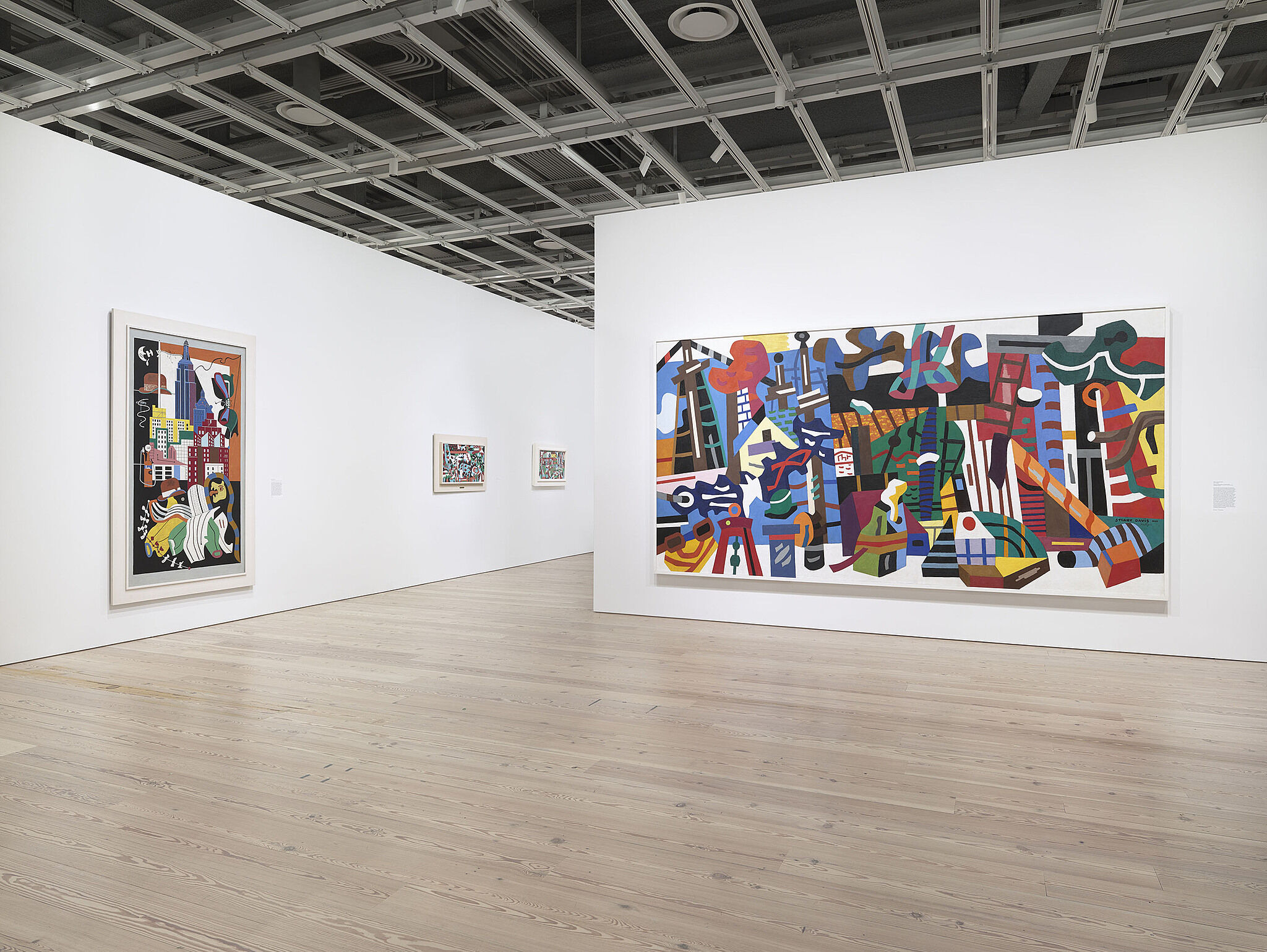
Installation view of Stuart Davis: In Full Swing (Whitney Museum of American Art, New York, June 10–September 25, 2016). Photograph by Ron Amstutz


Explore works from this exhibition
in the Whitney's collection

View 7 works

On the Hour

A 30-second online art project:
Frank WANG Yefeng, The Levitating Perils #2

Learn more about this project

Learn more at whitney.org/artport

On the Hour projects can contain motion and sound. To respect your accessibility settings autoplay is disabled.