Stuart Davis: In Full Swing | Art & Artists

June 10–Sept 25, 2016


Exhibition works

7 total
Product Still Lifes, 1921–25
Read more

Product Still Lifes, 1921–25


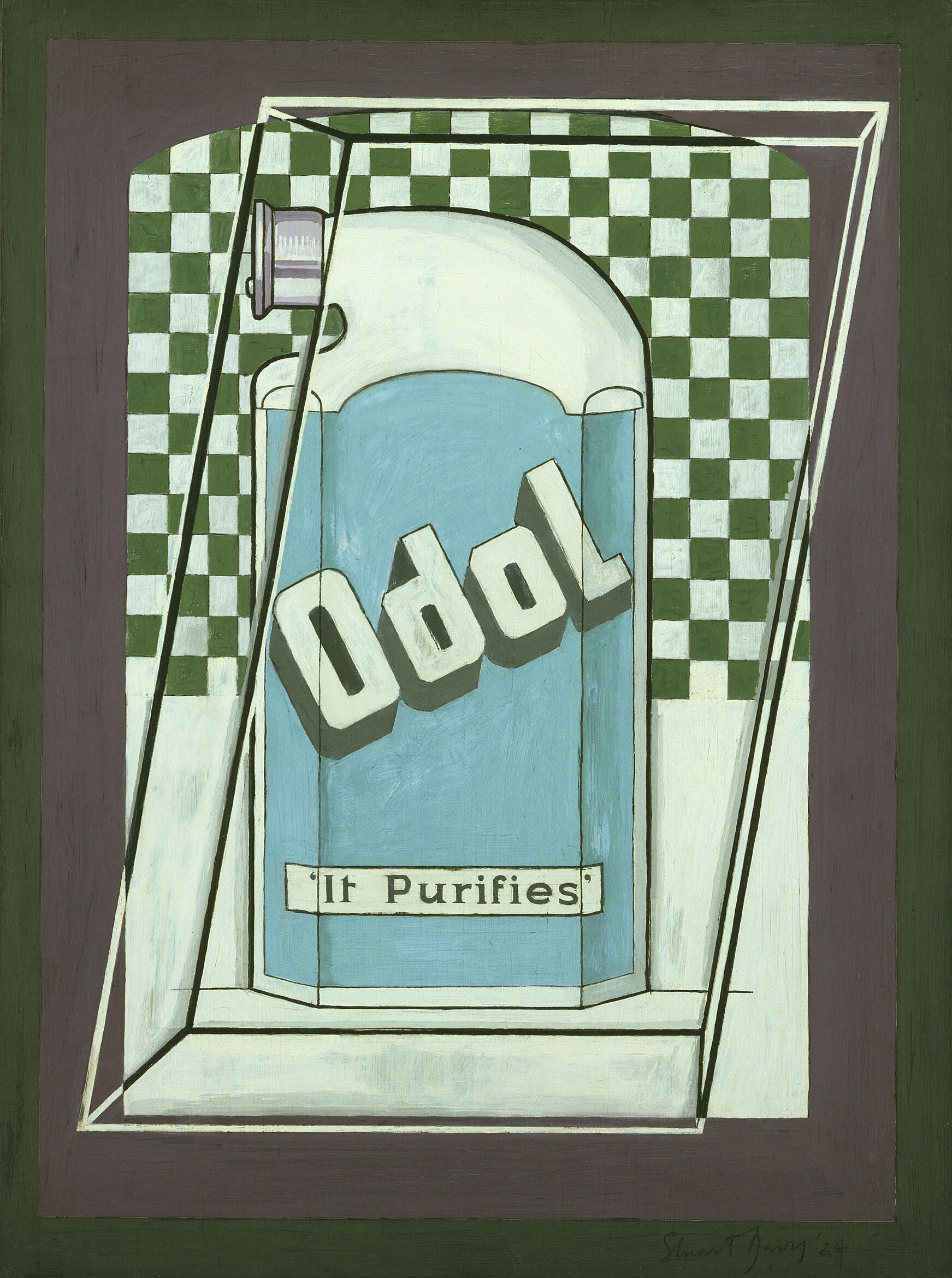
A painting of mouthwash labeled "Odol."

Stuart Davis, Odol, 1924. Oil on cardboard, 24 x 18 in. (60.9 x 45.6 cm). The Museum of Modern Art, New York; Mary Sisler Bequest (by exchange) and purchase, 1997. © Estate of Stuart Davis/Licensed by VAGA, New York, NY

Product Still Lifes,
1921–25

The 1920s saw an unprecedented proliferation of advertisements, mass-market products, and commercial packaging. Convinced that these elements of popular culture were expressions of modern America, Davis used them as subject matter, replacing traditional still-life props with imagery derived from consumer goods: packages of brand-name cigarette paper and loose tobacco, Odol mouthwash, and Edison Mazda electric bulbs. By exploiting the conventions of both advertising graphics and vanguard European art to depict mass-produced items associated with America, Davis created art that conveyed a distinctly national and modern experience. He likened these paintings to the exuberant poetry of Walt Whitman: "I too feel the thing Whitman felt and I too will express it in pictures America the wonderful place we live in." Davis's still lifes of consumer products were prescient; not until the 1960s would other artists so enthusiastically embrace the imagery of popular culture.

Below is a selection of works from Product Still Lifes, 1921-25.

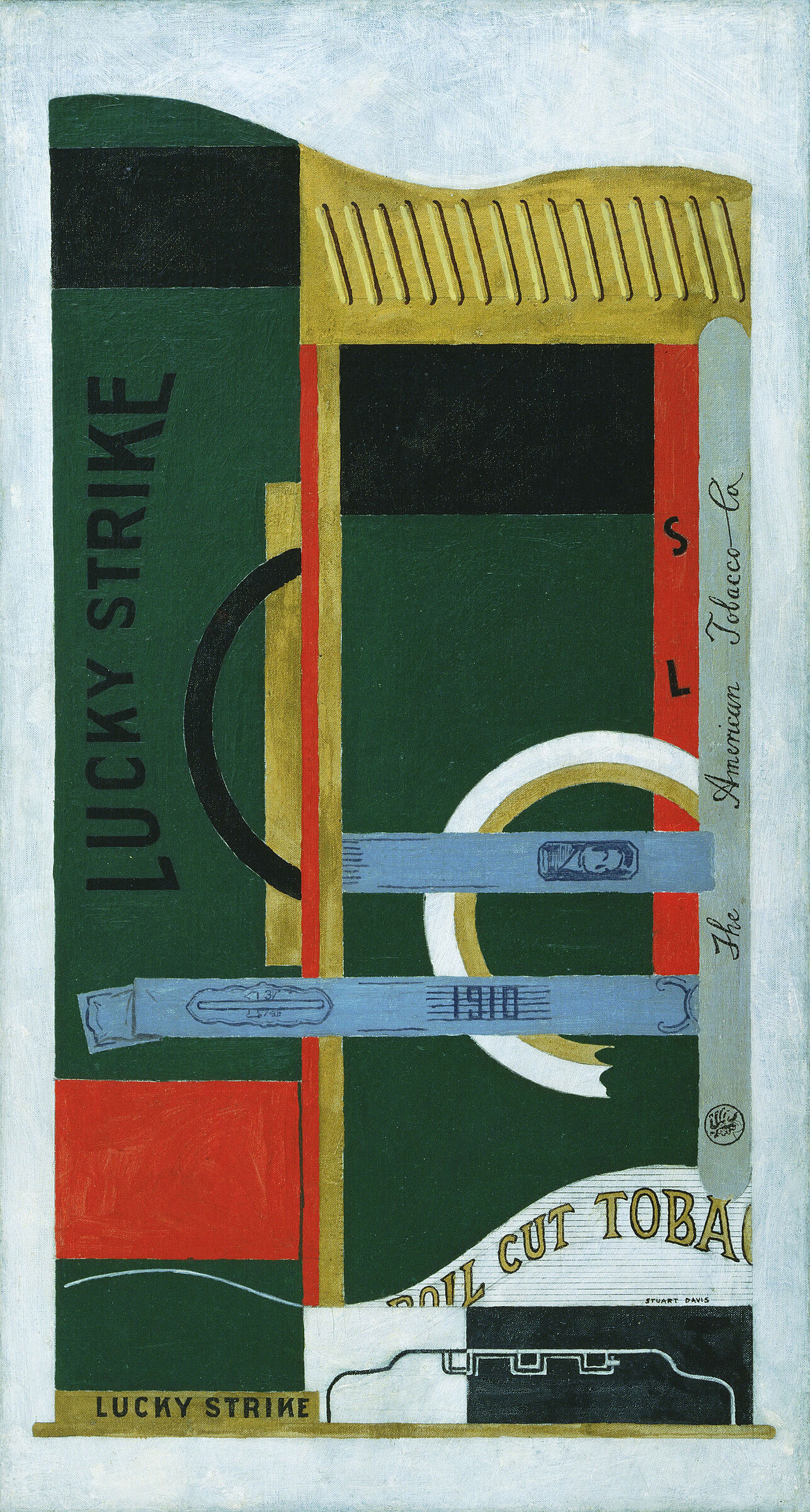
A painting of a Lucky Strike tobacco container.

Stuart Davis, Lucky Strike, 1921. Oil on canvas, 33 1/4 x 18 in. (84.5 x 45.7 cm). The Museum of Modern Art, New York; gift of the American Tobacco Company, Inc., 1951. © Estate of Stuart Davis/Licensed by VAGA, New York

Lucky Strike, 1921

At first glance, Lucky Strike looks like one of the Cubist paper collages that Pablo Picasso and Georges Braque introduced in Europe in the 1910s. Upon closer inspection, however, it becomes clear that rather than pasting pieces of paper on canvas, Davis illusionistically painted the two-dimensional design of a flattened package of loose tobacco. The widespread distribution of packaged tobacco to U.S. soldiers fighting overseas in World War I had made cigarettes a potent symbol of America, and by 1920, smoking had become pervasive. By using a vocabulary of flat geometric shapes to depict an American product, Davis created a Cubist painting that communicated a distinctly national experience.

0:00

Stuart Davis, Lucky Strike, 1924

0:00

Narrator: The cigarettes, pipe, matches, and newspaper in this still life all angle subtly away from the picture plane. The resulting space feels very shallow—almost flat, but with just enough sense of depth to create a sense of visual energy. Davis first discovered this kind of space in Cubist works on view at the 1913 Armory Show—the exhibition where most American artists first encountered European Modernism. 

Davis spent much of the next decade exploring this visual vocabulary, finally making it his own in the 1920s—in part by focusing on elements of American popular culture, like Lucky Strike cigarettes. And even when he drew on some of the Cubists’ favorite subjects—like the newspaper—Davis gave them his own spin.  

Mark Joshua Epstein: We know that Davis worked for a couple of years for a leftwing magazine called The Masses in the early 1910s, and that he was responsible for doing illustrations. 

NarratorMark Joshua Epstein is a painter and an Educator at the Whitney.

Mark Joshua Epstein: And we also hear that he bristled against having people write captions for his illustrations. So in this painting what’s hilarious to me is that he’s taken on the role of both the illustrator and the caption writer, but the captions have become these abstract brush strokes. 

Stuart Davis, Lucky Strike, 1924

In Stuart Davis: In Full Swing

Lucky Strike, 1924

A painting of mouthwash labeled "Odol."

Stuart Davis, Odol, 1924. Oil on cardboard, 24 x 18 in. (60.9 x 45.6 cm). The Museum of Modern Art, New York; Mary Sisler Bequest (by exchange) and purchase, 1997. © Estate of Stuart Davis/Licensed by VAGA, New York, NY

Odol, 1924

0:00

Stuart Davis, Super Table, 1924

0:00

Narrator: Davis has built this painting out of flat planes, with skewed and wavering lines. The resulting composition seems mobile, unstable, hard to pin down. 

Harry Cooper: The title is a pun, a Davis pun, because we really think it should be, maybe, a supper table. 

Narrator: Harry Cooper is curator and head of modern art at the National Gallery of Art, Washington, D.C. 

Harry Cooper: What is a Super Table? What's super about it? Maybe he's playing with the idea of what's on top of the table is super and what may be below the table.

There we begin to see two very different kinds of things happening in the image, thinking on my feet here. What we see above the table are recognizable things. The cocktail glass, some drapery, a bit of a back wall, which seems to have some exposed brick, albeit it at a jaunty angle.

The most puzzling thing on the table is what looks to me like some kind of folded card, possibly with a stamp on it, which seems to depict some kind of surrealist woman or female anatomy—but I wouldn't bet on it.

That brings us below the table where we are entering a realm of abstraction. There seems to be a bright, white illumination of what? A parallelogram set inside a non parallelogram with connecting lines. I sometimes think of that as a treadle underneath a sewing machine. I really don't know. Is it part of a rug? Are we looking into a fireplace, and irons? Or is it simply a place where Davis felt free to experiment, maybe because it's under the table.

Stuart Davis, Super Table, 1924

In Stuart Davis: In Full Swing

Super Table, 1925

Davis titled this painting Super Table to humorously identify it as a superior version of the traditional tabletop still life. The work’s abstract, boldly defined forms suggest the influence of the French artist Fernand Léger, whose work Davis admired. Within the context of the United States, the painting was radical; it was one of the few works by an American to be included in the Société Anonyme’s important 1926 International Exhibition of Modern Art held at the Brooklyn Museum.

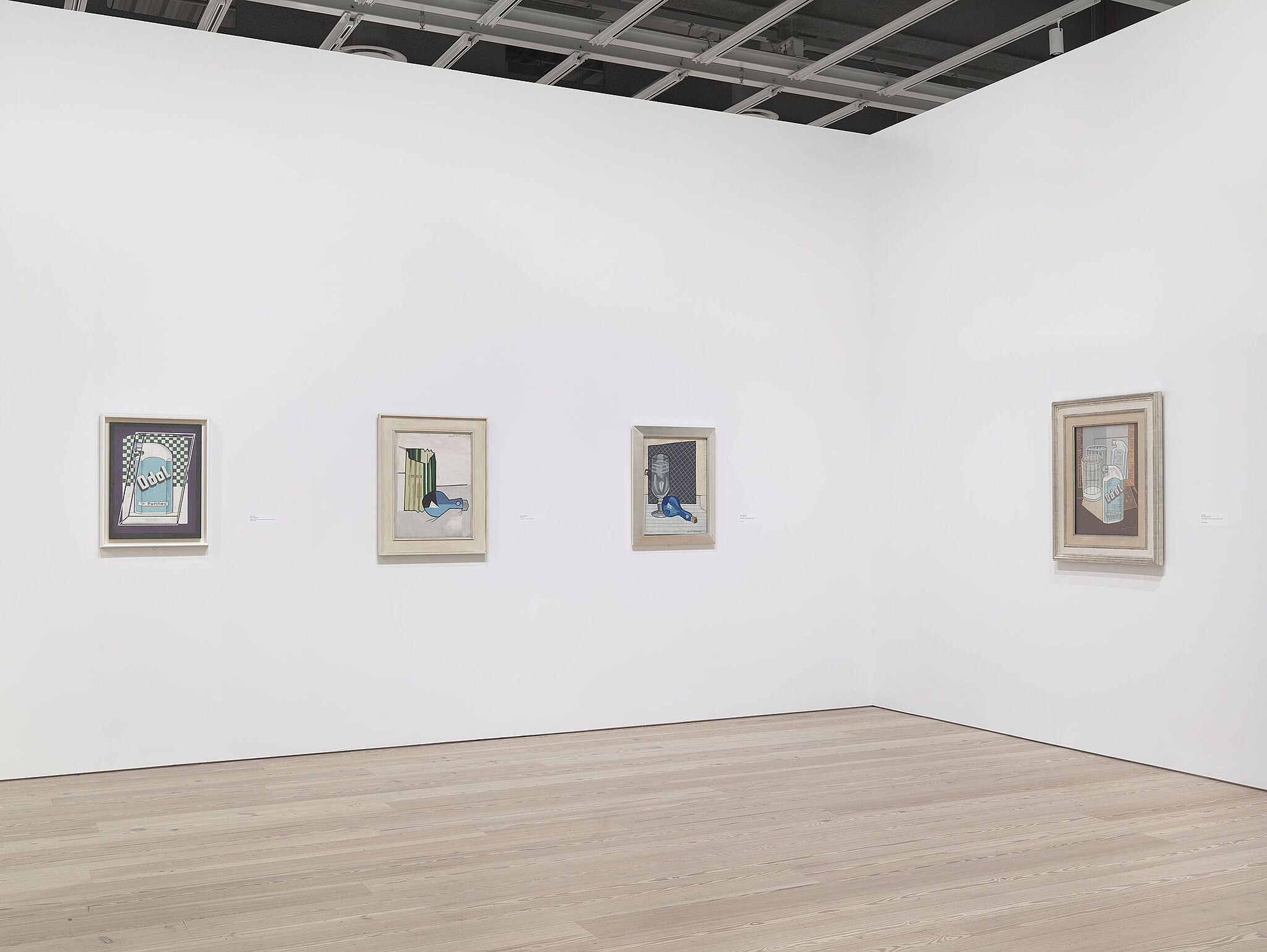
Installation view of Stuart Davis: In Full Swing (Whitney Museum of American Art, New York, June 10–September 25, 2016). Photograph by Ron Amstutz


Explore works from this exhibition
in the Whitney's collection

View 7 works

On the Hour

A 30-second online art project:
Frank WANG Yefeng, The Levitating Perils #2

Learn more about this project

Learn more at whitney.org/artport

On the Hour projects can contain motion and sound. To respect your accessibility settings autoplay is disabled.