Grant Wood: American Gothic and Other Fables | Art & Artists

Mar 2–June 10, 2018


Exhibition works

8 total
Prints, Illustrations, and Commercial Projects
Read more

Prints, Illustrations, and Commercial Projects


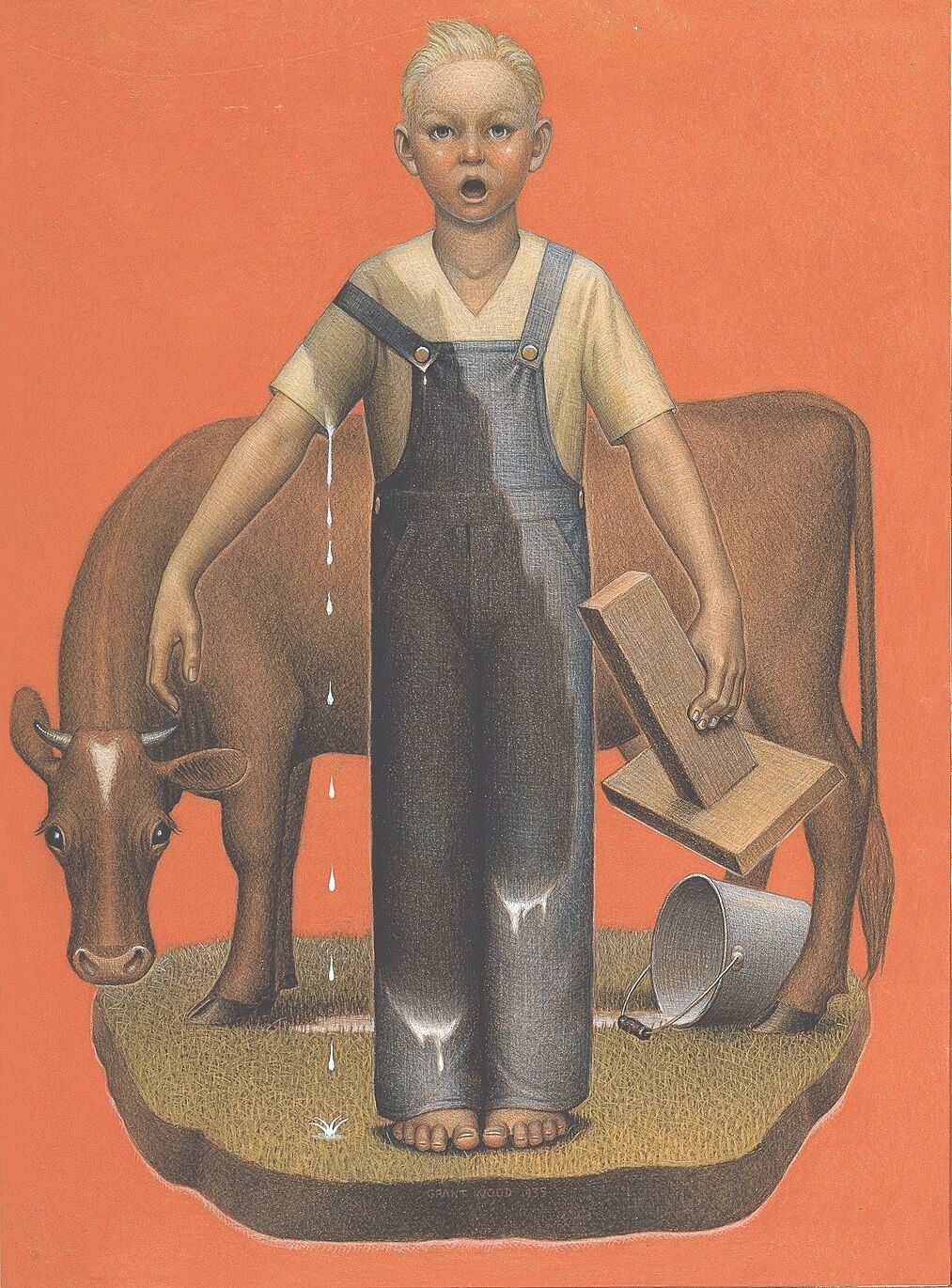
Boy standing in front of a cow with a spilt milking bucket behind him and milk on his clothing.

Grant Wood (1891–1942), Spilt Milk, 1935. Gouache on board, 26 3⁄16 x 19 1⁄2 in. (66.5 x 49.5 cm). Private collection; courtesy Sotheby’s. © Figge Art Museum, successors to the Estate of Nan Wood Graham/Licensed by VAGA, New York, NY. Image courtesy Sotheby’s

Prints, Illustrations, and Commercial Projects

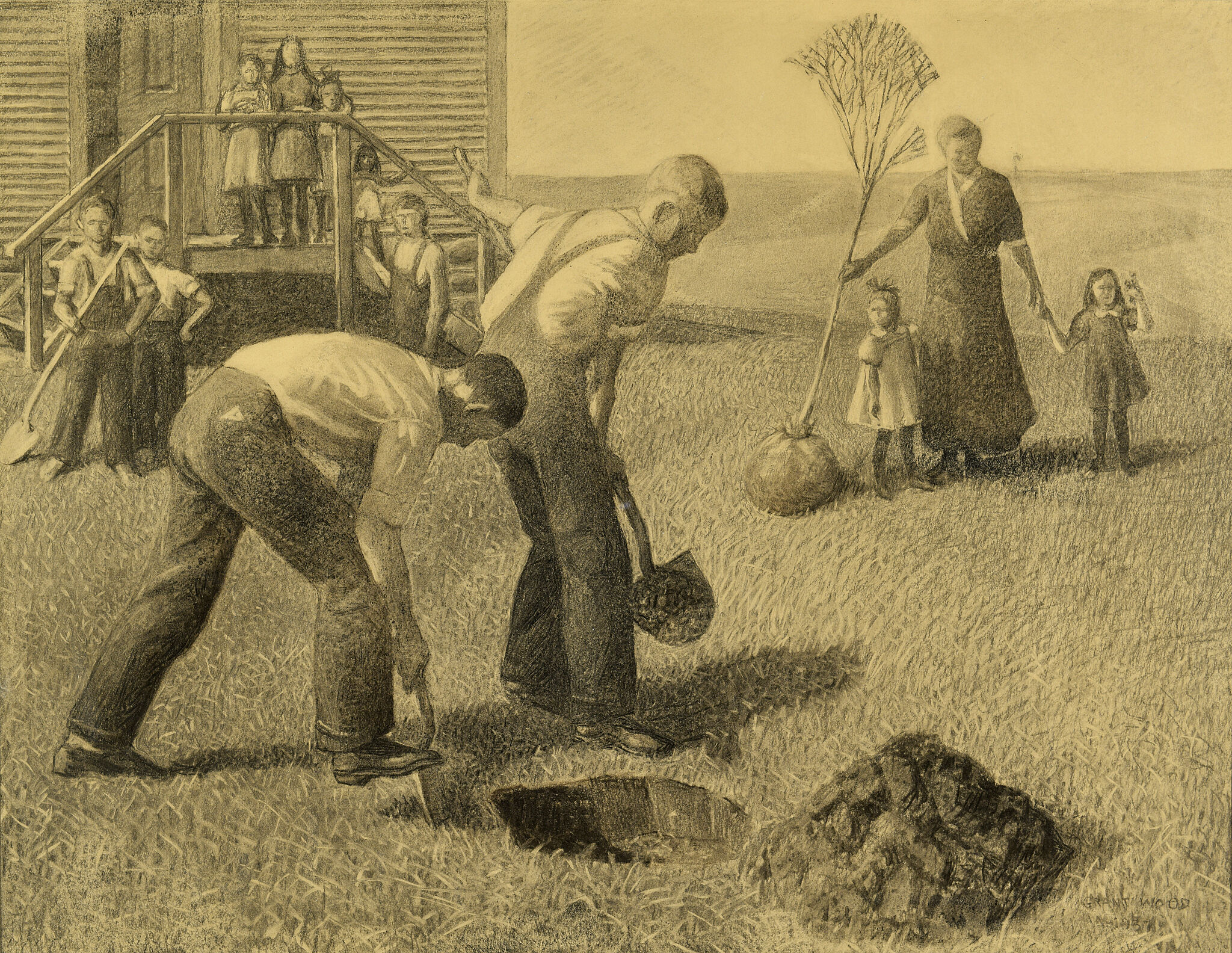
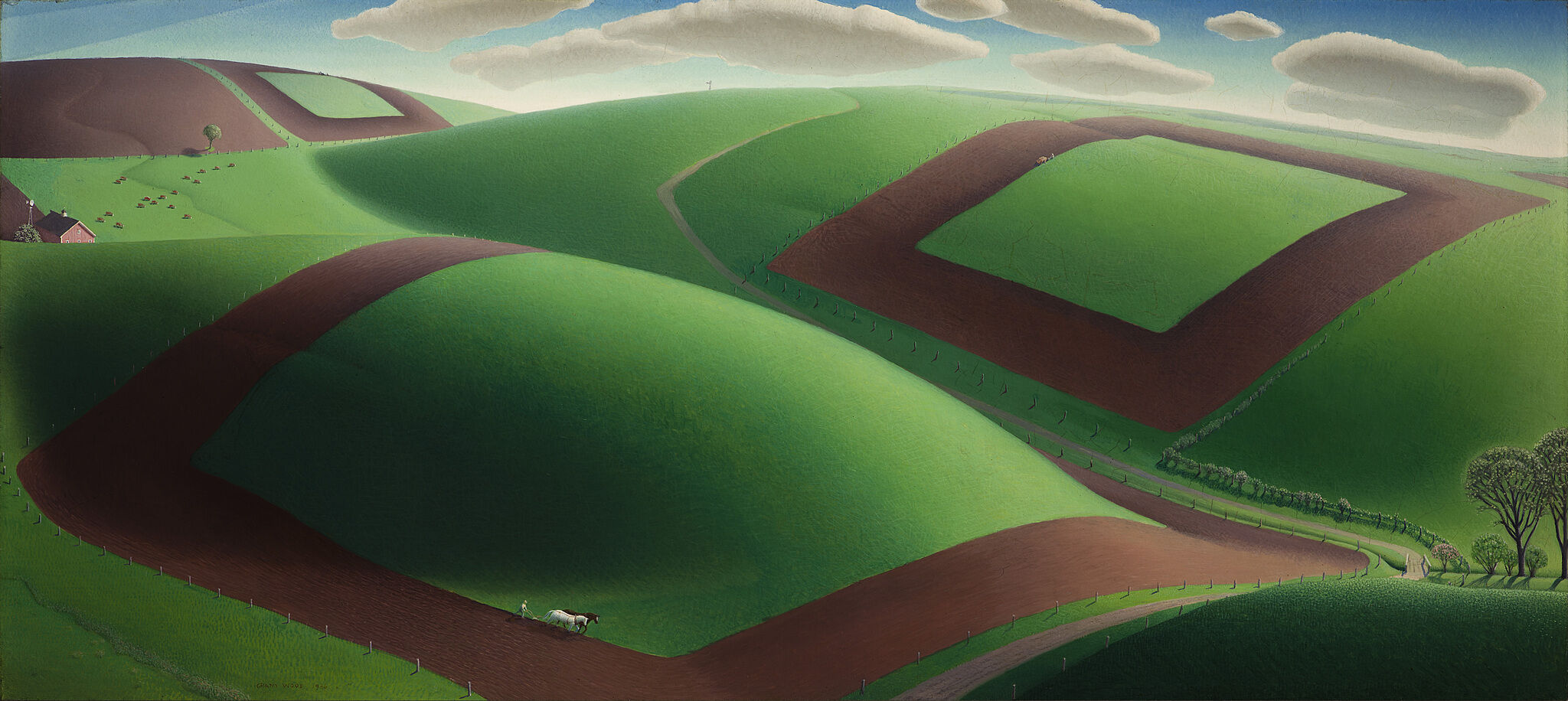
Grant Wood’s experience as a decorative artist led him to view fine and applied art as being equal. In addition to designing textiles, an armchair and accompanying ottoman, and a Steuben glass vase, he illustrated two books and made cover images for eight others. The first book he illustrated was the 1935 children’s book Farm on the Hill, written by Madeline Darrough Horn. In 1936, he illustrated a deluxe publication of Sinclair Lewis’s novel Main Street (1920). As he often did with his paintings, he asked friends to pose for the illustrations, dressing them in costume for the occasion. 

Wood’s desire to reach a broad audience with his art likewise led him to make lithographs through the Associated American Artists (AAA), which published and sold prints by major American artists in department stores and by direct mail for five dollars apiece. Making affordable art appealed to Wood, who completed eighteen lithographs for the AAA between 1937 and 1941.

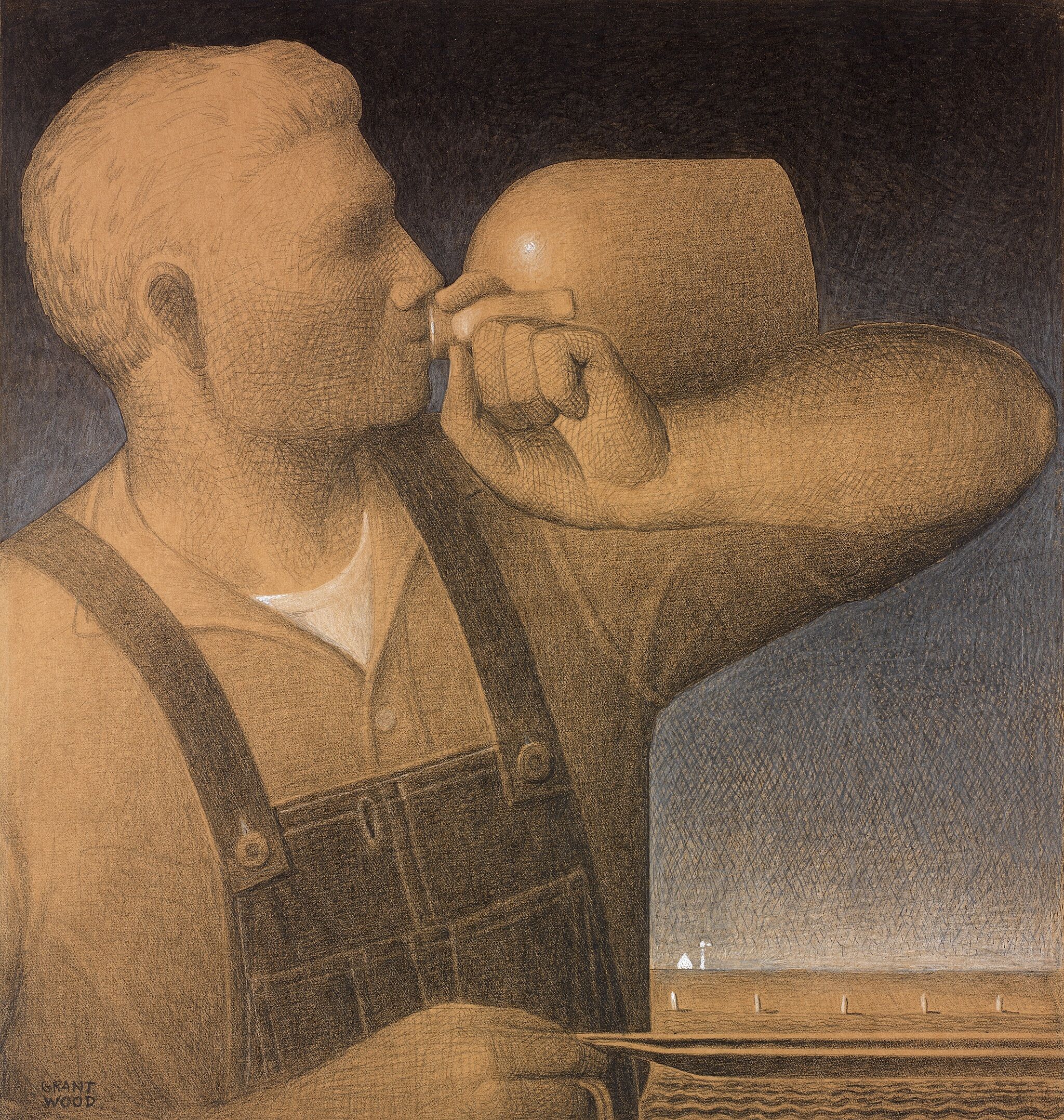
Painting of man drinking out of pewter jug holding reigns.

Grant Wood (1891–1942), Plowing on Sunday, 1934. Conté crayon, ink, and gouache on paper, 18 x 17 1⁄8 in. (45.7 x 43.5 cm). RISD Museum, Providence, Rhode Island; gift of Mrs. Murray S. Danforth 38.015. © Figge Art Museum, successors to the Estate of Nan Wood Graham/Licensed by VAGA, New York, NY. Photography by Erik Gould; courtesy Museum of Art, Rhode Island School of Design, Providence

Plowing on Sunday, 1934

Boy standing in front of a cow with a spilt milking bucket behind him and milk on his clothing.

Grant Wood (1891–1942), Spilt Milk, 1935. Gouache on board, 26 3⁄16 x 19 1⁄2 in. (66.5 x 49.5 cm). Private collection; courtesy Sotheby’s. © Figge Art Museum, successors to the Estate of Nan Wood Graham/Licensed by VAGA, New York, NY. Image courtesy Sotheby’s

Spilt Milk, 1935

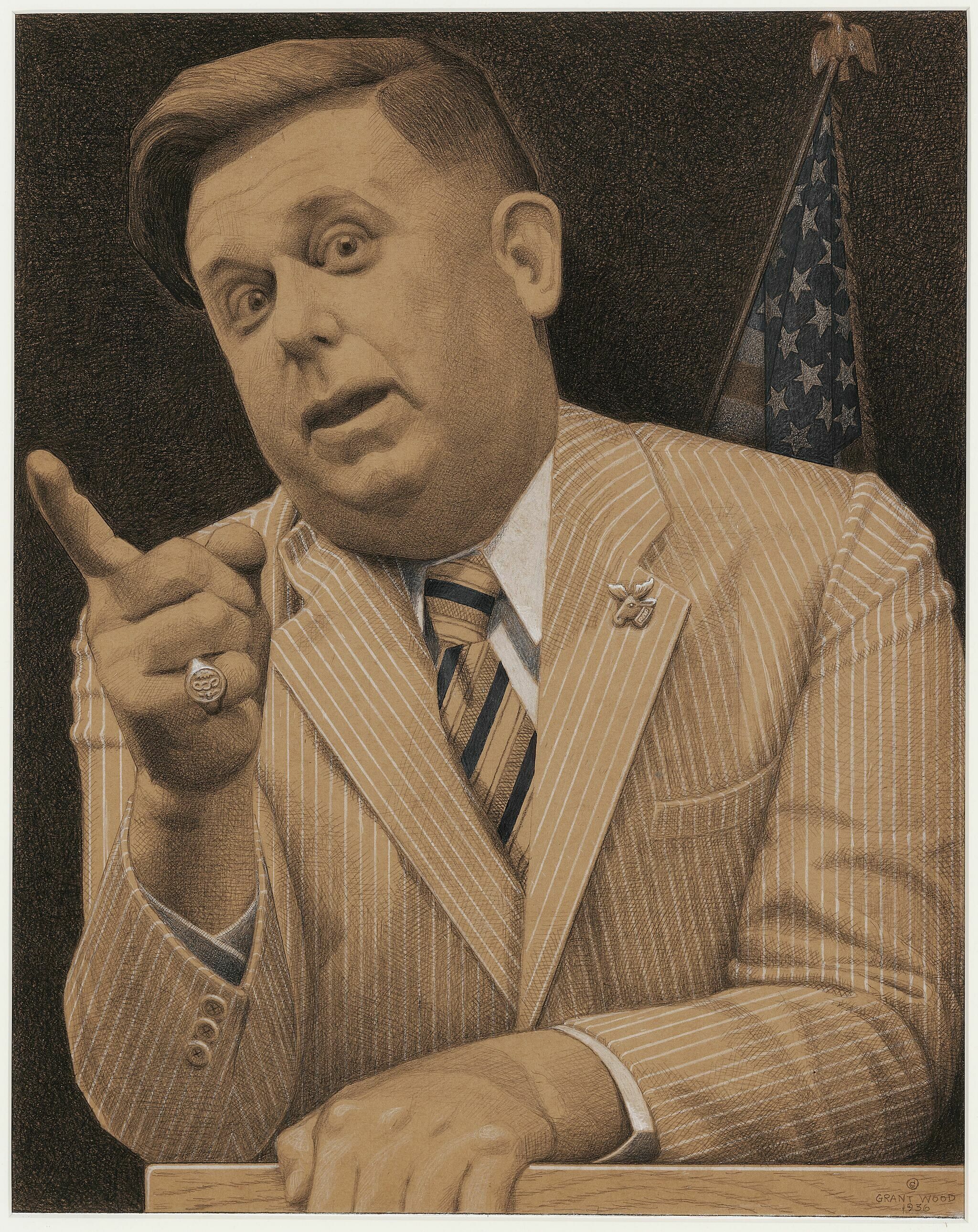
Charcoal drawing of man pointing.

Grant Wood (1891–1942), Booster, 1936. Charcoal, pencil, and chalk on paper, 23 7/8 x 18 5/8 in. (60.6 x 47.3 cm). Figge Art Museum; City of Davenport Art Collection; Museum purchase with funds provided by the Friends of Art Acquisition Fund and by Mr. and Mrs. Morris Geifman 1993.3 © MBI, Inc.

Booster, 1936

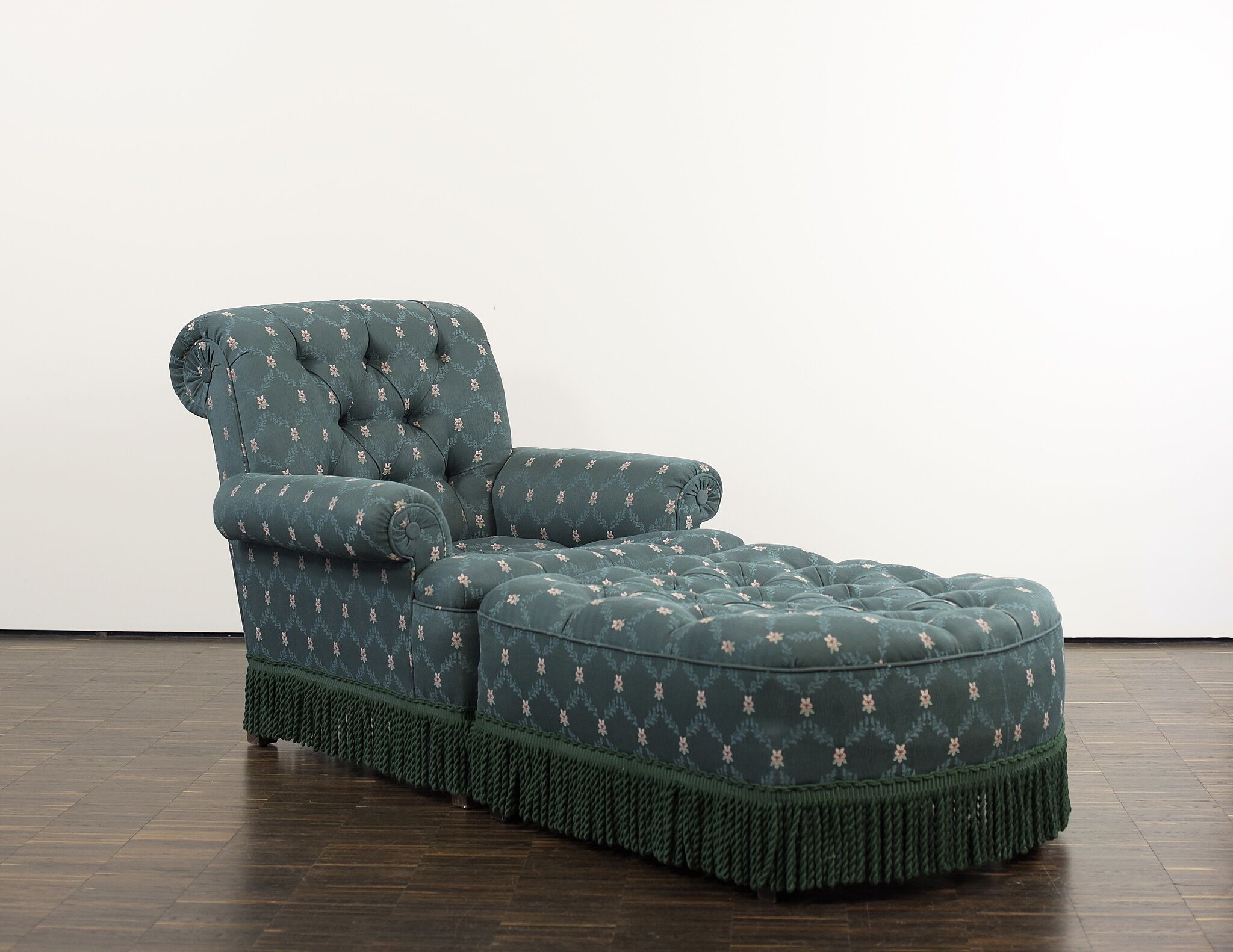
Photograph of Grant Wood Lounge Chair and Ottoman

Grant Wood Lounge Chair and Ottoman for Grant Wood Lounge Chair, 1938. Tufted rolled arm chair with cellulosic and wool fiber with upholstery on wood frame and tufted footstool with cellulosic and wool fiber with upholstery on wood frame, 32 1⁄2 x 33 x 38 1⁄2 in. (82.6 x 83.8 x 97.8 cm) and 16 x 27 x 33 in. (40.6 x 68.6 x 83.8 cm). Figge Art Museum, Davenport, Iowa, City of Davenport Art Collection, Grant Wood Archive; museum purchase with funds provided by the Friends of Art Acquisition Fund 1965.243.GW and 1965.244.GW. © Figge Art Museum, successors to the Estate of Nan Wood Graham/Licensed by VAGA, New York, NY

Grant Wood Lounge Chair and Ottoman for Grant Wood Lounge Chair, 1938

In 1935 Wood moved into a large mid-nineteenth century Italianate-style house in Iowa City and spent the next two years renovating and decorating the home in its original Victorian style. He designed this lounge chair and ottoman for his living room. Henry R. Lubben, a Cedar Rapids furniture maker, manufactured the design in a variety of fabrics, with or without tasseled fringe, and sold it in department stores throughout the Midwest as the Grant Wood Lounge Chair.

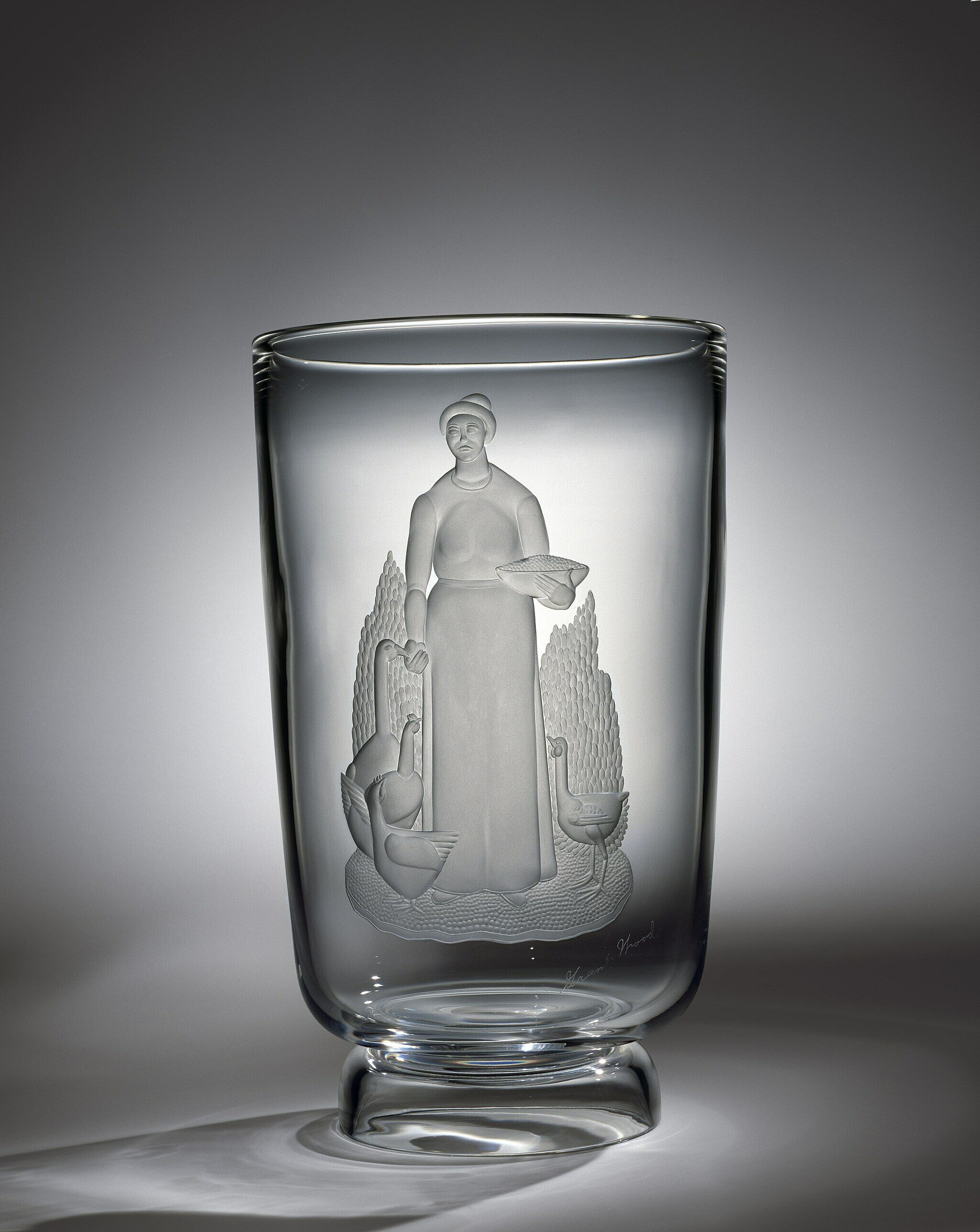
Vase with image of Woman Tending Goose and Chickens.

Grant Wood (1891–1942), Vase with Woman Tending a Goose and Chickens, 1939. Glass, 14 x 8 5⁄16 in. (35.5 x 21.1 cm). The Corning Museum of Glass, New York; gift of Harry W. and Mary M. Anderson in memory of Carl G. and Borghild M. Anderson and Paul E. and Louise Wheeler 89.4.33. © Figge Art Museum, successors to the Estate of Nan Wood Graham/Licensed by VAGA, New York, NY

Vase with Woman Tending a Goose and Chickens, 1939

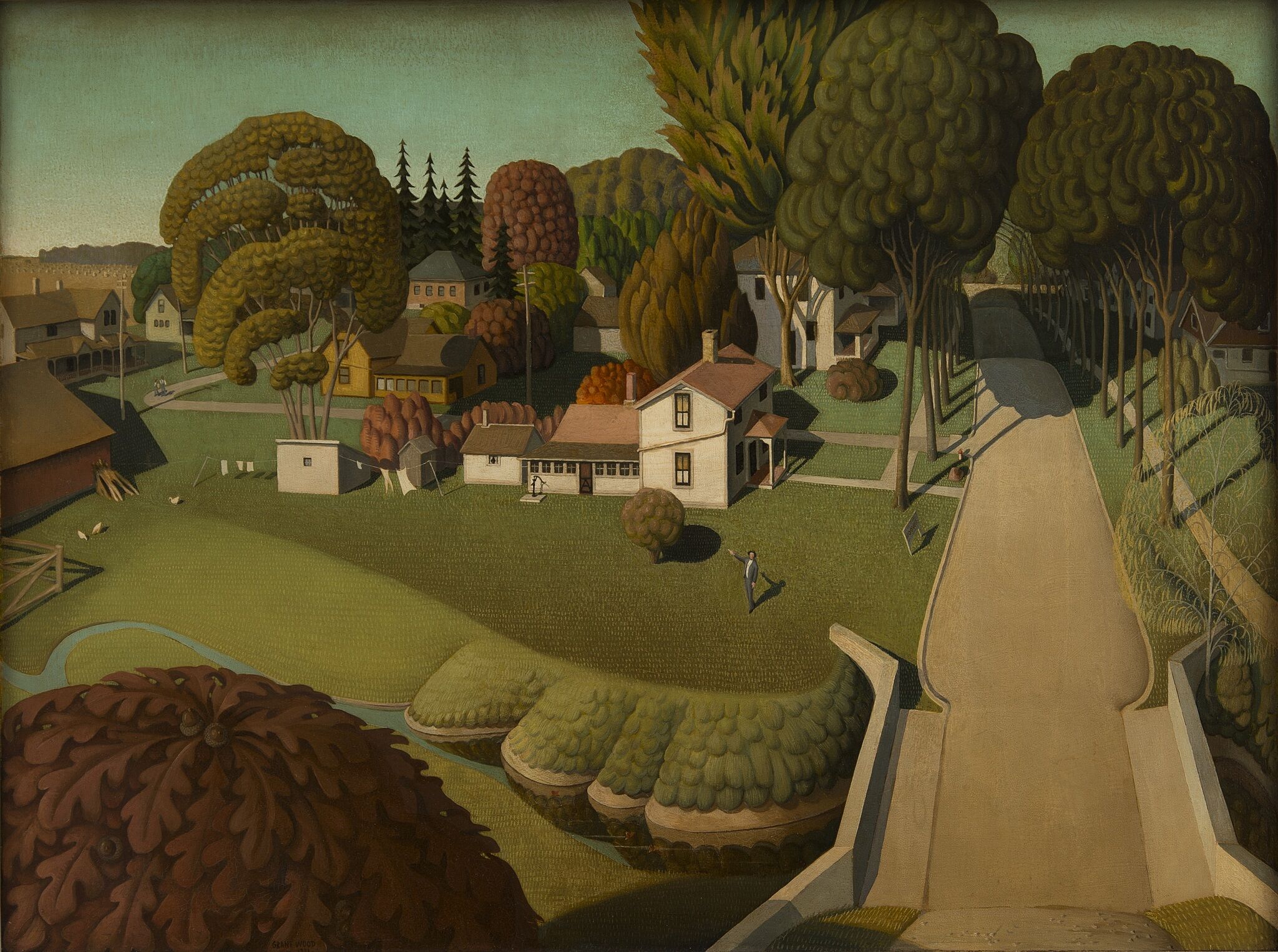
Wood was one of twenty-seven American and European artists that Steuben commissioned to create designs to be etched onto crystal vases and bowls that would be sold through its showroom. Wood adapted his design from the figure of the farmer’s wife from his 1932 Fruits of Iowa murals.

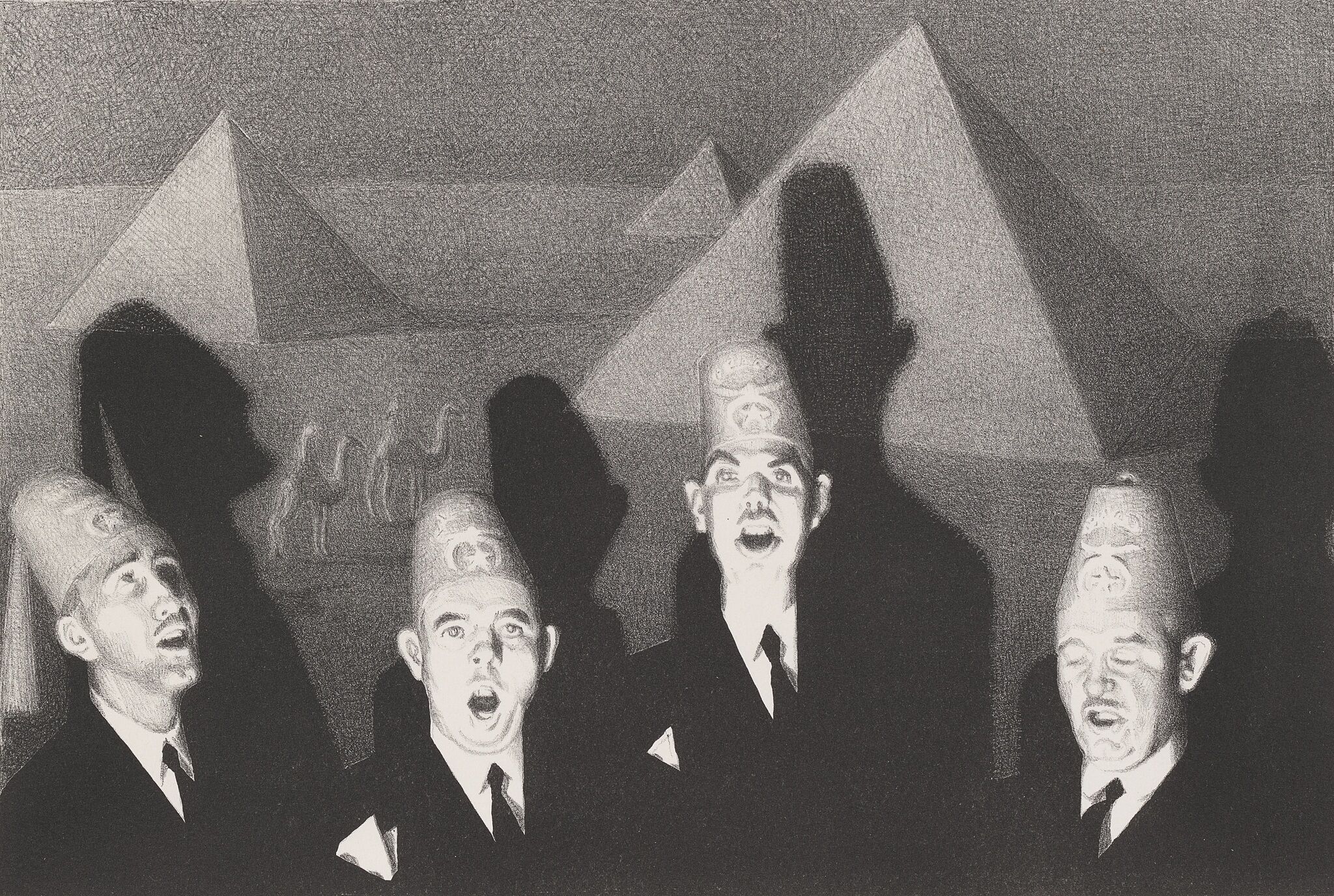
Print of male choral quartet with Egyptian pyramids and camels in background.

Grant Wood (1891–1942), Shrine Quartet, 1939. Lithograph: sheet, 12 x 16 in. (30.5 x 40.6 cm); image, 7 15⁄16 x 11 7⁄8 in. (20.2 x 30.2 cm). Whitney Museum of American Art, New York; gift of Arthur G. Altschul 78.28. © Figge Art Museum, successors to the Estate of Nan Wood Graham/Licensed by VAGA, New York, NY

Shrine Quartet, 1939

The Shriners are a fraternal organization associated with the Freemasons who had four chapters in Iowa in the 1930s. With little regard for the specificities of place, culture, or faith, the group incorporated North African and Middle Eastern iconography in their customs and rituals. Here, Wood pictures a group of Shriners alongside some of their preferred imagery—pyramids, camels, and Moroccan fezzes adorned with scimitars, crescent moons, and stars. He pokes fun at both the pomp and pretensions of historical grandeur of his singing subjects by dramatically lighting them from below, creating large cast shadows that reveal them to be standing in front of a painted backdrop.

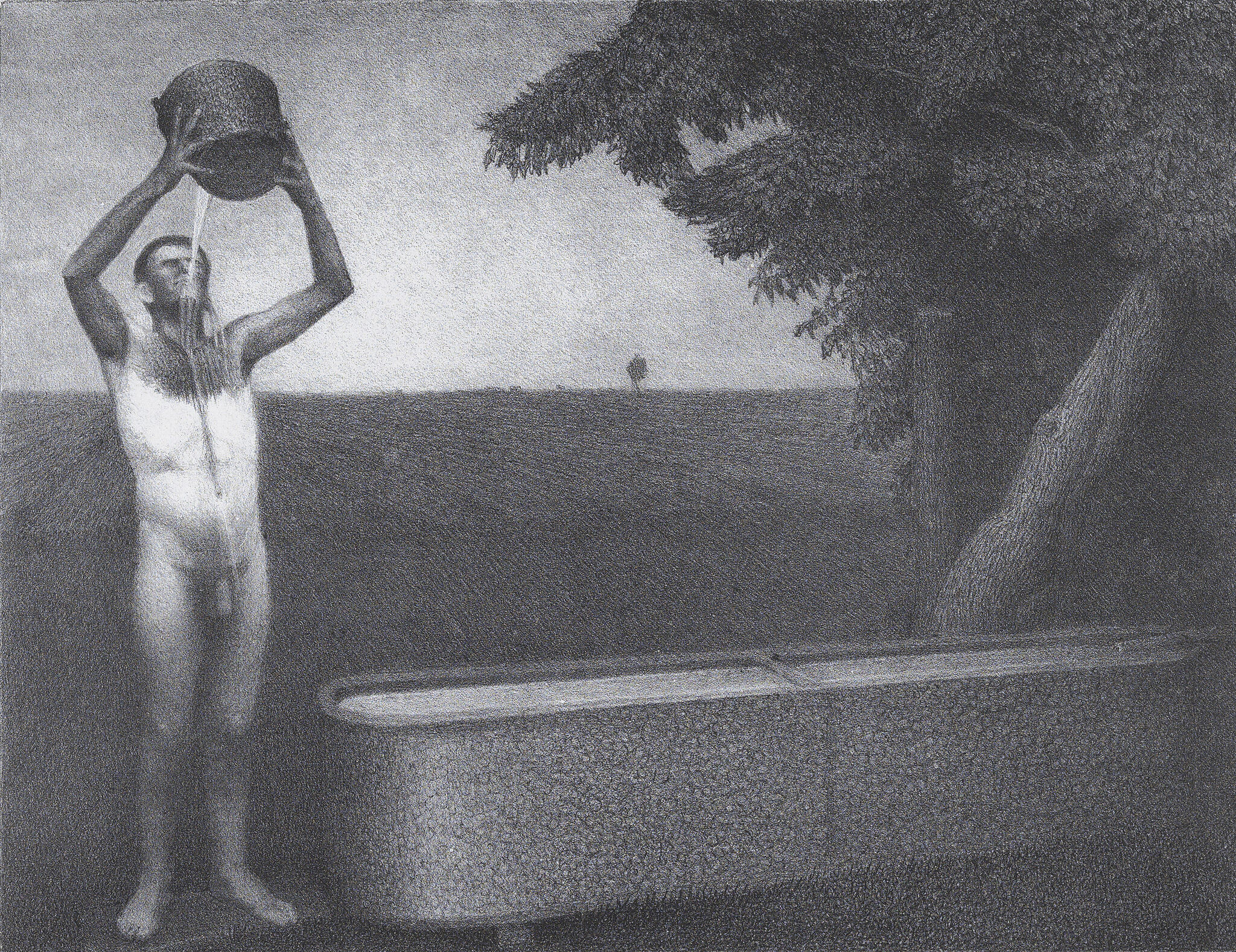
Print of man bathing nude outdoors with bucket.

Grant Wood, Sultry Night, 1939. Lithograph: sheet, 11 1/2 x 15 in. (29.2 x 38.1 cm); image, 9 x 11 3/4 in. (22.9 x 29.8 cm). The Metropolitan Museum of Art, New York; bequest of William S. Lieberman, 2005. © Figge Art Museum, successors to the Estate of Nan Wood Graham/Licensed by VAGA, New York, NY. Image © The Metropolitan Museum of Art, New York; courtesy Art Resource, NY

Sultry Night, 1939

The Associated American Artists (AAA) released this lithograph in 1939, expecting to sell it through its mail-order catalogue. The United States Postal Service classifed the print, with its frontal male nude, as pornographic, and refused to allow the AAA to send it through the mail. The controversy surprised Wood, who explained that the composition was based on childhood memories of farmers bathing at the horse trough with a pail of water after a day of working in the fields.


Explore works from this exhibition
in the Whitney's collection

View 5 works

On the Hour

A 30-second online art project:
Frank WANG Yefeng, The Levitating Perils #2

Learn more about this project

Learn more at whitney.org/artport

On the Hour projects can contain motion and sound. To respect your accessibility settings autoplay is disabled.