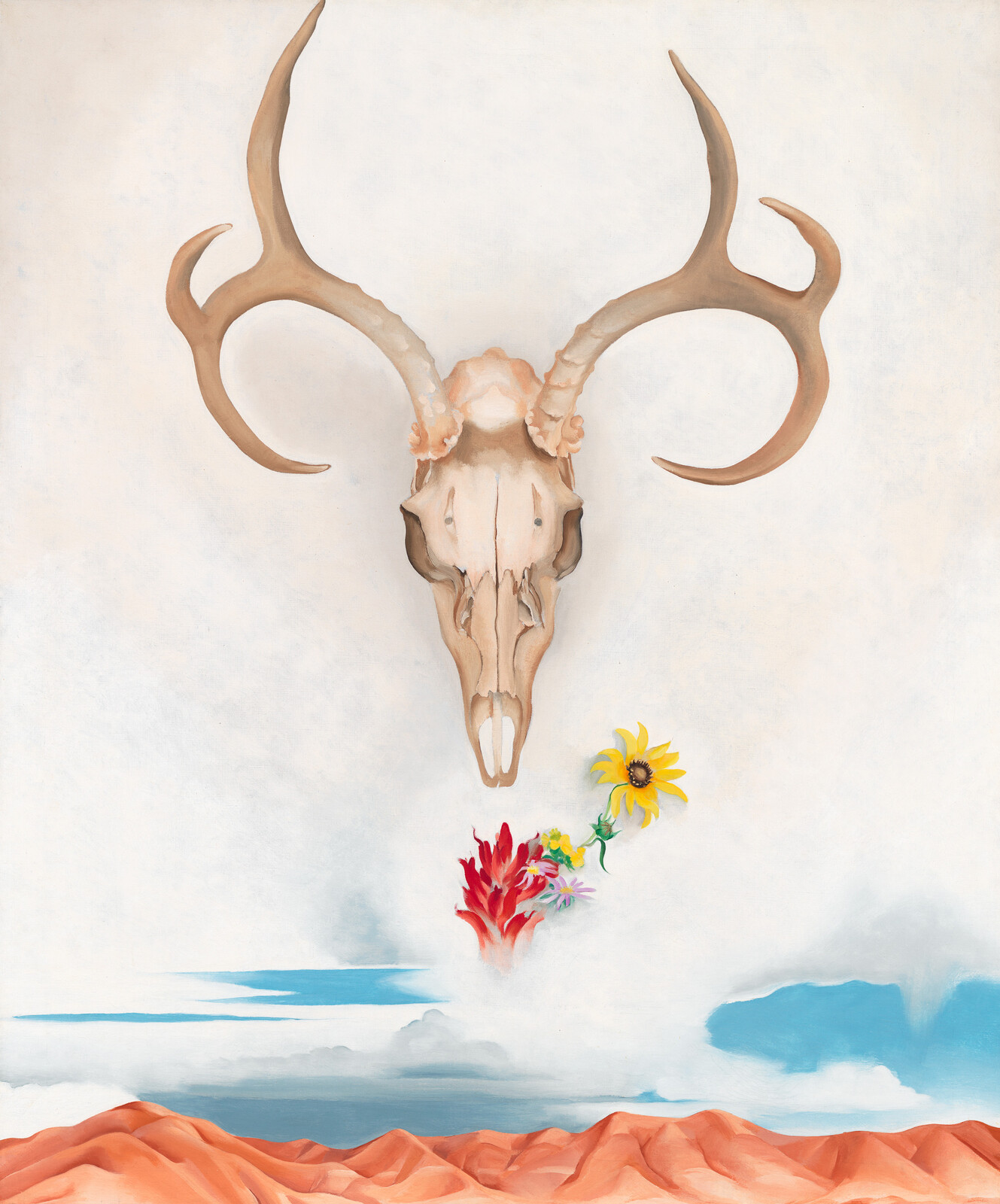
In Summer Days, Georgia O’Keeffe suspended an animal skull and several Southwestern flowers above a barren desert landscape. The large scale of the bones and blossoms and their placement in the sky give the painting a surreal quality. For O’Keeffe, the animal skull and vibrant flowers were symbols of the cycles of life and death that shape the natural world. This composition belongs to a group of paintings in which the artist depicted the sun-bleached bones she brought back east from her summer sojourns in New Mexico. The deer, horse, mule, and steer skulls she collected, as one would gather wildflowers, became potent souvenirs of a landscape that had deeply inspired her. As she explained, “The bones cut sharply to the center of something that is keenly alive in the desert.”
Visual description
Georgia O’Keeffe’s Summer Days is a vertical oil painting on canvas. It is about 3 feet tall by 2.5 feet wide. The paint handling is smooth and even across the surface of the work. It depicts a large deer skull with antlers and a bouquet of wildflowers floating in the clouds above a mountainous desert landscape.
A nearly life-sized skull dominates the work. The head is tilted forward — so that the viewer sees its top—and is painted in creamy white and beige tones. O’Keeffe paid particular attention to anatomical detail, such as eye sockets, ridges along the snout, and a fissure that runs from above the eyes to the nasal cavity, emphasizing the form’s symmetry. The skull is centered on the work’s vertical axis and stretches from the top edge of the canvas, which is grazed by the tip of its left antler, to just below the middle of the composition.
A few inches below the hollow nasal passage of the skull, there is a loosely arranged bouquet of five flowers. A red bloom floats on the clouds beneath the skull, and two pink and two yellow flowers stretch diagonally up toward the right, with the upper petals of the topmost yellow blossom at the same height as the skull’s nose.
The skull and the flowers appear to rest weightlessly atop the clouds, which are rendered in a soft white tinged with subtle greys and fill the composition from left to right. It is only in the bottom fifth of the canvas, beneath the flowers, that blue sky starts to peek through the clouds, just above the mountains. The undulating landscape, painted in a range of earthly orange hues, stretches across the bottom of the composition from left to right. The mountains appear to be far in the distance, occupying only a few inches of the lower register of the painting.
Audio
-
Verbal Description: Georgia O'Keeffe, Summer Days, 1936
In “Untitled” (America) and The Whitney's Collection: Selections from 1900 to 1965
0:00
Verbal Description: Georgia O'Keeffe, Summer Days, 1936
0:00
Narrator: Georgia O’Keeffe’s Summer Days is a vertical oil painting on canvas. It is about 3 feet tall by 2.5 feet wide. The paint handling is smooth and even across the surface of the work. It depicts a large deer skull with antlers and a bouquet of wildflowers floating in the clouds above a mountainous desert landscape.
A nearly life-sized skull dominates the work. The head is tilted forward — so that the viewer sees its top—and is painted in creamy white and beige tones. O’Keeffe paid particular attention to anatomical detail, such as eye sockets, ridges along the snout, and a fissure that runs from above the eyes to the nasal cavity, emphasizing the form’s symmetry. The skull is centered on the work’s vertical axis and stretches from the top edge of the canvas, which is grazed by the tip of its left antler, to just below the middle of the composition.
A few inches below the hollow nasal passage of the skull, there is a loosely arranged bouquet of five flowers. A red bloom floats on the clouds beneath the skull, and two pink and two yellow flowers stretch diagonally up toward the right, with the upper petals of the topmost yellow blossom at the same height as the skull’s nose.
The skull and the flowers appear to rest weightlessly atop the clouds, which are rendered in a soft white tinged with subtle grays and fill the composition from left to right. It is only in the bottom fifth of the canvas, beneath the flowers, that blue sky starts to peek through the clouds, just above the mountains. The undulating landscape, painted in a range of earthly orange hues, stretches across the bottom of the composition from left to right. The mountains appear to be far in the distance, occupying only a few inches of the lower register of the painting.
-
0:00
Georgia O’Keeffe, Summer Days, 1936
0:00
Melanie Adsit: This is a very different kind of portrait than the portraits we've been looking at, so far. Do you consider this to be a portrait?
Student: I think it's a portrait because a portrait doesn't have to be, actually accurate. It could be anything, as long as it represents someone, some place, something, some idea, an image.
Melanie Adsit: What symbols do we see in this painting? What do you think they might represent?
Student: This is a place of mountains and desert. The skull is like in the sky, which means they passed away.
Student: I, totally agree with that. It's really high rocks, or small mountains, or jagged hills. It represents the hardness, the challenging, the viciousness of where they live, or what's around them. The flowers are rest in peace and there's always hope. Even in the barrenness of desert, there’s always life.
Melanie Adsit: I love the way that you guys are talking about this, in terms of symbols of life and death. This artist's name was Georgia O'Keeffe. She lived here in New York, but she traveled to New Mexico every summer. She loved the landscape in New Mexico, and would collect things when she was out there. Not only would she collect flowers, she would also collect bones and skulls. She said that sometimes the bones were strangely more living than the animals walking around.
Student: This skull has a huge soul, as a huge representation. It's part of a big soul of the desert of New Mexico. It lives in soul, spirit, in our minds, and in our memories, instead of living through flesh and blood. -
0:00
Georgia O’Keeffe, Summer Days, 1936
0:00
Narrator: Like a mirage, a deer skull hovers in the sky above wild flowers. The artist, Georgia O’Keeffe, didn’t like to explain her paintings. To her, they were simple records of what she saw around her. Walking in the desert, she collected bones that had been bleached by the New Mexico sun.
Georgia O'Keeffe: The bones do not symbolize death to me. They are shapes that I enjoy. It never occurs to me they have anything to do with death. They are very lively. They please me. And I have enjoyed them very much in relation to the sky.
Narrator: O’Keeffe, who began her career in New York, eventually began living in the American Southwest in 1929.
Georgia O'Keeffe: When I got to New Mexico that was mine. As soon as I saw it that was my country. I’d never seen anything like it before but it fitted to me exactly. Like something that’s in the air—it’s just different. The sky is different, the stars are different, the wind is different.
Exhibitions
-
The Whitney’s Collection: Selections from 1900 to 1965
June 28, 2019–May 1, 2025
-
Where We Are: Selections from the Whitney’s Collection, 1900–1960
Apr 28, 2017–June 2, 2019
-
Human Interest: Portraits from the Whitney’s Collection
Apr 2, 2016–Apr 2, 2017
-
The Whitney's Collection
Sept 28, 2015–Apr 4, 2016
-
America Is Hard to See
May 1–Sept 27, 2015
-
American Legends: From Calder to O’Keeffe
Dec 22, 2012–June 29, 2014
-
Modern Life: Edward Hopper and His Time
Oct 28, 2010–Apr 10, 2011
-
Highlights from the Permanent Collection: From Hopper to Mid-Century
Feb 25, 2000–May 20, 2006
Installation photography
-
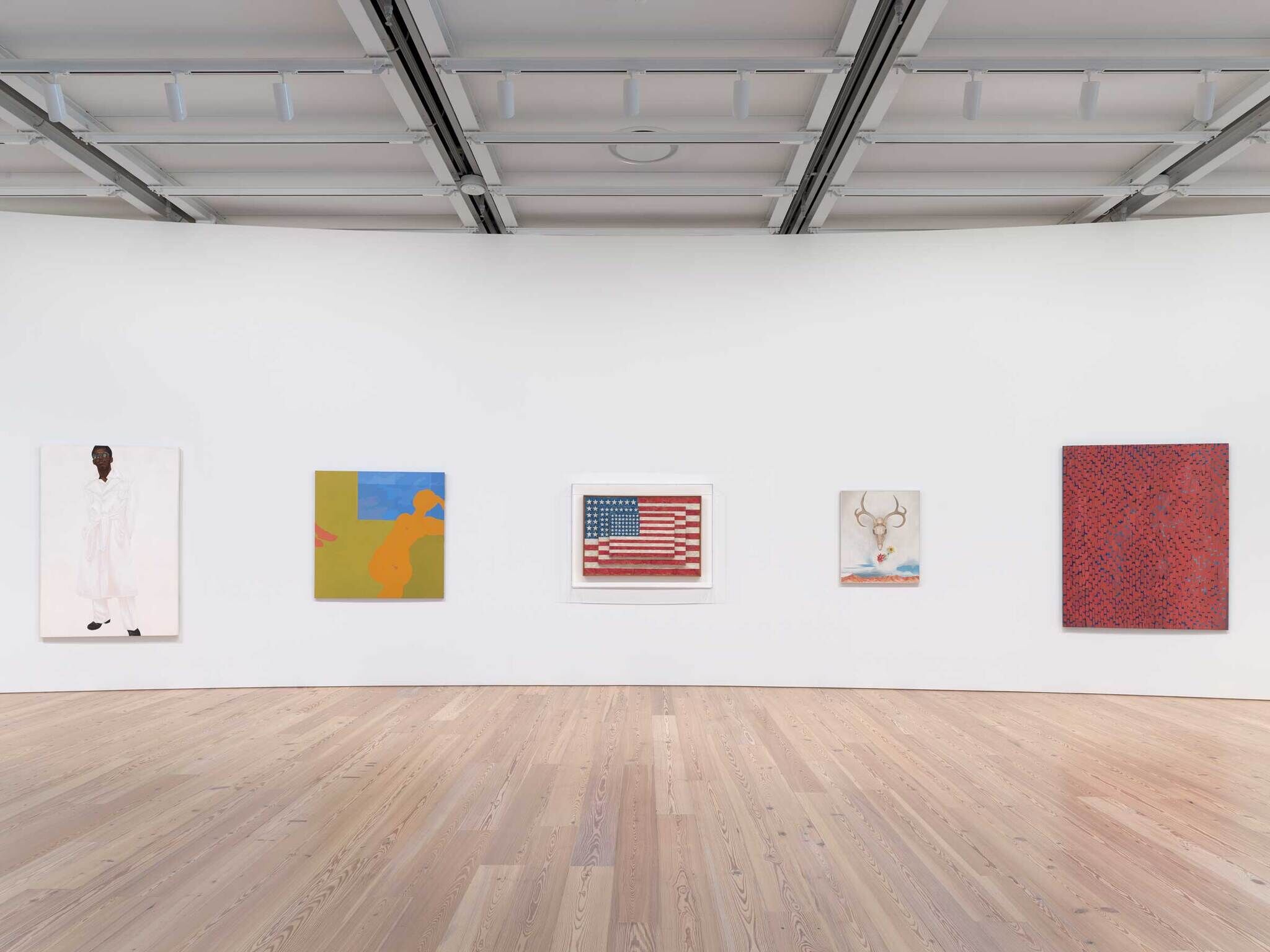
Installation view of “Untitled” (America) (Whitney Museum of American Art, New York, July 5, 2025-). From left to right: Barkley L. Hendricks, Steve, 1976; Kay WalkingStick, April Contemplating May, 1972; Jasper Johns, Three Flags, 1958; Georgia O’Keeffe, Summer Days, 1936; Alma Thomas, Mars Dust, 1972. Photograph by Ron Amstutz
From the exhibition “Untitled” (America)
-
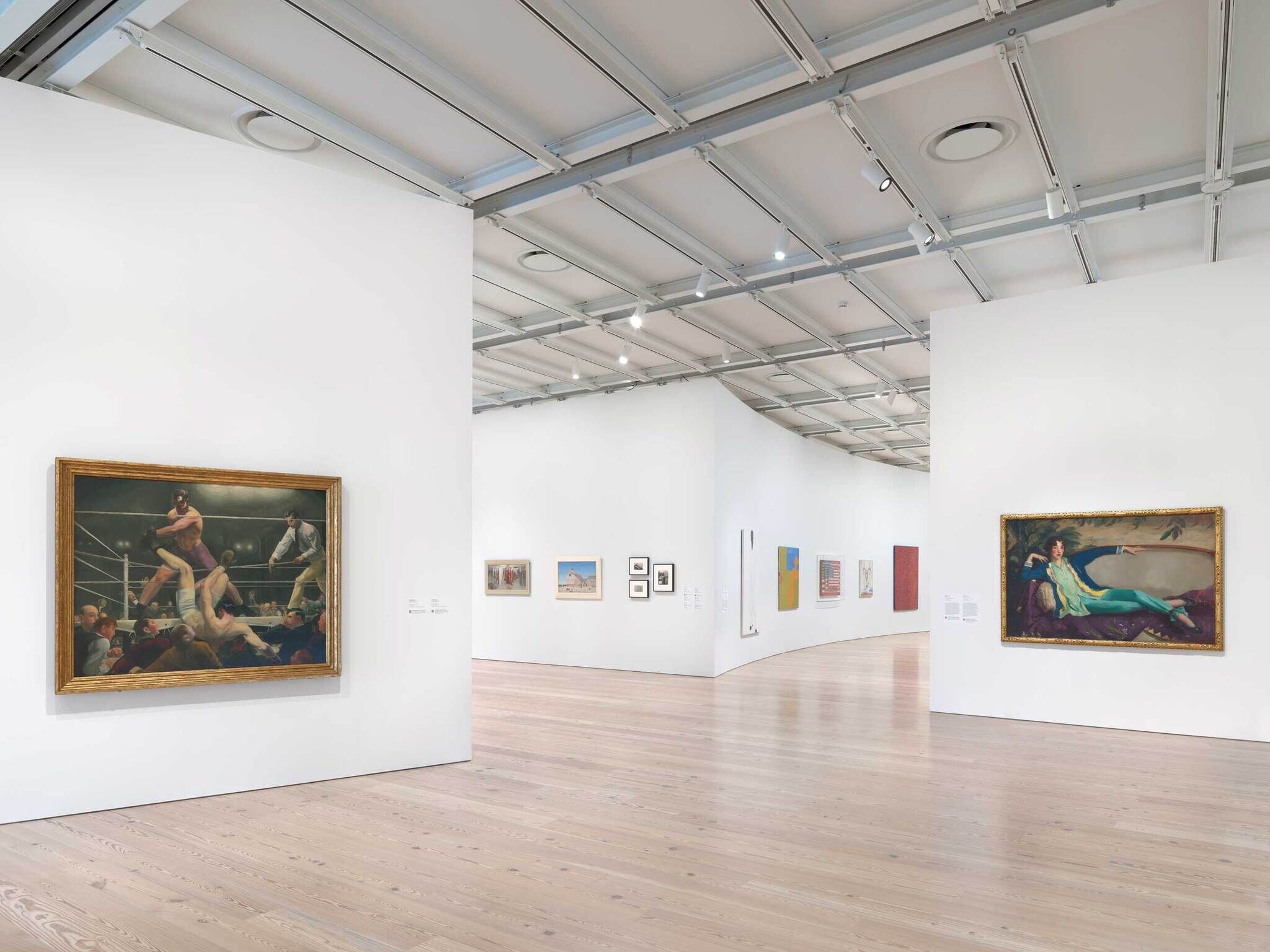
Installation view of “Untitled” (America) (Whitney Museum of American Art, New York, July 5, 2025-). From left to right: George Bellows, Dempsey and Firpo, 1924; George Tooker, The Subway, 1950; Margaret French, The Moon by Day, 1939; PaJaMa, Margaret French, George Tooker and Jared French, Nantucket, c. 1946; PaJaMa, Margaret French, Paul Cadmus and José Martinez, Fire Island, 1939; PaJaMa, Chuck Howard and Ted Starkowski, 1953; Barkley L. Hendricks, Steve, 1976; Kay WalkingStick, April Contemplating May, 1972; Jasper Johns, Three Flags, 1958; Georgia O’Keeffe, Summer Days, 1936; Alma Thomas, Mars Dust, 1972; Robert Henri, Gertrude Vanderbilt Whitney, 1916. Photograph by Ron Amstutz
From the exhibition “Untitled” (America)