The Lost World: The Art of Minnie Evans

Through Jan 10, 2027


Exhibition feature

9 total
6
Read more
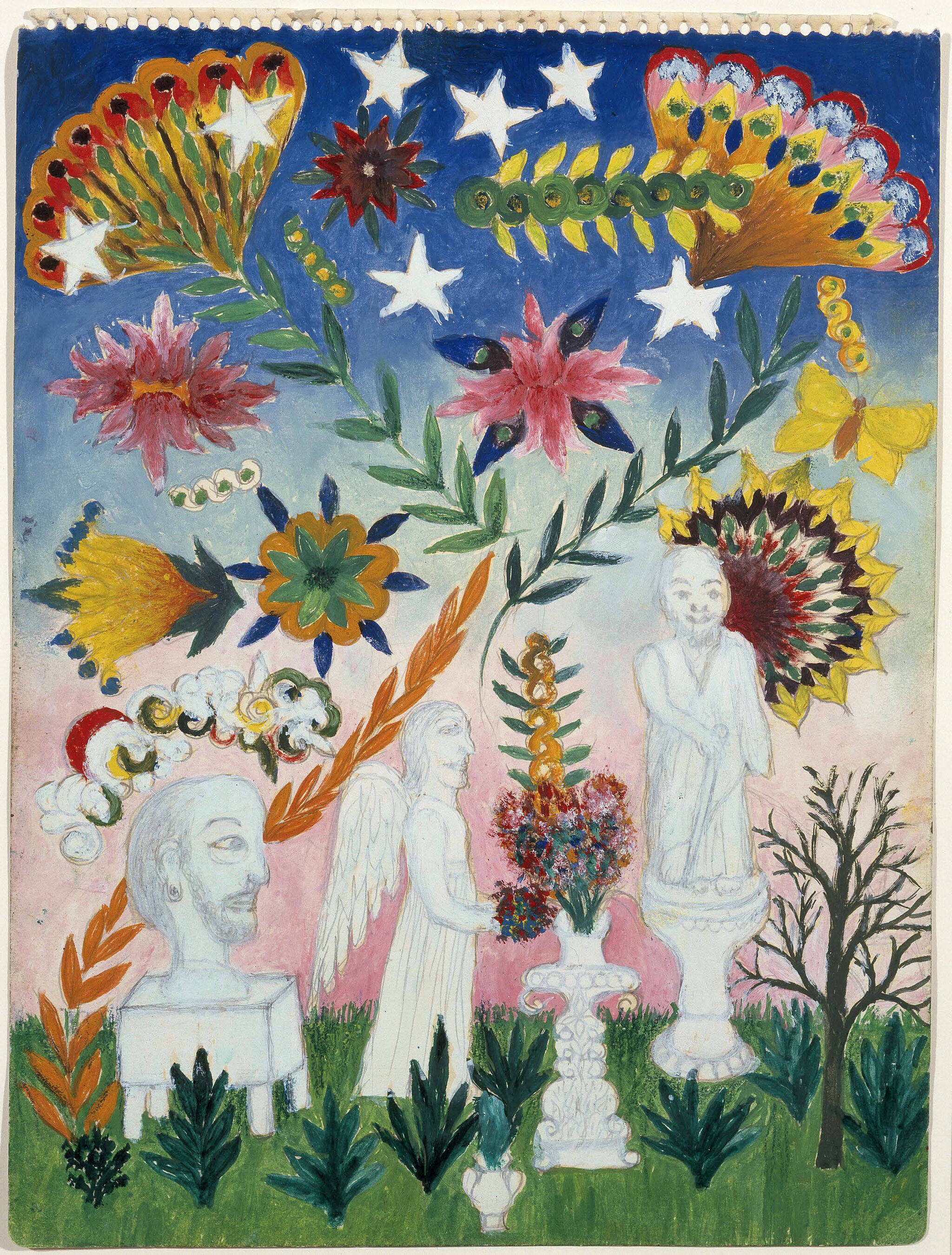
An angelic figure offers a bouquet in front of white statues amid bright flowers and stars.

Minnie Evans, Untitled (Statuary, Stars, and Flora), 1965. Oil, gouache, and pencil on paper  12 × 9 in.(30.48 × 22.86 cm). Collection of Wendy Williams, New York. © The Estate of Minnie Evans. Photograph by Christopher Burke

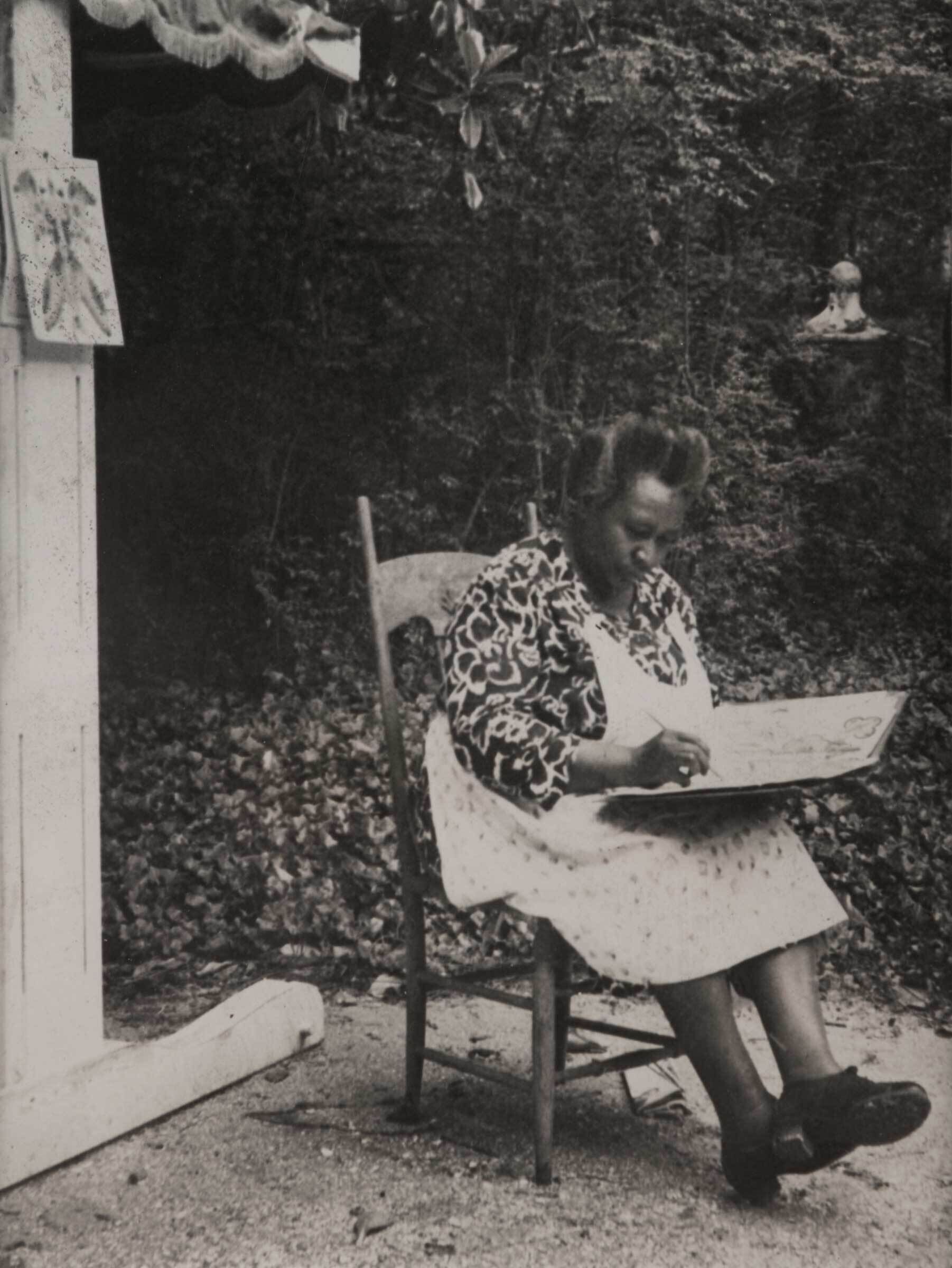
In 1948 the estate where Evans had worked for decades changed hands and its grounds were opened to the public as the Airlie Gardens. Evans was hired to collect admission fees at the front gate. For more than twenty years, seven days a week, rain or shine she sat at the entrance reading, praying, and making drawings that she shared with the garden visitors. With few people at the garden except during the annual Azalea Festival, Evans had ample time to walk the grounds "to talk with God," as she put it. There she would have seen fountains topped by cherubs and maidens, busts of Greek gods, doric columns, ivy-covered urns bursting with potted arrangements, statuary, gates, arbors, and the domed colonnaded structure known to local residents as the Temple of Love. Evans had included botanical imagery in earlier work, but daily proximity to the grounds inspired her to intensify her color, expand her repertoire of images, and shift her focus from single floral or insect forms to all-over compositions exploding with radiant blooms that suggest a world alive with divine presence.

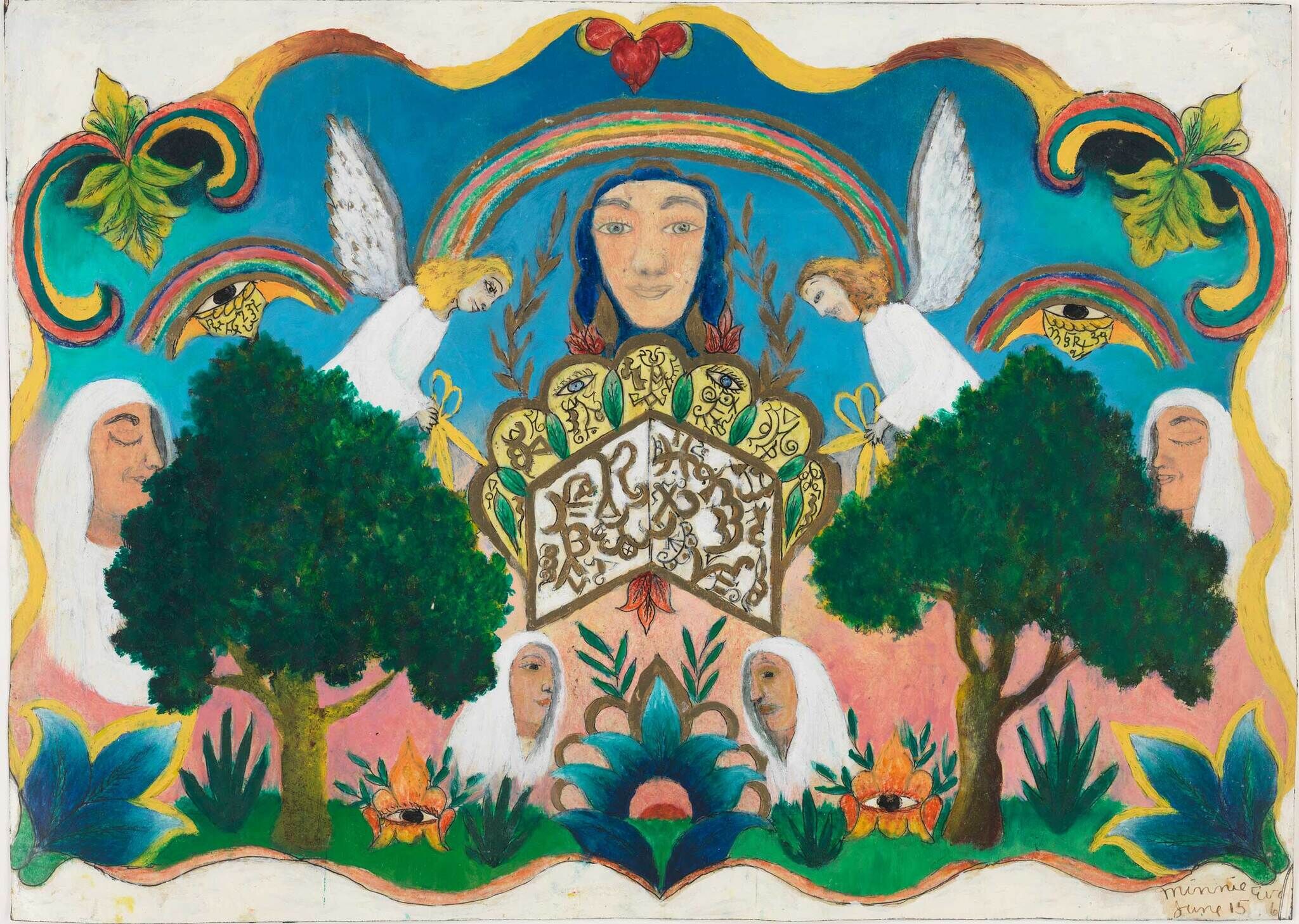
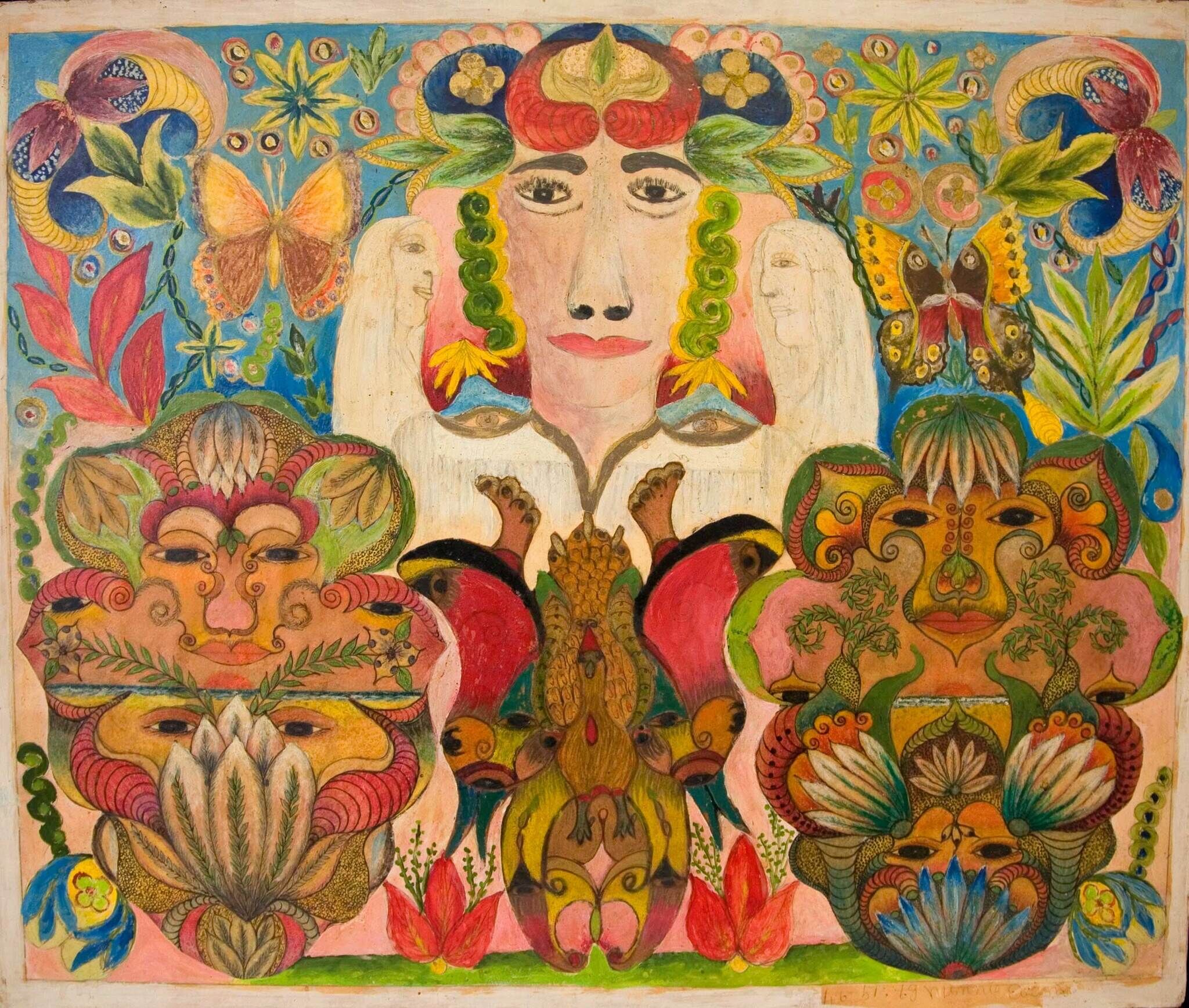
A colorful folk-style composition of many merged faces, floral motifs, winged figures, and trees.

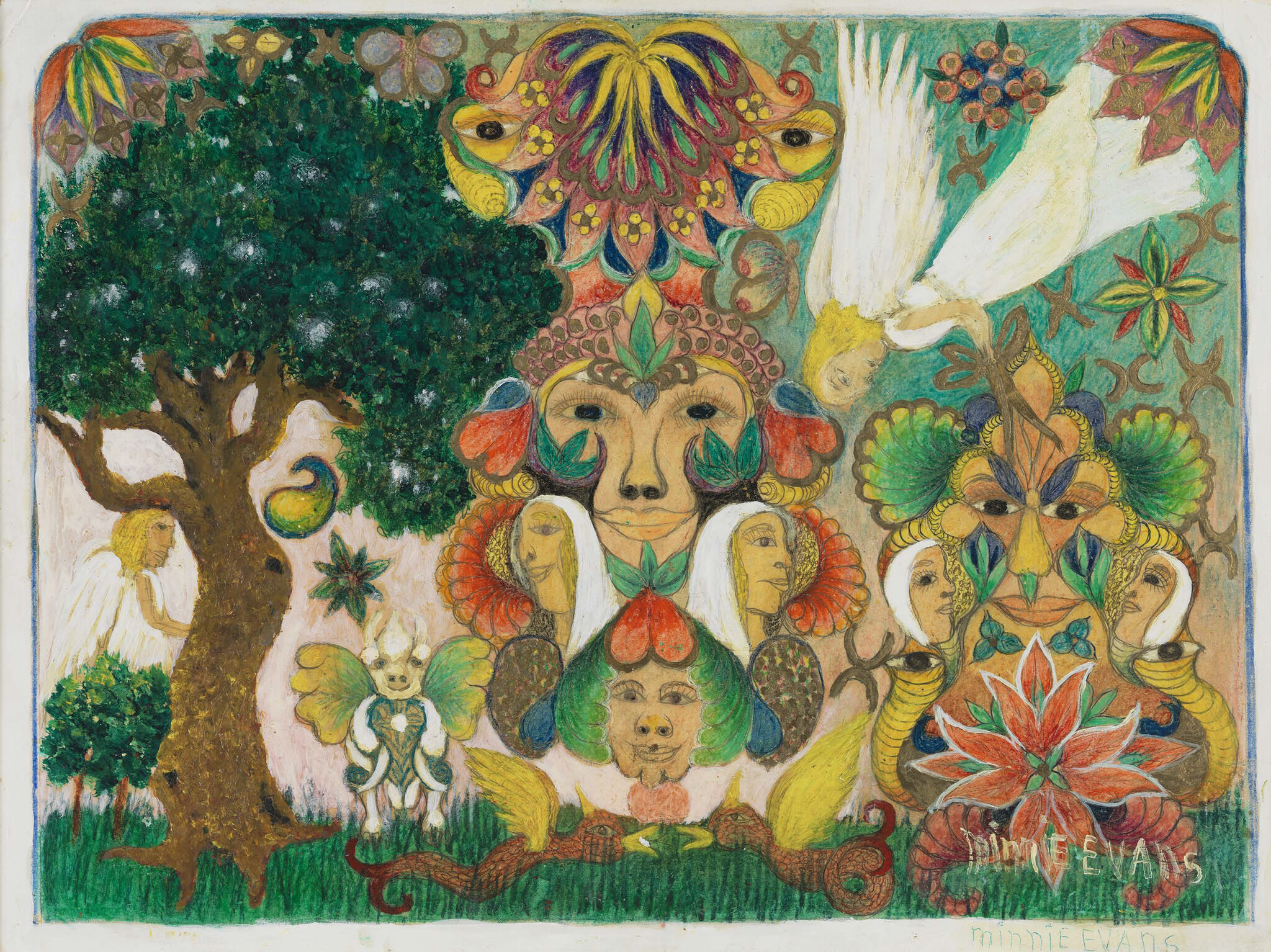
Minnie Evans, Untitled (Airlie Oak, Angels, Faces, Serpents), 1966. Oil, gold paint, crayon, and pencil on paperboard, 14 7/8 × 20 in. (37.78 × 50.8 cm). Collection of Wendy Williams, New York. © The Estate of Minnie Evans. Photograph by Christopher Burke 

Untitled (Airlie Oak, Angels, Faces, Serpents), 1966

Airlie Gardens's main attraction was—and remains—a tree that dates to at least 1545 with a circumference of almost thirty feet. Evans included images of the majestic oak in many of her drawings.

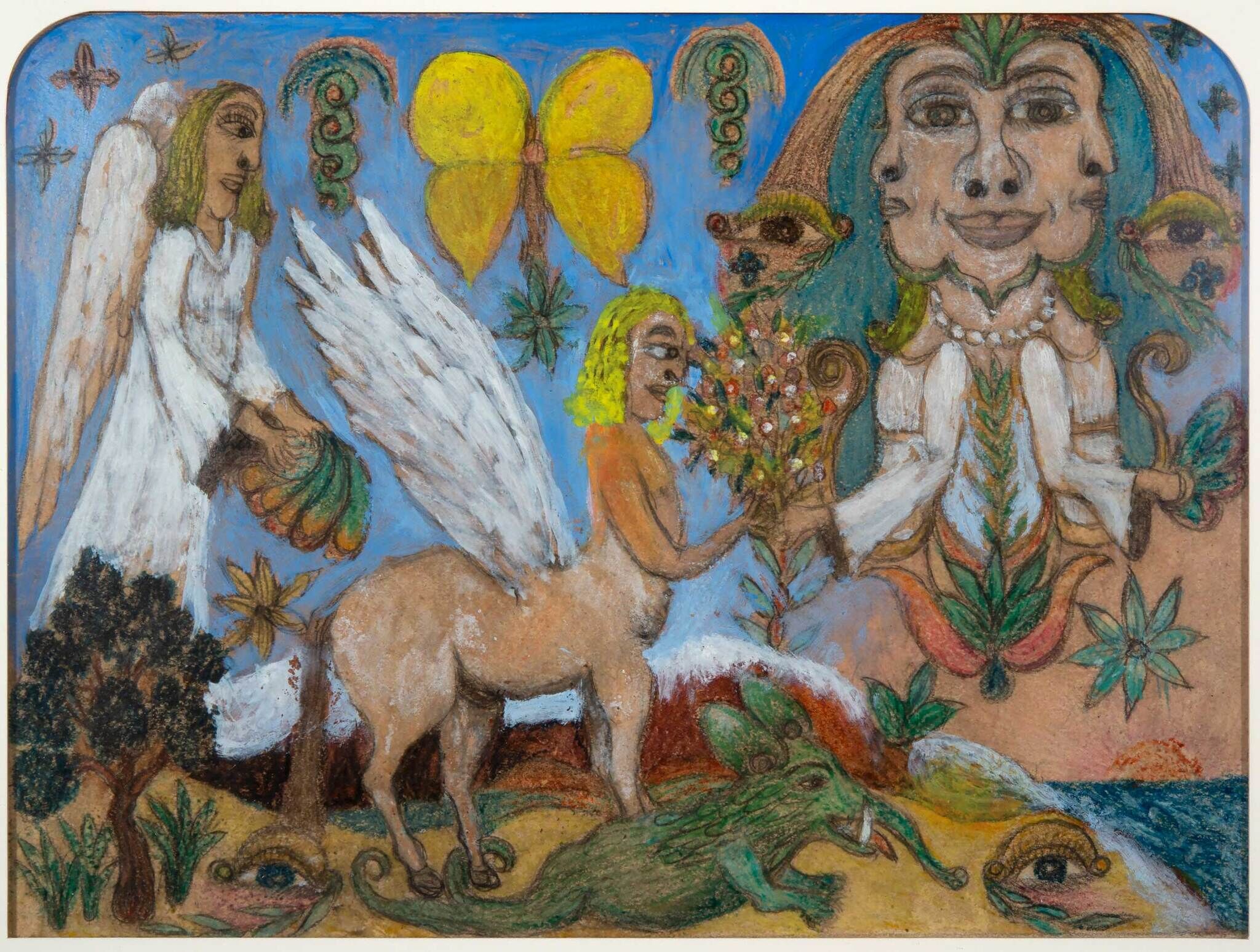
A surreal stacked totem with a winged horned creature, faces, snake, and plants by the sea.

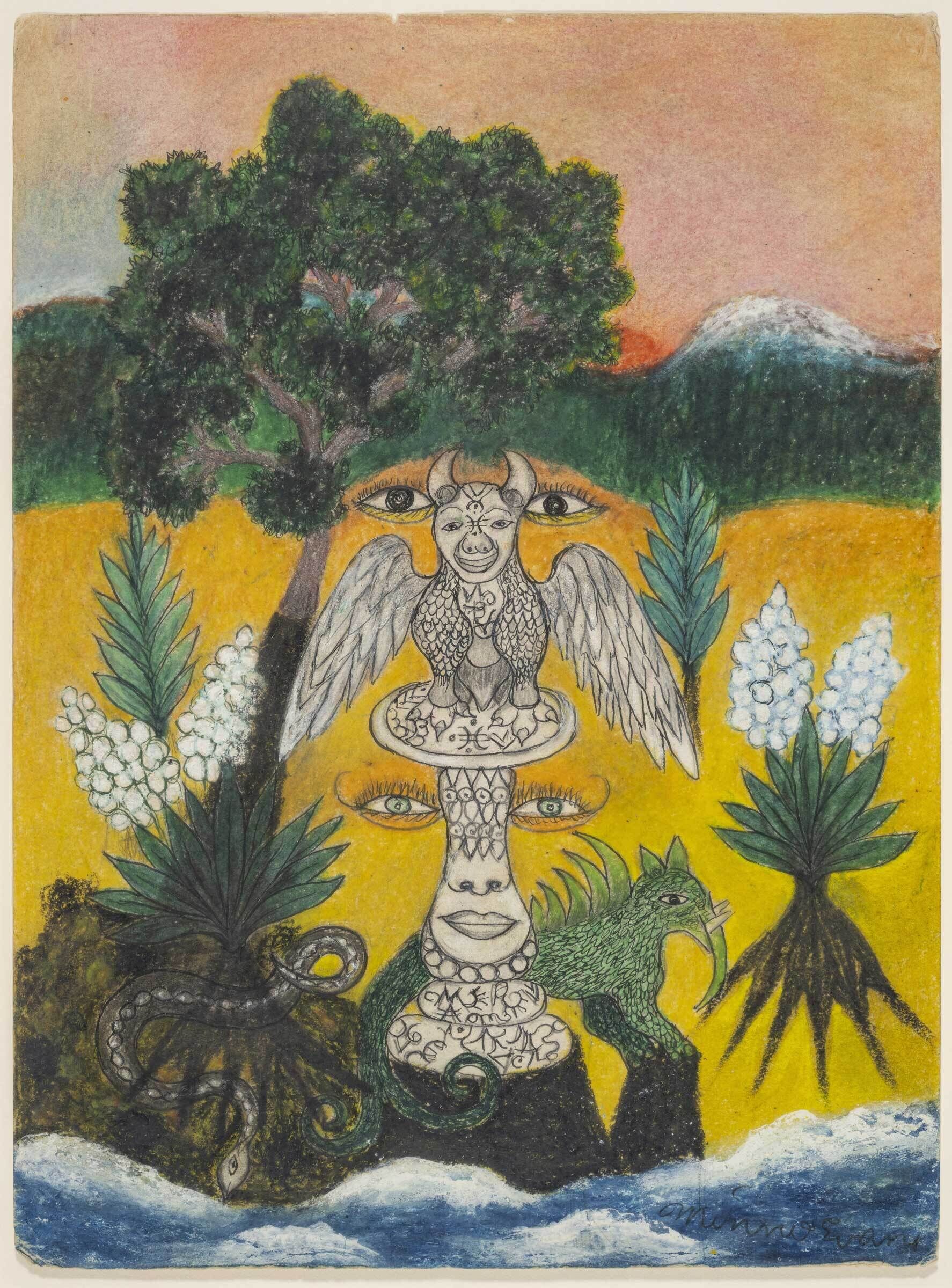
Minnie Evans, Untitled (Gargoyle, Eyes, Flowers, and Leaves), 1960s. Crayon on paper, 23 × 19 in. (58.4 × 48.3 cm). Collection of Thomas Isenberg. © The Estate of Minnie Evans. Photograph by Paul Mutino

Untitled (Gargoyle, Eyes, Flowers, and Leaves), 1960s

In 1958 Crayola released a pack of sixty-four crayons that Evans used to enhance the range of color in her work. Her proclivity for bright green, as seen in this work, attests to her love of nature and its seasonal cycles. "I have the blooms, and when the blooms are gone, I love to watch the green. God dressed the world in green," she said.

A colorful symmetrical butterfly drawing with bold black, yellow, blue, and red crayon shapes.

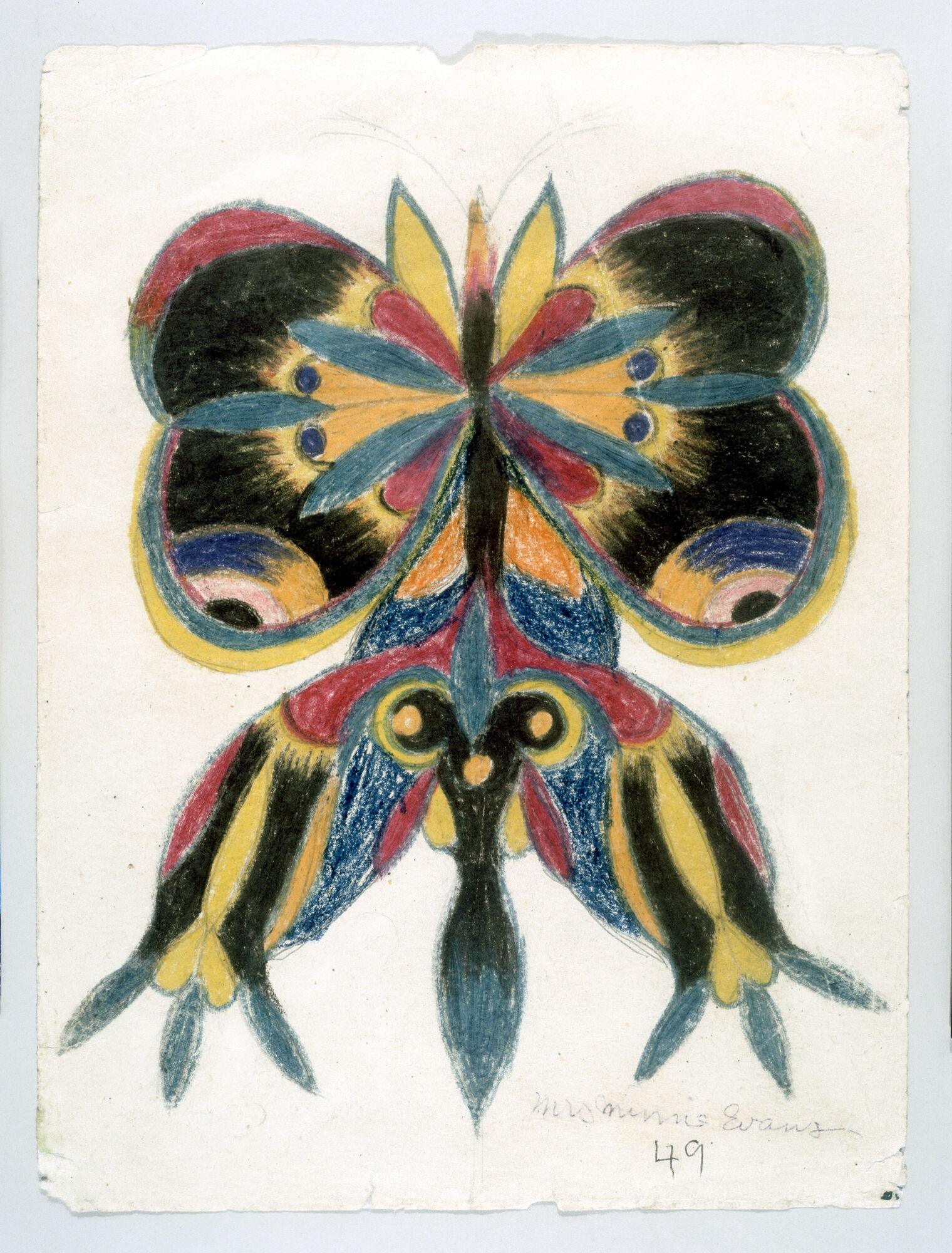
Minnie Evans, Untitled (Butterfly Form), 1949. Crayon and pencil on paper, 12 × 9 in. (30.48 × 22.86 cm). Collection of Wendy Williams, New York. © The Estate of Minnie Evans. Photograph by Christopher Burke

Untitled (Butterfly Form), 1949


Explore works from this exhibition
in the Whitney's collection

View 3 works

On the Hour

A 30-second online art project:
Frank WANG Yefeng, The Levitating Perils #2

Learn more about this project

Learn more at whitney.org/artport

On the Hour projects can contain motion and sound. To respect your accessibility settings autoplay is disabled.