The Lost World: The Art of Minnie Evans

Through Jan 10, 2027


Exhibition feature

9 total
​5
Read more
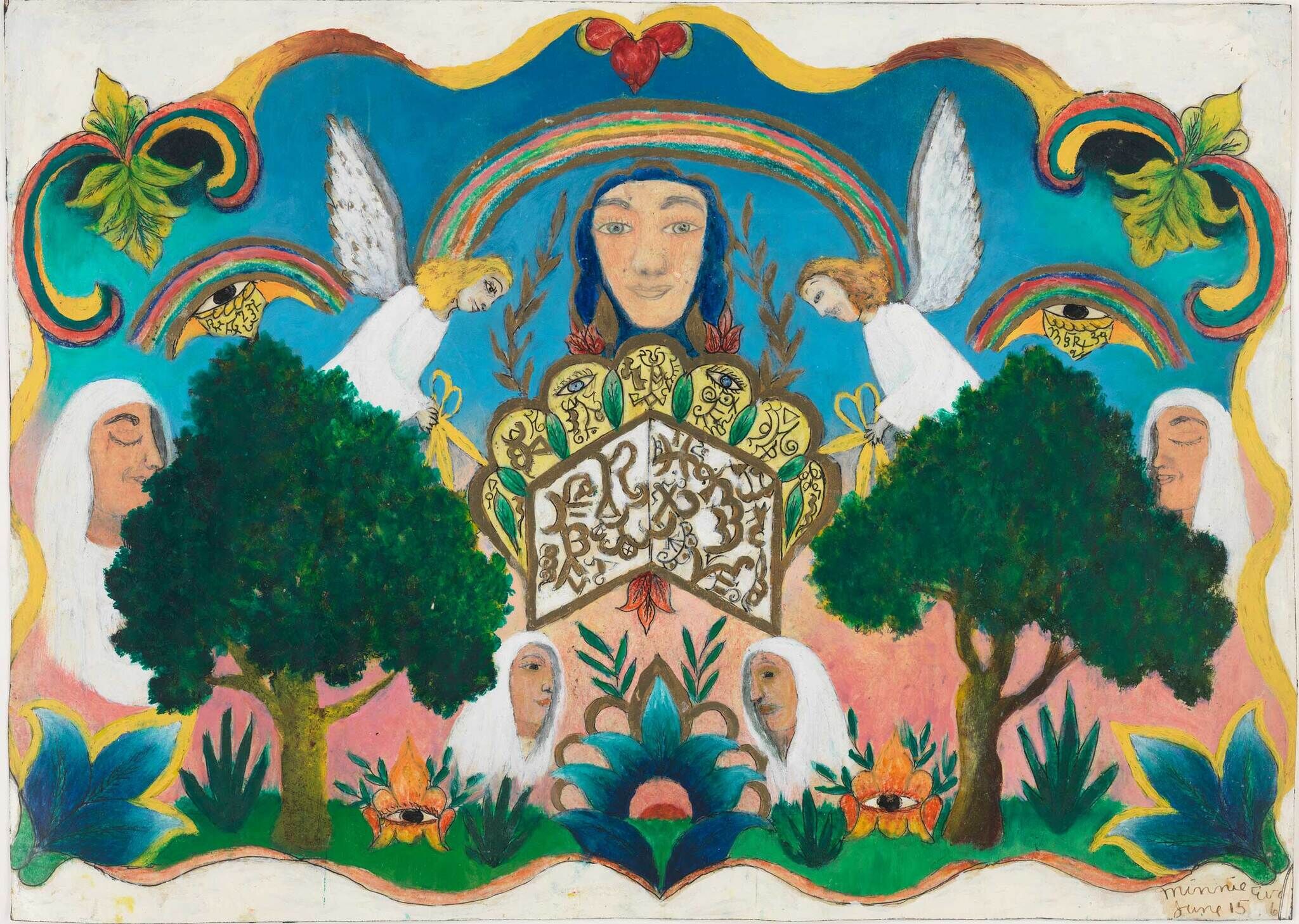
A central serene face and angels hover above nuns and lush trees in a colorful folk painting.

Minnie Evans, Modern Art, 1963. Oil, ink, and crayon on paper board, 11 1/4 × 14 1/2 in. (36.8 × 50.8 cm). Collection of Wendy Williams, New York. © The Estate of Minnie Evans. Photograph by Christopher Burke

Evans led a deeply spiritual life as a member of the St. Matthew African Methodist Episcopal Church and a close reader of the Bible. She was especially drawn to the final book of the New Testament, the book of Revelation, which describes Christ's return and the establishment of his eternal kingdom on earth. Inspired by her study of scripture, Evans filled much of her art with images of Christ and angels, who appear throughout the book of Revelation as divine messengers. Evans once described "the angel that stands by me" as directing her artistic efforts.

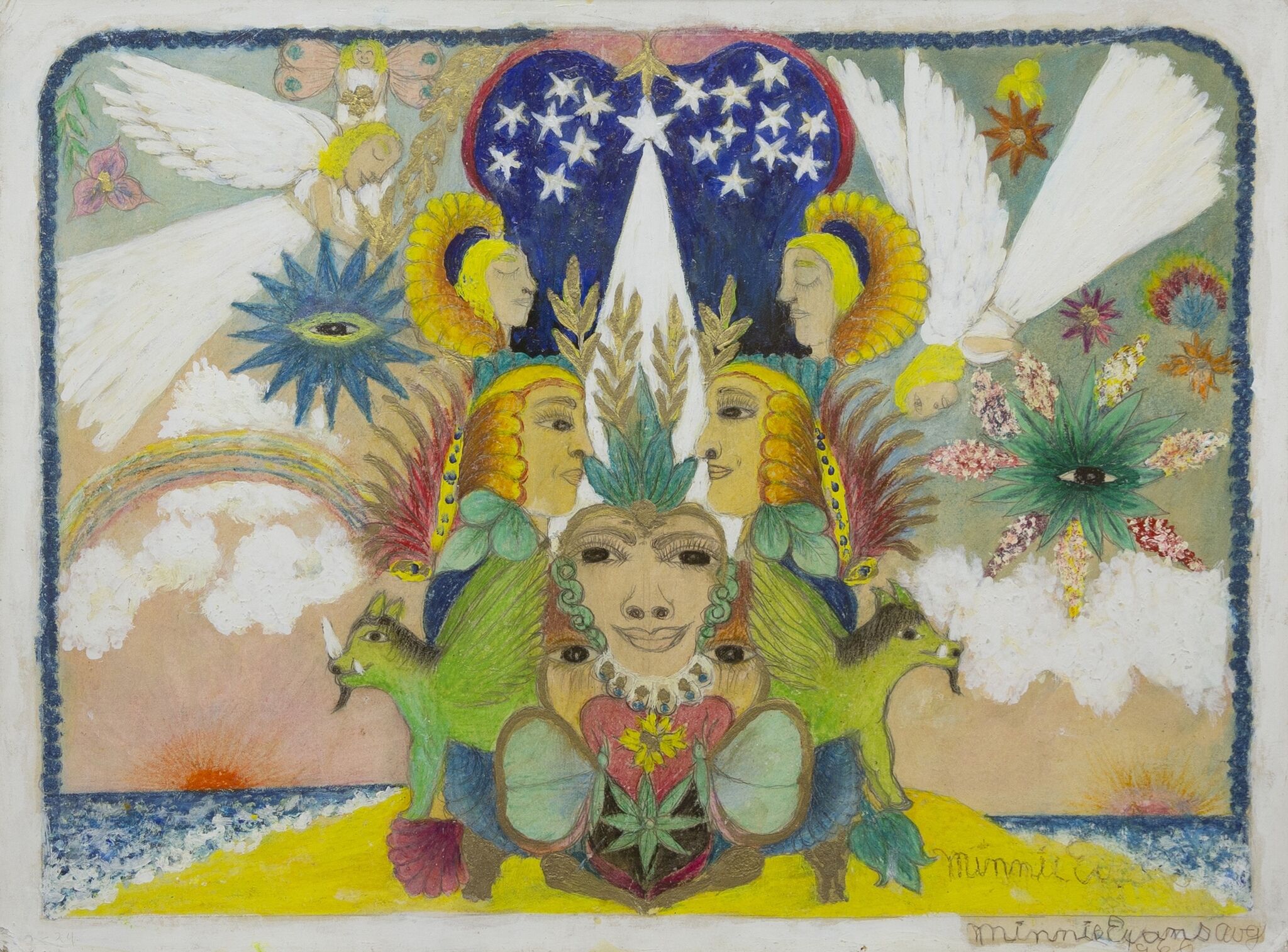
Colorful, symmetrical painting by Minnie Evans. At the center, a face emerges from layered flowers, leaves, and ornate patterns, flanked by two green animal figures. Above, four golden-faced figures with headdresses face inward. Large white-winged angels hover on both sides, accompanied by floating eyes, flowers, clouds, and a rainbow. Two setting suns sit below.

Minnie Evans, Untitled (Day to Night with Beasts and Angels), 1966. Crayon and pencil on paper, 14 7/8 × 19 3/4 in. (37.78 × 50. 16 cm). Collection of Josh Feldstein © The Estate of Minnie Evans

Untitled (Day to Night with Beasts and Angels), 1966

Evans called her works that feature both the night sky and the transitioning sun her "day to night" pictures. Because her dreams occurred during both sleeping and waking hours, her vision sometimes disoriented her sense of time. During one dream that seemed to begin in the morning but included the darkening sky, she remembered exclaiming, "What is this, is this the sun eclipse?"

Minnie Evans, Modern Art, 1963. Oil, ink, and crayon on paperboard, 11 1/4 × 14 1/2 in. (28.6 × 36.8 cm). High Museum of Art, Atlanta, purchase with funds from Dan and Merrie Boone and the General Acquisitions Fund. © The Estate of Minnie Evans

Modern Art, 1963

This drawing is characteristic of a new mode Evans began working in by the 1960s, using decorative curves to frame scenes by white angels who stand guard over a central form resembling an altar. Here the central form consists of images Evans had been developing for decades—long pine tree backgrounds, winged beasts, mandalas, and cryptic writing. That she titled this work Modern Art suggests her confidence in its status as an exemplar of twentieth-century art. In 1975, when the Whitney mounted Evans's first one-person museum exhibition in New York, this work was featured on the cover of the exhibition brochure.

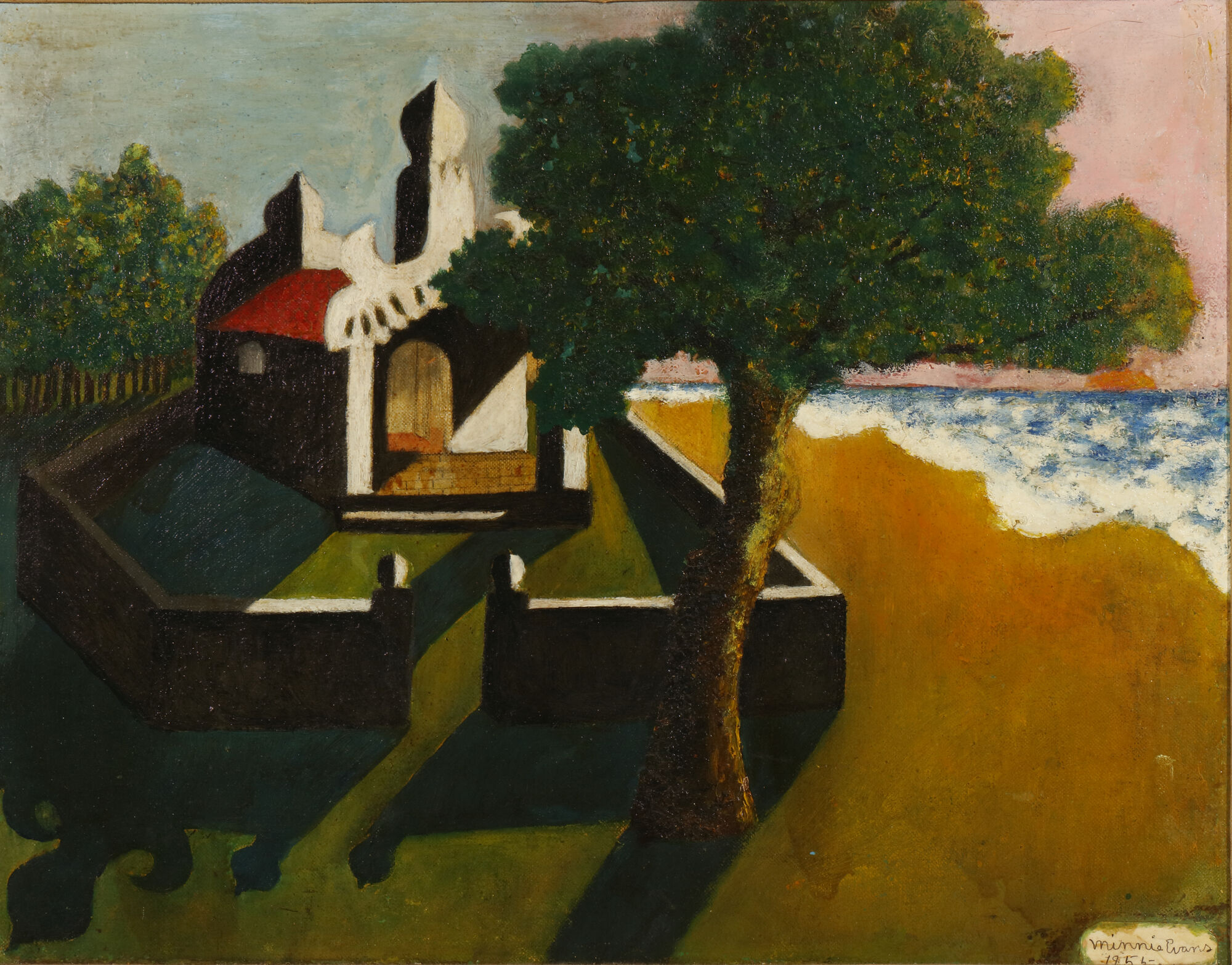
A small white coastal house beside a large tree casting long shadows toward a sandy beach.

Minnie Evans, Temple by the Sea, 1955. Oil on canvas, 16 3/4 × 20 1/2 in. (42.55 × 52.07 cm). High Museum of Art, Atlanta, gift of the Kallir Family in memory of John Kallir, 2025.60. © The Estate of Minnie Evans. Photograph by Mike Jensen

Temple by the Sea, 1955

Evans's interest in ancient history may have inspired her to include images of temples and walled villages in her work. This painting is unusual in its reference to a specific site—the Hindu temple known as Temple in the Sea, which was built in 1952 in Trinidad, the Caribbean island that was home to Evans's maternal ancestors. Her depiction of the temple in a coastal setting similar to that of Wilmington suggests Evans's desire to link her own history with that of her forebears.

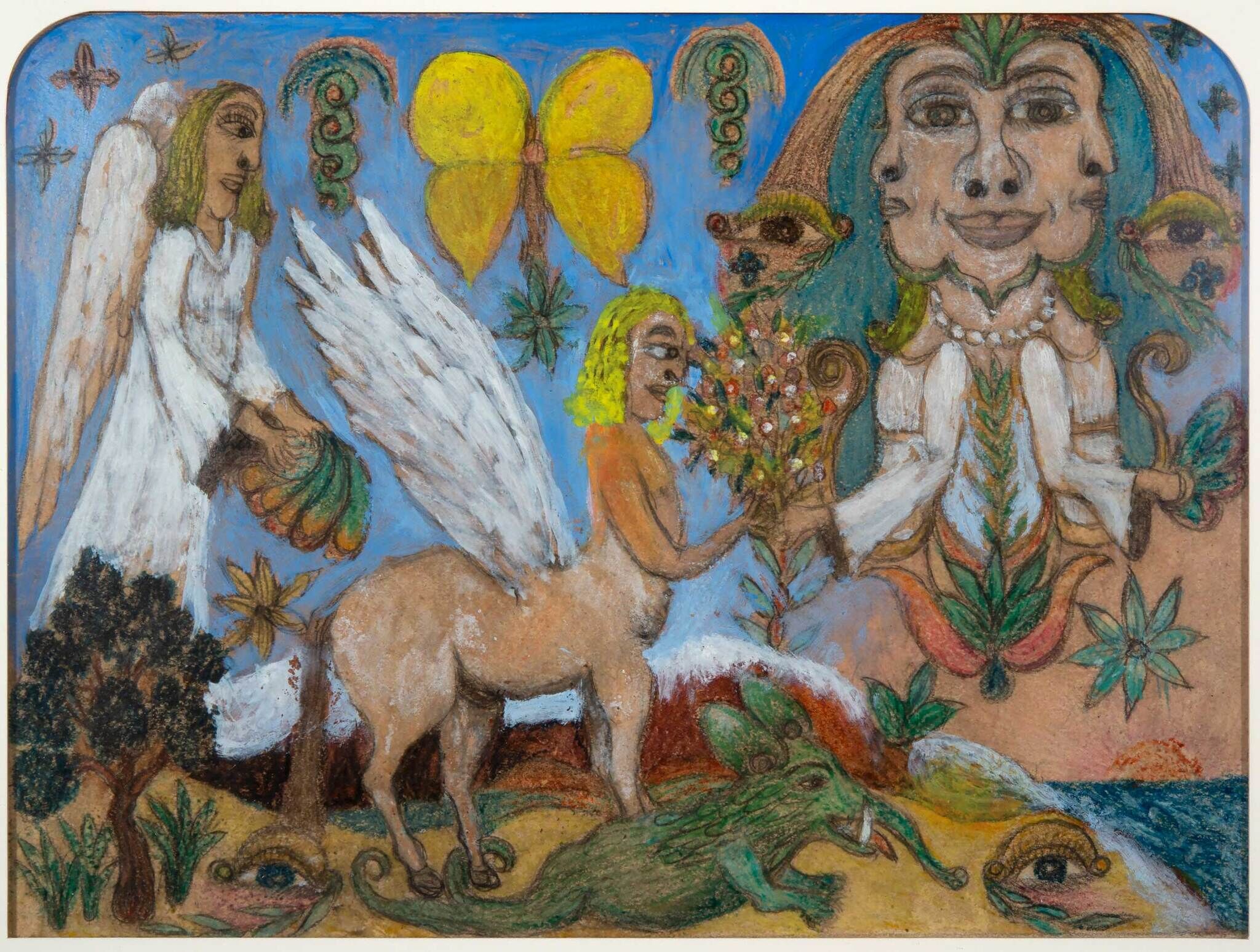
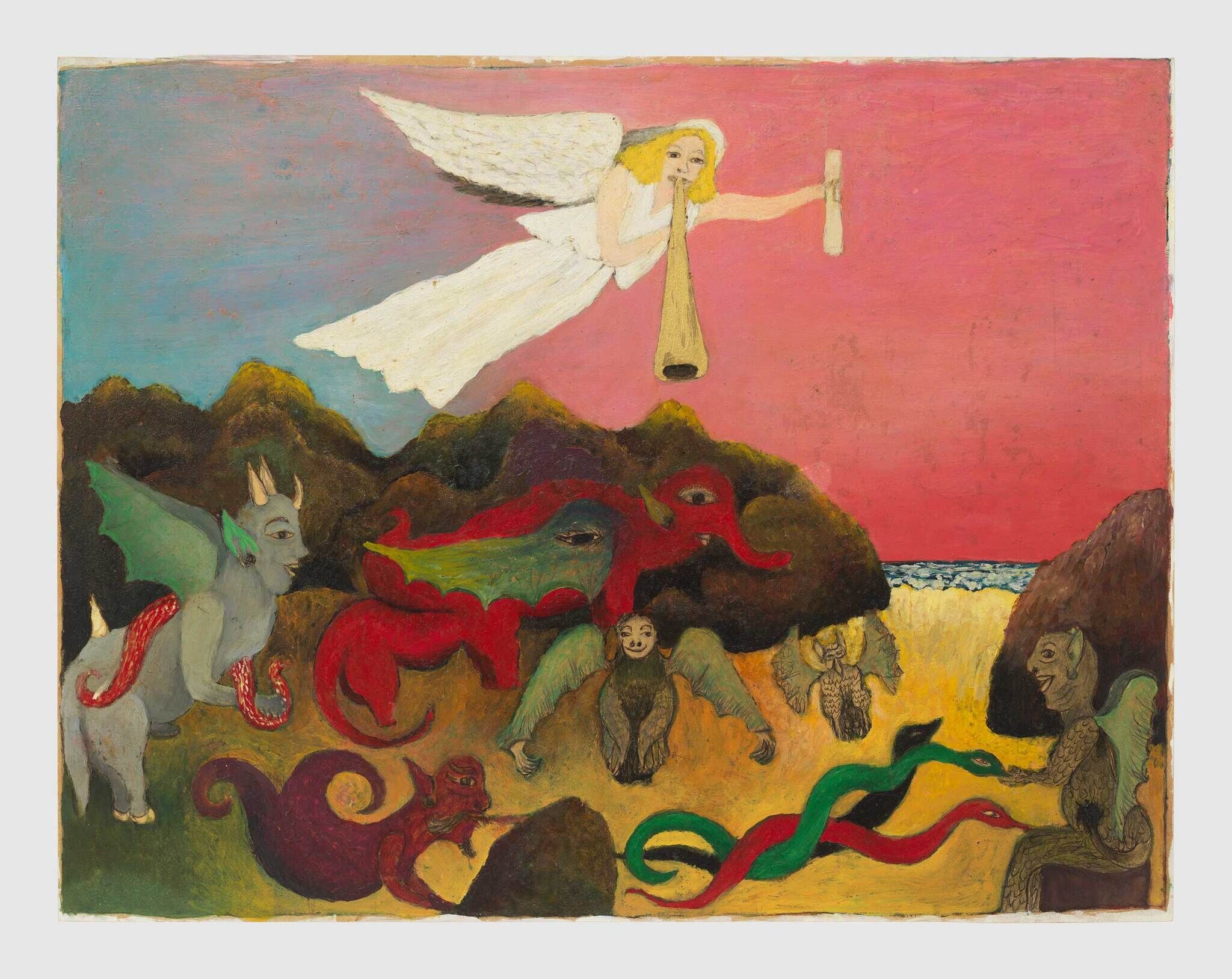
A winged angel flies and blows a long horn over bizarre colorful beasts on a hillside.

Minnie Evans, Voice of the Third Angel, 1963. Oil and ink on paperboard, 14 1/8 × 18 1/8 in. (35.9 × 46 cm). Collection of Joshua Feldstein. © The Estate of Minnie Evans. Photograph by Christopher Burke

Voice of the Third Angel, 1963

In the book of Revelation, St. John the Apostle's prophetic visions are filled with cryptic symbols of strange, hybrid beasts and monsters with multiple heads and snakes for tails. The placement of the creatures on a beach reflects the setting of the book of Revelation, which unfolds between sea and land. Evans's own coastal environment, as well as the kinship she may have felt with St. John the Apostle—who also communicated his visions—may have contributed to her identification with that book of the New Testament.

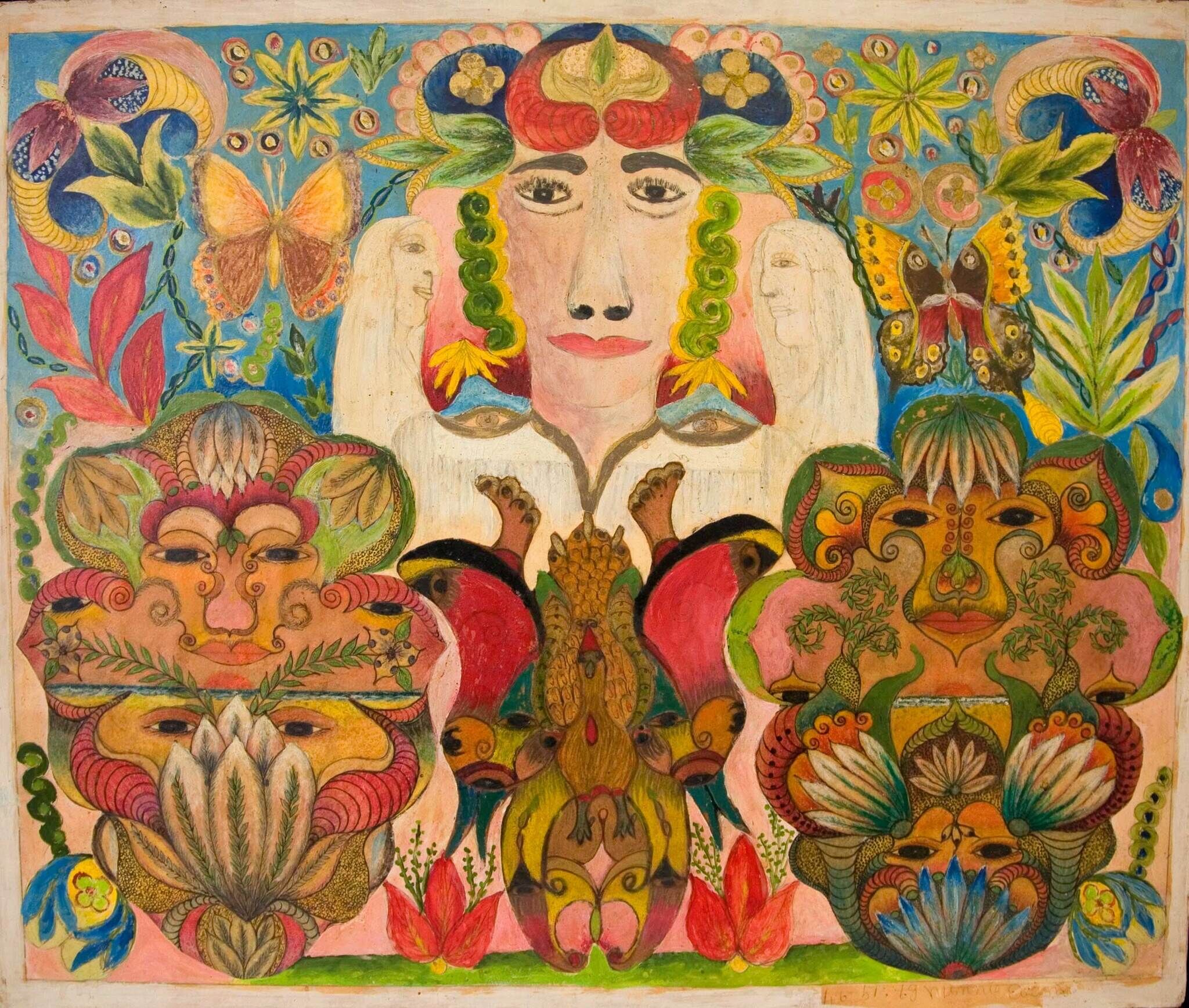
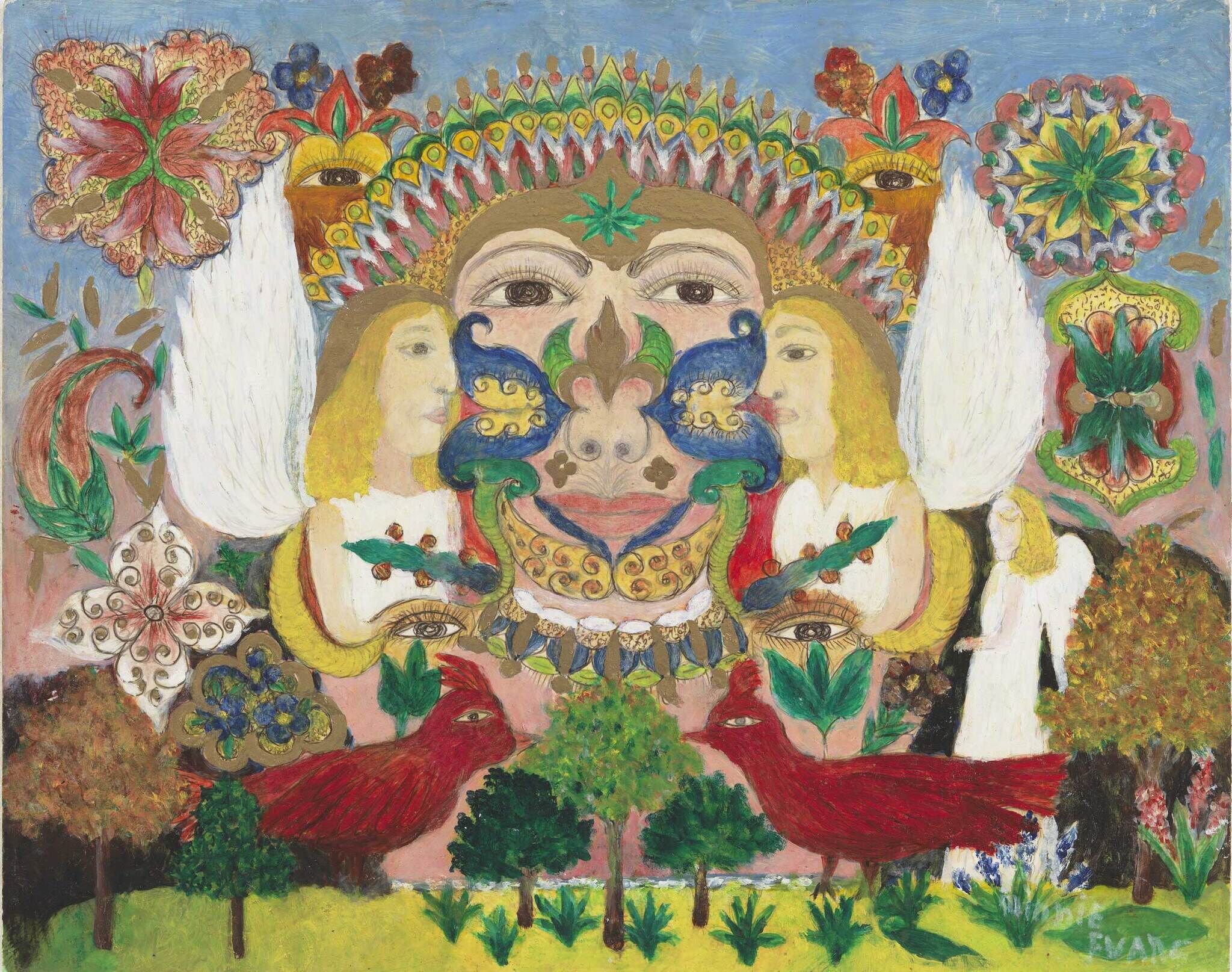
A colorful ornate face with two angelic figures kissing its cheeks and two red birds.

Minnie Evans, Untitled (Face with Crown and Angels), 1968. Oil, ink, gold paint, and pencil on paper, 17 × 19 1/2 × 1 3/8 in. (43.2 × 49.5 × 3.5 cm). Collection of Wendy Williams, New York. © The Estate of Minnie Evans. Photograph by Christopher Burke

Untitled (Face with Crown and Angels), 1968

As Evans's career evolved, angels came to dominate her compositions. She depicted them as intermediaries between the divine and human realms, unleashing their judgments through trumpets. The abundance of blond angels that emerged in her work in the 1960s fed the perception that Evans favored white people in her art, a critique that was especially powerful in the context of the contemporaneous Black Arts Movement. Evans insisted that the angels' white wings, robes, and skin were based on her spiritual visions of heaven rather than on racial distinctions.

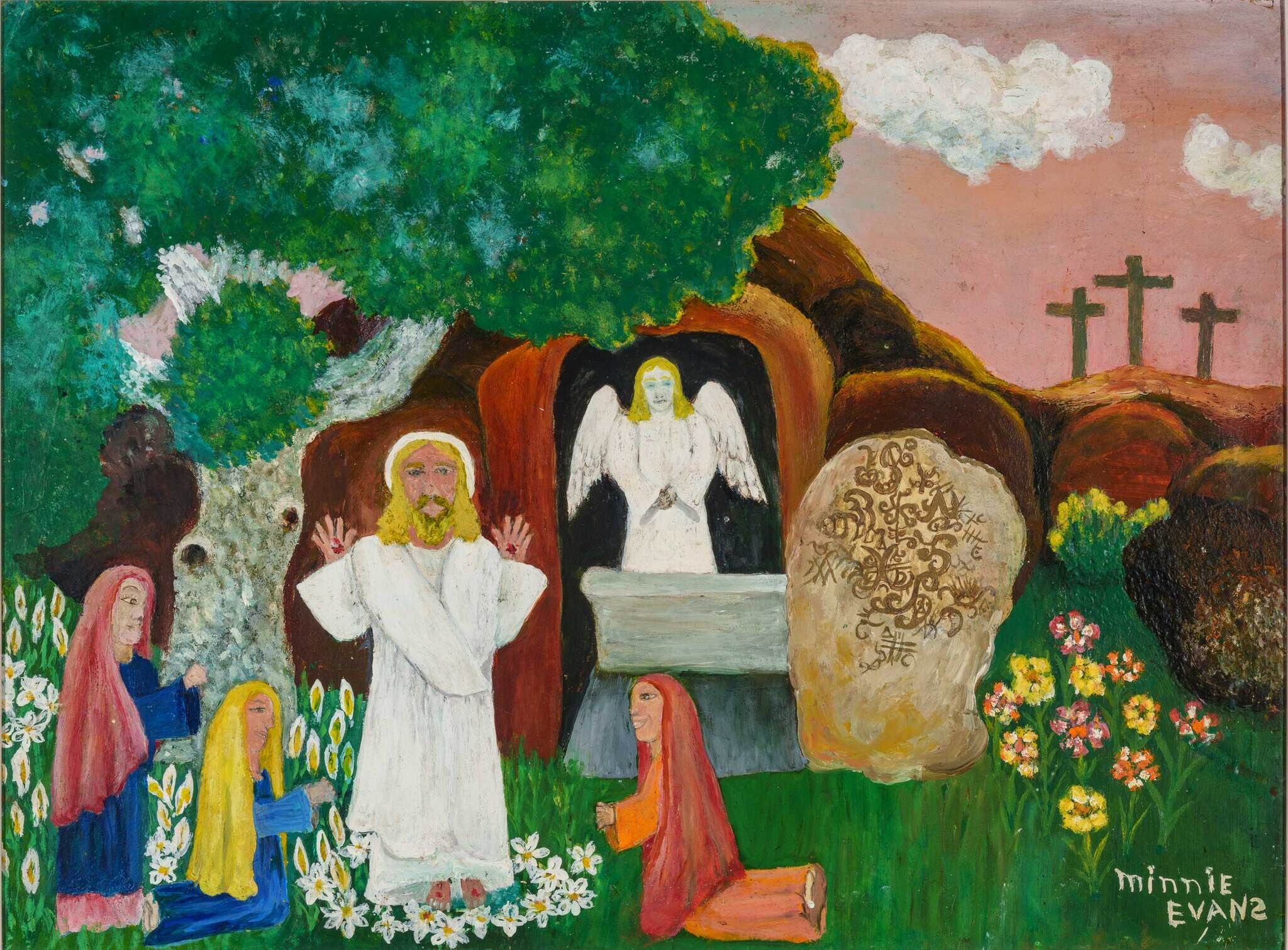
Jesus stands raised before a tomb as an angel watches and women kneel among flowers.

Minnie Evans, Resurrection, 1960. Oil on board, 18 × 24 in. (45.7 × 61.0 cm). Collection of John Jerit. © The Estate of Minnie Evans

Resurrection, 1960


Explore works from this exhibition
in the Whitney's collection

View 3 works

On the Hour

A 30-second online art project:
Frank WANG Yefeng, The Levitating Perils #2

Learn more about this project

Learn more at whitney.org/artport

On the Hour projects can contain motion and sound. To respect your accessibility settings autoplay is disabled.