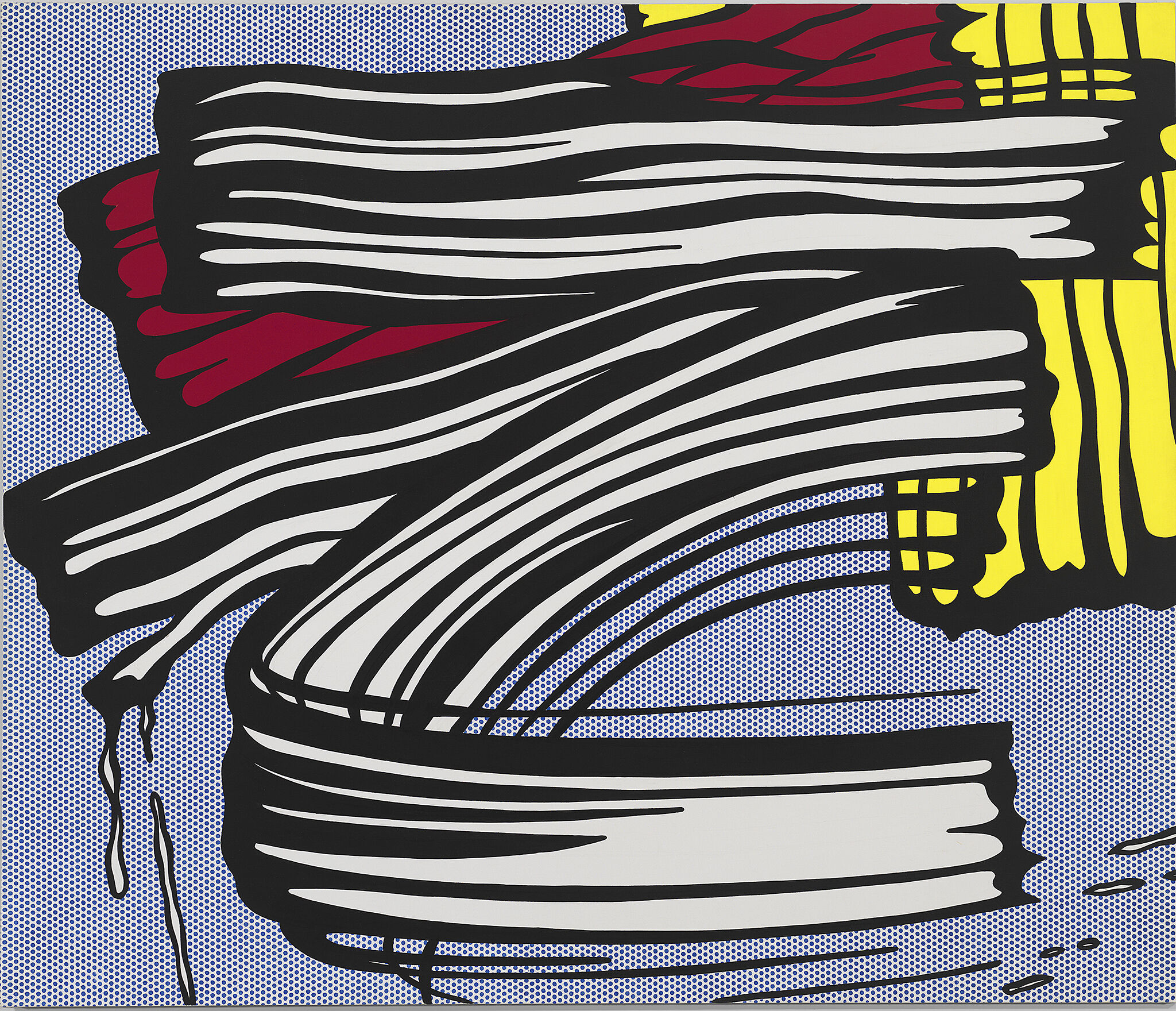
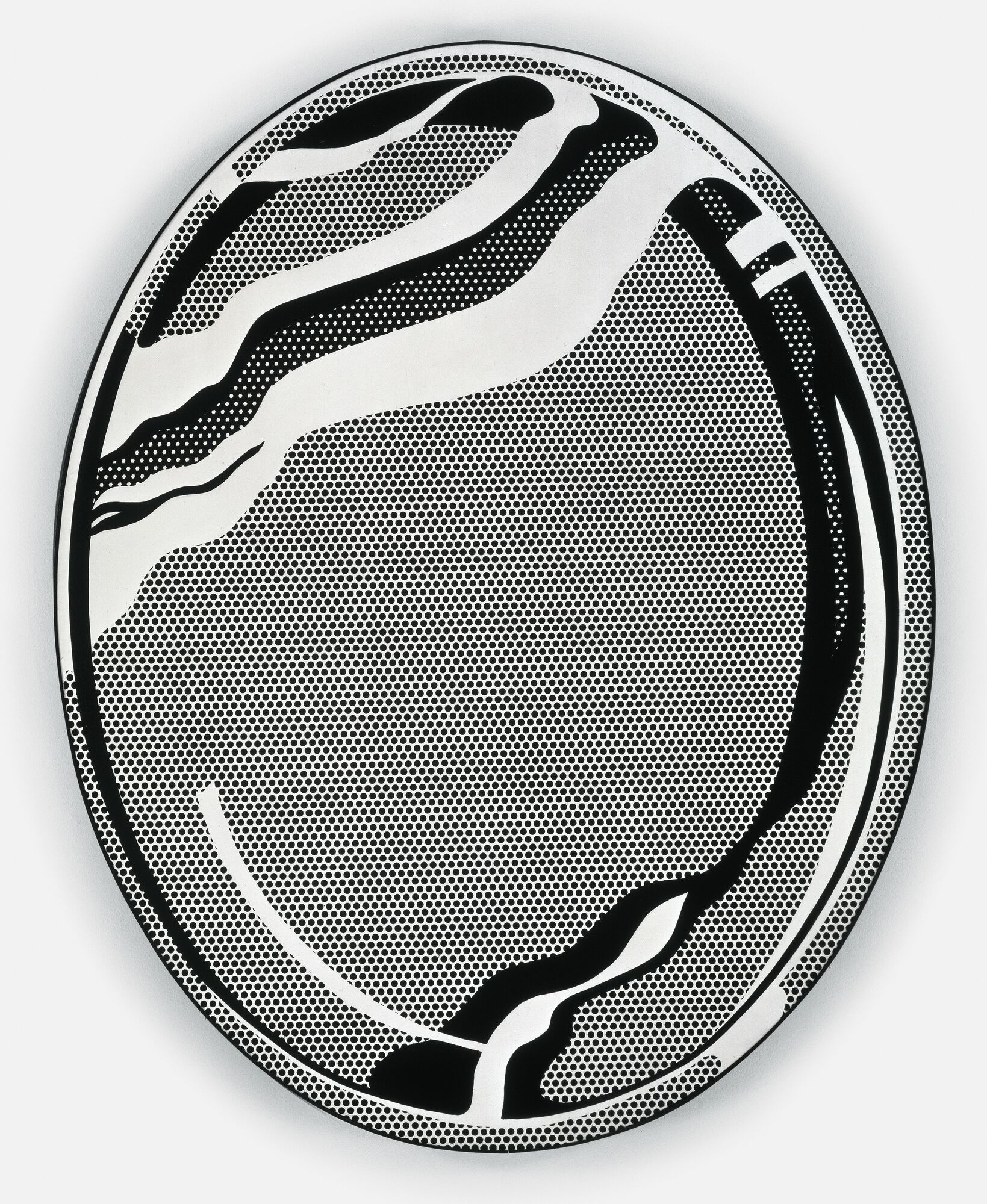
Despite their titles, Lichtenstein’s Mirrors (1969–72) do not reflect anything: not the artist at work making them, not the viewer standing in front of them, not even the room in which they hang. “They really only look like mirrors if someone tells you they do,” he later said. The Mirrors nod slyly at the centuries-old expectations of painting as an illusionistic medium, even as their forms offer up Lichtenstein’s response to developments in geometric abstraction and Minimalist sculpture of the 1960s and 1970s.
The series was inspired by printed sales brochures he saw in glass stores on the Bowery near his studio that “depicted mirrors with air-brushed mirror symbols, reflecting nothing.” He then photographed actual mirrors to study how light moved across their surfaces and translated those effects into curved bands, dots, highlights, and shadows, marking the first time the artist used photography to help him develop his imagery. In their isolation and simplification of a familiar object, the Mirrors recall Hoyt L. Sherman’s Flash Lab exercises, which trained artists to see ordinary things as unified visual forms. Here, Lichtenstein makes the act of looking the subject of his painting.