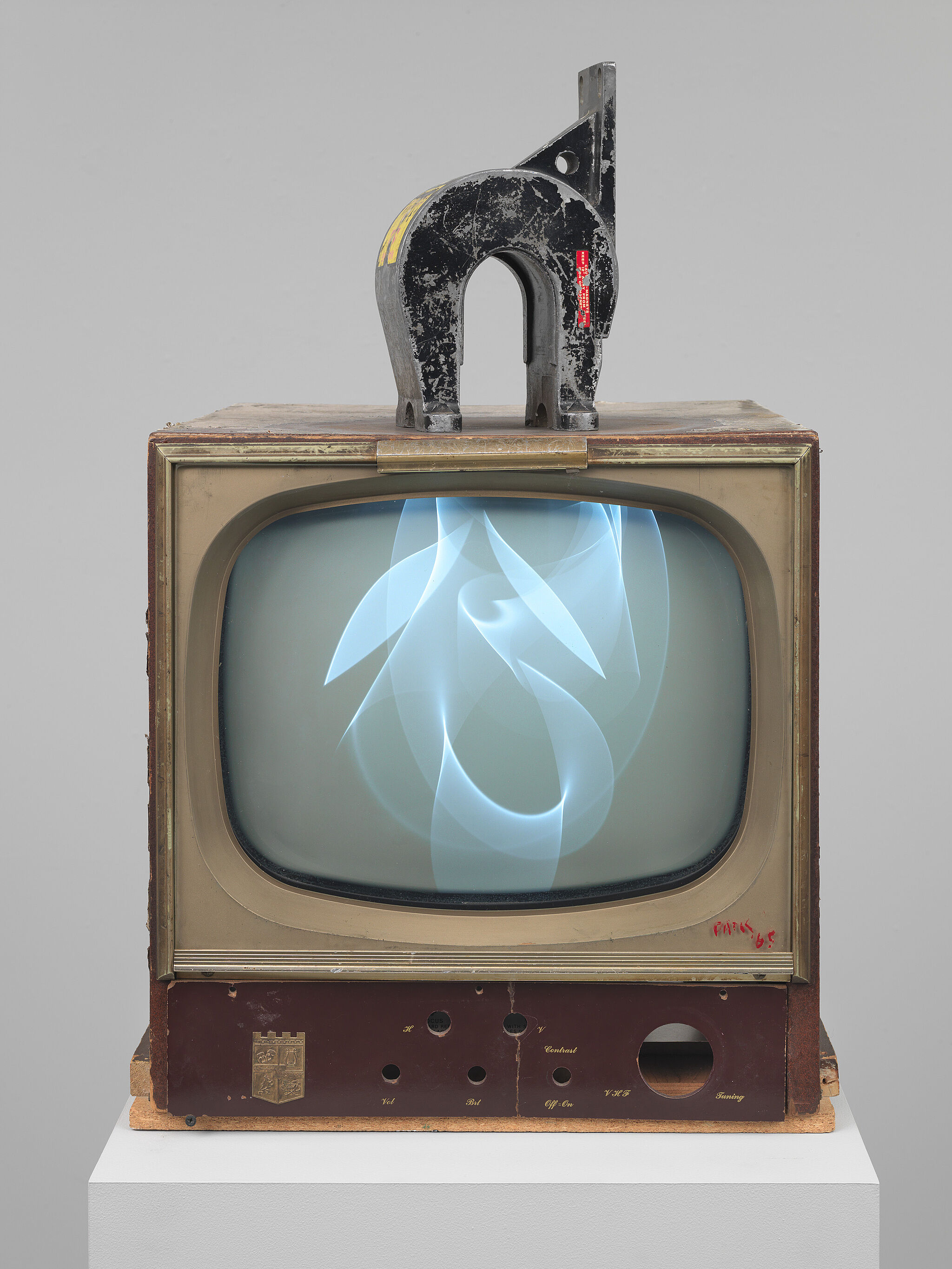
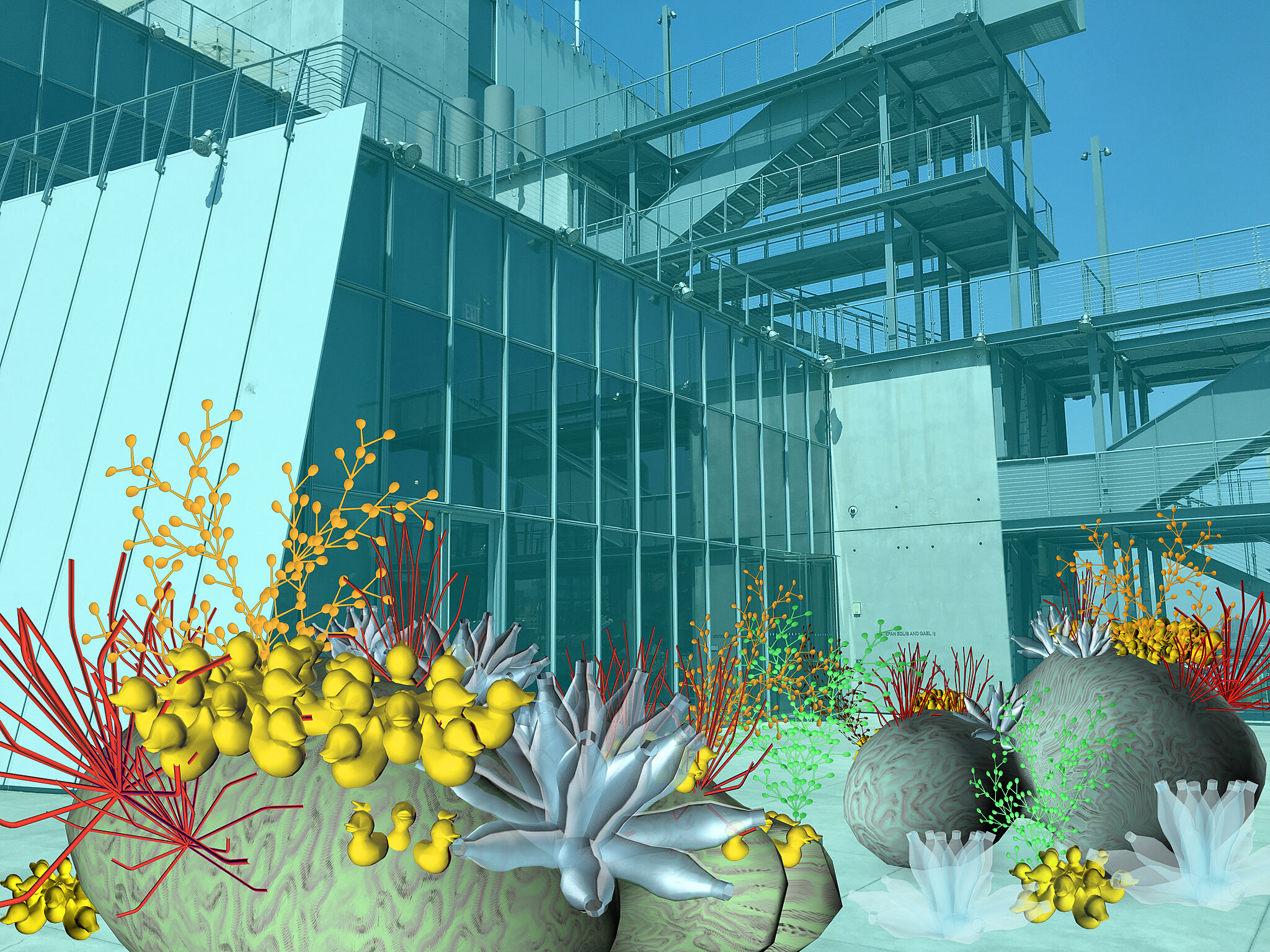
“Generative art” is defined as any art practice in which the artist hands over control to a system that can function autonomously and that contributes to or creates a work of art. These systems range from natural language instructions and mathematical operations to computer programs and biological processes. While artworks with generative qualities appear throughout the exhibition, works by Ian Cheng, Alex Dodge, and Cheyney Thompson underscore their own process of coming into being or emergence. This emphasis allows us to see an artwork as an open process, where algorithms enable variations in form. Whether using code or chat bots—computer programs designed to simulate conversation with human users—each of these works invites us to rethink authorship, materiality, communication, and meaning.
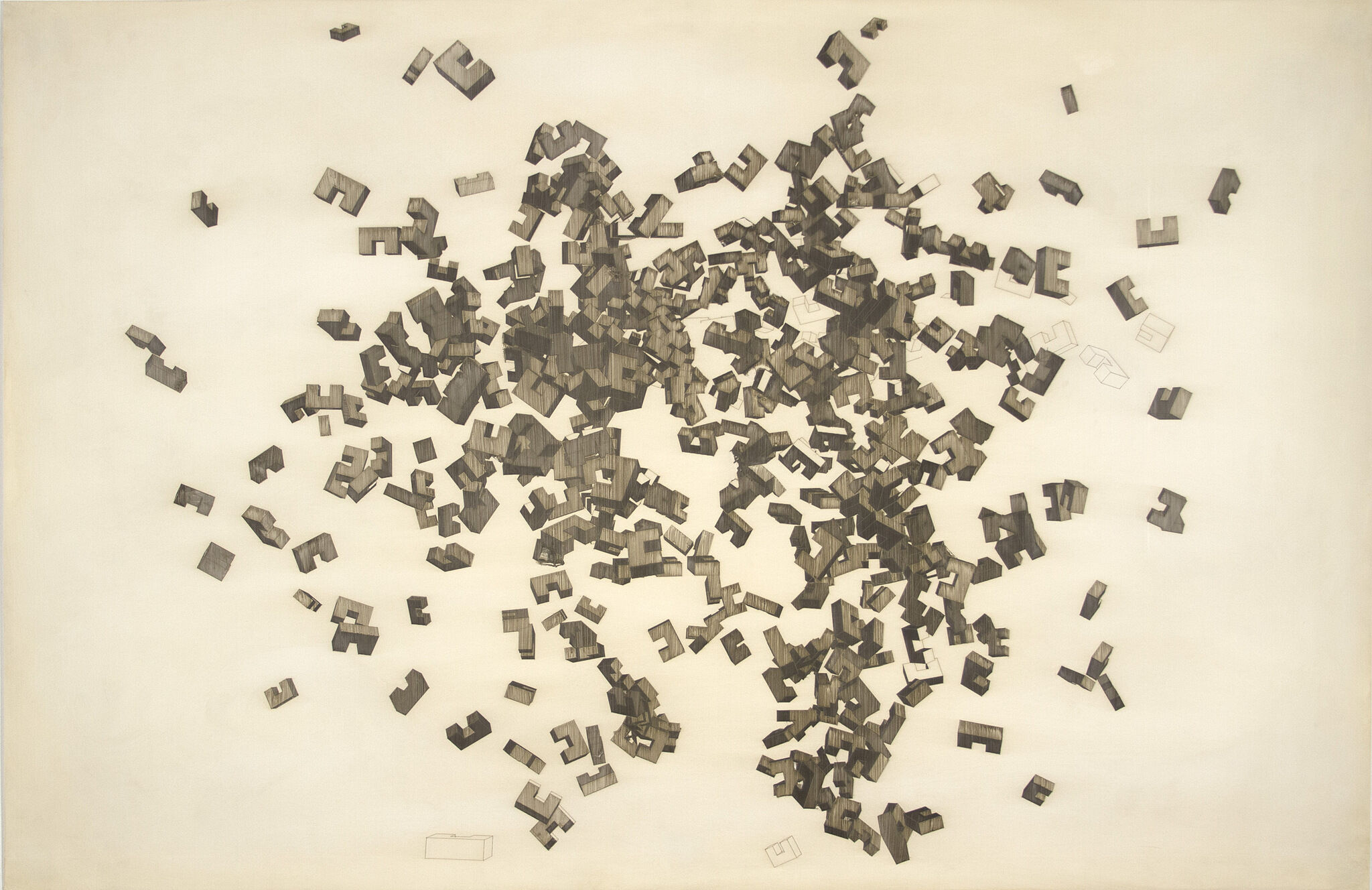
Alex Dodge, Human-Assisted Simulations of a Universal Will to Become (Simulation 9), 2014
Alex Dodge regards code as “a tool for understanding the world within a logical and abstract framework,” and he uses it to generate the visuals for his work. He considers his drawings investigations into complexity that model how intricate interconnected forms can be generated from seemingly basic parts. Here his work presents the possibility for infinite variation in the expression of shapes and in an ongoing pattern that builds upon itself. Dodge is particularly interested in how the digital/ephemeral and the physical/material— in this case graphite and watercolor—intersect in an artifact. His drawing underscores the power of code as a logic that allows forms to emerge and realize themselves.
Ian Cheng, Baby feat. Ikaria, 2013
In Baby feat. Ikaria, Ian Cheng’s software enables an audible conversation between three online chatbots whose voices animate a swirl of debris. Via Wi-Fi, the software queries three different customized chatbots from an online service so that they “talk” to each other. The debris exhibits a behavioral pattern, repeatedly coalescing and then disintegrating, sometimes appearing as an active agent, at other times as inert material, and often as an ambiguous hybrid. While the chatbots are programmed to have basic learning abilities and can continuously expand their dialogue, the “intelligence” of the bots is questionable. The visuals and behaviors of the floating debris capture an artificial intelligence that is lifelike yet mechanistic, reflecting the mix of nonhuman and human conversations that increasingly permeates our lives.
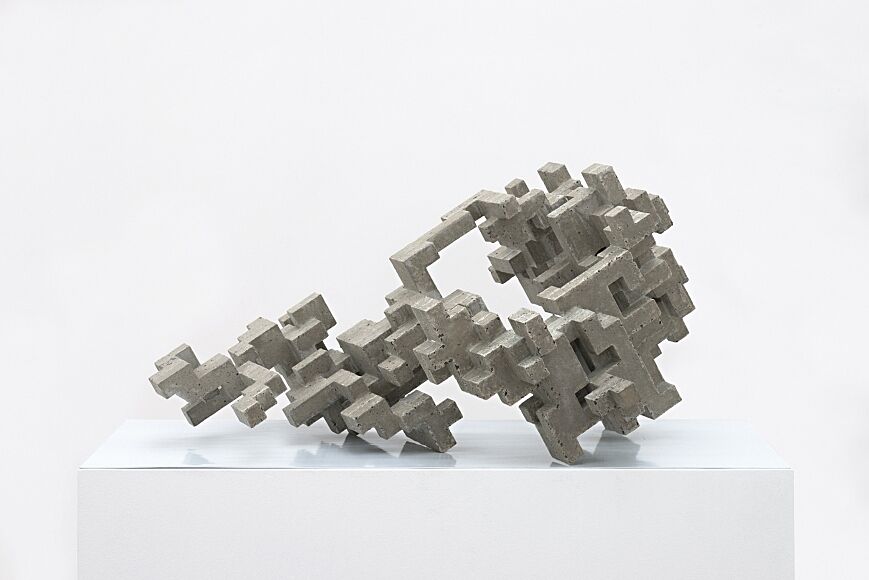
Cheyney Thompson (b. 1975), Broken Volume (10 L), 2013. Concrete. Whitney Museum of American Art, New York; promised gift of Thea Westreich Wagner and Ethan Wagner P.2014.33
Cheyney Thompson, Broken Volume (10 L), 2013
In his Broken Volume sculptures Cheyney Thompson arranges one-inch concrete cubes along a path prescribed by the Drunken Walk algorithm, a type of Random Walk algorithm used in fields ranging from computer science and biology to economics to describe a succession of random steps that maps possible variations of a phenomenon. The works in this series all share the same volume of concrete, ten liters (10 L). Since the algorithm places no constraint on the sculptural forms and does not acknowledge the material’s structural limits, the forms may break under their own weight. In fact, in the process of installing this work, it broke and is now presented in the exhibition as two parts. The Broken Volume series captures the tension between the immateriality of an algorithm and the physical forms it produces. In doing so, the series comments on the potentially precarious nature of the increasingly algorithmic design of our environment— from architecture to financial markets—in which rules define, encode, and clarify relationships between elements of our daily life.