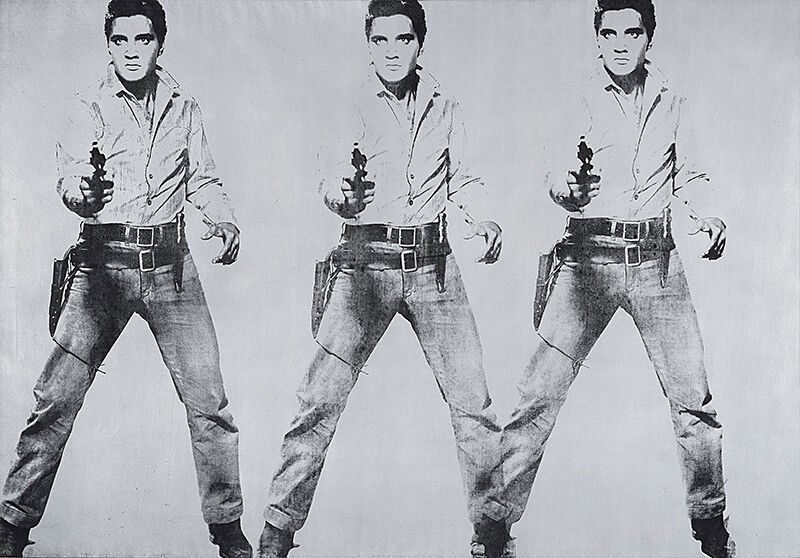
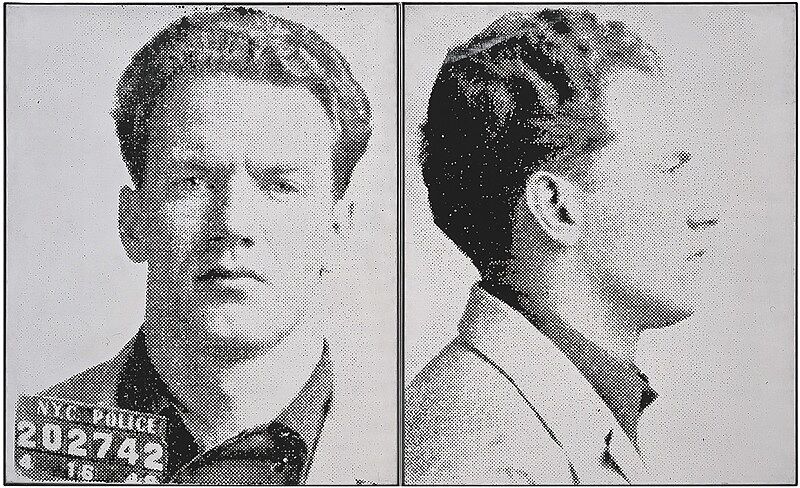
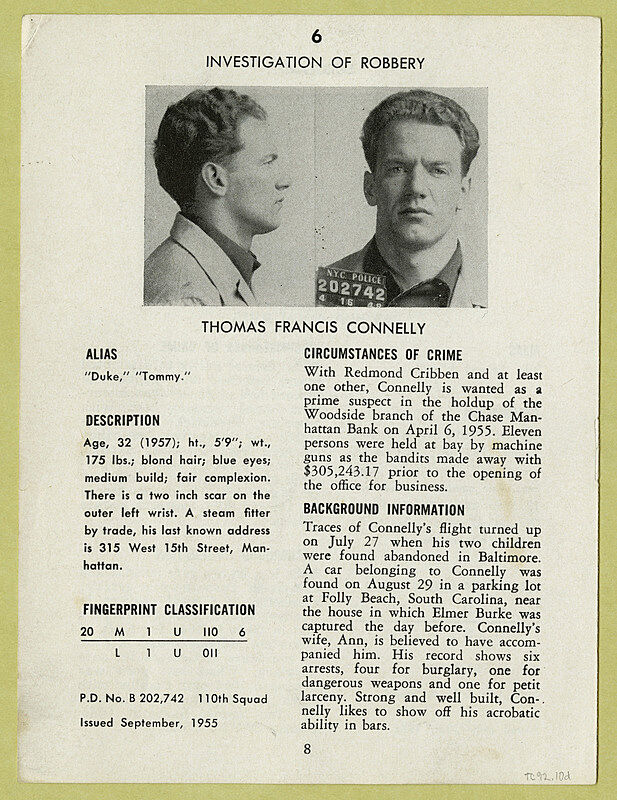
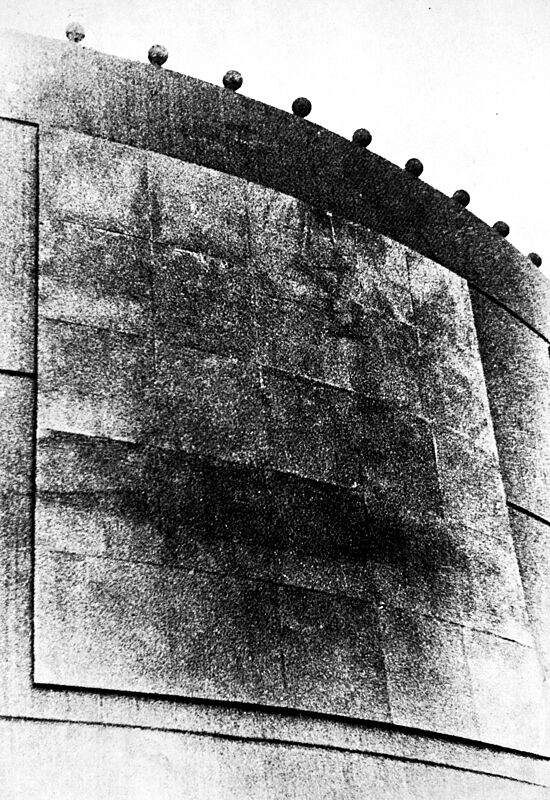
Warhol’s Most Wanted Men (1964) originated as his first public art project, a mural commission from architect Philip Johnson for the New York State Pavilion at the 1964 World’s Fair in Flushing Meadows, Queens. Warhol found his source images for the work in a booklet of photographs titled The Thirteen Most Wanted, circulated by the New York Police Department. Although the booklet’s producers were no doubt oblivious to any possible homoerotic double reading of “wanted” men, it seems to have been obvious to Warhol, who appropriated the concept for two nearly simultaneous projects made with very different audiences in mind: the public mural, Thirteen Most Wanted Men, and an unambiguously homoerotic film series, The Thirteen Most Beautiful Boys (1964–66). Alongside its other qualities, the mural constituted a sophisticated essay on the antihero, taking Warhol’s selection of bad-boy celebrities—Marlon Brando, James Dean, and Elvis Presley—to another level. Before the fair opened, Warhol was asked to remove the mural. The fair’s organizers found the subject matter too controversial, but not because of covert gay references: they were keen to promote an upbeat image and loath to implicitly condemn people who, though wanted for arrest, had not stood trial. Warhol did not remove the images; instead, he acceded to having the mural painted over in silver.
“In one way I was glad the mural was gone: now I wouldn’t have to feel responsible if one of the criminals ever got turned in to the FBI because someone had recognized him from my pictures.”