

In 1981, Keith Haring noticed that New York City’s electrical company, Consolidated Electric, used vinyl tarps to protect its equipment on the street and he was intrigued by the possibility of using the tarps as a new support for his art. He found a distributor from whom he could obtain white and brightly colored tarps, and began painting on them with black vinyl pigment. Untitled, October 19, 1981, an early example of this type of work, is a symmetrical composition featuring two kneeling or running men on either side of a television, on which appears one of Haring’s hallmark icons, what he called the "radiant baby." While more carefully composed than much of the artist’s work to date—which had required quick, spontaneous execution—the image’s untraditional materials, and the thick black lines animating every inch of its six-foot-square surface, retain some of the rawness of his street works. Haring’s tarps represent an important transitional moment in his career: they introduced the color, imagery, and pictorial arrangements that would dominate much of his work in the 1980s, and served as a model for the ambitious paintings, murals, and commercial products he would go on to produce.
Installation photography
-
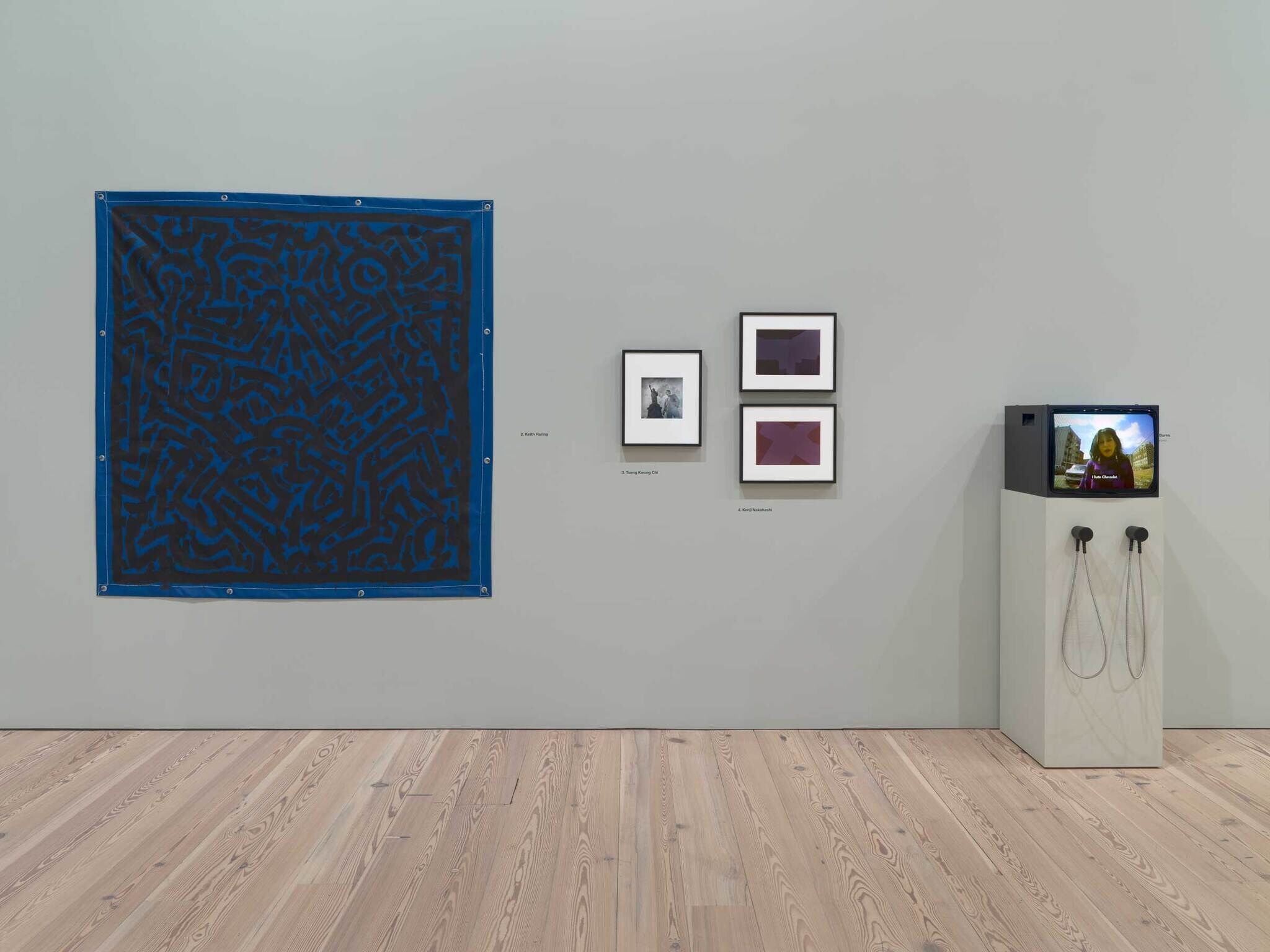
Installation view of Shifting Landscapes (Whitney Museum of American Art, New York, November 1, 2024-January 25, 2026). From left to right: Keith Haring, Untitled, 1981; Tseng Kwong Chi, New York, New York (Statue of Liberty), 1979; Kenji Nakahashi, A Cut-Out Sky (Marketfield St. Between Beaver St. & Broad St., N.Y.C.), 1984; Kenji Nakahashi, A Cut-Out Sky (The Corner of Exchange Pl. & William St., N.Y.C.), 1979; Diane Burns, Alphabet City Serenade, 1988. Photograph by Ron Amstutz
From the exhibition Shifting Landscapes