
Lew Baldwin: GoodWorld
July 2002
Lew Baldwin: GoodWorld
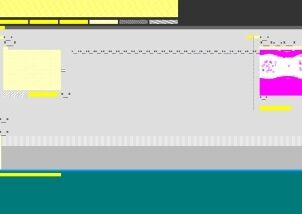
Lew Baldwin’s GoodWorld “wraps” the web in color and abstraction by erasing the content of individual pages and unifying it in a singular, generative artwork. Users can type URLs of websites into a navigation bar. The code then selects the prominent image on the respective page, chooses the dominant RGB (color) value from a set number of pixels, and transforms the page into an abstracted reproduction of the original by generating a representation in magenta squares. Most, if not all, of the remaining images on the page become yellow “wrappers,” and the text and links change into asterisks and lines that together symbolize a complacent happy face. The project neutralized the online experience of commercial websites in the early 2000s, which was dominated by flashing ads, banners, and pop-up windows. The web became, in the artist’s view, a dystopian “good world”: an unsettled, watered-down version of the safe and familiar space users expected from it at the time.
This project depends on external server functionality that is no longer online.
Lew Baldwin (b. 1969; New Brunswick, New Jersey) is an artist and filmmaker whose work spans video installations, film collaborations, painting, internet-based work, and music. His website redsmoke.com was included in the Whitney Biennial in 2000, and his work Milk Milk Lemonade was shown in the Whitney’s exhibition BitStreams in 2001. He created visual sequences for the feature film November (2004), starring Courteney Cox and James Le Gros, and directed the short film Abraded (2010), which was featured at the Woodstock Film Festival. In 2019 Baldwin returned to painting, seeing it as a natural extension of his digital and motion-based work. His art has been exhibited at the New Museum, New York; the Armory Center for the Arts, Pasadena; the Art Association of Jackson Hole, Wyoming; the Sundance Film Festival; and in various international venues in Venezuela, Brazil, Mexico, Italy, and Japan.
Gate Pages
Every month from March 2001 to February 2006, the Whitney invited an artist or collective to present their work in the form of a “Gate Page” on artport. Each page was meant to function as a portal to the artist’s own sites and projects. The Gate Pages comprise a range of artistic approaches to the format—while some of them are designed as entry points to the respective artist’s website or promote a recently launched work, others take the form of a more complex stand-alone project.
Wherever necessary and possible, these works are made functional through emulation and reconstructions from the Internet Archive. Not all of them have been restored to their original state and their conservation is ongoing. You can also view the original Gate Pages archive to see how they were presented at the time of their creation.
artport
View more on artport, the Whitney Museum's portal to Internet and new media art.