Grant Wood: American Gothic and Other Fables | Art & Artists

Mar 2–June 10, 2018


Exhibition works

8 total
Portraits
Read more

Portraits


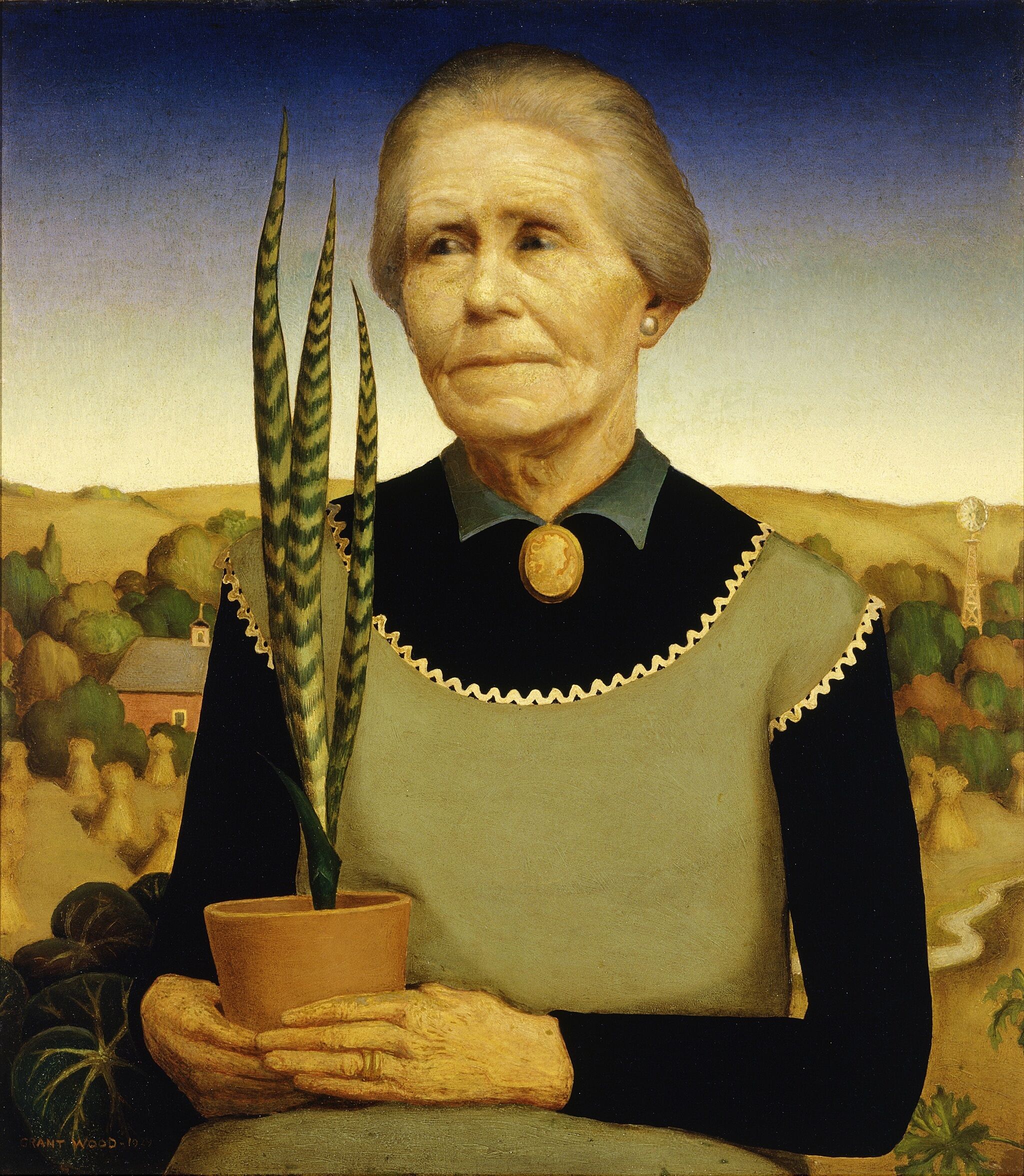
Painting of woman holding potted plant.

Grant Wood, Woman with Plants, 1929. Oil on composition board, 20 1/2 x 18 in. (52.1 x 45.7 cm). Cedar Rapids Museum of Art, Iowa; museum purchase 31.1. © Figge Art Museum, successors to the Estate of Nan Wood Graham/Licensed by VAGA, New York, NY

Portraits

By the late 1920s, Grant Wood had come to believe that the emergence of a rich American culture depended on artists breaking free of European influence and expressing the specific character of their own regions. For him, it was Iowa, whose rolling hills and harvested cornfields served as the background for his earliest mature portraits, those of his mother and Arnold Pyle. In Europe, he had admired Northern Renaissance painting by artists such as Hans Memling and Albrecht Dürer. By the time he painted American Gothic in 1930, he had concluded that the hard-edge precision and meticulous detail in their art could be used to convey a distinctly American quality, especially suggestive of the Midwest. Joined with Iowan subject matter, it became the basis of his signature style. 

Wood felt that all painting, portraiture included, must suggest a narrative in order to engender the emotional and psychological engagement he associated with successful literature. Consequently, he included images that hinted at the life and character of the depicted subject, taking care to avoid anecdotal illustration by painting archetypes rather than individuals. He left the “props” in his portraits intentionally ambiguous, making the stories they intimate so enigmatic that they defy ready explanation; they are puzzles to be deciphered by viewers based on their individual attitudes and experiences. As a result, Wood’s portraits have historically invited multiple interpretations.

Painting of woman holding potted plant.

Grant Wood, Woman with Plants, 1929. Oil on composition board, 20 1/2 x 18 in. (52.1 x 45.7 cm). Cedar Rapids Museum of Art, Iowa; museum purchase 31.1. © Figge Art Museum, successors to the Estate of Nan Wood Graham/Licensed by VAGA, New York, NY

Woman with Plants, 1929

Wood used his mother as the model for this portrait, highlighting what he called the “bleak, far-away, timeless” quality in her eyes that suggested to him the “severe but generous vision of the Midwest pioneer.” Taking his cue from the practice in Northern Renaissance art of depicting portrait subjects against a landscape background with symbolic objects, Wood presented this half-length figure holding a sansevieria plant, known for its ability to survive under the most inhospitable growing conditions, in front of a backdrop of rolling Iowa hills.

Portrait of young man.

Grant Wood, Arnold Comes of Age (Portrait of Arnold Pyle), 1930. Oil on composition board, 26 3/4 x 23 in. (67.9 x 58.4 cm). Sheldon Museum of Art, Lincoln, Nebraska; Nebraska Art Association Collection 1931.N–38. © Figge Art Museum, successors to the Estate of Nan Wood Graham/Licensed by VAGA, New York, NY. Photograph © Sheldon Museum of Art

Arnold Comes of Age (Portrait of Arnold Pyle), 1930

Wood completed this portrait of his studio assistant and former junior high school student Arnold Pyle during a moment of aesthetic transition, after he had resolved to paint Iowa subject matter but while he was still using a softly atmospheric style. Made to commemorate Pyle’s having turned twenty-one, Wood included images that referenced his subject’s transition into adulthood: the butterfly, a common image of metamorphosis, and the river of life that here separates youth, as represented by the two male nudes in the foreground, from maturity, symbolized by the harvested corn in the background. Despite the celebratory occasion, the work is invested with a poignant feeling of melancholy and longing.

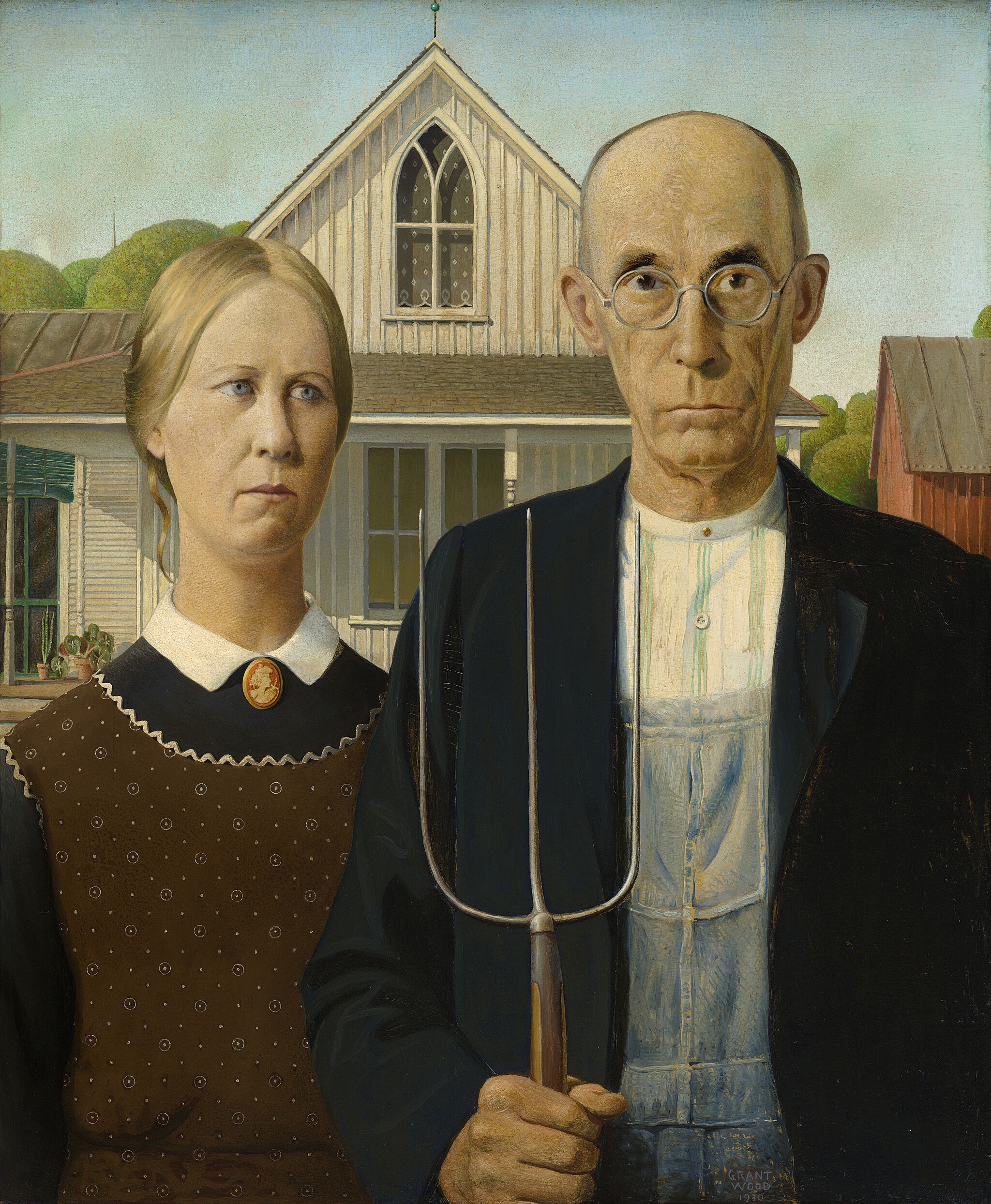
Painting of man holding a pitch fork and a woman in front of a house.

Grant Wood, American Gothic, 1930. Oil on composition board, 30 3⁄4 x 25 3⁄4 in. (78 x 65.3 cm). Art Institute of Chicago; Friends of American Art Collection 1930.934. © Figge Art Museum, successors to the Estate of Nan Wood Graham/Licensed by VAGA, New York, NY. Photograph courtesy Art Institute of Chicago/Art Resource, NY

American Gothic, 1930

Premiering at the Art Institute of Chicago in October 1930, this painting captivated the public’s imagination and catapulted Wood into the national spotlight overnight. A couple—modeled on Wood’s sister, Nan, and his dentist—stand in front of a Midwestern house. The house is notable for its lone “gothic” window, a typical feature of the then-popular Carpenter Gothic style of architecture, in which gothic elements are used in otherwise simple, modern wood structures.

Wood identified the pair as father and daughter, though the work was initially assumed to be a portrait of a husband and wife. “I simply invented some ‘American Gothic’ people to stand in front of a house of this type,” Wood later explained. From the painting’s debut onward, its meaning has been the subject of endless speculation. What has remained central is its seeming embodiment of something stereotypically American.

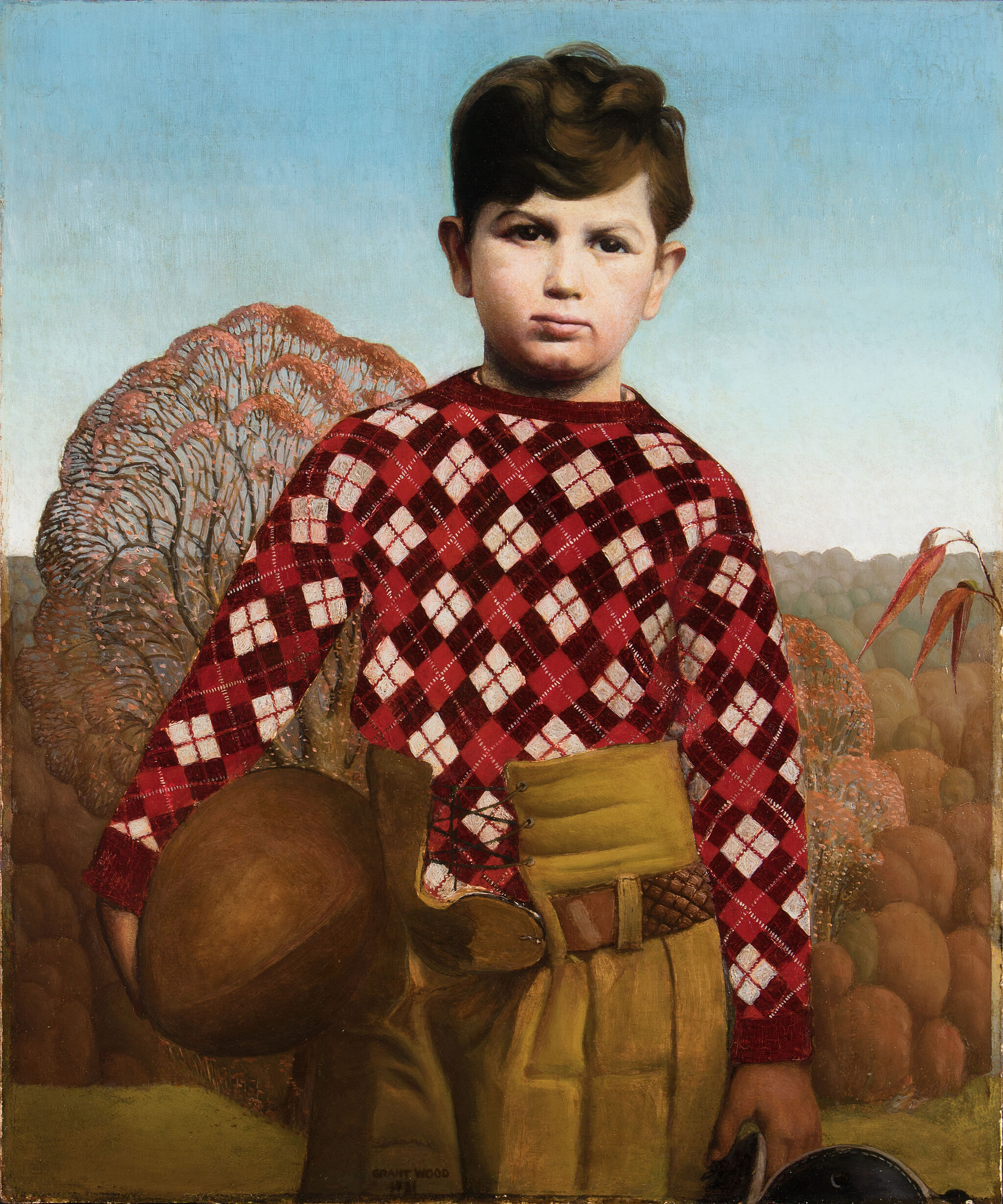
Portrait of a boy in a plaid sweater.

Grant Wood (1891–1942), Plaid Sweater, 1931. Oil on composition board, 29 1⁄2 x 24 1⁄8 in. (74.9 x 61.3 cm). University of Iowa Museum of Art, Iowa City; gift of Mel R. and Carole Blumberg and Family, and Edwin B. Green through the University of Iowa Foundation 1984.56. © Figge Art Museum, successors to the Estate of Nan Wood Graham/Licensed by VAGA, New York, NY. Photograph courtesy Midwest Art Conservation Center

Plaid Sweater, 1931

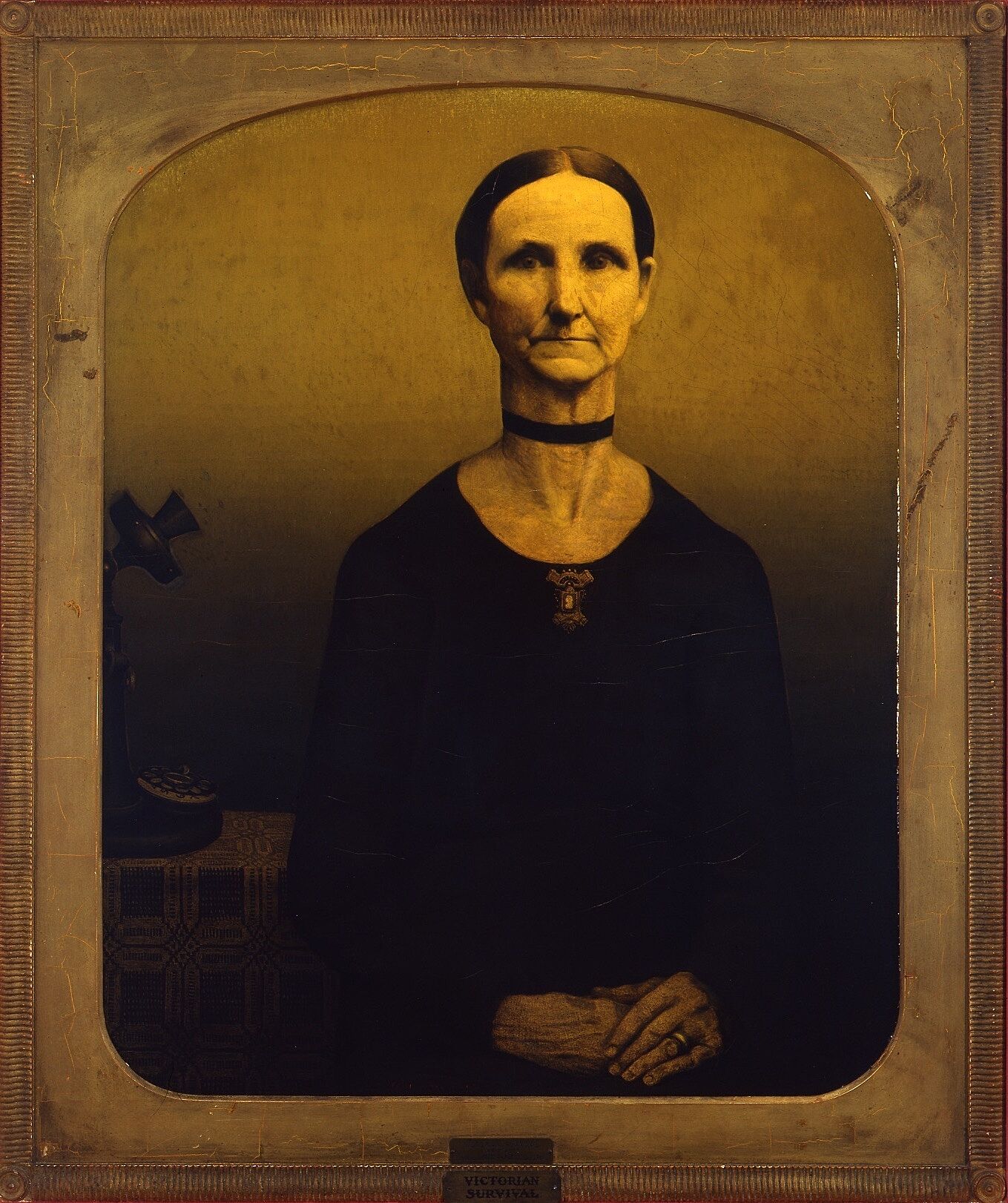
Portrait of woman.
Portrait of woman.

Grant Wood (1891–1942), Victorian Survival, 1931. Oil on composition board, 32 1⁄2 x 26 1⁄4 in. (82.6 x 66.7 cm). Carnegie-Stout Public Library, Dubuque, Iowa; on long-term loan to the Dubuque Museum of Art, Iowa; acquired through the Lull Art Fund. © Figge Art Museum, successors to the Estate of Nan Wood Graham/Licensed by VAGA, New York, NY

Victorian Survival, 1931

With its rounded edges, elaborate frame, and sepia tones, Victorian Survival purposely resembles the late-nineteenth-century tintype of Wood’s great aunt on which this work is modeled. With her stiff upright pose—accentuated by her long choker-bound neck—and tightly combed hair, the sitter’s old-fashioned demeanor contrasts sharply with the modern technology of the rotary dial phone. As always, Wood’s ambiguous symbolism inspires many interpretations. To some the contrast between the figure and the telephone is a humorous commentary on the trope of the gossipy spinster, while to others it has been interpreted as a clash between Victorian insularity and modernity.

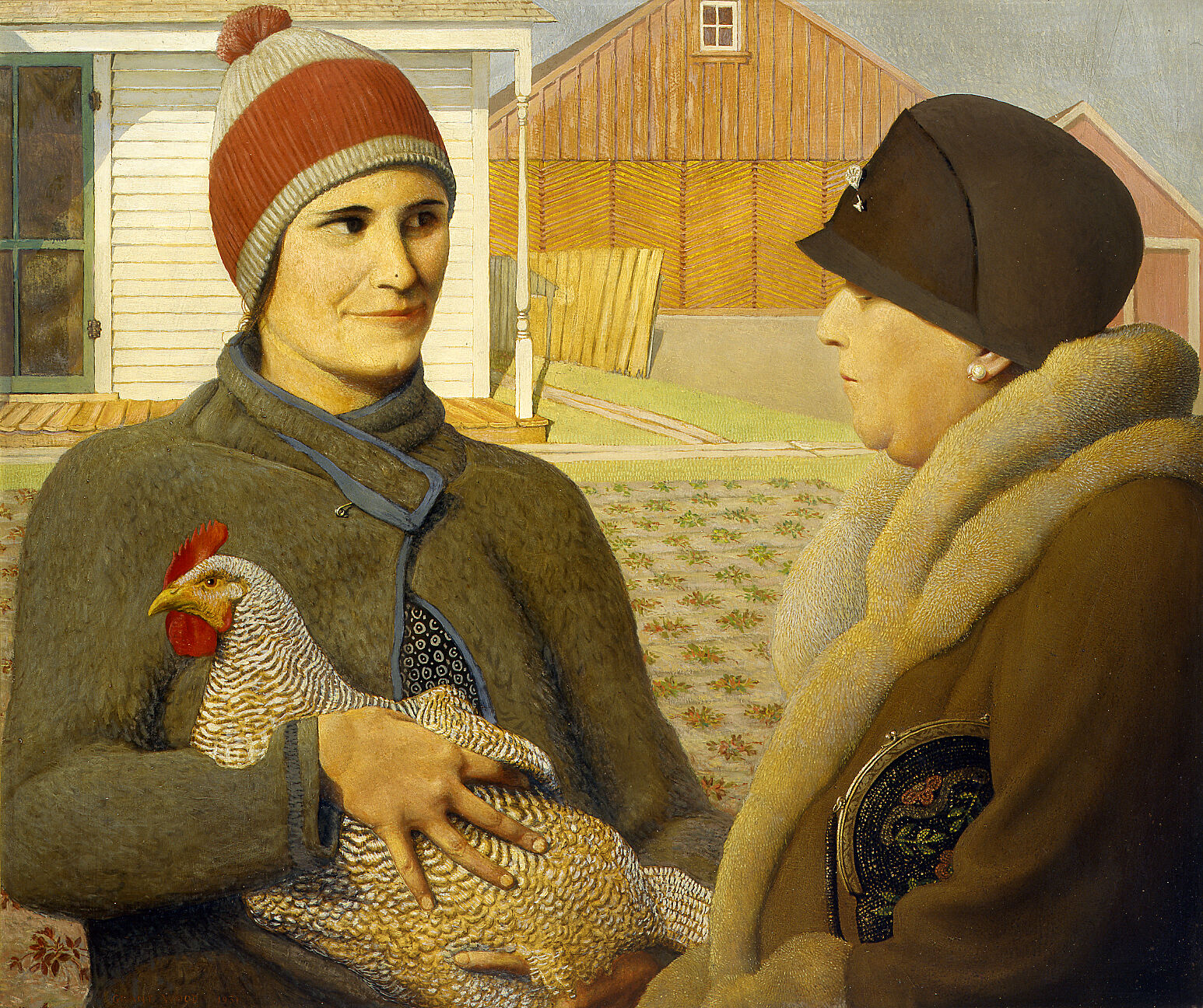
Painting of woman holding a rooster, speaking with another woman holding a purse.

Grant Wood (1891–1942), Appraisal, 1931. Oil on composition board, 29 1⁄2 x 35 1⁄4 in. (74.9 x 89.5 cm). Carnegie-Stout Public Library, Dubuque, Iowa; on long-term loan to the Dubuque Museum of Art, Iowa; acquired through the Lull Art Fund. © Figge Art Museum, successors to the Estate of Nan Wood Graham/Licensed by VAGA, New York, NY

Appraisal, 1931

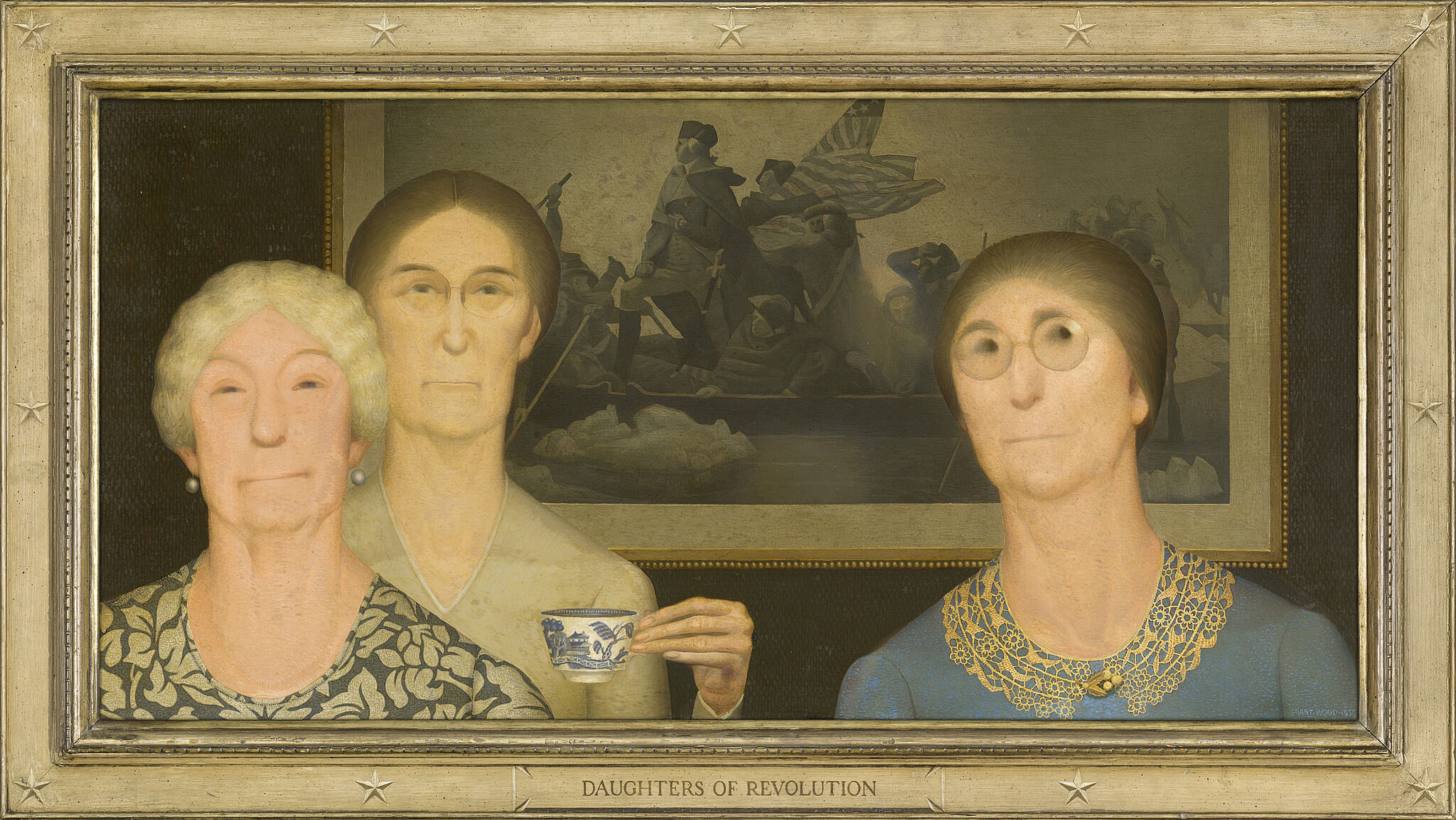
Portrait of three women.

Grant Wood, Daughters of Revolution, 1932. Oil on composition board, 20 x 40 in. (50.8 x 101.6 cm). Cincinnati Art Museum; The Edwin and Virginia Irwin Memorial 1959.46 © Figge Art Museum, successors to the Estate of Nan Wood Graham/Licensed by VAGA, New York, NY

Daughters of Revolution, 1932

In this painting Wood aimed to ridicule the Daughters of the American Revolution (DAR) for their claims to nobility based on ancestry, which he saw as antithetical to their celebration of democracy. The artist painted three of the group’s members in front of a reproduction of Emanuel Leutze’s painting of General George Washington crossing the Delaware River, contrasting the future president’s dynamism and bravery with the Daughters’s stiff poses, contemptuous expressions, and the inconsequential action of raising a teacup. New York critics celebrated the painting’s biting satire when it premiered at the Whitney Biennial in 1932, with one calling it “as delicious as it is wicked,” but it was met by protests from various DAR chapters that deemed it un-American.

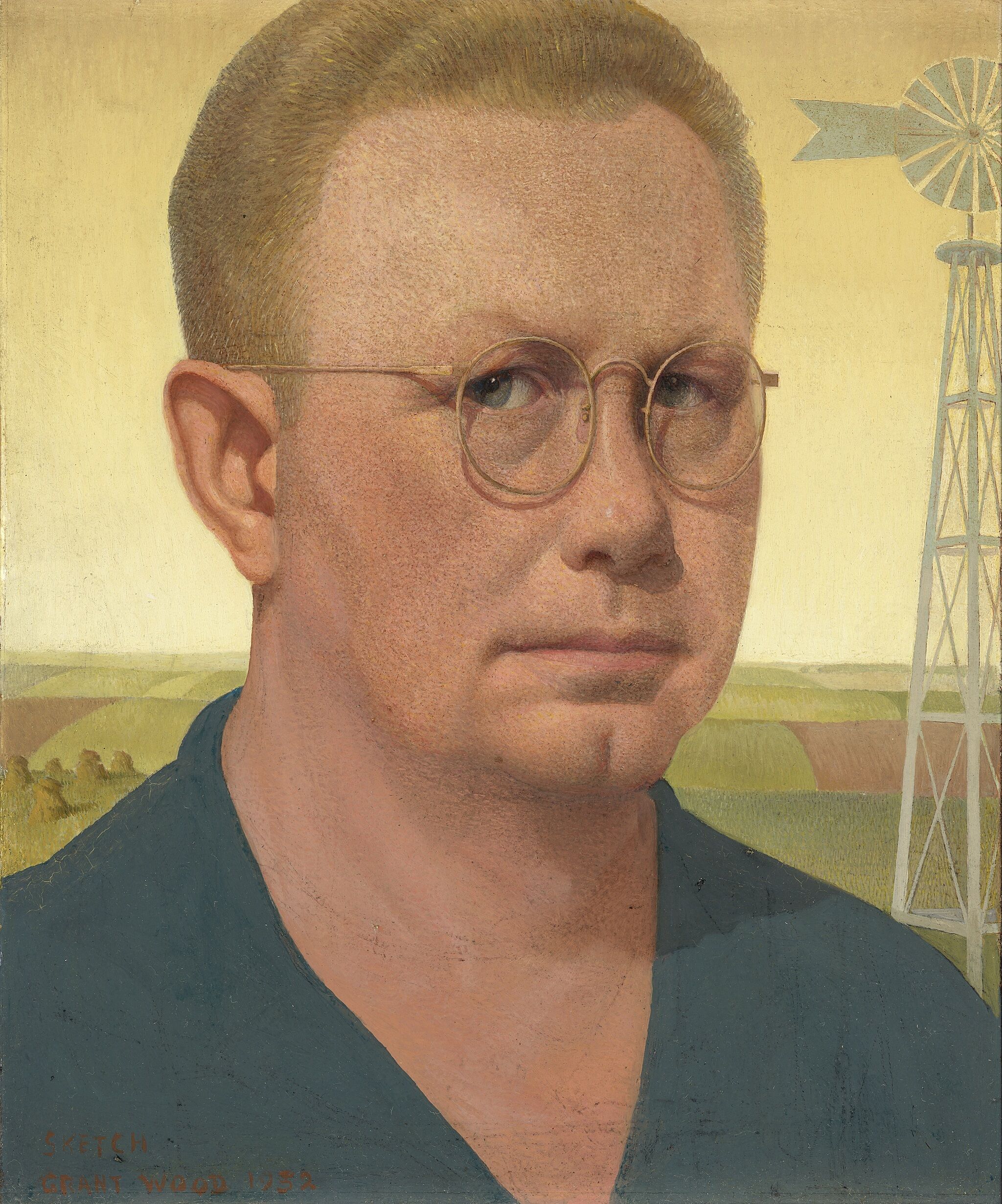
Self portrait of the artist.

Grant Wood (1891–1942). Self-Portrait, 1932/1941. Oil on composition board, 14 3⁄4 x 11 3⁄4 in. (37.5 x 29.9 cm). Figge Art Museum, Davenport, Iowa, City of Davenport Art Collection, Grant Wood Archive; museum purchase with funds provided by the Friends of Art Acquisition Fund 1965.1. © Figge Art Museum, successors to the Estate of Nan Wood Graham/Licensed by VAGA, New York, NY

Self-Portrait, 1932/1941

Painting of a group of people observing an artist painting on canvas.

Grant Wood, The Return from Bohemia, 1935. Pastel, gouache, and pencil on paper, 23 1⁄2 x 20 in. (59.7 x 50.8 cm). Promised gift to Crystal Bridges Museum of American Art, Bentonville, Arkansas. © Figge Art Museum, successors to the Estate of Nan Wood Graham/Licensed by VAGA, New York, NY. Photograph courtesy Alexandre Gallery, New York

The Return from Bohemia, 1935


Explore works from this exhibition
in the Whitney's collection

View 5 works

On the Hour

A 30-second online art project:
Frank WANG Yefeng, The Levitating Perils #2

Learn more about this project

Learn more at whitney.org/artport

On the Hour projects can contain motion and sound. To respect your accessibility settings autoplay is disabled.