Not on view
Date
2022
Classification
Paintings
Medium
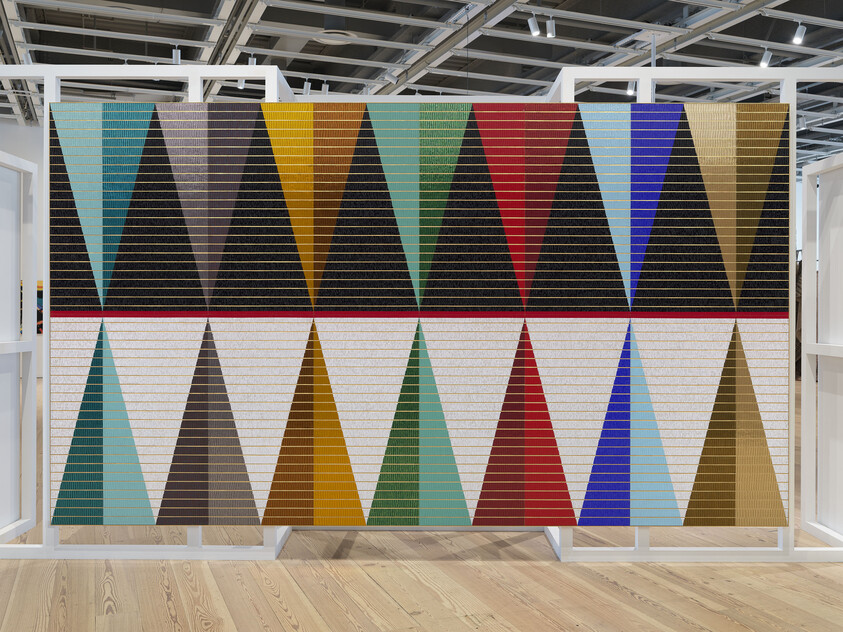
Acrylic, glass bugle beads, and synthetic sinew on aluminum panels, eight parts
Dimensions
Overall: 96 9/16 × 168 3/8 in. (245.3 × 427.7 cm)
Accession number
2023.14a-i
Credit line
Purchased jointly by the Whitney Museum of American Art, New York, with funds from the Director's Discretionary Fund; and the National Gallery of Canada, Ottawa
Rights and reproductions
© artist or artist's estate
Audio
-
0:00
Dyani White Hawk, Wopila | Linaje
0:00
Dyani White Hawk: Me llamo Dyani White Hawk. Soy sicangu lakota por parte de mi madre, alemana y galesa por parte de mi padre. Vivo en Shakopee, Minnesota, y tengo un estudio en Mineápolis.
Soy pintora y artista multimedia, así que me dedico mucho a pintar y a trabajar con cuentas, y también con púas de puercoespín. Mi práctica se nutre de las historias de abstracción del pueblo lakota y de la abstracción de la pintura en caballete.
El arte con cuentas es una parte importante de la historia artística de mi tribu, y se ha convertido en una parte importante de mi propia trayectoria artística. Las cuentas de vidrio, que se han vuelto sinónimo de las obras de arte de las llanuras, eran artículos de comercio que surgieron de un intercambio con personas no nativas. Antes de que el comercio trajera las cuentas, gran parte de ese trabajo se realizaba con púas de puercoespín. Ya ves lo emocionante que debe haber sido disponer, de repente, de este nuevo y hermoso material para empezar a incorporarlo en las prácticas artísticas propias. Y ahora, eso se ha integrado de tal manera en la historia artística de los pueblos nativos que estas cuentas de vidrio europeas ahora son prácticamente un sinónimo de las obras de arte de los indígenas norteamericanos.
Una gran cantidad de personas no nativas y de pintores no nativos se inspiraron en la historia del arte indígena: en las artesanías con cuentas y con púas de puercoespín, en los tejidos, en la cestería. Y muchos de los pintores más famosos, hombres blancos considerados como los pioneros de la abstracción, buscaban inspiración en el arte indígena. Coleccionaban ese arte porque reconocían la fuerza, la voluntad, la belleza y la experiencia que había en esas obras.
Hay un motivo por el cual les llama la atención, y un motivo por el cual se inspiran en ese trabajo. Y a menudo ni siquiera se habla de las tribus de las que procede el trabajo, no se les da el mismo tipo de relevancia, importancia u honor que a sus colegas no nativos. Por eso, con mi obra, busco resaltar y honrar esas intersecciones, crear oportunidades para entablar conversaciones en las que podamos hablar de las realidades de nuestras historias compartidas y, con suerte, empezar a crear narrativas que sean más honestas y más veraces sobre nuestra historia artística compartida en esta base terrestre, para que, con suerte, nuestras narrativas artísticas en el futuro reflejen una mayor verdad.

-
0:00
Dyani White Hawk, Wopila | Lineage
0:00
Dyani White Hawk: My name is Dyani White Hawk. I am Sičangu Lakota through my mom, German and Welsh through my dad. I live in Shakopee Minnesota and I have a studio in Minneapolis.
I’m a painter and multimedia artist, so I do a lot of painting and beadwork, porcupine quillwork. And my practice pulls from the histories of Lakota abstraction and easel painting abstraction.
Beadwork is an important part of the artistic history of my tribe and has become an important part of my own artistic journey. The glass seed beads that have become synonymous with plains artwork were trade items that came through a relationship with non-native people. A lot of that work before the beads were available through trade was done in porcupine quillwork. You can see how exciting it must have been to all of a sudden have this beautiful new material to start incorporating into your artistic practices. And now, that has become so strongly integrated into the artistic history of native people that these European glass seed beads are now fairly synonymous with Native American artwork.
A lot of non-native people, and non-native painters were looking to the history of Native art. In beadwork, in porcupine quillwork, weaving, basketry you know and a lot of the most famous white male painters, who are lifted up as the founders of abstraction, were looking to Indigenous art. They were collecting that art because they recognized the strength and the agency and the beauty and the expertise of that work.
There’s a reason why they’re attracted to it, right, and a reason why they’re looking at it. And often even the tribes that the work is coming from is not spoken to, is not given the same kind of relevancy, importance, or honor as their non-native counterparts. So, my work really is meant to pull out and honor those intersections, to create opportunities for conversations where we can speak to the realities of our shared histories, and hopefully start creating narratives that are more honest and more truthful about our shared artistic history on this land base, so that hopefully our artistic narratives going forward reflect a greater truth.