Visual description
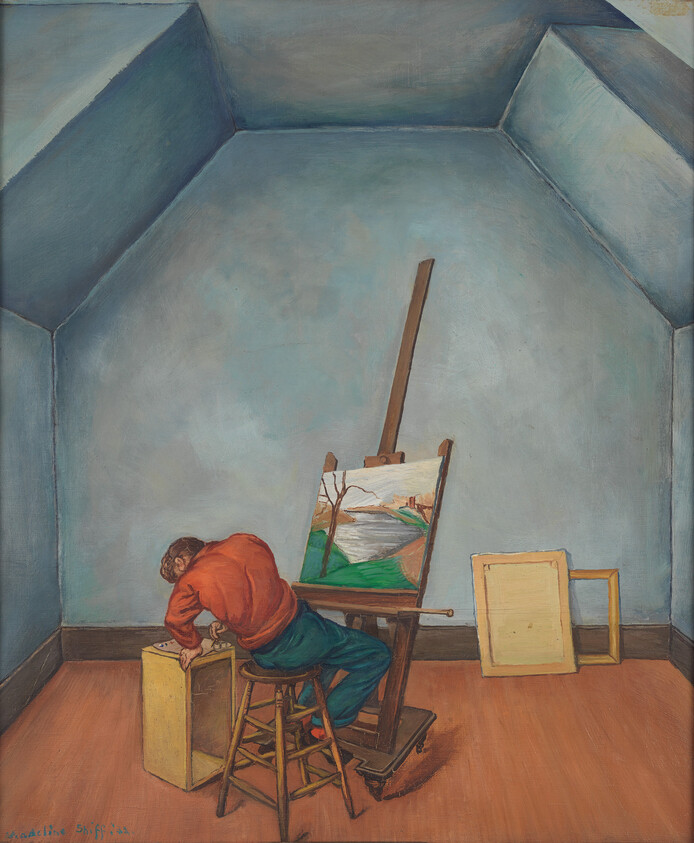
Wiltz at Work is a painting by Madeline Shiff that is 18 inches tall and 15 inches wide. Shiff portrays her husband, painter Arnold Wiltz, with his easel in the center of a small, windowless painting studio. Wiltz is shown from behind sitting on a wooden stool, bent over a small light wooden table to his left in the act of mixing paint. Resting on the easel is a green landscape painting featuring a body of water and a bare tree in the foreground. The natural world depicted inside Wiltz’s painting is in contrast to his relatively blank and windowless surroundings.
The nearly empty room has warm, orange-brown wood floors and blue-grey walls. The back wall is a pentagonal shape, symmetrically framing Wiltz and his canvas in a manner that emphasizes the compact size and barrenness of the studio. The only other objects in the room are the stool Wiltz sits on, his table, and an empty frame leaning against the back wall. Wiltz’s clothes, blue pants and an orange shirt and socks, mirror the colors of the space; the limited color palette adds to the illustration-like quality of Shiff’s painting style and the restricted feeling that she creates in her depiction of this studio. The room’s undecorated walls have a dynamic texture comprising various shades of muted blue and grey paint. This simple, yet painterly wall is punctuated by the vivid landscape painting and the top of the easel.
Not on view
Date
1932
Classification
Paintings
Medium
Oil on canvas
Dimensions
Overall: 18 × 15 in. (45.7 × 38.1 cm)
Accession number
32.51
Credit line
Purchase
Rights and reproductions
© artist or artist's estate
Audio
-
0:00
Madeline Shiff, Wiltz at Work, 1932
0:00
Wiltz at Work is a painting by Madeline Shiff that is 18 inches tall and 15 inches wide. Shiff portrays her husband, painter Arnold Wiltz, with his easel in the center of a small, windowless painting studio. Wiltz is shown from behind sitting on a wooden stool, bent over a small light wooden table to his left in the act of mixing paint. Resting on the easel is a green landscape painting featuring a body of water and a bare tree in the foreground. The natural world depicted inside Wiltz’s painting is in contrast to his relatively blank and windowless surroundings.
The nearly empty room has warm, orange-brown wood floors and blue-gray walls. The back wall is a pentagonal shape, symmetrically framing Wiltz and his canvas in a manner that emphasizes the compact size and barrenness of the studio. The only other objects in the room are the stool Wiltz sits on, his table, and an empty frame leaning against the back wall. Wiltz’s clothes, blue pants and an orange shirt and socks, mirror the colors of the space; the limited color palette adds to the illustration-like quality of Shiff’s painting style and the restricted feeling that she creates in her depiction of this studio. The room’s undecorated walls have a dynamic texture comprising various shades of muted blue and gray paint. This simple, yet painterly wall is punctuated by the vivid landscape painting and the top of the easel.
Installation photography
-
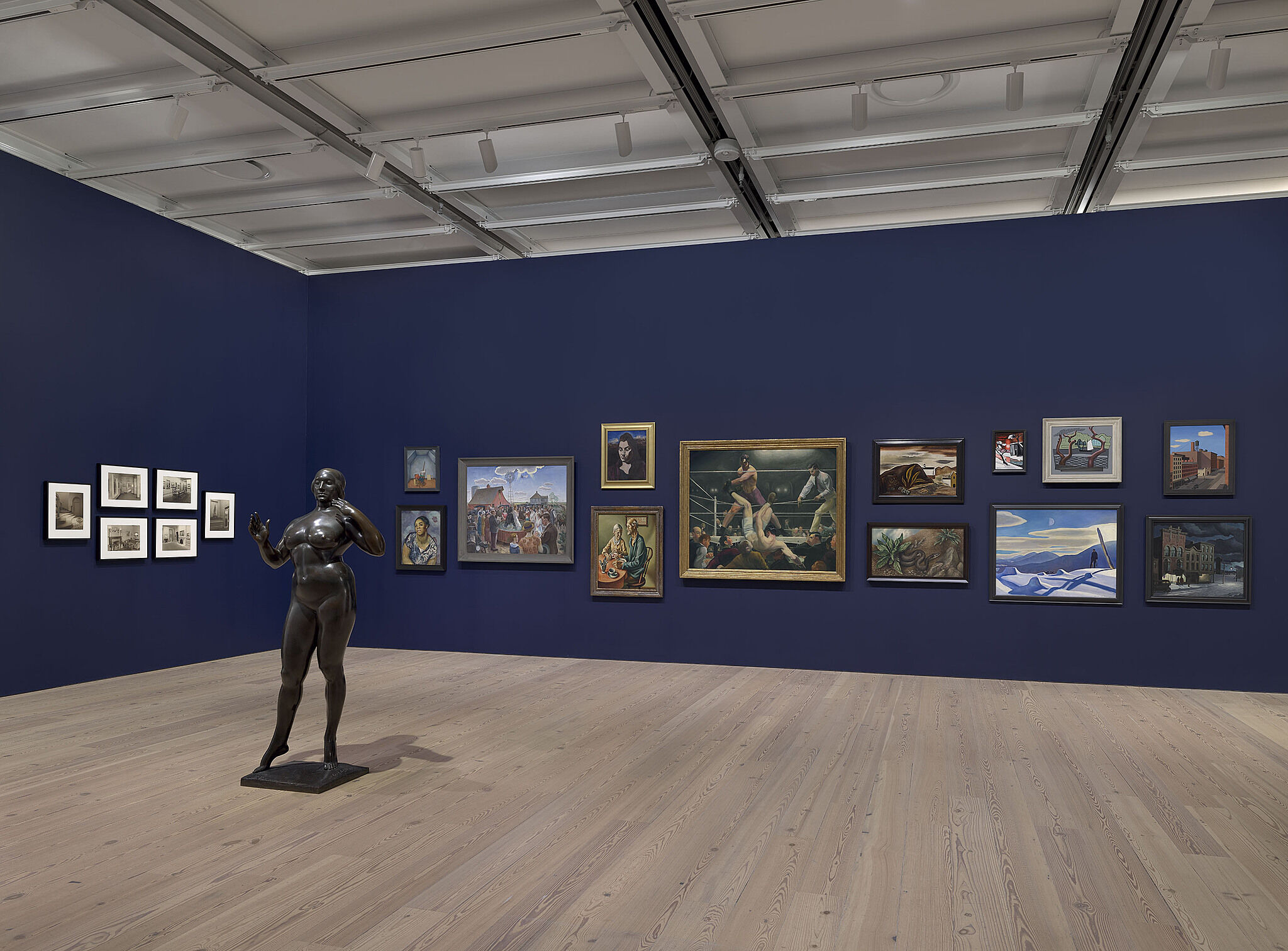
Installation view of The Whitney’s Collection: Selections from 1900 to 1965 (Whitney Museum of American Art, New York, June 28, 2019- ). Left wall: Six photographs by Charles Sheeler, (No title), 1933. Center of room: Gaston Lachaise, Standing Woman, 1912-27. Right wall, left to right, top to bottom: Madeline Shiff, Wiltz at Work, 1932; Anne Goldthwaite, Rebecca, c. 1925; John Steuart Curry, Baptism in Kansas, 1928; John D. Graham, Head of a Woman, 1926; Thomas Hart Benton, The Lord is my Shepherd, 1926; George Bellows, Dempsey and Firpo, 1924; Yasuo Kuniyoshi, Landscape, 1924; Katherine Schmidt, The Snake, 1932; Oscar Bluemner, Last Evening of the Year, c. 1929; Stuart Davis, Early American Landscape, 1925; Rockwell Kent, The Trapper, 1921; George C. Ault, Hudson Street, 1932; Charles Burchfield, Winter Twilight, 1930. Photograph by Ron Amstutz
From the exhibition The Whitney’s Collection: Selections from 1900 to 1965