
Making Knowing: Craft in Art, 1950–2019
2019
Hear from the artists and curators about works in the exhibition.
-
601
Ruth Asawa, Untitled (S.270, Hanging Six-Lobed, Complex Interlocking Continuous Form within a Form with Two Interior Spheres), 1954, refabricated in 1958
Audio, Kids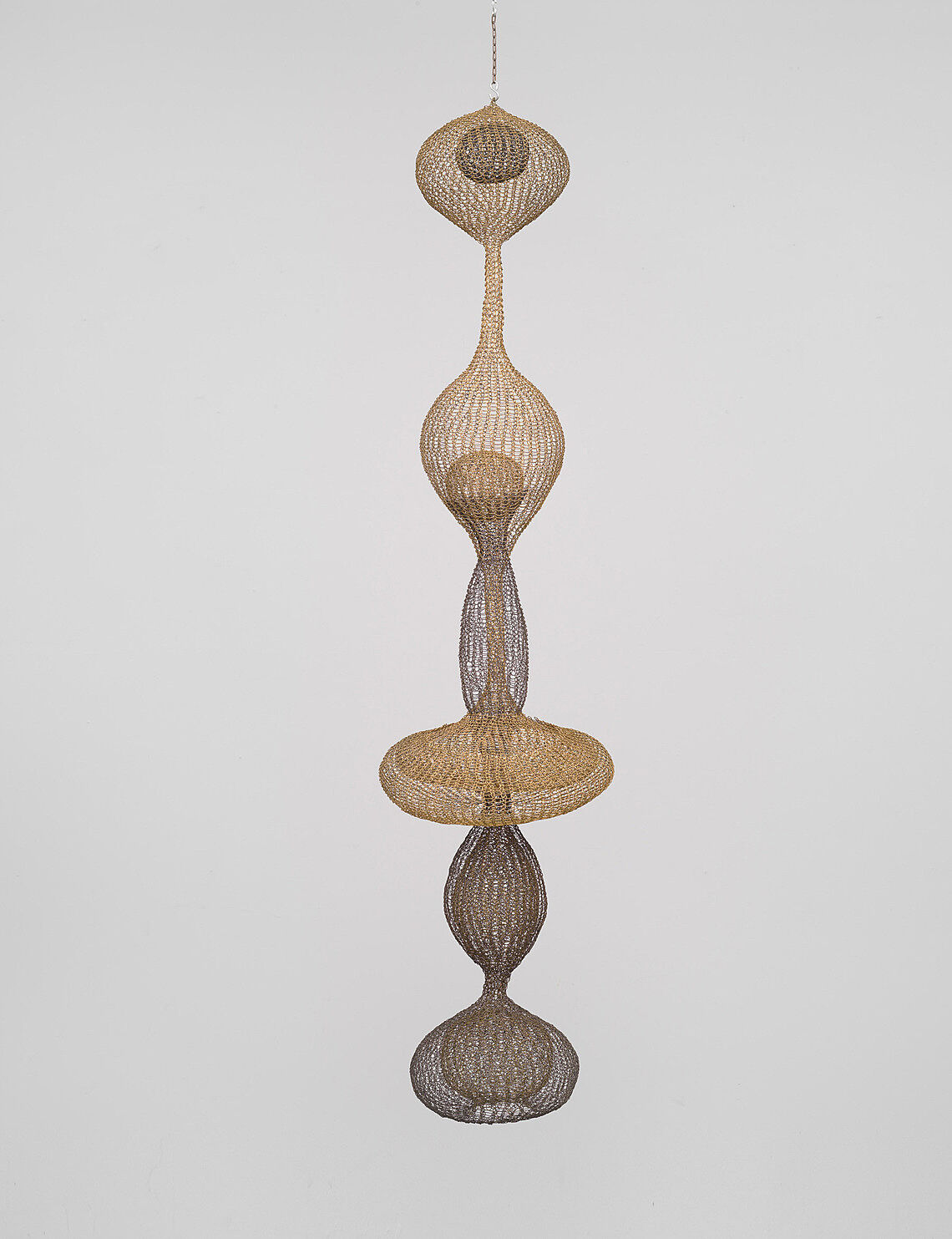
-
603
Anni Albers, Line Involvements IV, 1964
Audio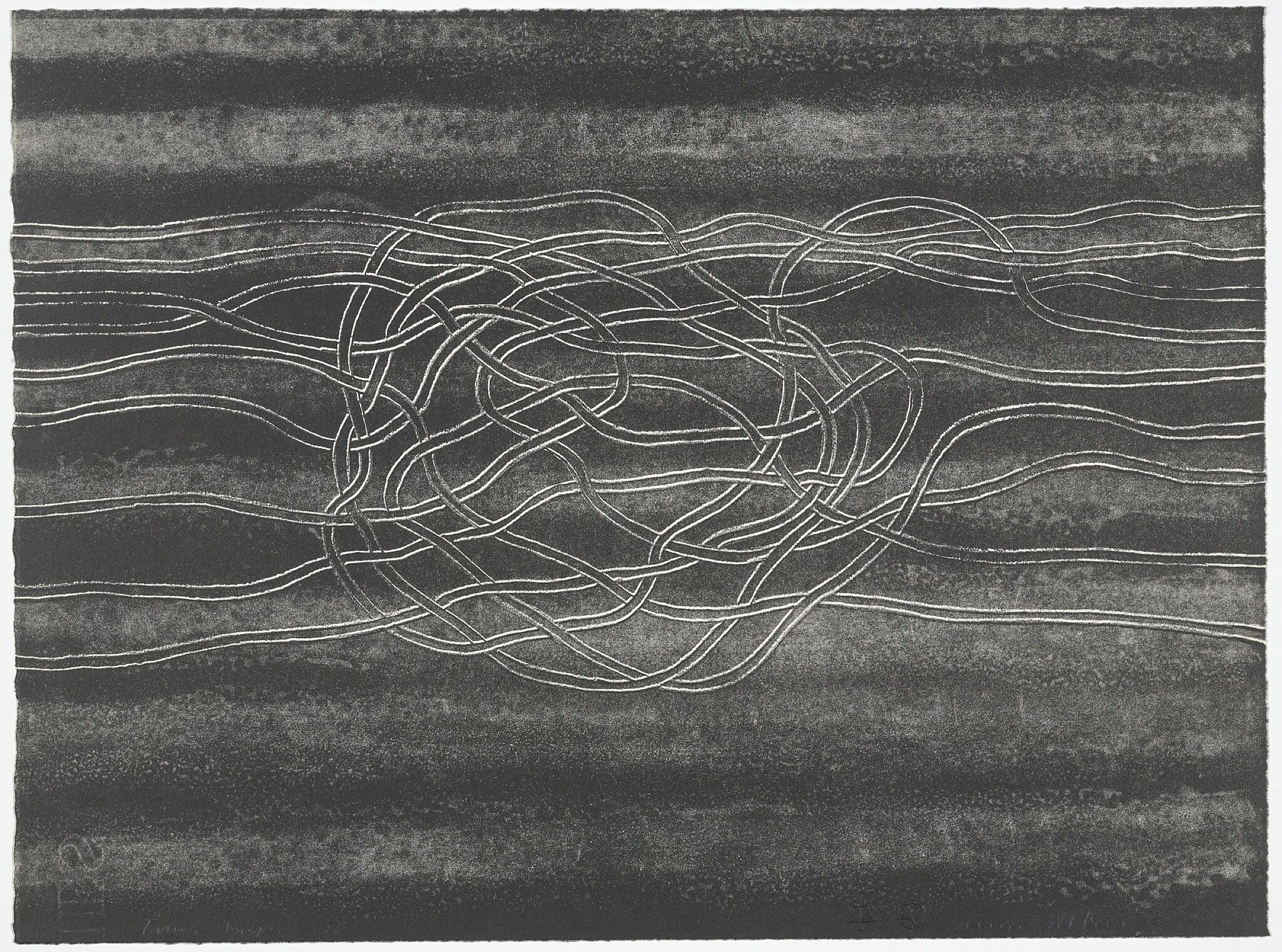
-
604
Lenore Tawney, Four Petaled Flower II, 1974
Audio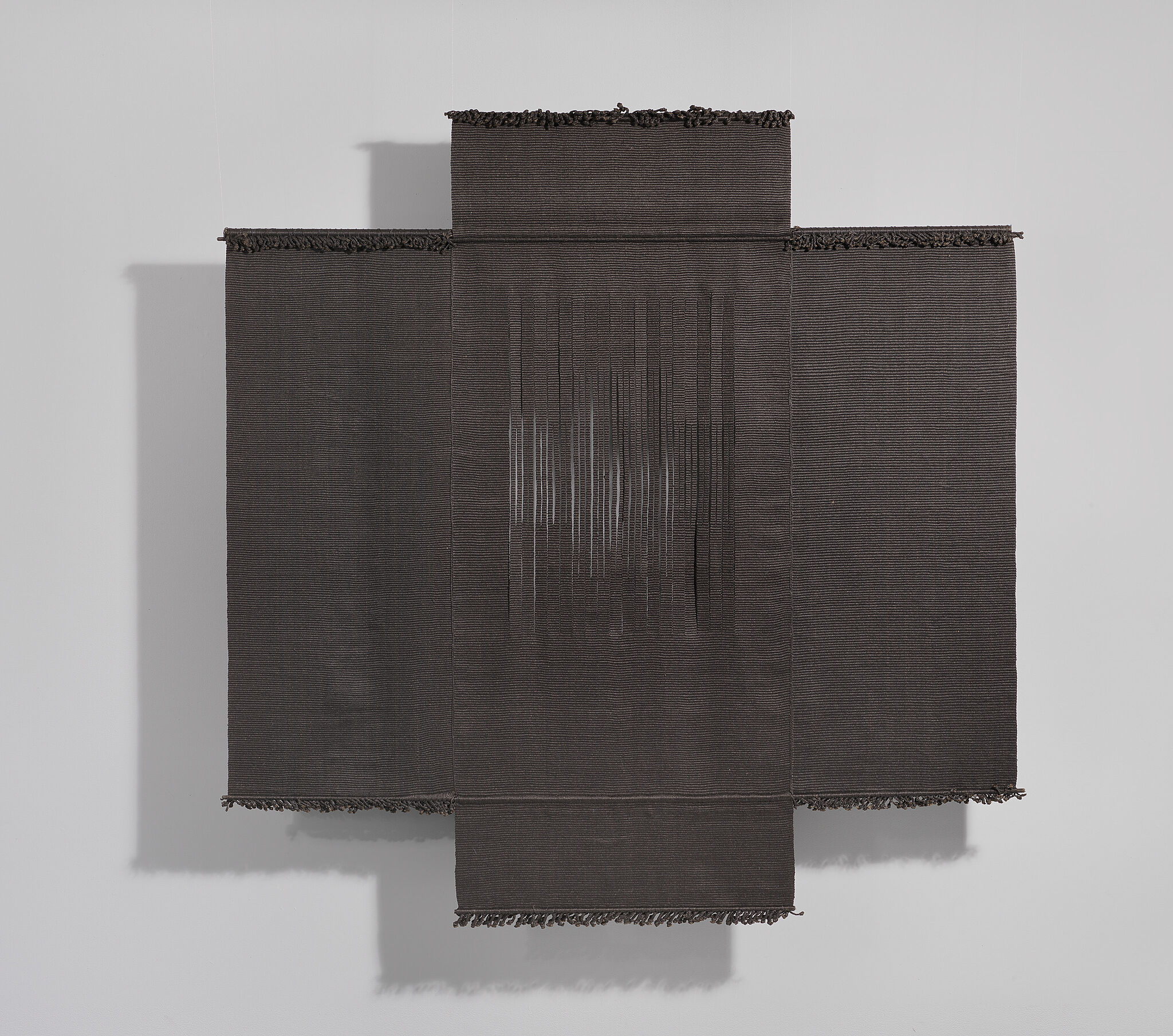
-
610
Claes Oldenburg, Giant BLT (Bacon, Lettuce, and Tomato Sandwich), 1963
Audio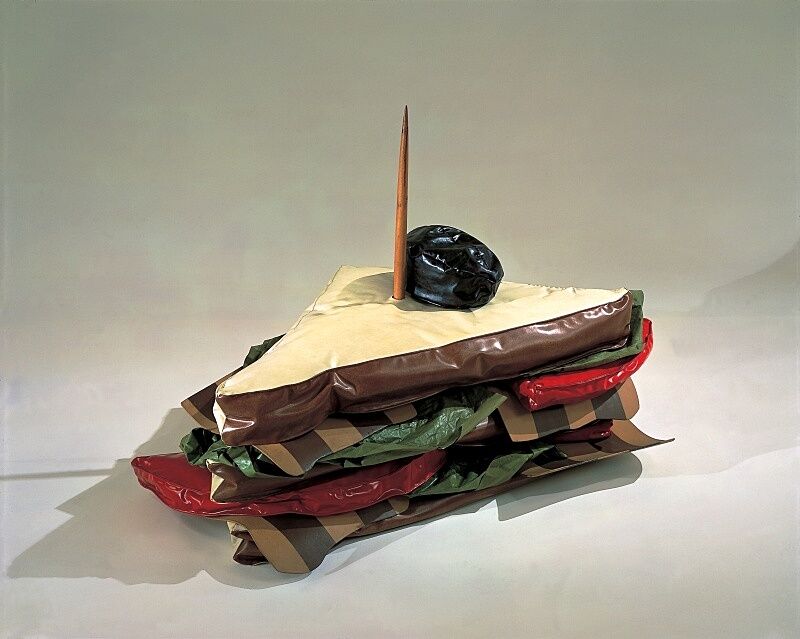
-
611
Yayoi Kusama, Accumulation, 1963
Audio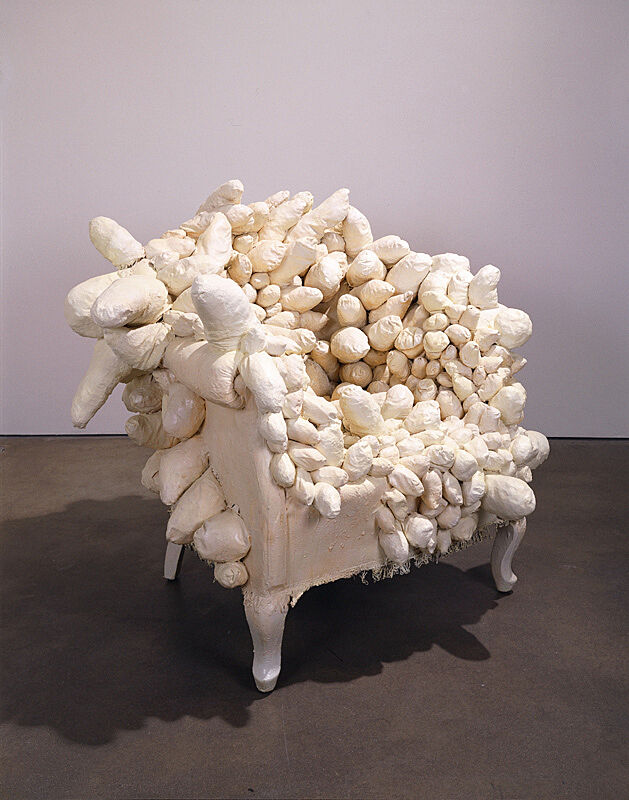
-
612
Howardena Pindell, Untitled, 1974–75
Audio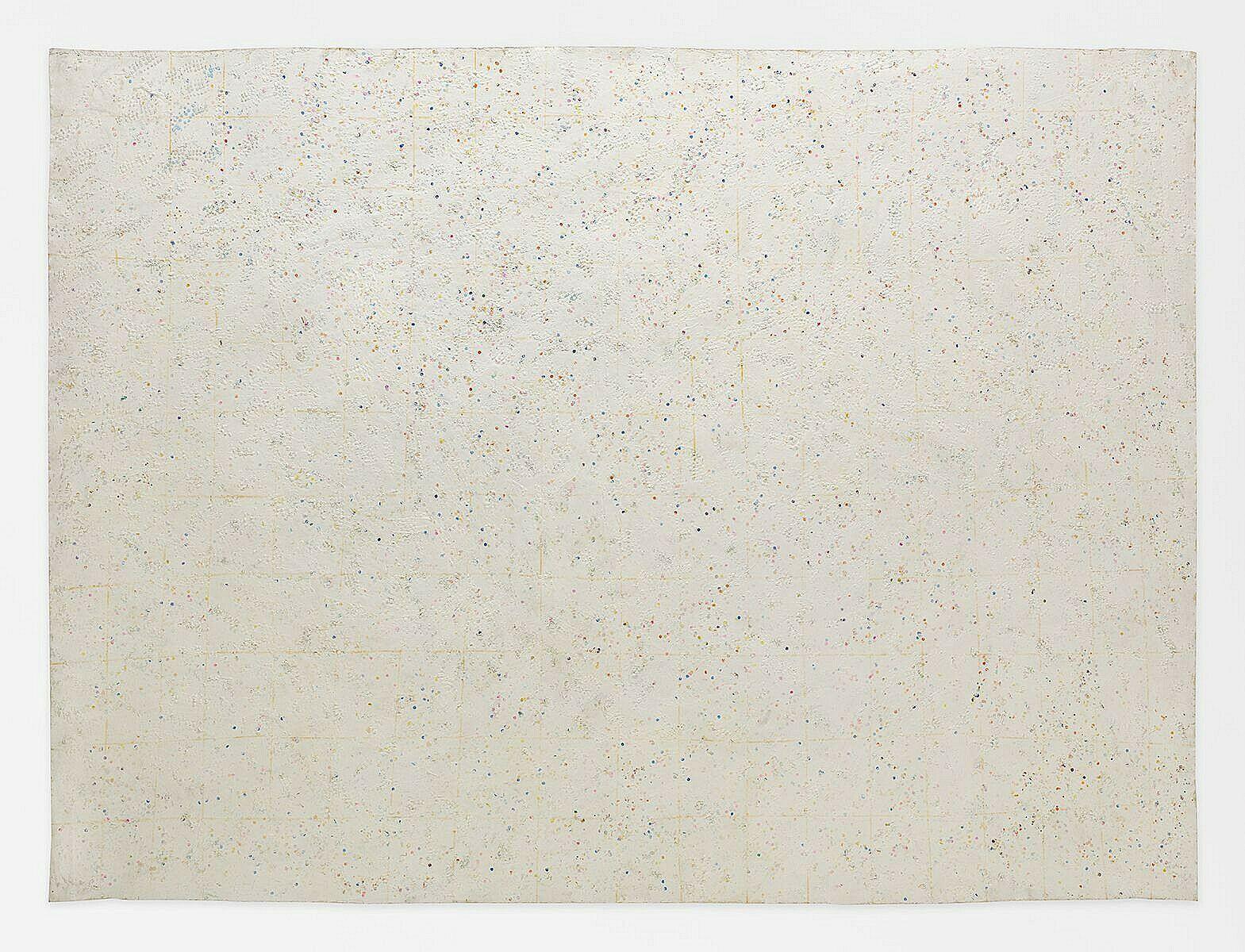
-
620
Harmony Hammond, Hug, 1978
Audio, Kids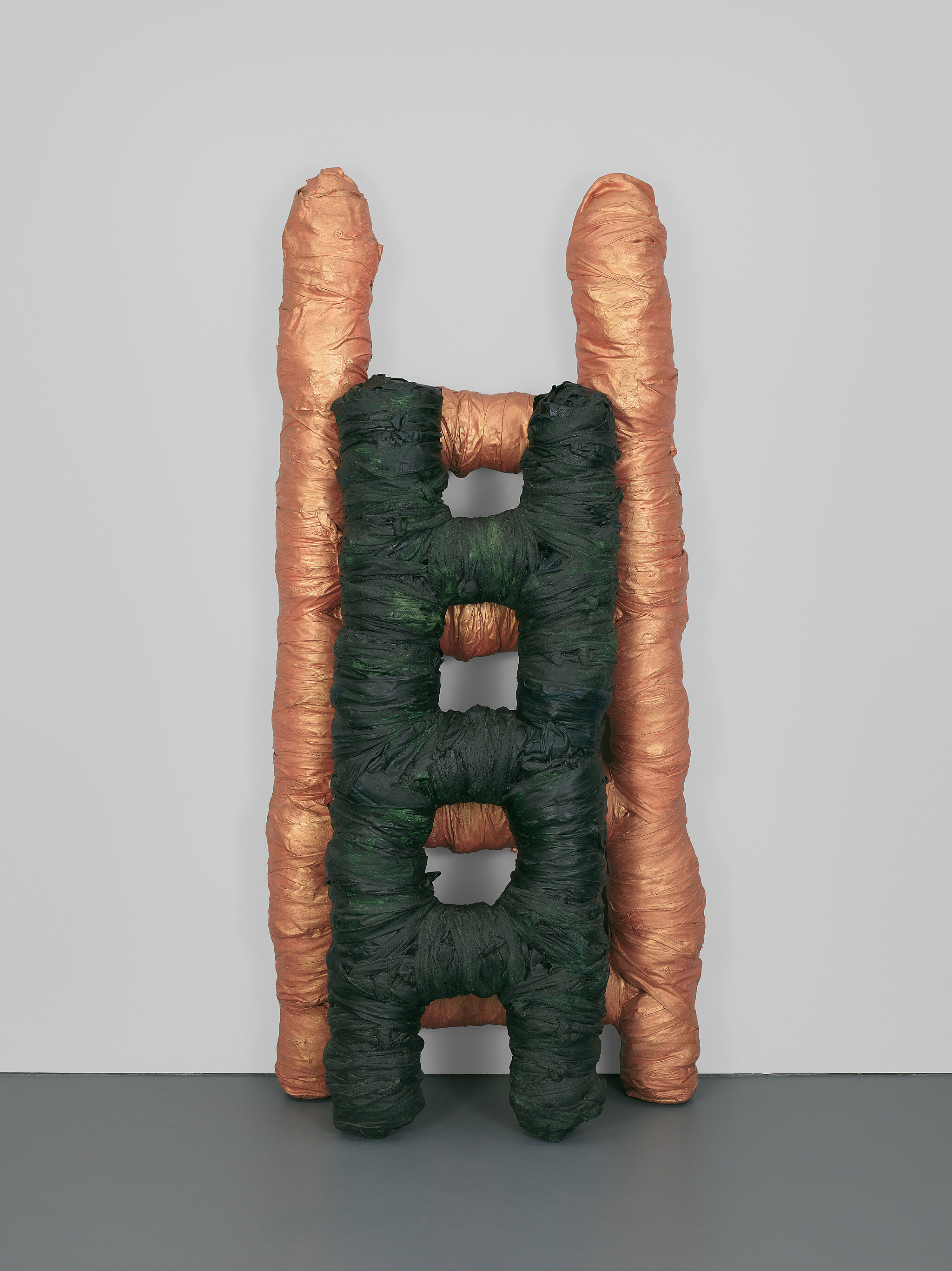
-
621
Miriam Schapiro, The Beauty of Summer, 1973–1974
Audio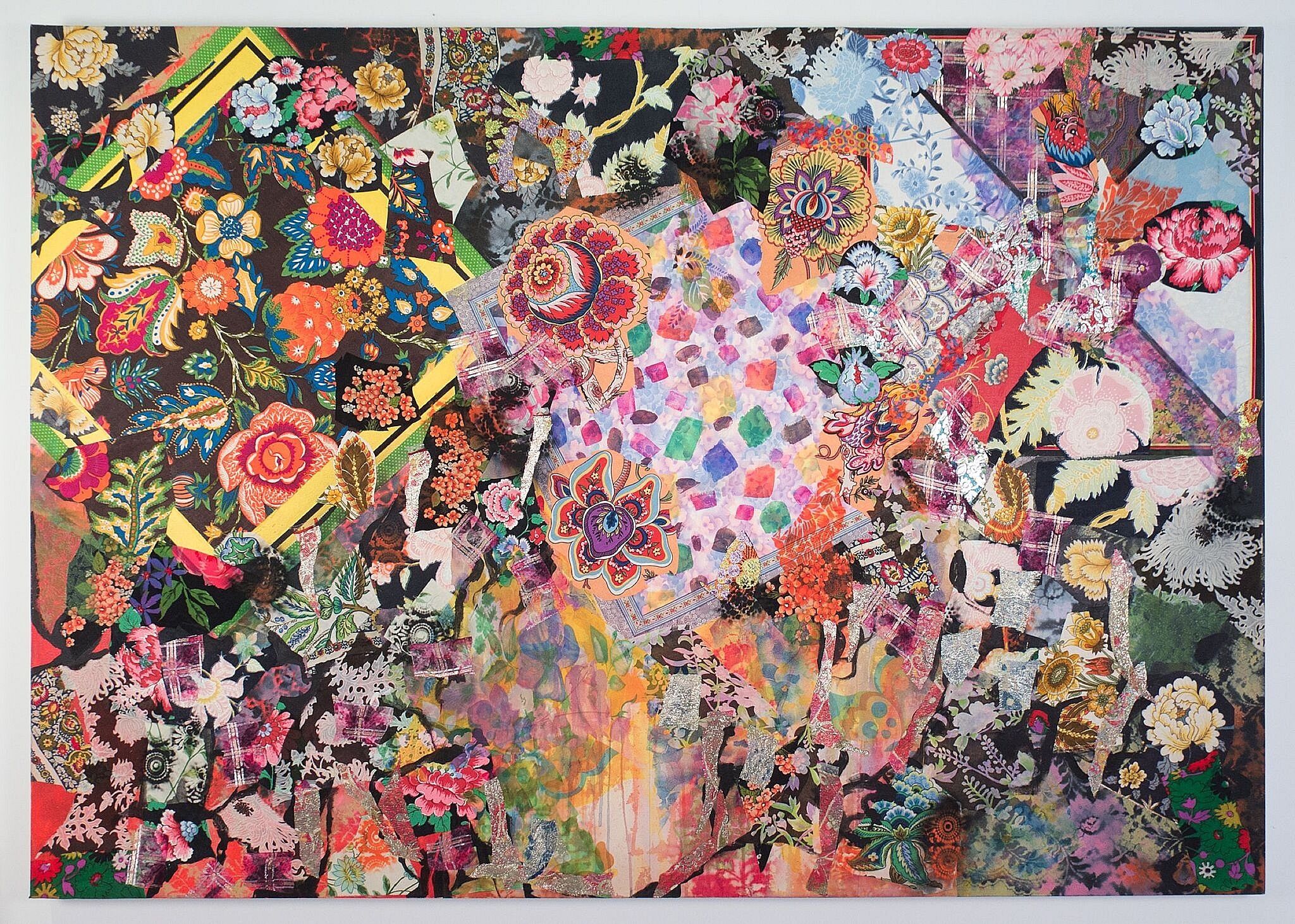
-
630
Pepón Osorio, Angel: The Shoe Shiner, 1993
Audio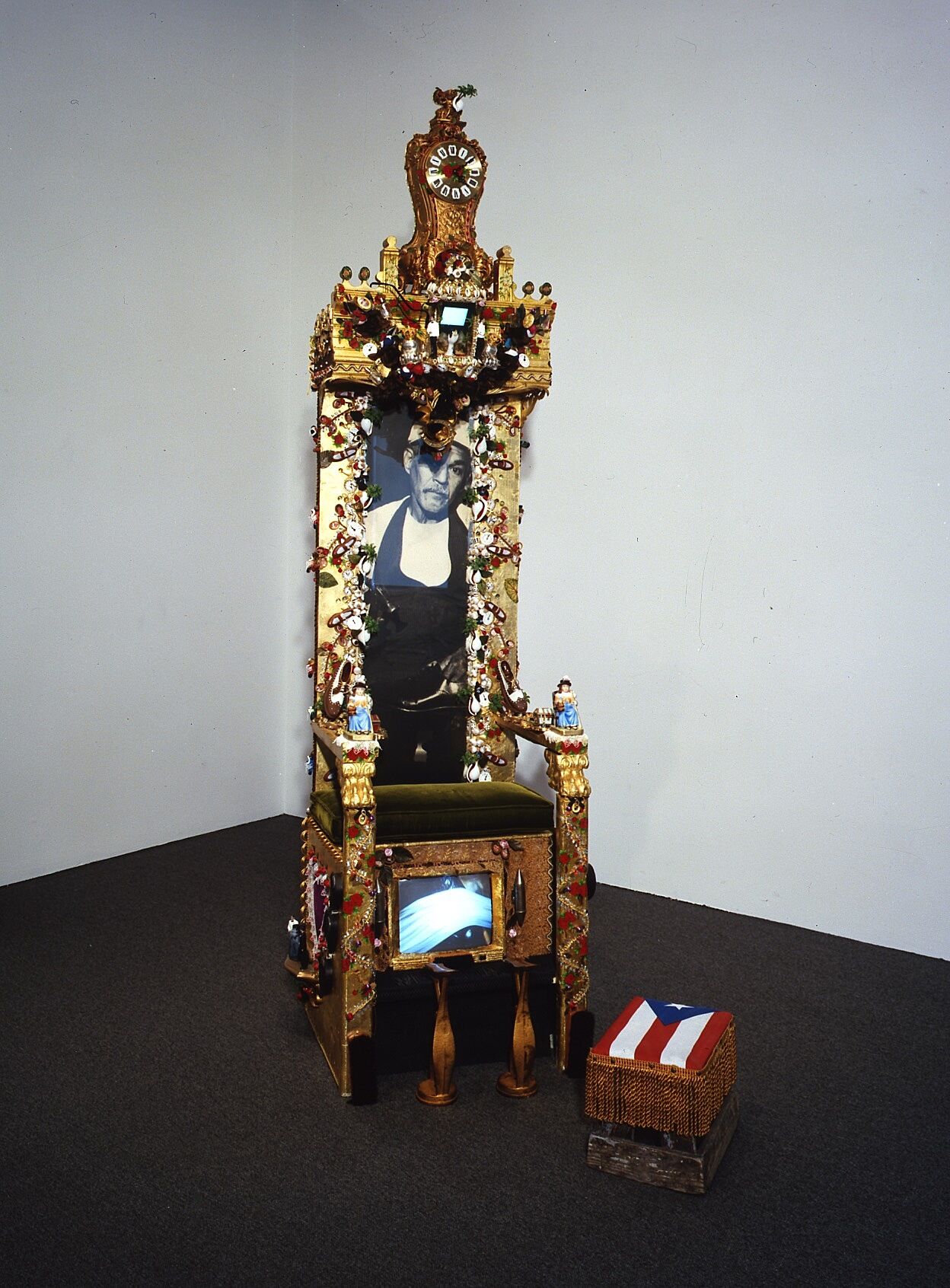
-
631
Mike Kelley, More Love Hours Than Can Ever Be Repaid and The Wages of Sin, 1987
Audio, Kids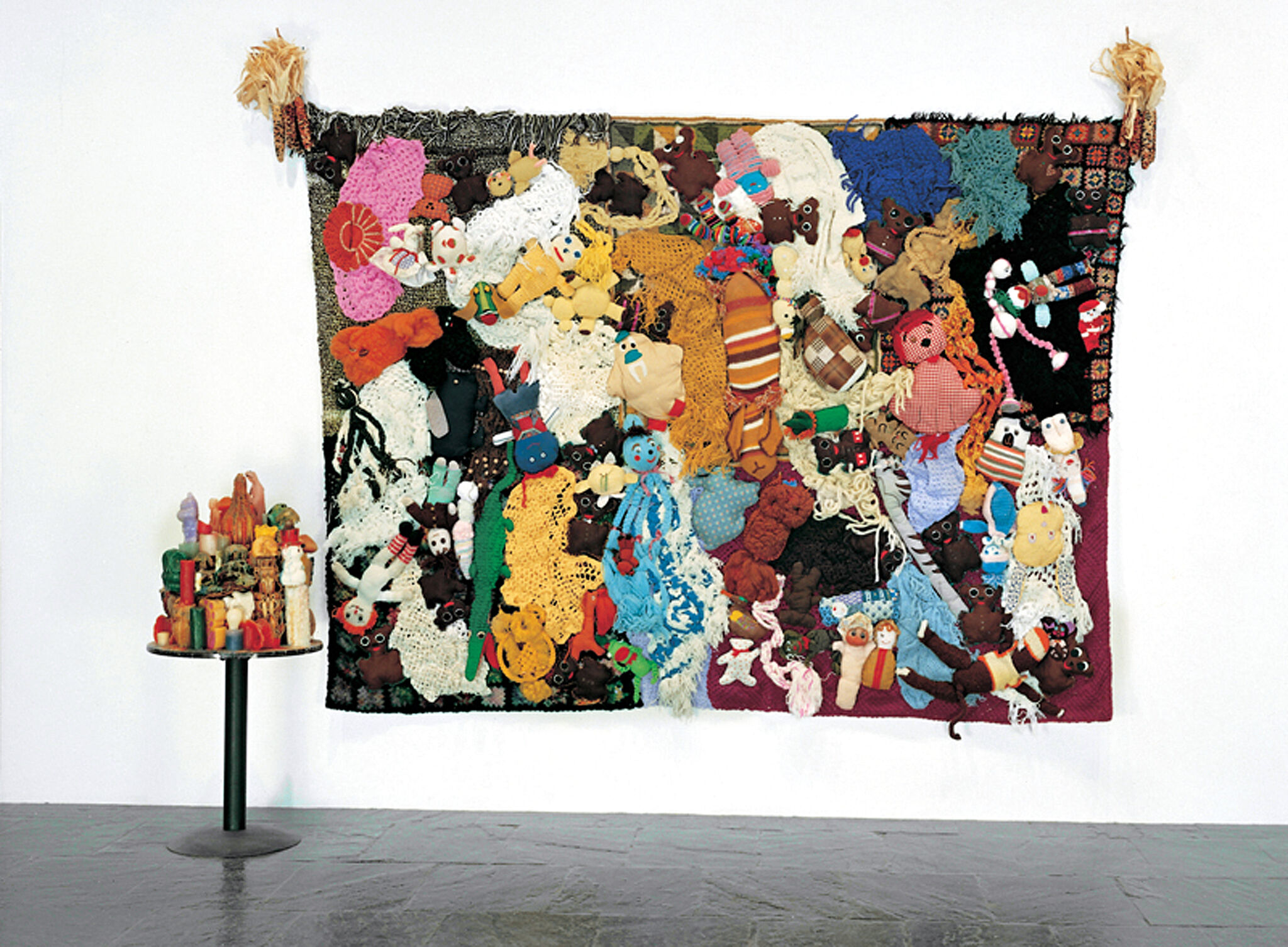
-
632
Thomas Lanigan-Schmidt, A Rite of Passage: The Velvet Cat Tail and the Silk Tiger Lily, 1987–1988
Audio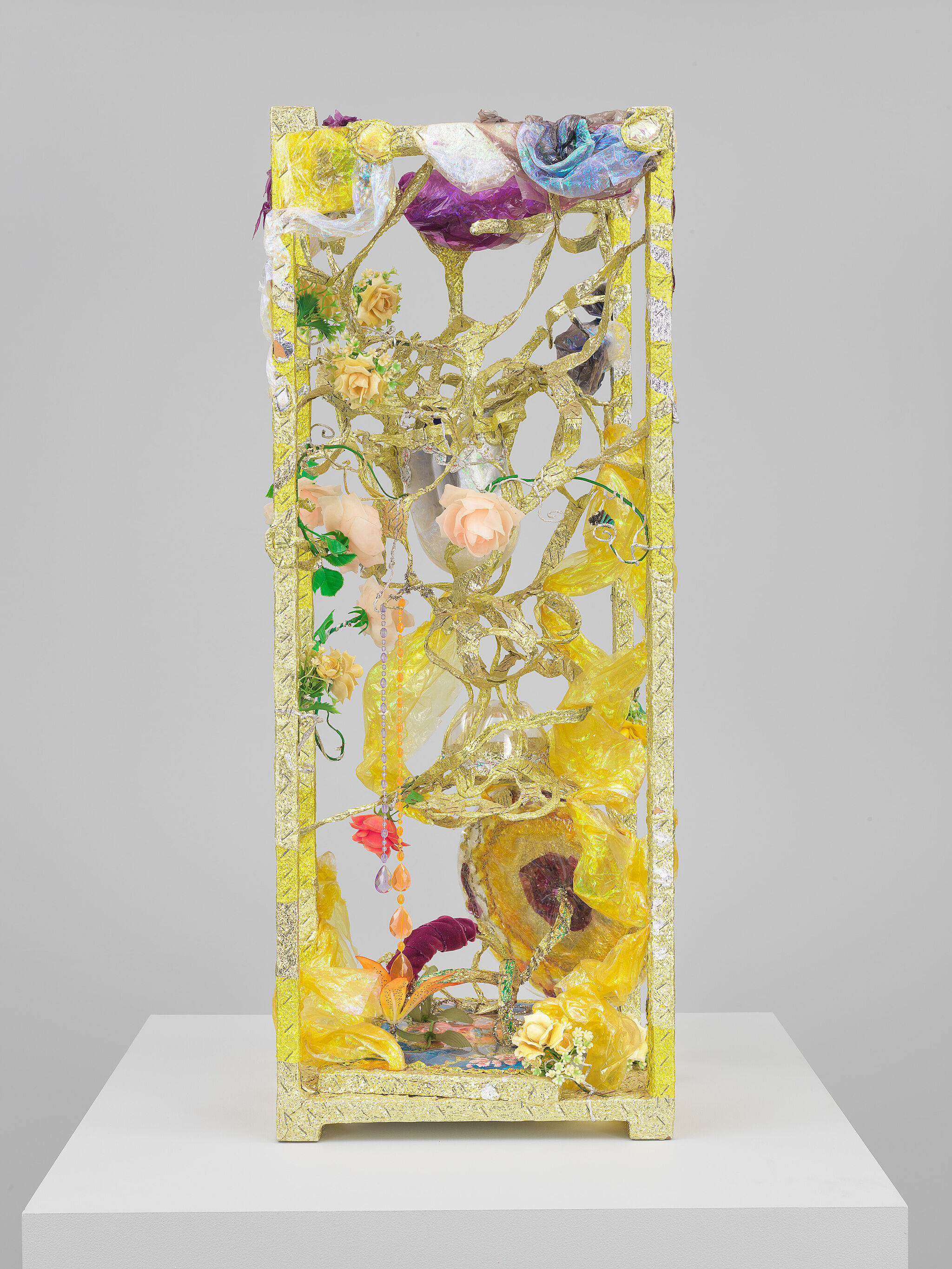
-
640
Erin Jane Nelson, Daufuskie Muscat, 2018
Audio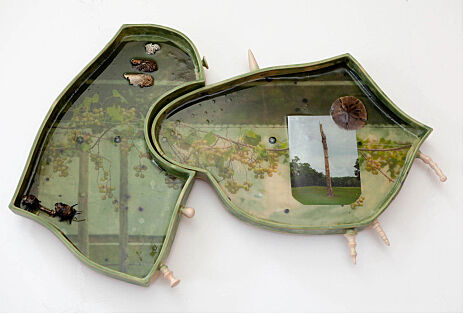
-
642
Nick Cave, Sound Suit #20, 2005
Audio, Kids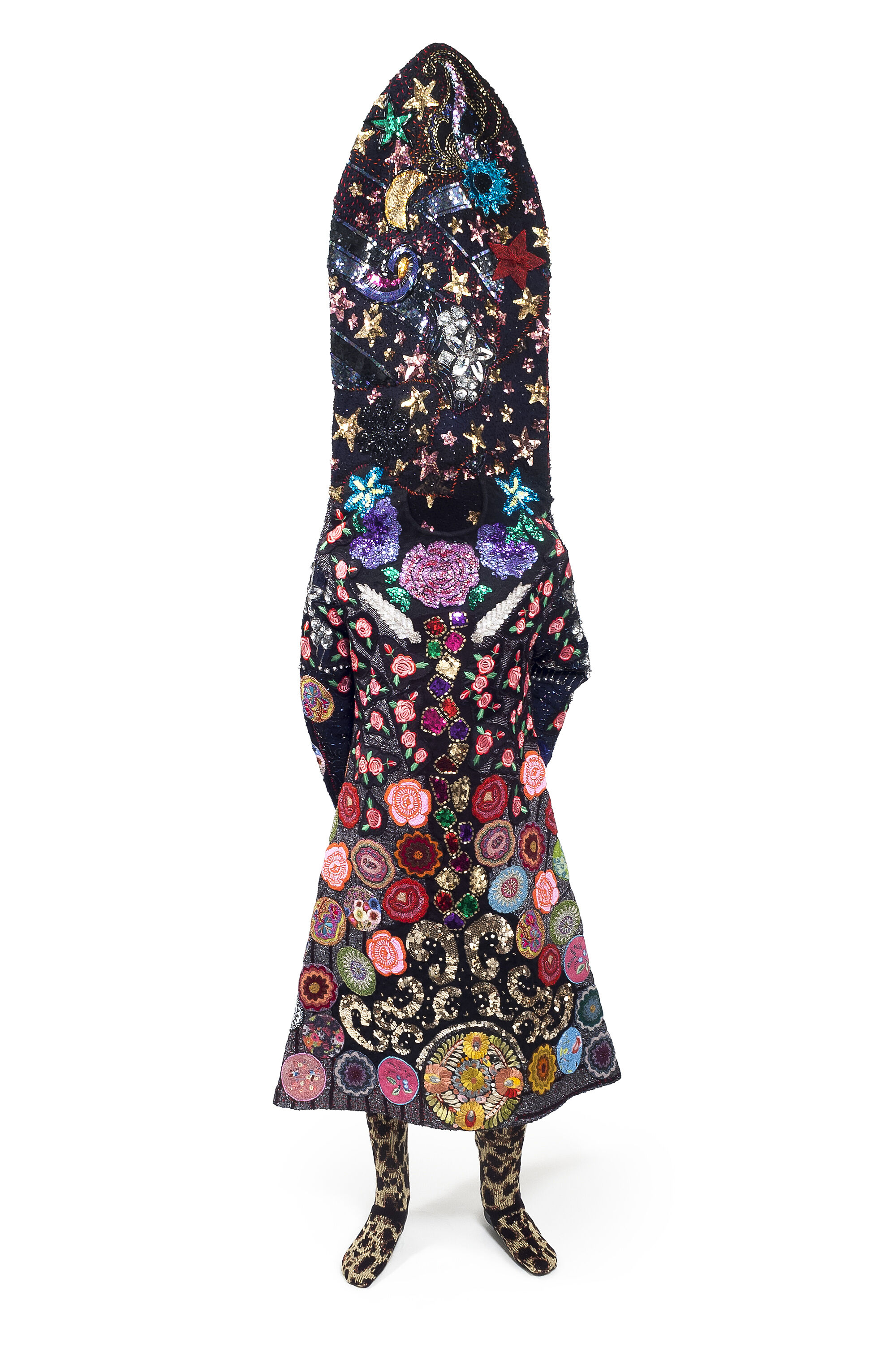
-
643
Marie Watt, Skywalker/Skyscraper (Axis Mundi), 2012
Audio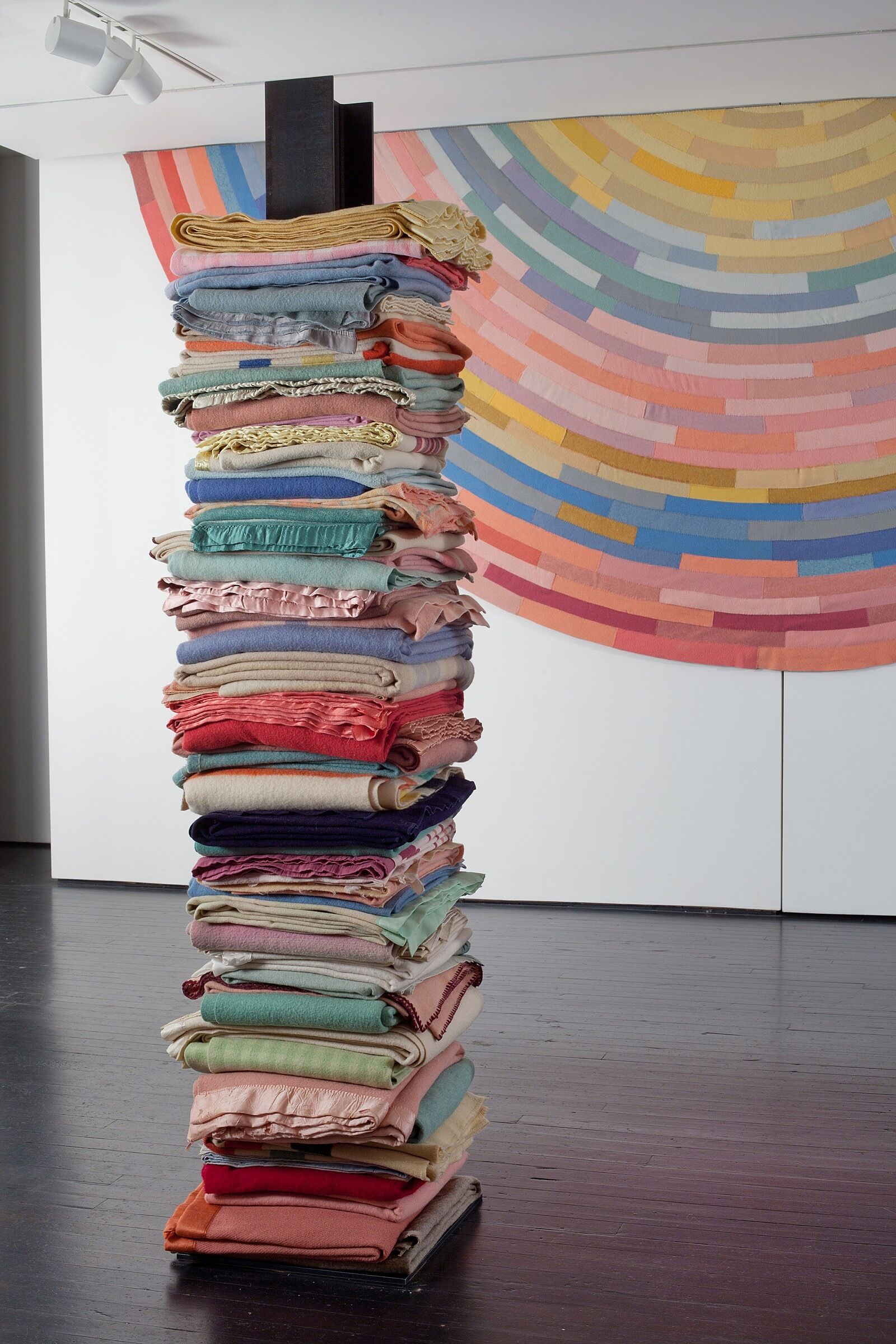
-
644
Kahlil Robert Irving, 100's, 2018
Audio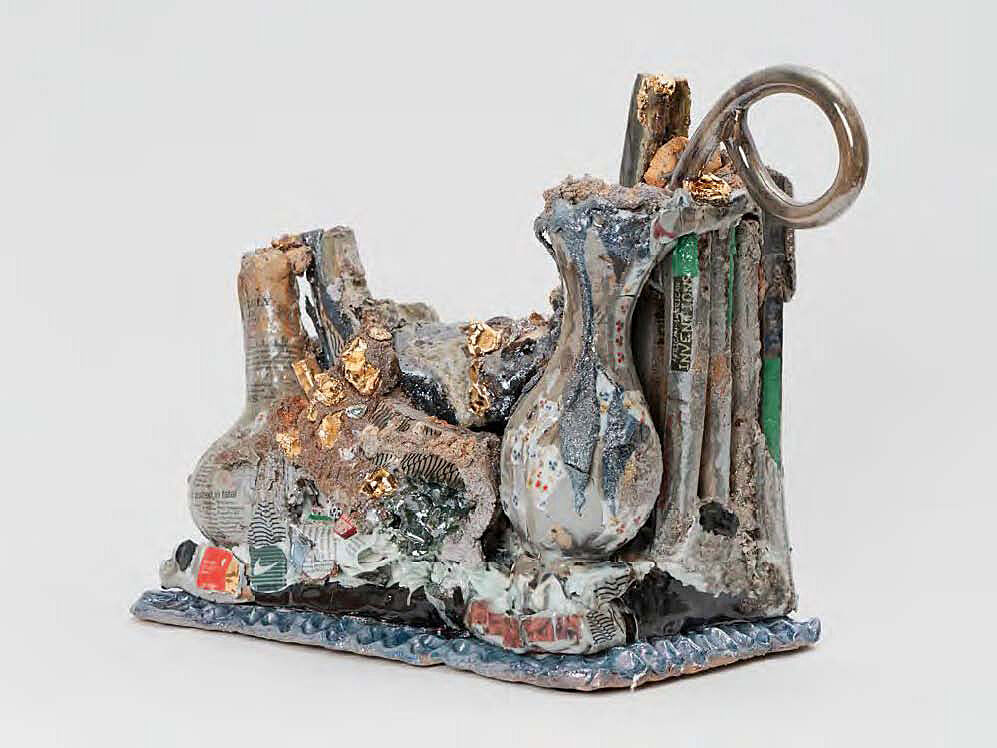
-
650
Arlene Shechet, A Night Out, 2011, and Y Wabi N, 2007
Audio, Kids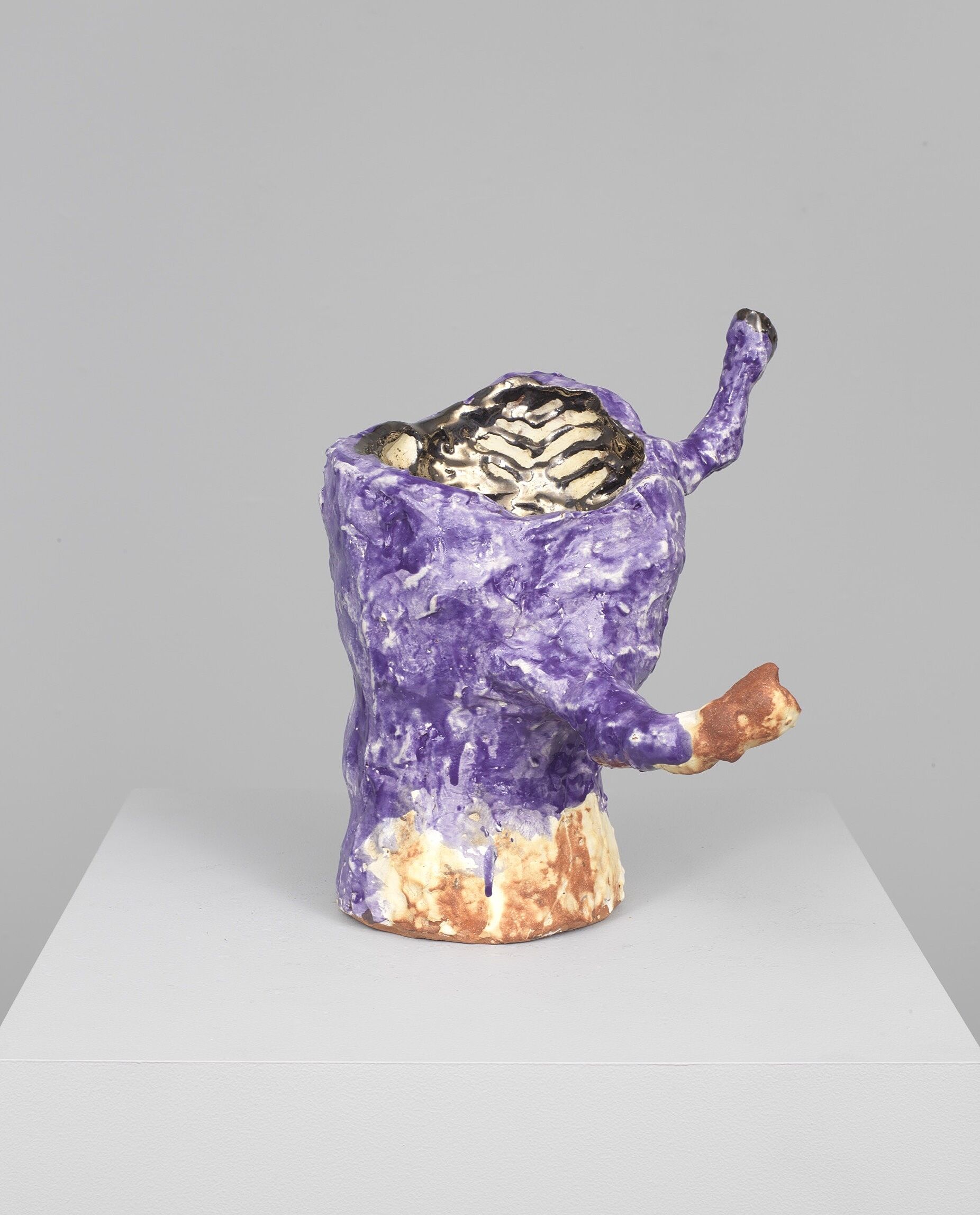
-
600
Introduction
Audio, Kids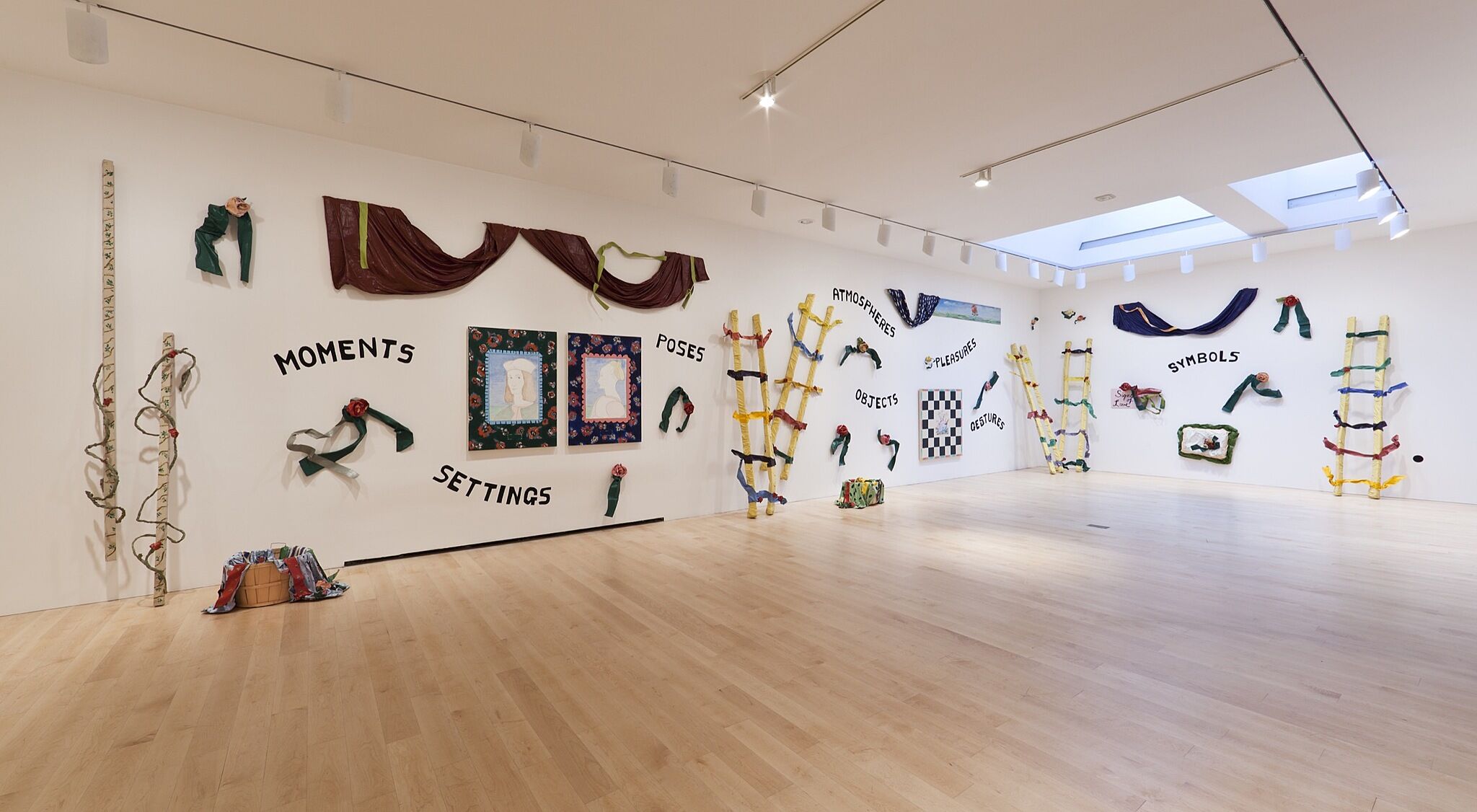
-
613
Singular Visions: Eva Hesse, No Title, 1970
Audio, Kids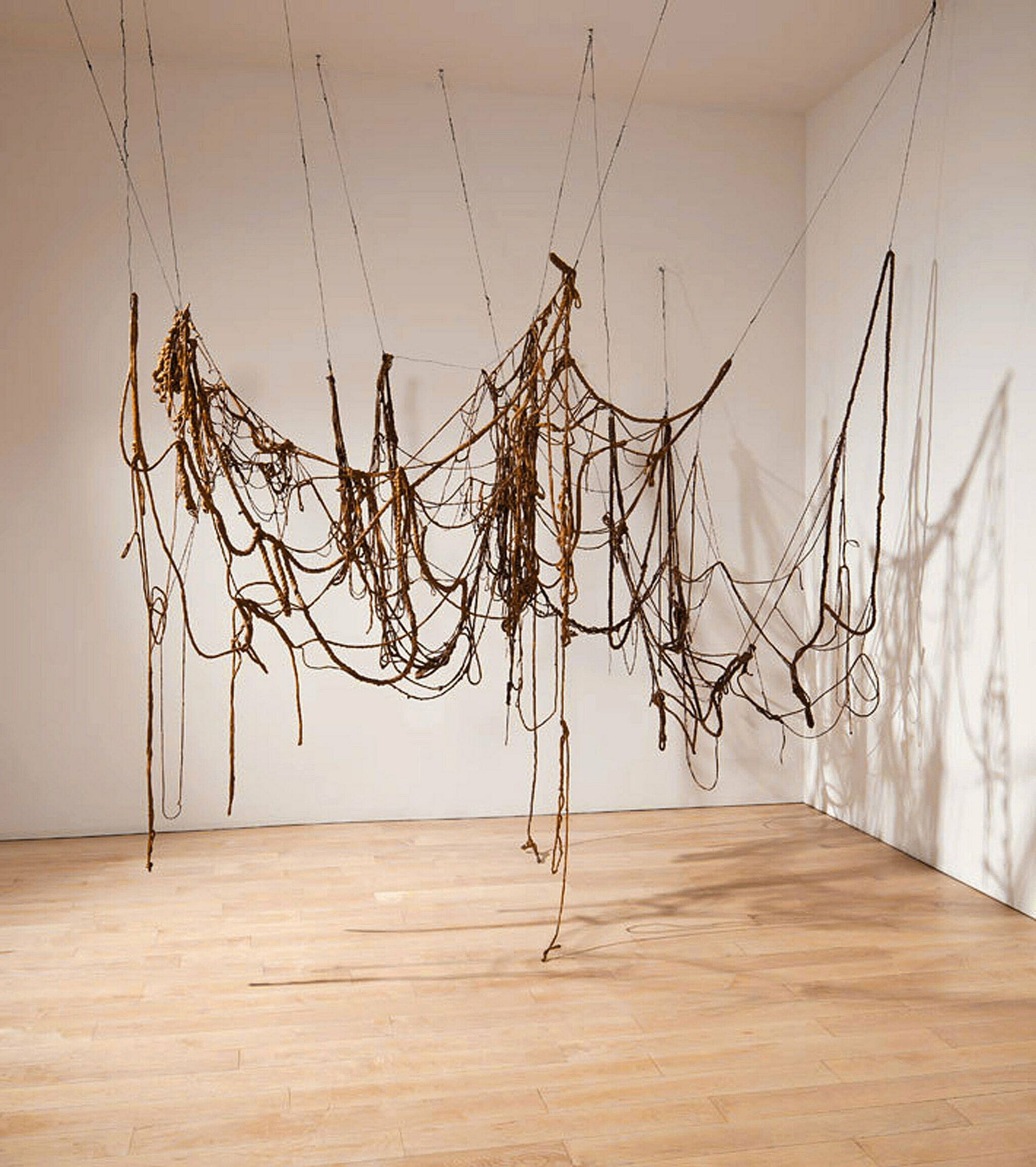
-
645
Simone Leigh, Cupboard VIII, 2018
Kids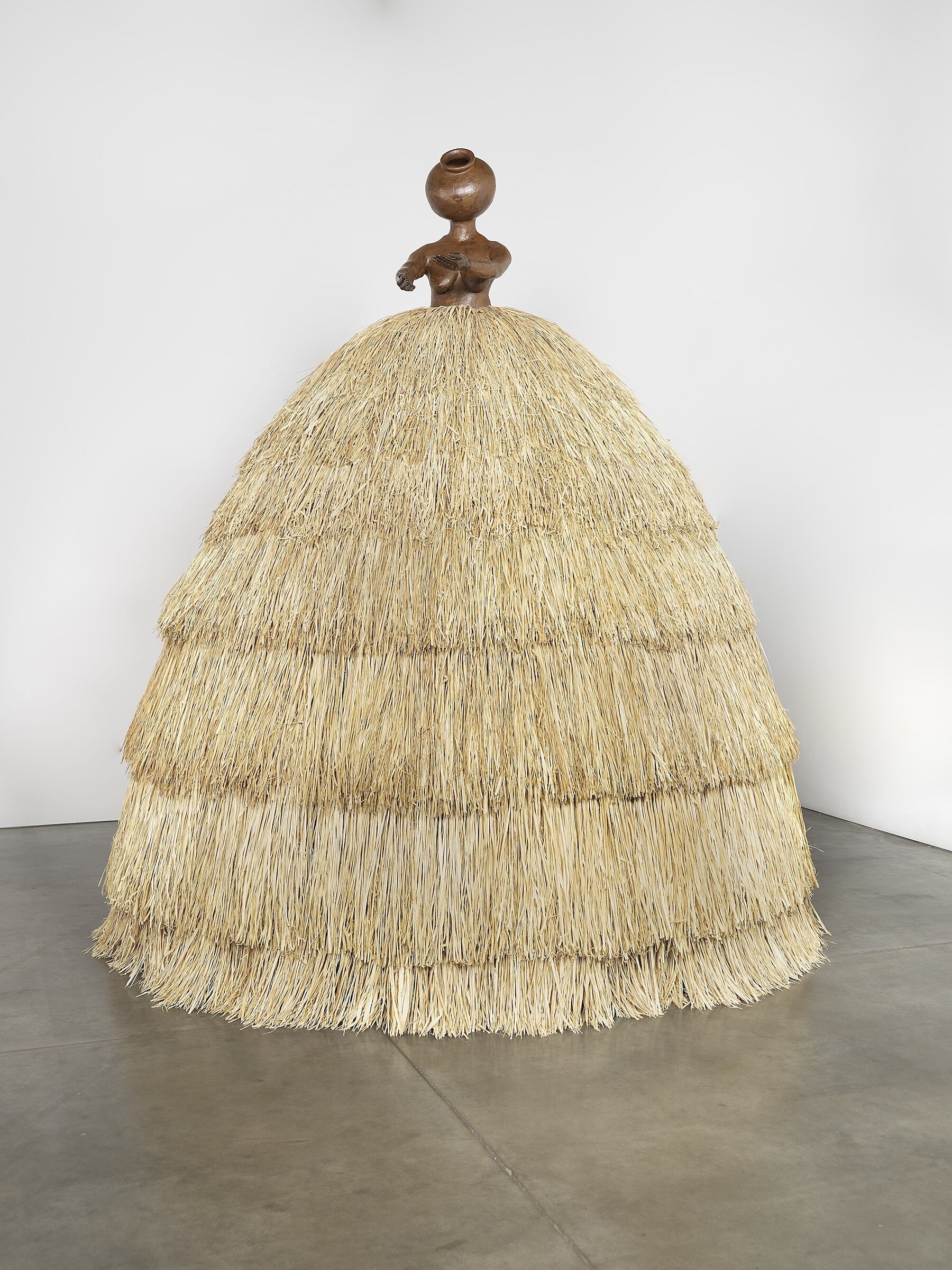
-
605
Sound Description and Transcription: Robyn Bretano, Cloud Dance, 1979
Sound description
Narrator: Ruth Asawa made sculptures like this one by weaving metal wire, a technique that she learned on a trip to Mexico City in 1947.
Ruth Asawa: That’s where I learned to knit and to knit with wire.
Narrator: Asawa attended Black Mountain College, an experimental art school that encouraged students to use everyday, found materials.
Ruth Asawa: If you take material you like to know how far you can take it from what it’s traditionally known to do. You find that you can go from two dimensions to three dimensions, that interests me. It can be any material. It doesn’t have to be wire.
Narrator: In 2002, the Archives of American Art recorded this oral history with Asawa. In it, she was asked whether it bothered her that her work might be seen in relation to craftmaking, rather than sculpting.
Ruth Asawa: It doesn’t bother me. Whether it’s a craft or whether it’s art. That is a definition that people put on things. And what I like is the material is irrelevant. It’s just that that happens to be material that I use. And I think that is important. That you take an ordinary material like wire and you give it a new definition. That’s all. I’m interested in what it can do by itself, that’s what excites me.
[Oral history interview with Ruth Asawa and Albert Lanier, 2002 June 21-July 5. Archives of American Art, Smithsonian Institution.]
Narrator: Ruth Asawa made this sculpture out of wire. She learned how to make the forms in Mexico, watching weavers make traditional baskets. Because she worked in wire, her weavings were see-through—made up mostly of air. At the same time, the materials seem really strong. Asawa once described her woven wire as seeming like medieval chain mail, a material used to make armor. Big yet light, strong yet airy: Asawa was interested in these oppositions. She also liked the way the shapes reminded her of things in nature. She once compared the woven patterns to lines she drew with her toes in the soil of the California farm where she had grown up.
Ruth Asawa, Untitled (S.270, Hanging Six-Lobed, Complex Interlocking Continuous Form within a Form with Two Interior Spheres), 1955 (refabricated 1957–58). Brass and steel wire, 63 7/8 × 14 15/16 × 14 15/16 in. (162.2 × 37.9 × 37.9 cm). Whitney Museum of American Art; gift of Howard Lipman 63.38. Artwork © 2023 Ruth Asawa Lanier, Inc./Artists Rights Society (ARS), New York. Courtesy David Zwirner. Photograph by Robert Gerhardt
Jennie Goldstein: Line Involvements is a series of lithographs by the artist Anni Albers, a group of works that she made in 1964. Anni Albers is best known as a weaver, a textile maker, someone who made textiles often specifically to be hung on the wall as opposed to usable, functional things. And she did that for decades.
Narrator: In 1963, a year before making this series, Albers permanently shifted her focus from textiles to lithographs.
Jennie Goldstein: And in Line Involvements, what’s so interesting is that you can see that although she’s working with a print medium, the thread, the sense of the individual string or strand that makes up a textile, a woven thing, is still there. It’s still apparent. It gets more and more complicated, successively ornate, and interlocking and interwoven as the series progresses. So it shares with textiles the same kind of fundamental questions about what can a line do. And what does a series of strings or strands do when they come into a kind of communication with each other?
Narrator: There are seven prints in this series. Because prolonged exposure to light will damage works on paper, we’re showing them only three at a time—rotating them on and off view. The display will always include a print from near the beginning, middle, and end of the series.
Anni Albers, Line Involvements IV, 1964, from the portfolio Line Involvements. Lithograph, 14 3/4 × 19 13/16 in. (37.5 × 50.3 cm). Courtesy Cristea Roberts Gallery, London. © 2019 The Josef and Anni Albers Foundation/Artists Rights Society (ARS), New York
Elisabeth Sherman: Four Petaled Flower II is a large weaving. It is a sculpture made out of fiber, made out of threads. It’s a densely woven fabric with four arms, you could say. And each of those arms is a completely closed weave.
Narrator: Assistant Curator Elisabeth Sherman.
Elisabeth Sherman: At the center of the composition, Tawney has woven in these open slits that allow some light to come through from behind. Prior to working in this way in the seventies, Tawney’s weavings were much more open and diaphanous. They were almost completely composed of light and empty space, with the threads very gently holding the composition together.
I think part of what changes in this period is the rise of Minimalism in the art world. Something else that’s very important to her over the whole span of her career is technical innovation. She’s both drawing on weaving techniques that she’s learned from many different cultures and technical understanding about the history of this mode of working around the world, but also her own technical innovations. So manipulating the loom itself as well as the ways in which you work with warp and weft, the horizontal and vertical threads in a weaving, to create structures and openings and transparencies that previously weren’t technically possible.
Lenore G. Tawney, Four Petaled Flower II, 1974. Woven linen and steel rods, 87 1/2 × 85 1/4 × 1 1/4 in. (222.3 × 216.5 × 3.2 cm). Whitney Museum of American Art, New York; gift of the Lenore G. Tawney Foundation 2014.298. © Lenore G. Tawney Foundation
Narrator: In 2011 at a lecture here at the Whitney, Claes Oldenburg spoke about his approach to scale in works like this one.
Claes Oldenburg: A lot of my work is very small, a lot of the work is very large, and it seems like it's in the same universe. It's just a matter of how far away you are from it. I think of scale as being a relative thing, and that almost anything that's small can be seen as something that's very big, and vice versa.
Narrator: By exaggerating a common object’s qualities, Oldenburg transforms our relationship to it. The dimensions and surface of this sculpture are the result of several, careful draft stages.
Claes Oldenburg: What we did is we started with a cardboard model, and then we went into what we call the ghost model. And the idea of the ghost model was that you could study your mistakes so you wouldn't make them in the vinyl. That was the early vinyl, which was really thick and beautiful, and soft and shiny. So when the object came to be made in vinyl, the final object, there had to be a preparation, because vinyl is so delicate that you can't make a mistake when you sew it.
Claes Oldenburg, Giant BLT (Bacon, Lettuce, and Tomato Sandwich), 1963. Vinyl, kapok fibers, painted wood, and wood, 32 × 39 × 29 in. (81.3 × 99.1 × 73.7cm). Whitney Museum of American Art, New York; gift of The American Contemporary Art Foundation Inc., Leonard A. Lauder, President 2002.255a-s
Narrator: Kusama called this sculpture Accumulation, referring to the proliferation of soft, pillowy phallic forms that cover the underlying chair. There’s something surreal about seeing an ordinary piece of furniture treated in this way. And of course the whole psychic resonance of the phallus changes when there are hundreds upon hundreds of them: the form becomes absurd.
In her autobiography—which was first published in Japan in 2002—Kusama wrote that the sculptures helped her work through her feelings of trauma.
“People often assume that I must be mad about sex, because I make so many such objects, but that’s a complete misunderstanding. It’s quite the opposite—I make the objects because they horrify me. I began making penises in order to heal my feelings of disgust towards sex. Reproducing the objects, again and again, was my way of conquering the fear. It was a kind of self-therapy, to which I gave the name ‘psychosomatic art.’ I make a pile of soft sculpture penises and lie down among them. That turns the frightening thing into something funny, something amusing. I’m able to revel in my illness in the dazzling light of day. By now, the number of penises I have made easily reaches into the hundreds of thousands.”
Yayoi Kusama, Accumulation, c. 1963. Sewn and stuffed fabric, wood chair frame, paint, 35 1/2 × 38 1/2 × 35 in. (90.2 × 97.8 × 88.9 cm). Whitney Museum of American Art, New York; purchase 2001.342. © Yayoi Kusama. Photograph by Tom Powel
Narrator: Artist Howardena Pindell.
Howardena Pindell: I started to want to introduce the grid and so I use something equivalent to a Sharpie marker and made a grid pattern, not a small one but maybe about seven or eight inches square. And in this case there's an orange grid pattern. But from a distance it almost looks like it's sewn.
I liked the grid. I think possibly because my father was a mathematician, would have a notebook with graph paper or [it] looked like graph paper to me.
Narrator: The artist explains how she made the small circular shapes that dot the surface of this work.
Howardena Pindell: I just went to Woolworth's, my loft was near Woolworths and I bought a plain old hole puncher and then I bought file folders, manila folders. And I would cut them in strips and punch them.
In the early work I only had one simple hole punch and I would gesso the canvas. And then I would draw the grid. And then on top of that I probably started using just white acrylic. And then I started extruding paint and sprinkling dots that had a kind of Sharpie marker quality of bleeding up, and that's what I wanted. I wanted that kind of whisper of color.
Howardena Pindell, Untitled, 1974–75. Mixed media on canvas, 75 × 94 3/4 in. (190.5 × 240.7 cm). Collection of Beth Rudin DeWoody. Courtesy the artist and Garth Greenan Gallery, New York
Harmony Hammond: Hi, this is Harmony Hammond, and I'm speaking to you by telephone from Galisteo, New Mexico, where I live and work.
For Hug, I wrapped strips and pieces of fabrics gathered from different sources, some from the domestic environment, and some from streets in the Lower Manhattan garment district. I wrapped them around ladder shaped armatures made of wood. Sometimes, I used old broken wooden ladders I'd found, and other times I made my own. The resulting organic abstract forms allowed me to escape figuration, but presence the body. Ladders always suggest the bodies that use them.
It was conceptually important to me that the ladder forms were not hollow or stuffed, but rather, like women's lives, made out of themselves from the inside out—with the inside showing on the outside. The wood armature functions as a skeleton, the layers of wrapped fabric as muscle and tissue, and the acrylic paint as skin.
It is kind of parallel to the early movement phrase, "The personal is political." Starting with the center, starting with the core, and moving out from the center. And probably it’s related to my martial arts practice also at the time. I was studying at that time the martial arts, T'ai chi ch'üan, but also the Japanese martial art, Aikido, in which case you are centered, and the movements are in circles out from the center. So, it's kind of all connected.
Narrator: Imagine these two ladder-like forms as if they were human bodies. How would you describe them? You might say that the little one leans on the large one, or that the larger one supports the smaller. You might describe them as being nestled together. A lot of the descriptions you might come up with would make the sculpture sound sort of...snuggly. And this is one reaction the artist wanted us to have to the work, which she titled Hug. Without representing bodies, she tried to give us the feeling of a body’s weight and touch.
Hammond made this work early in the feminist movement, when women were fighting for equality and looking for new ways to express themselves—ways that weren’t defined by men. For Hammond, trying to communicate bodily experience without actually picturing bodies was one way to do that.
Harmony Hammond, Hug, 1978. Acrylic on fabric and wood, 64 × 30 1/4 × 14 in. (162.6 × 76.8 × 35.6 cm). Whitney Museum of American Art, New York; gift of Rosemary McNamara 2017.208a-b. © 2019 Harmony Hammond/Artists Rights Society (ARS), New York
Narrator: In the early seventies, Miriam Schapiro was researching arts that were seen as traditionally feminine, such as weaving, collage, and needlepoint. Here, she collaged colorful flowers and metallic plaid motifs from a range of sources and cultures. She explained why she combined these images in an oral history for the Archives of American Art.
Miriam Schapiro: What traditionally women have made in art, has been the incorporation of certain kinds of what are now considered trivialized images. I think what we women did was to democratize art.
Narrator: Schapiro’s “femmage” works aimed to include different types of imagery within art history that had previously been excluded, specifically because they were done by women.
Miriam Schapiro: This kind of anxiety that arises about a separate culture, a separate group. How can we do that to gender? How can we take one half of gender and make it totally separate and different? Coming back to the discussion of power, we do live in a patriarchy, and the rules are set for us women. We need to move, to integrate ourselves into the totality of society, and we need to bring our own point of view with us as we do that. None of us ever wants to live separately.
[Oral history interview with Miriam Schapiro, 1989 September 10. Archives of American Art, Smithsonian Institution]
Miriam Schapiro, The Beauty of Summer, 1973–74. Acrylic and fabric on canvas, 50 × 70 in. (127 × 177.8 cm). Collection of Beth Rudin DeWoody. © 2019 Miriam Schapiro / Artists Rights Society (ARS), New York
Pepón Osorio: My name is Pepón Osorio and I live in Philly—Philadelphia.
So, Angel: The Shoe Shiner was done in 1993. And what I was most concerned [about], at that time, was connecting with people in my vicinity near the place where I lived.
And, so, I came across this shoeshiner. His name was Angel and we had many, many conversations, which is basically part of my whole process of making work. My methodology is that I spent a lot of time talking. And then, after that, sort of metaphors come in, and then I translate them into three-dimensional pieces.
And Angel had this relationship, which was very interesting, a co-relationship with power. He was always at the bottom of the client, and the client was always above him. I put him on the throne as a way of creating some sort of equity in that power relationship that is happening.
Narrator: In the video at the base of the throne, we see Angel using his spit to shine his client's shoes. For Osorio, this act also rebalanced the hierarchy of power. The throne is covered in materials that he thinks of as attributes of the shoeshiner.
Pepón Osorio: I gather a lot of the materials that encrusted the surface from the nearby novelty stores. Some of them are specifically for weddings and quinceañeras, which is the fifteen instead of sweet sixteens. Some of them, I got them at a 99-cent store.
Time, the clock is on the very, very top. And it's an element of time, and how he was running time because at the same time he was very scared that he would be thrown out—which, in fact, it happened—out of his business, because of the gentrification in the neighborhood.
Pepón Osorio, Angel: The Shoe Shiner, 1993. Painted wood, rubber, fabric, glass, ceramic, shells, painted cast iron, two video monitors, two color videotapes, hand-tinted photographs, paper and mirror. Whitney Museum of American Art, New York; purchase with funds from the Painting and Sculpture Committee 93.100
Narrator: Mike Kelley’s work More Love Hours than Can Ever Be Repaid is made out of stuffed animals, afghans, and other craft objects.
Mike Kelley: They were all used items that I bought at thrift stores and yard sales. And they're all handmade objects. So they're not the kind of objects that would generally be sold—they’re the kind of objects that would be given away.
Narrator: The work’s surface is tightly packed with objects, suggesting an almost compulsive desire to fill the picture plane. Kelley was interested in the huge amount of time it took people to make all of these craft objects.
Mike Kelley: It had an accumulative effect. If you saw these things as representing love, then it was a massive amount of love. If you saw the things as being inducers of guilt or repayment, then it was more than you could ever pay back. So depending on your point of view, you either see it as super-lovable or super-creepy. And you know, so people tend to see it either way. Like, some people are really repulsed by it, and some people love it to death.
Narrator: Kelley paired this work with the piece on the floor, called Wages of Sin. Like More Love Hours than Can Ever Be Repaid, Wages of Sin is a massive accumulation of a material we don’t usually associate with high art—candle wax.
Mike Kelley: [It’s] like the kind of sculpture that a teenager would make in their pot smoking room. And by titling it The Wages of Sin, it gives this kind of morbid teenage overtone, you know, some pseudo-ritualistic kind of thing.
Narrator: In the 1960s, many artists became interested in repetition and accumulation as almost mechanical techniques that downplayed the role of individual expression. In More Love Hours than Can Ever Be Repaid and Wages of Sin, Kelley questions that impulse. With the materials he uses, accumulation doesn’t result in just more of the same. Instead, it creates layers of association, feeling, and meaning.
Narrator: How many stuffed animals do you have? This many?! How many are here, anyway?
Mike Kelley scoured thrift stores and scooped up handmade toys and blankets that other people had given away. Toys they had once played with, and then gotten tired of.
By giving this work the title More Love Hours Than Can Ever Be Repaid, Kelley is imagining that someone who makes a toy or blanket by hand needs to be paid back. If someone’s grandma spent two weeks making her grandson a sock monkey, how much love does the grandkid owe her? Is it really possible to pay her back? Grandmas have a lot of love, what if you CAN’T? How does THAT make you feel?
Mike Kelley, More Love Hours Than Can Ever Be Repaid and The Wages of Sin, 1987. Stuffed fabric toys and afghans on canvas with dried corn; wax candles on wood and metal base, 120 3/4 × 151 3/4 × 31 3/4 in. (306.7 × 385.4 × 80.6 cm). Whitney Museum of American Art, New York; purchase with funds from the Painting and Sculpture Committee 89.13a-d. © 2019 The Mike Kelley Foundation for the Arts / Licensed by VAGA at Artists Rights Society (ARS), New York
Thomas Lanigan-Schmidt: The whole thing is supposed to be pleasant. the materials are supposed to be rich emotionally, but they're poor economically. If they were taken out of that box, they might fall apart.
Within the piece itself is a 45 RPM record. “Will You [Still] Love Me Tomorrow?” by The Shirelles. It was one of my favorite records back when I was around fifteen years old. 45 records aren't made anymore, but it's there because it's about a memory.
The fragility of the materials is as close as I can get to the fragility of memory itself. It's mostly about longing, the combination of memory and longing. It's also saturated with sex, but it's very repressed and veiled, the cat tail is obviously a kind of phallic symbol. The AIDS crisis is naturally a part of it, because this was made when there wasn't any cure or way of keeping a person alive with AIDS.
We go through many rites of passage. We first have our childhood with a transition into adulthood through our teenage years. It's kind of calibrated through sexual desire when we first fall in love when we first have sex, or we do, or we don't.
It's done in a way that's palatable to a very repressed person or a person who just wants the lyricism of desire, but doesn't want to deal with the animal side of it. “Will You [Still] Love Me Tomorrow?” The song is filled with hope and doubt.
Thomas Lanigan-Schmidt, A Rite of Passage: The Velvet Cat Tail and the Silk Tiger Lily, 1987–88. Wood ,metalic foil, 45 RPM vinyl record, artificial flowers, Saran wrap, metal staples, fabric, plastic beads, and fiber-tipped pen, 38 7/8 × 15 1/2 × 15 1/8 in. (98.7 × 39.4 × 38.4 cm). Whitney Museum of American Art, New York; gift of Robert Kushner 2001.291. © Thomas Lanigan-Schmidt and Pavel Zoubok Fine Art, NY
Narrator: The title of this work, Daufuskie Muscat, refers to a barrier island off the coast of South Carolina. Traditionally, Daufuskie had been inhabited by the Gullah Geechee people, who descended from Indigenous and freed enslaved people. In recent decades, they have been pushed out by the tourist industry. The work is a meditation on such displacements, whether driven by profit or climate change.
Erin Jane Nelson: I became interested in barrier islands in part because, after several years of back-to-back, brutal hurricane seasons, I just kept hearing about all of these regions that were being decimated.
Narrator: Erin Jane Nelson.
Erin Jane Nelson: And a lot of times the places that were falling victim to this weather were also kind of the places where a lot of Southern history, good and bad, had been contained and either acknowledged or not acknowledged.
Throughout the work, I use sort of nautical elements like the sand dollar in this piece and found wood from the beaches to really create a time capsule of the place. And then because barrier islands are this strange ecological phenomenon that protects the mainland, they have this really interesting shape to them. And that geographical shape is really partly what inspires the ceramic forms, which are somewhat oblong and kind of unspecific. And then also by encasing the works in resin, which I think appears to look like water, you get the sense of these places being wet or flooded, and that's something I really like about making this work.
Erin Jane Nelson, Daufuskie Muscat, 2018. Pigment prints, shells, and resin on glazed stoneware, 20 × 30 × 3 in. (50.8 × 76.2 × 7.6 cm). Whitney Museum of American Art, New York; gift of Avo Samuelian and Hector Manuel Gonzalez 2019.386a-b. © Erin Jane Nelson
Nick Cave: A Sound Suit really came out of the Rodney King incident in '92.
Narrator: Artist Nick Cave.
Nick Cave: It was the beginning of a body of work that was based around sort of creating this sort of shield, this sort of suit of armor, this sort of device of protection. And, so I was very interested in hiding gender, race, class, forcing you to look at this object without judgment. How I got to the form of this object was, I was thinking about the role of power and what brings us those ideas sort of translated. So, I was looking at the miter, the headdress from the Catholic Church. I was looking at the head of a missile. I was looking at the shape of a condom, and bringing all of these forces together brought me to this form.
Narrator: Cave has made more than five hundred sound suits. The first one was made out of twigs. After it occurred to him that he could wear it, he was excited to discover its rustling noise.
Nick Cave: The moment it made sound, it just led me right to this whole notion of protest. In order to be heard, you've got to speak louder. So, it was really about this very urgent condition that was built within the object, that was alarming and interesting for me in that aspect.
Narrator: This suit is not intended to be worn, but Cave still thinks of it in terms of sound.
Nick Cave: Sound is not something that you necessarily have to hear. It could be orchestrated through the way in which pattern is organized on a surface, the way in which light reflects as you move around and amongst a work of art.
Narrator: This is Nick Cave’s Sound Suit #20. The title lets you know that it’s not the only sound suit he ever made. In fact, he’s made hundreds! Many of them are made to be worn. Those make a sound when you move in them—whooshing, clacking, rustling. This one is too fragile, with its sequined and hand-beaded surface, he really thinks of it as a sculpture. But what if you could hear the pattern? It’s bright and busy, and seems noisy and exciting.
The Sound Suits are fun, and seem to suggest a world of possibility. But they’re also meant to disguise any person who might wear them, protecting them from discrimination based on race, gender, or anything else. Cave associates making noise with protest, and wants his sound suits to be used in making positive change.
Nick Cave, Soundsuit, 2005. Mixed media, 100 × 26 × 14 in. (254 × 66 × 35.6 cm). Collection of Beth Rudin DeWoody. © Nick Cave. Courtesy the artist and Jack Shainman Gallery, New York. Photograph by James Prinz Photography
Marie Watt: I work with reclaimed blankets that I scavenged from thrift stores. I was interested in working with blankets because in my tribe and in other Indigenous communities, we often give blankets away to honor people for being witness to important life events.
I'm a citizen of the Seneca nation and our community is located just west of Buffalo, by about forty minutes. When I moved from Portland to Brooklyn, New York, we exchanged the conifers and totem poles of the Pacific Northwest for scaffolding and skyscrapers. And it got me thinking a lot about the Iroquois and Indigenous presence in New York.
Narrator: Most of New York’s skyscrapers have been built by Iroquois ironworkers, known as skywalkers.
Marie Watt: I love the the association between a Skywalker being an Iroquois ironworker—an extended member of my family—and relating to Star Wars. I'm interested in Skywalker as a word that refers to this space that seems otherworldly, and mythic, and magical. Even spiritual. I think that is the space that Skywalkers and skyscrapers occupy. And it's a space that we all are familiar with. And it’s a space that can be sacred, a space that connects us. And when I say connects us, I think of humans, being located at different places around the planet, and yet this Skywalker/Skyscraper space is actually a space that we perhaps look up to. You know, it's occupied by the moon, and stars, and planets, and planes, and weapons. So, it's a space that makes me think.
Marie Watt, Skywalker/Skyscraper (Axis Mundi), 2012. Reclaimed wool blankets and steel, 96 × 20 × 22 in. (243.8 × 50.8 × 55.9 cm). Whitney Museum of American Art, New York; purchase with funds from the Painting and Sculpture Committee. © Marie Watt. Photograph by Aaron Johanson, courtesy PDX Contemporary Art
Kahlil Robert Irving: My name is Kahlil Robert Irving, and I'm an artist that lives and works in the United States.
Most people who see my work think that all of these things are found. The whole sculpture is constructed by me in the studio, so everything that you may think may be a found object is produced by me in the studio.
So the application of the overglaze enamels and image transfers are first constructed by me in the computer, printed out by a special printer, and then I adhere and fire every layer of the surface on the sculpture myself. This work was fired about twelve to sixteen times to be able to add all the images, all the color, and all the metallics that you see present.
I am interested in the history of decorative arts in relationship to its colonialist and oppressive domination over the world's cultures. Thinking about historical ceramic objects and also how those traded or industrially produced objects around the world, Asia and Europe, have found their way through the lineage of colonialism, and an imperialist order from European white supremacy around the world and found their way to the United States.
Kahlil Robert Irving, 100's, 2018. Glazed and unglazed stoneware and porcelain, opal luster, silver luster, blue luster, decals, 13 1/4 × 20 × 11 1/2 in. (33.7 × 50.8 × 29.2 cm). Whitney Museum of American Art, New York; gift of Avo Samuelian and Hector Manuel Gonzalez 2019.387. © Kahlil Robert Irving
Arlene Shechet: My name is Arlene Shechet, and I'm a sculptor.
Narrator: Shechet has two works in this display of works made in ceramics. They’re called A Night Out and Y Wabi N.
Arlene Shechet: The beauty of ceramics was that whatever I put on the surface and I fired became completely part of the structure of the piece. That's so unique to that material, to fire something in, so that the form and the surface are literally one thing.
One of the things that clay presented to me was that it needed to be hollow in order to be fired. Its hollowness was extremely attractive to me because it felt like it was a void around a breath, or a void that contained the breath. Sometimes when I was making those early pieces, I was even thinking about them being inhales or exhales. It was at a time when my father had congestive heart failure. I would spend days with him, and then come and work on these pieces, where I was painfully and sublimely aware of my ability to breathe, and what was happening with the materials as I thought of them being puffed up or deflated through breath.
Narrator: A Night Out is a blue form, placed on top of two block forms, one of which sits off-center on top of the other.
Arlene Shechet: I had always been thinking about, whatever I make, what does it sit on? How does it live in the world? The precariousness of the assemblage that I put together for that piece to sit atop is very related to me experiencing the precariousness of life and death, and our basic position in the world of not knowing, and trying to feel stability in an inherently unstable life.
Narrator: There are some art materials—like oil paint, or bronze—that people don’t usually use unless they go to art school. The works in this room are all made from a material that’s not like that at all—clay. A lot of us first used it in preschool, or even earlier. And we use ceramic mugs and plates everyday, too. Clay is so familiar, most of us probably don’t give it a lot of thought—but this room invites you to go ahead and think more about everything it can do. You’ll see elegant pots, smirking faces, colorful abstract forms, funky vessels, and one really tall man. Imagine using your hands to make these forms.
Arlene Shechet, A Night Out, 2011. Glazed ceramic, 57 × 21 1/2 × 16 1/2 in. (144.8 × 54.6 × 41.9 cm). Whitney Museum of American Art, New York; promised gift of Adam Sheffer in memory of Bradley Carmel T.2019.814a-d. © Arlene Shechet
Elisabeth Sherman: Making Knowing is an exhibition primarily drawn from the Whitney’s collection looking at the role of craft from 1950 to 2019.
Narrator: Assistant Curator Elisabeth Sherman.
Elisabeth Sherman: “Craft,” meaning traditional studio crafts of weaving and ceramics, but also expanded ideas of craft, whether that’s beads or found materials, or ideas of craft techniques and concepts taken up by contemporary artists.
Narrator: Assistant Curator Jennie Goldstein.
Jennie Goldstein: It has been the case that for some artists, taking up certain kinds of materials and methods, for instance weaving or textiles or ceramics, and bringing those materials and methods into the visual art world—the discourse, the galleries, museums, collector’s homes—is a kind of political act.
Elisabeth Sherman: Many of the materials and processes used by the artists in this exhibition have been marginalized. They’re not often seen in the same light as painting or sculpting in metal, these kind of big, prominent ways of working in the art world. And often this reason has been because these are the materials associated with or taken up by women artists, artists of color—for reasons of access, whether that be financial access or educational access. And so these associations have kept these materials, just like the people associated with them, in the margins. And part of what we hope to do with this exhibition is to show the inherent power in these ways of working.
Narrator: Welcome! The works in this sixth floor exhibition make creative use of craft techniques—including some that you might be familiar with. You’ll find thread, yarn, clay, beads, and other materials. Some of the artists use rope or rubber, others make their work out of stuffed animals and candle wax. All of them take an experimental approach to their materials—playing with them to find new possibilities.
One great example is right here at the beginning of the exhibition. It’s called Signs of Love. The artist Ree Morton made the letters and some of the other materials out of Celastic, a kind of plastic that’s flexible when it’s wet and hardens as it dries. Since artists hadn’t really used Celastic before, Morton could work with no sense of rules or expectations. The title tells us it’s about love, but what is it saying? There are some roses, and a pair of portraits showing a man and a woman who seem to be a couple. Then there are ladders, and words on the wall like “symbols” and “atmospheres.” These things could have something to do with love, but what? Morton leaves it up to us to come up with the story.
Ree Morton, Signs of Love, 1976. Acrylic, oil, colored pencil, watercolor and pastel on nitrocellulose-impregnated canvas, wood and canvas with felt. Whitney Museum of American Art, New York; gift of the Ree Morton Estate 90.2a-n. © Estate of Ree Morton. Courtesy Alexander and Bonin, New York. Photograph by Sheldan C. Collins
Narrator: To make this sculpture, Eva Hesse took knotted ropes and dipped them in liquid latex, a kind of rubber that hardens when it’s exposed to the air. Her only instructions about how to install it was that it should hang from thirteen points—but she planned to let the person hanging it decide where exactly those points should be.
Sculpture is one of the oldest art forms in the world. And from the beginning, it was meant to be solid and permanent—a good means of remembering a victory in war or a ruler who had passed away. By contrast, Hesse’s sculpture is flexible and open to change. If the old approach to sculpture was about remembering the past, maybe her work invites us to focus on what is happening right here in the present.
Eva Hesse (1936–1970). No Title, (1969–1970). Latex, rope, string, and wire, dimensions variable. Whitney Museum of American Art, New York; purchase, with funds from Eli and Edythe L. Broad, the Mrs. Percy Uris Purchase Fund, and the Painting and Sculpture Committee 88.17a-b © The Estate of Eva Hesse, courtesy Hauser & Wirth
Narrator: When you approach this sculpture—especially from kid height—it may look like a giant haystack. It’s actually made out of raffia—a kind of dried palm leaf used as a building and craft material in West Africa. Simone Leigh uses her sculpture to celebrate the women of the African diaspora—meaning women whose ancestors come from Africa, no matter where they live now. On top of the raffia skirt, you’ll see the form of a woman made in a glowing, brown-glazed clay. If you look closely, you’ll see that her head takes the form of a jug. Leigh modeled this form on jugs made by enslaved people in the American South. The figure has no eyes, mouth, or nose—the sense of expression comes entirely from the tilt of her head, and the open gesture of her arms.
Simone Leigh, Cupboard VIII, 2018. Stoneware, steel, raffia, and Albany slip, 125 × 120 × 120 in. (317.5 × 304.8 × 304.8 cm). © Simone Leigh. Photograph by Farzad Owrang. Image courtesy the artist and Luhring Augustine, New York
Sound Description and Transcription: Robyn Bretano, Cloud Dance, 1979
Running time: 13:09
Adaptations of poems, GET DANCING and FIRE, by Christopher Knowles
Read by Andy Ovanessian, music by Michael Galasso
[Background sounds: 00:00:00 - 00:02:43]
[Sounds include: a syncopated repetitive melody produced by instruments that sound Persian in their tenor and tone. The melody builds in complexity and volume.]
Get dancing get dancing get dancing get dancing get dancing get dancing.
This box uses gases for pressse for the presw of press. It could be real fun to.
Oh this is a tree for life and death. It could be the one was fine good.
He was flat like a hammer, it could be some of that, it could be some g.
Oh thank you very much I love you I am tired.
Get dancing get dancing get dancing get dancing get dancing get dancing.
This box uses gases for pressse for the presw of press. It could be real fun to.
Oh this is a tree for life and death. It could be the one was fine good.
He was flat like a hammer, it could be some of that, it could be some g.
Oh thank you very much I love you I am tired.
Get dancing get dancing get dancing get dancing get dancing get dancing get.
Oh thank you very much I love you I am tired.
Get dancing get dancing get dancing get dancing get dancing get dancing.
Get dancing get dancing get dancing get dancing.
Fire. The highway of you in it. Of you got the shores of you. This is OK.
“K” “K” “K” “K” “K” “K” “K”
Of a fire truck goes a siren to see any fire. Get them now.
Fire. Fire. Fire. Fire.
Would it like to die in this choice. I should sit on the sun and get some apples.
Would it like to get some right. Could it get some energy. Would it like to die in this choice. It could be.
Would it like to die in this choice. Would it like to die in this doice.
Would it like to die in this choice. Would it like to die in arranging.
Would you get the bird and bring it here. Good it for the others. Good. Good.
And. Get to the places offer you had a board over it. It was flying saucer to fly.
It could be a ball to pay into a stairs. It could be having my baby. It could be the one who had it. It could be a flying pastic. It call. Stand. Stand. Stand. Stand. Stand. Stand.
Ladies you are your seated up with their places up like a balloon.
Helpings are not to get uptight. Who who who who who who. Your hands are not supl.
To get bent like that. Would you like to see your sisters. It is.
It could be a wear of it, it got them out to your side to resist.
It could get bented up like be on to.
Ladies you are your seated up with their places up like a balloon.
Ladies you are your seated up with their places up like a balloon.
Ladies you are your seated up with their pla.
Fire. Hay you got much power inside with prosper into a leak. You get it to in.
Hay you got much sounding of a record of speed. You got all bold.
Hay you got much butterflies in your car. You got to take good care.
You got much power for everybody else to.
Fire. Fire. Fire. Fire. Fire. Fire. Fire. Fire. Fire. Fire. Fire. Fire.
Hay you got much power inside with prosper into a leak. You get it to in.
Hay you got much sounding of a record of speed. You got all bold.
Hay you got much butterflies in your car. You got to take good care.
You got much power for everybody else to.
Fire. Fire. Fire. Fire. Fire. Fire. Fire. Fire. Fire. Fire. Fire. Fire.
If if if if if you got much power take it out.
Fire. Fire. Fire. Fire. Fire. Fire. Fire. Fire. Fire. Fire. Fire. Fire. Fire. Fire. Fire. Fire. Fire. Fire. Fire. Fire.
This box uses gases for pressse for the presw of press. It could be real fun to.
Oh this is a tree for life and death. It could be the one was fine good.
He was flat like a hammer, it could be some of that, it could be some g.
Oh thank you very much I love you I am tired.
Get dancing get dancing get dancing get dancing get dancing get dancing.
0:00
0:00
