
Signs & Symbols
2012
This audio guide highlights selected works from the exhibition Signs & Symbols, focusing on the development of American abstraction after World War II.
-
200
Introduction to Signs & Symbols
Audio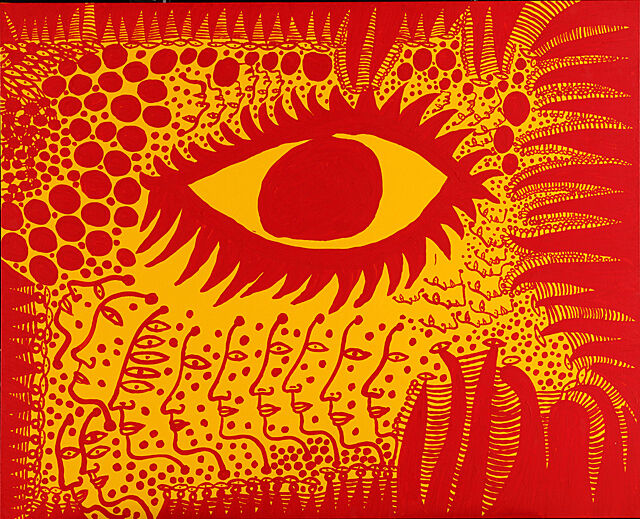
-
201
Louise Bourgeois, One and Others, 1955
Audio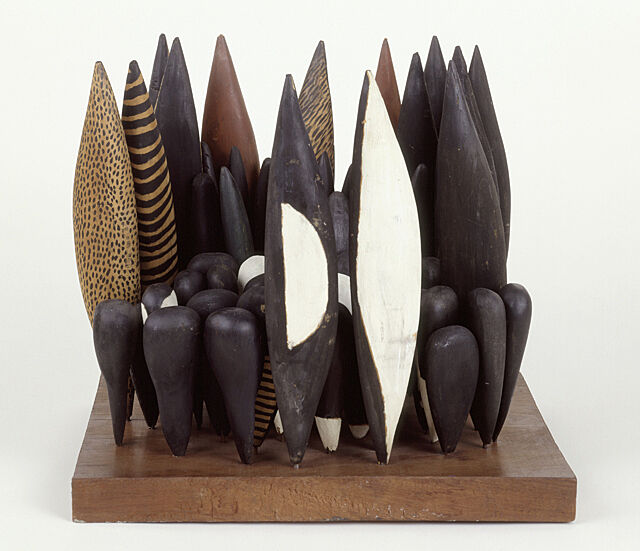
-
202
Mark Tobey, Universal Field, 1949
Audio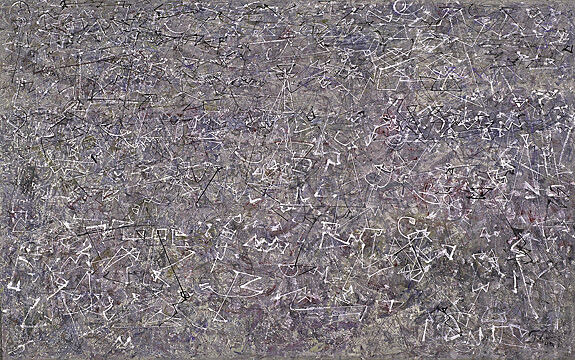
-
203
Will Barnet, Male and Female, 1954
Audio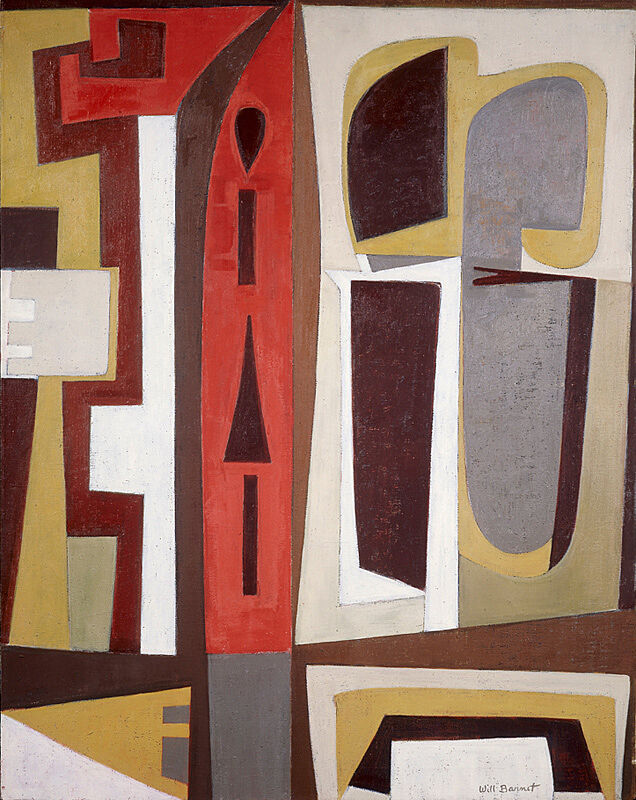
-
204
Steve Wheeler, Laughing Boy Rolling, 1946
Audio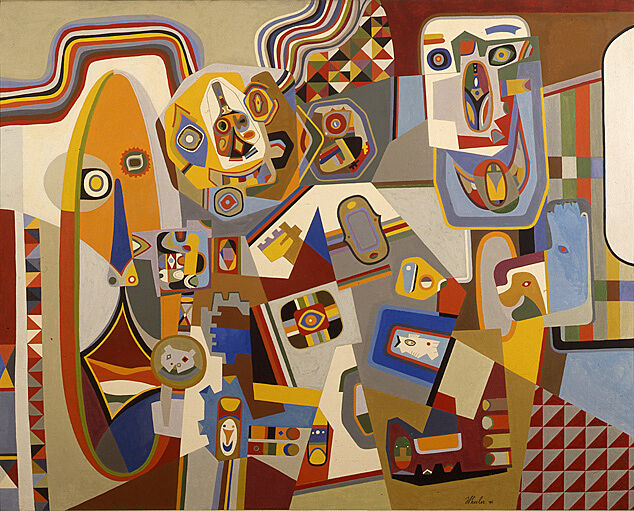
-
205
Forrest Bess, Drawing, 1957
Audio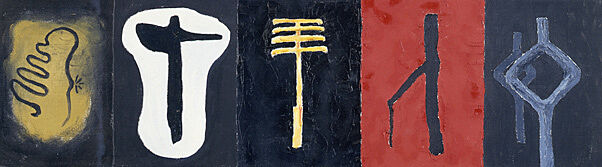
-
206
Mark Rothko, Agitation of the Archaic, 1944
Audio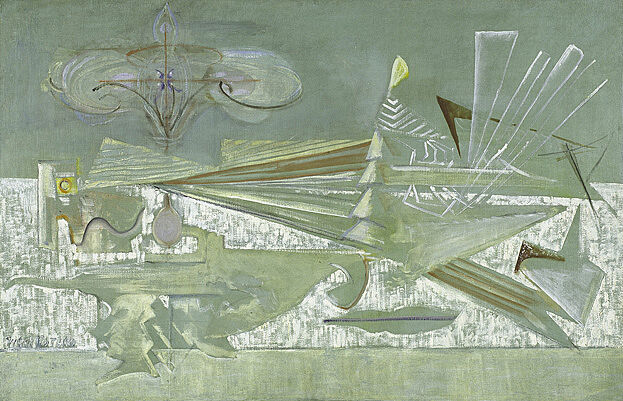
-
207
Adolph Gottlieb, Vigil, 1948
Audio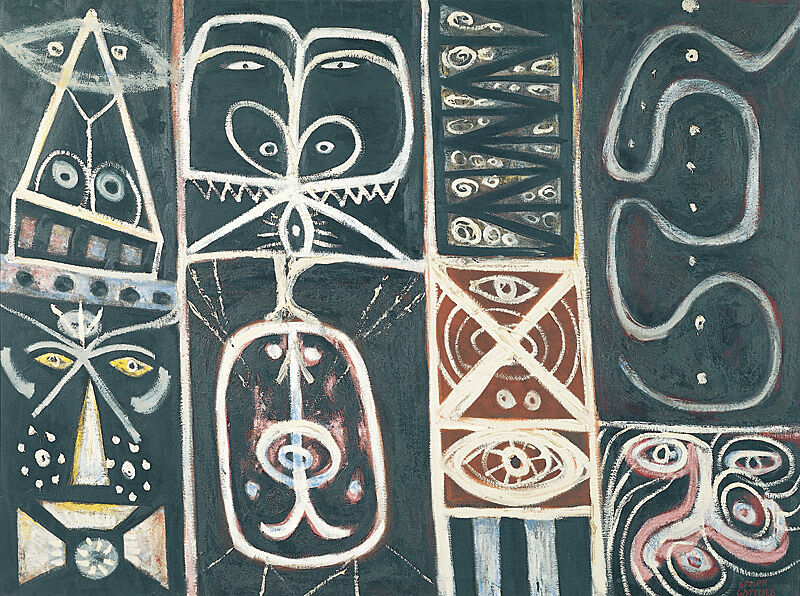
-
208
Aaron Siskind
Audio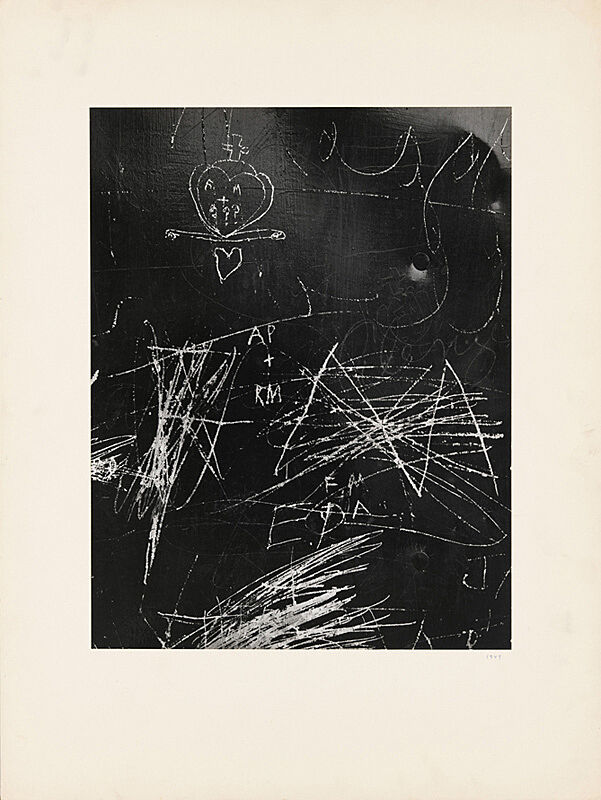
-
210
Jackson Pollock, Untitled, c. 1939–42
Audio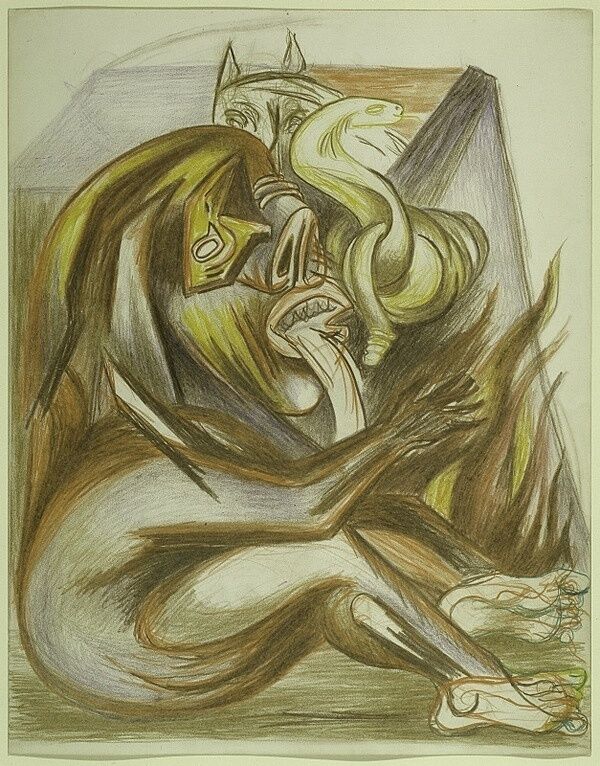
-
211
Richard Pousette-Dart, The Magnificent, 1950–51
Audio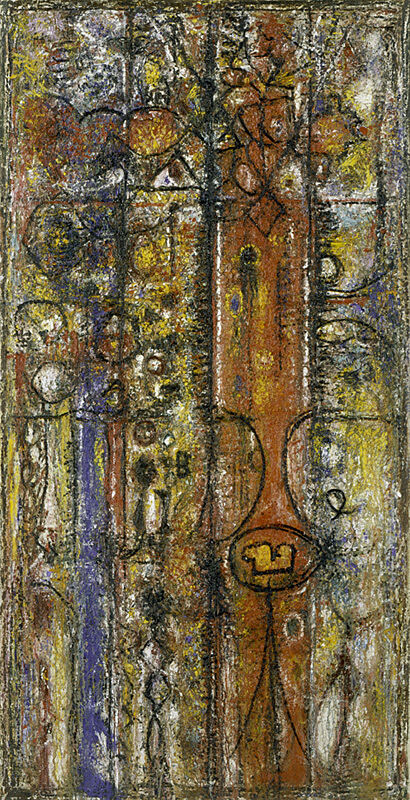
-
212
Isamu Noguchi, The Gunas, 1946
Audio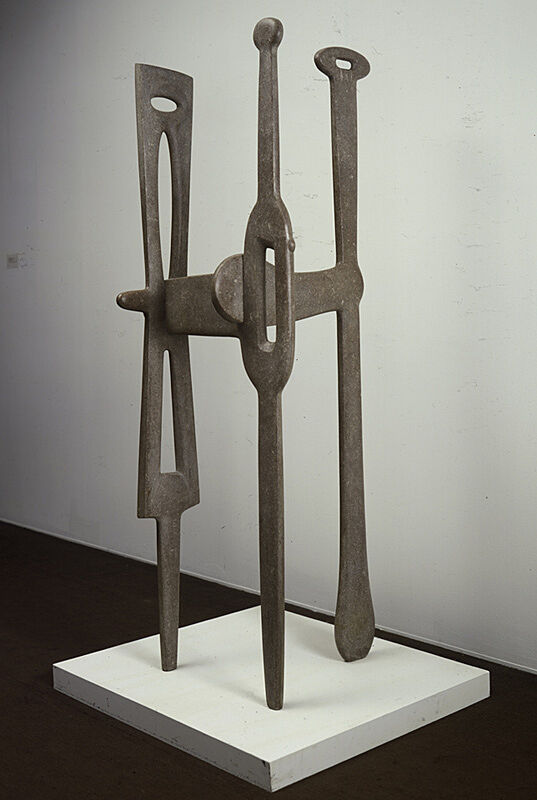
-
213
Alfred Jensen, A Perfect Equal Area I, 1960
Audio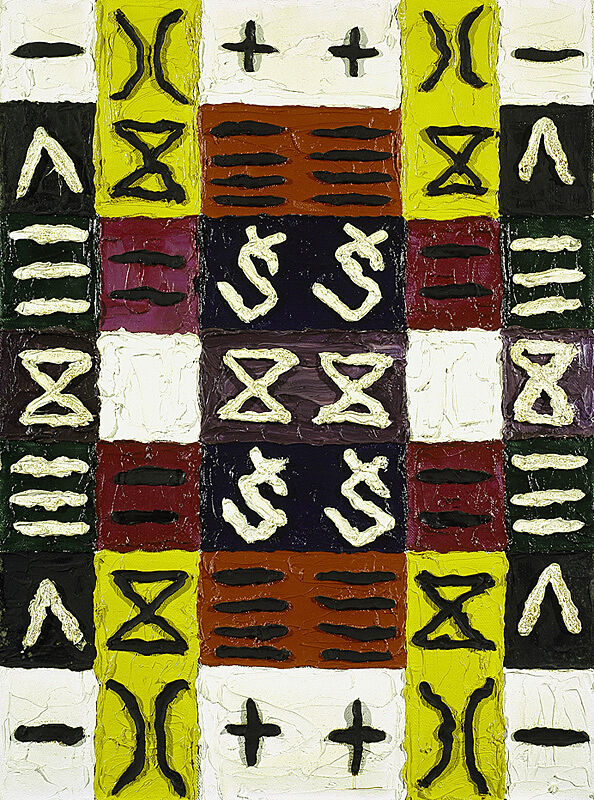
-
214
Jasper Johns, White Target, 1957
Audio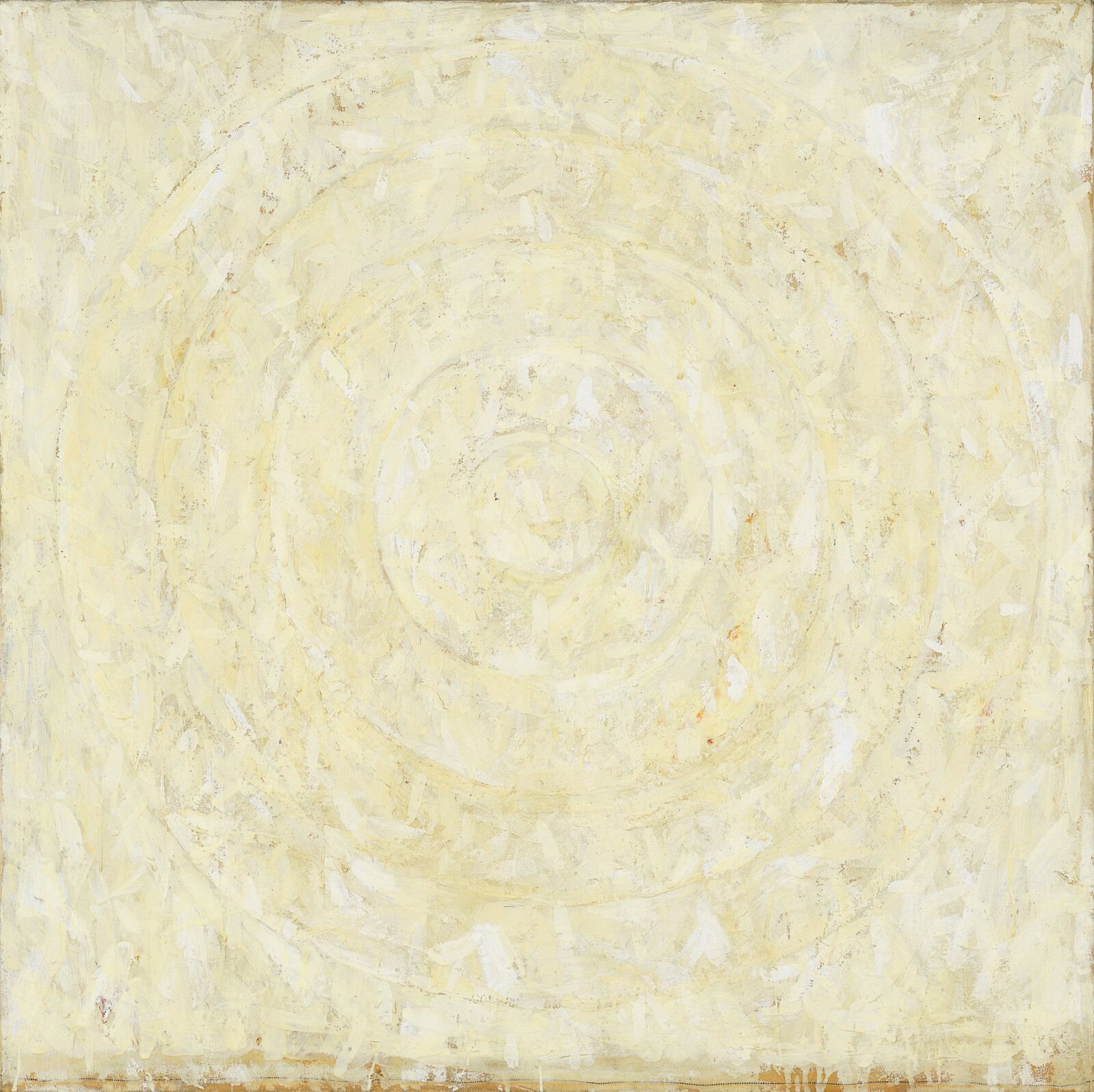
-
509
Alexander Calder, The Brass Family, 1929
Audio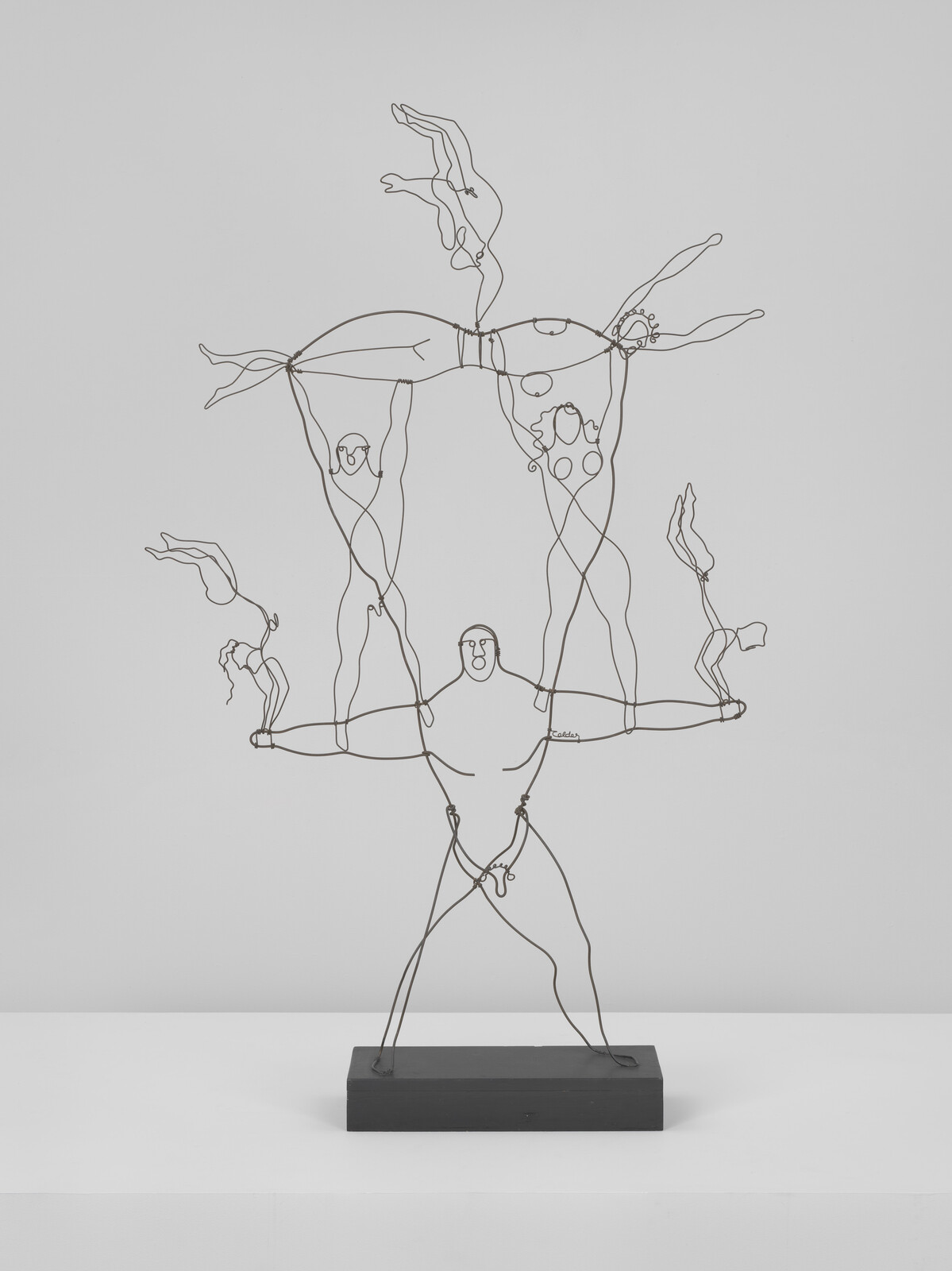
Narrator: Welcome to Signs & Symbols. Today, we’ll look at a number of works from the 1940s and 1950s, primarily drawn from the Whitney’s permanent collection.
This period is most often associated with the development of Abstract Expressionism—the large-scale, gestural works of artists such as Jackson Pollock, Willem de Kooning, Mark Rothko, and Barnett Newman. We’ll look at some of those artists today, but we’ll encounter them early on—before they initiated the styles for which they’re best known. And we’ll put them in dialogue with some of their lesser-known contemporaries, following them all as they examine what it meant to make art in postwar America.
European movements, especially Cubism and Surrealism, were important for many of these artists. But in the aftermath of the war, there was a strong desire on the part of many young American artists to distinguish themselves from their European counterparts. They wanted to invent a new, national aesthetic. In many respects, what they created was a kind of visual language. Some focused on calligraphic mark-making—a kind of inscription on the canvas. Others developed deeply personal symbols. Still others drew both imagery and syntax from the art of non-European cultures, or invented visual systems of their own. Such visual languages became the formal basis of their art as they attempted to reinvent abstract art for the postwar generation.
Yayoi Kusama, I Want to Live Honestly, Like the Eye in the Picture, 2009. Acrylic on canvas, 51 5/16 × 63 3/4 in. (130.3 × 162 cm). Collection of the artist. © Yayoi Kusama. Image courtesy Yayoi Kusama Studio Inc.; Ota Fine Arts, Tokyo; Victoria Miro Gallery, London
Narrator: In this sculpture, Louise Bourgeois assembled a cluster of small oblong carved pieces of painted wood. The structures seem vaguely anthropomorphic—like bodies, but armless and faceless. The work, called One and Others, embodies one of the central themes of her career—the relationship between the individual and the group. Made in 1955, the sculpture is the last of a series called Personages, which she began in the 1940s, after emigrating to the United States from France. As she described the series, “Even though the shapes are abstract, they represent people. They are delicate, as human relationships are delicate.”
As you look at the individual painted and shaped elements, notice how some are the same and some are different. In her sculpture, Bourgeois recreates the complicated dynamics of group behavior and identity. A few of the forms seem to stand alone, while others fade into the anonymity of the crowd.
As Bourgeois once stated, “The relation of one person to [his or her] surroundings is a continuing preoccupation. It can be casual or close; simple or painful or imaginary. This is the soil from which all of my work grows.”
Louise Bourgeois, One and Others, 1955. Painted and stained wood, 18 5/8 x 20 x 16 7/8in. (47.3 x 50.8 x 42.9cm). Whitney Museum of American Art, New York; purchase 56.43. Art © Louise Bourgeois Trust / Licensed by VAGA, New York, NY. Photograph by Jerry L. Thompson
Narrator: In Universal Field, Mark Tobey has woven black and white skeins of paint together into a delicate net, which seems to hover over the atmospheric gray ground. The effect is light and ethereal. It’s also very calligraphic—and not by accident. Tobey had traveled to Japan and China, where he studied calligraphy. Soon after his return, he invented the technique you see here, which he called “white writing.”
During the middle of the twentieth century, a number of painters had the ambition of producing an “all-over” composition. The idea was that the painting would present an utterly unified experience to the viewer—that it would have a real power in its wholeness. Tobey was a pioneer in developing the all-over canvas. He began making works like this one—unified by skeins of paint—before Jackson Pollock began his drip paintings. There’s some resemblance between the two artists’ bodies of work, but they were produced in very different spirits. Looking at a Pollock, for example, the poet William Carlos Williams once exclaimed, “paint on canvas—nothing else is real!” That may be poetic overstatement, but it captures Pollock’s commitments to materiality and immediacy. By contrast, Tobey’s quiet, lyrical paintings encourage a spiritual, contemplative state.
Mark Tobey, Universal Field, 1949. Tempera and pastel on cardboard, Overall: 27 7/8 x 43 5/8 in. (70.8 x 110.8 cm). Whitney Museum of American Art, New York; purchase 50.24. Photograph by Geoffrey Clements
Narrator: Will Barnet’s Male and Female consists of a number of vertical forms. The artist has identified the red one near the middle as the male, and the earth-toned form to the right as the female. He’s said that rather than making abstractions, he takes figures apart and puts them into an abstract relationship. Barnet is interested in the tension between certain colors and forms, and the sense of resolution in the painting as a whole.
Barnet has said that his artistic heroes are the Old Masters—Giotto, Daumier, and Ingres. Despite the relative abstraction of Male and Female, Barnet’s commitment to classicism shines through in the painting’s balance and composure. The vertical forms in Male and Female also bear a certain resemblance to Northwest Coast totem poles. Barnet, like many artists of his generation, was very impressed by Northwest Coast Native American art. He was part of the group known as the Indian Space Painters—so-called because of the patterned, all-over composition that they based on Native American textiles and pottery.
Will Barnet, Male and Female, 1954. Oil on canvas, 40 x 32in. (101.6 x 81.3cm). Whitney Museum of American Art, New York; gift of an anonymous donor through the Federation of Modern Painters and Sculptors 55.17. © Will Barnet/Licensed by VAGA, New York, NY. Photograph by Sheldan C. Collins
Narrator: Steve Wheeler’s Laughing Boy Rolling is punctuated with mask-like faces. Look closely at the large one near the upper right. The nose, mouth, and brow are each so complexly patterned that they’re like paintings within paintings. As you look around the canvas, you’ll see a number of these areas—details that draw you in, and then in again and again. There’s no overall landscape or narrative that relates each of these elements to the others. Yet it all hangs together, knitted into a cohesive composition by the painting’s tightly patterned surface.
Many of the individual features in Wheeler’s paintings resemble aspects of Native American painting, pottery, and textiles. Wheeler is often associated with a movement known as Indian Space Painting. As the name suggests, the group’s inspiration came not only from the surface appearance of masks or totems, but from the use of space in Native American Art. Here, Wheeler has adapted its all-over patterned ordering so that distinctions between objects and backgrounds are difficult—even impossible—to make. Pay attention to one element of the painting and those nearby seem to recede. Shift your focus and the whole composition seems to move in response.
European artists had also attempted to break down the distinction between figure and ground—particularly following Cubism. Looking to Northwest Coast art gave Wheeler a new way to approach these problems, one that would be uniquely and authentically American.
Steve Wheeler, Laughing Boy Rolling, 1946. Oil on canvas, Overall: 36 x 45in. (91.4 x 114.3cm). Whitney Museum of American Art, New York; purchase 47.3. Photograph by Peter Accettola
Narrator: Forrest Bess’s painting—called Drawing—presents us with five forms. Each is framed within the composition, isolated to emphasize its unique symbolic importance. Bess was literally a visionary painter. His works are based on visions he would see when he closed his eyes.
Bess supported himself—barely—as a fisherman on the Gulf coast of Texas. But he was a sophisticated artist, and savvy in his dealings with the New York art world. He showed his work at Betty Parsons Gallery—also the dealer for artists such as Jackson Pollock and Barnett Newman. But there were aspects of his work that Parsons found too extreme to put on view. Over many years, Bess assembled what he called his “medical manifesto”—a scholarly and art-historical examination of hermaphrodites. Most radically, the manifesto included documentation of Bess’s experiments on himself. The artist believed that if he could become a hermaphrodite, he could self-impregnate and achieve immortality. Over the course of his lifetime, he operated on himself twice in order to achieve his ideal. In the end, he believed that he failed only because he couldn’t find a doctor willing to undertake a third, more thorough operation.
Forrest Bess, Drawing, 1957. Oil on canvas, 8 x 28 in. (20.32 x 71.12 cm). Whitney Museum of American Art, New York; gift of Betty Parsons 82.6. Photograph by Geoffrey Clements
Narrator: Mark Rothko’s Agitation of the Archaic seems to be a kind of landscape. It’s divided into three horizontal zones, with the top and bottom suggesting a sky and ground. The central band is abstractly atmospheric. Beginning in 1950—six years after this painting’s completion—all figuration would drop out of Rothko’s paintings, leaving only these zones of contrasting color and intensity.
Here, the zones establish a backdrop for the abstract figures that criss-cross the canvas. It’s not clear exactly what these figures are, but it’s easy to imagine how they might move. Many of them seem to spin or rotate on an axis, fanning out as if to stir the space of the canvas.
At the time Rothko made this painting, he was a dedicated reader of the psychoanalyst Carl Jung. The artist was particularly interested in Jung’s argument that humanity shared a collective unconscious populated by archetypes—mythic forms and figures rooted in a primordial past. The title Agitation of the Archaic, then, suggests that the sense of movement in the painting is really a stirring deep in the mind.
Mark Rothko, Agitation of the Archaic, 1944. Oil on canvas, 35 3/8 x 54 1/4 in. (89.85 x 137.8 cm). Whitney Museum of American Art, New York; gift of The Mark Rothko Foundation, Inc. 85.43.1. © 2012 Kate Rothko Prizel & Christopher Rothko / Artists Rights Society (ARS), New York. Photograph by Geoffrey Clements
Narrator: In 1948, Adolph Gottlieb painted this dark, enigmatic canvas dominated by images of eyes. Titled Vigil, the painting belongs to a body of work the artist called Pictographs. Like many other artists of the postwar period, Gottlieb preferred to work in a semi-abstract mode. In his painting, he attempted to tap into the world of the subconscious by using images and symbols open to multiple interpretations.
Notice how this canvas is divided into rectangular sections. Look at the one second from the left. An archaic face appears at the top, with the suggestion of a body and feet at the bottom. Now look at the panel on the far right. Notice the thick line that circles down from the top. It suggests a river, a path, or even a snake. Gottlieb found inspiration in African tribal and Native American art. Primitive art, he said, was in touch with the subconscious.
In a 1960s radio program, the artist described his Pictographs:
Adolph Gottlieb: (Archival audio from Pacifica Archives) I would start by having an arbitrary division of the canvas into rough rectangular areas, and with the process of free association I would put various images and symbols within these compartments. And it was irrational; there was no logical or rational design in the placing of these. It was purely following an impulse, trying to use the method of free association. And then when all of these images and symbols were combined, they could not be read like a rebus. There was no direct connection from one to the other. However, by the strange juxtapositions that occurred, a new kind of significance stemmed from this juxtaposition.
. . . My favorite symbols were those which I didn’t understand. If I knew too well what the symbol signified, then I would eliminate it because then it got to be boring. I wanted these symbols to have. . . a certain kind of ambiguity and mystery.
Adolph Gottlieb, Vigil, 1948. Oil on canvas, 36 × 48 in. (91.4 × 121.9 cm). Whitney Museum of American Art, New York; purchase 49.2. © Adolph and Esther Gottlieb Foundation / Licensed by VAGA, New York, NY
Narrator: Aaron Siskind is best known for tightly focused photographic compositions. He honed in close on things like peeling paint, torn posters on city walls, wood grains, and patches of tar on asphalt roads. He used a large-format camera that captured detail beautifully—but his images are less “realistic” depictions of the world than they are found abstractions. He’s often called an Abstract Expressionist photographer, and his pictures have been compared to paintings by Willem de Kooning. They’re not totally abstract, though. The sources of the images are usually recognizable. A ripped advertisement on a brick wall will have an urban feel, while a close-up of a lava flow will have a natural one. But these associations become a kind of background—the real emphasis is on texture, line, and visual rhythm.
Aaron Siskind, Untitled, 1949. Gelatin silver print, Sheet and Image: 13 3/8 x 10 3/8in. (34 x 26.4cm). Whitney Museum of American Art, New York; gift of Alice and Leo Yamin 92.50. Photograph by Robert Gerhardt
Narrator: This drawing by Jackson Pollock is dominated by a kind of hybrid figure. Its hands and feet look human, but its mouth and nose are more animalistic. It forms a tight group with a serpentine snake, and a horse peers over the top of the composition.
Look at the central figure’s body. Pollock has outlined it in warm browns and ochres and highlighted the surfaces in a dark blue. He’s used these untraditional colors to model a body that is strange in its proportions but almost classical in its volume. As a young man he had studied with the American Regionalist Thomas Hart Benton, who advocated a return to Renaissance technique. Pollock largely resisted Benton’s teachings, but their effects still lingered here.
With its fractured forms and jumbled-up figures, Pollock’s drawing also responds to a European painting of a much more recent vintage—Pablo Picasso’s Guernica. Guernica was an anguished protest against a contemporary event, the bombing of the Basque town of Guernica during the Spanish Civil War. He painted it in 1937. It traveled to New York in 1939, and Pollock saw it soon after its arrival. He was captivated by its nightmarish intensity, and impressed by its contemporary relevance. His encounter with the painting intensified his sense that European artists—and Picasso most of all—were the ones to beat. Here, he responds to Picasso quite directly. In years to come—partly by struggling to make a more distinctly American art—he would create an abstract language that was more uniquely his own.
Jackson Pollock, Untitled, c. 1939–42. Colored pencil and graphite on paper, 14 × 11 in. (35.6 × 27.9 cm). Whitney Museum of American Art, New York; purchase with funds from the Julia B. Engel Purchase Fund and the Drawing Committee 85.18. © 2009 The Pollock-Krasner Foundation / Artists Rights Society (ARS), New York
Narrator: Richard Pousette-Dart was one of the first Abstract Expressionists to work on a monumental scale. With its intense colors and thick black contour lines, The Magnificent looks from a distance like a stained-glass window. But as one gets closer, the surface becomes the painting’s most insistent feature. It’s not only thick and richly textured, but multi-layered. Pousette-Dart began the work by inscribing graphic images on the canvas—the totemistic forms that interested many Abstract Expressionists through the 1940s. He then obscured these figures, moving towards abstraction but retaining a sense of cryptic, symbolic significance beneath the surface.
Richard Pousette-Dart, The Magnificent, 1950–1951. Oil on canvas, 86 1/4 x 44 in. (219.08 x 111.76 cm). Whitney Museum of American Art, New York; gift of Mrs. Ethel K. Schwabacher 53.43
Narrator: Isamu Noguchi made this sculpture from three interlocking pieces of carved marble—each one of which must be there in order for the work to remain upright. The composition thus seems somewhat precarious, but also wonderfully integrated.
Noguchi drew the title of the work, The Gunas, from South-Asian Indian literature. The term refers to the three aspects of humanity that make us complete—purity, passion, and darkness.
The sculpture comes from 1946—just after the end of World War II. This was an especially trying time for Noguchi, who was born in the United States to a Japanese father and American mother. After the bombing of Pearl Harbor, he fought to prevent the internment of Japanese Americans in prison camps. Failing in this mission, he had himself voluntarily interned in one of the camps for several months. After his release he received a deportation order, and remained in the country only after a legal battle.
Not surprisingly, the work that Noguchi made during the war tended to be very pessimistic—Surrealist sculptures exploring death and destruction. Here, then, is a kind of monument to reconciliation—but one that retains the darkness along with the purity and passion.
Isamu Noguchi, The Gunas, 1946. Marble, 73 1/4 x 26 1/4 x 25 1/2 in. (186.06 x 66.68 x 64.77 cm). Whitney Museum of American Art, New York; purchase, with funds from the Howard and Jean Lipman Foundation, Inc. 75.18a-c. © 2012 The Isamu Noguchi Foundation and Garden Museum, New York / Artists Rights Society (ARS), New York
Narrator: The painter Willem de Kooning once said that oil paint—rich and touchable as it is—existed to paint flesh. In paintings like this one, Alfred Jensen seems to have made a much less likely proposal: that it exists to work out systems of thought. Jensen’s paint is thick, and his color is incredibly brilliant. He applied the paint to his canvas straight out of the tube, and then spread it with a palette knife. Because the oil paint is translucent and because Jensen didn’t smooth the surfaces, this practice means that the painting is covered in reflective bumps and ridges. Together with Jensen’s brightly contrasting colors, this shiny texture animates the surface.
To organize the surface, Jensen used systems drawn from Arabic, Mayan, Chinese, and other ancient numerical systems. He also set up a series of dualities: black and white, primary colors against their complements, warm against cool. He mirrored, repeated, and transposed forms. He never worked out these systems in advance, but figured them out in the process of diagramming them. For Jensen—a truly international person who was born in Guatemala, moved all over Europe, and ended up in the United States—these systems became, among other things, a way to symbolically understand the universe through other civilizations’ cultures.
Alfred J. Jensen, A Perfect Equal Area I, 1960. Oil on canvas, Overall: 27 1/8 x 20 1/2in. (68.9 x 52.1cm) Frame: 29 3/16 x 22in. (74.1 x 55.9 cm). Whitney Museum of American Art, New York; gift of Lucille Bunin Askin in memory of her parents, Anna Armour Bunin and Henry L. Bunin 91.77. Photograph by Geoffrey Clements
Narrator: Jasper Johns made White Target in oil paint and encaustic, a painting medium consisting of melted wax. Encaustic hardens very quickly, so each brush stroke appears on the canvas exactly as Johns placed it. The individual strokes don’t blend into each other. As prominent as they are, there’s a uniformity to them—one that makes the surface very different from the spontaneous brushwork of the Abstract Expressionists. For these artists, who were a generation older than Johns, gesture was a highly personal matter. A dramatic brushstroke was understood to express an equally dramatic feeling. By contrast, Johns’s surface seems cool and somewhat distant.
For Johns, that impersonality was part of the point. He once told the art historian Leo Steinberg that he chose to paint things like flags and targets because they were, quote, “pre-formed, conventional, depersonalized, factual, exterior elements.” He could include them in paintings without them having to mean anything specific—which meant, in a way, that the paintings were abstract. But at the same time, they were very literal. Theoretically, one could play a real game of darts on a Target painting. And Johns’s Flags have stood in for American-ness on many occasions. So are they actual things, or paintings of things? With Johns’s work, the philosophical problems of representation became part of the painting tradition in a way they’d never been before.
Jasper Johns, White Target, 1957. Encaustic and oil on canvas, overall: 30 × 30 in. (76.2 × 76.2 cm). Whitney Museum of American Art, New York; purchase 71.211. © Jasper Johns / Licensed by VAGA at Artists Rights Society (ARS), New York
Narrator: This large sculpture, called The Brass Family, is one of many sculptures of circus performers Calder made apart from his miniature Circus. It is much larger than any of those elements, and its parts don’t move. In fact, in many ways it is a work about stability, and immobility. The large nude man who anchors this family is rock-solid: hugely muscular and constructed out of a heavy-gauge wire. His graceful family is more daintily constructed and more vulnerably posed—but there is little sense of physical danger. At the same time, it definitely reminds us that the circus is an entirely different world—The Brass Family doesn’t have the family structure that most of us are used to!
Caroline Simonds: In those days, in the '20s, you were—you were born into a trunk. You were born into the circus.
Narrator: Caroline Simonds is a clown and a former acrobat. She runs the Paris-based organization Rire-Médecin, which brings clowns to the pediatrics wards of hospitals.
Caroline Simonds: You just started off by standing on your father's shoulders when you were eighteen months old. Soon as you could walk they made you stand on your father's shoulders and then on his head, and then they flipped you up in the air and, they caught you by your feet.
Alexander Calder, The Brass Family, 1929. Brass wire and painted wood, overall: 67 × 41 1/8 × 8 7/8 in. (170.2 × 104.5 × 22.5 cm). Whitney Museum of American Art, New York; gift of the artist 69.255. © Calder Foundation, New York / Artists Rights Society (ARS), New York
0:00
0:00