Georgia O'Keeffe: Abstraction
2009
-
300
Georgia O’Keeffe, Sky Above Clouds III/Above the Clouds III, 1963
Audio -
301
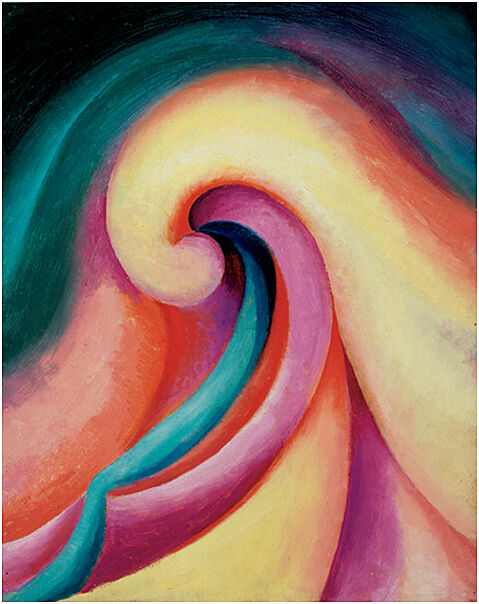
Georgia O’Keeffe, No. 20 – From Music Special, 1915
Audio -
303
Georgia O’Keeffe, Evening Star II, 1917
Audio -
305
Georgia O’Keeffe, 59th St. Studio, 1919
Audio -
306
Alfred Stieglitz Photographs
Audio -
307
Georgia O’Keeffe, Grey Lines with Black, Blue, and Yellow, 1923–1925
Audio -
309
Georgia O’Keeffe, At the Rodeo, New Mexico, 1929
Audio -
310
Georgia O’Keeffe, Jack-in-Pulpit – No. 2, 1930
Audio -
313
O’Keeffe’s Self-fashioning
Audio -
314
Georgia O’Keeffe, Black Door with Red, 1954
Audio
Narrator: Welcome to Georgia O’Keeffe: Abstraction.
Barbara Haskell: Georgia O’Keeffe is known—celebrated—for her landscapes, her flowers, her paintings of pelvis bones, and the realistic subjects.
Narrator: Exhibition Curator Barbara Haskell.
Barbara Haskell: And yet, throughout her career she did abstractions. It was the first thing she did, and in a sense, the last thing she did.
Narrator: Abstraction played a fundamental role in O’Keeffe’s art. It gave her a way to express feelings that she could not express in words. Many of O’Keeffe’s abstractions don’t contain recognizable imagery. They focus on her experience of people and places, rather than on realistic appearances. Some abstract works—like the large 1963 painting in this introductory area—take the natural world and distill it to its most basic elements. As the artist explains in this 1970s interview, she painted this work after looking out over the sky from an airplane window.
Georgia O'Keeffe: I was flying out from the big city, and the sky looked like you could just go out the door of the plane and walk right out to the horizon, the clouds looked so solid. Well, I couldn’t wait to get back to paint it.
Narrator: The boldly planar form of the sky and dense rhythm of the receding clouds allow us to share her sense that we might just walk off into the horizon.
Our tour continues in the gallery to the right. There, we’ll see some of O’Keeffe’s earliest abstractions. Just look for the numbered audio label.
Narrator: When O’Keeffe made this charcoal drawing, she was teaching in South Carolina, far from the New York art scene. Early in 1916, a friend brought a group of O’Keeffe’s drawings to the photographer Alfred Stieglitz. Stieglitz was the proprietor of an influential New York gallery called 291. It was the first to show and support modern art in America. Stieglitz’s interest in O’Keeffe’s drawings encouraged her to continue her radical experiments. The two also began an intense correspondence, and Stieglitz debuted O’Keeffe’s charcoals in May in a three-person show at his gallery.
O’Keeffe wrote this letter to Stieglitz on February 2, 1916. At the time, she was focused on her charcoal drawings.
“Mr. Stieglitz—I like what you write me—Maybe I don’t get exactly your meaning—but I like mine—like you liked your interpretation of my drawings . . .
I have been just trying to express myself— I just have to say things you know—Words and I are not good friends at all except with some people—when I’m close to them and can feel as well as hear their response—I have to say it some way—Last year I went color mad—but I’ve almost hated to think of color since the fall went—I’ve been slaving on the violin—trying to make that talk—I wish I could tell you some of the things I’ve wanted to say as I felt them.”
Narrator: O’Keeffe painted the watercolor Evening Star III and most of the works in this room while teaching art in a public high school in Canyon, Texas. It is an abstract response to the landscape of the American West, which she loved. Barbara Haskell:
Barbara Haskell: She talked about the plains, the wild emptiness of it, the silence. And she endows the series of pictures of the Evening Star with a sense of intensity of nature’s rhythms and its energy that extends out from one pulse point and fills the canvas, as if it’s extending beyond the boundaries of the picture.
Narrator: Three works from the Evening Star series are on this wall.
Barbara Haskell: What was unusual about O’Keeffe’s work, even in relationship to the other American modernists who were embracing abstraction, is that she never fractured form. She never adopted the Cubist fracturing and flattening of space. She always embraced the organic quality of nature—the sinuous, dynamic, rhythmic lines of nature.
Narrator: In 1918, O’Keeffe moved from Texas to New York, where she painted 59th St. Studio. The painting invites us to peer through a loosely-shaped doorframe between rooms. A soft light comes in through an elongated window—its oddly beautiful, glowing color suggesting an urban, street-lit dusk. The sharply pointed white and colored planes declare the painting’s modernity, introducing a new cosmopolitan edge.
O’Keeffe’s starting point here is clearly architecture—not nature, as it has been in the works we have seen so far. Yet the overall form of the painting resembles ones we’ve seen earlier in this exhibition. Light and colored planes suggest a dynamic movement around the painting’s edges, while the dark interior has a warm, enveloping quality. The painting doesn’t tell us much about the physical place, but it gives us hints about her attitude towards that place.
O’Keeffe lived and worked in this East 59th Street studio, which belonged to Alfred Stieglitz’s niece. The gallerist gave O’Keeffe a year’s financial assistance so that she could devote all of her energy to painting, without having to teach. During that year, their relationship deepened and Stieglitz moved into the studio. O’Keeffe and Stieglitz were married in 1924.
Barbara Haskell: O’Keeffe’s first one-person exhibition at the Gallery 291, was the occasion of Stieglitz’ first photographs of her. When she moved to New York in 1918, their photography sessions became more intimate, and he began to photograph her nude or partially nude.
Narrator: Some of these photographs are traditional portraits. But in other cases Stieglitz focuses in O’Keeffe’s breasts, torso, and thighs. O’Keeffe not only modeled for the photos, but helped print them in the dark room. In the process, she saw how an artist can manipulate a representational image by cropping it to create an abstraction. In some of the rooms that follow, you’ll see the effect this discovery had on O’Keeffe’s work.
But the photographs did more than change the way O’Keeffe saw art. They also changed the way that people saw her. Stieglitz included about forty-five pictures of O’Keeffe in a 1921 retrospective of his own work. The highly sexualized nudes instantly made her into a notorious newspaper personality—in part because they verified that she was intimately involved with the much older, still married Stieglitz. When Stieglitz staged an exhibition of her work a few years later, her celebrity garnered a lot of attention—not all of it to O’Keeffe’s liking. Many critics emphasized the sexuality they perceived in O’Keeffe’s work to the exclusion of almost all else. The photographs convinced them that she was a sexual free spirit—and so, they reasoned, her paintings must be emblems of female sexual experience.
Narrator: The forms on this canvas recall nature, but their high-key color is not quite natural. Two delicate pink forms frame brilliant layers of yellow, blue, and strands of green. At the heart of the composition there’s a black ellipse, suggesting an opening into a space beyond the form.
Here, O’Keeffe has borrowed techniques she picked up from modernist photography—close cropping and magnification. We seem to view this form at extremely close range, and this heightens the sense of abstraction.
Photography was an extremely important medium in early American modernism. As you can see in the room of photographs nearby, O’Keeffe became very familiar with modernist photographic techniques through her connection to Stieglitz and the vanguard photographers in his circle. At that time, many people refused to see photography as fine art—and they certainly didn’t see it as being on par with painting. Part of O’Keeffe’s radical modernity was to adapt the techniques of a new medium to the materials of an old one, forging them into a personal vision.
Further along this wall is a similar painting titled Grey Lines with Lavender and Yellow. Both paintings were made around the same time—in 1924 when O’Keeffe and Stieglitz were married. Stieglitz called them “the wedding pictures.” Since the time they were made they have rarely been shown together.
Barbara Haskell: In 1929, O’Keeffe took her first trip to New Mexico—the first of what would be yearly trips thereafter. This is one of the first paintings that describe an experience in New Mexico. This is a rodeo that she saw, and you can tell from this picture that she’s totally engaged with the riotous color and the forms of—of this art form that she’d never seen before.
Narrator: O’Keeffe responds here to the vibrant colors of the costumes and the swirling energies of human and animal life. She was also taken with the rodeo as the great mythic activity of the American Southwest, a landscape she loved.
Georgia O'Keeffe: When I got to New Mexico, that was mine. That was my country. I’d never seen anything like it before, but it fitted to me exactly.
It’s something that’s in the air. It’s just different. The sky is different. The stars are different. The wind is different.
Narrator: O’Keeffe continued to spend a good deal of time on the East Coast—in New York and a Lake George summer home. But she began going to New Mexico with increasing frequency through the 1930s and bought a house there in 1940.
Narrator: In 1930, O’Keeffe made five paintings of a wild flower called a jack-in-the-pulpit that was growing near her Lake George home.
Georgia O'Keeffe: I have a series of paintings of Jack-in-the Pulpits. At Lake George we had a good many Jack-in-the-Pulpits. My first one was almost photographic. It was about 10 × 12. And the next one got up to be 30 × 36. And the next one was 30 × 40. And in that one the jack got black. Well, then I made an abstract thing of all the different parts of the jack and then it got to be forty-eight inches high. And then I thought I ought to be able to simplify it more than that, and then I thought well the thing that makes you interested in that flower, and that you wouldn’t look at the flower without, is the jack in the middle of it. So I painted just the jack.
Narrator: It is typical of O’Keeffe to suggest that the most abstract image might be most meaningful. She once pointed out that in some ways realism isn’t very real at all. She did not want to capture the surface appearance of things. Instead, she worked to eliminate some things and emphasize others in order, as she put it, to quote “get at the real meaning of things.”
This series signals a subtle change in O’Keeffe’s approach. Her step-by-step move towards abstraction here is analytical—as if the flower were a problem she were trying to solve. In the earlier abstractions, she often seemed to be exploring an interior, imaginary space. Here she uses abstraction instead to reduce the observable world into its most essential, meaningful forms.
Narrator: In this case, you’ll see four magazines featuring O’Keeffe. They range from 1960 to 1968. As portraits of an artist, the photographs here are extremely different from the ones we saw earlier.
Barbara Haskell: Beginning in 1929, as O’Keeffe began to essentially reassert her own independence. She realized that the perception of herself through Stieglitz 's photographs as a sexual being was detrimental to the critical reading of her work, and she began to reframe her public persona.
Narrator: By the 1960s, that transformation was complete. She had carefully crafted her image as a solitary, independent artist, identified with the landscape of the American west. These magazine spreads bear witness to her transformation into an American icon. She had achieved a level of fame and celebrity achieved by few artists.
Narrator: O’Keeffe painted two canvases of the façade of her adobe home in Abiquiu, New Mexico. This façade was just her starting point. Wide expanses of nearly flat paint dominate both paintings, punctuated by schematic forms that depict O’Keeffe’s front door and patio. The compositions are more or less the same, but one is an intense sunset-red while the other is pure white, bleached by blinding heat or snowy cold.
Though O’Keeffe was remote from the art world when she made these paintings, they were very much of their moment.
Barbara Haskell: In the fifties, after she had moved to New Mexico for good she created paintings that in some ways announced a vocabulary that became the precedent for a younger generation. Instead of flowing, undulating forms that she’d used earlier in her career, she chose these large expanses of geometric color.
Narrator: This bold, planar vocabulary put her in dialogue with a much younger generations of artists—abstract expressionists like Barnett Newman and Mark Rothko, as well as young geometric abstractionists such as Ellsworth Kelly.
We’ll conclude our tour with the two reddish-pink watercolors hung together on the wall to your left. When you’ve found a comfortable spot in front of them, please press the PLAY button.
Narrator: Georgia O’Keeffe began her public career as an abstract artist, and—with these watercolors—she ended that way as well. In the early 1971, she began to suffer from macular degeneration, a condition that eventually left her with only peripheral vision. In her early eighties at the time, she began working with assistants to produce watercolors like the ones you see here. They return to the spare, organic motifs of her early charcoals. Though tentative as a result of her failing eyesight, they demonstrate her ongoing quest to use abstraction to distill the essence of her visual and emotional world. She passed away in Santa Fe at the age of 98, on March 6, 1986.
Special thanks to Perry Miller Adato for giving us permission to use interviews with the artist from her film “The Originals – Portrait of an Artist – Georgia O’Keeffe.” This material is licensed courtesy WNET.ORG.
Georgia O’Keeffe: Abstraction was organized by the Whitney Museum of American Art, New York; The Phillips Collection, Washington, DC; and the Georgia O’Keeffe Museum, Santa Fe, NM
This has been an Antenna Audio production.
0:00
0:00