
Grant Wood: American Gothic and Other Fables
2018
-
500
Introduction
Audio -
501
Corn Cob Chandelier for Iowa Corn Room, 1925
Audio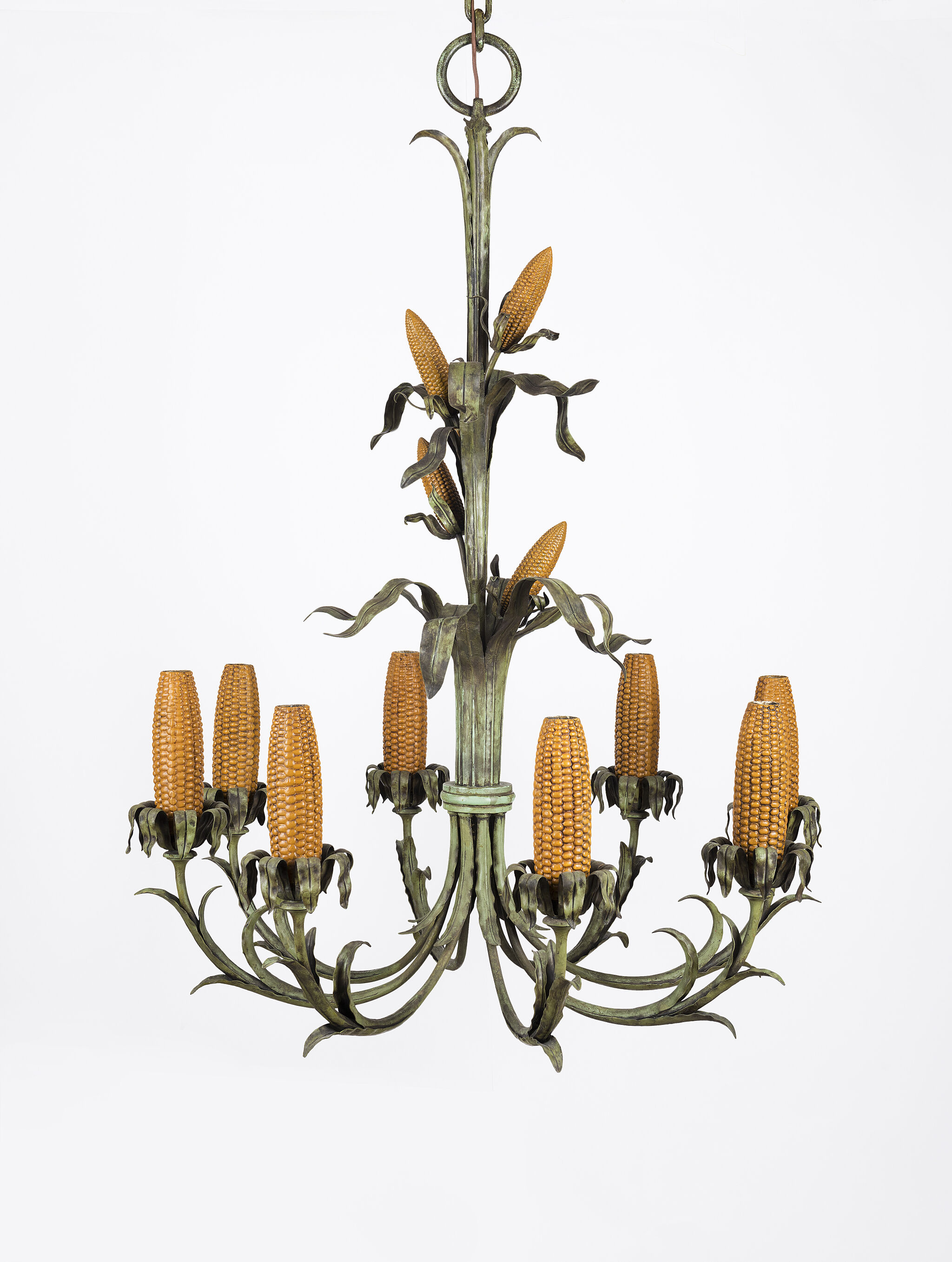
-
502
Overmantel Decoration, 1930
Audio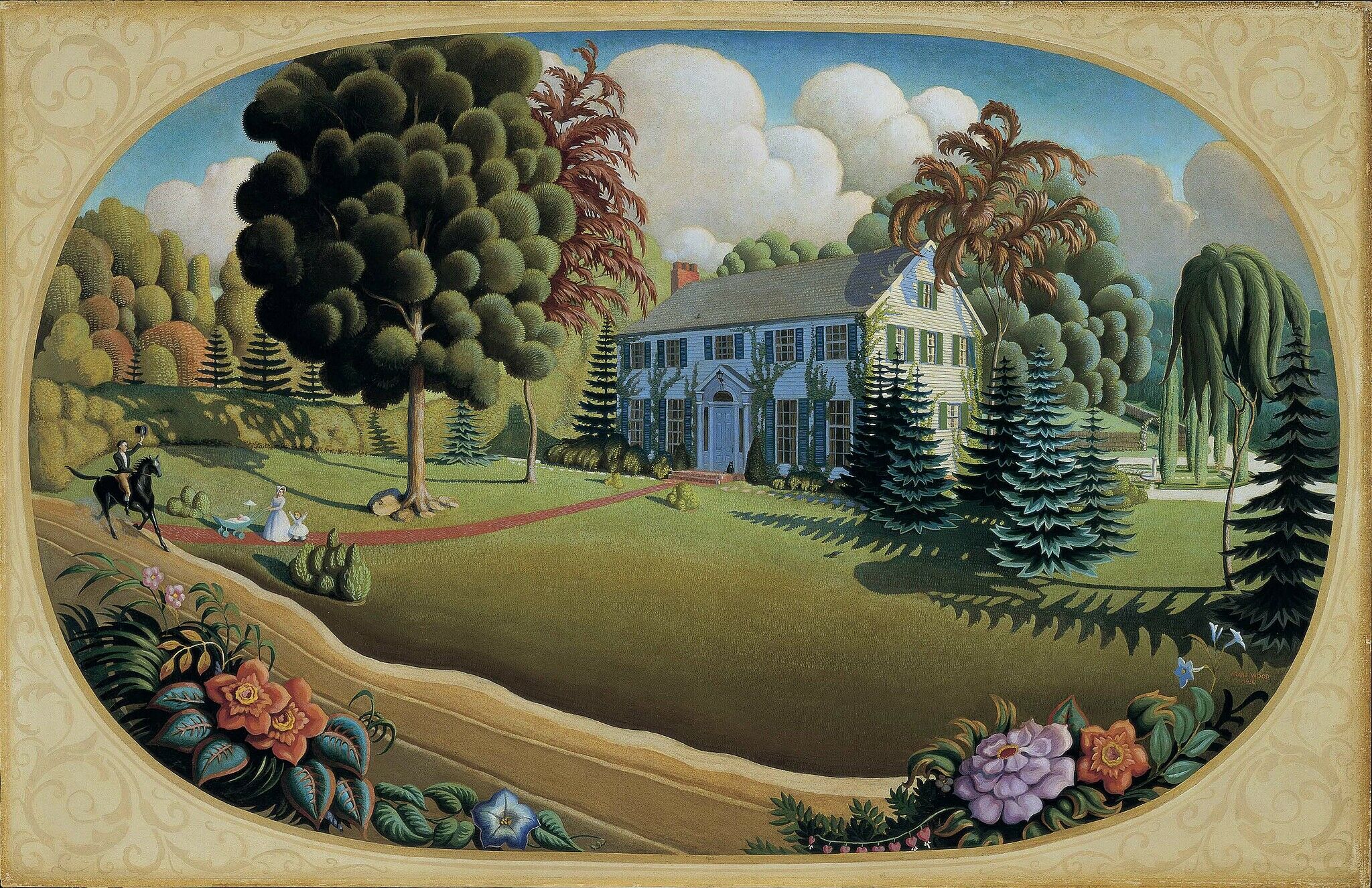
-
503
Sunlit Studio, c. 1925–26
Audio -
504
Exhibition model for Memorial Window
Audio -
505
Woman with Plants, 1929
Audio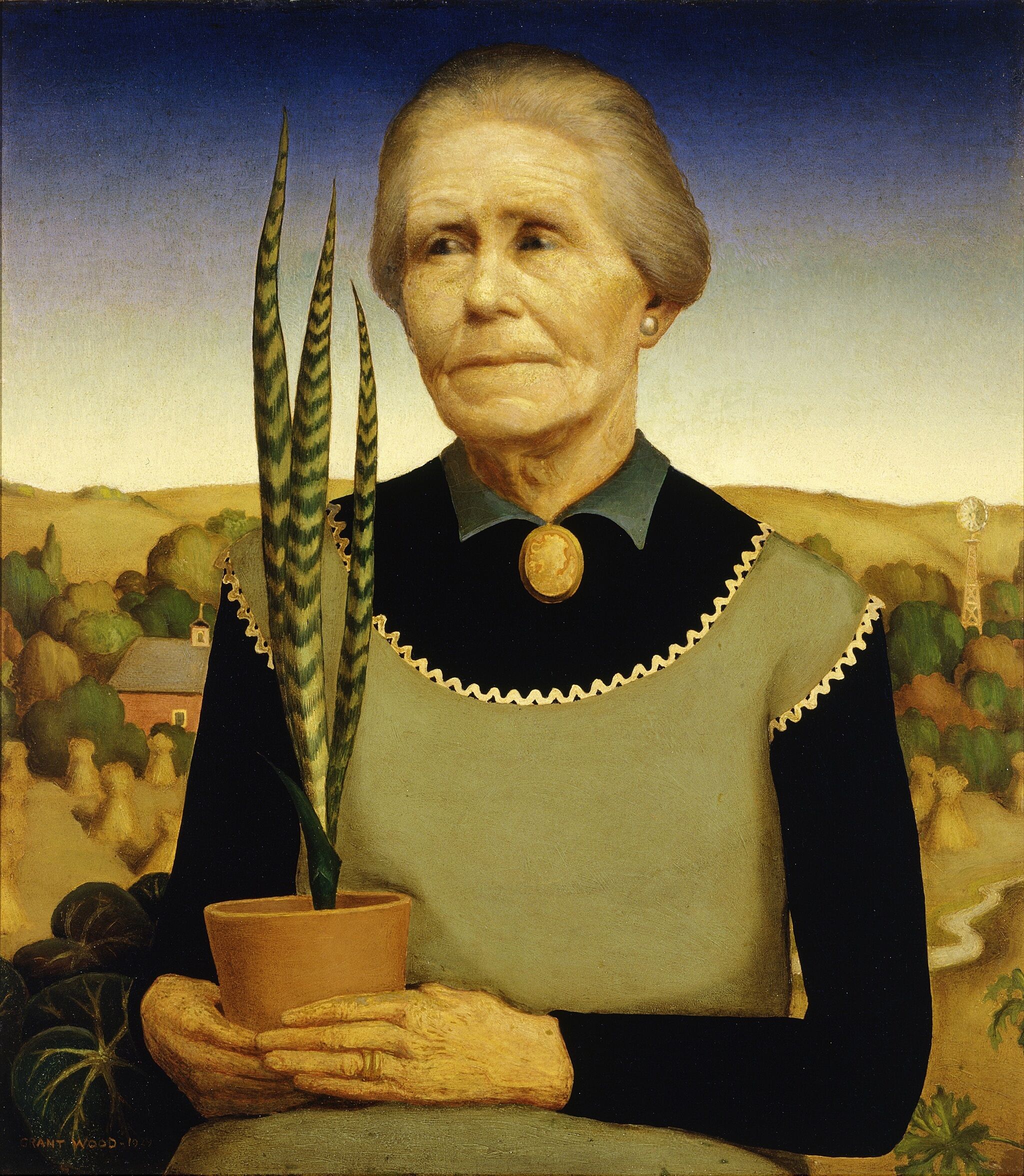
-
506
Arnold Comes of Age (Portrait of Arnold Pyle), 1930
Audio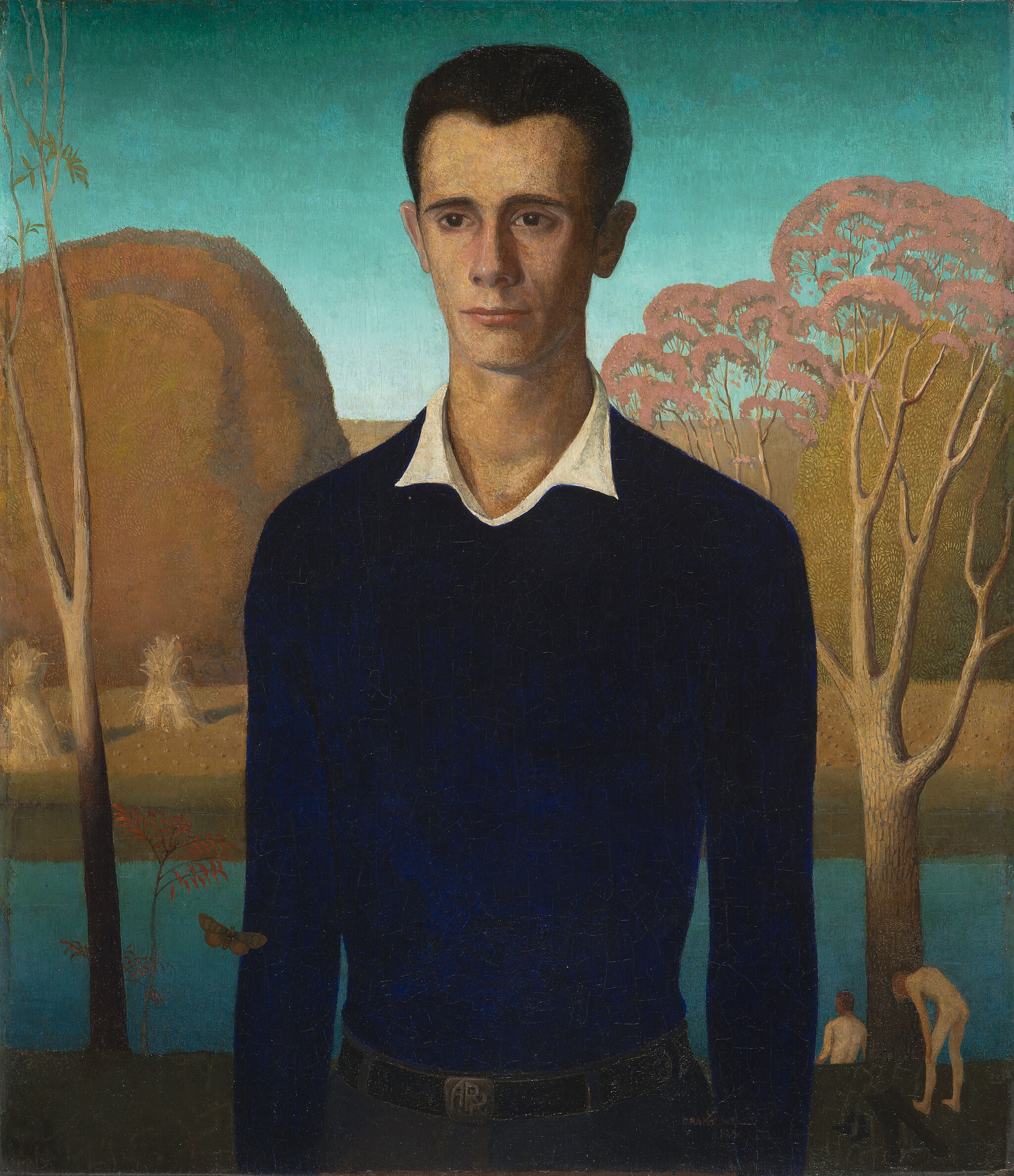
-
507
American Gothic, 1930
Audio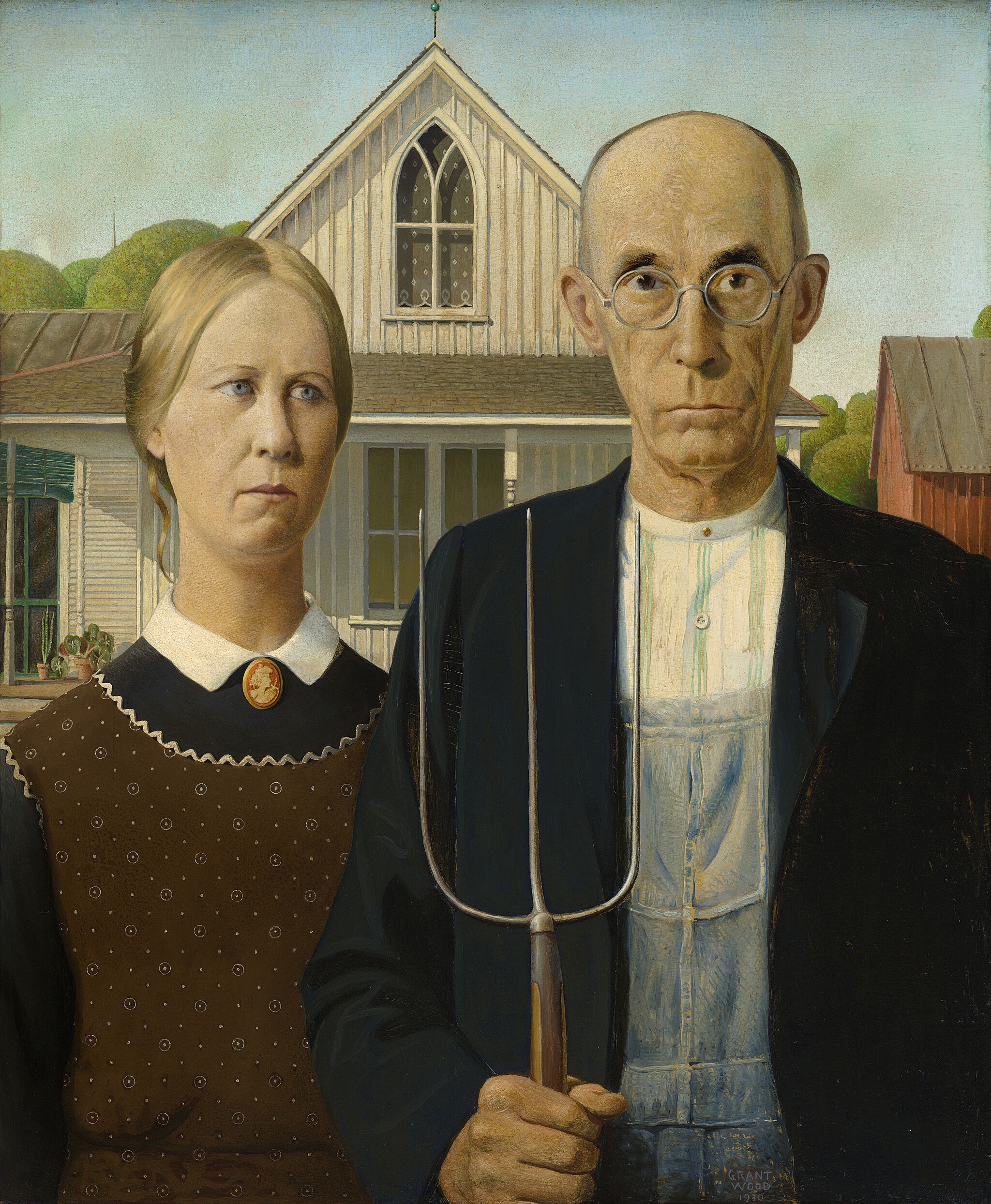
-
507-2
American Gothic, 1930
Audio
-
509
Daughters of Revolution, 1932
Audio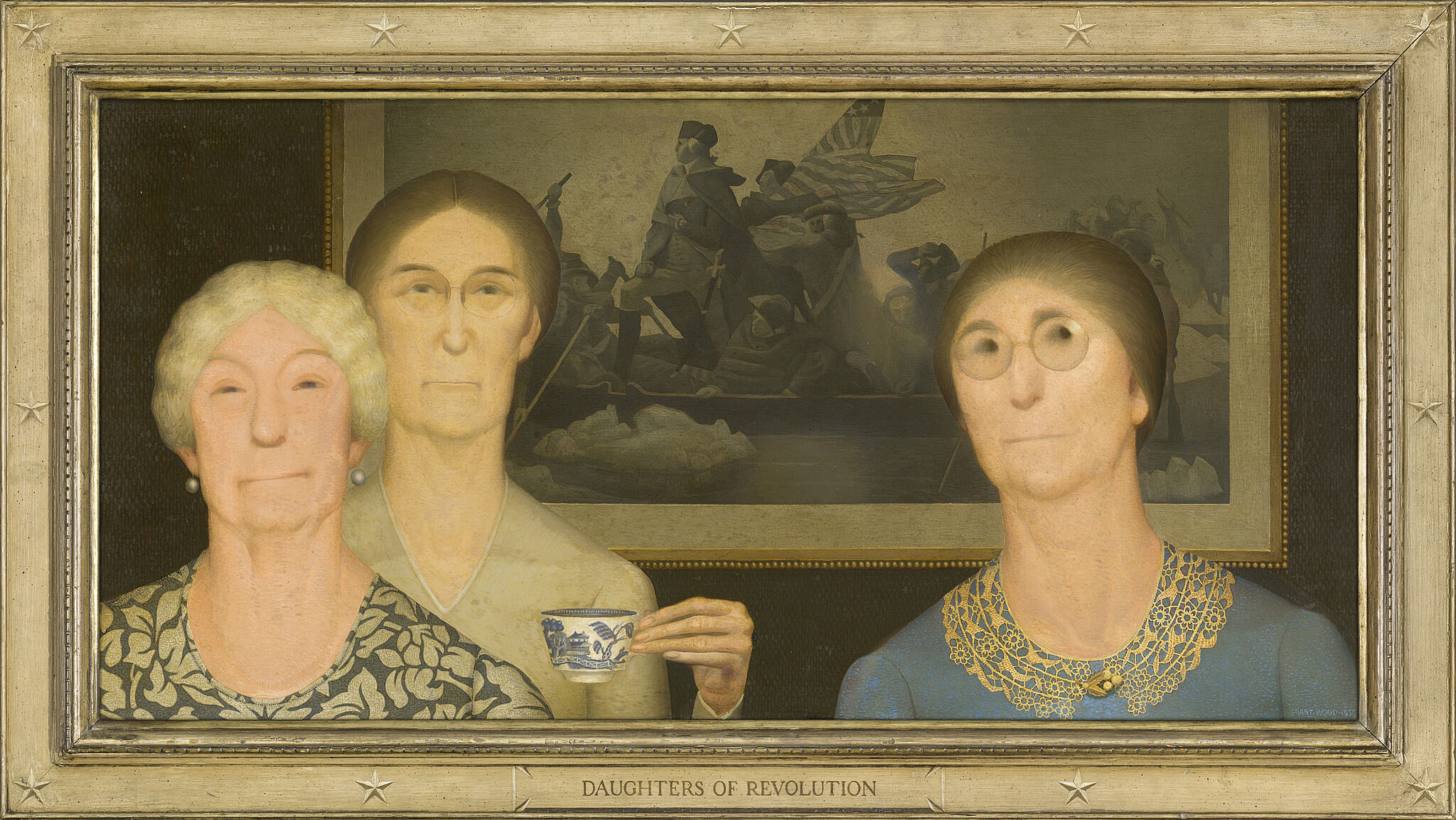
-
510
Parson Weems’ Fable, 1939
Audio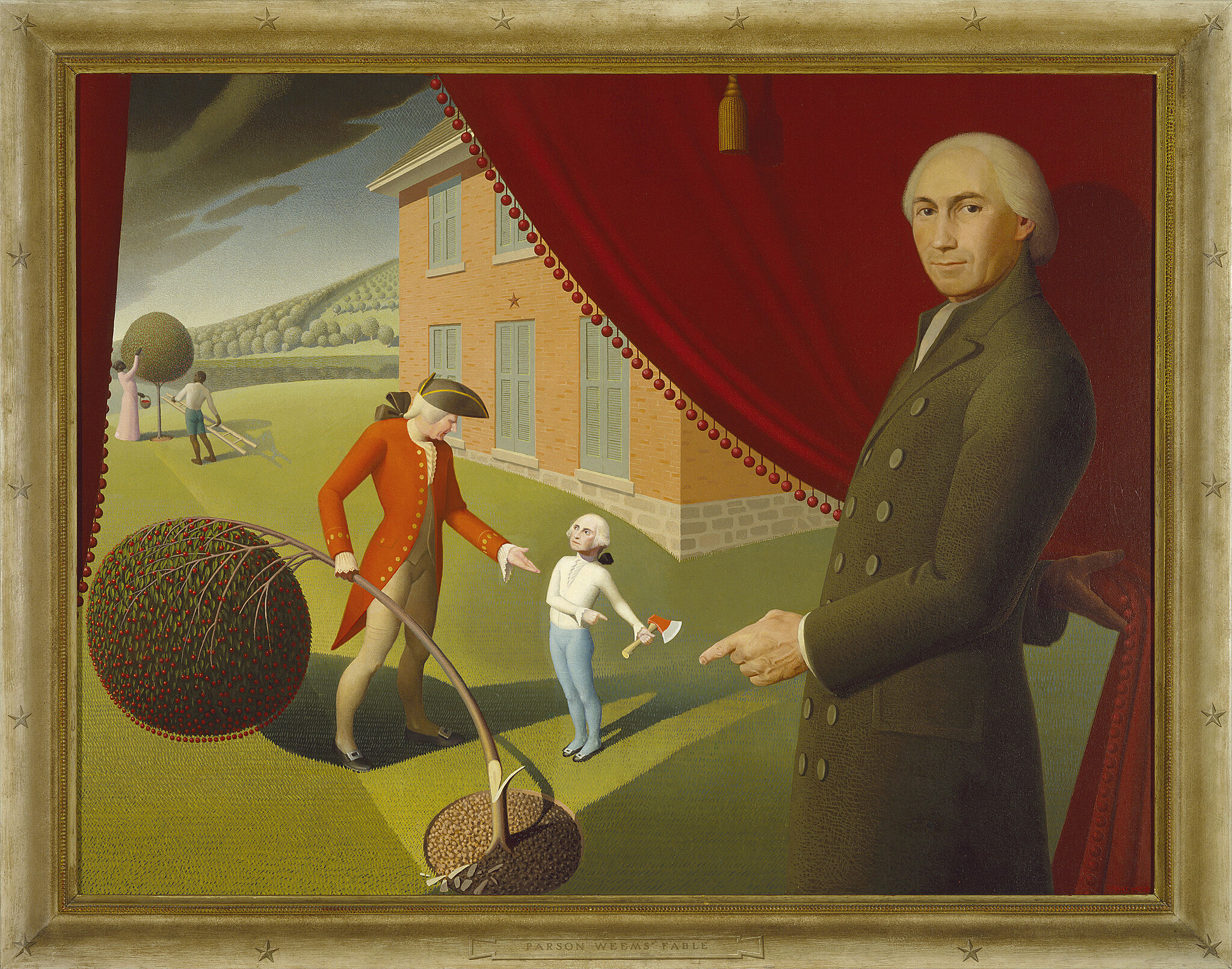
-
511
The Return from Bohemia, 1935
Audio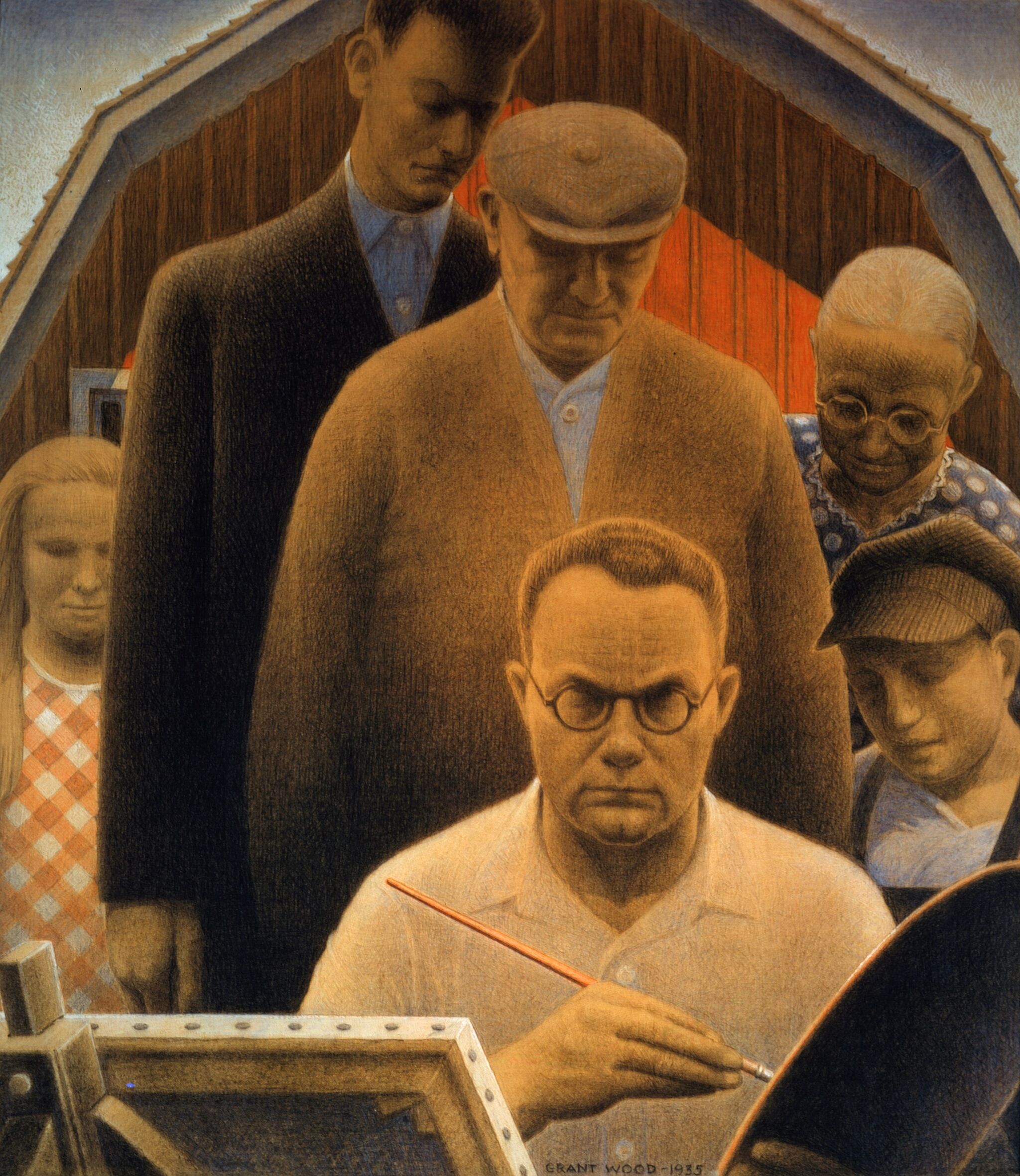
-
512
Boy Milking Cow, 1932
Audio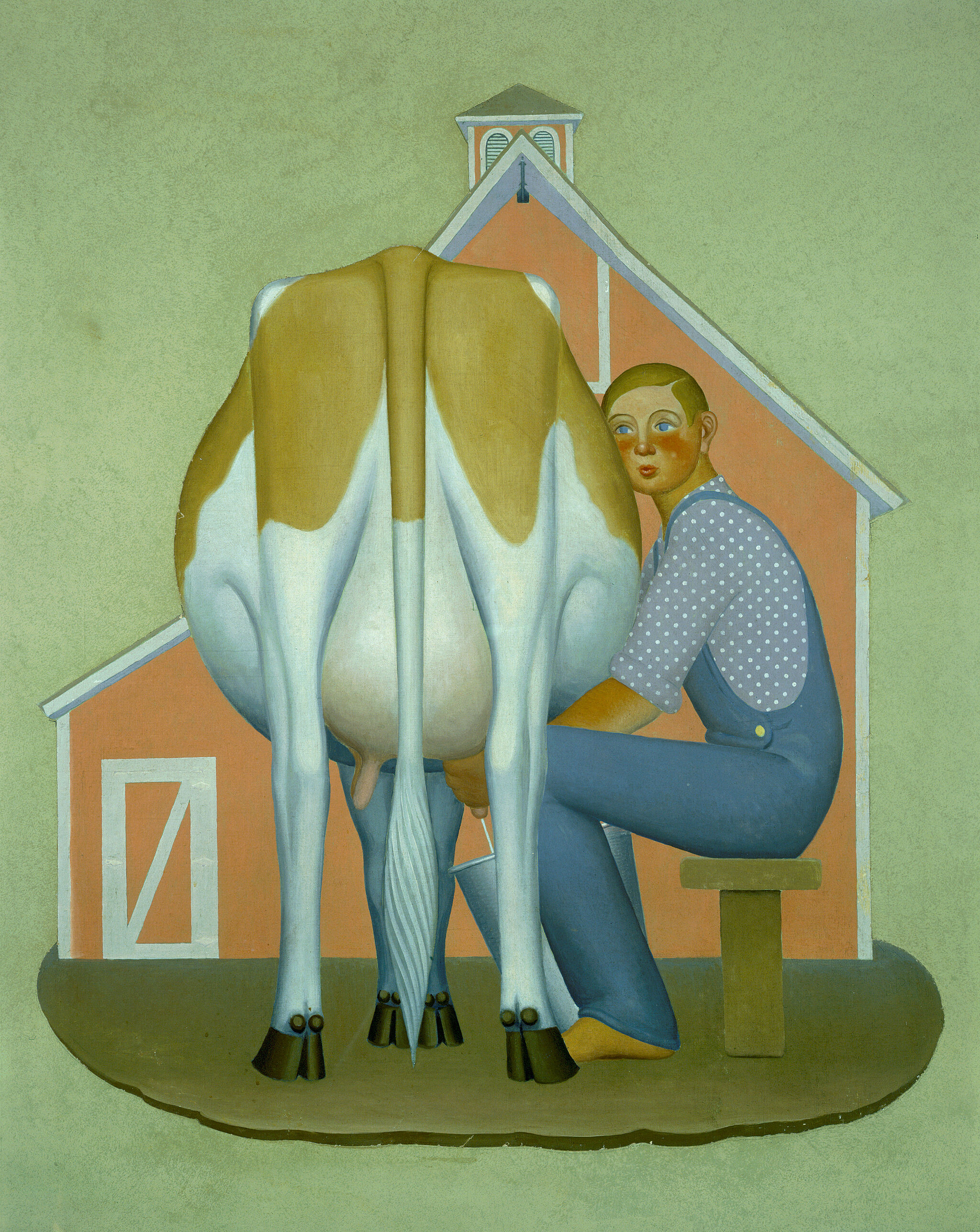
-
513
Dinner for Threshers, 1934
Audio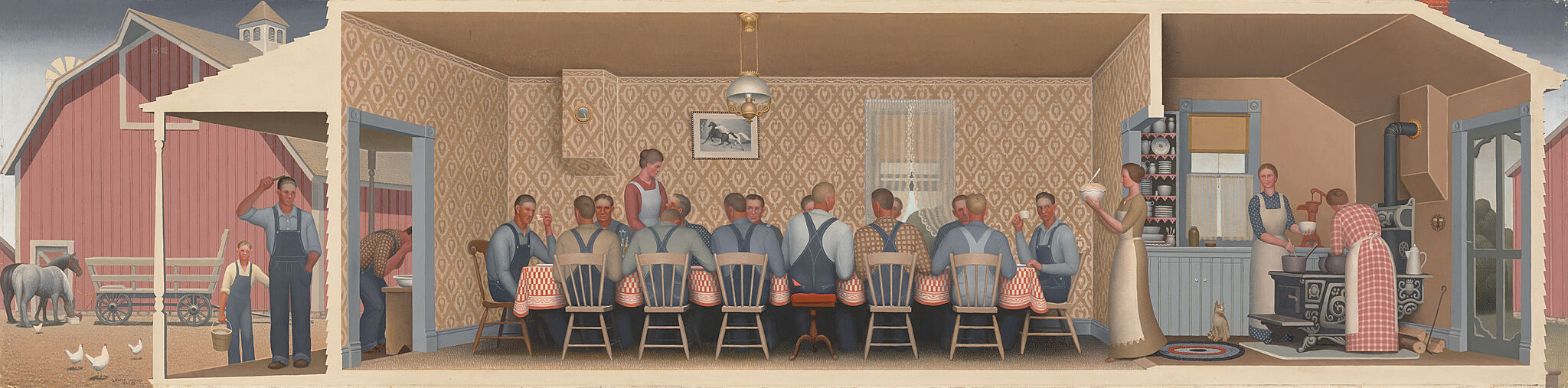
-
514
Exhibition projection of When Tillage Begins, Other Arts Follow and Study for Breaking the Prairie
Audio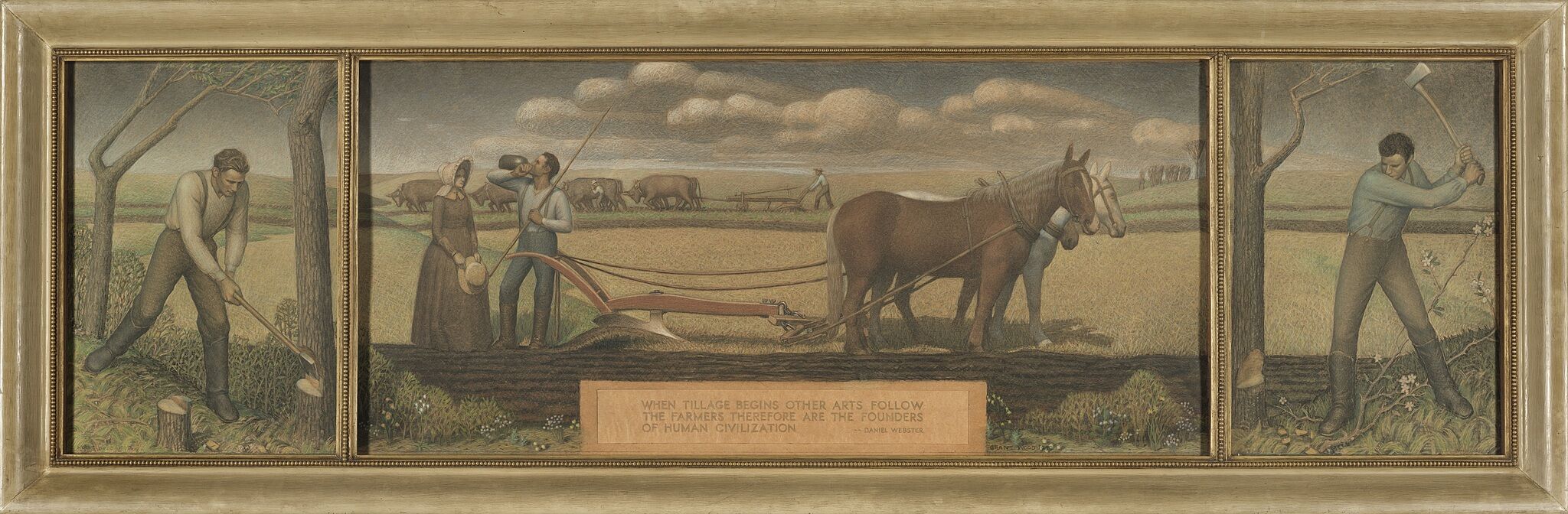
-
515
Sultry Night, 1939
Audio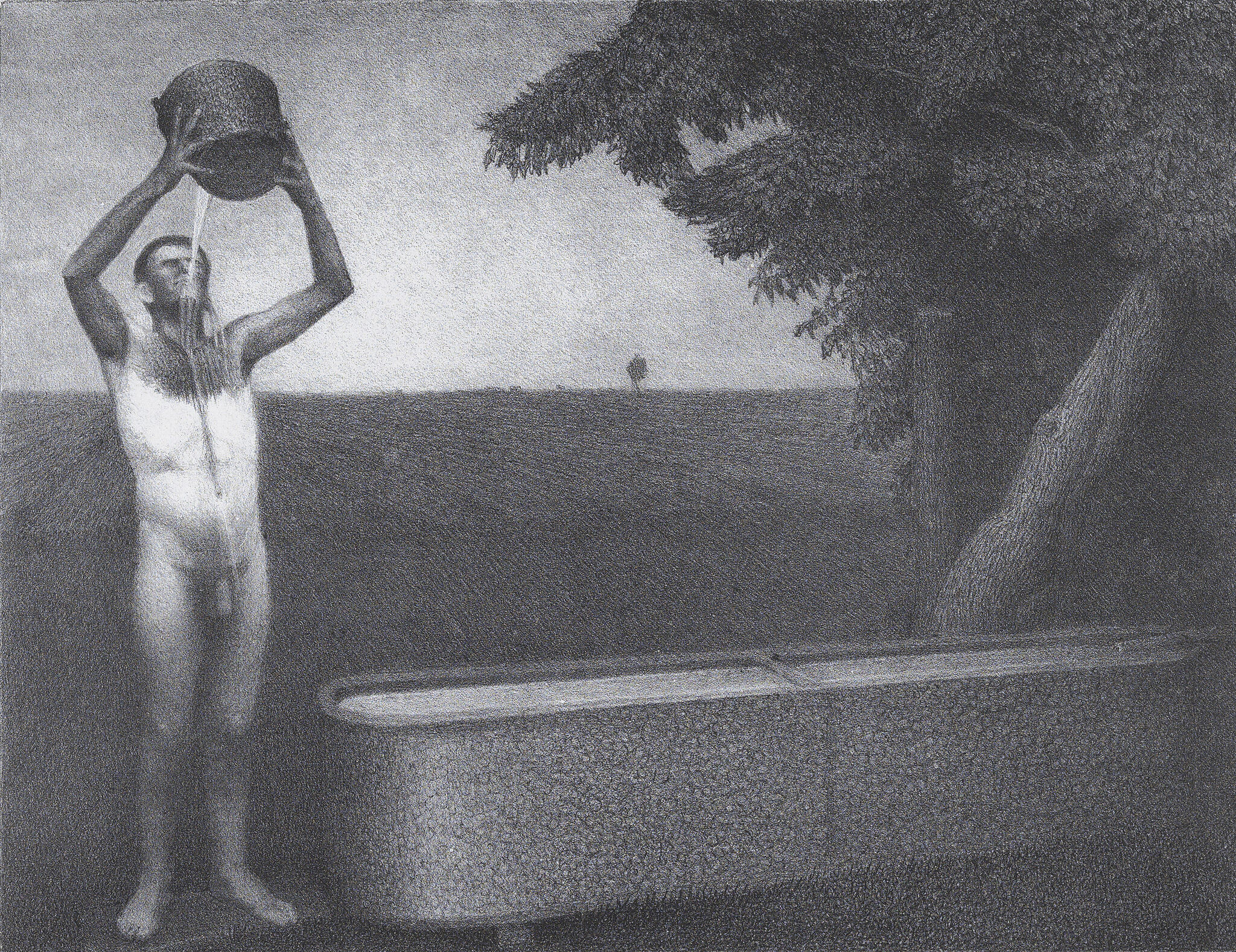
-
516
The Birthplace of Herbert Hoover, 1931
Audio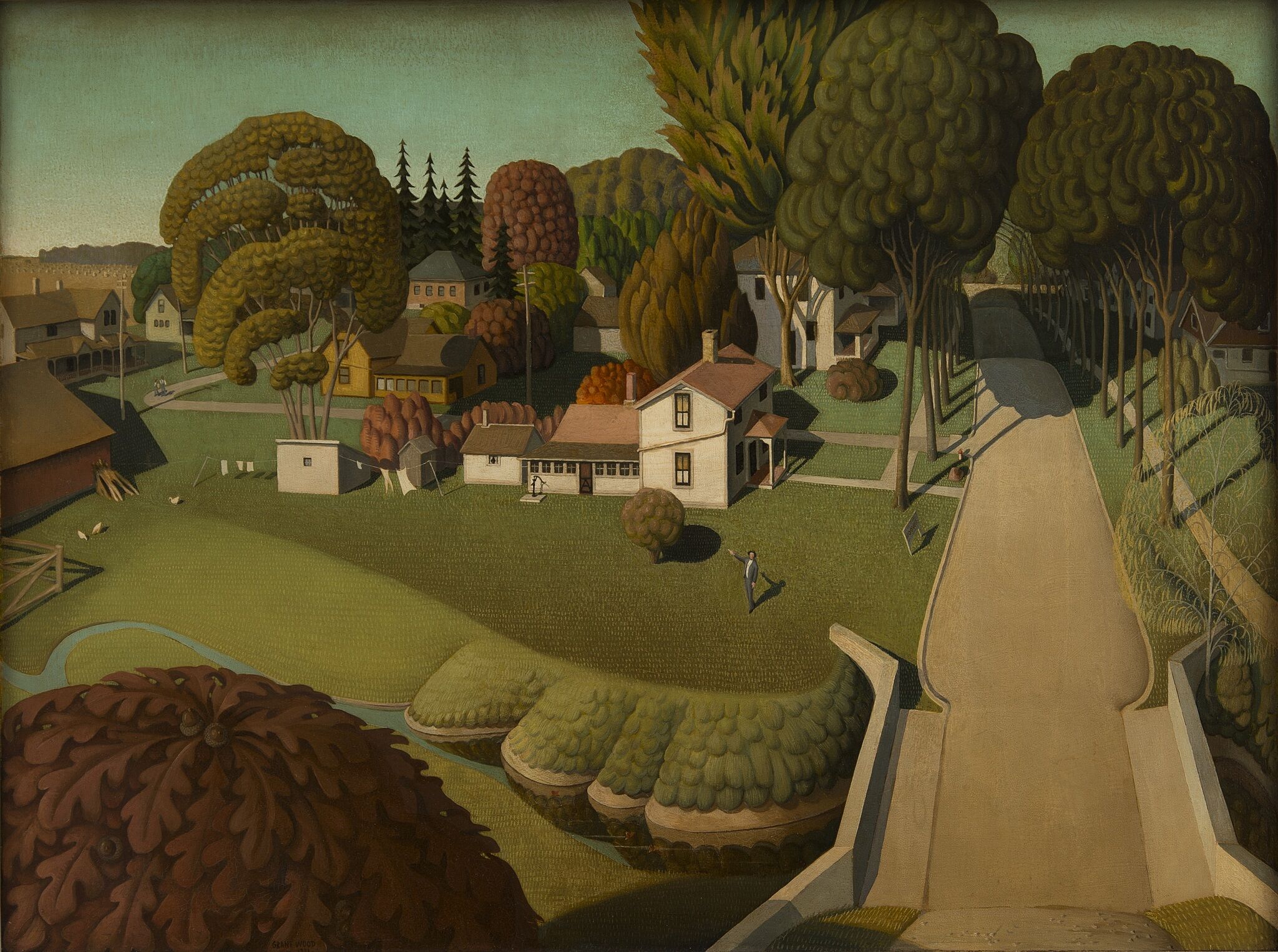
-
517
Stone City, 1930
Audio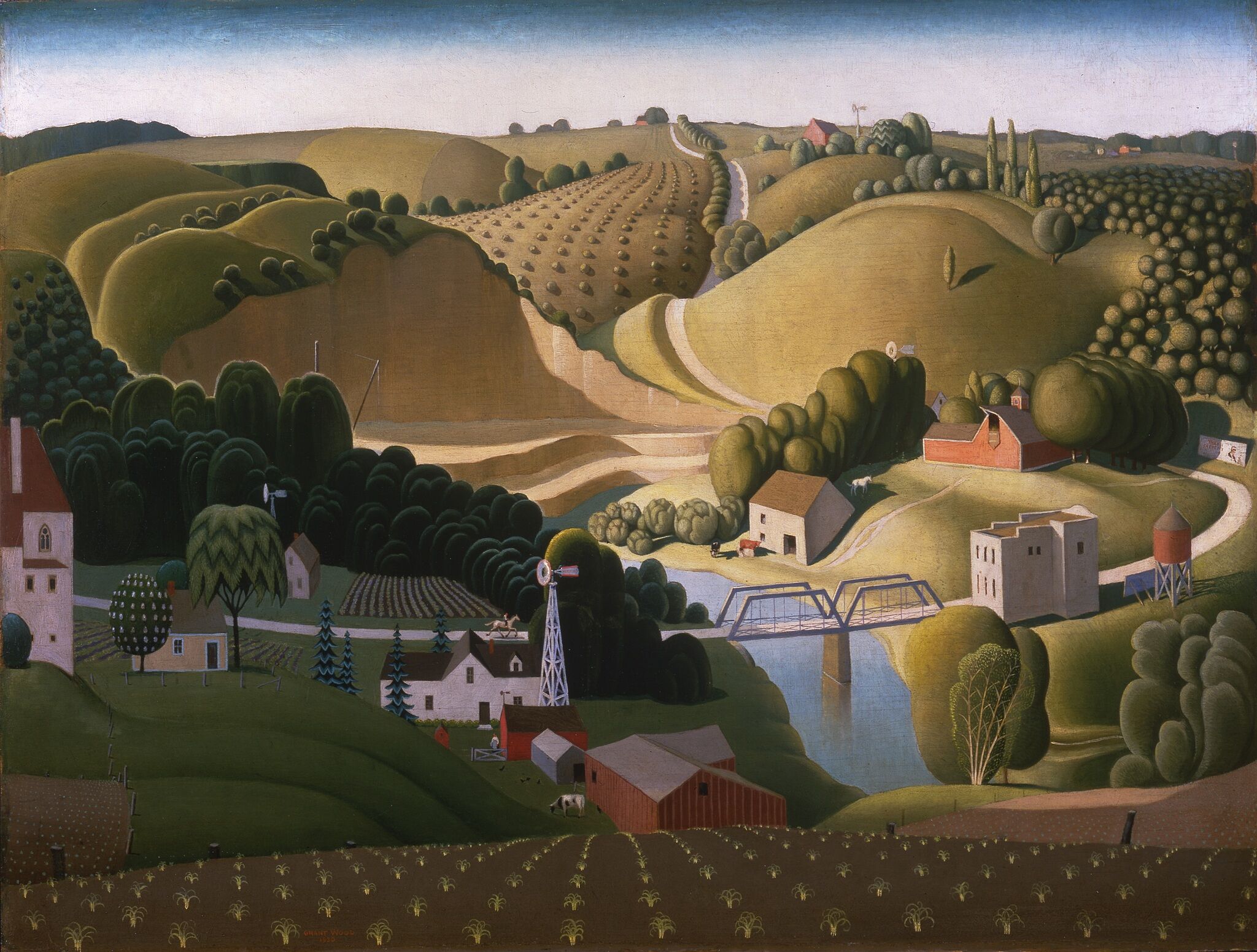
-
518
Death on the Ridge Road, 1935
Audio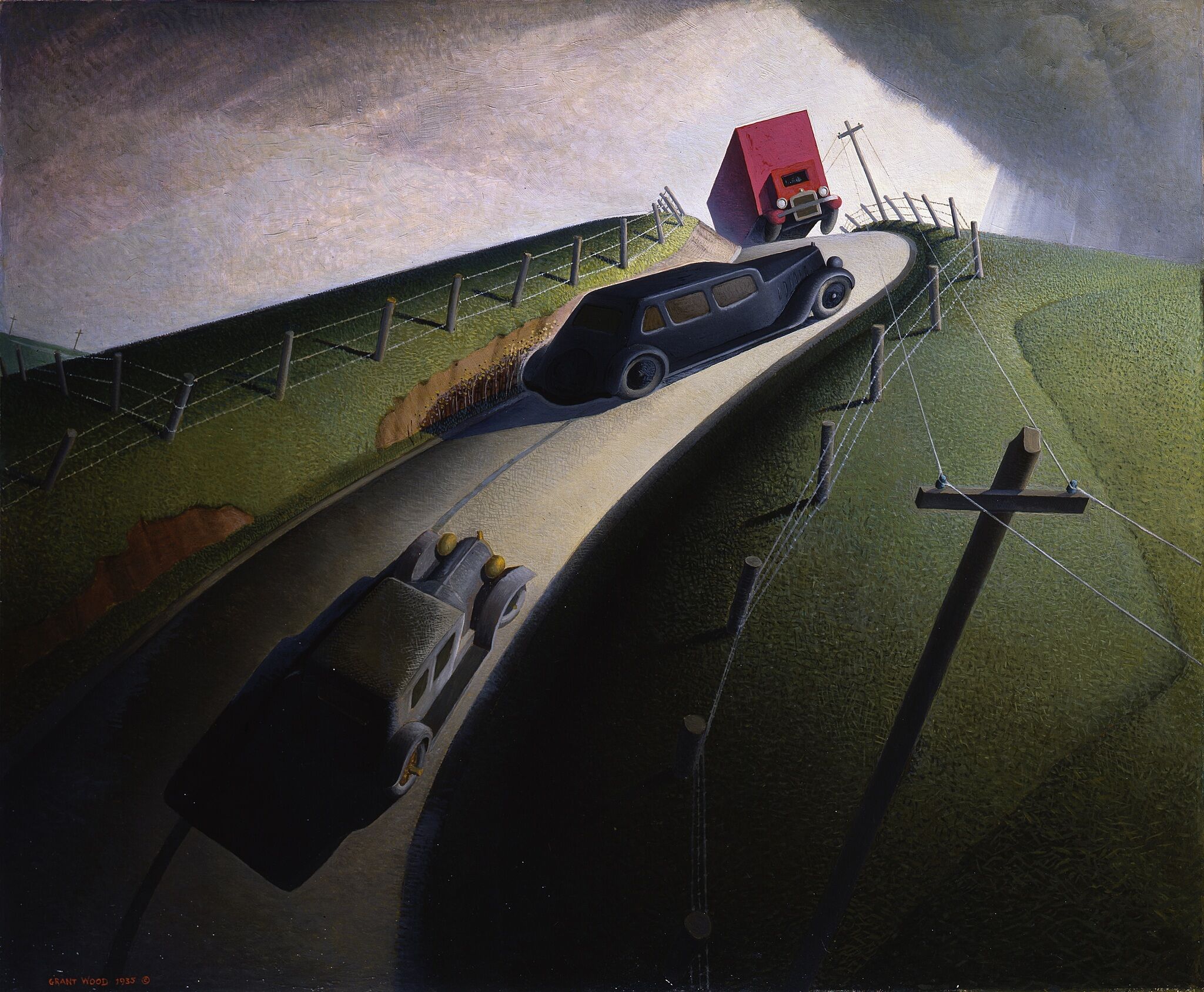
-
519
Spring in the Country, 1941
Audio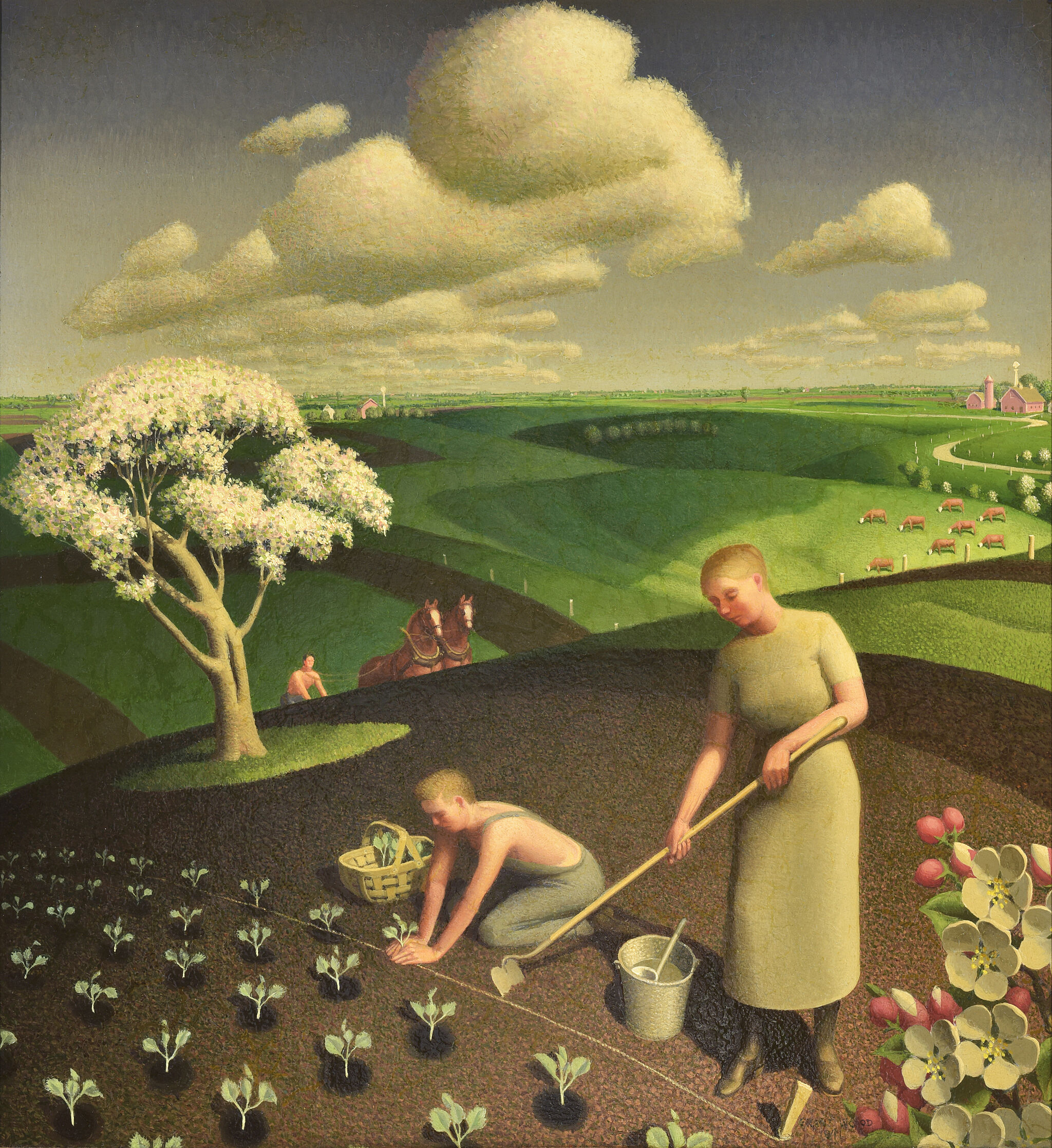
Narrator: Grant Wood’s American Gothic debuted in 1930, at the Art Institute of Chicago. Wood had been a moderately successful local artist, working in Cedar Rapids, Iowa. More or less overnight, his painting became an icon—a symbol of national identity—though there was a lot of disagreement about what exactly it symbolized. In this exhibition, we’ll have a chance to look beyond American Gothic—but also to see that many of its most captivating qualities run throughout Wood’s work.
If you haven’t already, go ahead and move into the first gallery of the exhibition. You’ll find decorative art objects that Wood made in the years leading up to the exhibition of American Gothic.
Glenn Adamson: You could say that the decorative was Grant Wood's preferred area of operation, the thing that he liked to do best.
Narrator: Glenn Adamson is a Research Fellow at Yale University and a design historian.
Glenn Adamson: Of course we think of him as a painter and he's made all these famous images. But he actually made a lot of his money as an interior designer. Made a lot of rooms and whole houses for clients in Cedar Rapids. He absolutely loved it.
Narrator: Wood and his friend Edgar Britton made this chandelier as part of an Iowa-themed dining room in the Montrose Hotel, in Cedar Rapids.
Sarah Humphreville: Every wall on the room was a mural of a harvested cornfield…
Narrator: Senior Curatorial Assistant Sarah Humphreville.
Sarah Humphreville: So you'd have this panoramic experience of walking into this scene that Iowans would have known well, and on top of the actual depiction of the field, they had painted the lyrics of the Iowa Corn Song, which I won't sing for you because I don't know the tune, but it's something about, "We're from I-O-Way" and it went on to—it extolled the virtues of the corn. So this was one part of an entire space dedicated to local Iowa subject matter.
Narrator: The commission was enormously successful—Wood and Britton went on to make corn rooms in two more Iowa hotels. Of course, these suites were much less complex than Wood’s most ambitious paintings. But he took them very seriously. He came from a crafts tradition that placed great importance on design in everyday life.
Sarah Humphreville: He really felt that art should be a democratic endeavor that, if you weren't making anything that was legible to your public and it wasn't accessible, that it was lost, and that was something that he kept with him in his painting as well.
Grant Wood, Corn Cob Chandelier for Iowa Corn Room, 1925. Copper, iron, and paint, 94 x 32 x 34 in. (238.8 x 81.3 x 86.4 cm). Cedar Rapids Museum of Art, Iowa; gift of John B. Turner II 81.17.3 © Figge Art Museum, successors to the Estate of Nan Wood Graham/Licensed by VAGA, New York, NY. Photograph © 2017 Mark Tade
Narrator: Wood painted this work to hang over a mantel, embedded into a Cedar Rapids living room.
Glenn Adamson: So the first thing you might think is that it's probably not a major work by Grant Wood. But it is a very interesting work by Grant Wood.
Narrator: Glenn Adamson.
Glenn Adamson: In fact, it might've even been in his mind, a kind of pendant to American Gothic. It's possible that they were painted at the same time.
It shows Grant Wood's imagination taking flight in the domain of ornament. He would talk about his "decorative adventures" that he took in his paintings.
If you look at the way the trees seem to be growing over the house and almost claiming it for nature, or the way that this fellow is riding past the house on a toy horse almost and lifting his hat in salute to this little family. It projects this idea of an idyllic or ideal American scene, but one that has a sort of weird, dark energy flowing underneath it and through it. It's so classic, typical of Grant Wood in that way.
Narrator: As we move through the exhibition, you’ll see that this darkness runs through a lot of Wood’s works—even in the places you’d least expect it. Barbara Haskell curated this exhibition.
Barbara Haskell: He moved from the farm, his family farm, when he was ten. And his desire to idealize a world that really was different from the world he was living in created a tension, which then was augmented by his status as an artist and his deeply closeted homosexuality. There's this very dark side, a kind of disquiet that enters the work that belies the cheerful bucolic exterior that is seems to advertise.
Grant Wood, Overmantel Decoration, 1930. Oil on composition board, 41 x 64 in. (104.1 x 162.6 cm). Cedar Rapids Museum of Art, Iowa; gift of Isabel R. Stamats in memory of Herbert S. Stamats 73.3. © Figge Art Museum, successors to the Estate of Nan Wood Graham/Licensed by VAGA, New York, NY
Narrator: Sunlit Studio depicts the single room in which Wood lived and worked—a tiny space up an alley in Cedar Rapids, which he shared with his mother and his adult sister, Nan. The family lived in such close quarters partly out of financial necessity. But Wood seems to have been quite content with this living situation. Certainly, the dancing, dappled sunlight here suggests that he was able to find great beauty there.
Wood’s paint handling in this composition is loose and thick. For much of the 1920s, Wood worked in this late-Impressionist style. He also traveled to Paris frequently throughout the decade, convinced that it was culturally superior to the Midwest. By the end of the decade, that attitude would change—and he would come to dismiss paintings like this one as being “Europe-y.”
Narrator: This is a half-scale exhibition copy of a stained glass window that Wood made for the Cedar Rapids Veterans building.
Barbara Haskell: It was a window to memorialize America's war dead.
Narrator: Barbara Haskell.
Barbara Haskell: He painted a giant figure of a woman representing peace, surrounded by foliage. Very stylized. In the lower quadrant of the painting are six figures of soldiers that participated in the six wars to date that America had been engaged in.
Narrator: Working on the window prompted Wood to abandon his Impressionist painting style.
Barbara Haskell: Working on the window forced him to work in a style, which he ultimately felt was more in keeping with this personality. Very flattened abstracted forms, decorative stylization, the clarity of the shapes, those were all things that he had practiced as a child and eliminated when he adopted Impressionism.
Narrator: Wood designed the window in 1927. A year later, he went to Munich, Germany, to oversee its production. German craftsmen painted most of it, but Wood thought their designs for the soldiers looked too medieval and stylized. In the end, he painted these himself.
Narrator: In this portrait, the artist’s mother holds a sansevieria plant—known for its hardiness and endurance. Her light-green dress ties her visually to the farms beyond, suggesting a deep connection between her and the land. Each detail Wood has chosen to include here is significant. Explaining why this painting was so important to him, he later wrote: “I spent twenty years wandering around the world hunting ‘arty’ subjects to paint. I came to Cedar Rapids, my home town, and the first thing I noticed was the cross-stitched embroidery of my mother’s apron.”
Wood made the painting the year after going to Munich to supervise production of the Memorial Window. Like the other works in this gallery—including American Gothic—it resembles northern Renaissance portraits Wood had admired while he was there. Building on their example, he found a way to fuse style and subject matter that felt authentic to his time and place.
Grant Wood, Woman with Plants, 1929. Oil on composition board, 20 1/2 x 18 in. (52.1 x 45.7 cm). Cedar Rapids Museum of Art, Iowa; museum purchase 31.1. © Figge Art Museum, successors to the Estate of Nan Wood Graham/Licensed by VAGA, New York, NY
Barbara Haskell: Arnold Comes of Age is a portrait of Arnold Pyle, who was a student of Grant Wood's when he was teaching middle school in Cedar Rapids, and then after graduation, Pyle became Wood's studio assistant.
Wood believed that paintings needed to tell stories. He felt that every painting had a beginning, a middle, and an end. In order to expand the idea of a sitter's personality and life, he thought he would include symbolic objects. So in every portrait he includes images that reflect something about the sitter's personality.
On the sleeve of Arnold's shirt is a butterfly, which represents symbolically the metamorphosis of life. There's a river of life dividing frolicking nude teens in the foreground and a harvested cornfield in the background to represent maturity. The other aspect of the picture, however, is a melancholy sense of sadness about it. I think it reflects Wood's own ambivalence about growing up.
Grant Wood, Arnold Comes of Age (Portrait of Arnold Pyle), 1930. Oil on composition board, 26 3/4 x 23 in. (67.9 x 58.4 cm). Sheldon Museum of Art, Lincoln, Nebraska; Nebraska Art Association Collection 1931.N–38. © Figge Art Museum, successors to the Estate of Nan Wood Graham/Licensed by VAGA, New York, NY. Photograph © Sheldon Museum of Art
Narrator: When asked what American Gothic was about, Wood often said that it was really about architecture. This answer was typical of him—he didn’t like to give much away. But it’s true that the starting point was the house in the background. With a gothic-style window that seemed out of sync with its simple construction, the house seemed to him typically American. He later used his dentist and his sister Nan—in separate sittings—as the models for this couple.
To hear about why this painting may have captured so many viewers’ imaginations, please tap to continue.
Grant Wood, American Gothic, 1930. Oil on composition board, 30 3⁄4 x 25 3⁄4 in. (78 x 65.3 cm). Art Institute of Chicago; Friends of American Art Collection 1930.934. © Figge Art Museum, successors to the Estate of Nan Wood Graham/Licensed by VAGA, New York, NY. Photograph courtesy Art Institute of Chicago/Art Resource, NY
Sarah Humphreville: You have these people who are standing so close to each other that they're really physically overlapping.
Narrator: Sarah Humphreville.
Sarah Humphreville: She's right behind him and isn't engaging with him at all, and he's not engaging with her. She's looking out off to the side at something that—we don't know what it is—with this very kind of grim expression on her face as he's gazing imploringly into you, confronting you in many respects.
When it was first premiered, it was praised in the Chicago Evening Post, praised as being AMERICAN in all capital letters, and many people from around the country really saw their own experiences in this in a positive way. Critics on the East Coast saw this as this great, biting critique of these people that they assumed to be oppressive and puritanical, and they really delighted in it too. So you had people responding to it from what we say now are both sides of the aisle, interpreting it in different ways, but interpreting it to their own ends, and I think that that openness is a large part of the reason why the work succeeds, both then and now.
Grant Wood, American Gothic, 1930. Oil on composition board, 30 3⁄4 x 25 3⁄4 in. (78 x 65.3 cm). Art Institute of Chicago; Friends of American Art Collection 1930.934. © Figge Art Museum, successors to the Estate of Nan Wood Graham/Licensed by VAGA, New York, NY. Photograph courtesy Art Institute of Chicago/Art Resource, NY
Glenn Adamson: This is a painting called Daughters of Revolution and that is a reference to the Daughters of the American Revolution heritage group that was very active in the early twentieth century.
Narrator: Glenn Adamson.
Glenn Adamson: Now, Wood had a run in with them a few years before he made this painting. It's often been suggested that it is meant to mock them, that it's like a piece of revenge on Wood's part.
But it's maybe a little bit more complicated than that. They're standing in front of this famous image by Emanuel Leutze, Washington Crossing the Delaware. So they have this print on the wall behind them. With the title on this handmade frame with the stars on it, that Wood himself designed, you could see them possibly as representing America in some way. Probably in a very conservative way, but nonetheless, a kind of national identity.
On the other hand, there's this funny prop that the middle of these ladies holds, this Willow ware cup. So a kind of Chinese-derived porcelain cup. She's clinging onto it very tightly with this kind of chicken-foot-like hand. Very tense.
That's so typical of Wood. That he puts something right in your face and lavishes this care on it, but you don't know whether he loves it or whether it makes him afraid.
Grant Wood, Daughters of Revolution, 1932. Oil on composition board, 20 x 40 in. (50.8 x 101.6 cm). Cincinnati Art Museum; The Edwin and Virginia Irwin Memorial 1959.46 © Figge Art Museum, successors to the Estate of Nan Wood Graham/Licensed by VAGA, New York, NY
Narrator: Wood called this painting Parson Weems’ Fable. Weems was an early biographer of George Washington. Here, he pulls back a curtain to reveal the action.
Glenn Adamson: Washington is shown in this extremely surreal manner, right in the center of the picture, holding an ax with a child's body, stockinged legs. But the head of the adult George Washington, not just any head, but a specific reference to Gilbert Stuart's portrait of Washington that appears on our one dollar bill.
Narrator: Glenn Adamson.
Glenn Adamson: So you have this strange composite figure, who is both young and old at the same time. Of course, he is in the act of confessing that he's chopped down the cherry tree. His father in the red coat is confronting him. So this is the famous scene, "Father, I cannot tell a lie. It was I that chopped down the cherry tree." Wood has given us this scene right in front of a house that is a dead on copy of Grant Wood's own house.
So what's going on here? Well, your guess is as good as mine in some ways. But certainly one thing we could say is that this is an imaginative journey for Wood back to his own childhood and his relationship to his father. Maybe it has something to do with Grant Wood's homosexuality, which was very much a closeted, secret sexual identity for him and something that he really struggled with in a very homophobic period of American history. I think of it in some ways as a very tragic painting. As an image of Grant Wood trying to come to terms with his own past and his present.
Grant Wood, Parson Weems’ Fable, 1939. Oil on canvas, 38 3/8 x 50 1/8 in. (97.5 x 127.3 cm). Amon Carter Museum of American Art, Fort Worth, Texas 1970.43. © Figge Art Museum, successors to the Estate of Nan Wood Graham/Licensed by VAGA, New York, NY
Narrator: Wood intended this painting to be the cover of his memoir, The Return from Bohemia. He only completed one chapter of the book, and never published it.
R. Tripp Evans: The viewer is confronted with a scene that includes the artist himself staring stonily out towards the viewer from behind an easel, and then behind him are a number of onlookers who are pressed in behind him, watching in wonder or meditation of what he is producing, and behind that is a giant barn.
Narrator: R. Tripp Evans wrote the biography Grant Wood: A Life.
R. Tripp Evans: So what was intended, I would imagine to be a sort of self portrait as a analogue to the autobiography that he's writing. It ended up being a very strange and ambivalent scene about how he thought of himself as an artist. Return from Bohemia was quite literally about a rejection of European modernism. A rejection of the belief that to be a legitimate painter he had to be a Parisian, American expat. So for him, that idea of a return from Bohemia was about a sort of homecoming, a recognition of the importance of home and region. But I argue, too, that it was a closing down of that part of his life.
Grant Wood, The Return from Bohemia, 1935. Pastel, gouache, and pencil on paper, 23 1⁄2 x 20 in. (59.7 x 50.8 cm). Promised gift to Crystal Bridges Museum of American Art, Bentonville, Arkansas. © Figge Art Museum, successors to the Estate of Nan Wood Graham/Licensed by VAGA, New York, NY. Photograph courtesy Alexandre Gallery, New York
Narrator: Wood painted Boy Milking Cow and the two nearby canvases for the same hotel that commissioned the corn cob chandelier we saw at the beginning of this tour. He called the series the Fruits of Iowa.
Wood once said that he got his best ideas while milking a cow. But while he adopted the persona of “farmer painter” in public—even adopting overalls as a kind of uniform—he was more conflicted in private. Sara Sherman Maxon, whom Wood married in 1935 and divorced four years later, described this tension.
R. Tripp Evans: His suggestion that he's a farmer painter, his constant expressions of love for the Iowa soil and for his region. Sara is very illuminating about this as well in her memoirs.
Narrator: R. Tripp Evans.
R. Tripp Evans: She actually says that Wood's relationship with his region and with his family was a really complicated one. That, in a sense, he was more of a city boy than a farm boy to her. He confided to her that he absolutely detested milking cows, for example.
So there are moments like that that you think, boy, how much of what we are hearing, even from Wood's own mouth, was an intentional form of camouflage?
Grant Wood, Boy Milking Cow, 1932. Oil on canvas, cut out and mounted on fiberboard, 71 1⁄4 x 63 1⁄4 in. (181 x 160.7 cm) framed. Coe College, Permanent Art Collection, Cedar Rapids, Iowa; gift of the Eugene C. Eppley Foundation. © Figge Art Museum, successors to the Estate of Nan Wood Graham/Licensed by VAGA, New York, NY. Photograph by Mark Tade, 2005
Glenn Adamson: This painting is called Dinner for Threshers and it is one of Wood's most interesting and complicated pictures.
Narrator: Glenn Adamson.
Glenn Adamson: One way you could think about it is as a stage set. So it looks almost like the stage of a theater where a play is happening and you're seeing a house in cross-section.
Another way to think about it is as a kind of reference to Leonardo da Vinci's Last Supper. You have this table right in the middle with a gathering of men around. It does seem in fact that there's a kind of ritualistic quality, maybe even a religious implication to the picture.
But there's a third way of looking at the picture as a scene of Grant Wood's own childhood. You could even imagine that that figure way over on the left is himself, Grant Wood carrying this pail. Other figures in the painting might be stand ins for his sister or his father, his mother. It's a scene of a kind of idyllic perfection in a historical American setting.
Given that Grant Wood had a somewhat complicated set of memories about his childhood—his father died when he was only ten years old—the nostalgia that you see in a picture like this is also tinged with loss. So, as so often with Grant Wood's work, it's I think right to look at this picture as on the one hand, very romantic and celebratory, but on the other hand, tinged with a kind of sadness.
Grant Wood, Dinner for Threshers, 1934. Oil on board, 20 x 80 in. (50.8 x 203.2 cm). Fine Arts Museums of San Francisco; gift of Mr. and Mrs. John D. Rockefeller 3rd 1979.7.105. © Figge Art Museum, successors to the Estate of Nan Wood Graham/Licensed by VAGA, New York, NY
Narrator: The video projected here documents one of Wood’s largest projects, a New-Deal era mural he oversaw in the Iowa State library in Ames.
Sarah Humphreville: One of the sub-projects of the New Deal was directed at artist relief and the first project to do this was called the Public Works of Art project. It launched in December 1933, and Wood was pretty quickly appointed to be the state director for Iowa. He used the University of Iowa and Iowa City as his headquarters and then he ended up teaching there shortly after his appointment was made. In addition to being appointed the state director, he was also among the first artist to receive a commission, and this commission was for three murals for the library at Iowa State University in Ames on the theme of "When tillage begins, other arts follow," which is a quote taken from Daniel Webster.
Grant Wood, Study for Breaking the Prairie, 1935–39. Colored pencil, chalk, and graphite pencil on paper, 22 3/4 x 80 1/4 in. (57.8 x 203.8 cm). Whitney Museum of American Art, New York; gift of Mr. and Mrs. George D. Stoddard 81.33.2a–c. © Figge Art Museum, successors to the Estate of Nan Wood Graham/Licensed by VAGA, New York, NY
Narrator: Wood rarely painted such frank portraits of masculinity. He himself described the image as a kind of practical ritual of his boyhood, necessary before modern bathrooms. His contemporaries did not see it in such innocent terms. Wood first produced the composition as a painting, then as this lithograph intended for sale through a mail order catalog.
R. Tripp Evans: The lithograph is banned by the U.S. postal system—being an example of pornography—and the painting itself, Wood ends up destroying.
Narrator: R. Tripp Evans.
R. Tripp Evans: When Sultry Night the painting was unveiled, there were gasps and embarrassment at this image of a very frontally nude, front and center male figure. And the way that his sister described Wood's counter-reaction to that was that, due to his own sense of panic about the reception of this painting, he actually cut out the figure of the farmer—only the nude within the painting—and burned it.
And it was a source of tremendous pain for him, in a lot of ways. It was a controversy unlike ones that had come before paintings like Daughters of Revolution or American Gothic. He was perfectly happy confronting critics about controversy surrounding satire of social foibles, that kind of thing.
But controversy that began to tread on issues of sexuality, morality, homoerotism, the male body, those kinds of issues really became quite dangerous for Wood, and increasingly so towards the end of his career.
Grant Wood, Sultry Night, 1939. Lithograph: sheet, 11 1/2 x 15 in. (29.2 x 38.1 cm); image, 9 x 11 3/4 in. (22.9 x 29.8 cm). The Metropolitan Museum of Art, New York; bequest of William S. Lieberman, 2005. © Figge Art Museum, successors to the Estate of Nan Wood Graham/Licensed by VAGA, New York, NY. Image © The Metropolitan Museum of Art, New York; courtesy Art Resource, NY
Barbara Haskell: The Birthplace of Herbert Hoover was a commission that Wood was given. There were some Republicans in Iowa.
Narrator: Barbara Haskell.
Barbara Haskell: Herbert Hoover was in his third year of his presidency. They thought they would make a gift of a painting to him. Wood was chosen, the most important artist in Iowa, for this president who was born in Iowa.
He had been born in this very humble two-room cabin, and when he launched his campaign for the presidency, he did it in West Branch in front of the home that he had been born in. He made the statement that it represented the physical properties of the unbounded opportunities of American life. The cabin became almost a national shrine.
Narrator: Here, the modest cabin has been dwarfed by a building that had been built in front of it in the intervening years. It’s almost unnoticeable, though Wood does give us one winking direction by which to find it.
Barbara Haskell: He had a young man standing in the front yard, almost like a toy figure pointing to the cabin that had been Herbert Hoover's birthplace.
At the time, Wood gave the painting to these Republicans from Iowa who thought that they would gain Hoover's favor by giving him a present and they were so upset by the picture. It wasn't what they wanted. It didn't glorify Hoover's humble beginnings, and they rejected it. Sent it back to Wood.
Grant Wood, The Birthplace of Herbert Hoover, 1931. Oil on composition board, 29 3/4 x 40 in. (75.2 x 100 cm). Purchased jointly by the Des Moines Art Center and the Minneapolis Institute of Art; with funds from the Edmundson Art Foundation Inc., Mrs. Howard H. Frank, and the John R. Van Derlip Fund 1982.2. © Figge Art Museum, successors to the Estate of Nan Wood Graham/Licensed by VAGA, New York, NY. Photograph by Rich Sanders
Narrator: Stone City is the earliest landscape on view in this room—Wood painted it in 1930, the same year as American Gothic. It’s hard-edged and meticulously detailed—both qualities that Wood had come to think of as being distinctly American. The composition reflects Wood’s deep engagement with decoration and design.
Sarah Humphreville: Almost every surface, if it isn't a broad expanse of color, is patterned in some way, so we see on the upper right, all of these circular trees—that are really just reduced to little globs—descend into the background. And we completely understand what they are, but they're very, very stylized, and the plants growing in the foreground take on a kind of note of ornamentation.
Even in the areas where we do have those flat expanses of color, they still have the kind of sinuous curves that's characteristic of arts and crafts style, and those curves, themselves, become patterns, so we see the road down the middle of the canvas winding us back, we see these hills undulating one on top of each other, in a way that's completely unnatural. All of that detail then gets further carried out exactly to the horizon line, so that you have this overall sense of patterning that feels very realistic, but again, this hyperreality is about as unreal as it can possibly, possibly get.
Grant Wood, Stone City, 1930. Oil on wood, 30 1/4 x 40 in. (76.8 x 101.6 cm). Joslyn Art Museum, Omaha, Nebraska; gift of the Art Institute of Omaha 1930.35. © Figge Art Museum, successors to the Estate of Nan Wood Graham/Licensed by VAGA, New York, NY
Sarah Humphreville: Death on the Ridge Road is the first landscape that Wood paints in his new, reduced landscape style, and by reduced I mean that he's really stripped away a lot of the ornamentation and, in that, vegetation that you see in a lot of his other paintings, so all of the frilly, very precise trees are all of a sudden taken out.
Narrator: Sarah Humphreville.
Sarah Humphreville: And we're left with these expanses of green in the hills as the road moves through the mountains and, really, all that you then see are these cars on a collision course, the very winding road that they're on, and these three telephone poles, and not a whole lot else, and one of the effects of that is that instead of having your attention directed to all parts of the canvas, you really have to focus on this tragic scene in front of you, and Wood painted this in a moment of a lot of personal stress.
One of the things that is very strange about this painting and quite unsettling is that, for all of the action that is inherent in it, it doesn't actually seem like the action is happening. Everything still feels really frozen the way that his other paintings do. I think a lot of that is the way he handles light, and that the light kind of isolates objects from one another.
Grant Wood, Death on the Ridge Road, 1935. Oil on composition board, 39 x 46 1/16 in. (99 x 117.2 cm). Williams College Museum of Art, Williamstown, Massachusetts; gift of Cole Porter 47.13. © Figge Art Museum, successors to the Estate of Nan Wood Graham/Licensed by VAGA, New York, NY
Barbara Haskell: Spring in the Country and Spring in Town were the two last paintings that Wood executed before his death. He had become very involved in the political situation in Europe. He was very liberal. He was a great fan of President Roosevelt and a number of intellectuals. With those intellectuals he agreed that somehow American cynicism had begun to erode patriotism, and with the rise of fascism in Europe, the nation was actually in danger of being invaded.
Wood, in picking up on what Roosevelt said, he actually cited Roosevelt as his impetus and inspiration, he talked about the fact that artists had to really come to the fore. It was a time when Americans had to be reminded of what they stood to lose if they didn't defend the country. He talked about wanting to create images of a homey American life that would be worthy of defense.
Narrator: Wood meant to create a whole series of these paintings. He painted only two, and they were the last works he made. Late in 1941, he was diagnosed with pancreatic cancer. He died a few months later, just a few hours short of his fifty-second birthday.
Thank you for joining me. This is the last stop on our tour.
Grant Wood, Spring in the Country, 1941. Oil on composition board, 23 1/2 x 21 1/2 in. (59.7 x 54.6 cm). Cedar Rapids Museum of Art, Iowa; museum purchase 93.12. © Figge Art Museum, successors to the Estate of Nan Wood Graham/Licensed by VAGA, New York, NY. Photograph © 2017 Mark Tade
0:00
0:00