Fast Forward: Painting from the 1980s
2017
-
800
Introduction to Fast Forward: Painting from the 1980s
Audio -
801
Julia Wachtel, Membership, 1984
Audio
-
802
Kenny Scharf, When the Worlds Collide, 1984
Audio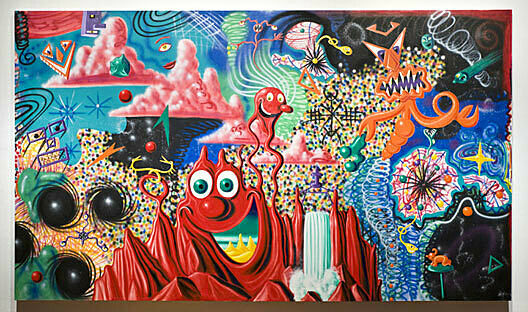
-
804
Terry Winters, Good Government, 1984
Audio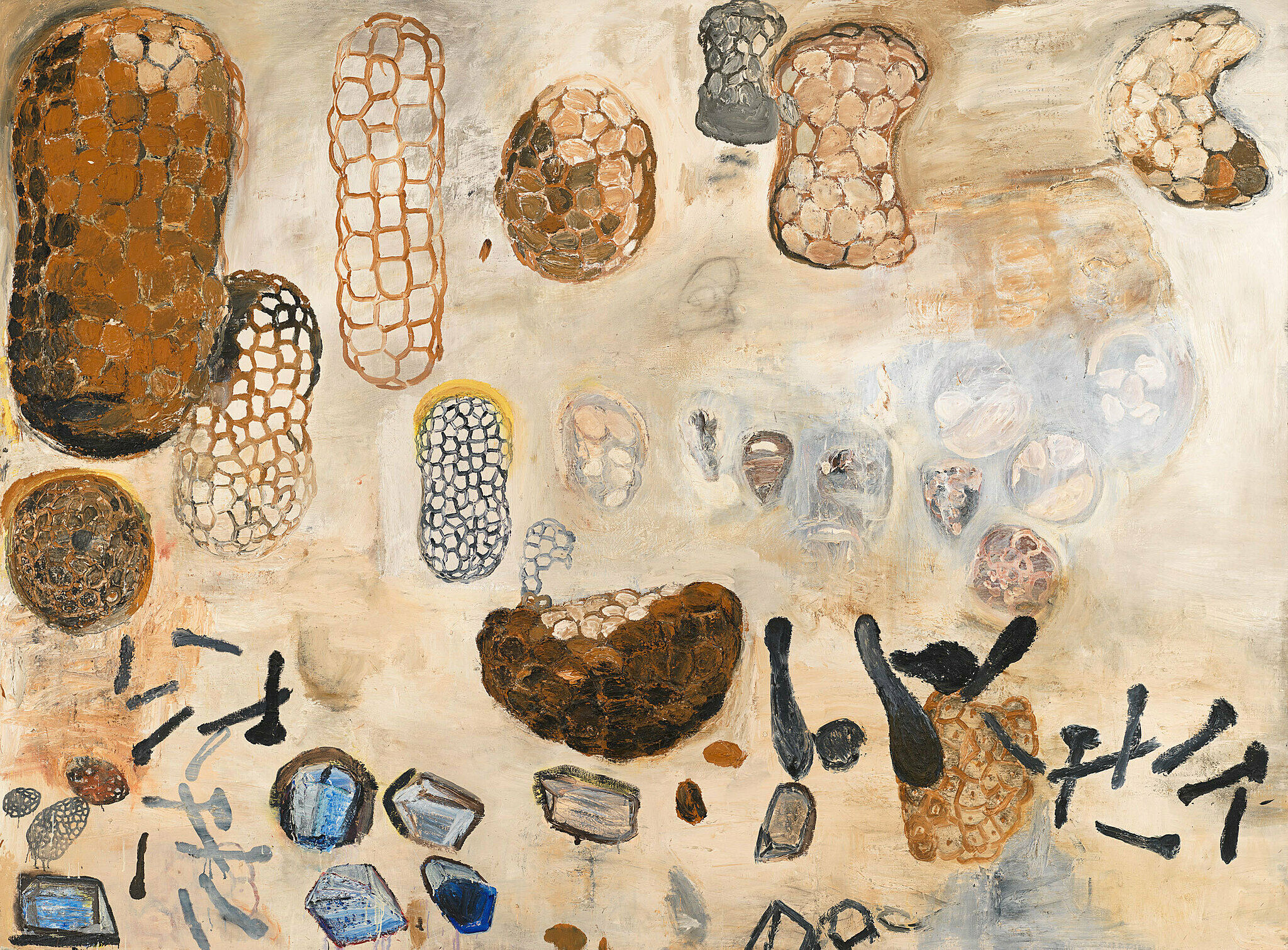
-
805
Elizabeth Murray, Druid, 1979
Audio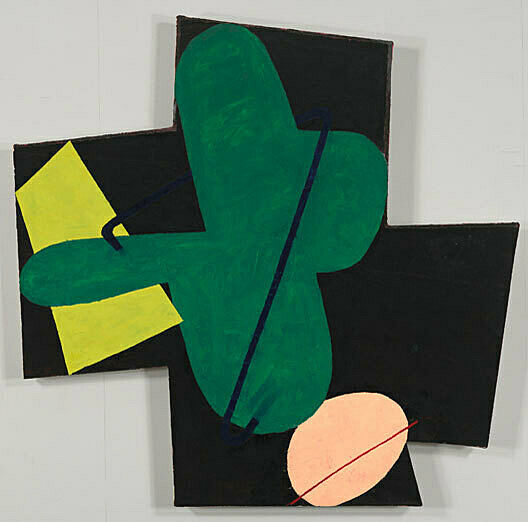
-
806
Joyce Pensato, Reclining Glove, 1983
Audio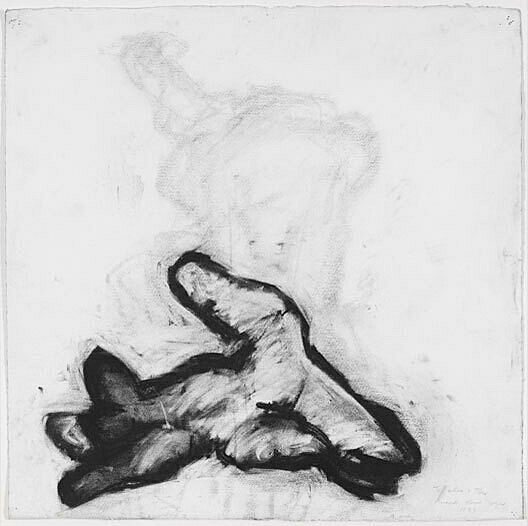
-
807
Joyce Pensato, Untitled, 1992
Audio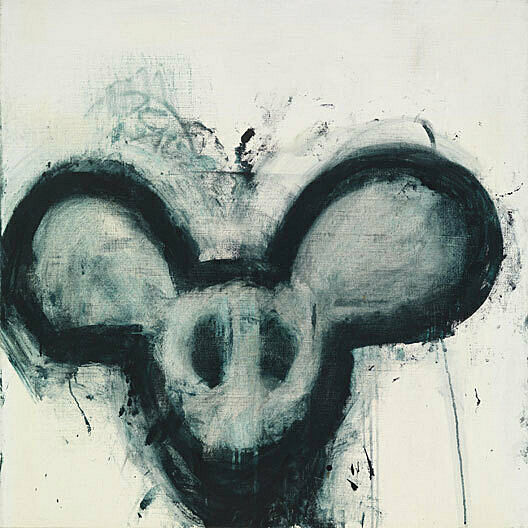
-
808
Andrew Masullo, 1667, 1988
Audio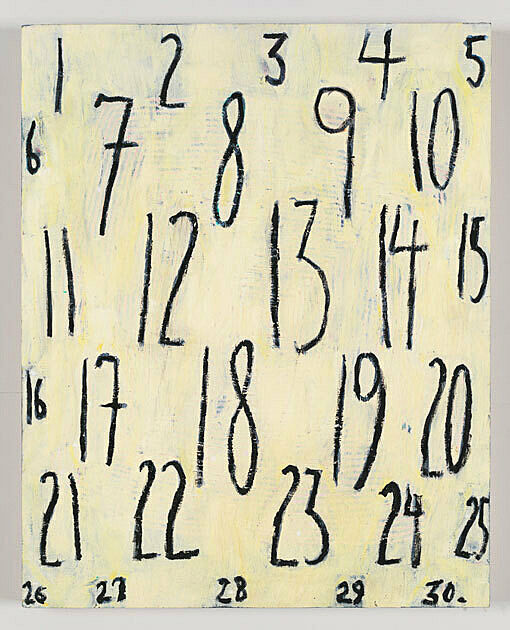
-
809
David Wojnarowicz, Fear of Monkeys/Evolution, 1988
Audio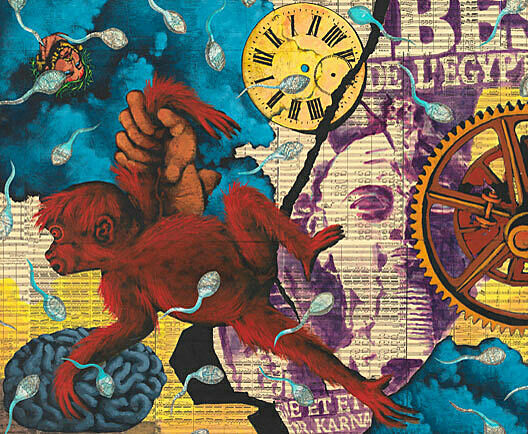
-
810
David Salle, Sextant in Dogtown, 1987
Audio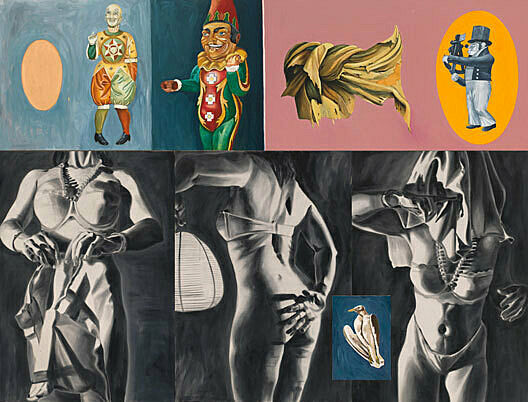
-
811
Robert Colescott, The Three Graces: Art, Sex and Death, 1981
Audio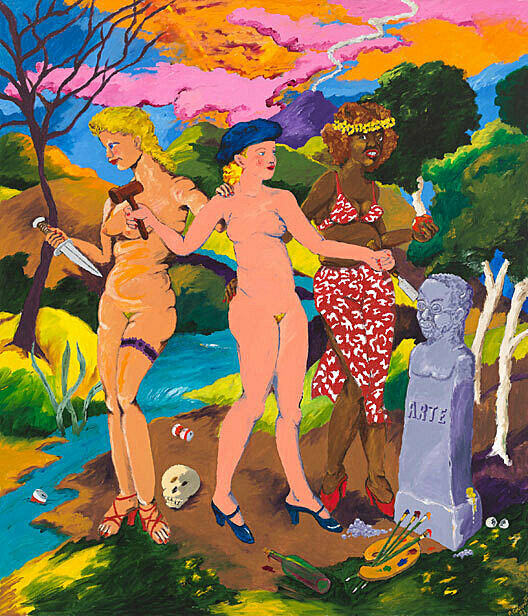
-
811-2
Robert Colescott, The Three Graces: Art, Sex and Death, 1981
Audio
-
812
Leon Golub, White Squad I, 1982
Audio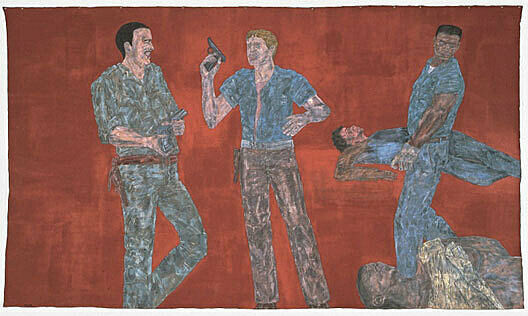
-
813
Eric Fischl, A Visit To / A Visit From / The Island, 1983
Audio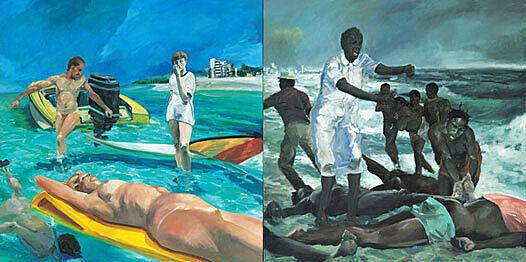
Jane Panetta: Welcome to Fast Forward: Painting from the 1980s. I’m Jane Panetta, Associate Curator here at the Whitney.
It was a very explosive moment in the art world and even in New York specifically. A huge number of galleries opened, at the time, artists run galleries and more alternative spaces. And, you know, a lot of these artists that are in this show gained a lot of recognition right away, gained gallery representation right away, the art market is exploding, there’s a lot of criticism circulation, bubbling up around this. And I think there’s also an ability at the time to conflate high and low that hadn’t been a hallmark of the 1960s and 70s, and that was also a new path for artists and another, if you will, explosive thing happening: that artists felt comfortable going out into the streets, thinking about graffiti as an art form, thinking about the connection between public and private.
So the title Fast Forward came in part from an article I read on Keith Haring, that was talking about the climate, this moment, in the early 1980s in particular and more generally, and that there was this idea that there was suddenly a kind of new freedom for artists to paint what you want. To make big garish paintings, to appropriate but not use photography, to make abstract work that was referential, there was kind of this new pace to things, new scale to things that wasn’t there before. And then beyond that I really like the reference to the VCR, which of course came of age in the 1980s as well.
To hear about the organization of this show, tap to continue.
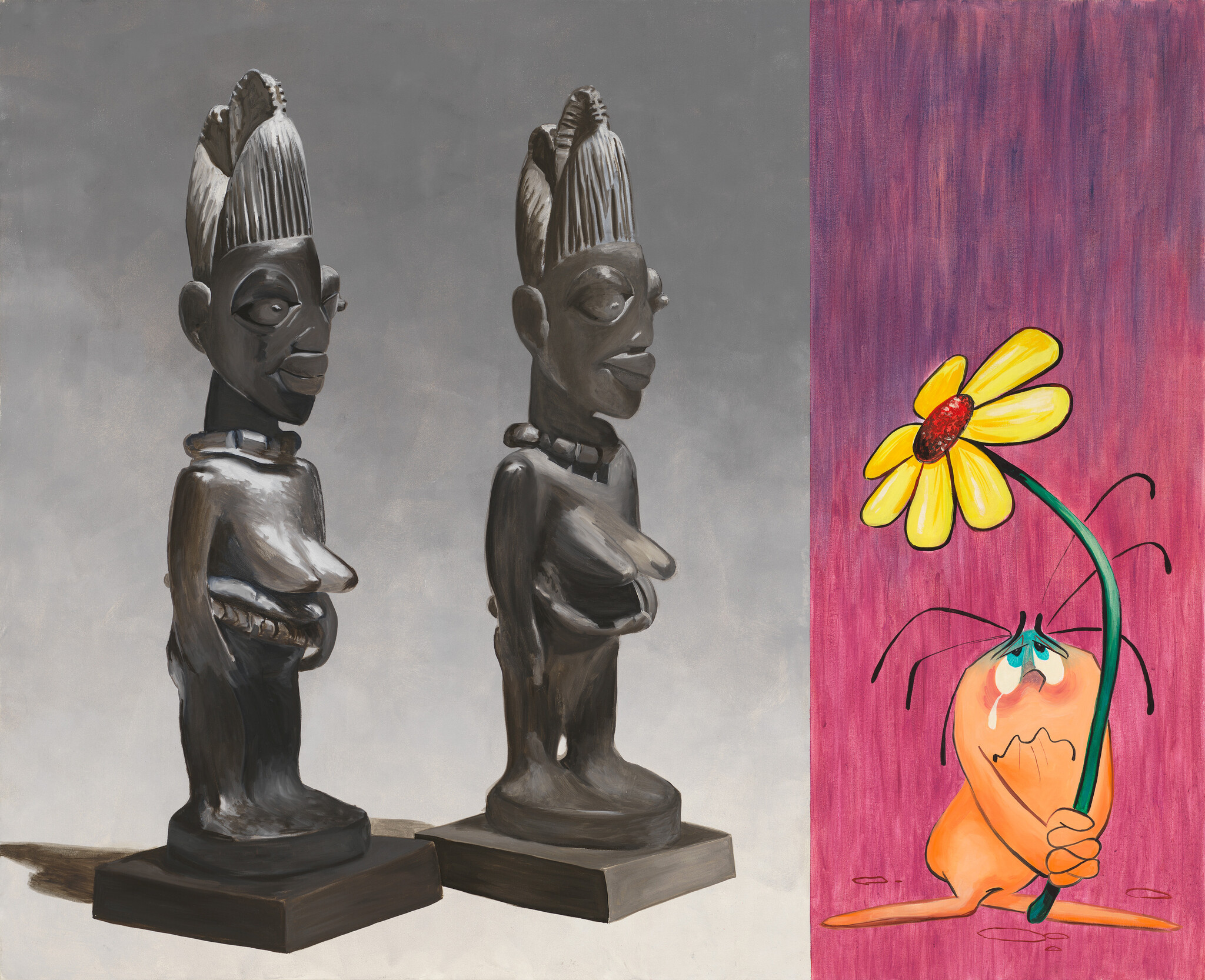
Julia Wachtel: The idea behind Membership really was to speak to how we identify with our own social group, our own culture.
Narrator: Artist Julia Wachtel.
Julia Wachtel: It's split in two sections, and in the case of the cartoon, what interested me was my feeling that the cartoon represented a position of alienation or failure or some deficit in respect to his own peer group. He's alone, the African sculptures are paired together so they are already in some kind of group that defines them.
The idea of otherness and the other is certainly played out in this painting. And you know, now that I'm looking at this painting thirty something years later and particularly with the title, Membership, it gives me pause. Because, you know, we're obviously in a moment right now where the idea of the other is being framed in extremely negative terms, and there's a lot of people in this country who would like to restrict membership to our society based on negative definitions of the other.
Julia Wachtel, Membership, 1984. Oil on canvas, 66 x 81 in. Whitney Museum of American Art, New York; Purchase, with funds from the Painting and Sculpture Committee 2016.114 114 © Julia Wachtel; courtesy the artist and Elizabeth Dee New York. © Julia Wachtel
Kenny Scharf: My name’s Kenny Scharf. This painting is kind of my idea of showing how everything can exist at the same time. There’s peace. There’s chaos. Pretty much everything can exist together. I always felt very strongly about having fun in creating art, and also in conveying that sense of fun and including the viewer in on it.
I made up a manifesto back in ‘81 where I define the term “Pop Surrealism.” I kind of came to the conclusion that because of my very early bombardment, by the media, of saturation with advertisements and television and everything, that my subconscious was filled with pop imagery.
I’ve had a long fascination with science fiction, the movies from that time usually stem from the fear of nuclear catastrophe, which is, you know, the greatest threat of all. It’s such an unfathomable, scary thing that I naturally think about things like that.
This painting, actually, I painted it in my very good friend Keith Haring’s studio. I had no studio at the time, I don’t remember why, and he was away and he lent me his studio. And that’s why, if you see on the bottom right there’s my version of a Keith Haring baby on a little pedestal and that’s my little thanks to him for letting me use his studio to do the painting.
Kenny Scharf, When the Worlds Collide, 1984. Oil and acrylic spray paint on canvas, 122 5/16 × 209 5/16 in. (310.7 × 531.7 cm). Whitney Museum of American Art, New York; Purchase, with funds from Edward R. Downe, Jr. and Eric Fischl 84.44 © 2017 Kenny Scharf/Artists Rights Society (ARS), New York
Narrator: Artist Terry Winters draws from biological and botanical imagery to create the enigmatic shapes you see in this painting. The large forms hovering on the top look like honeycombs and the black shapes drifting along the bottom seem reminiscent of chromosomes. These semi-abstract forms allow Winters to explore a variety of painting techniques.
Terry Winters: There is a way I was trying to develop an almost encyclopedic range of paint applications across the surface. So there’s a range of paint handling from very thin and transparent layers in the, sort of the middle section of the painting, to these very densely impastoed constructions of the forms in the upper left of the painting. And some forms that are much more volumetric and others that are built out of linear constructions.
Just as there was an interest in developing different kinds of paint surfaces, there was also an interest in the range of techniques and paint applications that could be applied to the picture. So there was a classical use of brushes but also rags and painting knives that were also used in getting the paint on the surface.
Narrator: The title of the painting, Good Government, is in part a reference to a famous fourteenth century Renaissance fresco by Ambrogio Lorenzetti, which Winters saw in Siena just before making this work. But it also refers to the way everything in the painting comes together.
Terry Winters: And at some point the picture, all of these disparate elements came together for me in some sense. It reminded me a bit of those charts you would see in elementary school about good government, where all the different things were all working together. And it took on that almost sort of modernist, formalist idea about when the painting is working, and suddenly it was all sort of working.
Terry Winters (b. 1949), Good Government, 1984. Oil on linen, 101 1/4 × 136 1/4 in. (257.2 × 346.1 cm). Whitney Museum of American Art, New York; purchase, with funds from The Mnuchin Foundation and the Painting and Sculpture Committee 85.15 © Terry Winters
Elizabeth Murray: I don’t like to have ideas when I begin to work, because if I got the idea before I start, it just feels like why do it? You know, I know what it is already!
Narrator: The forms and figures in Elizabeth Murray’s painting Druid seem to take part in a playful dialogue. Everything’s a little off-kilter, as if the participants in this imaginary conversation were trying to outdo each other’s surprises. Murray used the canvas to heighten this skewed effect. She explained her use of shaped canvases in a slide talk given at the Whitney in 1980, just a year after painting Druid.
Elizabeth Murray: And I got involved in just having the eccentric shapes made to paint on. And I think it had very much to do with, one, I was bored with just painting on rectangles or squares. And also they change how the shape is on the wall a lot, they change the relationship to the wall, and it feels more organic to me right now. But also, there are just a lot more edges, kinds of ways of going off the canvas, off the painting. It feels like I can be either very conflicting, or I can be nice, or I can do a lot of different things. It feels like a wider range of mood or modality for expression.
Elizabeth Murray, Druid, 1979. Oil on shaped canvas, 55 13/16 × 55 3/8in. (141.8 × 140.7 cm). Whitney Museum of American Art, New York; Gift of Anne and Joel Ehrenkranz 99.147 © 2016 The Murray-Holman Family Trust/Artists Rights Society (ARS), New York, NY
Joyce Pensato: Hi, I'm Joyce Pensato, in my studio with my dog Charlie.
Narrator: Joyce Pensato was born in Brooklyn, and has had a studio there in Williamsburg since she graduated from art school in 1979. Her charcoal drawing called Reclining Glove combines her classical training with an interest in her urban surroundings.
Joyce Pensato: I kind of zoomed into gloves that were on the street, that were lost or something. I connected to gloves, ‘cause they look very like Matisse’s human figure lying on a couch or something. I would pose the glove. You’re looking down at it rather than straight on. And just the way the wrinkles of the glove was so incredible to me, you know, so human. Like that might be a fifty year old person.
Joyce Pensato, Reclining Glove, 1983. Charcoal on paper, 21 7/8 × 22 3/16 in. (55.6 × 56.4 cm). Whitney Museum of American Art, New York; Promised gift of Thea Westreich Wagner and Ethan Wagner P.2011.309 © Joyce Pensato
Joyce Pensato: Mickey was very important to me.
Narrator: Joyce Pensato.
Joyce Pensato: You know, to own it. To make it my own. Even though it’s a familiar face, or familiar shape. I love—it started with, I love the form of it as an abstraction. And I wanted to make it not like a cartoon, so to give it more—I think of it like Edvard Munch or something, it’s very expressive, and it has a lot of emotion in it, rather than a happy Mickey.
Narrator: This was one of Pensato’s first paintings of Mickey Mouse. She’s become best known for these rough, stark paintings of cartoon characters—and she says they helped her find her path as an artist.
Joyce Pensato: Before, my drawings were these cartoon guys, and the paintings went abstract, because I couldn’t hold onto it. The paintings looked like everybody else’s abstract painting at that time. It didn’t have a personal touch. It was—when I did that Mickey it was really exciting for me, I discovered something. I just wanted to do tons of Mickeys at that point. And to take the images that I loved doing and try to accept who I was, rather than trying to be this painter.
Joyce Pensato, Untitled, 1992. Oil on linen, 36 × 36in. (91.4 × 91.4 cm). Whitney Museum of American Art, New York; Promised gift of Thea Westreich Wagner and Ethan Wagner P.2011.308 © Joyce Pensato
Andrew Masullo: Oil paint’s rich. The colors are rich, and it feels rich, and you can take your time.
Narrator: Artists have to take their time with oil paint, because it dries slowly. Andrew Masullo.
Andrew Masullo: I don’t run out of ideas with oil paint. You know, something’s really wet and it has to be put away. I’ve tried acrylics in the past, and things dry so quickly that I put stuff down and it’s all dried, and I can keep going―but I have nothing to keep going on; I’m running on fumes and everything looks awful. It’s much better to do some and then have to put it away, and sort of feel this little heartache like “oh, I don’t want to put this away right now, because I do kind of think I might know what I want to do next.” But I’m forced to put it away, which is a good thing, because then I can take it out and it’s completely fresh again once I look at it. Hopefully completely fresh again!
Andrew Masullo, 1667, 1988. Oil on wood, 18 1/16 × 14 1/2 in. (45.9 × 36.8 cm). Whitney Museum of American Art, New York; Promised gift of Thea Westreich Wagner and Ethan Wagner P.2014.22 © Andrew Masullo
Narrator: A human hand roughly grasps a monkey, whose limbs flail and eyes bulge in alarm. Sperm swims about, their forms cut from maps and collaged onto the composition’s surface. There’s a clock without hands, and a solitary gear with no mechanism to lock into. The manufactured, or, as the artist called it, “the pre-invented world,” is not to be trusted.
David Wojnarowicz called this work Fear of Monkeys/Evolution. When he made it, the AIDS crisis had already ravaged New York’s art community. He received his own diagnosis that same year. This composition responds to the crisis both with its furious intensity and with its symbolic imagery. The monkey points both to the possible origin of the HIV virus. The motionless clock hints at mortality. The sperm shapes suggest both desire and contagion.
The year after making this composition, Wojnarowicz explained the impulse behind his work: “My paintings are my own written versions of history, which I don’t look at as being linear. I don’t obey the time elements of history or space and distance or whatever; I fuse them all together. For me, it gives me strength to make things, it gives me strength to offer proof of my existence in this form. I think anybody who is impoverished in any way, whether physically or psychically, tends to want to build rather than destroy.”
David Wojnarowicz, Fear of Monkeys/Evolution, 1988. Acrylic and opaque watercolor on cut papers, 24 1/4 × 29 5/16in. (61.6 × 74.5 cm). Whitney Museum of American Art, New York; Gift of Steven Johnson and Walter Sudol 2001.309 Courtesy the Estate of David Wojnarowicz and P.P.O.W. Gallery, New York
Jane Panetta: This painting, called Sextant in Dogtown, is by artist David Salle. Although it seems to be telling a story, one would be hard-pressed to say exactly what the artist is trying to communicate. He presents us with an odd assortment of seemingly unrelated images: a woman performing a bizarre striptease act, a couple of nasty-looking clowns, and a strange figure operating an old-fashioned sea navigation device called a sextant. Salle’s images come from a variety of sources including magazines, photographs, and pornography. Salle puts these images together in a painting the way another artist might create a collage using scraps of paper. Each of these fragments brings with it a series of associations and meanings.
Salle began making paintings in the late 1970s, when painting itself was considered by many to be passé. When his work was first shown, it generated controversy. What seems clear now is that it captures a particular cultural moment, and comments on the media-saturation and consumerism of the Reagan era.
David Salle, Sextant in Dogtown, 1987. Oil and acrylic on canvas, 96 3/16 × 126 1/4 in. (244.3 × 320.7 cm). 99 1/8 × 129 3/8 in. (251.8 × 328.6 cm). Whitney Museum of American Art, New York; Purchase, with funds from the Painting and Sculpture Committee 88.8a-e Art © David Salle, Licensed by VAGA, New York, NY
Lowery Sims: This is Lowery Sims. I am Designated Curator Emerita from The Museum of Arts and Design, but I've worked at the Metropolitan Museum and the Studio Museum in Harlem, and I've spent a lot of time looking at Robert Colescott, so I'm happy to be your guide into deciphering this very complex painting.
The Three Graces: Art, Sex and Death draw on themes that come from art and mythology from antiquity, and then in the classical revival during the Renaissance. The three figures traditionally represent characters of charm, beauty, and creativity. But Colescott transforms these concepts with modern nuances, with references to vernacular pop and media. Adding, I think almost a punk nuance, characterizing them now as art, sex, and death. Sounds like the Sex Pistols or something.
Narrator: If you’d like to hear Lowery Sims discuss the trio in detail, please tap to continue.
Robert Colescott, The Three Graces: Art, Sex and Death, 1981. Acrylic on canvas, Overall: 84 × 72in. (213.4 × 182.9 cm). Whitney Museum of American Art, New York; Gift of Raymond J. Learsy 91.59.1 With permission of the Estate of Robert Colescott © 2017 Estate of Robert Colescott / Artists Rights Society (ARS), New York
Lowery Sims: We'll start with the grace at the left. She wears only a garter on her left thigh, and red open strap sandals. Curiously she holds a knife pointed dangerously towards her own body.
The central figure is fair complected, with vivid blonde hair. She wear an artist's beret and black Mary Jane shoes. She holds the hammer in her right hand, which is extended upward, in a preparation to make contact with the chisel that is aimed at a square pillar with the head of a man. The head is a self-portrait of Colescott and he designates himself as representing art, as you can see by the word arte.
There is a self-deprecating quality to this depiction, as he paints himself about to be demolished by the central figure. The image has a character of what is known as Vanitas, or a concept that talks about the fleeting quality of life and things. This is a familiar theme in Colescott's work, where he depicts himself succumbing to romantic obsessions.
The third figure is clearly black, and she has a reddish afro crowned by yellow flowers. She wears a red and white patterned bra and sarong skirt, and red shoes and holds an apple in her hand. Evocations of Eve, perhaps in the garden.
I think that what we can see here is how Colescott in his astute familiarity with art history uses themes that are familiar to us that he not only redirects, but recreates to find new narratives around gender and race, and also as he's often said, to interject black people into art history.
Robert Colescott, The Three Graces: Art, Sex and Death, 1981. Acrylic on canvas, Overall: 84 × 72in. (213.4 × 182.9 cm). Whitney Museum of American Art, New York; Gift of Raymond J. Learsy 91.59.1 With permission of the Estate of Robert Colescott © 2017 Estate of Robert Colescott / Artists Rights Society (ARS), New York
Leon Golub: White Squad really means death squad; that’s another term for it. These are attempts on my part to grapple with events today, to grapple with media in a certain sense, and to put things up front as much as I can.
Narrator: This painting depicts five men in the aftermath of an execution. Leon Golub drew on a variety of journalistic sources in making the composition, which responds to large-scale human rights abuses committed by death squads in Central and South America. Golub was particularly concerned with these groups because they often worked on behalf of governments who had been installed or supported by the C.I.A.
Golub once described his style as a form of “barbaric realism.” Much of its roughness comes from his painting technique. He described his method in this 1999 lecture, recorded at the Whitney.
Leon Golub: I build up the paint, I build up a number of surfaces, and I scrape it down using solvents. In a sense I skin the canvas to remove the external traces of color and form, and often will rebuild toward the end partially.
Leon Golub, White Squad I, 1982. Acrylic on linen, with metal grommets, 120 × 210in. (304.8 × 533.4 cm). Whitney Museum of American Art, New York; Gift of the Eli Broad Family Foundation and purchase, with funds from the Painting and Sculpture Committee 94.67 Art © The Estate of Leon Golub, Licensed by VAGA, New York, N.Y.
Eric Fischl: The painting has on the left panel a scene of people, presumably a family sort of frolicking in the crystal clear waters of a Caribbean Island.
Narrator: Eric Fischl discusses his painting, A Visit To / A Visit From / The Island.
Eric Fischl: There's some reference to a hotel/condo building in the background on a white beach. In the panel on the [right] is a scene of absolute desperation and tragedy of Haitian boat people who have attempted to escape their hell and have washed up on the shores of Miami. I created a place that is emotionally uninhabitable for any length of time.
Through the news media—through our sort of global reach in terms of information, the drama and tragedies, the desperation, comes into our awareness, into our homes every day and creates a tension riveted by the drama of people trying to survive. And at the same time, living in a place where you actually can't help or you can't help them in an immediate and direct way, creates, in me anyway, a huge conflict. Knowing that this other stuff was going on, which was far more urgent, far more important. So I guess what it is, is the horrible irony of the simultaneity of our world.
Eric Fischl, A Visit To / A Visit From / The Island, 1983. Oil on canvas, 84 × 168in. (213.4 × 426.7 cm). Whitney Museum of American Art, New York; Purchase, with funds from the Louis and Bessie Adler Foundation, Inc., Seymour M. Klein, President 83.17a b
0:00
0:00