
Archibald Motley: Jazz Age Modernist
2015
-
800
Introduction to Archibald Motley: Jazz Age Modernist
Audio, Kids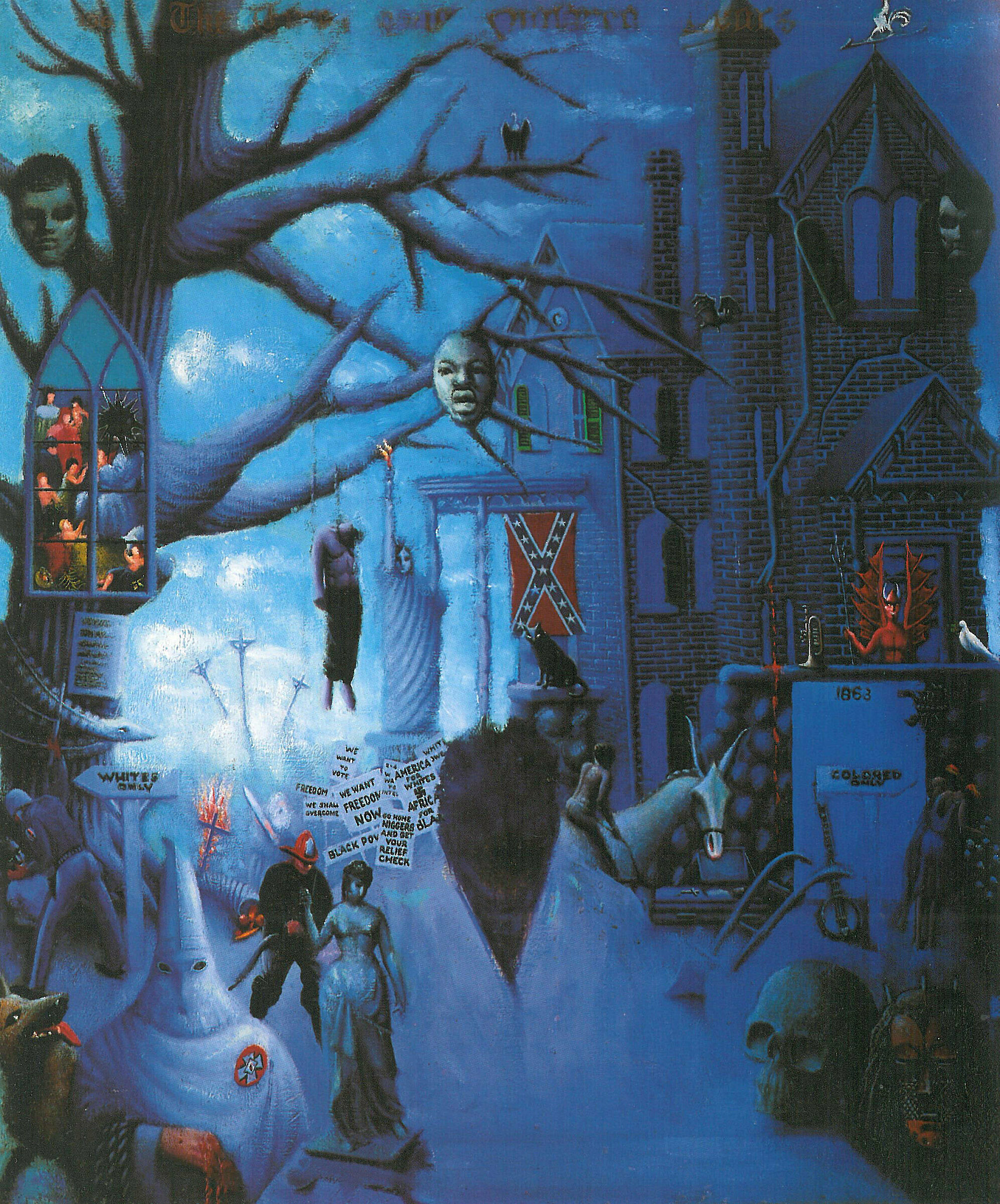
-
801
Archibald J. Motley Jr., Mulatress with Figurine and Dutch Seascape, 1920
Audio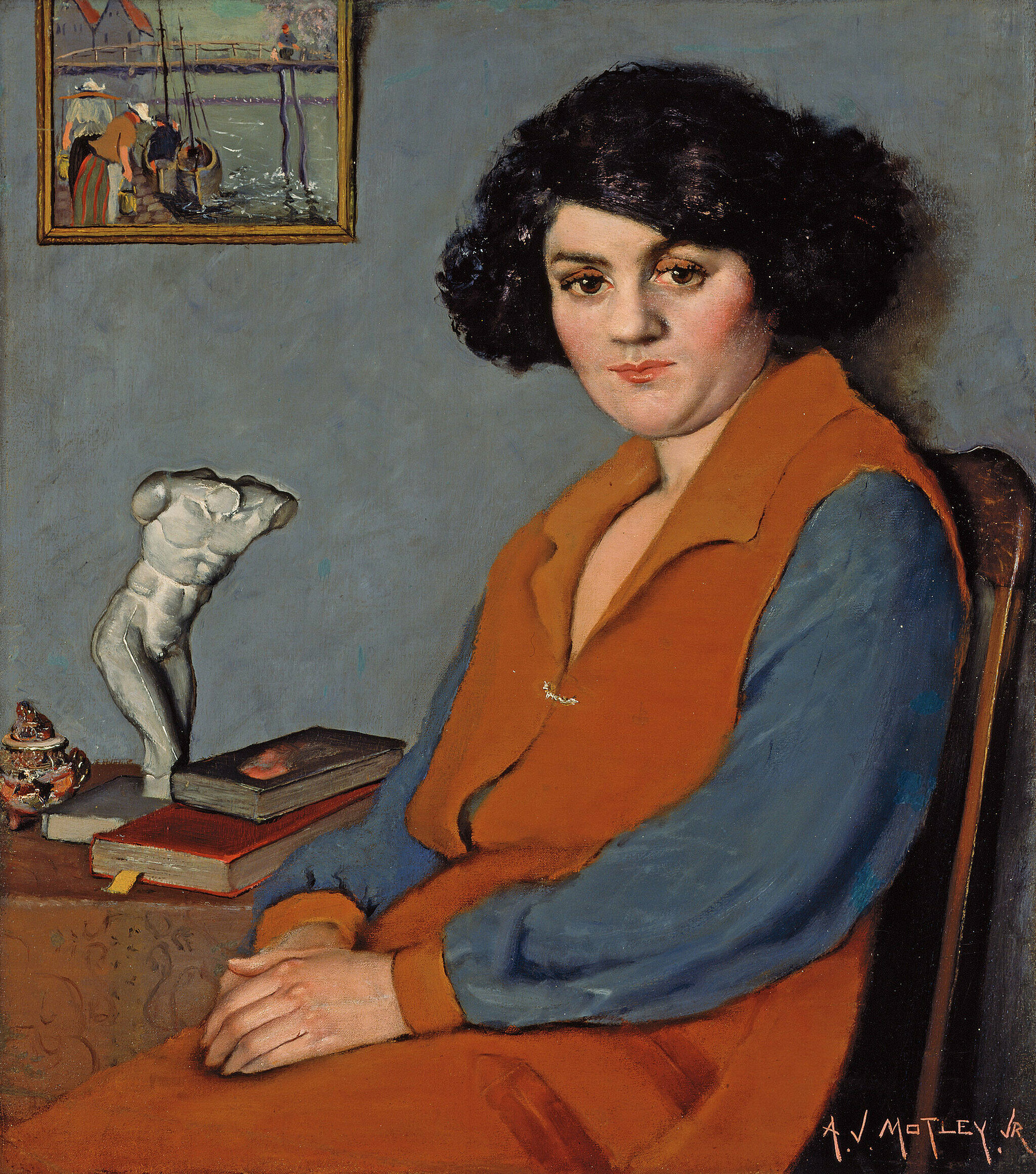
-
803
Archibald J. Motley Jr., Portrait of My Grandmother, 1922
Audio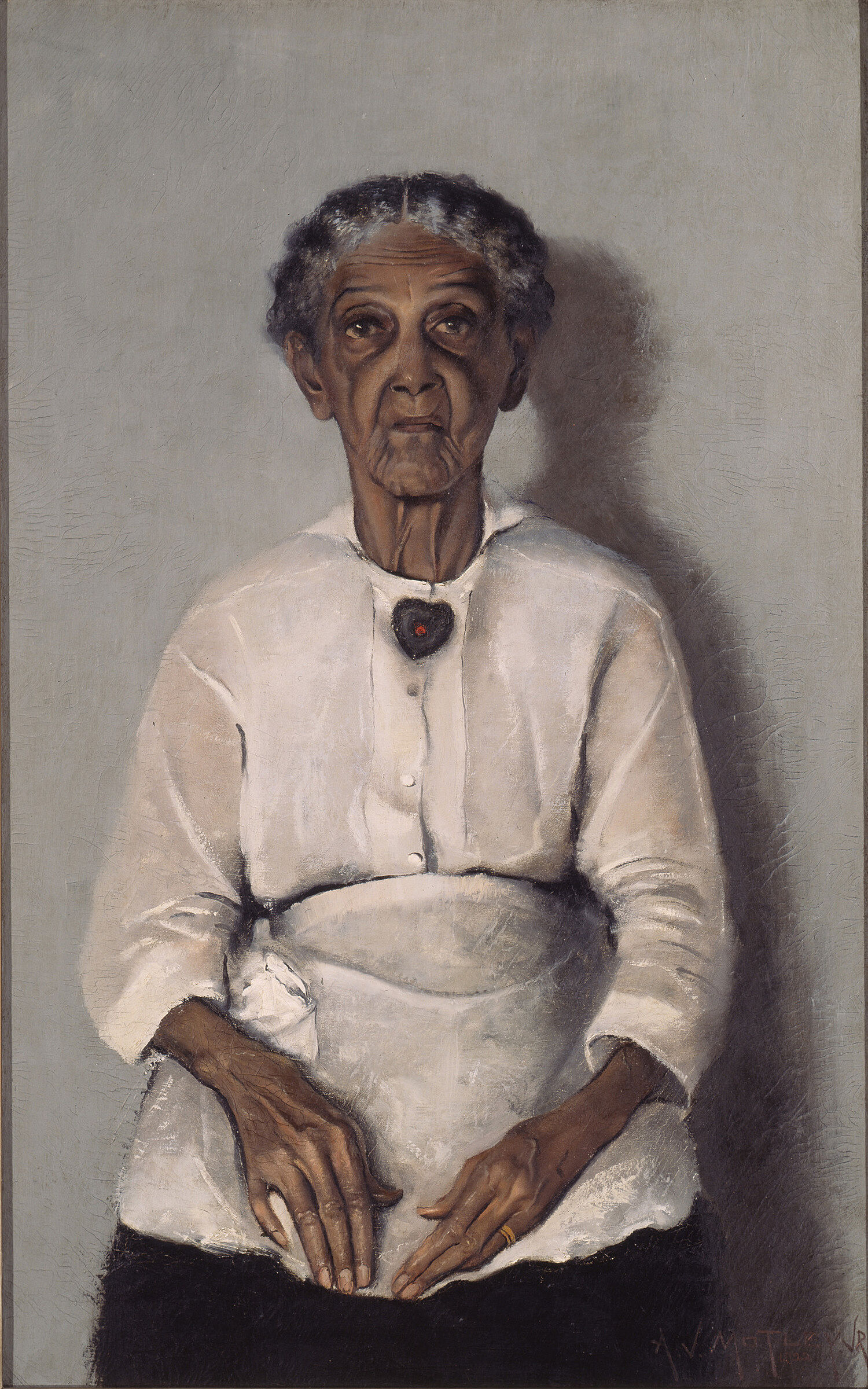
-
805
Archibald J. Motley Jr., Blues, 1929
Audio, Kids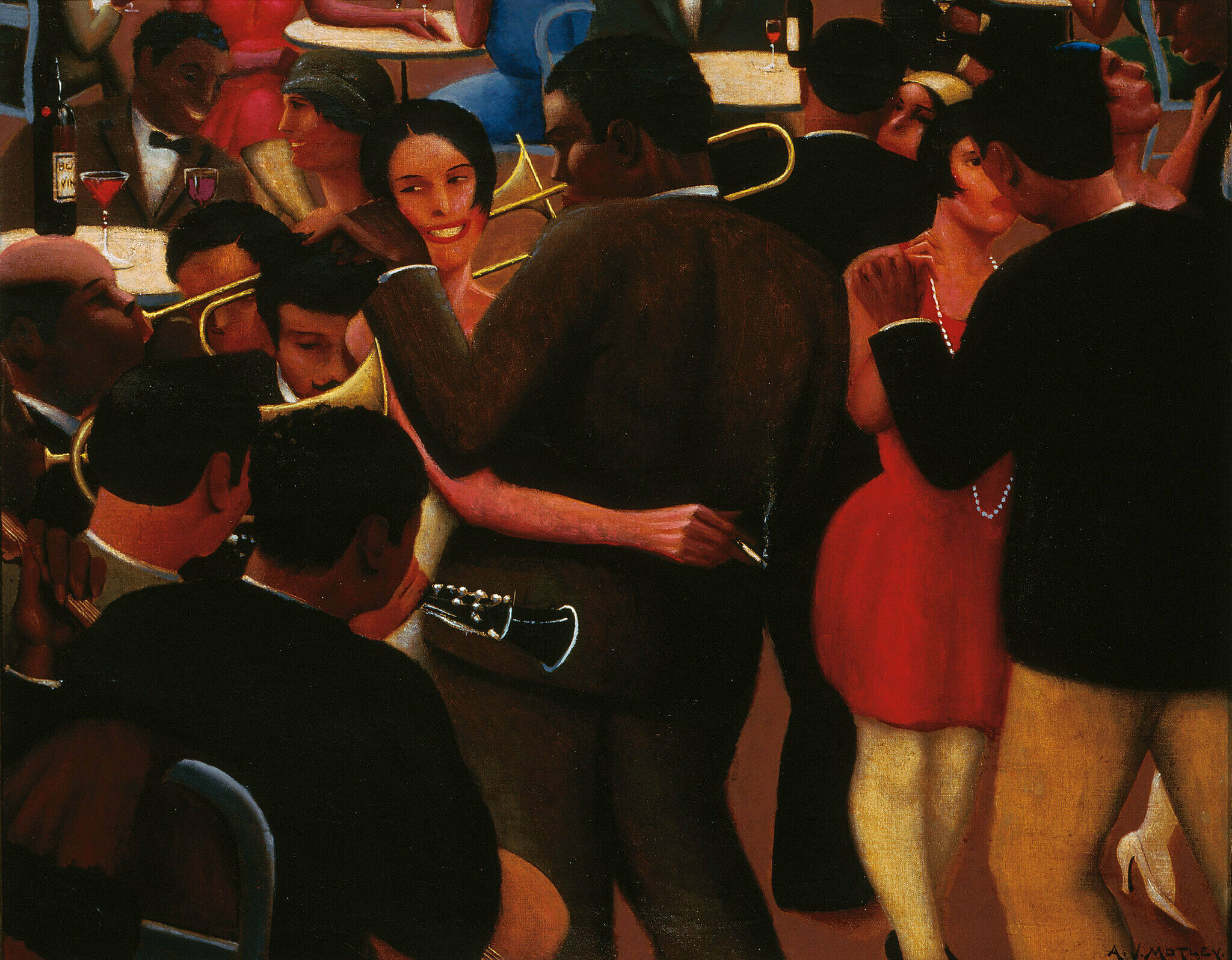
-
806
Archibald J. Motley Jr., Black Belt, 1934
Audio, Kids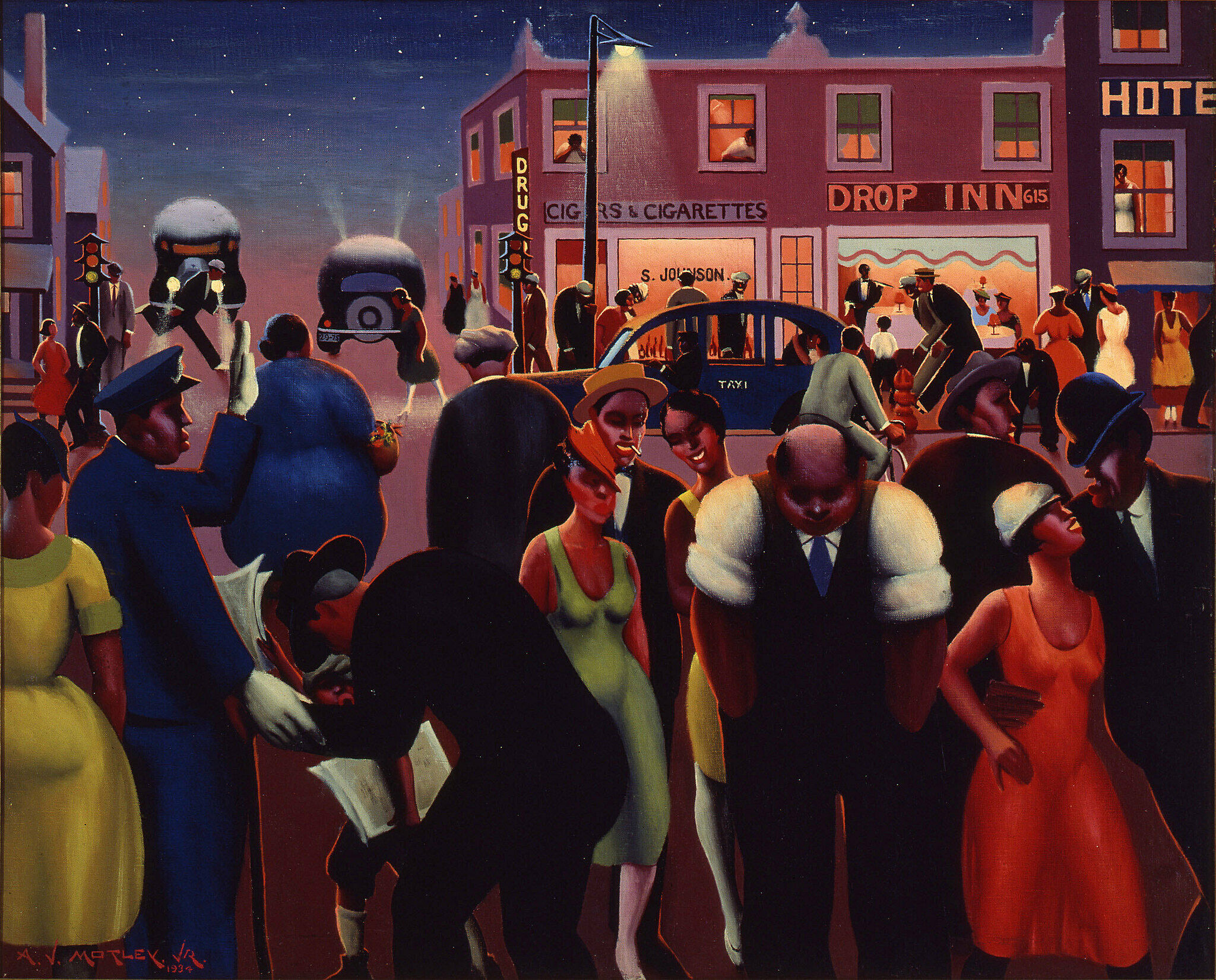
-
807
Archibald J. Motley Jr., Gettin’ Religion, 1948
Audio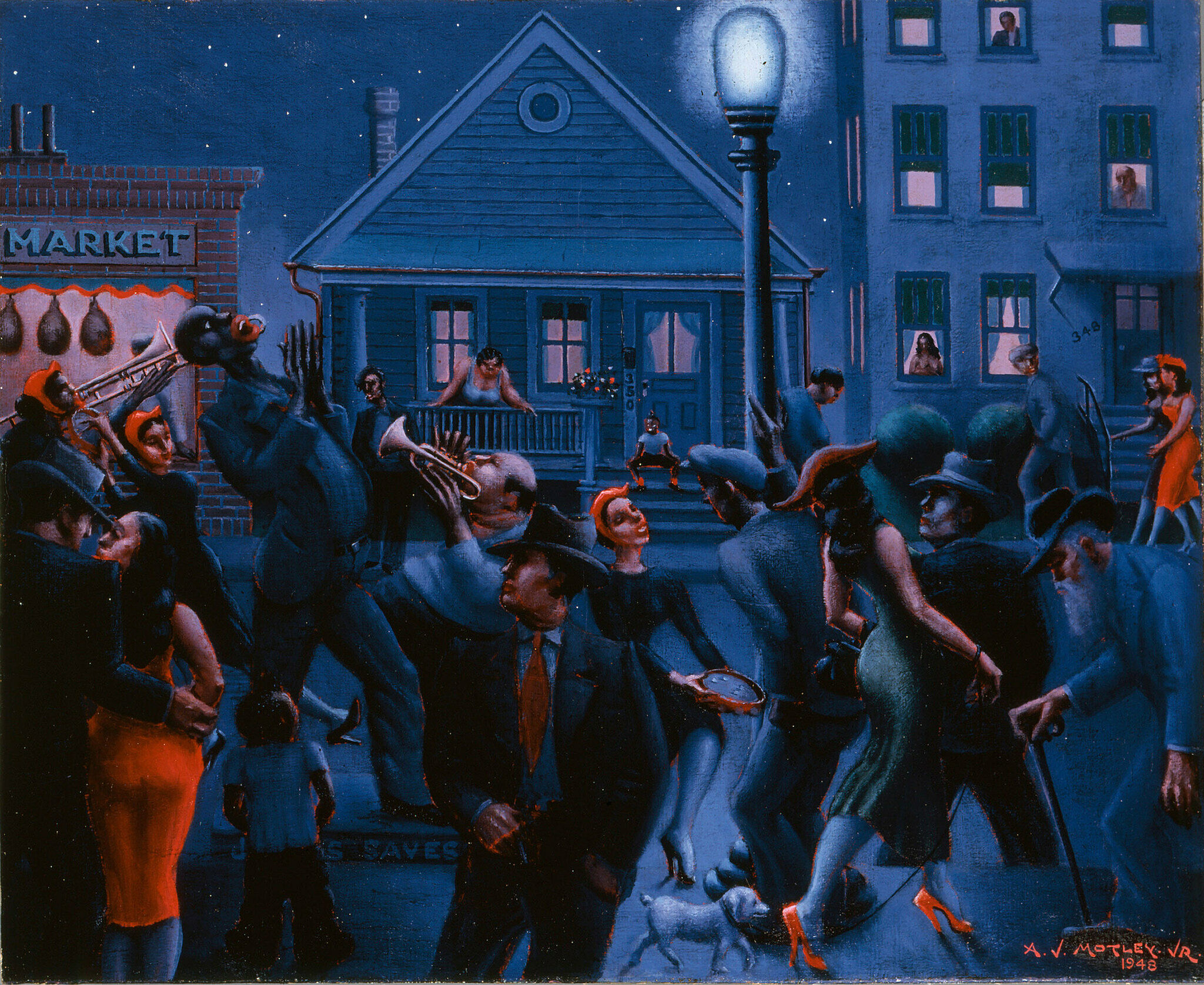
-
808
Archibald J. Motley Jr., Cocktails, 1926
Audio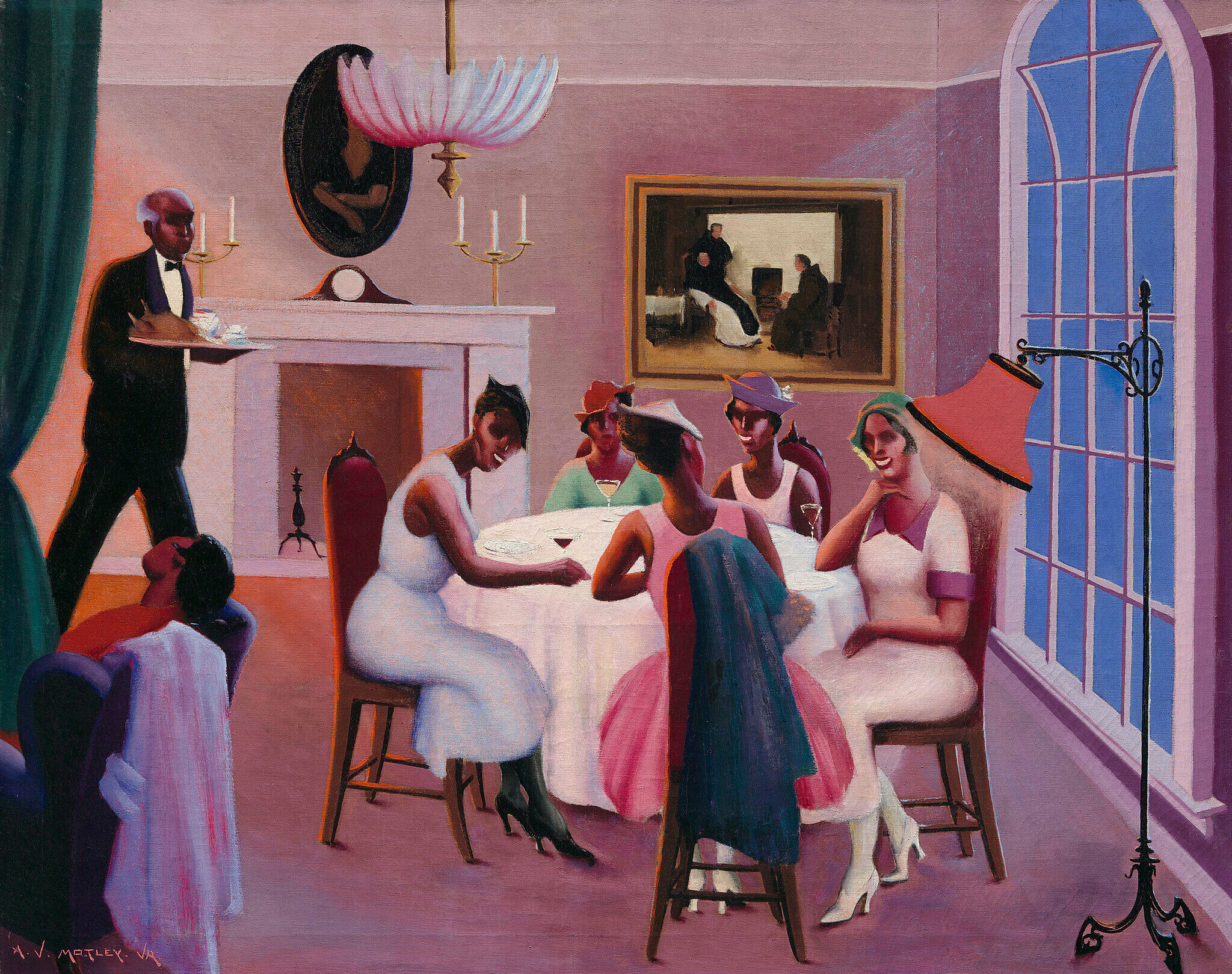
-
809
Archibald J. Motley Jr., The Picnic, 1926
Audio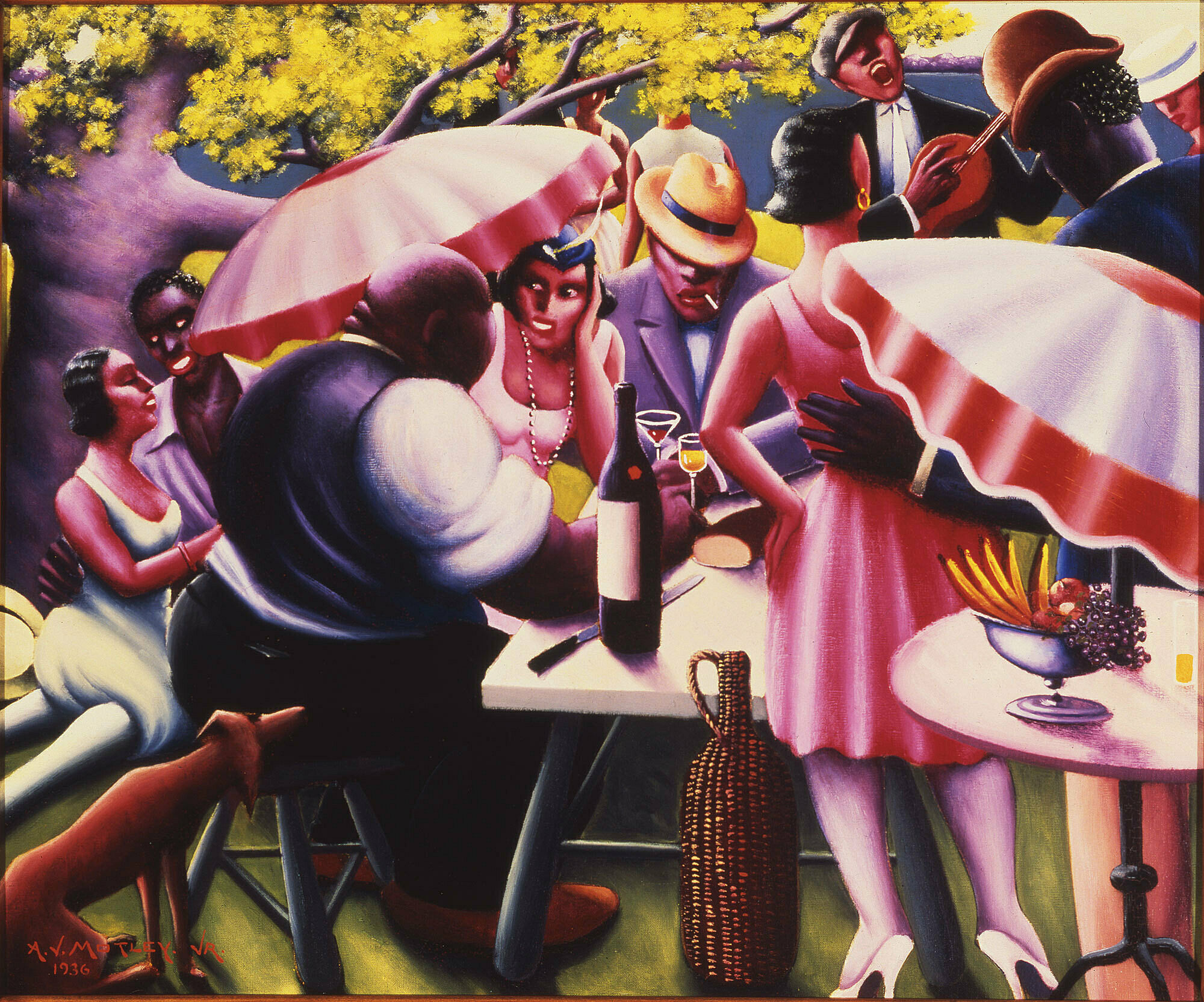
-
810
Archibald J. Motley Jr., Brown Girl After the Bath, 1931
Audio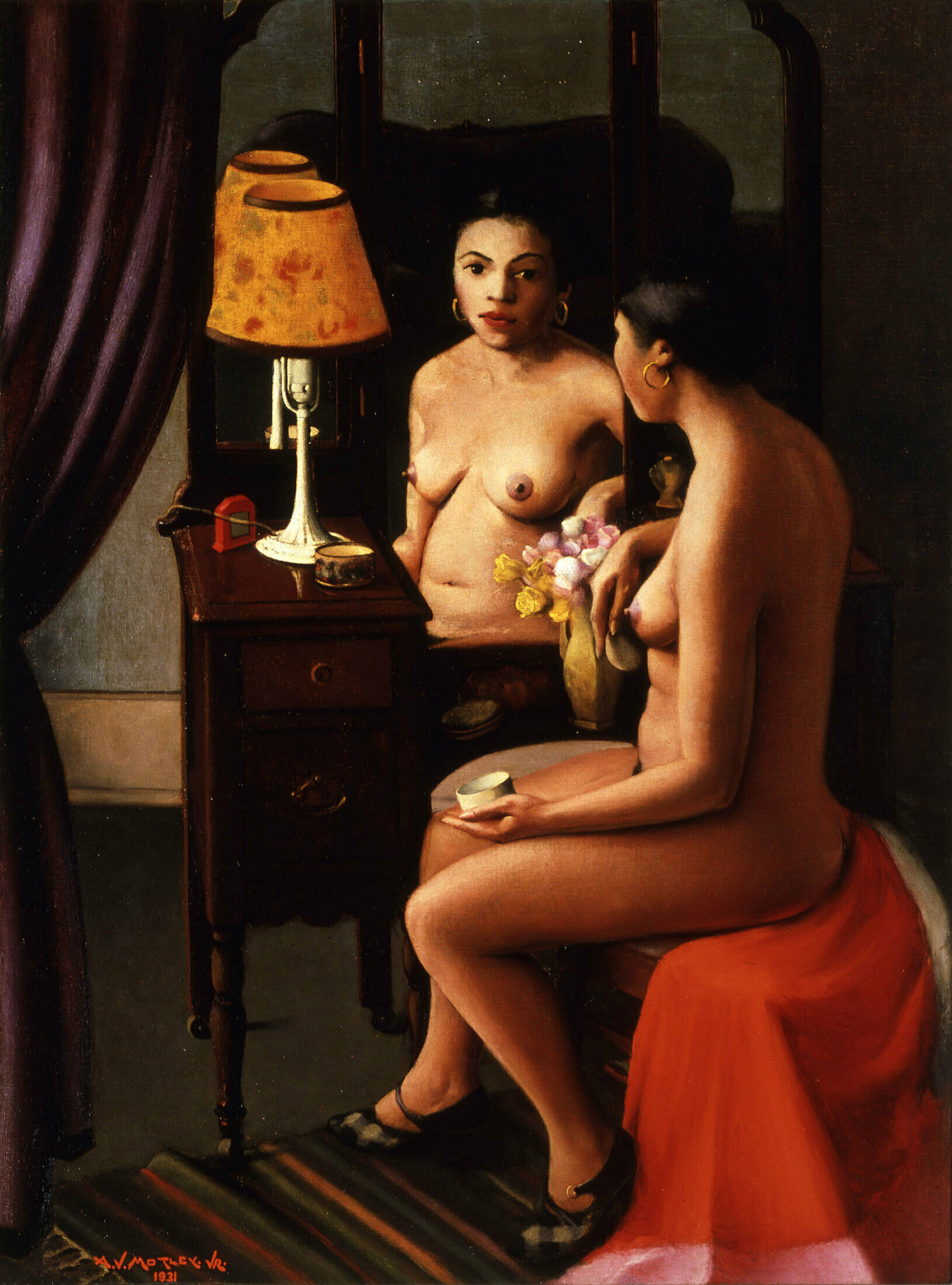
-
811
Archibald J. Motley Jr., Between Acts, 1935
Audio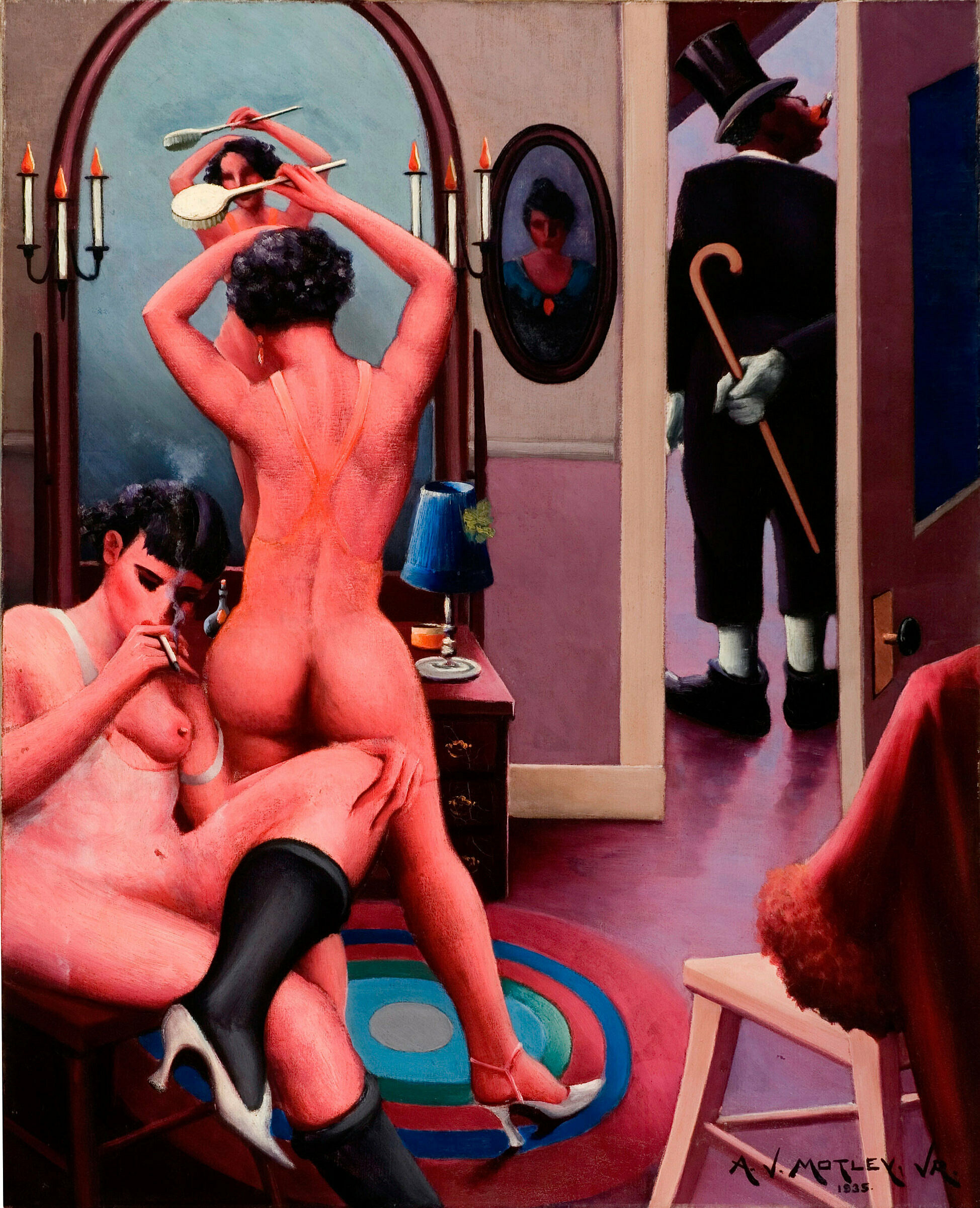
-
814
Archibald J. Motley Jr., Tongues (HolyRollers), 1929
Audio
-
813
Archibald J. Motley Jr., Lawd, Mah Man’s Leavin’, 1940
Audio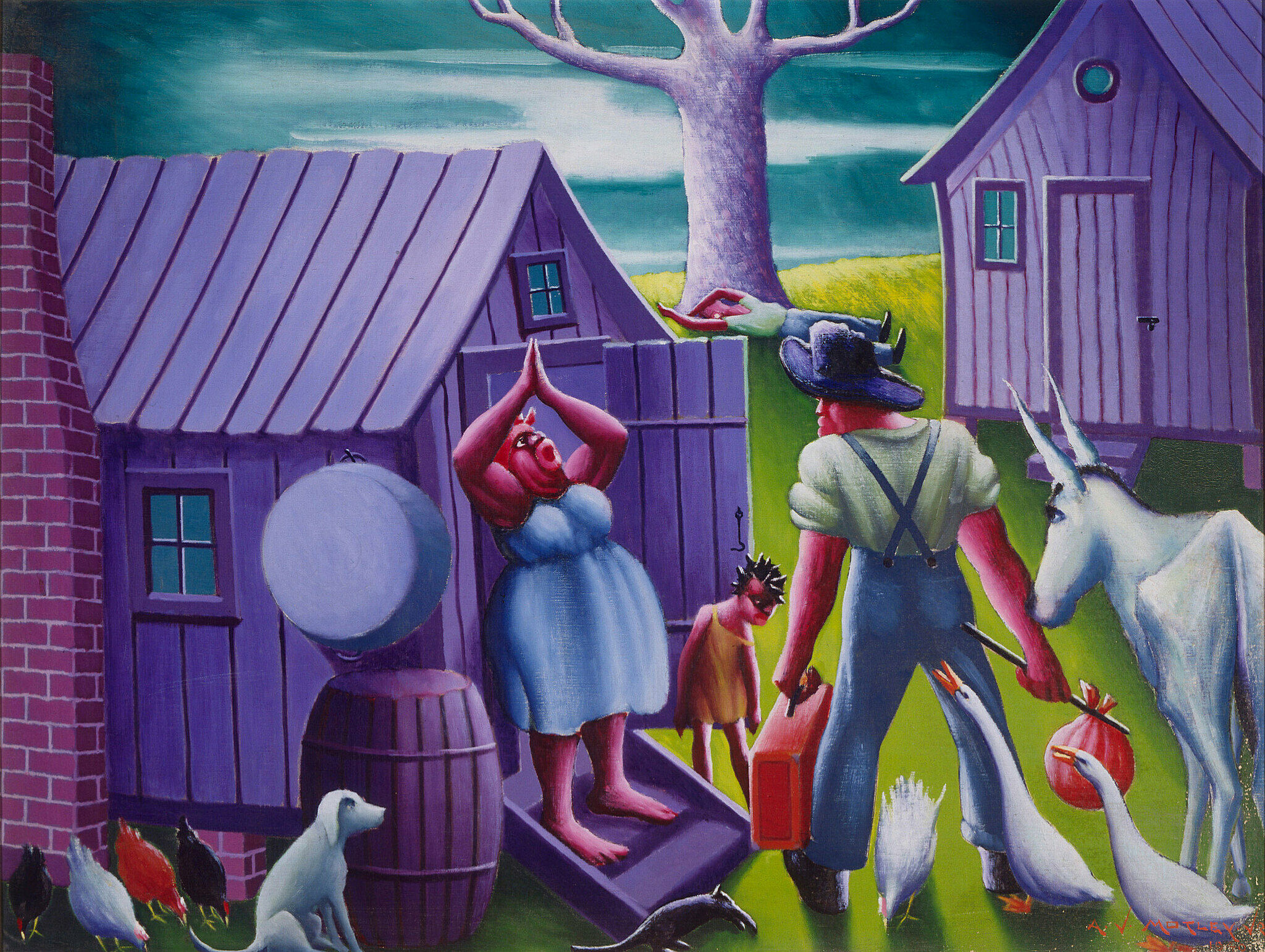
-
815
Archibald J. Motley Jr., The First One Hundred Years: He Amongst You Who is Without Sin Shall Cast the First Stone: Forgive Them Father For They Know Not What They Do, c. 1963–72
Audio
-
802
Archibald J. Motley Jr., The Octoroon Girl, 1925
Kids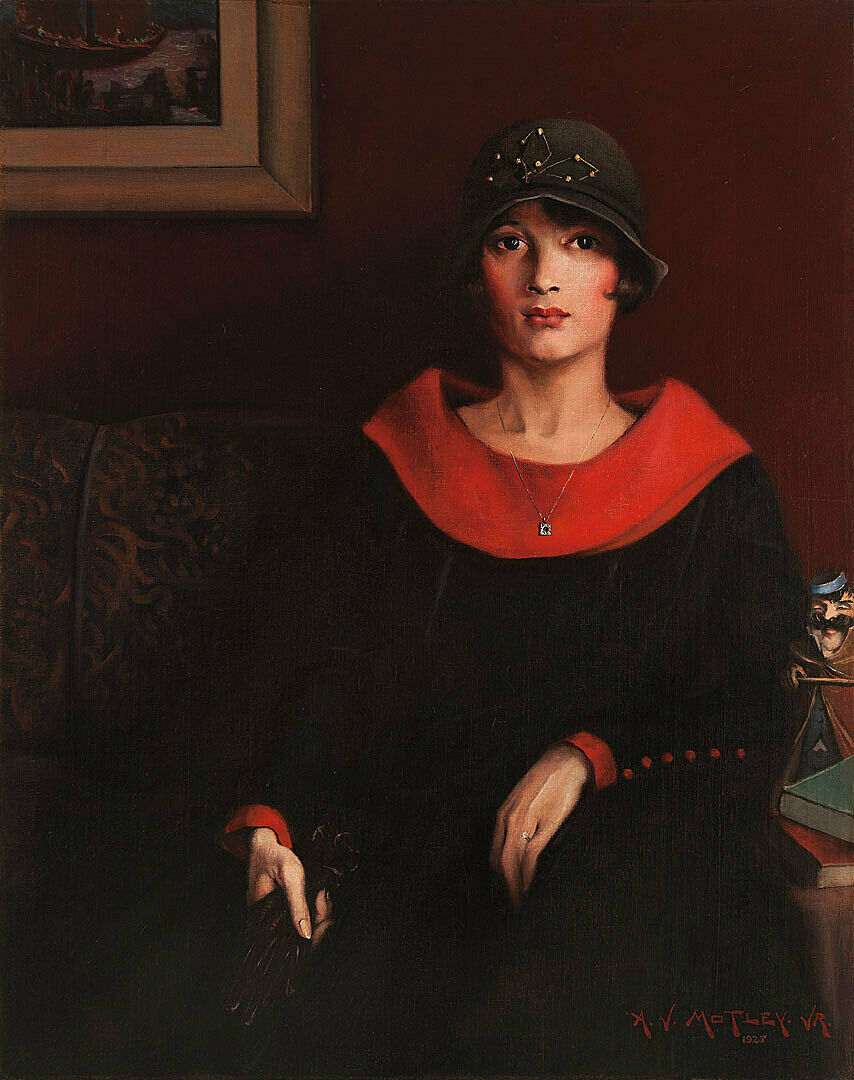
-
804
Archibald J. Motley Jr., Mending Socks, 1924
Kids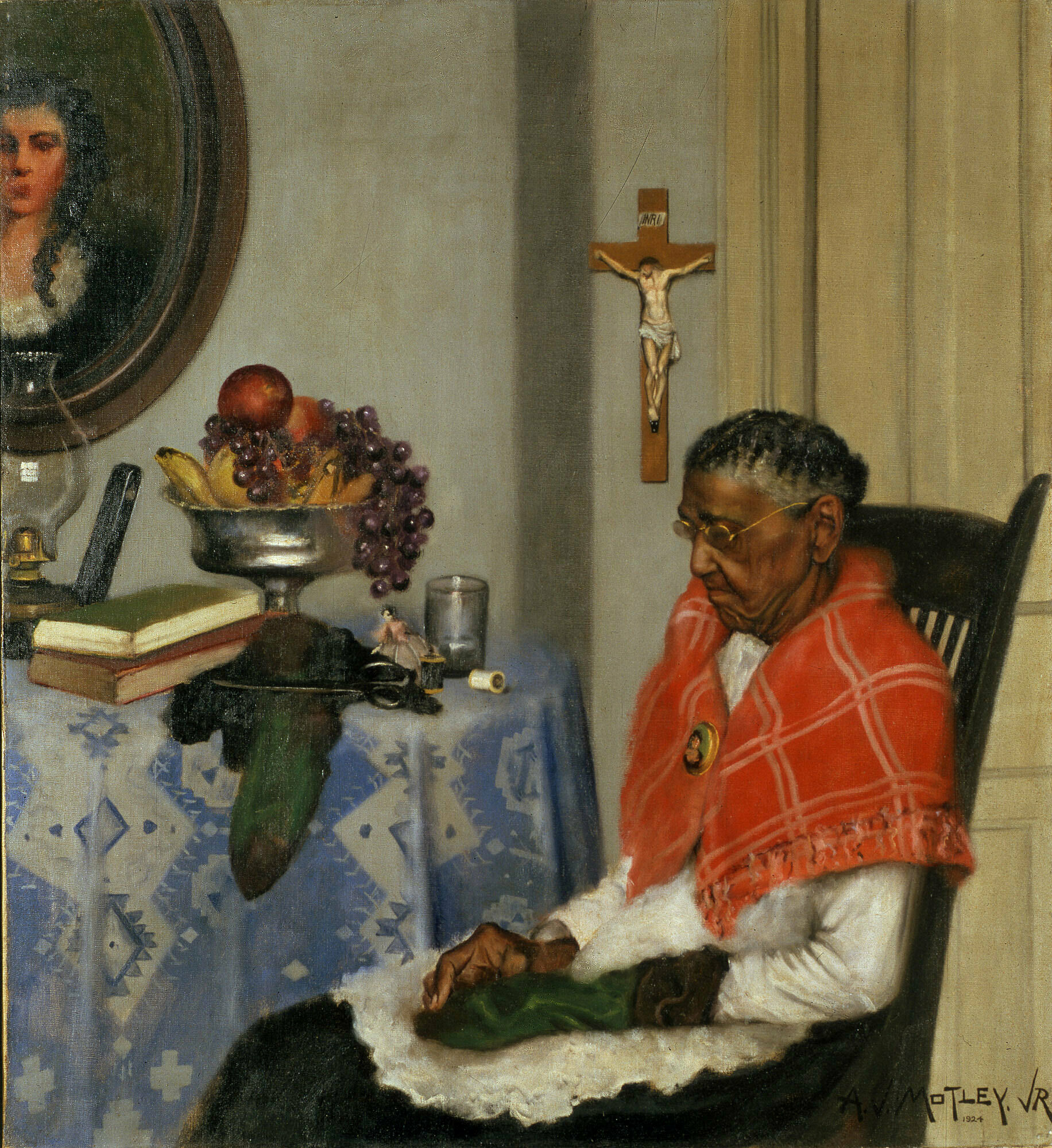
-
812
Archibald J. Motley Jr., Town of Hope, 1927
Kids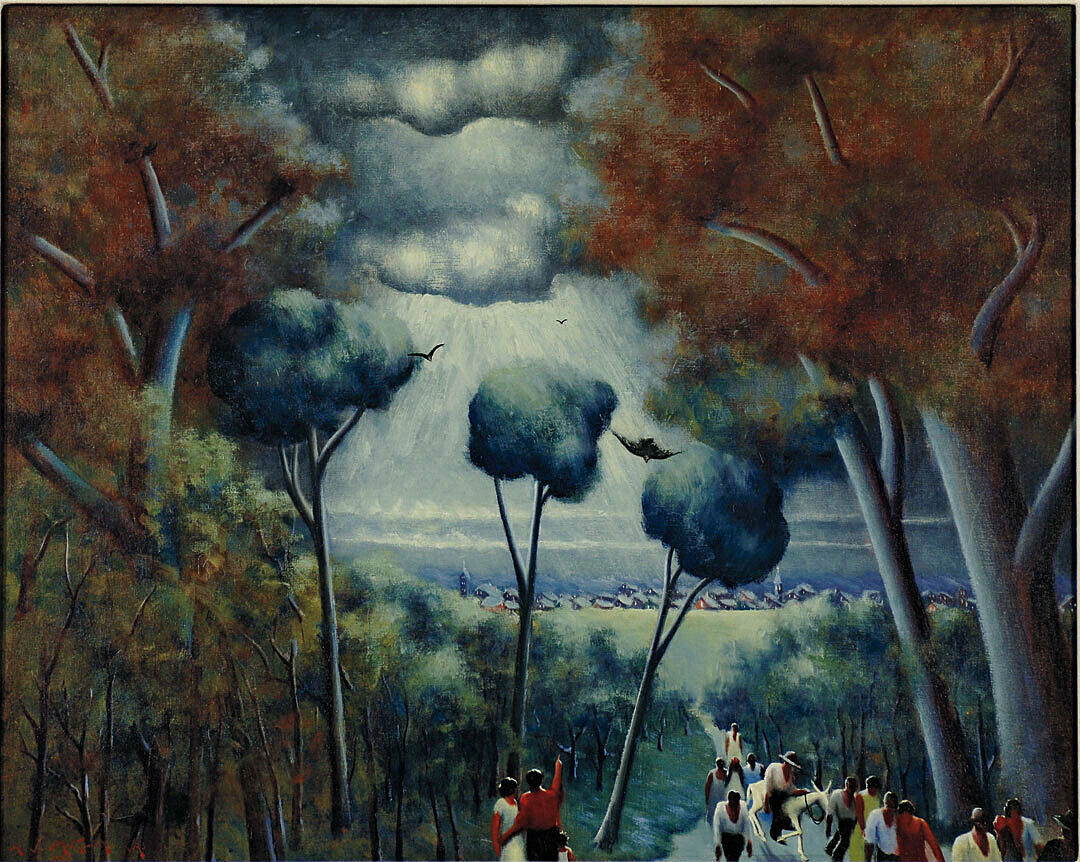
Carter Foster: Welcome to Archibald Motley: Jazz Age Modernist. I’m Carter Foster, Steven and Ann Ames Curator of Drawing, and curator of this exhibition at the Whitney Museum. We often associate the Jazz Age in the United States with Harlem. But as Motley’s career demonstrates, Chicago—among other American urban centers—was also a vital site for the renaissance in African American art after the Great Migration.
Near the entrance, you’ll see a self-portrait that Motley painted in 1933, when he was forty-two years old. Motley had studied painting at the School of the Art Institute of Chicago; his self-portrait emphasizes his classical training as well as his personal refinement.
As you move into the first gallery, you’ll find other portraits that Motley made throughout his career. It was as a portraitist that Motley had his earliest critical and commercial successes. Looking around, you’ll see that he approached his sitters with a great deal of sensitivity, insight, and technical skill. As time went on, Motley widened his scope, chronicling Chicago’s South Side and other sites of black modernism. This exhibition presents us with an opportunity to recognize Motley’s great contribution to American art. Please enjoy your visit.
Narrator: Welcome to this exhibition, Archibald Motley: Jazz Age Modernist. Archibald Motley is best known for portraits, cityscapes, and paintings of jazz clubs. These were all popular subjects in American art during the 1920s, when Motley began his career. But unlike other American artists at the time, he mostly painted the African American community—especially in his hometown, Chicago.
Please walk into the first room of the exhibition—it’s full of vivid, realistic portraits.
Archibald J. Motley Jr., The First One Hundred Years: He Amongst You Who is Without Sin Shall Cast the First Stone: Forgive Them Father For They Know Not What They Do, c. 1963–72. Oil on canvas, 48 7/8 x 40 3/4 in. (124 x 103.5 cm). Collection of Mara Motley, MD, and Valerie Gerrard Browne. Image courtesy the Chicago History Museum. © Valerie Gerrard Browne
NARRATOR: Motley called this painting Mulatress with Figurine and Dutch Seascape, describing his sitter with a historic term referring to a biracial woman. Motley—who was classically trained at the School of the Art Institute of Chicago—places tremendous weight in the details. He uses the woman’s clothes, setting, and calm bearing to emphasize her elegance.
AMY MOONEY: He really opens up this picture so that we can seemingly inquire as to who she is, and moreover, what she is.
NARRATOR: Amy Mooney is Associate Professor of Art and Design at Columbia College, Chicago.
AMY MOONEY: When I look at this woman, she to me seems to possibly be a variety of origins. She could potentially be Italian. She could be potentially from a Spanish background, but Motley brings us back around specifically to the discussion about race in the United States through the title. He doesn't name her as a portrait of Dr. and Mrs. So-and-So. Instead, he specifically prescribes a racial category to her. What's particularly interesting about this is when he puts that code out there, that name, “mulatress,” we as viewers have to figure out what that term means to us in our own understanding of the racial discourse during this time period.
I think that that's purposeful. Motley was really interested in having this discourse with viewers as to how they read the codes and signs of race and especially how those codes and signs could be countered by our assumptions of class and gender.
When we think of someone of mixed race during this time period, we frequently are concerned that there are these elements of not fitting in one group or into the other group. Instead, when we look at the Mulatress, she does fit in. This is her setting. She is confident. These are her elements. There's no crisis here. This reflects some of his own discussion of his own background. Motley was a person of mixed race. He is interested in exploring that through this series of portraits that he does here.
Archibald J. Motley Jr. (1891–1981), Mulatress with Figurine and Dutch Seascape, c. 1920. Oil on canvas, 31.375 × 27.625 in. (79.7 × 75.6 cm). Collection of Mara Motley, MD, and Valerie Gerrard Browne. Image courtesy the Chicago History Museum, Chicago, Illinois © Valerie Gerrard Browne
RICHARD POWELL: The painting entitled Portrait of my Grandmother is one of the most amazing portraits in this group.
NARRATOR: Richard J. Powell is John Spencer Bassett Professor of Art and Art History at Duke University. He curated the exhibition, which originated at Duke’s Nasher Museum of Art.
RICHARD POWELL: It's a portrait of his paternal grandmother, Emily Sims Motley. She was born in Kentucky, under slavery.
NARRATOR: She and the rest of the Motley family came to Chicago by way of Louisiana, part of the Great Migration of African Americans fleeing the Jim Crow South in search of better jobs. Her bedroom was next to Archibald Motley’s studio in his parents’ house.
RICHARD POWELL: Most of the painting is incredibly smooth and one can barely see the brushstrokes—but when you get to this brooch, it's built up with lots of oil paint, and it's gnarled, and it's black with this little tiny dot of red in it.
It has almost the shape that gives you the sense of a heart. But this is not your valentine’s heart, a nice pretty red one that you get on February 14. So one takes from that the obvious associations of expressivity, of what we would call the antithesis of all this smoothness in the work. There's a rough quality to this.
And again, given that we have this biography, this sense of this woman born a slave in 1842, who clearly as a black woman in the mid to late nineteenth century, up to the early twentieth century, has seen a lot, and has experienced perhaps just as much. Yet Motley in his elegant way says I'm going to not so much foreground this, I'm going to place this in the center of the action, but it's going to be surrounded by love. I'm going to surround this with forthrightness. I'm going to surround this with perseverance and survival.
Archibald J. Motley Jr., Portrait of My Grandmother, 1922. Oil on canvas, 38 1/4 × 23 7/8 in. (97.2 × 60.6 cm). Collection of Mara Motley, MD, and Valerie Gerrard Browne. Image courtesy the Chicago History Museum. © Valerie Gerrard Browne
RICHARD POWELL: Motley is probably best known for this painting, Blues. The painting was created in 1929. Archibald Motley was the recipient of a Guggenheim Foundation Fellowship, one of the first African American artists to get that honorific award. He uses his fellowship to go to Paris. He spends 1929 and the early, early bits of 1930 in Paris.
NARRATOR: Paris may have been the capital of modernism in the 1920s—in no small part due to the influence of African American musicians and performers like Josephine Baker and Sidney Bechet. This was fertile territory for Motley. Here, he depicts a real nightclub.
RICHARD POWELL: Le Bal Negre was a popular West Indian cabaret in the fifteenth arrondissement in Paris. This was a multiracial kind of place. Paris had that reputation for not having the same kind of restrictions on blacks and whites fraternizing with one another.
When you look at this painting, you're struck automatically by the density of it, how Motley has chosen to push and to collapse so much within the four sides of the composition. But Motley does this in a very, very sophisticated way so that bodies seem to create patterns and rhythms across the expanse of the composition. Musicians seem to echo and repeat their body motifs. In doing that, Motley is creating rhythm within the picture itself.
Narrator: Motley called this painting Blues—though the brass instruments weaving in and out of the composition suggest that they were listening to jazz music. In the 1920s, when Motley made this painting, jazz music usually involved a swinging beat, and thrilling improvised solos. Can you see how he’s used those ideas in this painting? He’s alternated between dark areas and light or bright ones, giving the painting a strong visual rhythm that’s kind of like a beat. And every once in a while, certain details pop out, like musical soloists—did you notice the single high-heeled foot in the lower right corner? Motley loved to use dramatic lighting to give his paintings energy. What else does he seem to shine a spotlight on?
Motley made this painting in Paris, where he lived for two years. He enjoyed Paris because it was more racially tolerant than the United States. Here, he was probably painting a real nightclub—one where African Americans, Africans, people from the Caribbean, and white Europeans mixed freely.
Archibald J. Motley Jr. (1891–1981), Blues, 1929. Oil on canvas, 36 × 42 in. (91.4 × 106.7 cm). Collection of Mara Motley, MD, and Valerie Gerrard Browne. Image courtesy the Chicago History Museum, Chicago, Illinois. © Valerie Gerrard Browne
DAVARIAN BALDWIN: You see Motley's wonderful cinematic play with spotlight effects, and exaggerated features, and kind of a panoramic view, so here we have not just buildings, or amusement, or sidewalks, but kind of a showcasing of black expressive behavior.
NARRATOR: Davarian Baldwin, the Paul E. Raether Professor of American Studies at Trinity College in Hartford, discusses the painting Black Belt.
DAVARIAN BALDWIN: At the upper‑right‑hand corner, you see the two gentlemen walking in unison as they cross a picture window of the Drop Inn, so there's a certain kind of invitation, and then to the right of that you see kind of a woman looking out of a window. You're not sure if it's a single room occupancy home or if it is a brothel, but of course, it's suggesting it might be a brothel with the word "hot" right above the window. Motley is really good with this kind of diversity of black experience. It captures an actual place, what African American Chicago called The Stroll, which is Black Chicago's commercial and amusement district.
NARRATOR: To hear more about Motley’s Chicago, please tap the button.
Narrator: This painting depicts a street in Chicago known as The Stroll—the business and entertainment district for the predominantly African American neighborhood known as Bronzeville or the Black Belt. Think back to Motley’s portraits, with their extremely naturalistic style. How does this painting feel similar or different? He hasn’t painted the faces with the same detail—he’s more interested in the energy of the crowd. And everything is bathed in strange color from the artificial lights, which makes everything look intense and exciting. Everywhere you look, there are groups of people living out some kind of drama—and Motley seems to invite you to imagine what it is.
Archibald J. Motley Jr. (1891–1981), Black Belt, 1934. Oil on canvas, 33 × 40 1/2 in. (83.8 × 102.9 cm). Hampton University Museum, Hampton, Virginia. Image courtesy the Chicago History Museum. © Valerie Gerrard Browne
Narrator: Davarian Baldwin discusses another one of Motley’s Chicago street scenes, Gettin’ Religion.
Davarian Baldwin: Here, the entire piece is bathed in a kind of a midnight blue, and it gets at the full gamut of what I consider to be black democratic possibility, from the sacred to the profane. In the middle of a commercial district, you have a residential home in the back with a light post above it, and then in the foreground, you have a couple in the bottom left-hand corner. Then in the bottom right-hand corner, you have an older gentleman, not sure if he's a Jewish rabbi or a light-skinned African American.
Like I said this diversity of color tones, of behaviors, of movement, of activity, the black woman in the background of the home, she could easily be a brothel mother or just simply a mother of the home with the child on the steps. You're not quite sure what's going on. It really gets at Chicago's streets as being those incubators for what could be considered to be hybrid cultural forms, like gospel music that came out of the mixture of blues sound with sacred lyrics. You could literally see a sound like that, a form of worship, coming out of this space, and I think that Motley is so magical in the way he captures that. But the same time, you see some caricature here.
The gentleman on the left side, on top of a platform that says, "Jesus saves," he has exaggerated red lips, and a bald, black head, and bright white eyes, and you're not quite sure if he's a minstrel figure, or Sambo figure, or what, or if Motley is offering a subtle critique on more sanctified, or spiritualist, or Pentecostal religious forms. You're not sure if he's actually a real person or a life-sized statue, and that's something that I think people miss is that, yes, Motley was a part of this era, this 1920s and '30s era of kind of visual realism, but he really was kind of a black surreal painter, somewhere between the steady march of documentation and what I consider to be the light speed of the dream.
Archibald J. Motley Jr. (1891-1981), Gettin’ Religion, 1948. Oil on canvas, 40 x 48 3/8 in. (101.6 x 122.9 cm). Whitney Museum of American Art, New York; purchase, Josephine N. Hopper Bequest, by exchange 2016.15
DAVARIAN BALDWIN: Motley loves to play, it seems to me, with expressing class, or status, or difference through curios, through a display of art pieces within the art piece.
NARRATOR: Davarian Baldwin discusses Cocktails.
DAVARIAN BALDWIN: Ways of expressing black distinction here play out with the obvious display of a black butler, but on the back wall, you have a portrait which requires a certain kind of social status to be able to have a portrait done of yourself or of someone in your family. Then, of course, in the middle, we have these lovely society women lunching or having cocktails in the middle of the day, so clearly the expression here is one of leisure.
NARRATOR: Motley’s paintings often suggest the degree to which Motley, who was raised middle class, identified with his subjects—or set himself apart from them.
DAVARIAN BALDWIN: This one is not panoramic like some of his other street scenes. This is more of an inside view, a kind of an interior take on the domicile, so I think that even in the kind of framing of this piece, he's suggesting that he, or the viewer, should feel comfortable on the inside of this piece in a certain kind of way.
Archibald J. Motley Jr., Cocktails, c. 1926. Oil on canvas, 32 x 40 in. (81.3 x 101.6 cm). Museum of Fine Arts, Boston; The John Axelrod Collection-Frank B. Bemis Fund, Charles H. Bayley Fund, and The Heritage Fund for a Diverse Collection. Digital image © 2014 Museum of Fine Arts, Boston, Massachusetts. © Valerie Gerrard Browne
RICHARD POWELL: We have in this image an outdoor scene of people having a good time, couples listening to a guitarist, couples looking at one another under a tree.
NARRATOR: Richard Powell on Motley’s painting, Picnic.
RICHARD POWELL: We have wine and bread, and this kind of a convivial, relaxed scene. But Motley doesn't end there, he infuses in the scene a kind of a fierce modernism. That fierce modernism, I would say, is reflected in a purple tree, in the yellow leaves on that tree, in the incredible pink, and magenta, and purple clothes that many of these people wear. In fact, the colors of many of these people go beyond naturalistic colors. They seem to take on these incredible neon-like chromatics. Then he distorts the bodies in subtle ways so that one gets a sense that this is not just showing people out in a park enjoying themselves, but this is a composition. This is a composition that has to do with almost a modernistic energy that infiltrates everything on the south side of Chicago.
Archibald J. Motley Jr., The Picnic, 1936. Oil on canvas, 30 x 36 in. (76.2 x 91.4 cm). Howard University Gallery of Art, Washington, DC. Image courtesy the Chicago History Museum. © Valerie Gerrard Browne
AMY MOONEY: Here we are looking at Archibald Motley's painting Brown Girl After the Bath. We are allowed to look into this woman's bedroom. If you'll notice a curtain has been pulled back and she sits in front of her vanity looking at us looking at her.
NARRATOR: The painting reflects Motley’s deep familiarity with the Renaissance tradition of the nude—but he also tweaks that tradition with the title, Brown Girl after the Bath. Amy Mooney.
AMY MOONEY: He steps across some of those lines by reminding us again that this is a brown girl, an African American woman, a rare subject for fine art at this period and rarely seen in American museums at this point. Motley is interested in working against that canon that was so exclusionary and did not include beautiful depictions such as the one he's created here for us.
What's also really interesting, too, is as much as we are allowed to look at her, we are confronted with her looking back at us. There's no doubt that she is aware of our interest, our scrutiny as such, and she challenges it. She is a participant in this exhibition of herself, is confident in it, and perhaps comfortable even.
Archibald J. Motley Jr., Brown Girl After the Bath, 1931. Oil on canvas, 48 1/4 x 36 in. (122.6 x 91.4 cm). Columbus Museum of Art, Ohio; gift of an anonymous donor. Image courtesy the Chicago History Museum. © Valerie Gerrard Browne
AMY MOONEY: In this work the artist has set up a tableau, and we can sneak into it almost as if we are voyeurs.
NARRATOR: Amy Mooney.
AMY MOONEY: From the background we can see a gentleman standing at the door. He is dressed in a vaudeville costume where we can see a top hat, a cane, a black suit that's too short, large shoes. Also we can see the mode of exaggeration that the artist is employing in terms of his facial characteristics as if he was going to be a performer in the black-face minstrelsy shows that were popular during this period.
Inside the room we see two women who seem to be in between acts, literally that they are performers in a burlesque at this time. They're scantily clad and seemingly in a moment of rest and kind of not aware that we are looking at them.
What's also really interesting though is how much effort the artist put into th
e setting. So many details, everything from a portrait that's included on the wall to very fine woodwork to the almost target-like rug that one of the woman stands on. The artist seems to be going back and forth between elements that we might consider to be low-brow and elements that are considered high-brow and the fact that so often in modern life the two come to be mixed together. We experience them simultaneously.
When we look at the women in particular, we notice that they don't look back at us as in so many of the other portraits that the artist did. I don't think that this tended to be a portrait per se, but rather a slice of life.
Archibald J. Motley Jr., Between Acts, 1935. Oil on canvas, 39 1/2 x 32 in. (100.3 x 81.3 cm). Terra Foundation for American Art, Chicago; Daniel J. Terra Art Acquisition Endowment Fund. Digital image © Terra Foundation for American Art / Art Resource, New York. © Valerie Gerrard Browne
NARRATOR: Tongues (Holy Rollers) depicts a Pentecostal Church. Motley was raised Roman Catholic. He was obviously fascinated with ecstatic worship—not only the spectacle of people speaking in tongues, but also new musical forms that were being created.
DAVARIAN BALDWIN: Gospel music, or the gospel sound as a form of worship, I mean, what a lot of laypeople don't know is that in '29, the music that we know today as gospel music wasn't fully developed as a standalone style, and form, and genre of music, of worship.
NARRATOR: Davarian Baldwin.
DAVARIAN BALDWIN: Before this, the dominant form of worship was a much more kind of reverent, particularly in large black churches of Chicago and other places, old line form of worship. But here, we have this more kind of working class hybrid form of worship that is being captured visually and taking shape. So, literally, you have the body swing in this piece as if meant to embody a new sonic articulation of black worship and spiritual affect.
Motley is depicting this phenomena ongoing, but there still is some high-level ambivalence in play here for Motley the Catholic, Motley the insider/outsider. If you notice, a lot of the figures in the piece have exaggerated red lips in the Minstrel style, but at the same time, the band, which you wouldn't have in, say, a more traditional form of worship, they're in tuxedos.
Then on the left-hand and right-hand side, you have stage curtains. So, is this a Minstrel show, a rural church, or an urban ballroom theater, you're not quite sure. He never lets you rest on a solid category because of his surreal approach to black life, that he is an artist. He's creative. He's playing with a mixture of tropes and experiences that all compose the black experience.
NARRATOR: To hear more about Motley’s approach to this scene, please tap the button.
Archibald J. Motley Jr., Tongues (Holy Rollers), 1929. Oil on canvas, 29 1/4 x 36 1/8 in. (74.3 x 91.8 cm). Collection of Mara Motley, MD, and Valerie Gerrard Browne. Image courtesy the Chicago History Museum. © Valerie Gerrard Browne
NARRATOR: Richard Powell discusses this painting, Lawd Mah Man’s Leavin.’
RICHARD POWELL: It definitely generates a lot of comments. I think it generates comments because it is so strong. What I mean by strong is that it's a painting that ramps up a lot. Let's just take color, for example—turquoise skies, purple shacks, pea-green grass, and bodies that seem to be pink, and purple, and red.
This is a painting where the color wheel has definitely been turned up. Then, of course, we have these bodies, these people, or rather, let's say, these entities, because they seem to be on the other side of reality.
What I would argue is that first of all, this is not reality. This is straight out of the imagination. This is straight out of the bits and pieces of something that we might call a blues narrative. These were the songs that we heard all throughout that time period. Of course, when you heard Bessie Smith sing St. Louis Blues, the lyrics were about sadness, but she was singing it in such a hilarious, offhanded, almost sly way, that you knew that the words did not connect necessarily with the feeling.
I want to really stress that with Lawd, Mah Man's Leavin', that this is a work that on the surface seems to be stereotypic. But I would say that Motley is strategically using those broad characterizations to make a larger statement. To make a statement, perhaps, about these up-north folks who haven't quite really fit into the slick ways of urban life.
Archibald J. Motley Jr., Lawd, Mah Mans’s Leavin’, 1940. Oil on canvas, 30 1/8x 40 1/8 in. (76.5 x 101.9 cm). Saint Louis Art Museum; gift of the Federal Works Agency, Works Projects Administration. Image courtesy the Chicago History Museum. © Valerie Gerrard Browne
CARTER FOSTER: This is a late painting by Motley, it’s very much toward the end of his life.
NARRATOR: Carter Foster.
CARTER FOSTER: But he worked on this canvas for a long time, almost ten years. And it’s the most overtly political statement that he made as an artist, really. It’s not that politics doesn’t enter into his other works, but here he’s very clearly making a statement about race relations in America. And you see these disembodied heads of these three great figures in American history, Martin Luther King, JFK—John F. Kennedy, Jr.—and Abraham Lincoln, all of whom were assassinated and were in some sense martyrs for the advancement of American history. So that’s very striking.
Also striking is the lynched figure that you see hanging from a tree, right next to the Statue of Liberty. So he’s come up with all of these allegories. It’s an interesting approach to history. It’s not really an organized narrative, it’s—everything sort of functions as a symbol. I think it’s very striking the way he uses this sort of overall blue tonality, which was sort of a signature for him—if you notice his other paintings have this blue tonality that he seemed to like. And he loved artificial light effects. But it’s especially powerful here for the way it offsets the red, and the red really becomes a potent visual contrast to the blue. And with the red you see blood on the right, you see the devil, you have the confederate flag, you see a Ku Klux Klan member with a red insignia on their outfit. You see fire, so the red really pops out, and is forceful in the way it’s making a statement about these events.
NARRATOR: This is the last stop on our tour. Thank you for joining me today, and please enjoy the rest of your visit.
Archibald J. Motley Jr., The First One Hundred Years: He Amongst You Who is Without Sin Shall Cast the First Stone: Forgive Them Father For They Know Not What They Do, c. 1963–72. Oil on canvas, 48 7/8 x 40 3/4 in. (124 x 103.5 cm). Collection of Mara Motley, MD, and Valerie Gerrard Browne. Image courtesy the Chicago History Museum. © Valerie Gerrard Browne
Narrator: This young woman looks us right in the eye. This is the first clue Motley gives us about her personality. What others do you notice? Artists often use people’s hands to tell us about their mood or character—and this woman’s rest calmly in her lap, perfectly manicured, gently grasping an elegant pair of gloves. And what about the colors he’s used? Most of the painting is dark, but her collar, lips, and cheeks stand out in bold red. Everything about this woman suggests that she is confident in herself.
Motley’s portraits of African Americans generally express great dignity. Motley hoped that seeing themselves portrayed in art would help black people feel proud and confident in their identities. He also wanted to help white people see the beauty and accomplishments of African Americans, hoping this might dispel negative stereotypes and racism.
While this woman looks modern, the title Motley gave this painting is old-fashioned. It’s Octoroon Girl. “Octoroon” is an out-of-date term for a person who is one-eighth African American, and usually had somewhat lighter skin—nobody uses this term anymore. Motley once said that he wanted to paint every African-American skin tone there was, from dark to light—showing the beauty of all.
Archibald J. Motley Jr., The Octoroon Girl, 1925. Oil on canvas, 38 x 30 1/4 in. (96.5 x 76.8 cm). Courtesy Michael Rosenfeld Gallery, LLC, New York. Image courtesy the Chicago History Museum. © Valerie Gerrard Browne
Narrator: The woman in this painting is Emily Sims Motley, the artist’s grandmother. Portrait painters like Motley often use props and costumes to tell us about the people they’re picturing. What do you notice here? Motley has put in a lot of detail. Did you notice her pin? The little doll on her table? Motley has also painted her wrinkles and gray curls with loving care.
One of the most important details in this painting is the portrait that hangs on the wall. It’s a white woman, in a formal pose. Motley’s grandmother was born into slavery, and freed at the end of the Civil War—about sixty years before this painting was made. The portrait on her wall shows the daughter of the family who owned her. Take a moment to compare the two images. How are they different? Motley has left the portrait on the wall kind of blurry and indistinct, while his grandmother is detailed and lifelike. He seems to suggest that the world of slavery is a distant memory, and to emphasize the richness of the present.
Archibald J. Motley Jr., Mending Socks, 1924. Oil on canvas, 43 7/8 x 40 in. (111.4 x 101.6 cm). Ackland Art Museum, The University of North Carolina at Chapel Hill; Burton Emmett Collection. Image courtesy the Chicago History Museum. © Valerie Gerrard Browne
Narrator: What kind of a story do you think Motley is telling here? There’s a town on the horizon. A group of people are walking away from it. There are dark clouds, and crows circle overhead. Motley called this painting Town of Hope—is that the title you were expecting?
Between 1910 and 1930, almost two million African Americans left the South, hoping to escape racism and find jobs. This period is known as the Great Migration. Many migrants, like Motley’s own family, came to Chicago. They mostly traveled on trains or buses—not on foot, like the people in this painting. This isn’t a straightforward picture of the Great Migration, but it is an imaginative response to it. Motley leaves the meaning of this painting up to you. Do you think these people are walking away from their homes in the South? Or did they try to go to the town on the horizon—and find that it was less welcoming than they had hoped?
Some of Motley’s other paintings show the vibrant communities that African Americans were able to form in Chicago. But this painting reminds us that the Great Migration was a time of difficulty as well as hope and possibility.
Archibald J. Motley Jr., Town of Hope, 1927. Oil on canvas, 38 1/2 × 31 1/2 in. (80 × 97.8 cm). Johnson Publishing Company. Image courtesy the Chicago History Museum. © Valerie Gerrard Browne
0:00
0:00