
Noah Wardrip-Fruin, Adam Chapman, Brion Moss, Duane Whitehurst: The Agent’s Story
February 2003
Noah Wardrip-Fruin, Adam Chapman, Brion Moss, Duane Whitehurst: The Agent’s Story
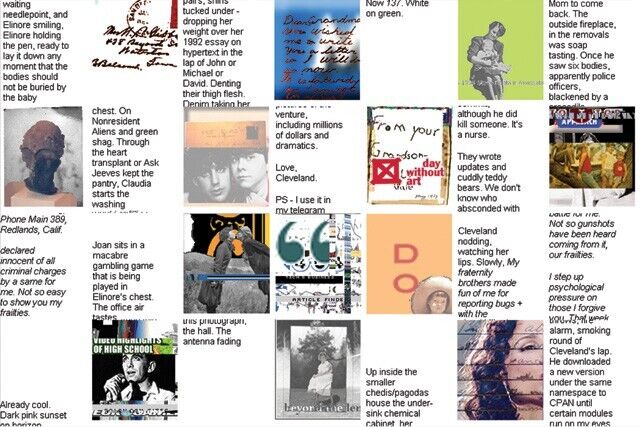
The Agent’s Story by Noah Wardrip-Fruin, Adam Chapman, Brion Moss, and Duane Whitehurst was a sequel to their work The Impermanence Agent (1998), a storytelling web agent. In that earlier work, the agent monitored each user’s web browsing and then customized the texts and images from the visited pages into a narrative. The Agent’s Story turned the original project inside out: rather than showing each user a personalized story, it presented all visitors with stories altered by the browsing of a few “featured” individuals. Throughout February 2003, the agent’s story was progressively changed by the browsing of these selected users, with the results continually viewable to every visitor of the Gate Page. The project thus shifted from an individual to a collective experience, and from long-term customization by a single user to a one-month surveillance of a group. Visitors did not see the original story, only the results of many alterations; they saw not the respective browser’s story but the agent’s.
Noah Wardrip-Fruin (b. 1972; Palo Alto, California) explores new models of storytelling in games, how games express ideas through play, and the literary possibilities of computational media. His collaborative playable media projects, including Screen (2003) and Talking Cure (2002), have been presented in New York by the Guggenheim Museum, and the New Museum; as well as at the Krannert Art Museum, University of Illinois, Urbana-Champaign; the Hammer Museum, Los Angeles; and a wide variety of festivals and conferences. He is a professor of computational media at the University of California, Santa Cruz, and codirects the Expressive Intelligence Studio, a technical and cultural research group.
Adam Chapman (b. 1972; Los Angeles, California) has exhibited internationally at venues including the Fundació Pilar i Joan Miró, Palma de Mallorca, Spain; the deCordova Sculpture Park and Museum, Lincoln, Massachusetts; the Triennale der Photographie Hamburg, Germany; the Museum of the Moving Image, Queens; and the Catharine Clark Gallery, San Francisco. Chapman has been a visiting artist at the American Academy in Rome; MacDowell Colony, Peterborough, New Hampshire; Anderson Ranch Arts Center, Snowmass Village, Colorado; and the Banff Centre for Arts and Creativity, Canada, among others. He has taught at Yale University, New York University, and Parsons School of Design, The New School.
Brion Moss (b. 1973; Palo Alto, California), an engineer by training and vocation, does not generally think of himself as an artist, but thoroughly enjoyed being part of the conceptualization and creation of The Impermanence Agent and The Agent’s Story.
In the 1990s, Duane Whitehurst (b. 1969; Burlington, North Carolina) worked for the Voyager Company and New York University. After moving to the Pacific Northwest in 1999, he has been working in energy efficiency and local government technology projects. He thinks it is a testament to the internet’s potential that the group who made this Gate Page did not have its first in-person meeting until the project was completed.
Gate Pages
Every month from March 2001 to February 2006, the Whitney invited an artist or collective to present their work in the form of a “Gate Page” on artport. Each page was meant to function as a portal to the artist’s own sites and projects. The Gate Pages comprise a range of artistic approaches to the format—while some of them are designed as entry points to the respective artist’s website or promote a recently launched work, others take the form of a more complex stand-alone project.
Wherever necessary and possible, these works are made functional through emulation and reconstructions from the Internet Archive. Not all of them have been restored to their original state and their conservation is ongoing. You can also view the original Gate Pages archive to see how they were presented at the time of their creation.
artport
View more on artport, the Whitney Museum's portal to Internet and new media art.