
Memo Akten & Katie Hofstadter: The Thinking Ocean
2026
Memo Akten & Katie Hofstadter: The Thinking Ocean
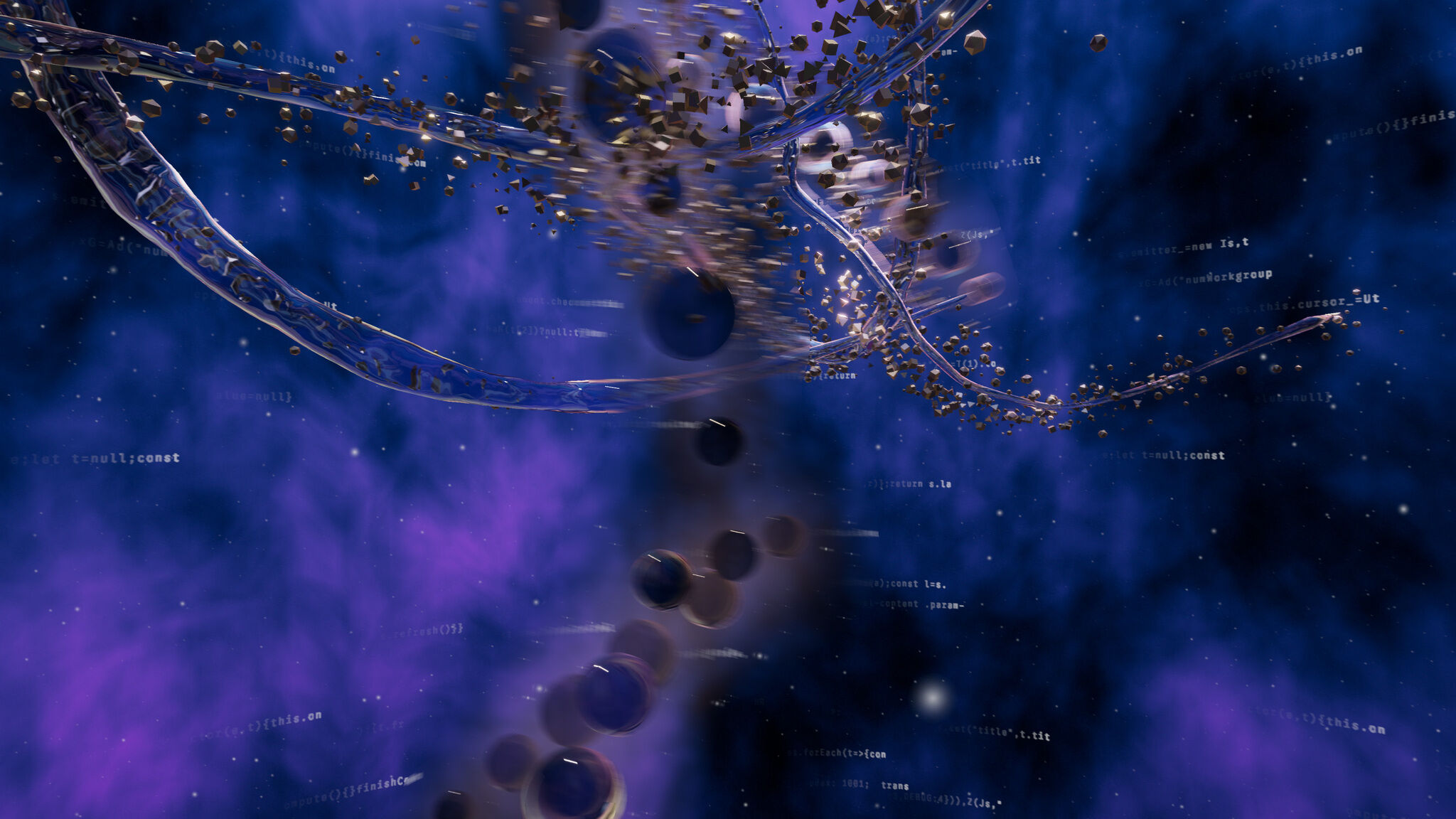
Memo Akten & Katie Hofstadter, still from The Thinking Ocean, 2026
The Thinking Ocean by Memo Akten and Katie Hofstadter, part of their series Cosmosapience, simulates a dynamic body of water, fluctuating between the physics of fluids and the logic of code. Viewers navigate an underwater scene, with drifting clouds of particulate matter and swirls of bubbles. The environment becomes increasingly abstracted, morphing into patterns reminiscent of organic cell structures, circuitry, and code. Currents generated by the movement of a faintly visible, abstract, humanlike form create the perception of the ocean as an embodied presence. The shift between fluid dynamics and computation exposes oceans and computers as expressions of the same underlying principles—systems that can store and transmit information and flow. Recent research has shown that Navier-Stokes equations, which govern the movement of fluids like water and air, in principle can perform any computation that a digital computer can. The Thinking Ocean highlights our increasing bias towards granting agency to machines that mimic human behavior while failing to notice the complex computations of natural systems. The work is accompanied by a voice reciting a nonlinear poem that is procedurally constructed in real time.
Alexander Whitley, choreography, performance, and motion capture; Paige Emery, music and soundscapes; Niklas Niehus, WebGPU consultant and developer; and Milana Aernova, studio assistant
Developed in dialogue with researchers at the Scripps Institution of Oceanography’s SOARS Lab (Scripps Ocean-Atmosphere Research Simulator).
Memo Akten & Katie Hofstadter are interdisciplinary artists and researchers whose work investigates the entanglements of technology, consciousness, embodiment, and culture. Together, their collaborative research and practice explore how emerging technologies—particularly AI and data systems—interact with the embodied, emotional, and ecological dimensions of human experience.
Memo Akten (b. 1975; Istanbul, Türkiye) is an artist, musician, and researcher whose practice bridges machine learning, consciousness, perception, and spirituality. He is a pioneer in artistic explorations of deep neural networks and a recipient of the Prix Ars Electronica Golden Nica (2013). His works have been exhibited worldwide, from the Ming Contemporary Art Museum, Shanghai, and the Moscow Museum of Modern Art to the Grand Palais in Paris and the Venice Biennale.
Katie Hofstadter (b. 1981; Macon, Georgia) is a multidisciplinary artist, writer, and curator whose work investigates the complex relationships between embodiment, consciousness, and technologically mediated imagination. Her projects have been exhibited worldwide, and her writing appears in publications like Flash Art, Bomb, and The Bulletin of Atomic Scientists. She is cofounder of global public art campaigns such as the ARORA network and the Climate Clock in New York.
artport
View more on artport, the Whitney Museum's portal to internet art and its online gallery space for commissions of net art.