
Natalie Bookchin: Metapet Splash
May 2003
Natalie Bookchin: Metapet Splash
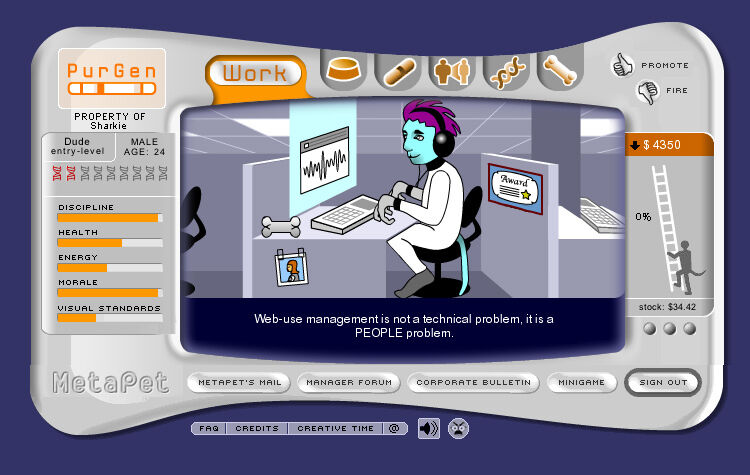
Metapet Splash is an entry page to Natalie Bookchin’s online game Metapet (2002), which relaunched in an updated version on May 1, 2003, and exists as an archive today. The work explored the social and political concerns surrounding genetic engineering, corporate culture, and the electronic gaming industry. Players took on the role of the corporate manager of a Metapet, a hybrid species created by inserting a gene from a trained dog into a human to create a more obedient worker. The player’s challenge was to find the right balance between a firm hand and a gentle coax; offering promotions or vacations, for example, would make the bioengineered pet work more efficiently. Bookchin’s game placed the player at the center of corporate biotech culture and made them experience the role of a complicit manager.
The original Metapet is no longer online, but it can still be partially viewed on the Internet Archive, and more information about the project is available at bookchin.net/projects/metapet.
Natalie Bookchin (b. 1962; New York, New York) has made single and multi-channel video and sound works, films, interactive installations, photographs, performances, texts, net art, online computer games, embroidery, drawing, and hacktivist public interventions. Her work has been shown at venues including MoMA PS1, the Kitchen, and the International Center of Photography in New York; the Los Angeles County Museum of Art and the Museum of Contemporary Art, Los Angeles; the Massachusetts Museum of Contemporary Art, North Adams; Tate Modern, London; Centre Pompidou, Paris; and La Virreina Center de la Imatge, Barcelona. She has received awards and fellowships from the California Arts Council (2002); the Guggenheim Foundation (2002); the Center for Cultural Innovation (2009–11); the Durfee Foundation (2007); the Rockefeller Foundation (2004); the California Community Foundation (2007); the Jerome Foundation (1999); the Daniel Langlois Foundation for Art, Science, and Technology; and the Yaddo (2016) and MacDowell (2016) communities, among others.
Gate Pages
Every month from March 2001 to February 2006, the Whitney invited an artist or collective to present their work in the form of a “Gate Page” on artport. Each page was meant to function as a portal to the artist’s own sites and projects. The Gate Pages comprise a range of artistic approaches to the format—while some of them are designed as entry points to the respective artist’s website or promote a recently launched work, others take the form of a more complex stand-alone project.
Wherever necessary and possible, these works are made functional through emulation and reconstructions from the Internet Archive. Not all of them have been restored to their original state and their conservation is ongoing. You can also view the original Gate Pages archive to see how they were presented at the time of their creation.
artport
View more on artport, the Whitney Museum's portal to Internet and new media art.