
George Legrady: Making Visible the Invisible
November 2005
George Legrady: Making Visible the Invisible
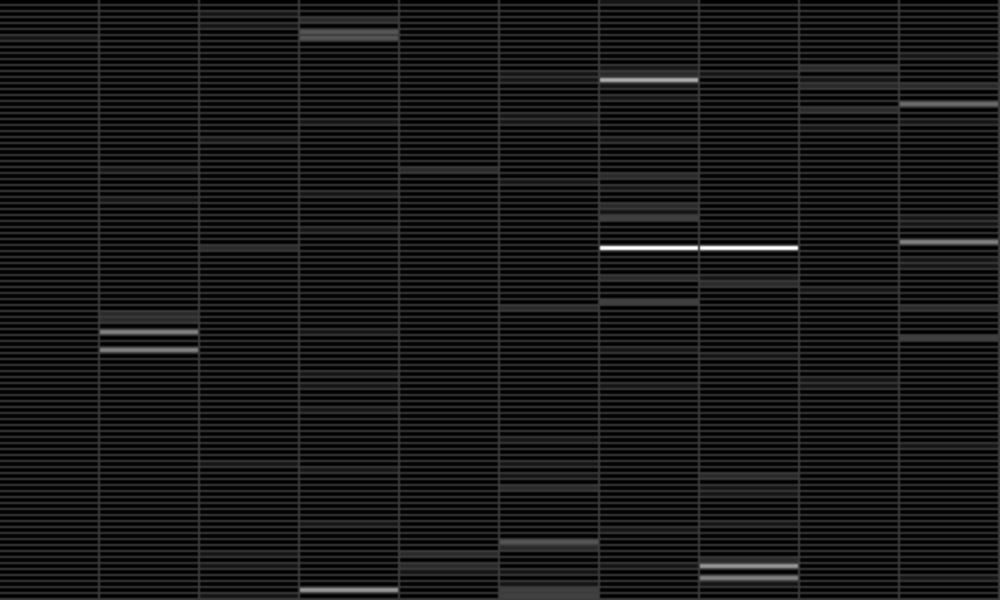
Making Visible the Invisible by George Legrady is a data visualization project based on statistical analysis of the book and media circulation in the Seattle Central Library. The Gate Page is a database that tracks hourly data of library checkouts, including books, CDs, DVDs, and other materials. The data at the library is classified in two separate categories: fiction and nonfiction items arranged by discipline according to the Dewey Decimal Classification System. The Gate Page features the number of books checked out, a map highlighting current circulating books according to their Dewey classification category, an hourly histogram of circulation activities, and the top twenty most active Dewey categories. Clicking on each category reveals a chronological list of titles checked out during the previous hour. One of the longest continuously running online data visualization sites to date, the work reveals the ways in which information flows and how subjects of interest evolve over time, making visible the invisible patterns of collective knowledge consumption.
Project credits: George Legrady, concept and artistic direction; Andreas Schlegel, web design and interface.
George Legrady (b. 1950; Budapest, Hungary) has explored born-digital processes in fine arts since the mid-1980s. His work has ranged from a fusion of computation with photography to multilinear interactive narratives to site-specific installations using custom software for real-time visualization. His installations have been exhibited internationally since the early 1990s at venues including the Cornerhouse Gallery (1985–2015), Manchester, United Kingdom; the Museum of Contemporary Art Kiasma, Helsinki; Centre Georges Pompidou, Paris; Ars Electronica, Linz, Austria; DEAF (Dutch Electronic Art Festival), Netherlands; the San Francisco Museum of Modern Art; and the National Gallery of Canada. He has received awards from Creative Capital Foundation (2002); the Daniel Langlois Foundation for the Art, Science, and Technology (2000); the Canada Council for the Arts (1992, 1994, 1997); and the National Endowment for the Arts (1996).
Andreas Schlegel (b. 1975; Stuttgart, Germany) is a Singapore-based artist and educator whose practice bridges art, design, and technology. His solo and collaborative works have been exhibited at the Institute of Contemporary Arts Singapore, National Gallery Singapore, Groninger Museum in the Netherlands, Total Museum of Contemporary Art in Seoul, and Tainan Art Museum in Taiwan, among others. He holds degrees from UC Santa Barbara and Merz Akademie, Stuttgart, and teaches at LASALLE College of the Arts, University of the Arts Singapore.
Gate Pages
Every month from March 2001 to February 2006, the Whitney invited an artist or collective to present their work in the form of a “Gate Page” on artport. Each page was meant to function as a portal to the artist’s own sites and projects. The Gate Pages comprise a range of artistic approaches to the format—while some of them are designed as entry points to the respective artist’s website or promote a recently launched work, others take the form of a more complex stand-alone project.
Wherever necessary and possible, these works are made functional through emulation and reconstructions from the Internet Archive. Not all of them have been restored to their original state and their conservation is ongoing. You can also view the original Gate Pages archive to see how they were presented at the time of their creation.
artport
View more on artport, the Whitney Museum's portal to Internet and new media art.