
Beatriz da Costa, Jamie Schulte, Brooke Singer: SWIPE Stickers
June 2004
Beatriz da Costa, Jamie Schulte, Brooke Singer: SWIPE Stickers
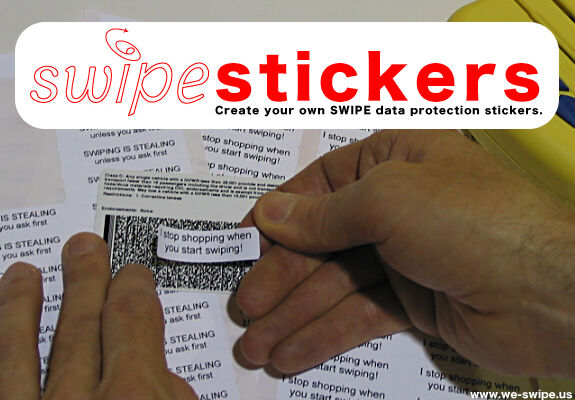
The online sticker-making project SWIPE Stickers—by Beatriz da Costa, Jamie Schulte, and Brooke Singer (aka Preemptive Media)—was part of the artist collective’s larger work Swipe, which critiques the collection of personal data from magnetic stripes, commonly used for data storage in the 1990s, or 2D barcodes on credit cards and items like driver’s licenses. With a single swipe, companies can extract information, often without the cardholder’s knowledge or consent, to profile customers under the guise of security or age verification. During the month of June 2004, the artists invited visitors to the Gate Page to submit slogans for stickers. Participants could then download, print, and affix the stickers to the barcode of their license or credit card’s magnetic stripes to temporarily disable them, thus blocking their data’s transfer into commercial databases. The Swipe project drew attention to data collection and surveillance practices in the United States, highlighting how databases function as tools of organization and instruments of power in the digital age.
The artist collaborative Preemptive Media (active 2002–6) produced three major projects, Swipe, Zapped! (2006), and AIR (2006–8). Each member brought a variety of specializations, experiences, and interdisciplinary interests to the collaborative practice.
Beatriz da Costa (1974–2012) was an interdisciplinary artist and tactical media practitioner working at the intersection of contemporary art, science, engineering, and politics. She examined the role of the artist as a political actor engaged in technoscientific discourses, which is the subject of her 2008 book Tactical Biopolitics: Art, Activism, and Technoscience, co-edited with Kavita Philip. A retrospective of her work, Beatriz da Costa: (un)disciplinary tactics was presented in 2024 by the Los Angeles Municipal Art Gallery as part of the Getty’s initiative PST Art: Art & Science Collide.
Jamie Schulte is an engineer with an interest in designing systems that engage human aesthetics, culture, and politics. He holds master’s degrees in electrical and computer engineering and in knowledge discovery and data mining from Carnegie Mellon University, Pittsburgh. He has exhibited work throughout the United States, and in countries including Canada, Germany, Austria, the United Kingdom, and Brazil.
Brooke Singer engages technoscience as an artist and educator in websites, gardens, workshops, photographs, maps, installations, and public art that often involves participation in pursuit of social change. She is professor of new media the State University of New York, Purchase. She has exhibited nationally and internationally at institutions such as MoMA PS1, New York; the Andy Warhol Museum of Art, Pittsburgh; the Banff Centre for Arts and Creativity, Canada; the Neuberger Museum of Art, Purchase, New York; and Matadero Madrid.
Gate Pages
Every month from March 2001 to February 2006, the Whitney invited an artist or collective to present their work in the form of a “Gate Page” on artport. Each page was meant to function as a portal to the artist’s own sites and projects. The Gate Pages comprise a range of artistic approaches to the format—while some of them are designed as entry points to the respective artist’s website or promote a recently launched work, others take the form of a more complex stand-alone project.
Wherever necessary and possible, these works are made functional through emulation and reconstructions from the Internet Archive. Not all of them have been restored to their original state and their conservation is ongoing. You can also view the original Gate Pages archive to see how they were presented at the time of their creation.
artport
View more on artport, the Whitney Museum's portal to Internet and new media art.