
Benjamin Fry: computational information design | sketches
September 2005
Benjamin Fry: computational information design | sketches
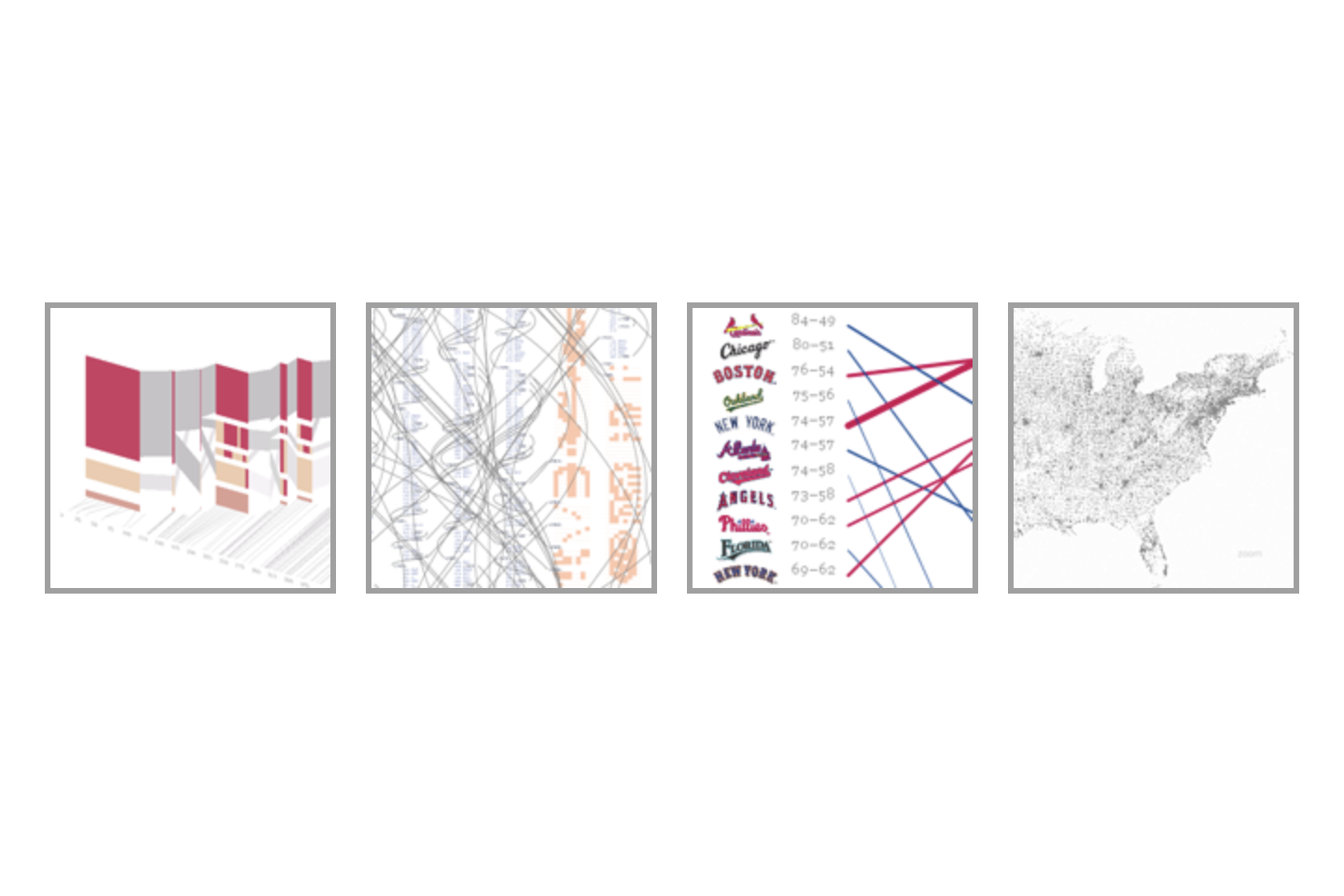
Benjamin Fry’s computational information design | sketches acts as an entry portal to four interactive sketches that combine information visualization, data mining, and graphic design to interpret complex datasets. Each sketch offers a unique approach to data representation and explores how visualization shapes new understandings of information. The sketch isometricblocks looks at deviations in genetic data among individuals, specifically so-called single-nucleotide polymorphisms (SNPs or “snips”), single-letter changes that occur every few thousand letters in the genome and exhibit distinct patterns. Researchers look for these patterns in genome sections of hundreds of people in search of diseases such as Crohn’s—a dataset used in isometricblocks. The distellamap sketch visualizes the internal operations of code within six Atari 2600 cartridge games, among them Combat and Pac-Man. The maps show the code as columns of assembly language, with conditional statements—such as “if x is true, go to y —visualized as curves drawn from the point of the statement to its destination. The sketch salary vs. performance analyzes the relationship between team spending and rankings during the 2005 Major League Baseball season; and zipdecode allows users to input US postal codes to see their corresponding geographic locations on a map.
Benjamin Fry (b. 1975; Ann Arbor, Michigan) creates work combining computer science, statistics, graphic design, and data visualization to explore information. With Casey Reas in 2001, he created Processing, an open-source programming language and environment. His work has been shown in the 2002 Whitney Biennial and the 2003 and 2006 Cooper Hewitt Smithsonian Museum National Design Triennial, as well as at the Museum of Modern Art and the International Center of Photography in New York; Ars Electronica, Linz, Austria; and in the films Minority Report (2002) and Hulk (2003). Fry was selected as one of Fast Company’s Fifty Most Influential Designers in America (2011) and as one of Slate’s Top Right (2011) and received the National Design Award for Interaction Design (2011).
Gate Pages
Every month from March 2001 to February 2006, the Whitney invited an artist or collective to present their work in the form of a “Gate Page” on artport. Each page was meant to function as a portal to the artist’s own sites and projects. The Gate Pages comprise a range of artistic approaches to the format—while some of them are designed as entry points to the respective artist’s website or promote a recently launched work, others take the form of a more complex stand-alone project.
Wherever necessary and possible, these works are made functional through emulation and reconstructions from the Internet Archive. Not all of them have been restored to their original state and their conservation is ongoing. You can also view the original Gate Pages archive to see how they were presented at the time of their creation.
artport
View more on artport, the Whitney Museum's portal to Internet and new media art.