
Marc Lafia and Fang-Yu Lin: The Battle Of Algiers
2006/2018
Marc Lafia and Fang-Yu Lin: The Battle Of Algiers
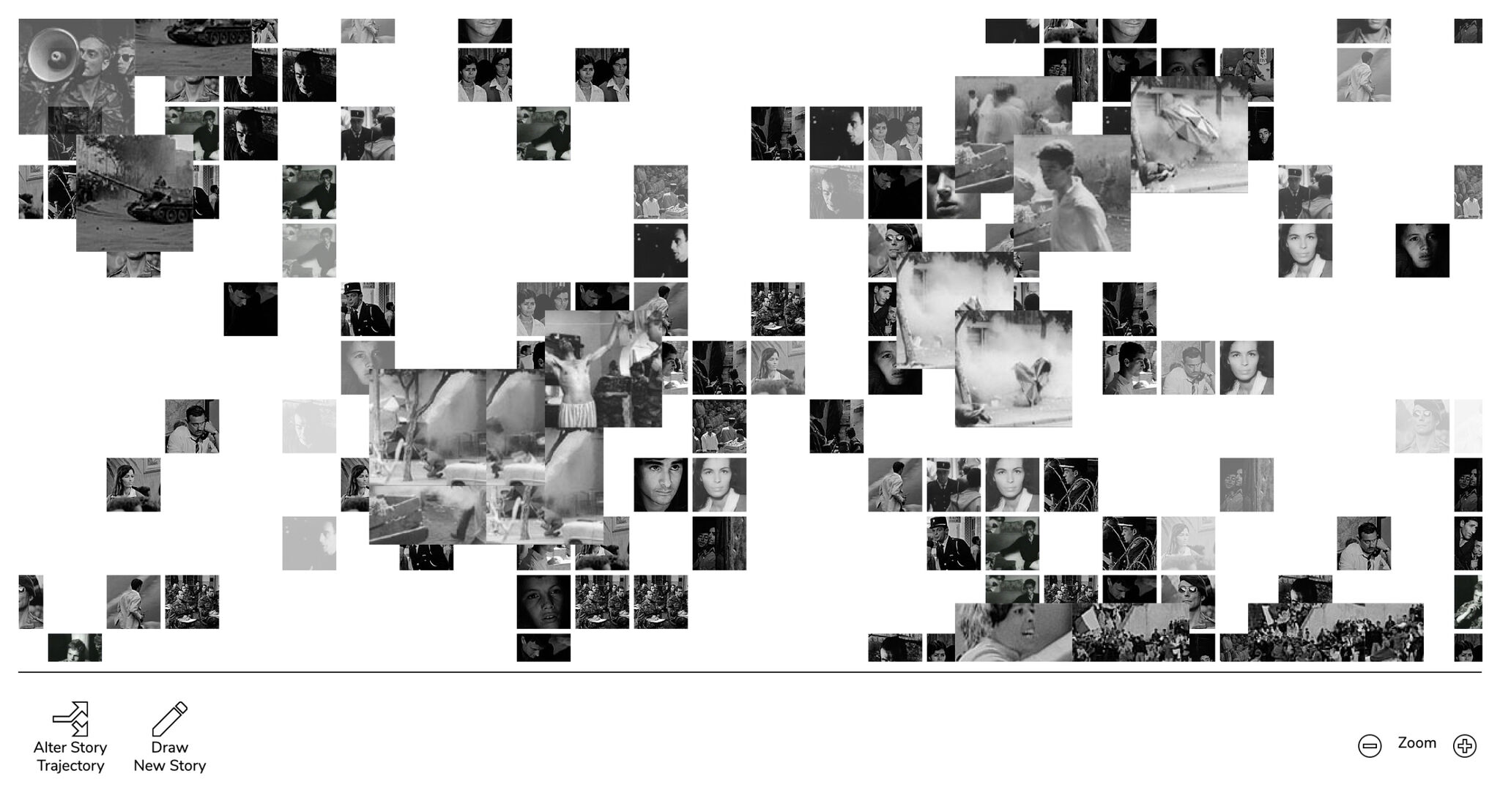
Screenshot of Marc Lafia and Fang-Yu Lin’s The Battle of Algiers, launched March 1, 2006. Restored version, 2018
Marc Lafia and Fang-Yu Lin’s The Battle of Algiers recomposes scenes from the 1966 film of the same title by Italian director Gillo Pontecorvo. The original film is a reenactment of the Algerian nationalist struggle leading to independence from France in 1962. The success of the actual battle for independence has been attributed to the nationalists’ organization: a pyramidal structure of self-organized cells. Lafia and Lin recomposed the film along a cell-based structure, in which the French Authority and Algerian Nationalist cells are represented by stills from the film and move according to different rule sets. When cells of the opposing camps intersect, they trigger videos displaying each side’s tactics (as depicted in the film) according to the rules of the system.
The Battle of Algiers was updated in 2018 to work in modern web browsers with a new user interface, as part of Programmed: Rules, Codes, and Choreographies in Art, 1965–2018.
The Battle of Algiers was the second in a series of three works co-commissioned in collaboration with Tate Online. Critical texts and video interviews with the artists accompany the works at Tate.
Read more about the work and its 2018 reconstruction at tate.org.uk.
Marc Lafia (b. 1955; Philadelphia, Pennsylvania) is an artist and filmmaker whose work explores how network culture changes our relationship to knowledge, memories, and our bodies, producing new subjectivities and ways of interacting with the world. For Lafia, computation and algorithmic procedures allow for the production of new structures of organizing image and information, as well as new ways of distributing affects and emotions. Lafia’s works have been exhibited at the Walker Art Center, Minneapolis; the Whitney Museum of American Art, New York; Tate Online; ZKM Center for Art and Media Karlsruhe, Germany; the Centre Pompidou, Paris; Anthology Film Archives, New York; International Film Festival, Rotterdam, Netherlands; and in China at the Minsheng Art Museum, Shanghai, and the 2014 Shenzhen Sculpture Biennale. He has taught in California at Stanford University, the San Francisco Art Institute, and Art Center College of Design in Pasadena, as well as at Pratt Institute and Columbia University in New York.
Fang-Yu Lin (b. 1973, Taipei, Taiwan) is a new media artist and technologist. Focusing on internet art and interactive installation, Fang’s work reflects the interplay of human experience, culture, and technology. In addition to receiving an honorary mention from Prix Ars Electronica (2005), his works have been featured in venues such as Tate Online; FILE Electronic Language International Festival, Brazil; Seoul New Media Festival; Les Rencontres Internationales, Bauhaus Dessau, Germany; and SIGGRAPH. Fang coauthored, with Alison Lewis, Switch Craft: Battery-Powered Crafts to Make and Sew (2008), a wearable-technology DIY book. He holds an MFA in design and technology from Parsons School of Design, The New School, and an MS in information from the University of Michigan.
artport
View more on artport, the Whitney Museum's portal to internet art and its online gallery space for commissions of net art.