
Alexander Galloway: How to Win “Super Mario Bros”
April 2003
Alexander Galloway: How to Win “Super Mario Bros”
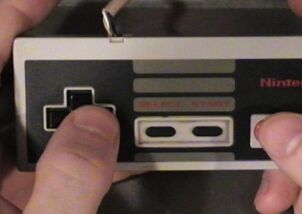
How to Win “Super Mario Bros” by Alexander R. Galloway gives users access to thirty-two text files that map every single click required for a successful playthrough of the game, resembling pseudo-conceptual scores in binary code. Accompanying the texts are thirty-two downloadable video files that document the artist’s finger movements on the controls as he maneuvers each stage of the game from start to finish. Galloway’s work presents a paradox: while it appears to provide instructions on how to win the game, it is nearly impossible for any user to re-create the artist’s exact actions. In this way, the work opens a conversation about the ways in which information is made visible or obscured within digital systems.
Alexander R. Galloway (b. 1974; Walnut Creek, California), a writer and computer programmer, explores issues in philosophy, technology, and theories of mediation. As the founding member of the Radical Software Group (RSG, 2001), he is the creator of Carnivore (launched 2001), a networked surveillance tool based on the notorious FBI software of the same name. Carnivore has been exhibited internationally and won a Prix Ars Electronica 2002 Golden Nica. Galloway is a recipient of a Guggenheim Fellowship (2019) and the Berlin Prize (2018). He is a professor of media, culture, and communication at New York University and the author of several books on digital media and critical theory, including Uncomputable (2021), Excommunication: Three Inquiries in Media and Mediation (with Eugene Thacker and McKenzie Wark, 2013), The Interface Effect (2012), and PROTOCOL: How Control Exists after Decentralization(2003).
Gate Pages
Every month from March 2001 to February 2006, the Whitney invited an artist or collective to present their work in the form of a “Gate Page” on artport. Each page was meant to function as a portal to the artist’s own sites and projects. The Gate Pages comprise a range of artistic approaches to the format—while some of them are designed as entry points to the respective artist’s website or promote a recently launched work, others take the form of a more complex stand-alone project.
Wherever necessary and possible, these works are made functional through emulation and reconstructions from the Internet Archive. Not all of them have been restored to their original state and their conservation is ongoing. You can also view the original Gate Pages archive to see how they were presented at the time of their creation.
artport
View more on artport, the Whitney Museum's portal to Internet and new media art.