MY MELODRAMA: BODY GENRE AND ROY LICHTENSTEIN’S FEMINIZED DISTRESS
Carmen Winant
Related exhibition
The exhibition Roy Lichtenstein: Like New is on view Oct 11, 2026–May 10, 2027.
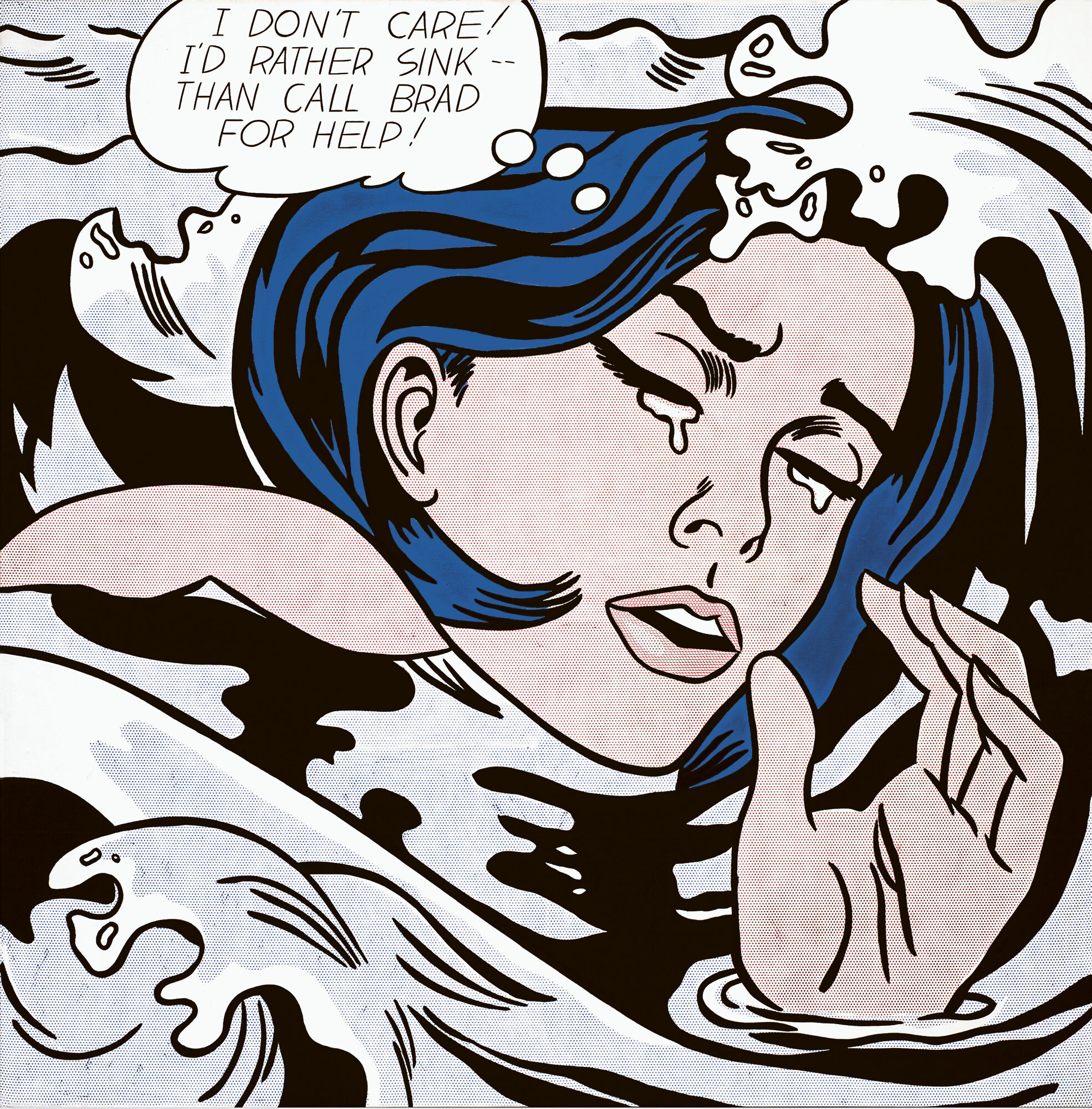
Fig. 1. Roy Lichtenstein, Drowning Girl, 1963. Oil and acrylic on canvas, 67 5/8 × 66 3/4 in. (171.6 × 169.5 cm). The Museum of Modern Art, New York. Philip Johnson Fund (by exchange) and gift of Mr. and Mrs. Bagley Wright. © Estate of Roy Lichtenstein/DACS 2026 © The Museum of Modern Art/Licensed by SCALA/Art Resource, NY.
When I was in sixth grade, I was prompted by other girls in my class to physically hide from someone who I had thought was our friend. At recess, as she walked around calling for us, we quietly crouched, out of sight in an outdoor playground structure. The only rationale given for this act was that she was “too melodramatic,” a designation we surely would never have assigned to a boy. Years later, as an undergraduate student, I took a film studies course about domestic narratives. We read theorists like Laura Mulvey and bell hooks, and I was prompted, for the first time, to consider melodrama not as an insult but as a subversive tool—a means of exploring women’s emotional, sometimes pathologized, desires.See Laura Mulvey, “Visual Pleasure and Narrative Cinema,” Screen 16, no. 3 (1975): 6–18; and bell hooks,“The Oppositional Gaze: Black Female Spectators,” Black Looks: Race and Representation (Boston: South End Press, 1992), 115–31.Between these events and thousands of others in between, I discerned that melodrama belongs to the excesses of women and all bodies marked by gender. When asked to write a short essay on gendered melodrama in Roy Lichtenstein’s work, I immediately said yes. But then came the harder question: Which melodrama would I be writing about?
Academic scholarship offers a multitude of definitions for the term melodrama. It references a genre, a mode, a style, a historical form, and even—my favorite—a way of feeling. It encompasses gothic, romantic, social, and disaster narratives, along with their many subcategories: nautical, equestrian, crime, medical, fantasy, familial, religious, and political. And it can unfold anywhere: at the kitchen sink, on a horse, in a hospital, out at sea. Its stakes, however, remain constant. Melodrama is rooted in an emotional plot (e.g., romance, motherhood) that portends, for its subject, a dire outcome (disaster, defeat, shame).
There is no subtlety here: Wherever it takes place and whatever the outcome, melodrama remains the domain of flustered, overly emotional women (or feminized subjects) engulfed in the perception of cataclysmic distress. The melodramatic figure experiences conflict as highly personal, and her suffering takes on symbolic and moral significance. Something has gone wrong and become supercharged; the potential for psychic injury feels like a tidal wave, immense enough to swallow its subject whole.
Given that melodrama is assigned to bodies marked by gender—women, queer and trans people—it follows that it festers in gendered spaces, typically, within the domestic sphere. What better breeding ground for melodrama than the home, that classic site of romantic fantasy and entrapment? What better stage for anxiety and disappointment than under the covers, on the telephone, in the bubble bath, or gazing into the mirror? (Melodrama can unfold outside of the home, but even then it is infected with the yearnings of private life.) And as with all forms of social assignation, melodrama is shaped not only by gender but also by the economic order; it is archetypically middle class. Consider the narratives of postwar American women who have daytime hours to spare, boyfriends to wait for (or husbands to wait on), and old selves to mourn. These are our quintessential melodramatic subjects, set in their melodramatic spaces.
Since the 1980s, a small cadre of feminist film theorists has wrestled melodrama back from the brink of feminine vacuousness and passivity, arguing that it is not synonymous with the trivial, pathetic female subject, as traditionally imagined. Peel back the skin, these writers collectively urge, and you will find that melodrama serves to critique the existing social order—be it in lowbrow films, television, literature, or theater. (As with a lot of feminist film theory, this is an act of epistemological reclamation.) Christine Gledhill, a pioneering scholar on the subject, argues that, rather than being purely maudlin, melodrama can be a site of serious negotiation between patriarchal projections of women and their real suffering.See Christine Gledhill, ed., Home Is Where the Heart Is: Studies in Melodrama and the Woman’s Film (London: BFI Publishing, 1987).We take women’s pathos seriously, according to Gledhill, when we refuse irony and instead dwell in ambivalence—between pleasure and frustration, evil and virtue, victim and agent, real and unreal.
A particularly imaginative analysis comes from the late Linda Williams, whose writing on the performance of desire on-screen has profoundly influenced my visual artwork. In her essay “Film Bodies: Gender, Genre, and Excess” (1991), Williams situates melodrama alongside horror and porn as “body genres,” in which emotional “excesses” have the potential to provoke a visceral response in the viewer. Williams writes of weeping as exemplifying such spectacle (“excess” doubles here to describe overfowing tears as well as a surplus of vulnerability, twin abjections). With “weepies,” especially when the emoting body is female, “the body of the spectator is caught up in an almost involuntary mimicry.”Linda Williams, “Film Bodies: Gender, Genre, and Excess,” Film Quarterly 44, no. 4 (Summer, 1991): 4.In other words, melodrama invites viewers to mirror the screen in ways not unlike an infant with her mother.
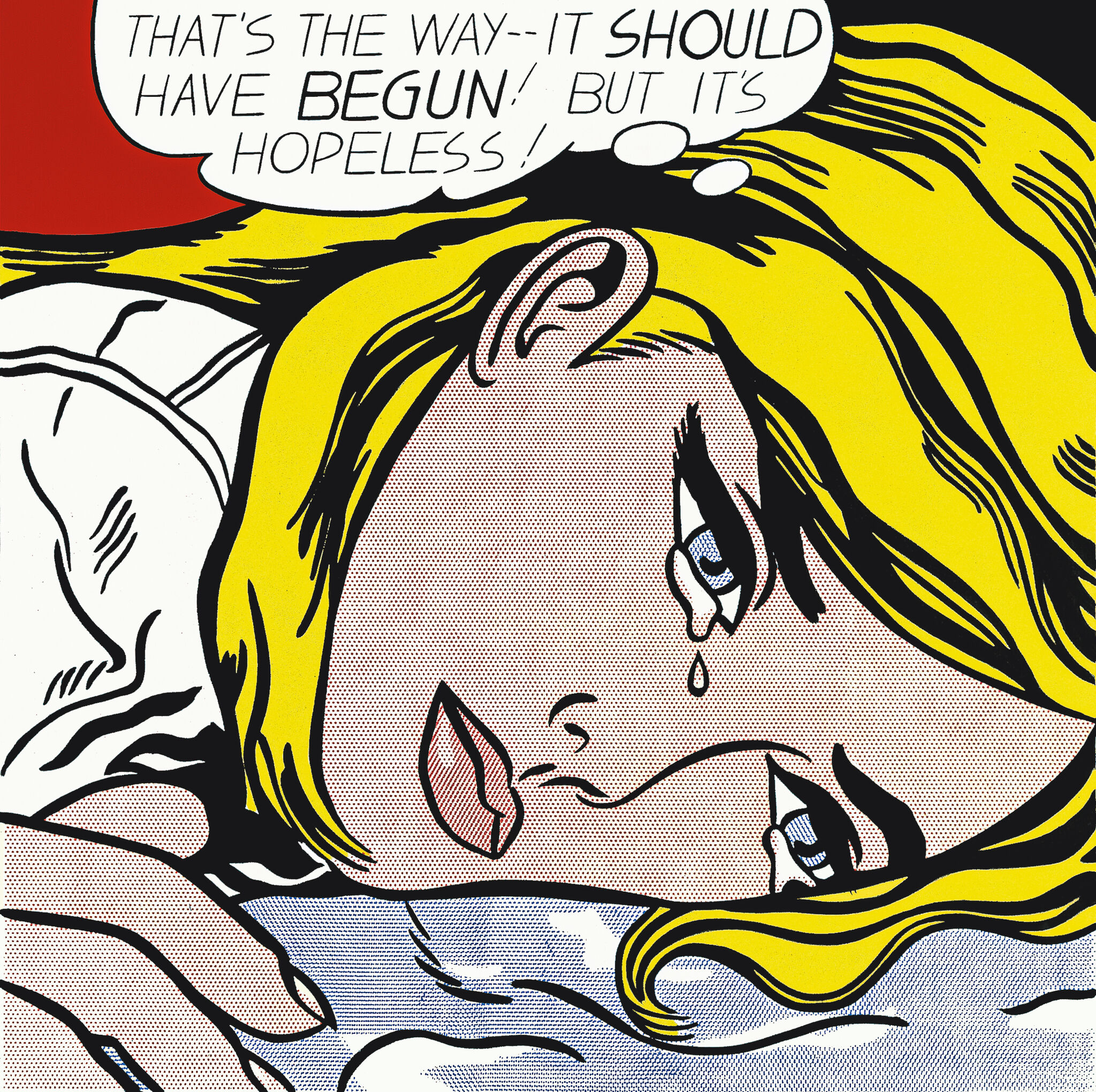
Fig. 2. Roy Lichtenstein, Hopeless, 1963. Oil and graphite pencil on canvas, 44 1/8 × 43 7/8 in. (112 × 111.5 cm). Peter and Irene Ludwig Foundation, Aachen, Germany. © Estate of Roy Lichtenstein/DACS 2026.
For Williams, melodrama is not mocking or gratuitous but a strategy for moving audiences—largely women whose desires and frustrations are often repressed or unmet—through embodied cues into their own “sobs of anguish.” As an artist who thinks a lot about the body as a tool to better understand our social conditions, bodily agency, and structural power, and as a viewer who never leaves a weepie without weeping, I am touched by this rubric of emotional call-and-response. I crack open my Roy Lichtenstein catalogue to Drowning Girl (1963; fig. 1) and I study an image I have seen hundreds of times, asking myself: How might I read it now through the lens of feminist study, of body genre? I revisit the young, white woman adrift: her Benday-dotted skin; her red lipstick; her blue-black hair, perfectly coifed despite the waves; her pooling tears. I read those familiar lines perched in a thought bubble above her head: “I don’t care! I’d rather sink--than call Brad for help!” This time, instead of approaching this scene with wry detachment, I am porous, immersed. In the spirit of Williams, I ask myself: What sensations are unlocked in my body as I gaze at this helpless Drowning Girl who is resigned to her watery fate?Williams, “Film Bodies,” 4.A flood of feelings—sympathy, desperation, shame, anxiety, even arousal—rise in my throat like Lichtenstein’s stylized seawater.
I turn to another page in my Lichtenstein catalogue, to Hopeless (1963; fig. 2). This face looks almost identical to that of the young, white woman in Drowning Girl. Both paintings of crying women were made in the same year, and I often confuse them in my mind. The woman in Hopeless, though, has blond hair and open eyes, and she lies prone on what seems to be a rumpled bed. Above her head, the thought bubble reads, “That’s the way--it should have begun! But it’s hopeless!” Gazing at this despondent character and reading the panicky words and punctuation recalls, for me, a male colleague’s comment from when I was in my twenties and working a desk job. He told me that women should never use exclamation marks in their emails; he thought he was doing me a favor. Hopeless brings me to revisit that humiliation (still with me almost two decades later) and the sting of being rendered “too much” for doing so little. I allow myself to simmer in that feeling, my heartbeat pulsing in my fingertips.

Fig. 3. Roy Lichtenstein, Crying Girl, 1964. Porcelain enamel on steel, 46 × 46 in. (116.8 × 116.8 cm). Edition of 5. © Estate of Roy Lichtenstein/DACS 2026.
In the past, I have felt torn about Drowning Girl and Hopeless, as well as Lichtenstein’s Crying Girl (1963; fig. 3)—a composition with no language at all, only a crying young blond. These works made me worry that his oeuvre reinforces stereotypes of hysterical femininity rather than posing a real challenge to them. But feminist thought has, as usual, interpellated me, broadening my paranoid positions. Now, in addition to courting melodrama as a site of emotional catharsis—“of the body beside itself,” as Williams writes—I have released the need to resolve the tensions inherent to melodrama. Feminists continue to teach me that the most interesting reading is the messy one. (Writing on melodrama in soap operas, scholar Tania Modleski argues that we must “resist ideological closure.”Tania Modleski, “The Search for Tomorrow in Today’s Soap Operas: Notes on a Feminine Narrative Form,” Film Quarterly 33, no. 1 (1979): 12–21.)These emotional and narrative contradictions—or what feminist film scholars refer to as ambivalence—are themselves where the meaning lives.
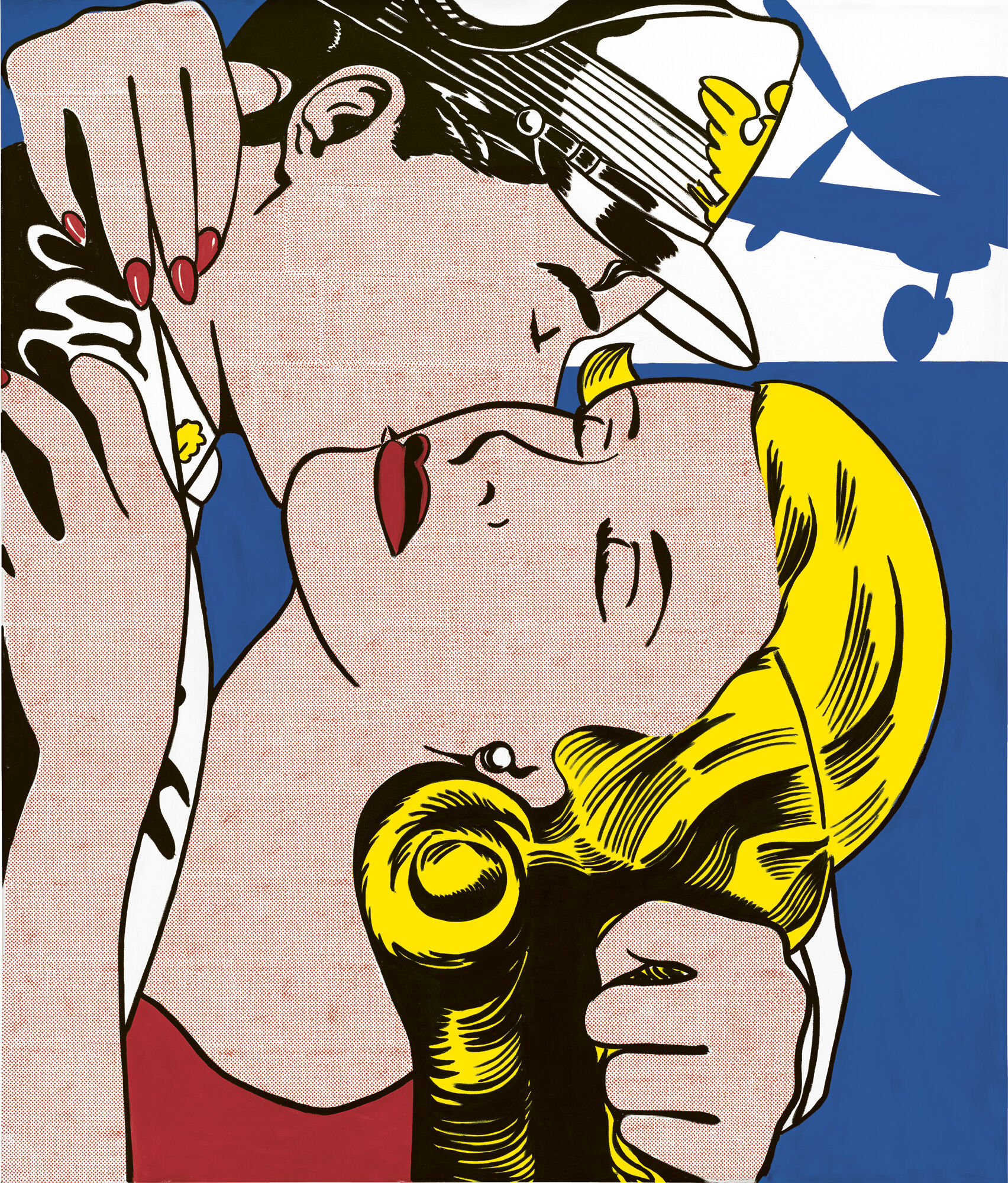
Fig. 4. Roy Lichtenstein, The Kiss, 1961. Oil, graphite and pencil on canvas, 80 × 68 in. (203.2 × 172.7 cm). Private collection. © Estate of Roy Lichtenstein/DACS 2026.
Lichtenstein, interviewed in 1997 by David Bowie, addressed the artificiality central to his depictions of romantic emotion, saying, “I think that [it] has a lot to do with all kinds of things presented through the media in the modern day. I mean, it’s even in movies—you know, two people are about to kiss, and in reality you’ve got a guy at the camera . . . and there’s probably a stylist who’s just powdered their noses. The actors have to pretend that they’re amorous in this situation, while there are all these technical people involved.Roy Lichtenstein in “New Again: Roy Lichtenstein,” interview by David Bowie, Interview, January 1998, https://www.interviewmagazine.com/art/new-again-roylichtensteinReading these lines calls to mind The Kiss (1961; fig. 4), in which Lichtenstein’s young, blond subject—eyes closed, head tilting back—embraces her paramour in uniform. But the scene does not read as passionate so much as meticulously staged. These lovers feel emotionally distant (almost as if they’d just had their noses powdered). Artworks like The Kiss demonstrate Lichtenstein’s attunement to the weirdness of staging melodramatic emotion for mass consumption, which Bowie interpreted as peak “irony.” Feminists offer a different, almost dialectical take. For them, all that staging of unreality offers the potential to summon something emotionally real, and even physically spasmodic, in the viewer.
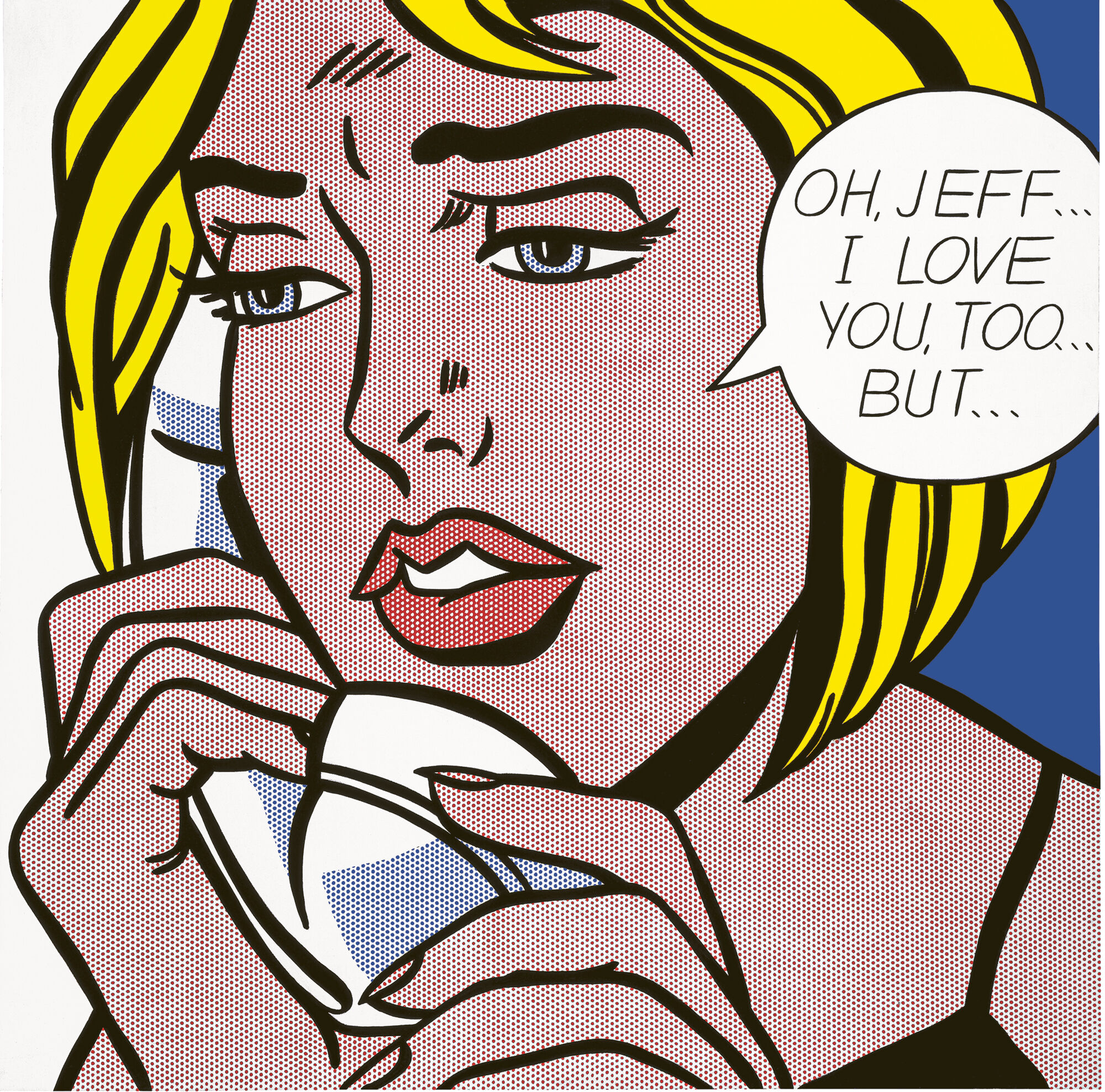
Fig. 5. Roy Lichtenstein, Oh, Jeff . . . I Love You, Too . . . But . . ., 1964. Acrylic, oil, and graphite pencil on canvas, 48 3/8 × 48 in. (122.9 × 121.9 cm). Charles Simonyi Collection. © Estate of Roy Lichtenstein/DACS 2026.
I continue flipping through my Lichtenstein catalogue, settling finally on Oh, Jeff . . . I Love You, Too . . . But . . . (1964; fig. 5). Blond, young, white, blue-eyed: Is this the same figure as in Hopeless? It hardly matters; these women are symbols above subjects. What sets this one apart, however, is the absence of tears, the hint of agency. Here, our protagonist speaks rather than thinks, and she seems to be asserting a tepid control over her situation: “I love you, too . . . but . . .” Is she (at last) readying herself to end the romance?
Oh, Jeff . . . captures the different sides of melodrama: the emotional spectacle and the subject’s perpetual uncertainty and equivocation. This woman appears caught between desire and dissatisfaction, empowerment and self-doubt, performance and sincerity. Does any painting by Lichtenstein embody this promise more precisely than Oh, Jeff . . ., which trails off, quite literally, with an ellipsis? In 1995, Lichtenstein told the New York Times that “irony alone doesn’t make a painting,” making clear that he courted such irresolution in his work. Decades later, I am learning to do the same. To make space for melodrama’s multitudinous ways of feeling.Michael Kimmelman, “At the Met with: Roy Lichtenstein; Disciple of Color and Line, Master of Irony,” New York Times, March 31, 1995.
This essay is excerpted from the exhibition catalogue Roy Lichtenstein: Like New.