Staten Island
Mabel Dwight, ever curious and open in her work, was fiercely protective of her privacy. However, in the last couple decades of her life Dwight wrote passionately articulate essays about her prints, subjects, and artist philosophy. The manuscript was left unfinished and remains unpublished, but below is an excerpt, an ode to her favorite borough.
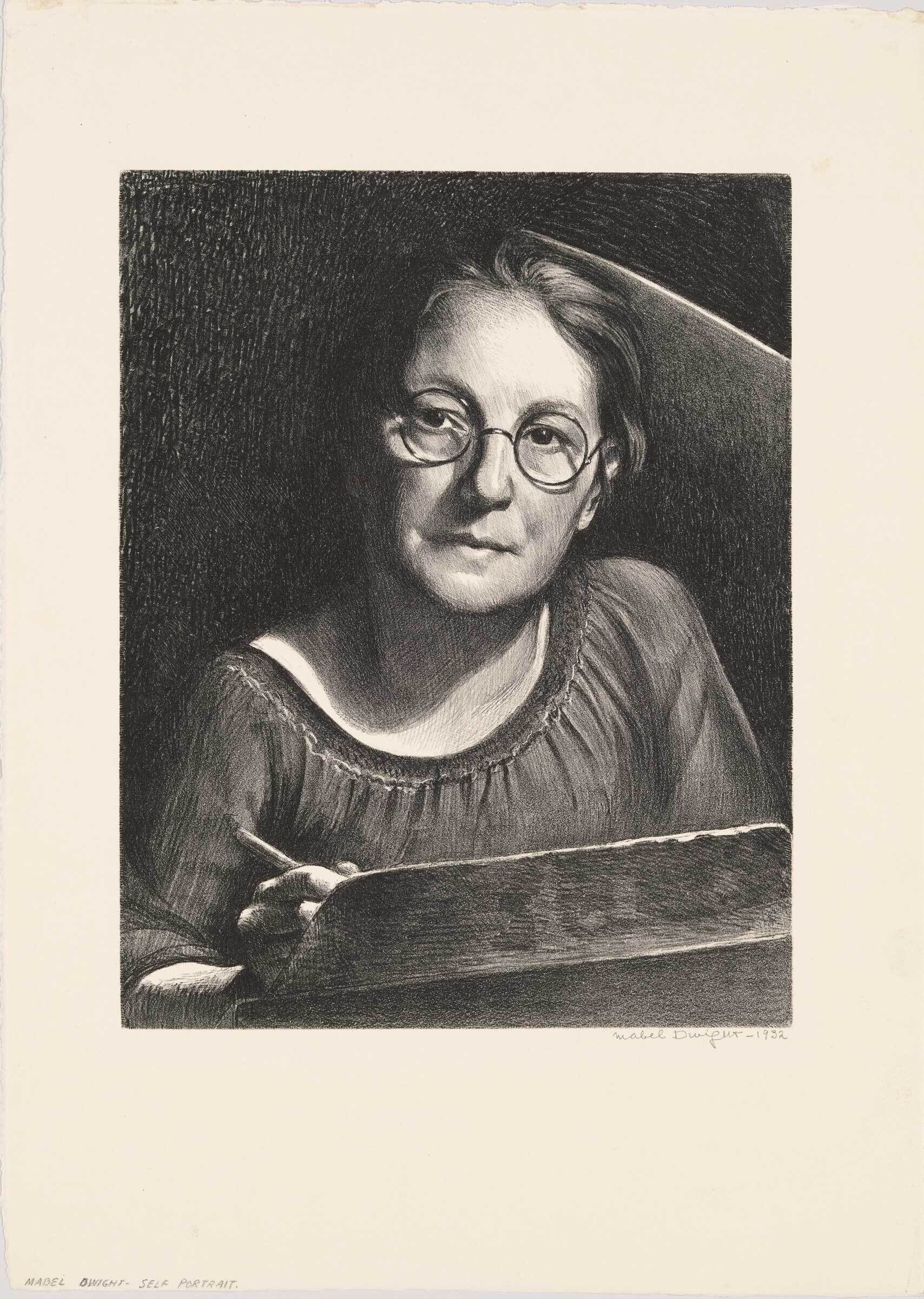
Mabel Dwight, Self-Portrait, 1932. Lithograph, 15 15/16 × 11 1/2 in. (40.5 × 29.2 cm). Whitney Museum of American Art, New York; purchase 32.100
Great harbors liberate my emotions and companion my thoughts. The amply-decked ferry boats that ply the harbor waters around New York were my pals for years. The one that went to Staten Island gave the longest ride, so it was my favorite. Generally I was satisfied with the good round trip passage, but ocassionally I broke the sea voyage by a trolley trip inland. The car I preferred skirted along the shore line in the direction of the Jersey coast. We passed a group of dead mansions, Greek columned and proud looking in their decay; we went by a beautiful place called Sailors Snug Harbor, with salty old men in blue suits dotting the grounds in friendly groups. I always began to warm up immensely about here.
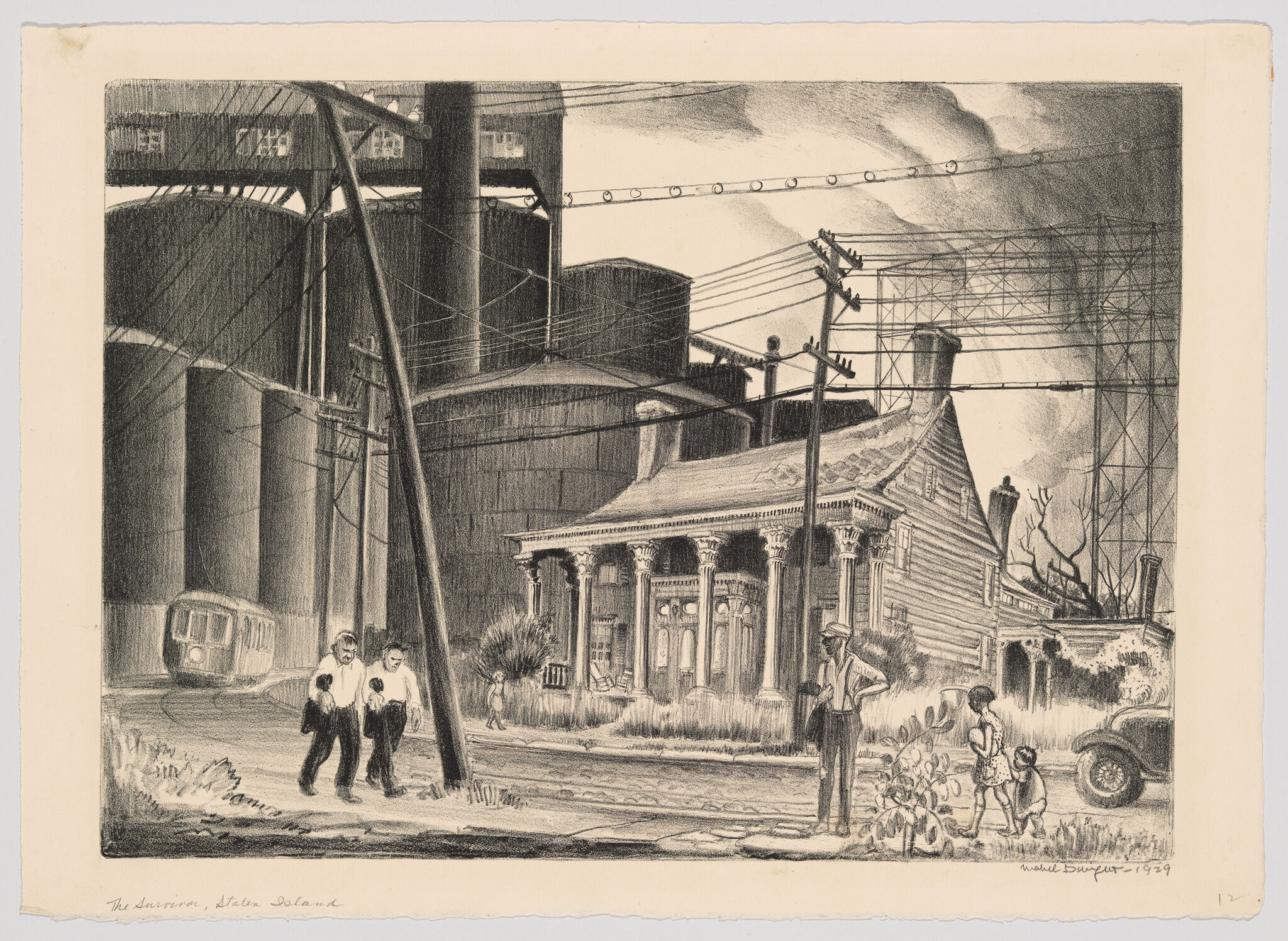
Mabel Dwight, The Survivor, Staten Island, 1929. Lithograph, 11 1/2 × 15 7/8 in. (29.2 × 40.3 cm). Whitney Museum of American Art, New York; gift of Mr. and Mrs. Michael H. Irving 78.85
Still following the shore we began to run parallel to Jersey, with that narrow stream of water called Kill van Kull between. Evening is the best time, just after sunset. This is the hour of dusk; enchantment walks the earth. Gas tanks, foundrys, funnels, chutes, pagoda like towers made up of big pans, each one resting in another one, the masts of boats—and a strange little Saragossa Sea where dead tugs and ferry boats slowly and peacefully sank into the mud, their black hulks listing grotesquely, without thought of Port or Starboard; now and then an old mansion with delicate pilasters and gracious lines decaying sadly between black monsters, Paddy's long underwear swelling and flipping in the bit of weed choked yard—all these things became a symphony with beauty the developed theme. The hour is an artist that softly blurs details, simplifies masses and gives sculptoresque power to sordid facts. When I began to make lithographs I did not forget this shore. Here one's fancy is titilated by strange contrasts and weird juxtapositions. I was told that sixty or seventy years ago rich southerners had their summer homes on that shore of Staten Island. Some of the old houses have lived on to become ramshackle tenements or laborers' boarding houses. In my lithograph, Survivor, one of these houses is seen. Their flower gardens, that once sloped down to the water's edge, are now traversed by trolley lines and trampled to death by giant tanks; long enclosed passage ways, high scaffold and mysterious, stretch from one strange structure to another; electricity, like a great unseen spider, has woven an intricate black web of lines against the sky; the lines go everywhere, from pole to pole, from tower to tower; they cross and recross the street, they enmesh the world about them, they arise as high spidery structures, all lines and no substance. A few gaunt trees raise naked arms; only weeds thrive here now; they uproot the stones of the sidewalk, they grow high enough to look impudently in the windows of the poor old houses.
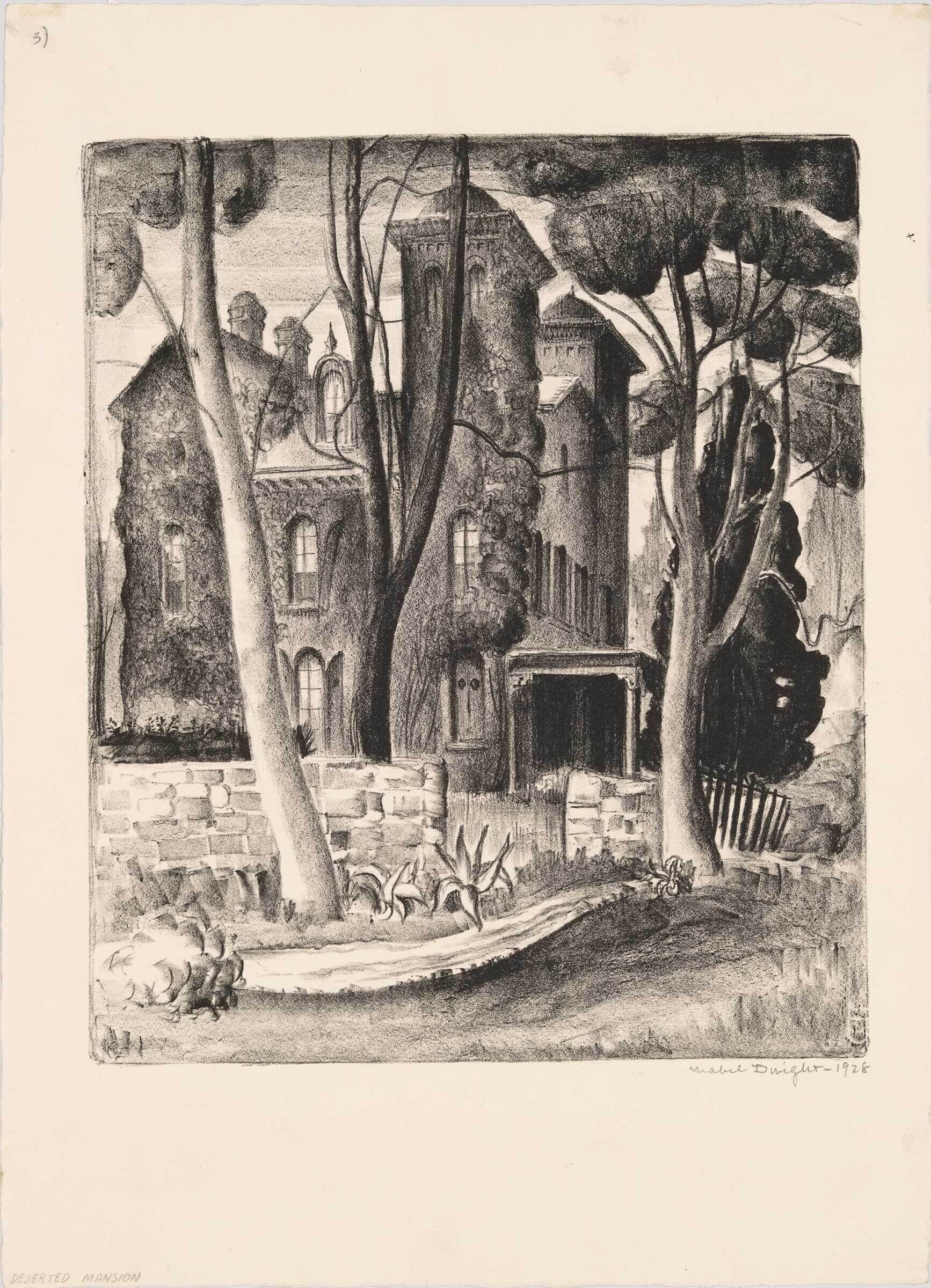
Mabel Dwight, Deserted Mansion, 1928. Lithograph, 15 7/8 × 11 1/2 in. (40.3 × 29.2 cm). Whitney Museum of American Art, New York; purchase 32.6
But not all of the shore is turgidly dramatic; it has its lyric passages—salt marshes, the water at high tide making little lush green islands of the marsh grass. Decaying piers stretch into the stream and long dingy flat boats, those snails of the water ways, float silently back and forth. The Jersey shore opposite, is silhouetted jaggedly against the evening sky—church steeples, long low factory buildings, high smoke stacks, water tanks on tall stilts, a phantasmagoria of things that pattern themselves fascinatingly at this hour. And at this time the boys of the neighborhood come to the shore to swim. They shed their clothes in the tall grass and their bodies look pale and lovely in the soft light.
The car speeds on, through poor, ugly little towns, ugly as American towns know so well how to be. They are not old but they look senile. But these are just workers' houses—anything is good enough for workers! More marshes. On a bit of sandy stretch an old scow had been beached. Nailed to the scow was a very crudely painted sign; it read: “Tired millionaires yacht club.” I nearly fell off my seat with delight! Boys and young men were sitting on the edge of the boat, their feet hanging over, others leaned against a kind of shanty which they had evidently built on deck. I made this discovery on one of my early trips along the shore and I intended to come back and try to meet the wit, but I didn't do so. I came back, to be sure, many times, but I just rode past, getting a stab of delight each time I saw the sign. Tired millionaires might not be gracious to intruders.
One evening, while waiting for the return trolley, I made the sketch for my lithograph, Dusk. I had been doing some watercolors along the shore in the late afternoon. In the middle of the day that corner scene had seemed commonplace, drab, but as I stood there at dusk with a pale pink and gold light in the sky, against which the poor little house, the bushes, the telegraph poles were patterned with arresting power and importance, I realized as I had so many times before, that poetry is everywhere. It had been waiting on that corner in the afternoon but I hadn't recognized it then. Not that I always need romantic lighting to enable me to see poetry or beauty; some of the scenes along that shore around my imagination more at noon than at poetical twilight. Moonlight and twilight have their verity of course, but they are enchanters, flatterers. The cold white light of reality also releases a beauty in things. But I have always been peculiarly susceptible to the magic of twilight. It seems a brief moment when time rests, and like a muezzin calls all life to prayer. Two pilgrims, day and night, meet and prostrate themselves silently, in answer to the call. But a curtain falls imperceptibly the pilgrims salute and part, time moves on. It is a violation of life that most people must live unable to respond to that muezzin call, indeed unconscious of it. But that is the hour when the gorged subways tear through the bowels of the earth, their human cargo dangling from straps; it is the hour of the busy frying pan and cocktail shaker, the hour when necessity shifts gear, steps on the gas and changes direction—the rush hour. Yet that twilight call is there, in the dingy streets, coming over the roof tops, to anyone who is still enough to hear it.
Dwight, Mabel. Typescript of autobiography, n.d., Carl Zigrosser Papers. Kislak Center for Special Collections, University of Pennsylvania, Philadelphia, PA.