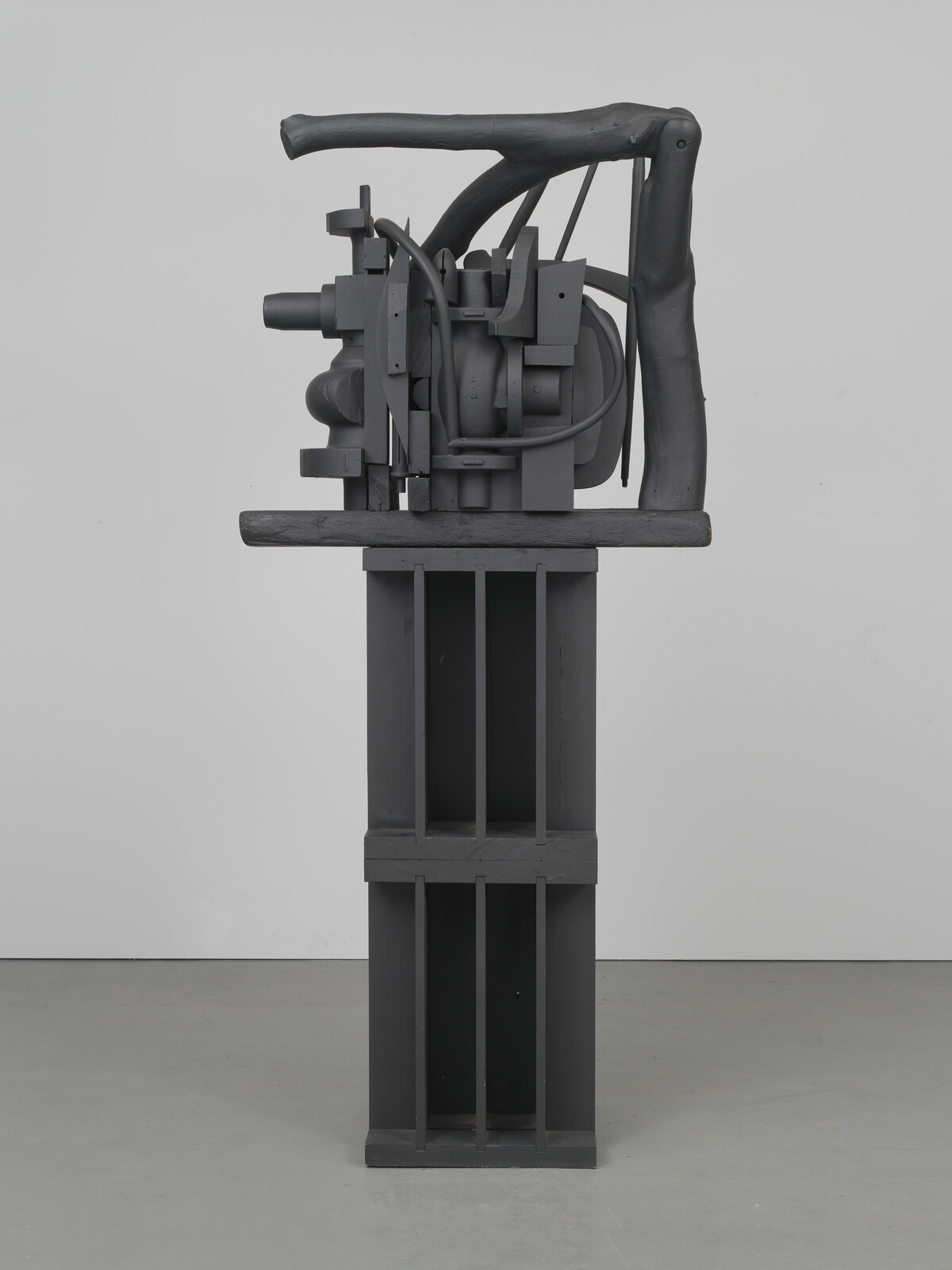
The Alchemy of Louise Nevelson’s Black Majesty (1955)
Queen of the black black
In the valley of all all
With one glance sees the King.
Mountain top
The climb
The way
Restless winds
Midnight blooms
Tons of colors
Tones of waterdrops
Crystal reflections
Painting mirages
Celestial splendor.
Highest grandeur.
Queen of the black black.
King of the all all.
—Louise NevelsonLouise Nevelson, “Queen of the black black,” ARTnews (September 1961): 45.
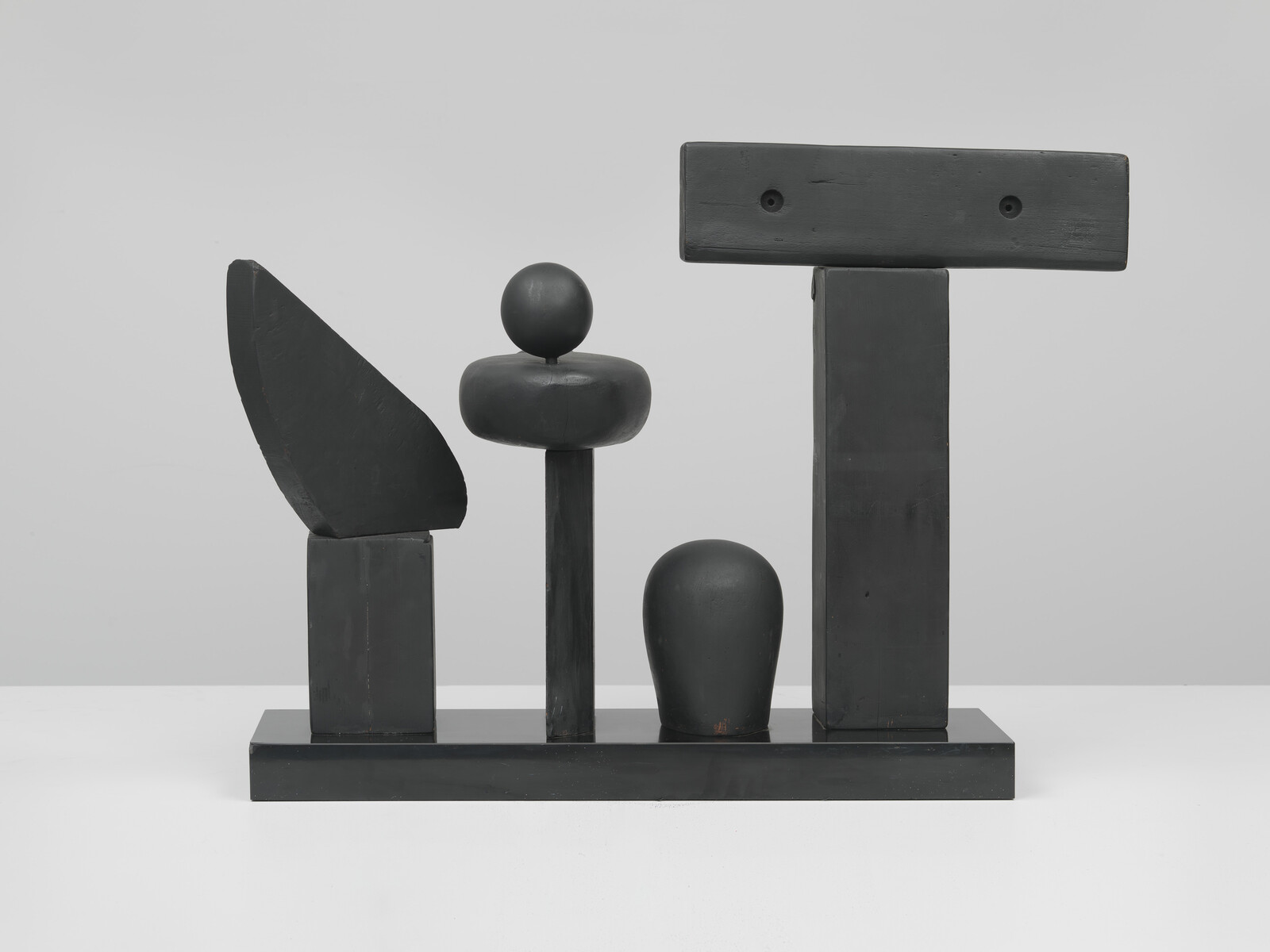
Louise Nevelson, Black Majesty, 1955. Painted wood and plywood, overall: 28 × 38 1/4 × 16 1/8 in. (71.1 × 97.2 × 41 cm). Whitney Museum of American Art, New York; gift of Mr. and Mrs. Ben Mildwoff through the Federation of Modern Painters and Sculptors, Inc. 56.11. ©Estate of Louise Nevelson/Artists Rights Society (ARS), New York
Standing twenty-eight inches tall and roughly thirty-eight inches wide, Black Majesty (1955) is composed of four irregular wooden constructions painted matte black and arranged in a row along a black laminate base. All of the wood is marred by the cracks and dents of prior use. At the far right, a T-shaped structure towers over the other elements: a millinery block, a duck decoy with a spherical head perched on a split piece of timber, and a wing-shaped fragment affixed to a square post. Although Louise Nevelson (1899–1988) scavenged these materials from the streets of New York, they evoke the docks of coastal towns like Rockland, Maine, where she grew up. Part urban, part maritime, the found and juxtaposed articles can be understood as a dreamscape in the Surrealist tradition. The unifying coat of black paint also suggests a shadowy nightscape, slowing recognition of the individual items and rendering the familiar strange. The duck decoy, a hunter's lure designed to trick prey, is an apt metaphor for Nevelson’s process of camouflaging her objects within a monochrome black field. The dual function of the decoy—as both hunting equipment and collectible folk art—also mirrors Nevelson’s own recontexualization of functional objects as sculpture.
Nevelson began working with scraps of discarded wood in the 1940s—more than a decade before assemblage or junk art came to prominence in New York with the ascent of artists like Robert Rauschenberg (1925–2008) and Robert Indiana (1928–2018). Nevelson’s earliest constructions are smaller and more tethered to representational imagery than the wall-spanning stacks of wooden boxes for which she is best known. Clown (1942), for example, is a five-foot-tall geometric figure composed of what appears to be part of a sawhorse, an ornately carved furniture leg, and other wooden architectural fragments akin to those she would later use in her “walls.” Nevelson’s work stands apart from other junk art of the 1950s in that she infused her humble materials with a certain drama, splendor, and mystery. Even her Clown has a touch of majesty, his raised arm festooned with an acanthus leaf and his head crowned with metal hooks.
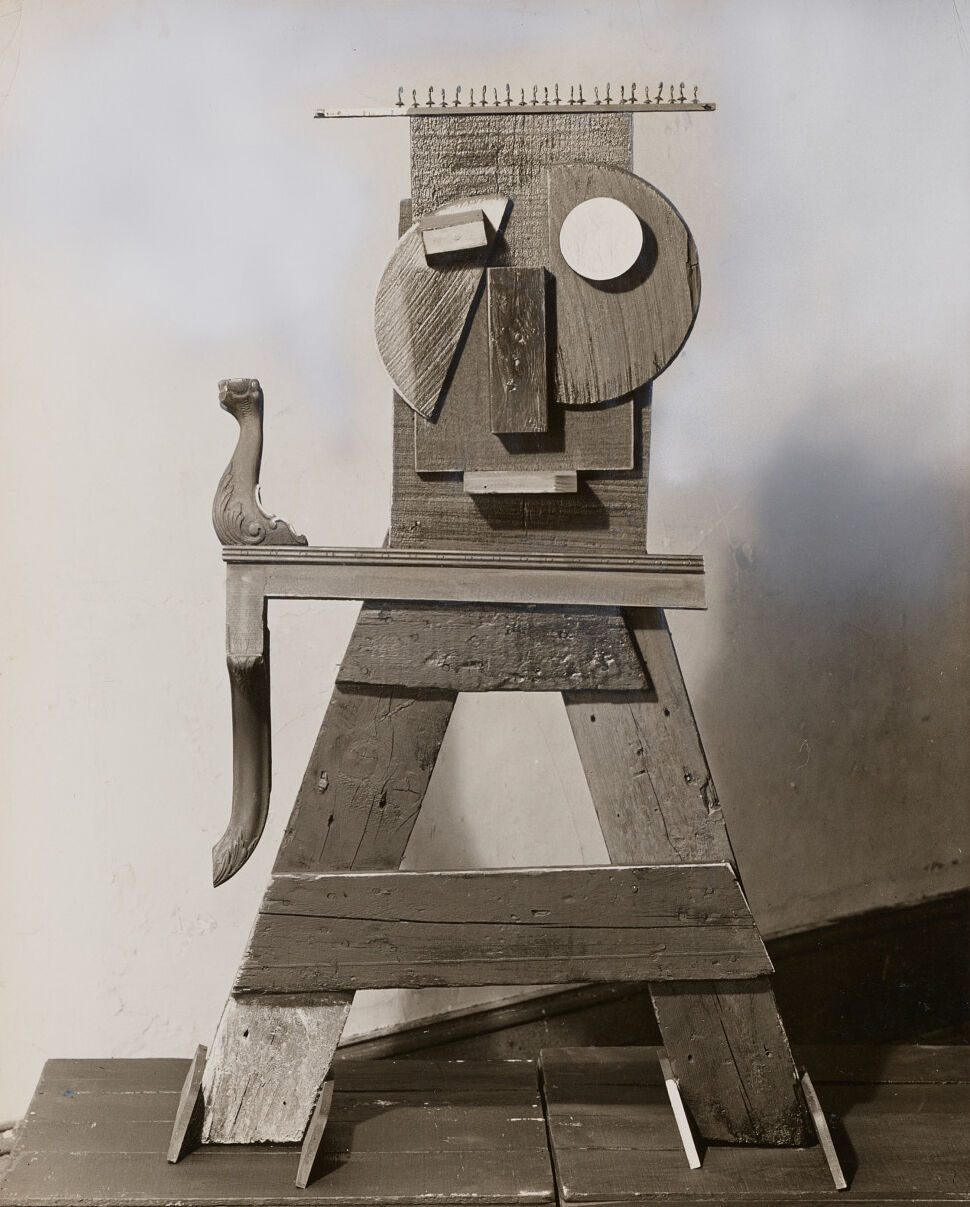
Louise Nevelson, Clown, 1942. Wood and metal, 60 × 36 × 7 in. (23.6 × 14.2 × 2.8 cm). Destroyed. Louise Nevelson papers, Archives of American Art, Smithsonian Institution. © 2025 Estate of Louise Nevelson/Artists Rights Society (ARS), New York. Photograph by John Schiff
In developing her singular approach to assemblage, Nevelson looked not only to avant-garde artists like Pablo Picasso, whose Cubist constructions from the 1910s certainly informed Clown, but also to vernacular examples. The circus-themed work was partly inspired by a clown’s head that she purchased in a junk shop on Third Avenue. And her additive technique resonates with that of an elaborately decorated bootblack box that caught her eye on the streets of New York in 1942. The Italian immigrant Giovanni Indelicato, who shined shoes on the corner of Broadway and Seventh Street, lovingly adorned the equipment of his trade with colorful glass and metal baubles he had collected from pushcarts and five-and-ten-cent stores. Nevelson brought Indelicato’s creation to the attention of Museum of Modern Art director Alfred Barr, who invited the shoeblack to exhibit his resplendent stand in the museum lobby, where it was credited to the pseudonym Joe Milone. While Nevelson’s affinity for folk and popular art is evident in Clown, her subsequent series of terracotta and cast stone Moving-Static-Moving Figures (c. 1945) is in closer dialogue with the abstract, geometric vocabulary of Cubism.
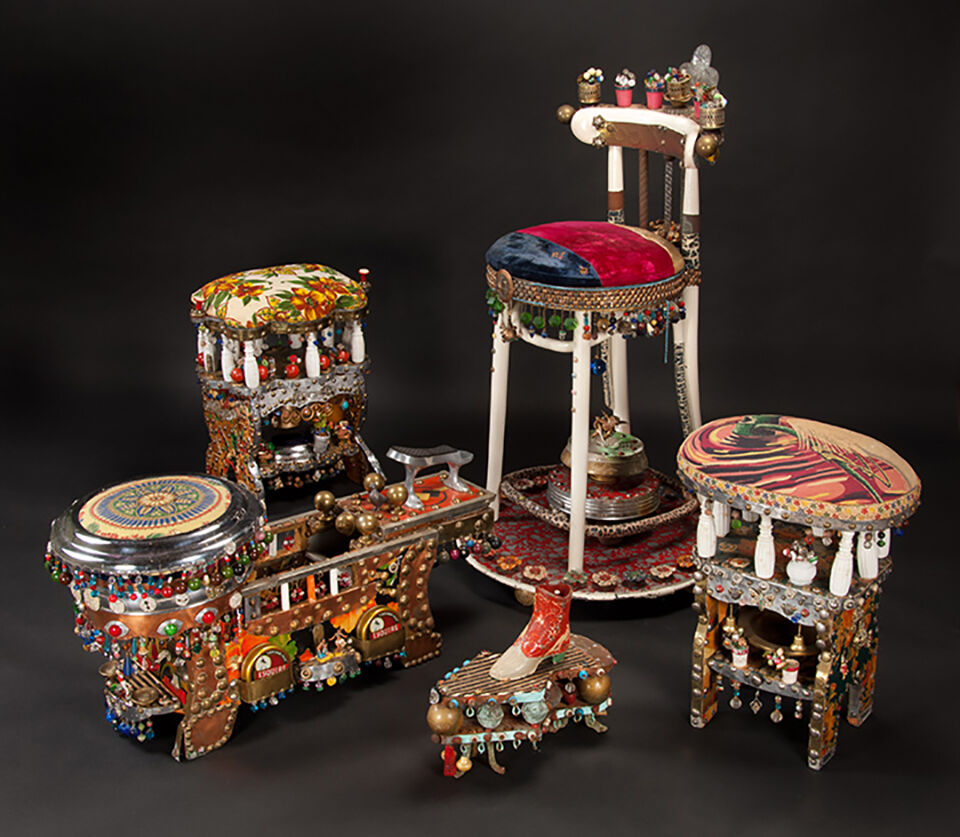
Giovanni Indelicato, Shoe Shine Stand, c.1930–42. Metal, copper, brass, glass, and cotton. Fenimore Art Museum, Cooperstown, New York; museum purchase N0001.2014.a–e. Photograph by Richard Walker
When Nevelson returned to producing wooden assemblages in the mid-1950s, she disguised their lowly origins by painting them black, which she described as “the most aristocratic color of all.” “I have seen things that were transformed into black, that took on just greatness,” Nevelson explained. “I don’t want to use a lesser word. Now, if it does that for things I’ve handled, that means that the essence of it is just what you call—alchemy.”Louise Nevelson, Dawns + Dusks: Taped Conversations with Diana MacKown (New York: Charles Scribner’s Sons, 1976), 126.What Nevelson referred to as the “alchemy” of her work could also be described as dandyism, or the feigning of aristocratic status through sartorial refinement and extravagance that challenged the established social order of nineteenth-century Britain. Nevelson’s frequent recycling of Victorian crown moldings and turned-wood spindles in her work speaks to her affinity with that era. By “dressing up” this cast-off wood in elegant black, Nevelson established a do-it-yourself model of nobility that was detached from material wealth.
Nevelson was well-known for her bold sense of style, from her enormous false lashes to her layering of luxurious furs and silk scarves over denim work shirts, which she once remarked was a rebellion against the expectation that “artists were always to look poor in America.” She was quick to clarify, “I don’t mean you have to be expensively dressed.”Nevelson, Dawns + Dusks, 185–86.As with her sculptures, her wardrobe incorporated vintage pieces for which she admittedly paid little but transmuted into a distinctive look. Art historian Julia Bryan-Wilson, in her recent monograph on Nevelson—or, more precisely, what she calls a “countermonograph” or “feminist queering of the monograph form”—briefly discusses Nevelson’s dandyism, both in her self-presentation and her work, in relation to drag. Noting that the dandy is typically theorized as a male figure, Bryan-Wilson argues that Nevelson’s inhabitation of the trope troubled both class and gender norms.Julia Bryan-Wilson, Louise Nevelson's Sculpture: Drag, Color, Join, Face (New Haven: Yale University Press, 2023), 52.Nevelson’s frequent references to aristocracy and majesty in her sculptures might also be understood in relation to the subversive use of royal titles in drag subcultures to exalt marginalized practices and members of society.
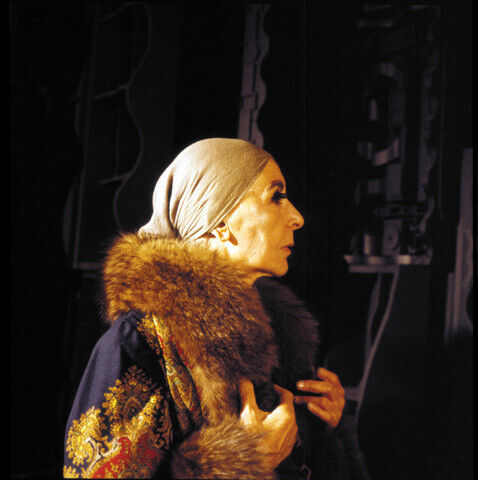
Pedro E. Guerrero, Louise leans pensively on a black glass table in front of a black wall for this portrait in her studio, 1977/78. Gelatin silver print. © Estate of Pedro E. Guerrero
In addition to endowing her assemblages with lofty titles and aristocratic black—and later bridal white and regal gold—trappings, Nevelson used theatrical staging to enhance their magnificence. Black Majesty was first shown in Nevelson’s 1955 solo exhibition Ancient Games, Ancient Places at Grand Central Moderns Gallery in New York. Anticipating her ambition to create sculptural environments, this presentation united individual pieces under an archetypal narrative: the heroic journey. The protagonist, a carved figurative sculpture titled Bride of the Black Moon (1955), was surrounded by assemblages representing the four continents of her voyages: Black Majesty, Forgotten City (c. 1955), Night Scapes (c. 1955), and Cloud City (also called That Silent Place, 1954–55).Laurie Wilson, “The Royal Voyage,” in Louise Nevelson: Atmospheres and Environments (New York: Whitney Museum of American Art, 1980), 56.All were painted black, appropriate to the nocturnal atmosphere alluded to in their titles. When the Whitney Museum of American Art acquired Black Majesty the following year, Nevelson wrote in an object questionnaire: “I compose my work pretty much as a poet does, only instead of the word I use the plastic form for my images.”Louise Nevelson, Black Majesty (1955) Object Questionnaire, 1956, Whitney Museum of American Art Object Files.The implied vastness of the bride’s travels contrasts with the humble nature and dimensions of the sculptures and calls to mind ancient epic poetry. Nevelson’s hero, however, is female.
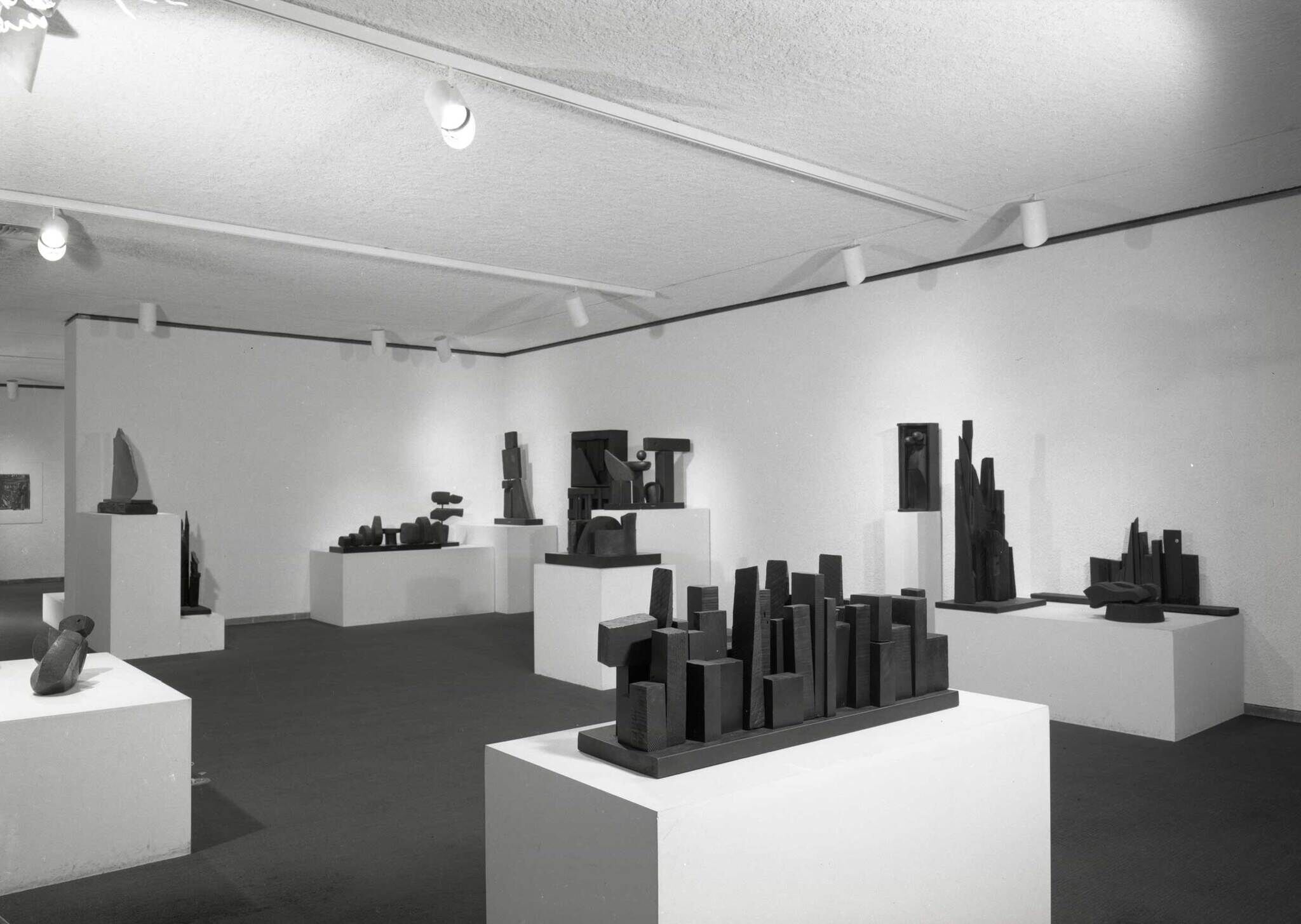
Installation view of Louise Nevelson (Whitney Museum of American Art, New York, March 8–April 30, 1967). © 2025 Estate of Louise Nevelson/Artists Rights Society (ARS), New York. Photograph by Geoffrey Clements
By the end of the 1950s, Nevelson was showing her work in dimly lit spaces or under blue spotlights, which further obscured the individual components and lent her sculptures an otherworldly quality. She also expanded the size of her assemblages, filling wooden containers with found fragments and piling them up against walls to imply continuous accumulation. When she showed Black Majesty and her later black “walls” in her first museum retrospective, held at the Whitney in 1967, she worked with curator John Gordon to create what one reviewer described as a “half-light” that “subdues the visual sense.”Dido Smith, “Louise Nevelson,” Craft Horizon (May/June 1967): 44.Nevelson insisted on designing the installation, explaining to Gordon: “I am, and will always be, an environmental artist, so this must be a retrospective environment of my total composition.”Louise Nevelson, letter to John Gordon, January 14, 1967, Whitney Museum of American Art Archives, Main Branch Exhibition Records, Box 42, Folder 7.She later rejected the term “environment” in favor of “atmosphere,” explaining that “environment has become so non-specific and my work is so involved with atmospheric mood.”Louise Nevelson, letter to Thomas Armstrong, November 8, 1978, Whitney Museum of American Art Archives, Main Branch Exhibition Records, Box 99, Folder 31.Like her signature black monochrome surfaces, Nevelson’s use of atmospheric lighting and large scale emphatically elevated her everyday materials.
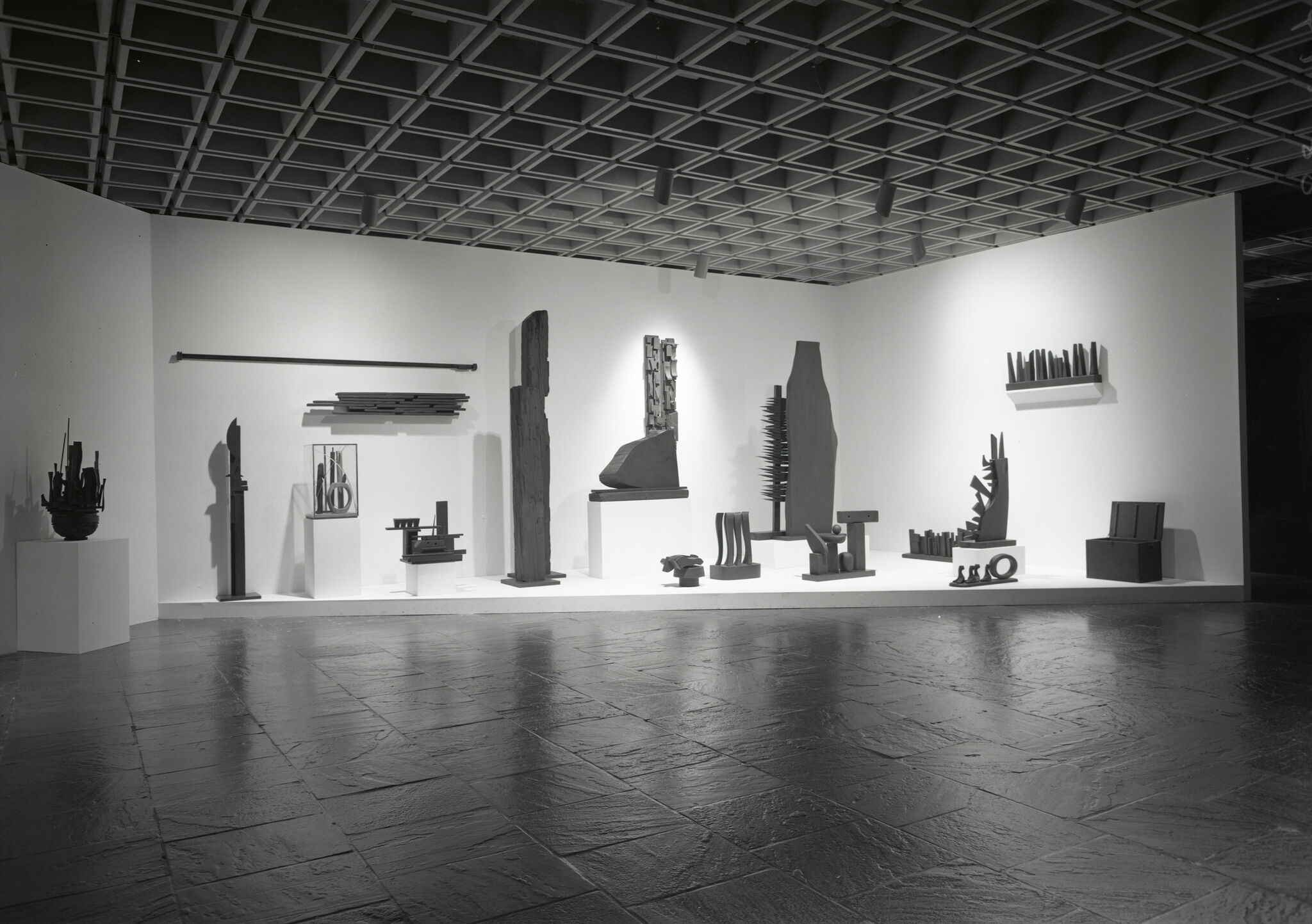
Installation view of Louise Nevelson: Atmospheres and Environments (Whitney Museum of American Art, New York, May 27–September 14, 1980). © 2025 Estate of Louise Nevelson/Artists Rights Society (ARS), New York
At the age of eighty, Nevelson loosely recreated Ancient Games, Ancient Places in her 1980 Whitney exhibition Atmospheres and Environments. Since many of the works from the 1955 show were lost or destroyed, she included sculptures from subsequent presentations at Grand Central Moderns, The Royal Voyage (of the King and Queen of the Sea) (1956) and The Forest (1957), and re-titled the new environment The Royal Voyage. Some of the works, including Black Majesty, sat directly on a triangular white platform, while others stood on pedestals of varying heights or hung on the wall. The mix of vertical and horizontal sculptural components implied an underlying grid, anticipating Nevelson’s later use of boxes to organize her complex assemblages. In the darkened gallery, spotlights on the sculptures liken them to actors in a drama. In this new iteration of her early environments, the narrative theme became less important as she increasingly relied on staging and lighting to establish each sculpture as an element in a total composition.
The playwright Edward Albee, a friend and source of inspiration to Nevelson, posited in his catalogue essay for Atmospheres and Environments that Nevelson’s constructions should be viewed as “worlds” in which the pieces always add up to a larger sculptural idea, even if the parts are no less interesting than the sum.Edward Albee, “Louise Nevelson: The Sum and the Parts,” in Louise Nevelson: Atmospheres and Environments, 27, 30.Indeed, Nevelson went to great lengths to envelop her assemblages in an overarching atmosphere, but she did not conceal the identity of every scavenged element—like the duck decoy body in Black Majesty, which becomes recognizable upon closer inspection.
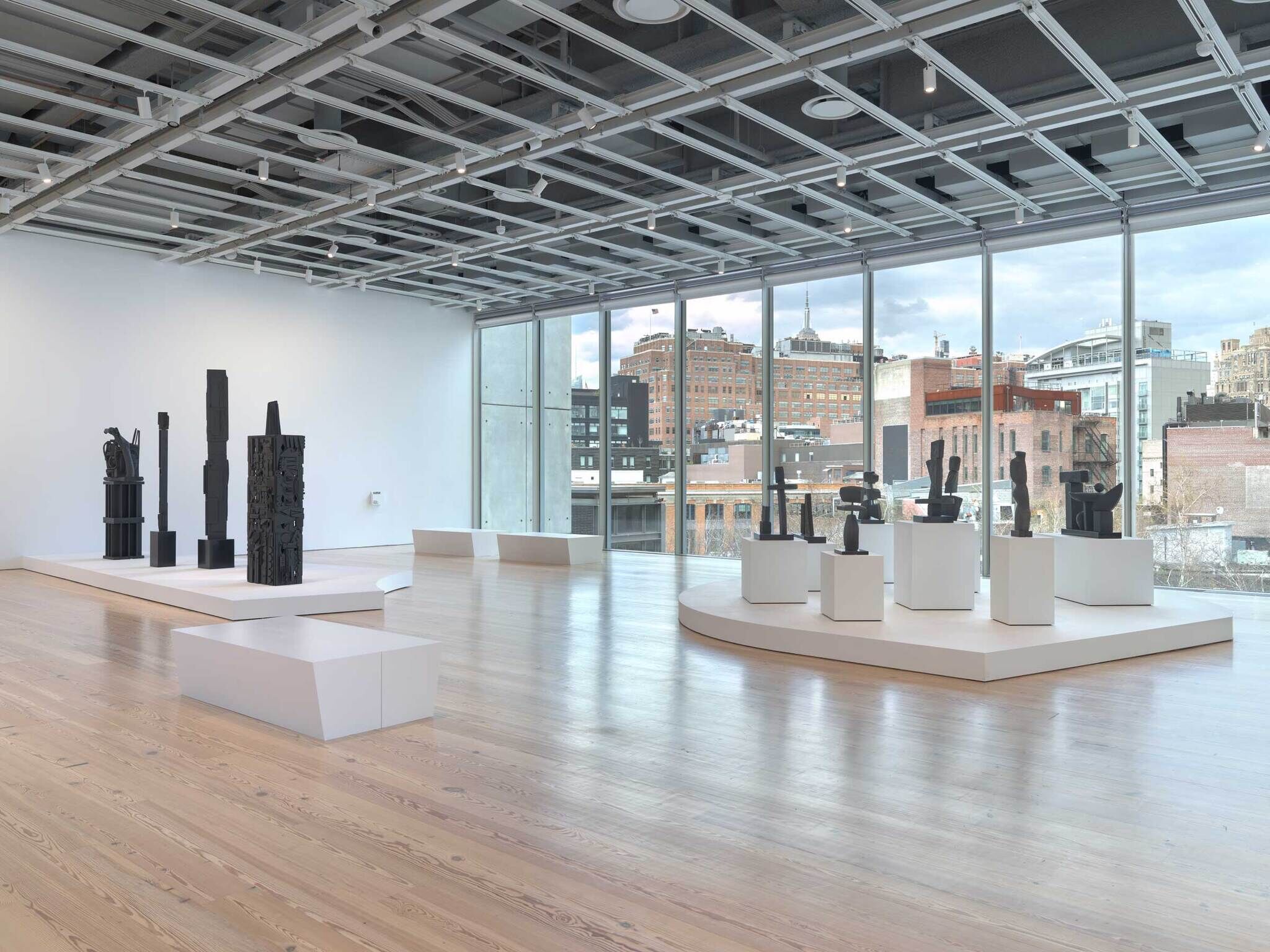
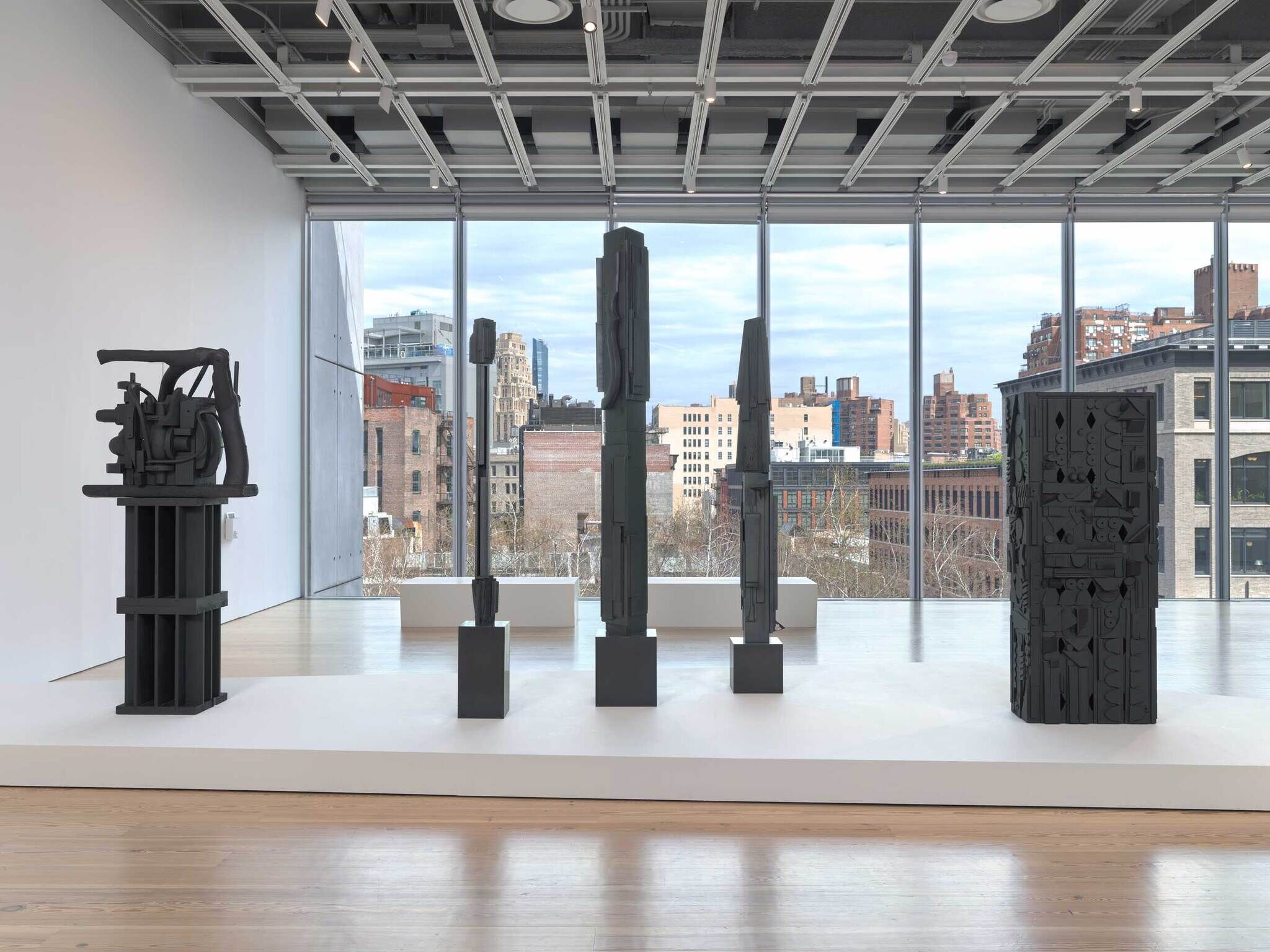
Installation view of Collection View: Louise Nevelson (Whitney Museum of American Art, New York, April 9-August 20, 2025). From left to right: Present Universe III, 1985; Rain Forest Column XII, 1967; Rain Forest Column VII, 1962–64; Rain Forest Column XXIII, 1964–67; Dream House XXIII, 1972; Moving-Static-Moving Figures, c. 1945. © 2025 Estate of Louise Nevelson/Artists Rights Society (ARS), New York. Photograph by Ron Amstutz
Collection View: Louise Nevelson presents the artist’s work in ever-changing natural light, from the hazy illumination of her beloved dawns and dusks to broad daylight that encourages close examination of its intricate surfaces. The windows in the gallery look out onto the Manhattan streets that yielded the very materials from which the sculptures are fashioned. In this context, Black Majesty appears as a microcosm of the city, echoing its duality of grittiness and glamour. Its rising vertical forms resemble a tiny urban skyline. Nevelson later cited the miniature mansion in the set design for Albee’s 1964 play Tiny Alice as an influence on her work. But she was already constructing alternative worlds with Black Majesty, which emerged from a series of cityscapes inspired by New York, such as Night Presence IV (1955). The latter tabletop sculpture became the model for Nevelson’s first public work in New York, Night Presence IV (1972), which stands on Park Avenue and 92nd Street. She described the large-scale, Cor-ten steel replica of the wooden assemblage as “a celebration of half a century of living and working as an artist in New York.”Margot Gayle and Michele Cohen, Guide to Manhattan’s Outdoor Sculpture (New York: Prentice Hall, 1988), 255.It is also a testament to the monumental vision nascent in her earliest assemblages.
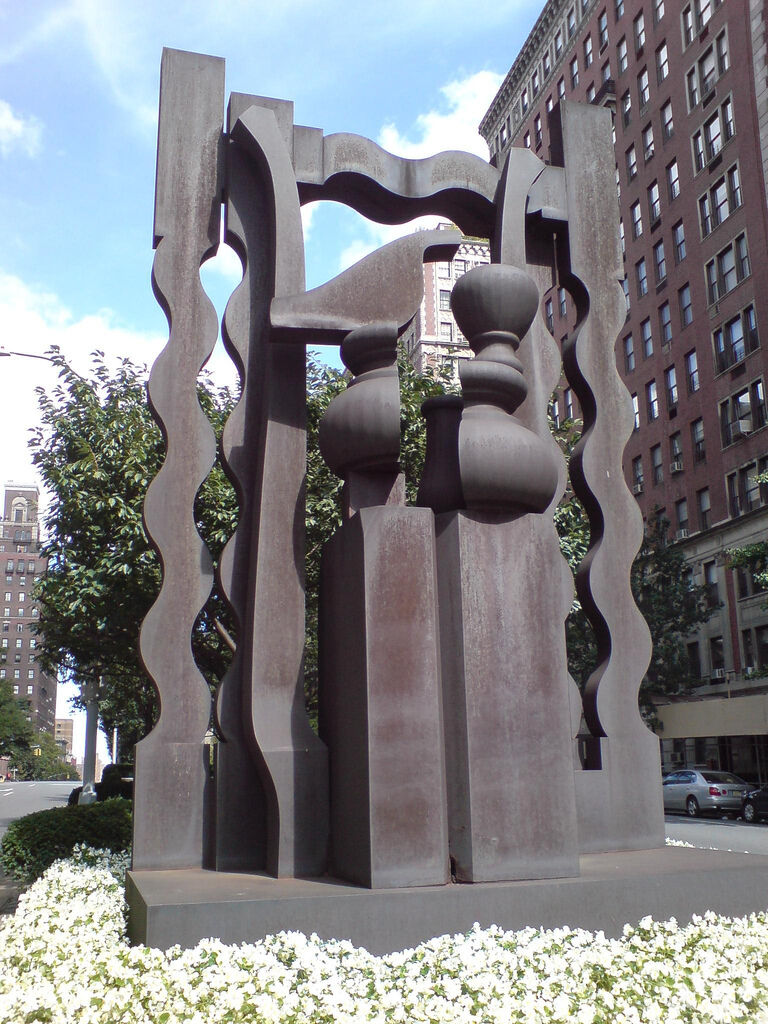
Louise Nevelson, Night Presence IV, 1972. Cor-Ten steel, 22 × 13 × 9 feet. Park Avenue and 92nd Street, New York. Photograph by Art Nerd New York
Black monochrome, for Nevelson, not only masked her debased materials but also transformed them into something greater. This procedure is encapsulated in the very title, Black Majesty, and allegorized in her 1961 poem “Queen of the black black,” which speaks of a climb from a valley toward mountains and sky. Before reaching “Celestial splendor,” the queen of the poem passes through “Midnight blooms / Tons of colors.” These two phrases seem contradictory at first, the former evoking an image of black flowers or the darkness that flourishes at night—the opposite of chromatic variety. But Nevelson also spoke of black as the “acceptance” rather than “negation” of color since it “encompasses all colors.”Nevelson, Dawns + Dusks, 126.Whether interpreted as an adjective or noun, “midnight” in the poem describes black as the ultimate color that embraces all others. If Nevelson herself is the “Queen of the black black,” then the final lines of the poem might be a key to her work: by “painting mirages,” which in her case were illusory shadows rather than water, she redefined the parameters of “highest grandeur.”