
Pacha, Llaqta, Wasichay: Indigenous Space, Modern Architecture, New Art
2018
“The cultures that these artists are looking towards are not pre-Columbian, in the strict sense of the word, in terms that they're not frozen in time. They're not dead cultures, they're still very much alive.”
—Marcela Guerrero, assistant curator
Hear from the exhibition’s artists and curator about selected works from the exhibition.
-
500
Introduction
Audio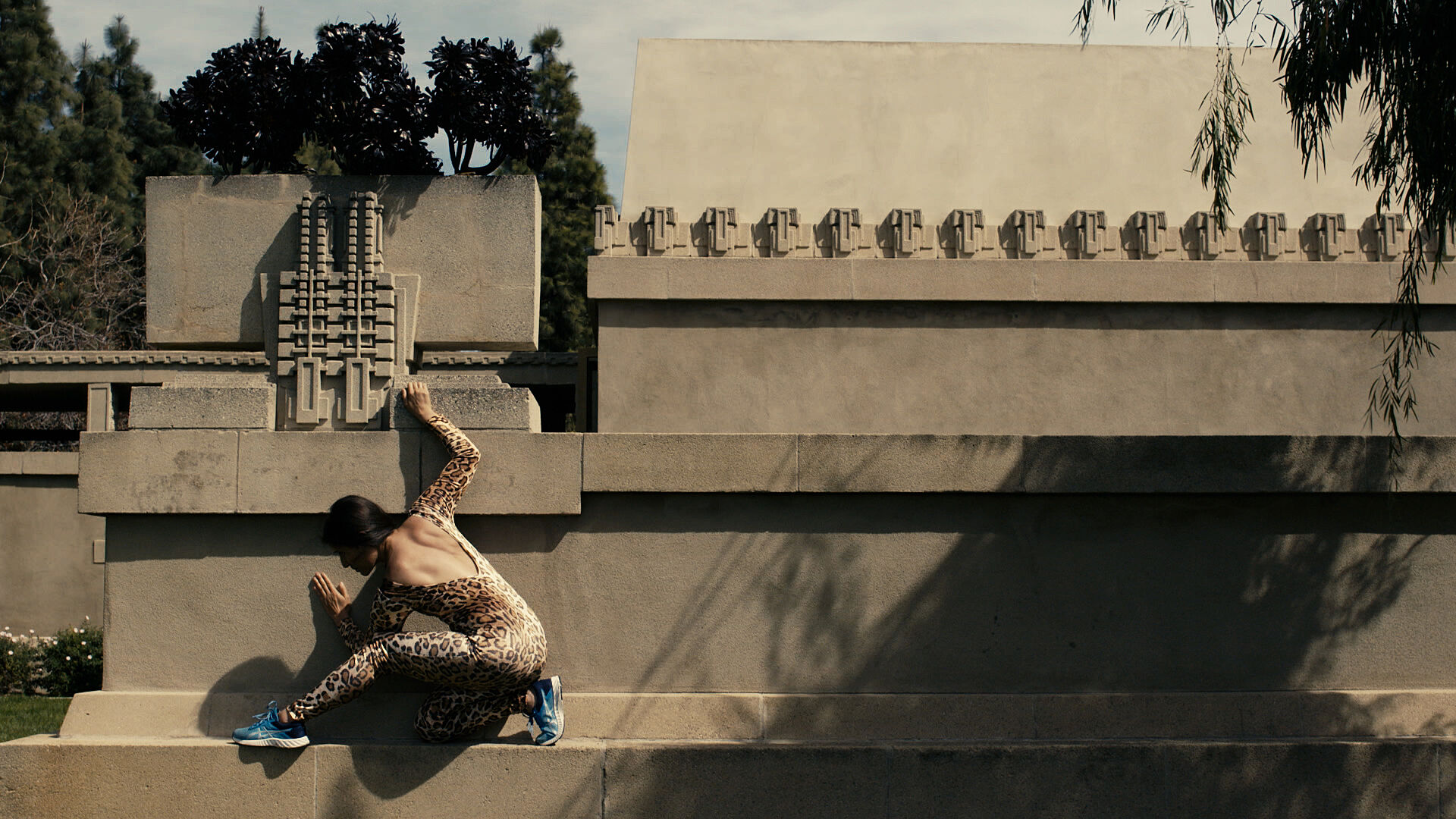
-
501
Clarissa Tossin
Audio, Transcription
-
502
Ronny Quevedo
Audio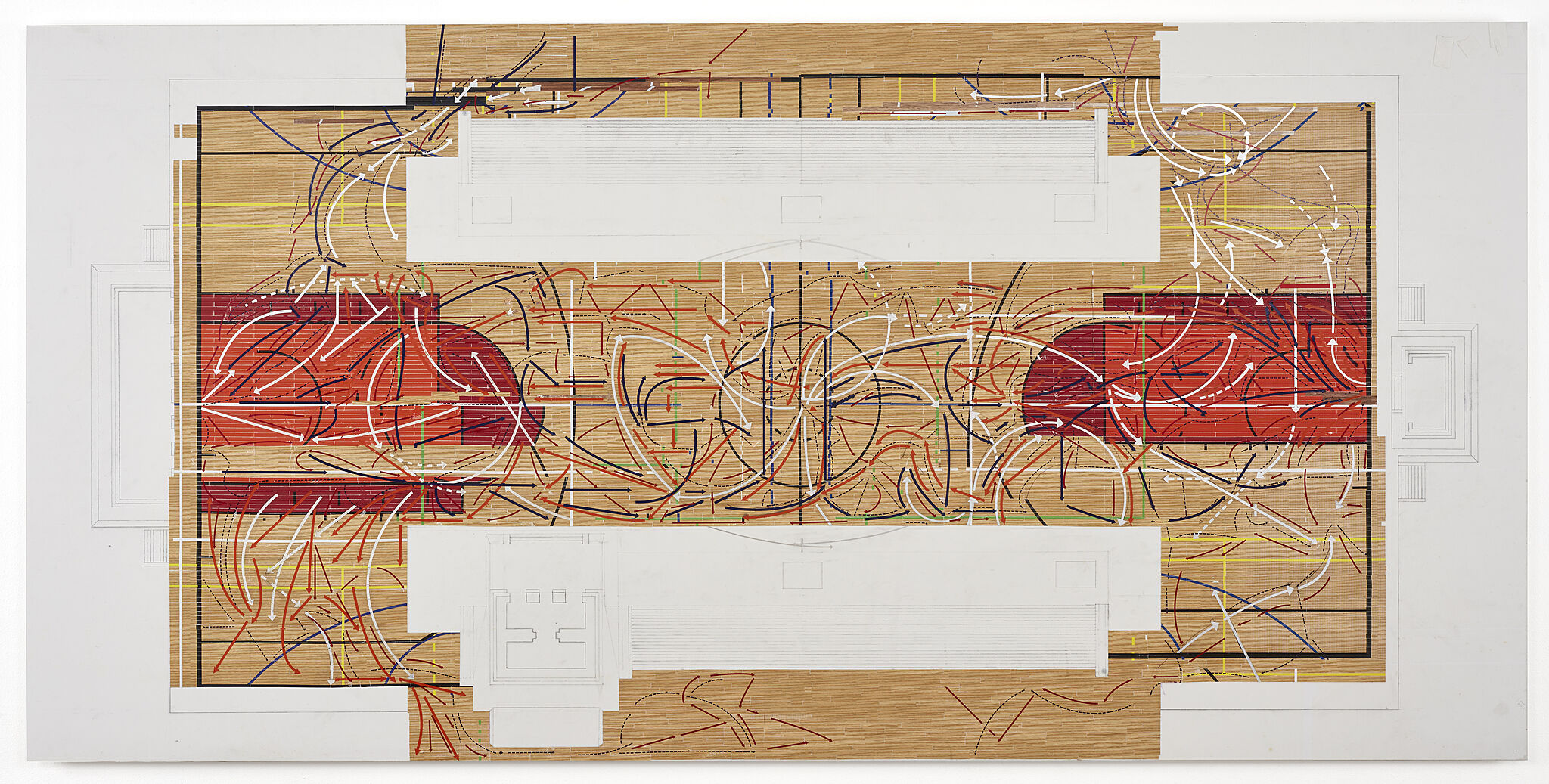
-
503
Guadalupe Maravilla
Audio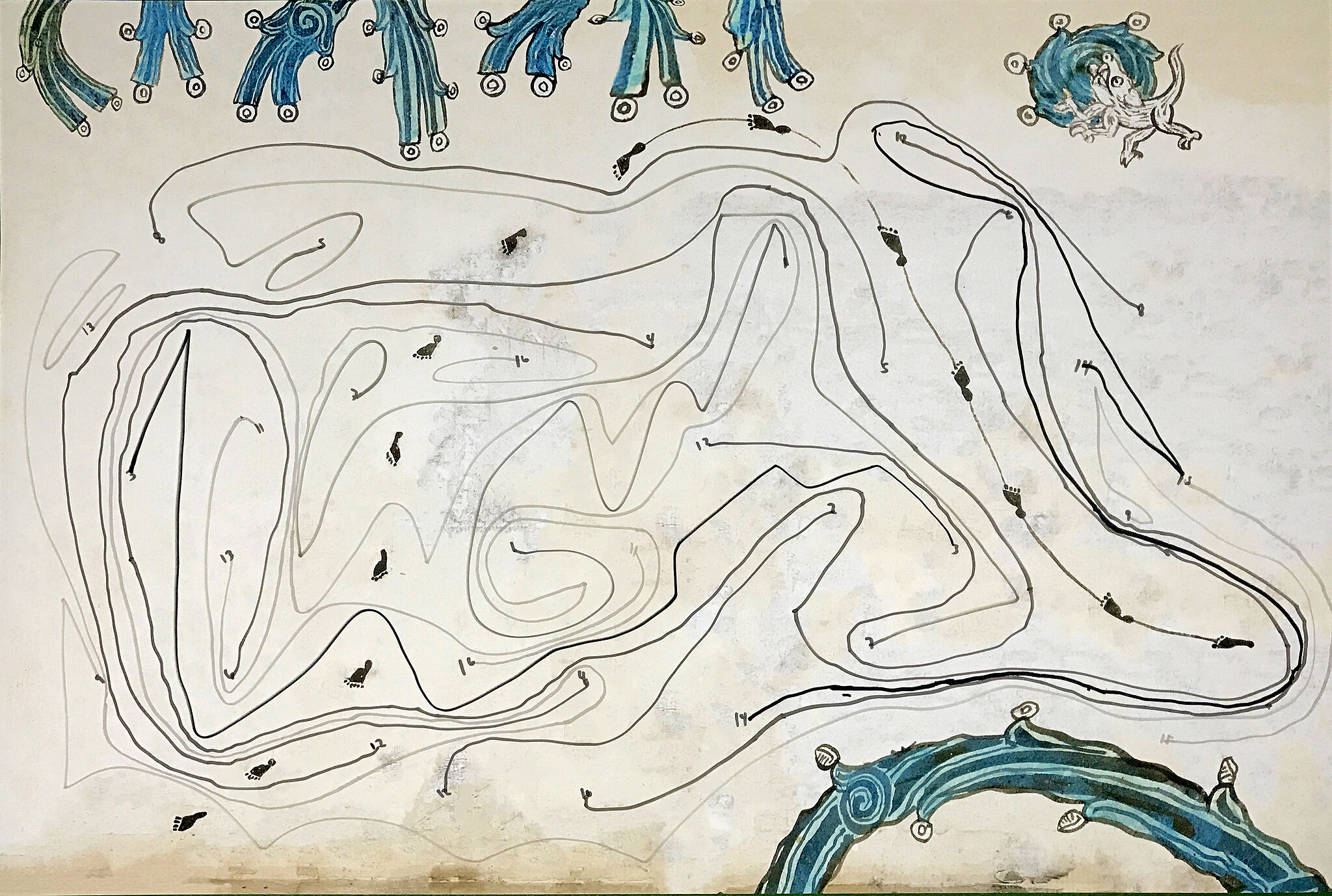
-
504
Livia Corona Benjamin
Audio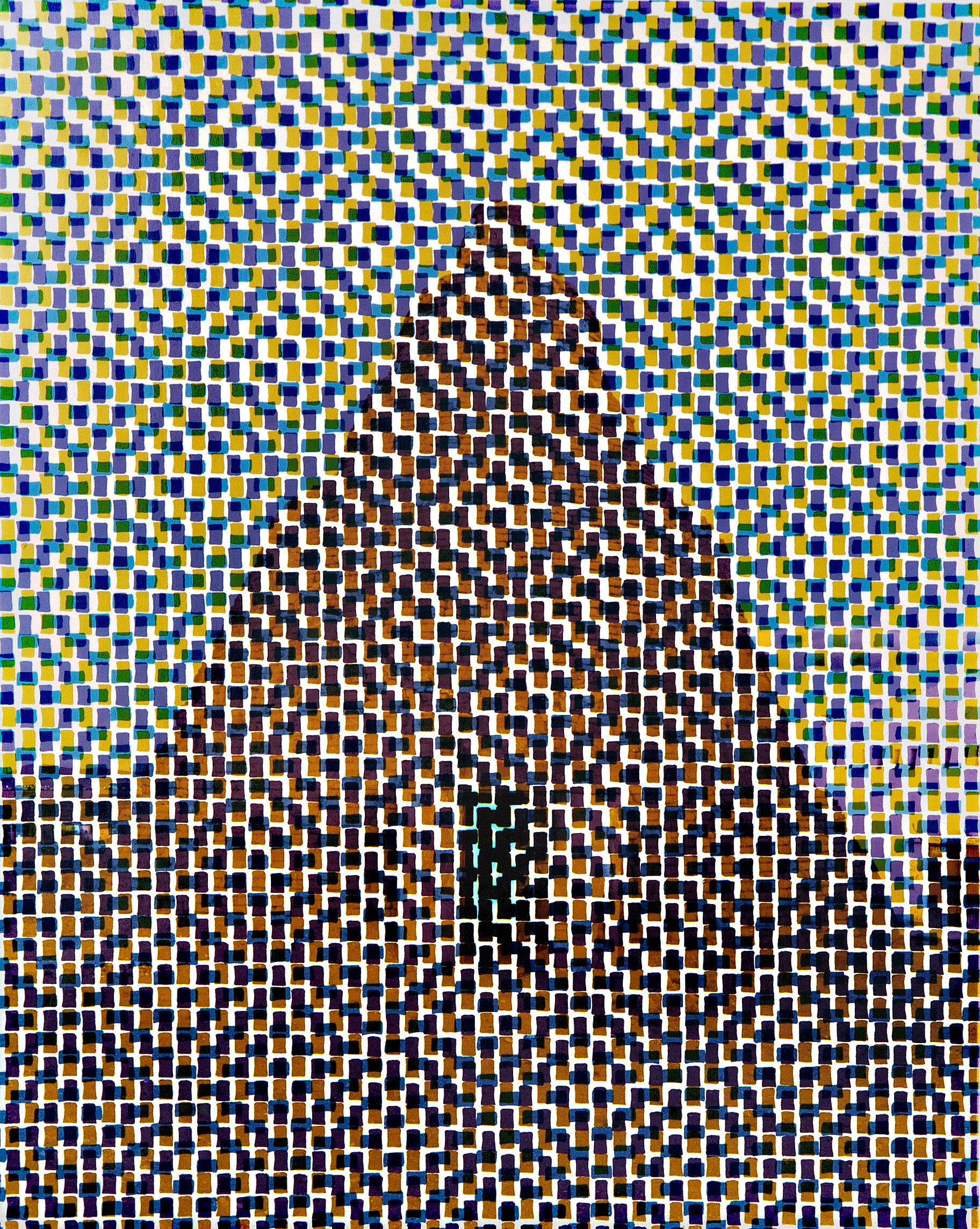
-
506
Jorge González
Audio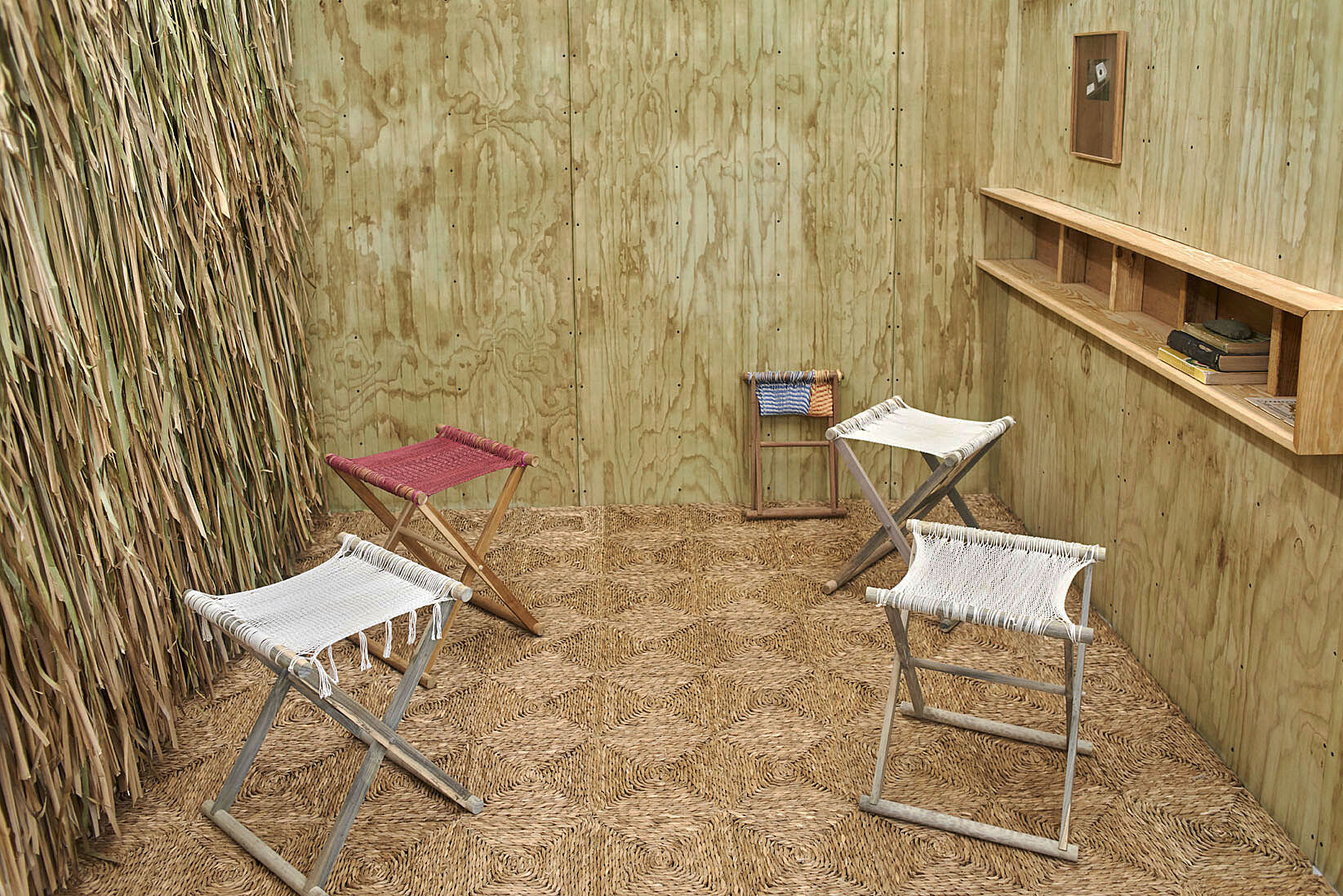
-
507
Claudia Peña Salinas
Audio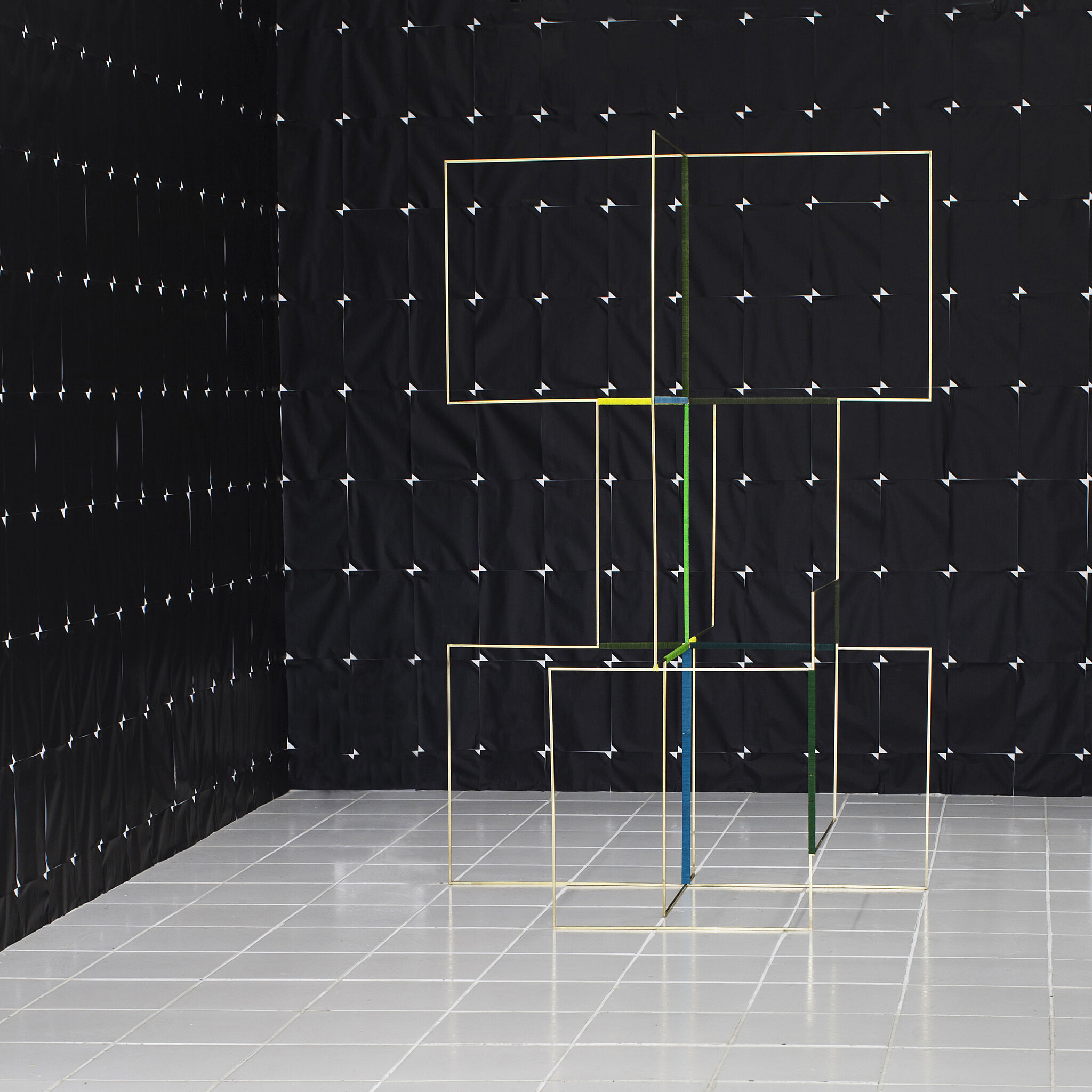
-
509
william cordova
Audio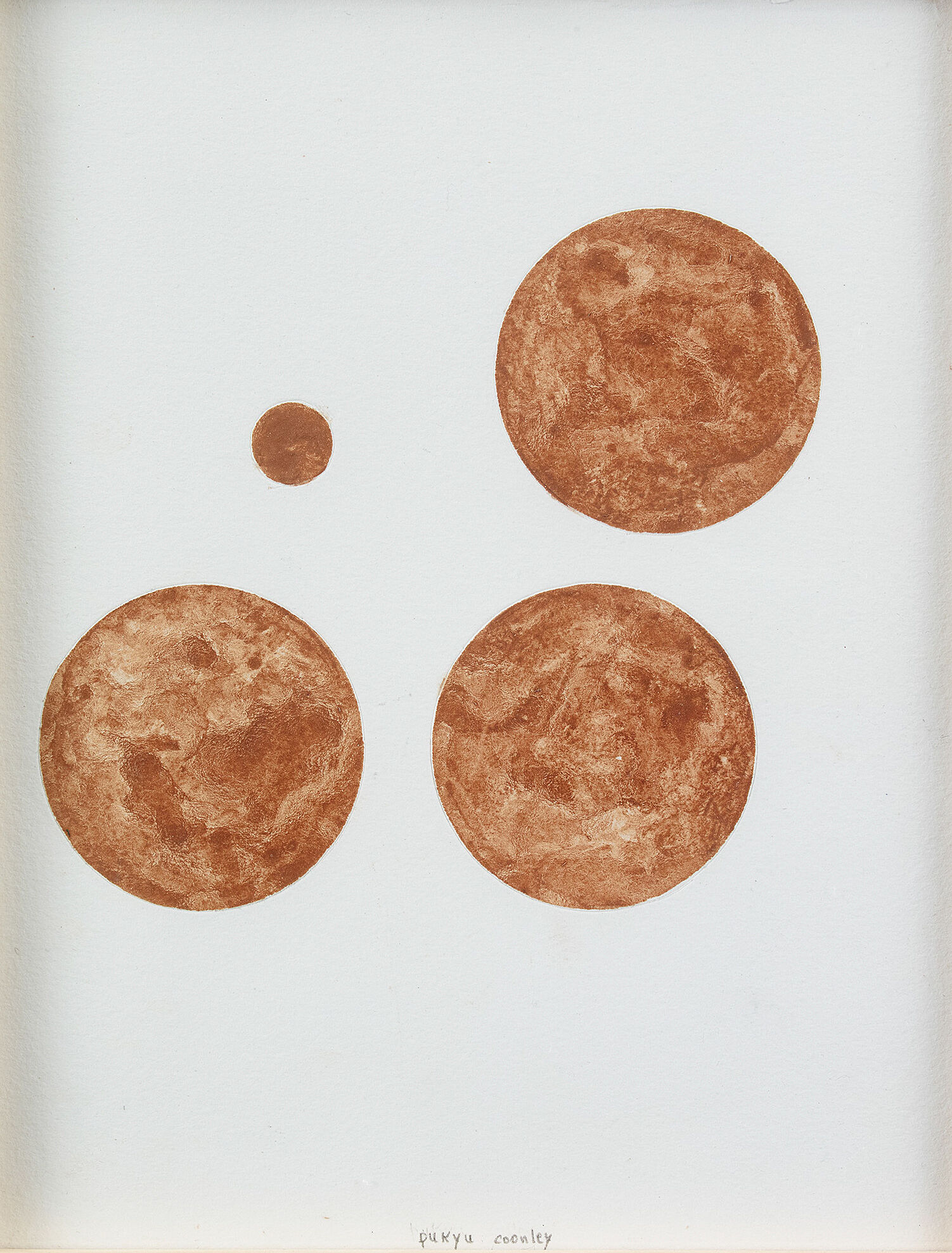
-
505
Livia Corona Benjamin, Nadie Sabe, Nadie Supo
Transcription -
508
Claudia Peña Salinas, Tlachacan
Transcription
Marcela Guerrero: My name is Marcela Guerrero. I curated this exhibition.
Pacha, Llaqta, Wasichay: Indigenous Space, Modern Architecture, New Art is a group exhibition of seven young, emerging Latinx artists who are inspired by notions and concepts of space and architecture coming from indigenous cultures in the Americas.
The cultures that these artists are looking towards are not pre-Columbian, in the strict sense of the word, in terms that they're not frozen in time. They're not dead cultures, they're still very much alive. With this exhibition, I wanted to make a nod to the conversation, especially in the U.S., that we're a very varied, heterogeneous group, which also includes indigenous populations that are still very much alive, and with their own languages, and cultures, and traditions in countries throughout the Americas, but also in the U.S.
Clarissa Tossin, still from Ch'u Mayaa, 2017. Video, color, sound, 17:56 min. Whitney Museum of American Art, New York; purchase, with funds from the Film and Video Committee 2019.320. © Clarissa Tossin
Clarissa Tossin: Hi, my name is Clarissa Tossin.
This series of sculptures, The Mayan, is based on the interior design of the Mayan Theater, in Downtown Los Angeles.
I rubbed layers of silicon on sections of the walls and doors, and some other interior design details of the Mayan Theater and then peeled it out. I combined them with some hand gestures and feet positions that are based on ancient Mayan pottery and murals where dancers, or performers, or ceremonies are being depicted.
The Mayan Theater is a building that is really rich, in the way it used specific archaeological sites and mythological figures into its interior design. Part of my work was to find the original sources. Because it's really the combination of three archaeological sites, but made into a Theater.
In this series of sculptures I wanted to make the building dance, or to make the building embody some physical bodily qualities. That's why the imprints of the building are made out of silicon. It’s this really soft and drape-y material that speaks more to the body than the rigidity of walls and architectural structure.
It was an interest in architecture and the relationship with Mesoamerican and Mayan templar structure, and how it was recreated, reformulated, and how it became a historical movie theater in a city that today has big part of the population who is Mayan. I'm not sure how aware they are of these buildings. My question was, what does it mean to have these spaces as landmarks and historical buildings, and how they relate to the cultural fabric of that city today? It was interesting to do this archaeology of the present.
The work doesn't try to make a claim that it's closer to the Mayan culture than the building ever was—that it's acknowledging that the history of The Hollyhock House needs to be revisited and acknowledged.
Clarissa Tossin, Ch'u Mayaa
Running time: 18 mins
Sounds include: a wind instrument playing a low, melodious tune overlaid with the silence of nature; crickets, birds chirping and the calls of hawks, roosters and various other animals.
Animal calls continue tune stops; echoes of wind rustling against leaves; fast and rhythmic thump of a heartbeat that amplifies; muffled sound of panting breath; quick, short spurts of wind; rhythmic, low beat of a drum; wind instrument plays sharp tune.
Drum beats at different speeds and pitches; ticking sounds; gunshot-like sounds of thunder throughout that fade into the sound of a heartbeat; thunder overlaid with cacophony of glass and other objects breaking; heart beat stops.
Clarissa Tossin, still from Ch'u Mayaa, 2017. Video, color, sound, 17:56 min. Whitney Museum of American Art, New York; purchase, with funds from the Film and Video Committee 2019.320. © Clarissa Tossin
Ronny Quevedo: My name is Ronny Quevedo.
My interest in games started through going to indoor soccer leagues in New York City. The majority of them were coordinated and held by migrant workers here in the city from South America and Central America.
Narrator: Mixing materials like contact paper and gold leaf, Quevedo creates overlays of modern and ancient gaming fields.
Ronny Quevedo: Over the years, I've become interested on how the field becomes a place of communal exchange, a place of competition, but also a place of cultural pride. I've been looking at fields of play in the pre-Columbian era.
A lot of the information behind them is deduced, a lot of it is taken from other manuscripts or different things that exist, because a lot of that information is lost. My interest in that space, in the space that I came across as a child, is really about looking for your point of origin, really thinking about heritage in this very malleable way, and looking at ancestry in this really abstract way that is not fixated on one sole position of generation, or one sole position of tradition or even worship.
Narrator: In the sculpture Ulama, Ule, Olé, Quevedo repurposes milk crates.
Ronny Quevedo: My use of milk crates stems from looking at an urban landscape and materials that have been appropriated for multiple uses.
I use the milk crate, in this case, as a hoop the way it would be used in a basketball game by incorporating it into a hoop that would be used for pre-Columbian game. So, the conflation of time is really interesting to me, in which something very, very modern, plastic, can also work well with something that's pre-Columbian. For me, I'm really interested in how both landscapes of an urban space and a ruin can exist at one time.
Ronny Quevedo, ULAMA-ULE-ALLEY OOP, 2017. Enamel, silver leaf, vinyl, and graphite pencil on mylar, 42 × 84 in. (106.7 × 213.4 cm). Collection of the artist. Photograph by Argenis Apolinario
Guadalupe Maravilla: I recently changed my name to Guadalupe Maravilla, formerly Irving Morazan, to show solidarity to my undocumented father, who uses Maravilla in his last name in his fake identity. As a child, I migrated alone into the United States from El Salvador escaping the civil war, and was undocumented until I became a U.S. citizen as an adult.
The foundation of my drawings are maps from the sixteenth century manuscript Historia Tolteca Chichimeca, originally written in Nahuatl, in Mexico. What interests me in the Historia Tolteca Chichimeca manuscript was that I started marking my original migration route when I crossed the U.S.-Mexico border as a child.
The manuscripts map an area that I crossed in my two-month journey to the United States.
The original manuscripts are drawn by a Catholic priest in the indigenous style of drawing of that time.
Those drawings illustrate crossing routes, rivers, rituals, their connection to plant medicine and the colonization, among many things associated with the indigenous daily life of that time. My process consists of altering actual symbols and motifs of the original maps to compose new maps digitally. The next step is to play the childhood game tripa chuca with pencil or marker on top of the newly printed maps with someone who is undocumented to create abstract immigration routes.
Tripa chuca is a number and lines game that I used to play as a child in El Salvador. The result resembles an abstract fingerprint or a line map, shapes made by two people that share similar experiences of crossing to the lands to become undocumented immigrants in the United States. The participants who play tripa chuca in the drawing are all undocumented. My father participated, a student facing deportation, and a seventy-two-year-old mariachi singer.
Guadalupe Maravilla, Requiem for a border crossing of my undocumented father #3, 2016. Archival inkjet print, 30 x 20 in. (50.8 x 76.2 cm). Edition 3 of 5. Collection of the artist
Livia Corona Benjamin: The buildings that we see in the photographs are conical shaped, as you can see. They were meant to be grain storage silos. There were 4,500 of them, approximately, all built from a single architectural plan, designed by late modernist architect Pedro Ramírez Vázquez.
Narrator: The silos were built across Mexico to be used by collectives of independent farmers. After the North American Free Trade Agreement went into effect in 1994, industrial agriculture practices from the North devastated these small farming communities. The majority of the silos fell into disuse—and to date stand empty. They are located in once-thriving rural areas now abandoned by laborers who’ve migrated north in search of work. Take a look at the diagrams underneath the large black-and-white photographs. These consider the challenges of reanimating infrastructure and architecture when there is very little community or economy to support it. The photographs also suggest the passage of time and shifts in power.
Livia Corona Benjamin: The photos allude to the aesthetic choice of printing in black and white silver gelatin prints, using techniques that are no longer common—it's a stubborn choice at this point. There's something about the way in which they appear that deliberately accentuates an era that has gone by. It plays too with the early twentieth century way of documenting pre-Hispanic ruins in situ.
It brings one to imagine these buildings to be of a bygone era, where the governmental support for these communities was eliminated to make way for a new type of colonization—in this case, colonization from north to south, rather than from Europe to the Americas.
Livia Corona Benjamin, Infinite Rewrite XVIII, 2016. Analog photogram on chromogenic paper with aluminum mount on stacked acrylic base, 10 7/16 × 8 3/8 × 1 7/16 in. (26.5 × 21.3 × 3.6 cm). Collection of the artist. Image courtesy the artist
Jorge González: I’m Jorge González, a Puerto Rican artist.
For the exhibition, there's a main attention on a specific fiber, which is cattail. We call it enea. I have been drawn to this material given to artisanal practices in the island, by two different families.
Narrator: One of these families, weaves mats from the enea. The other uses the cattails to make furniture.
Jorge González: Both are traditions that are close to a hundred years of being transmitted from different families, from different generations within the families. I've worked with both families in attaining the knowledge.
There are other recognitions among the work that I am conscious of. How this mat, also, organizes itself within design proposals in Puerto Rico by modernist architects that arrive to the island with a conscious of working with our climatic context.
Narrator: In this installation, González explores the ways Puerto Rico’s craft traditions connect the island to its indigenous past. He has also included prints of petroglyphs left by the Taíno, and other pre-Columbian objects.
Jorge González: I am grateful for the people who have paved the way in claiming our being indigenous or the indigenous groups that are in the Antilles. That's how the bridge between modernity and the indigenous has happened in my work, dealing with artisanal traditions and working within the landscape.
Jorge González, dyed cotton stools seen in the exhibition 359 dias en 19 meses (359 days in 19 months) at Embajada, Puerto Rico. Image courtesy of Embajada, Puerto Rico
Claudia Peña Salinas: Hi, my name is Claudia Peña Salinas.
For maybe about four, five years now, I've been working with these two water deities that come from the Aztec, and it's Tlaloc and Chalchiuhtlicue. They're almost like drawings in space too and the colors that I'm using, they're these yarns that are dyed with colors that associated with the deities. In this case, they would be a bunch of greens and blues.
My way of coming into sculpture is through installation, so everything is always part of each other. So, the main sculpture would be the deity and then from there, all these other things branch off.
Narrator: Today, the sculptures that Salinas based these works on can be found at the National Museum of Anthropology in Mexico City.
Claudia Peña Salinas: I discovered that he'd been brought from a small town two hours away from Mexico City, so I went to the town. All this later became two photographs that will be in the show. One that shows the Tlaloc in the original site, the one that's in front of the Anthropology Museum, and then the other one that's in the town of Coatlinchan which is the replica. I traveled to those places and just used one photograph to be placed in front of the original stone, and then the other ones to inverse that, kind of bring back the original back to the town, if it is only in this way through a photograph.
Claudia Peña Salinas, Tlalicue, 2017. Brass and dyed cotton, 72 1/2 x 49 x 49 in. (187.2 x 124.5 x 124.5 cm). Collection of the artist; courtesy Embajada, Puerto Rico. Image courtesy the artist
Marcela Guerrero: When our guests come out to the Whitney terrace, they're going to see a great monumental installation by Peruvian artist william cordova. william was born in Peru but has actually lived in Miami and in the United States for many, many years.
The structure’s titled Huaca Sacred Geometries. The structure is inspired by an Ichma Temple.The Ichma people were a pre-Inca group of people that lived in Peru before the Spanish came.The Huaca is a name for a temple. So, Huaca Huantille is a temple that is located actually nearby were william grew up in the Magdalena del Mar district in Lima.
This temple, for many years it was in disarray and disuse before the government came in and took over it and made it very nice and pretty, and made it a national historic archeological site. But before that, many homeless people took over the Huaca and made it their home. And basically, they created their shelters out of scaffolds. And so, this is kind of paying a tribute to the people who lived there before the government came in and took over.
There are two other elements that are part of the installation. People will see gourds placed in what might seem sporadic or kind of random, but it's actually a reference to maybe an orbit or a constellation of stars.
Narrator: For slaves escaping the southern part of the United States on the Underground Railroad, the “drinking gourd” was code for the Big Dipper—and the path to the North.
Marcela Guerrero: We can see through the gourds and also the stainless steel gate, which is kind of evoking the confluence of many different cultures that are actually also part of the foundation of Peru, incorporating not just indigenous and obviously the Spanish, but also the Afro-Peruvian communities that make-up what Peru is today.
william cordova, untitled, 2016. Peruvian cacao on paper, 11 1/8 × 9 1/8 in. (28.3 × 23.2 cm). Collection of the artist; courtesy Sikkema Jenkins & Co., New York
Livia Corona Benjamin, Nadie Sabe, Nadie Supo
Running Time: 06:38
Speaker 1: La inversión que requiere el campo para producir los alimentos que todos consumimos es considerable. Cuando el campesino no tiene recursos suficientes para invertir ¿qué pasa? Entre otras instituciones, conasupo hace un esfuerzo para que no se detenga la producción, proporcionando al campesino diversos apoyos y múltiples servicios. El campesino responde.
Speaker 2: Conasupo también.
Noel Aguilar: Cuando se hicieron las bodegas yo tenía ocho años, yo les traía lonche a mi gente que andaba trabajando a mí, a mi papá, a mis hermanos mayores que yo. Les traía en la mañana el desayuno, en la tarde la comida y por eso yo recuerdo cuando se hicieron estas bodegas, estos conos. Sí nos benefició mucho, en el aspecto que antes el precio no era seguro. Venía un comprador y nos compraba a un precio, venía otro y a otro precio. Entonces, cuando se abrieron aquí las conasupos se estabilizó el precio.
Era el precio de garantía y subiera o bajara, el gobierno nos pagaba a ese precio, siempre lo respetó. Nosotros fuimos de acuerdo y nos convenía porque era un precio justo para todos, así es. Aquí se dijo que ya no se completaba dinero, que esto, que lo otro, pero [unintelligible] para desaparecer conasupo, más bien la desapareció el gobierno. Nuevos gobernantes, claro, ya los anteriores pues sí, trabajaron bien, pero hubo nuevos y ya no les gustó conasupo. Como no les dejaría ganancia, ya lo que querían no sé, pero así fue desapareciendo conasupo.
Por eso mucha gente se ve obligada a tener que salir al otro lado, porque aquí aunque tenga tierra, no muchos no tienen para sembrar, ese apoyo que necesitamos en el campo, de que nos abran las puertas tantito, de poder seguir haciéndole lucha, a trabajar, entretenernos en algo. Mucha gente se desespera, mejor al otro lado y arriesgar su vida porque es muy peligroso. Y aun así, así se va la gente para el otro lado, ¿cómo ve? Muchos sí regresan y muchos no, porque allá se quedan, o se quedan en el camino; a eso se arriesga uno.
Se desesperan más bien por no haber empleos para uno, porque mucha gente sí con carrera, batallan para conseguir trabajo sin ninguna carrera. Los que nos dedicamos aquí al campo no sabemos otra cosa más que el campo.
Speaker 1: Para ahorrar y ganar, primero conasupo. Buenos pesos y 1000 millones de pesos en premios. En conasupo ahorra, gana premios y contribuye al abasto de productos en zonas apartadas del país. Gane hasta un millón de pesos en productos que usted elige.
Speaker 3: Para que usted gane.
Speaker 3: Primero con conasupo.
Claudia Peña Salinas, Tlachacan
Running time: 18 mins
Sounds include: wind instrument playing low note; clattering of objects colliding and sliding back and forth throughout; clinking of glass; drops of water echoing and increasing in volume throughout; irregular beating of a drum; thunder; water moving and splashing; instrument playing a series of irregular long notes; horn playing.
0:00
0:00