Ruth Asawa Through Line
2023
-
800
Introduction
Audio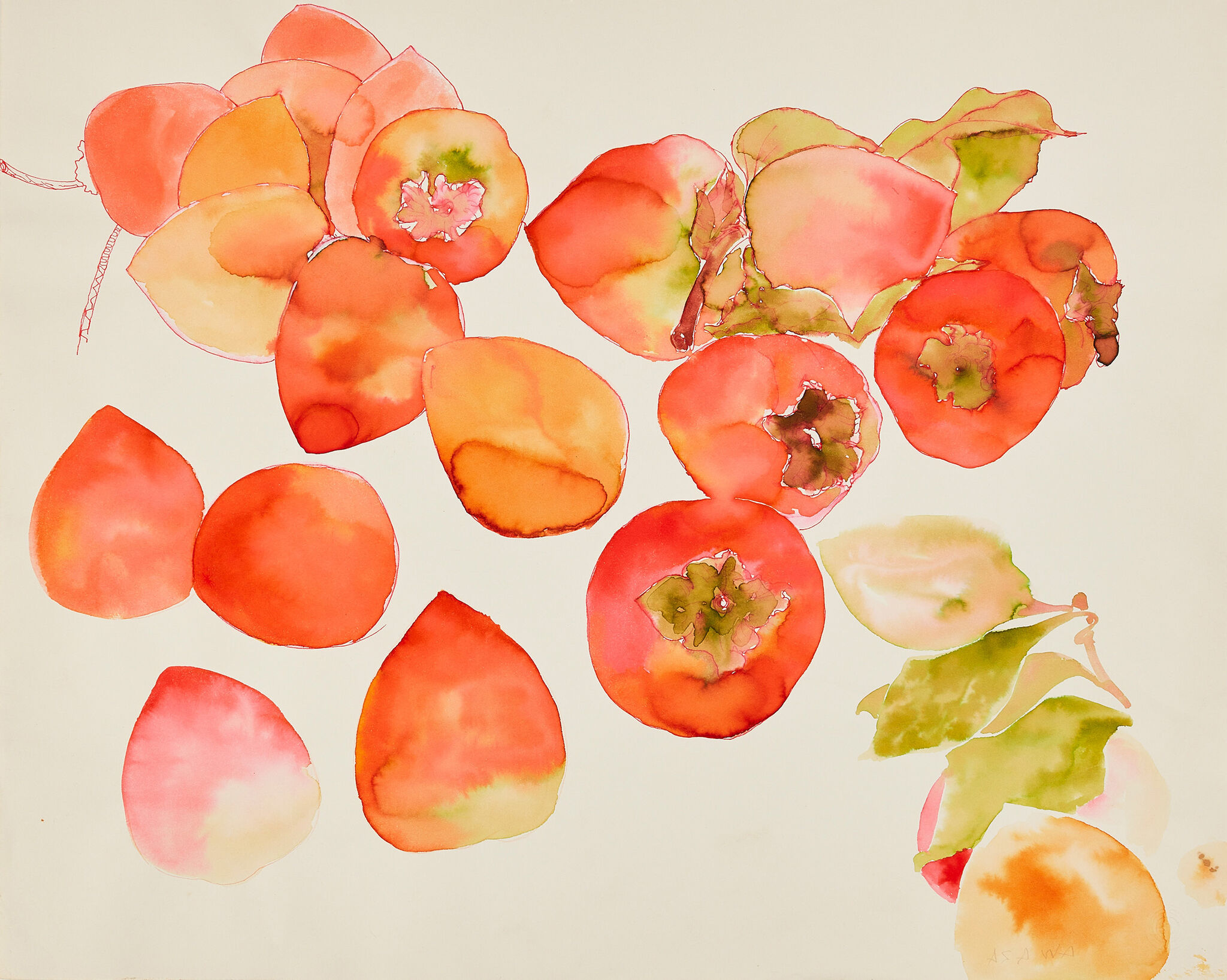
-
801
Untitled (BMC.68, Stem with Leaves), c. 1948–49
Audio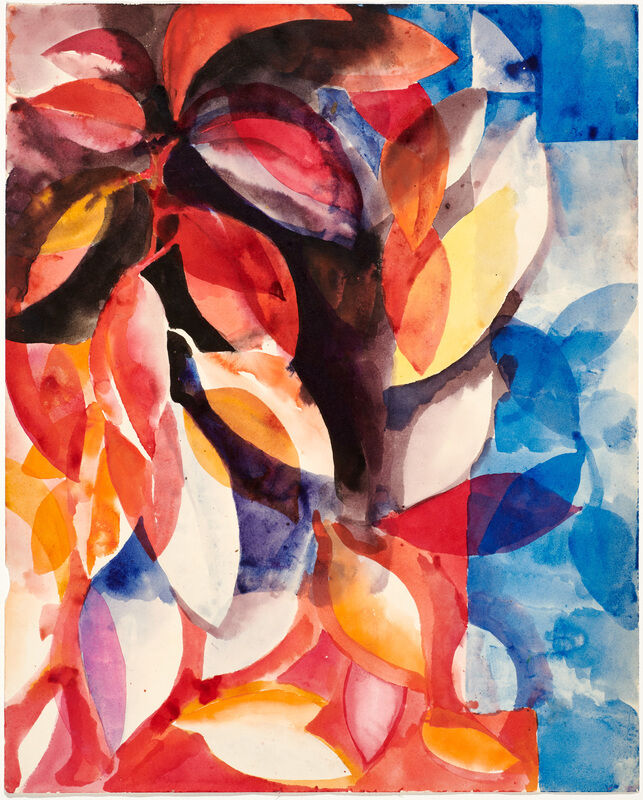
-
802
Untitled (SF.045c, Potato Print - Branches, Purple/Blue), c. 1951–52
Audio, Verbal description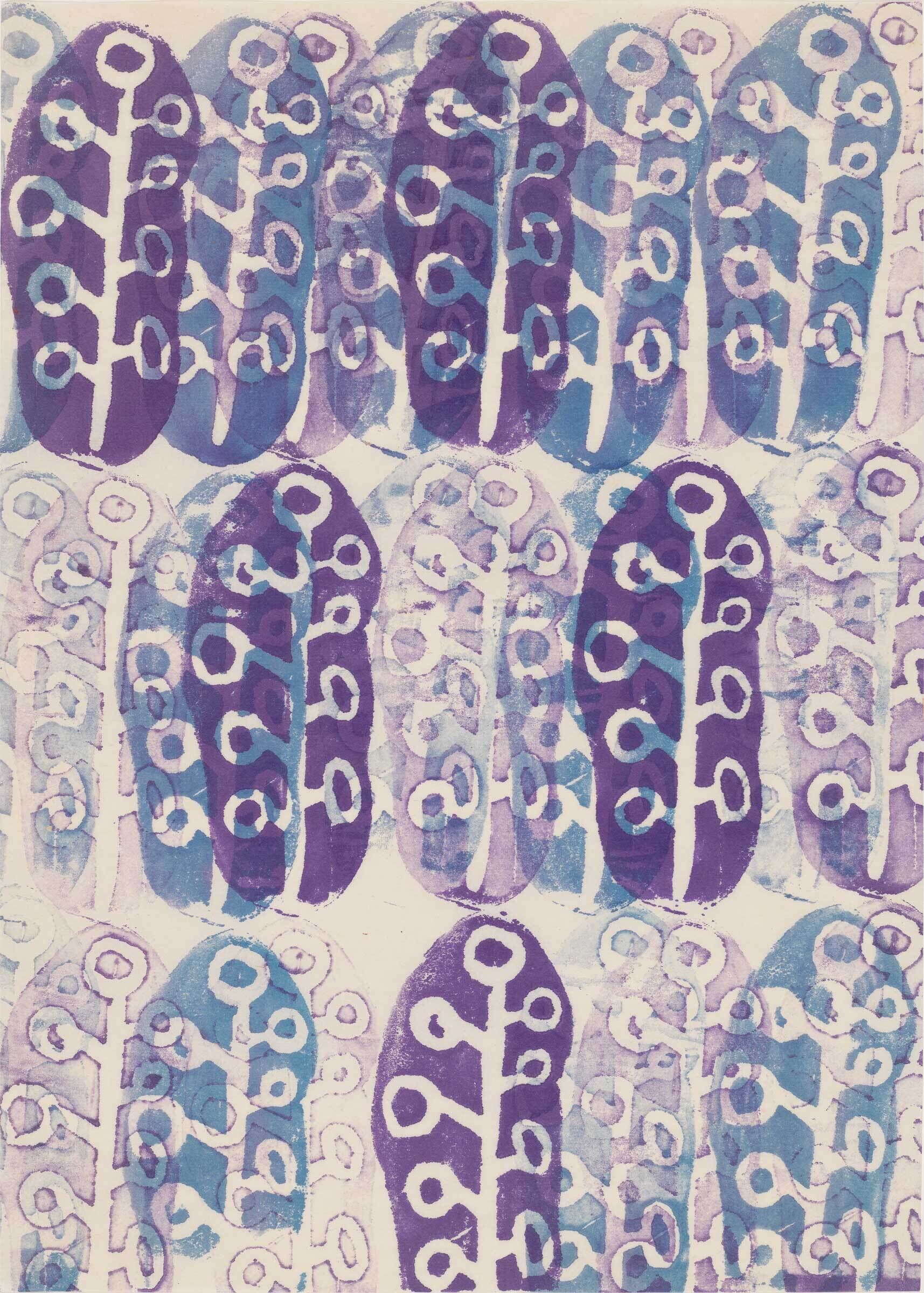
-
803
Untitled (LP.009, Fish), 1987
Audio, Verbal description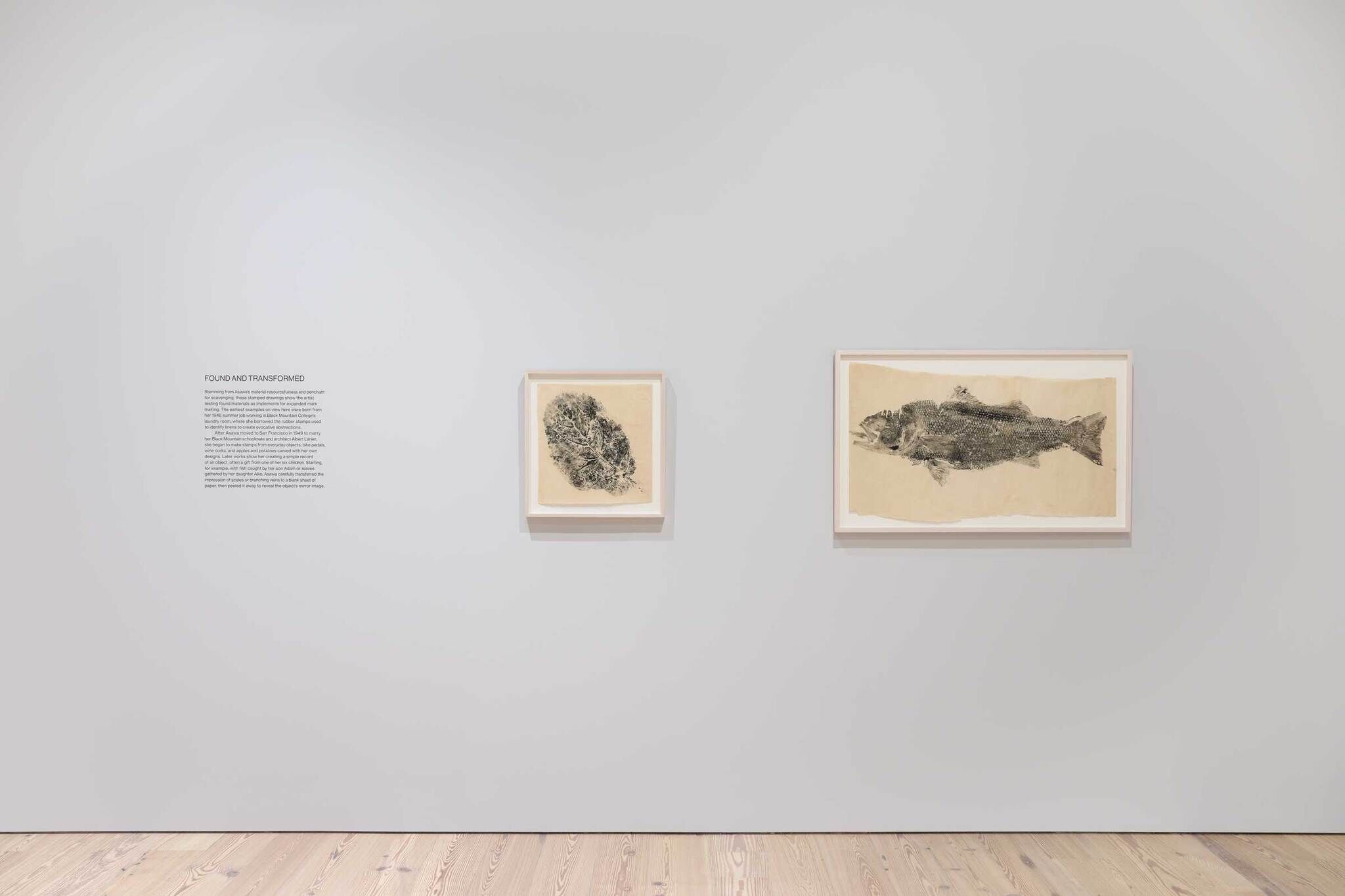
-
804
Untitled (S.270, Hanging Six-Lobed, Complex Interlocking Continuous Form within a Form with Two Interior Spheres), 1955 (refabricated 1957–58)
Audio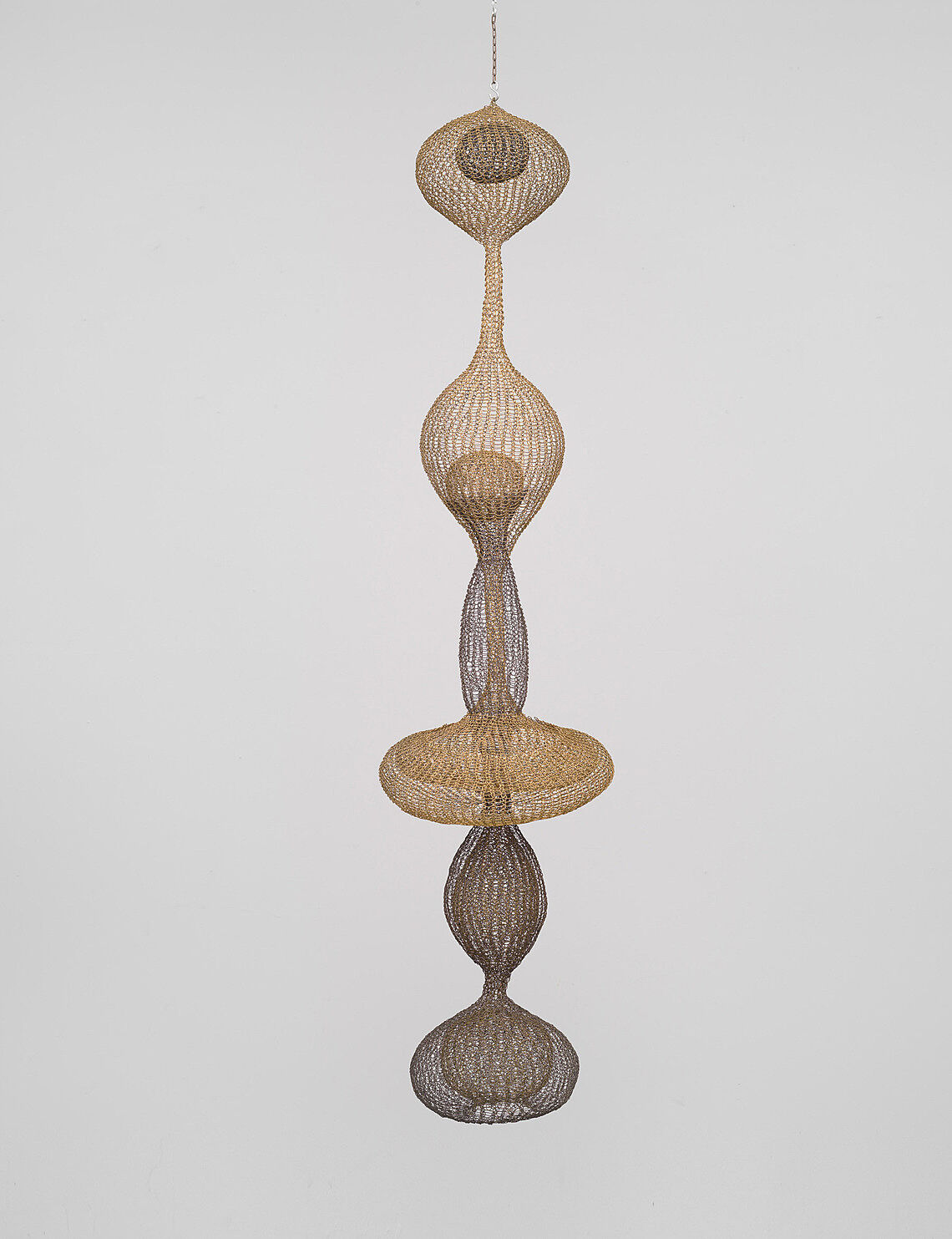
-
805
Untitled (ZP.16B, Twelve Looped-Wire Sculptural Forms), c. mid-to-late 1950s
Audio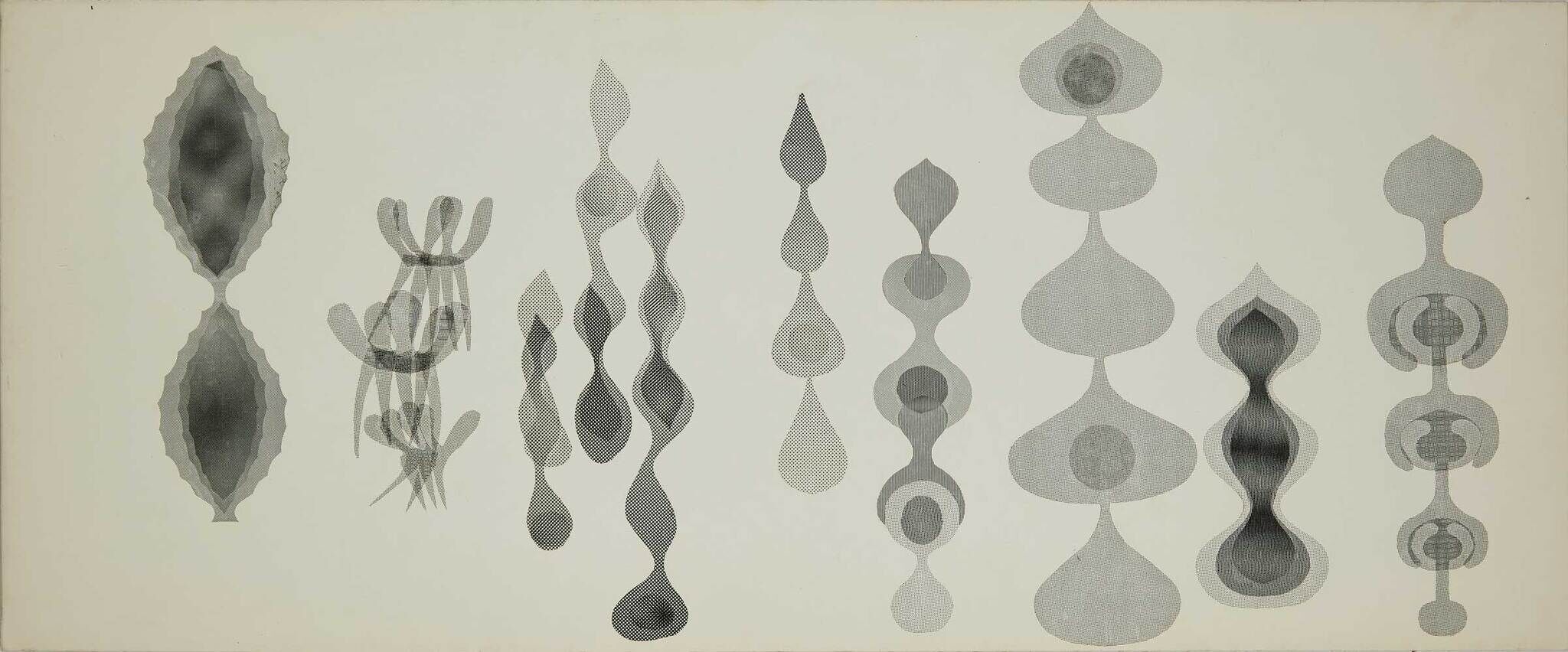
-
806
Untitled (S.691, Wall-Mounted Paperfold with Horizontal Stripes), 1951
Audio, Verbal description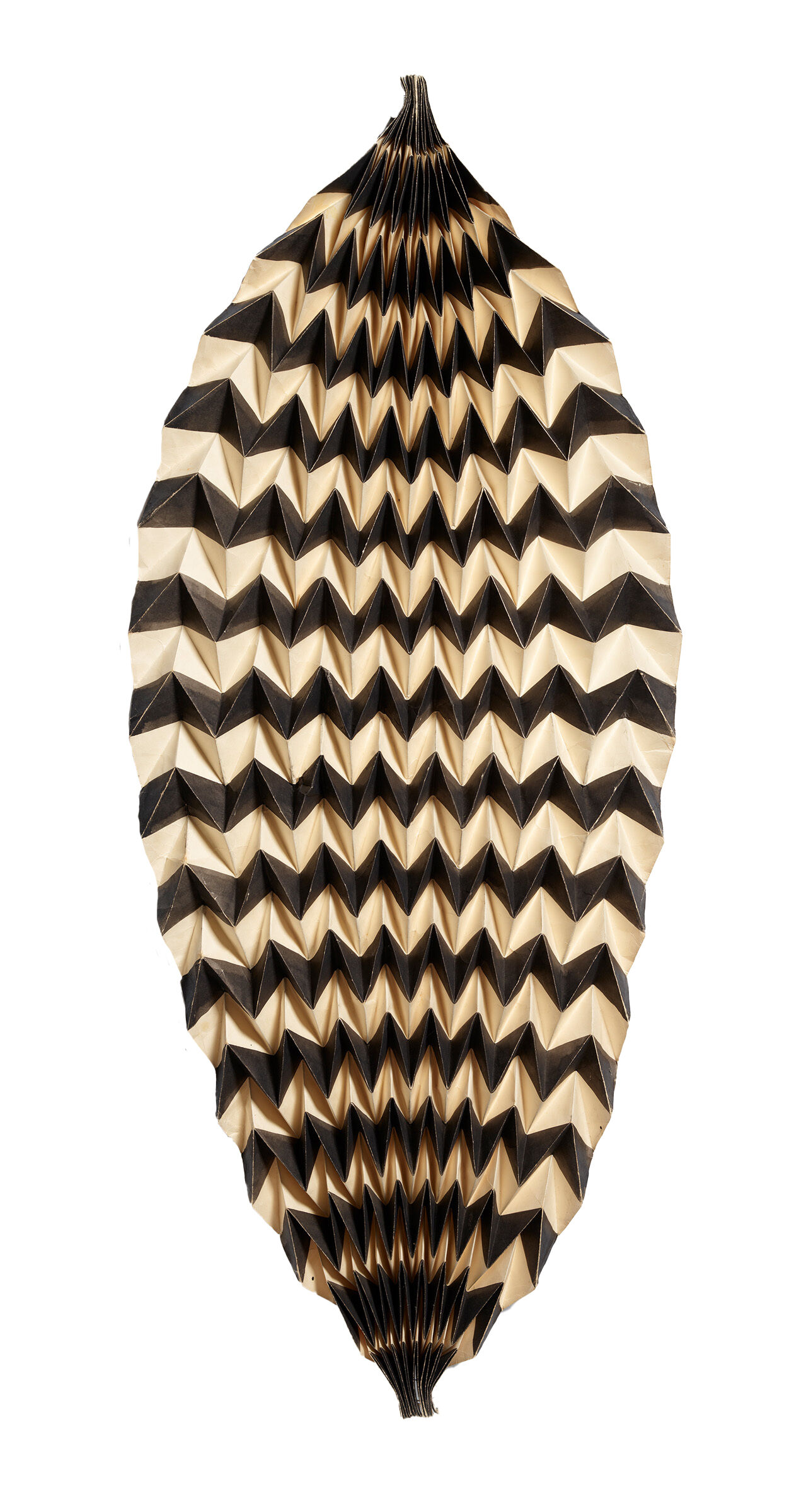
-
807
Laurence Cuneo, Addie Laurie Lanier and Aiko Cuneo discussing a paperfold model for San Francisco Japantown's Origami Fountains (PC.006), 1975
Audio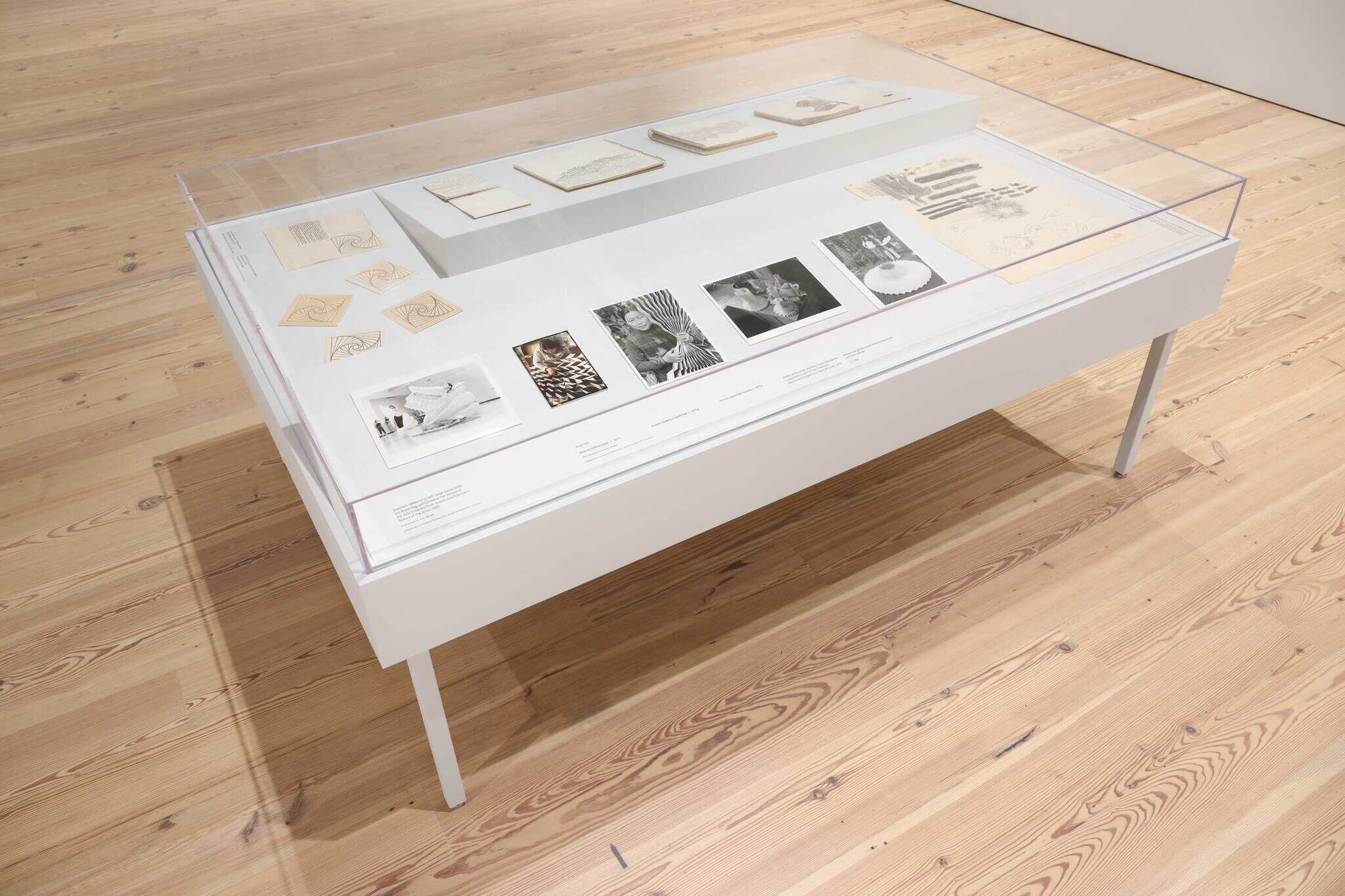
-
808
Untitled (SF.031, Red Meander on Pink), c. late 1950s
Audio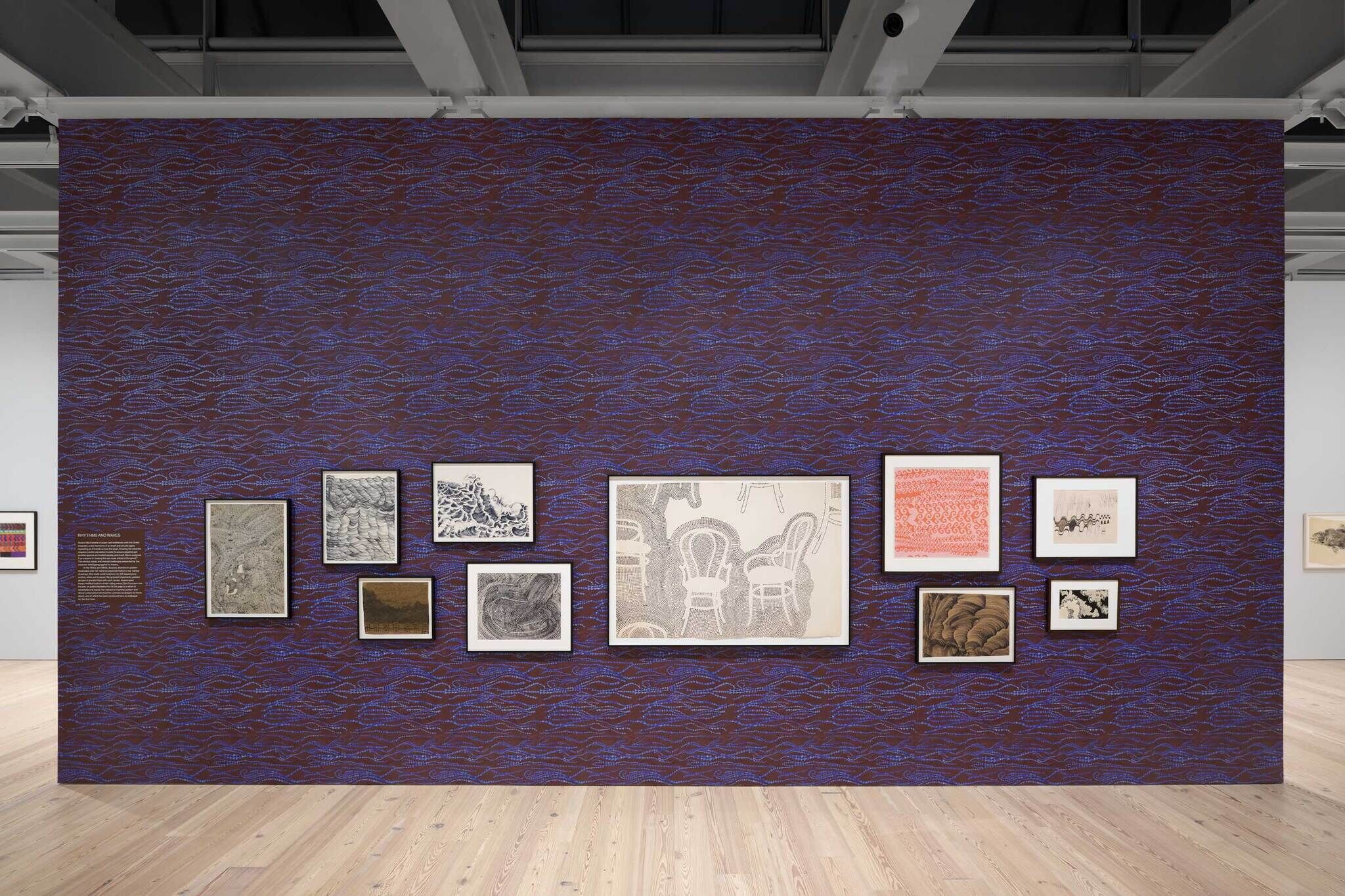
-
809
Untitled (PF.295, Endive), c. early 1990s
Audio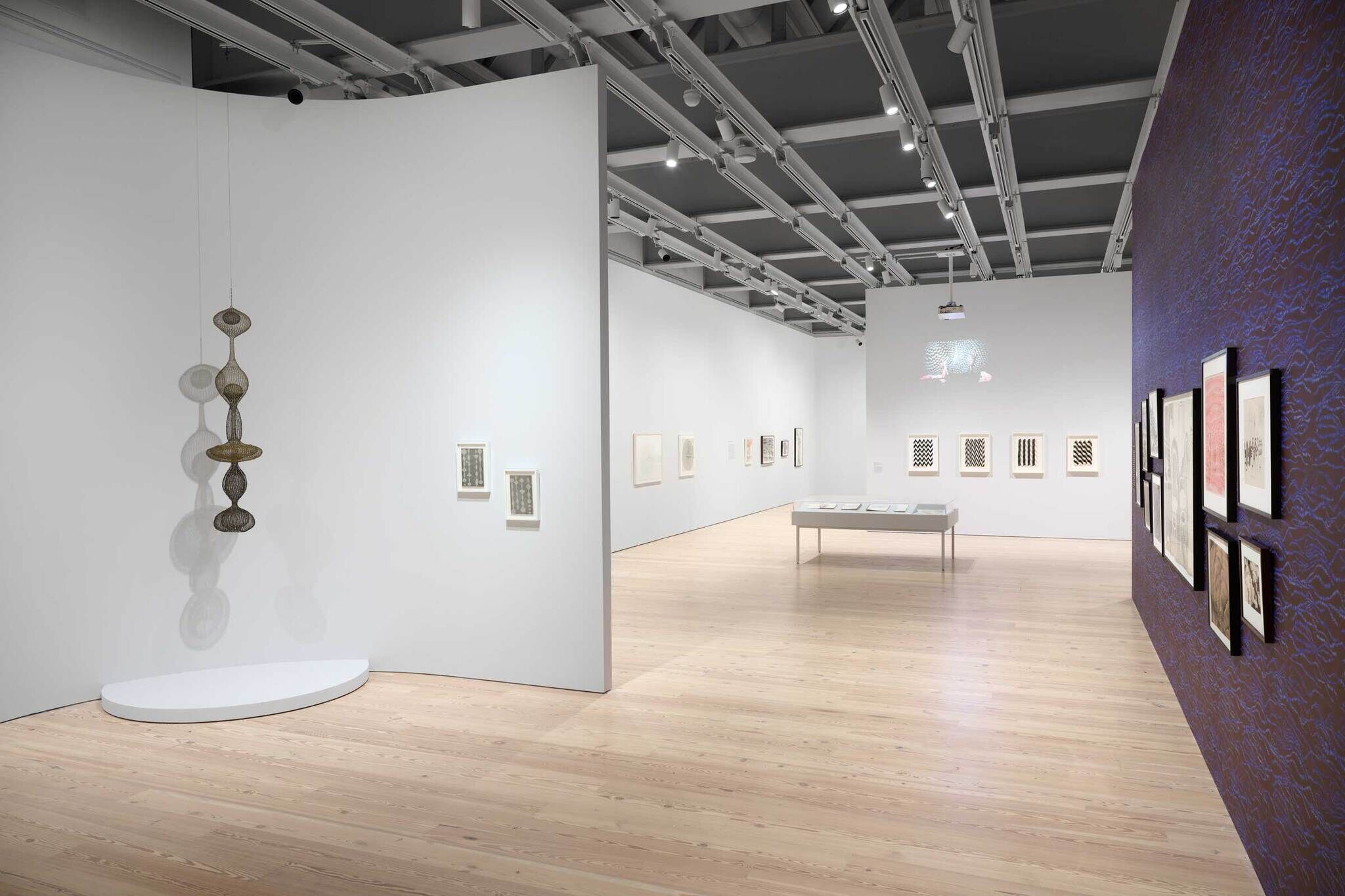
-
810
Redwood 356 (PF.1012, Cross-Section of Redwood Tree), 1960
Audio
-
811
Untitled (PT.106, Plane Tree #12), 1959
Audio, Verbal description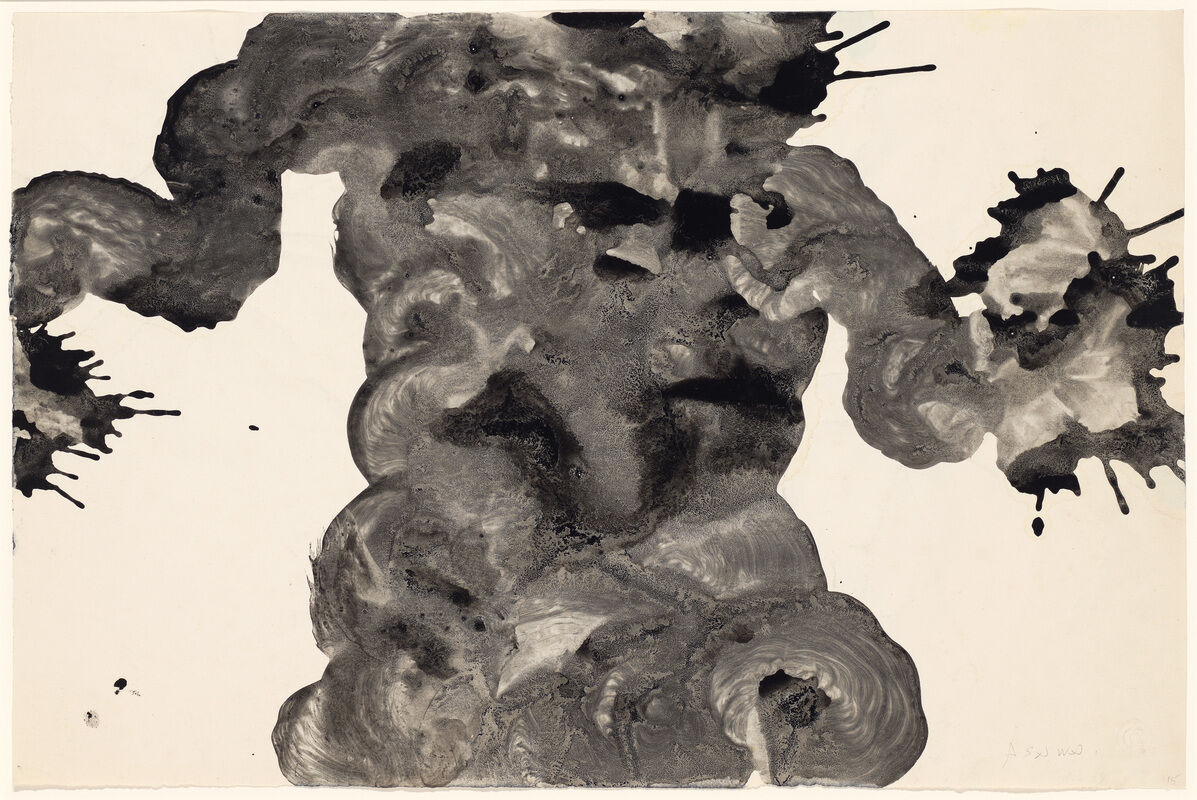
-
812
Untitled (S.003, Freestanding Reversible Undulating Form), 1998 Bronze
Audio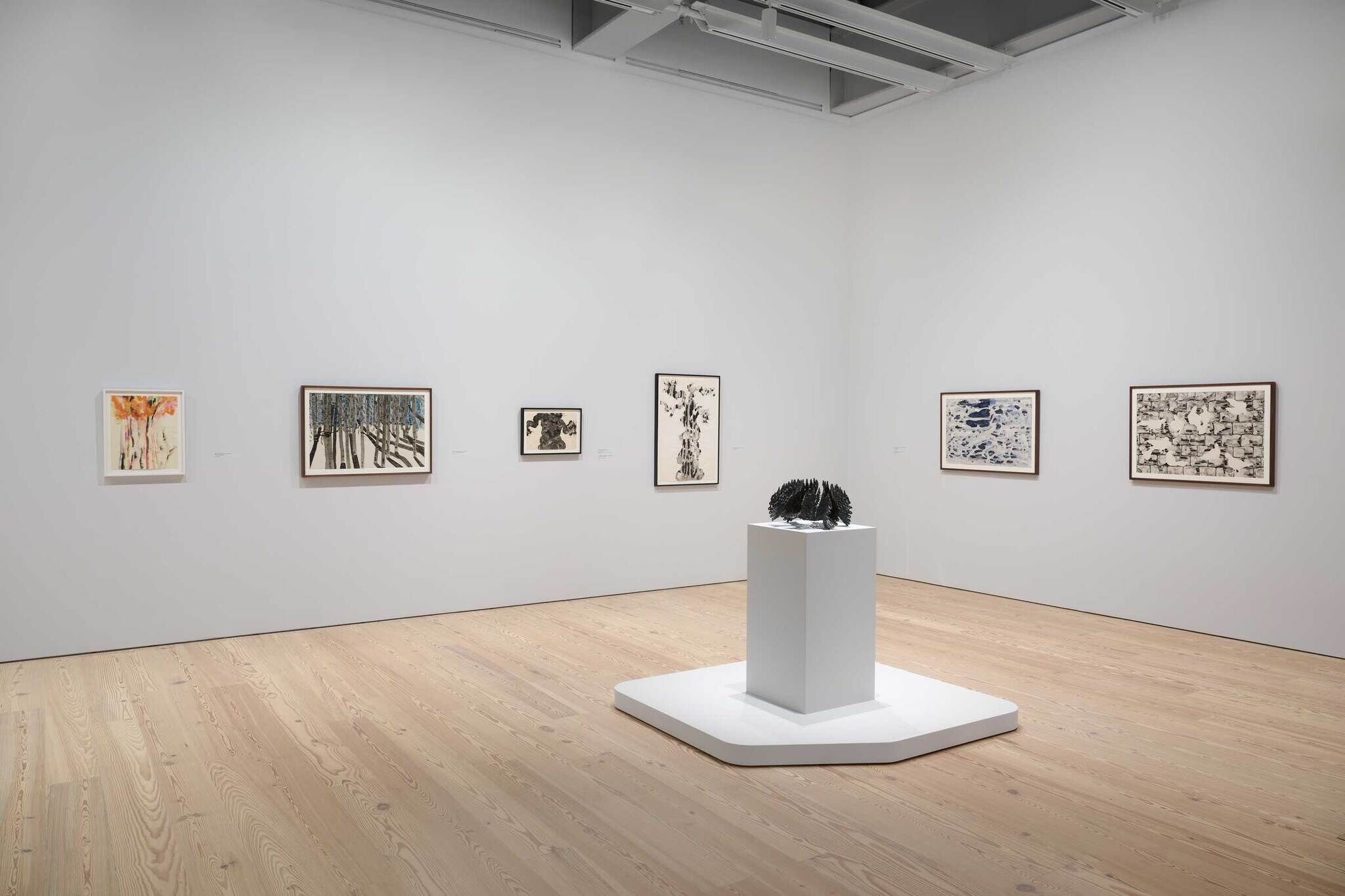
-
813
Untitled drawings of Addie Lanier sleeping (SB.013), c. 1960
Audio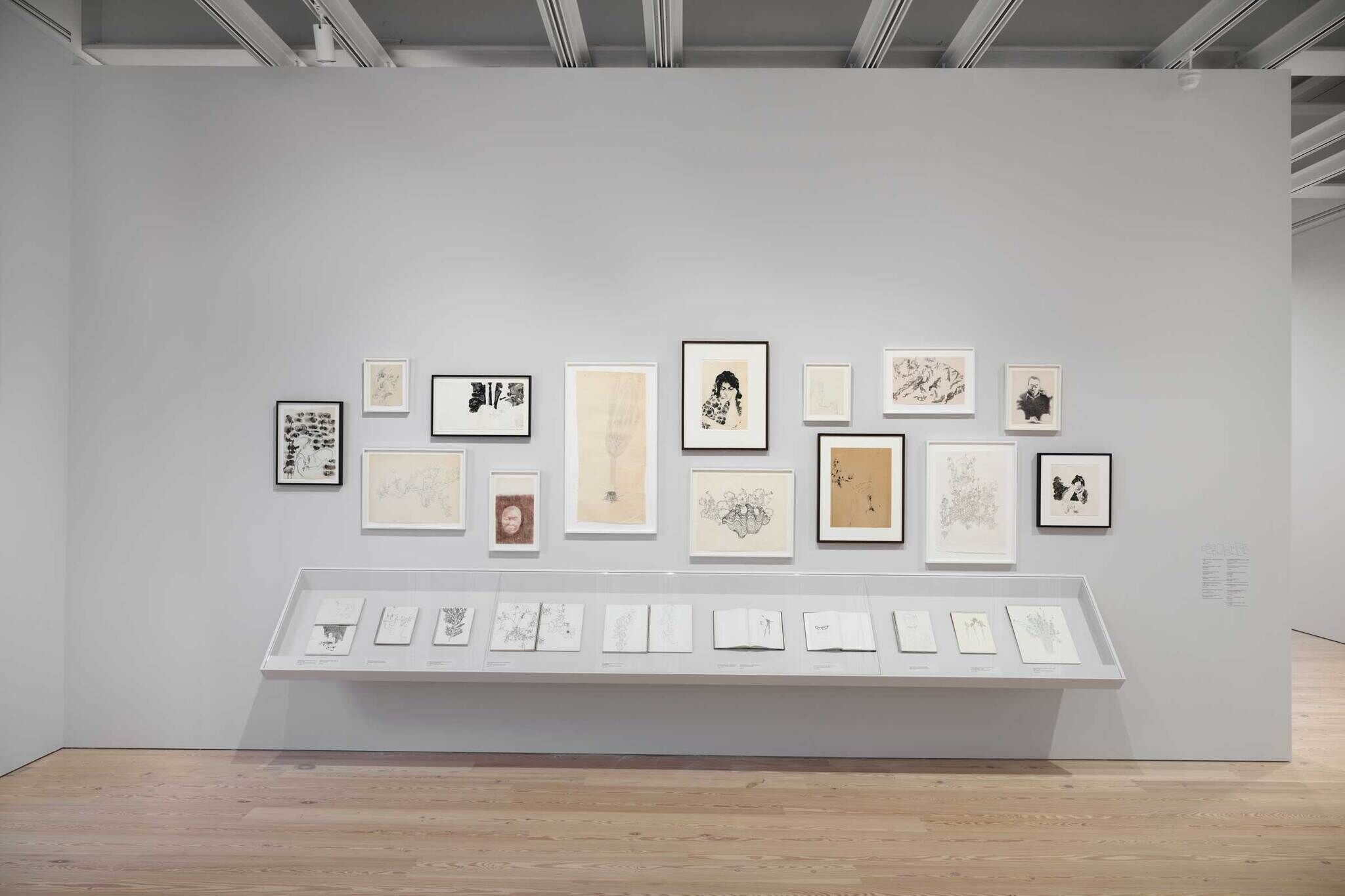
-
814
Suzanne Jackson, 2.11.77 (SB.100), 1977
Audio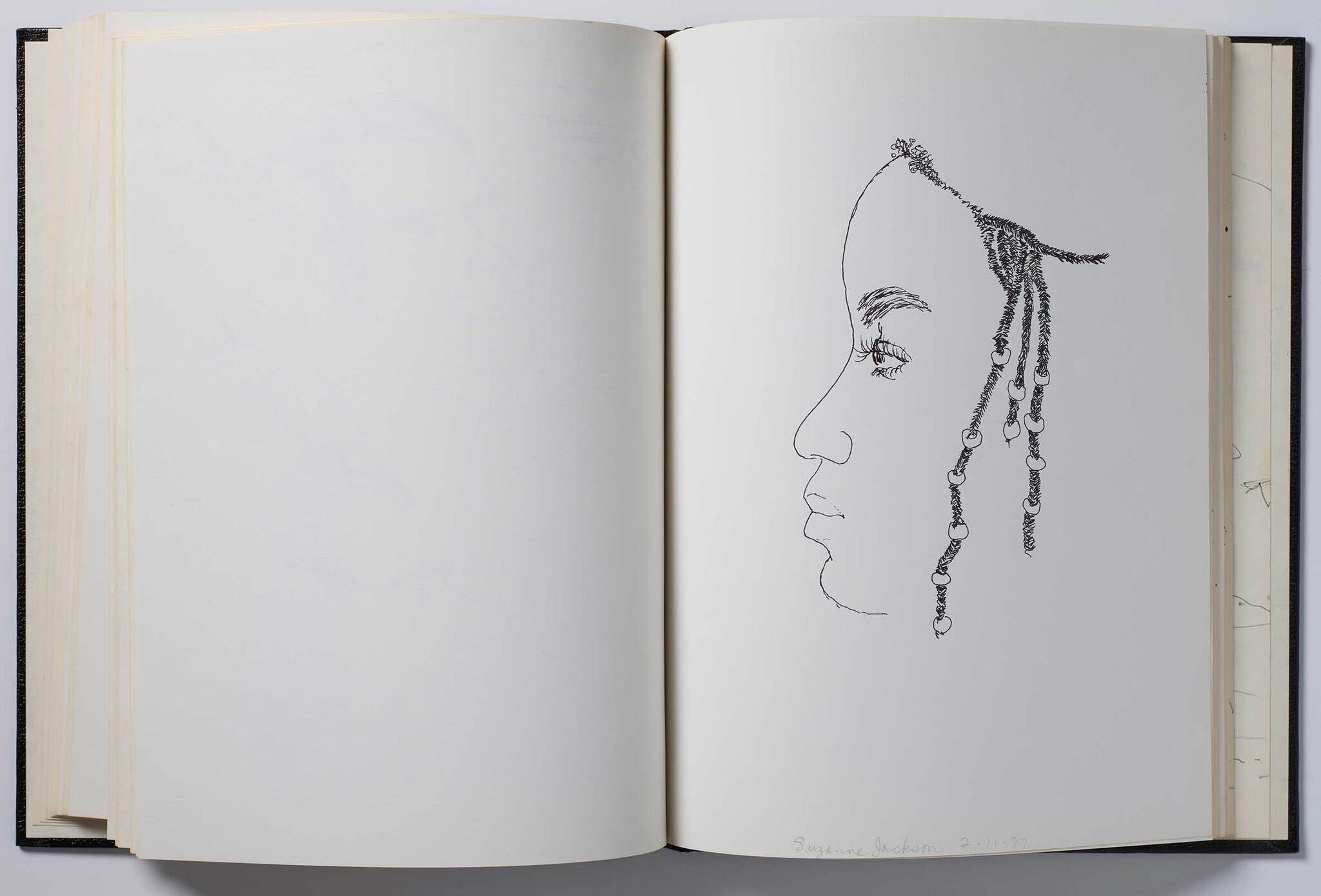
-
815
Untitled (MI.146, Clam Shell with Petunias), c. 1969
Audio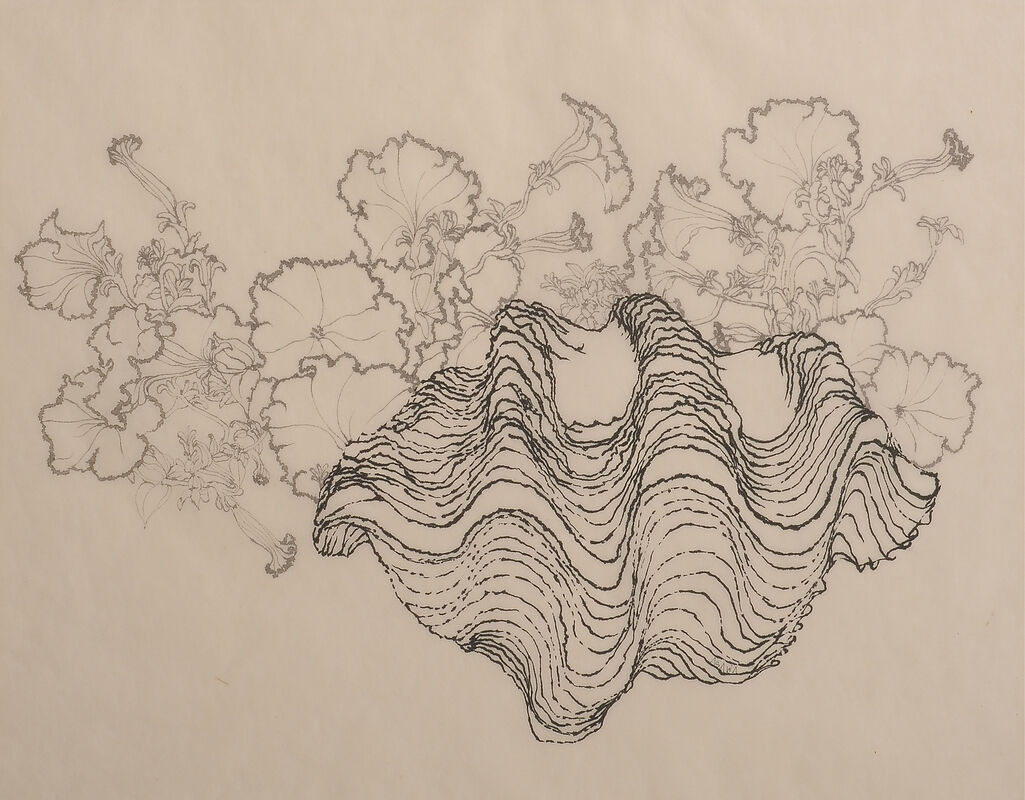
Narrator: Welcome to Ruth Asawa Through Line, an exploration of over five decades of the artist's extraordinary drawing practice. For this exhibition, we created a drawing activity guide that visitors of all ages can use! These drawing exercises are similar to ones Asawa used herself, and present a unique way of knowing the world. And if you'd rather just look and listen, that's great too! In this guide you can hear the perspectives of the curator and paper conservator at the museum, artists who’ve been inspired by Asawa, and two of Asawa’s children.
As the exhibition’s title suggests, drawing was a through line in Asawa’s work and remained an active practice throughout her life. She was born in 1926, and grew up on her family’s farm in southern California. She attended Japanese school every weekend, where she learned calligraphy and origami—traditions that she would later adapt to her own creative ends. Art–especially drawing—also sustained her through the sixteen months when she and her family were incarcerated during World War II.Throughout this difficult period, drawing served as a salvation and purpose, an activity that sustained her. She later reflected, 'I think [art] did help with the anger, but I didn't know it at the time.”
The first section of the exhibition is called “Learning to See.” Here, you’ll find works that Asawa made at Black Mountain College in North Carolina. At the time, the German refugee Josef Albers led the art program there. He encouraged students to focus on process, materials, and close observation. Asawa carried the lessons learned at Black Mountain throughout her life, treating drawing as a means of investigating the world—not simply picturing it.
Ruth Asawa, Untitled (WC.252, Persimmons), c. 1970s–80s. Watercolor on paper, 14 × 17 in (35.6 × 43.2 cm). Private collection. Artwork © 2023 Ruth Asawa Lanier, Inc./Artists Rights Society (ARS), New York. Courtesy David Zwirner
Kim Conaty: This watercolor is both a somewhat abstracted representation of leaves on stems and it's also a color study where we really see Asawa working through primary and secondary colors.
Narrator: Kim Conaty is the Steven and Ann Ames Curator of Prints and Drawings, and organized this presentation of Ruth Asawa Through Line at the Whitney.
Kim Conaty: For example, you'll see areas where a red and yellow leaf overlap and the overlapping portion is orange. You'll also see areas where Asawa has used orange on white, giving us the color itself.
This watercolor is a great example of the type of work that Asawa was doing while at Black Mountain College.
Black Mountain College was a liberal arts college nestled in the woods of North Carolina and that environment was also very important for the students working there. Many of the teachers encouraged the students to go into the forest, to work from nature, to make collages from leaves, for example. You'll also see that Asawa leaves parts of the paper in reserve, meaning not painted on. So what we're getting that feels like a white is in fact the paper itself, and this idea of economy, using less and getting more, was also a key tenet of the teachings of Josef Albers that inspired Asawa. The art classes that Asawa took at Black Mountain College were very focused on the foundations of art making, studying key concepts like line, form, and color.
Narrator: As you explore this exhibition, you’ll see that Asawa returned again and again to the looping forms and overlapping curved lines that she uses to make these leaves. You’ll also see her returning to the drawing fundamentals that she learned at Black Mountain. In this room you’ll see works that she made in her classes with Albers, like a contour line study of her own hand. The exercise in the printed drawing guide comes from his instruction as well: how do you teach your hand to follow your eye, and not the other way around? Throughout her life, Asawa celebrated this kind of mind-body connection as an essential part of drawing.
Ruth Asawa, Untitled (BMC.68, Stem with Leaves), c. 1948–49. Watercolor on paper, 19 3/4 × 16 in. (50.2 × 40.6 cm). Fine Arts Museums of San Francisco; gift of Aiko and Laurence Cuneo. Artwork © 2023 Ruth Asawa Lanier, Inc./Artists Rights Society (ARS), New York. Courtesy David Zwirner. Photograph by Jorge Bachmann. Courtesy Fine Arts Museums of San Francisco
Clara Rojas-Sebesta: Hi, my name is Clara Rojas-Sebesta. I'm the Ellsworth Conservator of Works on Paper and we are here in the conservation studio.
This is Untitled [(SF.045c Potato Print - Branches, Purple and Blue)], circa 1951 to '52. To create this work, Asawa took an ordinary potato about the size of the palm of her hand, sliced it in half to give her a flat surface. She then would have carved into that flat surface her shape that she wanted to repeat over in this print. The form she chose is an abstracted tree form with a center trunk topped by an open circle loop.
Asawa did not re-ink the potato as she moved across the row, so the ink would become lighter and lighter as she moved across. And in some cases, only the outline of the tree form was left. This really gives you a play of positive and negative space and transparency, which reflects her practice in other works of art.
Narrator: As you’ll see throughout this room, Asawa often printed and stamped paper using everyday objects. “An artist,” she later explained “is an ordinary person who can take ordinary things and make them special.”
Narrator: This is Untitled (SF.045c Potato Print - Branches, Purple and Blue), circa 1951 to '52. It's a stamped ink-on-Japanese-paper print, about 14 inches tall and 10 inches wide, oriented vertically.
Clara Rojas-Sebesta: To create this work, Asawa took an ordinary potato about the size of the palm of her hand, sliced it in half to give her a flat surface. Into the surface of this flat potato, she incised a tree-like form with a center trunk topped by a loop. And then on either side of the branch are four branches with loops at the end as well, alternating left and right. The potato would have been dipped in purple or blue ink and Asawa pressed it to the paper in a repeated pattern across the page, allowing the ink to deplete over the course of the row, resulting in layers of transparent blue and purple ink.
Narrator: Asawa oriented the potato stamp vertically and pressed it onto the paper eight times per row in the same vertical orientation, overlapping the stamps occasionally. Each of the three rows moves off the edge of the sheet to the left and the right, giving the sense that infinite repetition was possible in this print.
Clara Rojas-Sebesta: She chose to print this work on Japanese paper. It's a very thin paper that also responded to the liquid of the ink and there's a rippling along the surface as well.
Asawa did not re-ink the potato as she moved across the row, so the ink would become lighter and lighter as she moved across. And in some cases, only the outline of the tree form was left. This really gives you a play of positive and negative space and transparency, which reflects her practice in other works of art.
Ruth Asawa, Untitled (SF.045c, Potato Print — Branches, Purple/Blue), c. 1951–52. Stamped ink on paper, 14 1/4 × 10 1/4 in. (36.2 × 26 cm). Whitney Museum of American Art, New York; purchase with funds from the Drawing Committee, the Director’s Discretionary Fund, and partial gift of Paul Lanier 2018.112. Artwork © 2023 Ruth Asawa Lanier, Inc./Artists Rights Society (ARS), New York. Courtesy David Zwirner. Photograph by Denis Y. Suspitsyn
Narrator: Asawa used Japanese paper to make this print of a large fish.
Clara Rojas-Sebesta: This would be a life-size impression of an actual fish in an art form called Gyotaku. It's a traditional Japanese fish printing, which would have been used by fishermen to record their catch.
In the process of inking the fish, the ink collected differently across the surface. The choice of paper would have been important because it's a very thin, lightweight paper, but also strong. Japanese paper is made out of very long fibers that hold up even when they're wet, the thinness of the paper allows her to see how the ink is being absorbed from the back of the paper.
Some of the edges of the fish don't appear, but you can see her pressing the fish's jaw as you're moving across the dorsal fins, the pectoral fins, and the change in the size of the scales.
And we still see evidence of that process in the paper. It's quite wrinkled horizontally or around all the edges of the fish, so you can see where the paper was draped over it.
Narrator: Asawa used processes like this as a way to study and explore.
Narrator: Clara Rojas-Sebesta, Ellsworth Kelly Conservator of Works on Paper.
Clara Rojas-Sebesta: This is Ruth Asawa's Untitled (LP.009, Fish) from 1987.
It's ink on Japanese paper. It's 22 by 40 inches, which is about arms-width, and we're looking at a print of a fish. The fish extends the full width of that paper. This would be a life-size impression of an actual fish in an art form called gyotaku. It's a traditional Japanese fish printing, which would have been used by fishermen to record their catch.
Narrator: The large fish’s imprint takes up the horizontal width of the paper, with its head facing left. Outside of its open mouth, there is a smudge of ink that resembles a fishing lure or tongue. The fish’s body is inked in meticulous detail against the cream-colored paper.
Clara Rojas-Sebesta: To create this work, Asawa would have inked the fish, applying the ink with a brush or a brayer or a roller. In the process of inking the fish, the ink will have collected differently across the surface. The choice of paper would have been important because it's a very thin, lightweight paper, but also very strong. Japanese paper is made out of long fibers that hold up even when they're wet, and your fish that's printed with ink would be wet. And as she's moving forward, taking the impression, the thinness of the paper allows her to see how the ink is being absorbed from the back of the paper. And we still see evidence of that process in the paper. It's quite wrinkled horizontally around all the edges of the fish, so you can see where the paper was draped over it.
In looking at this print, you see how the ink rested in the different surfaces, the crevices of the fish in different ways, and that gives us an overall gray tone with darker blacks along the right side of all the scales, creating this beautiful pattern across the surface of the fish.
Installation view of Ruth Asawa Through Line (Whitney Museum of American Art, New York, September 16, 2023–January 2024). From left to right: Untitled (LP.001, Large Leaf), c. early 1990s; Untitled (LP.009, Fish), 1987. Photograph by Filip Wolak
Narrator: Ruth Asawa made sculptures like this one by looping wire, a technique that she learned on a trip to Mexico City in 1947.
Ruth Asawa: That’s where I learned to knit and to knit with wire.
If you take material you like to know how far you can take it from what it’s traditionally known to do. You find that you can go from two dimensions to three dimensions, that interests me. It can be any material. It doesn’t have to be wire. It’s just that that happens to be material that I use. And I think that is important. That you take an ordinary material like wire and you give it a new definition. That’s all. I’m interested in what it can do by itself, that’s what excites me.
Narrator: The Archives of American Art recorded this oral history with Asawa in 2002.
[Oral history interview with Ruth Asawa and Albert Lanier, 2002 June 21-July 5. Archives of American Art, Smithsonian Institution.]
Ruth Asawa, Untitled (S.270, Hanging Six-Lobed, Complex Interlocking Continuous Form within a Form with Two Interior Spheres), 1955 (refabricated 1957–58). Brass and steel wire, 63 7/8 × 14 15/16 × 14 15/16 in. (162.2 × 37.9 × 37.9 cm). Whitney Museum of American Art; gift of Howard Lipman 63.38. Artwork © 2023 Ruth Asawa Lanier, Inc./Artists Rights Society (ARS), New York. Courtesy David Zwirner. Photograph by Robert Gerhardt
Narrator: After Asawa made her wire sculptures, she was often interested in exploring their forms on paper—as she did here. By experimenting with different methods of drawing the sculptures, she found a material that helped her see the sculptures in new ways: screentone. Conservator Clara Rojas-Sebesta.
Clara Rojas-Sebesta: Screentone is a pre-printed plastic self-adhesive material with very high sheen and small patterns, varying patterns, that were used by illustrators in advertising in the 1950s as part of creating illustrations for commercial use. Ruth Asawa takes advantage of these patterns by cutting them into organic shapes that were studies for her sculptures. And by layering varying patterns, she could explore transparency and the way forms change in with a moire pattern.
Kim Conaty: This was a really important part of Asawa's practice, both on paper and in three dimensions.
Narrator: Curator Kim Conaty.
Kim Conaty: She was really interested in the idea of transparency and how one could look at something, but at the same time see space within and beyond it, and thus create relationships between one form and another.
Ruth Asawa, Untitled (ZP.16B, Twelve Looped-Wire Sculptural Forms), c. mid-to-late 1950s. Screentone on board, 10 × 24 in. (25.4 × 61 cm). Private collection. Artwork © 2023 Ruth Asawa Lanier, Inc./Artists Rights Society (ARS), New York. Courtesy David Zwirner
Clara Rojas-Sebesta: So the paperfold began as a sheet of paper, 93 by 48 inches. Asawa then painted 16 black stripes, alternating horizontal black and white stripes. It was then folded accordion style eight times and then folded again to create 16 different mountains and valleys, which form the pattern across the paper fold. These are all traditional origami folding techniques that Ruth Asawa used.
Narrator: Conservator Clara Rojas-Sebesta.
Clara Rojas-Sebesta: In addition to the black and white play of ink on paper, we also have a play of light and shadow as light hits the mountains and valleys of the accordion-folded paper.
Narrator: Exercises at Black Mountain College encouraged students to explore all dimensions and possibilities of a material.
Clara Rojas-Sebesta: A classic sort of Black Mountain College exercise that was assigned to all students was to create certain forms out of a piece of paper without cutting or taping, just using the natural potential of a piece of paper, the natural strength of it, the natural ways it moves, and that was a problem-solving challenge that was given to many students at the time.
Clara Rojas-Sebesta: My name is Clara Rojas-Sebesta. I'm the Ellsworth Kelly Conservator of Works on Paper.
Narrator: This is Untitled (S.691, Wall-Mounted Paperfold with Horizontal Stripes) from 1951.
Clara Rojas-Sebesta: It's an ink-on-paper sculpture. This large paperfold is about 70 inches tall and 30 inches wide at its widest point. It is an ovoid or leaf shape that is pinched at the top and pinched at the bottom. So you have a rhythm in this work where it's closed at the top, expands and almost breathes in the center, and then comes right back to the bottom, which is also held together with a metal ring. And those would have been the rings that held this on the wall originally.
So the paperfold began as a sheet of paper, 93 by 48 inches. Asawa then painted sixteen black stripes, alternating horizontal black and white stripes. It was then folded accordion-style eight times and then folded again to create sixteen different mountains and valleys, which form the pattern across the paperfold. These are all traditional origami folding techniques that Ruth Asawa used.
In addition to the black and white play of ink on paper, we also have a play of light and shadow as light hits the mountains and valleys of the accordion-folded paper. This is a heavy paper, not a specific art paper. Something that would hold those folds and live up to that sort of handling. The ink has been applied with a brush, so it's not an even black. You really get a sense of her brush work and mark-making throughout the work.
As part of the life of this artwork, it would have been folded and unfolded and the places where Asawa handled it, at the center, were the greatest parts of expansion and contraction. There's handling dents and creases in places where the folds aren't quite as sharp. So it really gives a sense that this is a living object, that this is a performed object that has that movement implied and that's the evidence of it in the hand there.
Ruth Asawa, Untitled (S.691, Wall-Mounted Paperfold with Horizontal Stripes), 1951. Ink on paper, 69 1/2 × 29 × 2 1/4 in. (171.5 × 73.7 × 5.7 cm). Private collection. Artwork © 2023 Ruth Asawa Lanier, Inc./Artists Rights Society (ARS), New York. Courtesy David Zwirner
Addie Lanier and Aiko Cuneo: It's so funny to see us together. You see a family resemblance, don't you? Yeah.
Aiko Cuneo: Okay. I am Aiko Cuneo, and that's me on the right there. I'm the eldest daughter of Ruth and Albert.
Addie Lanier: I'm Addie Lanier. I'm the younger daughter.
So you guys understand that my mother, of course, her studio was in her home. So this paper folding, the scoring of this paper was, the paper's six feet wide. And it came on a roll. It was from a printer, so it was kind of a heavier weight card stock. So we're scoring the lines, the vertical lines, using T-squares, but you've got to get a T square that's going to go across a six foot piece of paper. So I remember it being this kind of large undertaking
Aiko Cuneo: You can see that we have a model in my hand there. I'm holding one that is made the same idea, but it's using one inch graph paper that they have in elementary schools, usually used for math.
Narrator: Asawa had six children, and she made her artmaking a part of every aspect of her home life.
Aiko Cuneo: The other thing is we learned how to do this kind of paper folding fairly young. I know I was doing it when I was probably eight, nine, or ten. It's a good exercise. Don't you think?
Addie Lanier: Yeah. It's a great exercise. It's always a challenge. And she folded until the bitter end. Until she really couldn't do it, she folded paper.
Aiko Cuneo: I think a lot of my mother's work is that very kind of intense, meditative, repetitious work, then what she does to change it makes it even more her own. I mean, I think she was a scientist who happened to be an artist. Just what happens if, what happens if.
Installation view of Ruth Asawa Through Line (Whitney Museum of American Art, New York, September 16, 2023–January 2024). Clockwise, from top left: Letter from Ruth Asawa to Barbara (Bobbie) Loines Dreier, April 20, 1951; Untitled cityscape drawing (SB.243), c. 1957–59; Untitled drawing (SB.059), 1971; Untitled drawing (SB.070), 1973; Untitled drawing of Albert Lanier sleeping (SB.024), c. early 1960s; Untitled (FF.1053, Experimental Pen and Ink and Brushed Ink Technique Examples), c. late 1950s–early 1960s; Addie Laurie Lanier and Aiko Cuneo discussing a paperfold model for San Francisco Japantown's Origami Fountains (PC.006), 1975; Various paperfold models, c. 1970s; Ruth Asawa holding a paperfold, c. 1970s; Ruth Asawa folding paper, c. 1975; Dancers rehearsing with large paperfolds for Breathing, performed at School of the Arts (now Ruth Asawa San Francisco School of the Arts), 1989; Untitled (SF.037, Logarithmic Spiral Square Notecards), c. 1951. Photograph by Filip Wolak
Kim Conaty: Asawa was fascinated with the form of the Greek meander, which is a line that curls in on itself and then uncoils again to continue ad infinitum. And as you can see in this work, it can create a space where it's nearly impossible to determine which part is foreground, which part is background.
In formal meander studies, one of the great challenges relates to something that Albers would often tell his students, make the eye move ahead of the pencil. This meant that in order to create the meander form where positive and negative space were in fact equal, you in fact have to be thinking ahead of what you're about to draw in order to encompass the right amount of space to be able to uncoil your line. While this can be seen as a highly specific, almost mathematical type of process, it was also one that was conducive to a truly lyrical line-making experience and that's what I think we really feel in this particular drawing.
Narrator: As you look at this wall, you’ll see a number of works that explore the idea of repeating waves, or repeating rhythms in different directions. You’ll notice that the works are hung on a wallpaper that was created from one of Asawa’s drawings, this one based on a pattern of repeating triangles, inspired by stacked thorns. If you’re using the printed drawing guide, you could choose one of these patterns to explore—amplifying it across the page in your own way.
Installation view of Ruth Asawa Through Line (Whitney Museum of American Art, New York, September 16, 2023–January 2024). From left to right: Untitled (BMC.93, In and Out), c. 1948–49; Untitled (FF.1211, Paul Lanier on Patterned Blanket), 1961; Untitled (AB.004, Waves), c. late 1950s–early 1961; Untitled (MI.053, Houses and Hills), 1963; Untitled (AB.002, Waves 2), c. late 1950s; Bentwood Rocker (MI.176), c. 1959–63; Untitled (MI.153, Seven Thonet-Style Bentwood Chairs), c. 1950s; Untitled (SF.031, Red Meander on Pink), c. late 1950s; Untitled (AB.005, Waves), c. late 1950s–1961; Untitled (BMC.57, Curved Lines), c. 1946–49; Untitled (BMC.59, Meander - Straight Lines), c. 1948; Untitled (LP.009, Fish), 1987. Photograph by Filip Wolak
Virginia Overton: With this picture, this drawing of endive, when I first saw it, I wasn't sure what it was.
Narrator: Artist Virginia Overton.
Virginia Overton: It felt like it could be a lot of different flowers or fruits or vegetables. It had the possibility to go in a lot of different directions. But the other quality that really fascinated me was the amount of line on the page. So she just drew and drew all of these detailed crinkles and wrinkles of the edges of the vegetable. And I wondered if you stretched that line out, how long would it be?
Because it does feel, in a way, like one continuous line almost, like her woven hanging sculptures. Those are made of one long piece of wire, and this drawing feels like that. It's just on a single plane, a flat piece of paper.
I think the fact that she was a gardener is a very telling part of her practice. She was interested in the organic and interested in the natural world, and ways in which she could investigate it, transform it, change it into art. It was a very active process. I mean, as gardening is when you're actually growing things, her art practice was very much like a form of that.
Installation view of Ruth Asawa Through Line (Whitney Museum of American Art, New York, September 16, 2023–January 2024). On wall, from left to right: Untitled (S.270, Hanging Six-Lobed, Complex Interlocking Continuous Form within a Form with Two Interior Spheres), 1955 (refabricated 1957–58); Untitled (ZP.04, Four Looped-Wire Sculptural Forms), c. mid-to-late 1950s; Untitled (ZP.05, Four Looped-Wire Sculptural Forms), c. mid-late 1950s; Untitled (PF.295, Endive), c. early 1990s; Redwood 356 (PF.1012, Cross-Section of Redwood Tree), 1960; Untitled (BMC.148, Trees), c. 1948–49; Untitled (PF.1016, Eucalyptus Grove), 1961; Untitled (PT.106, Plane Tree #12), 1959; Untitled (PT.064, Plane Tree), c. early 1960s; Untitled (S.842, Mounted Paperfold of Alternating Horizontal Black and White Zig-Zag Pattern), c. 1952; Untitled (S.839, Mounted Paperfold of Columns of Alternating Black and White Parallelograms), c. 1952; Untitled (S.841, Mounted Paperfold of Alternating Vertical Black and White Stripes), c. 1952; Untitled (S.843, Mounted Paperfold with Diagonal Black and White Stripes), c. 1952; On projector: Breathing, 1989; Untitled (FF.1211, Paul Lanier on Patterned Blanket), 1961; Untitled (AB.004, Waves), c. late 1950s–early 1961; Untitled (MI.053, Houses and Hills), 1963; Untitled (AB.002, Waves 2), c. late 1950s; Bentwood Rocker (MI.176), c. 1959–63; Untitled (MI.153, Seven Thonet-Style Bentwood Chairs), c. 1950s; Untitled (SF.031, Red Meander on Pink), c. late 1950s; Untitled (AB.005, Waves), c. late 1950s–1961; Untitled (BMC.57, Curved Lines), c. 1946–49; Untitled (BMC.59, Meander - Straight Lines), c. 1948. Photograph by Filip Wolak
Virginia Overton: Redwood 356 is one of Asawa's self-described torture exercises.
Narrator: The title includes the number “356” because that’s how many rings Asawa drew, moving outward from a small inner circle until she reached the end of the page. Viginia Overton.
Virginia Overton: In this drawing, one of the things that struck me initially was whether it was a drawing of an actual slice of a tree or a drawing of the idea of a tree and what a tree is. And so looking at it, I could see it both ways, but it's interesting if it is the drawing of the idea of a tree, it does such a succinct job of capturing that.
I work with wood so much and seeing this drawing really evoked something emotional in me almost. I'm very familiar and connected to all types of wood, and I remember seeing my first redwood in California when I was in my twenties. It was such a massive, massive tree, and it was just shocking to see something that was so old and still standing and still thriving. So when I saw this drawing of Asawa's, the fact that it's 356 rings suggests quite an old tree, and then this convergence of her hand replicating that feeling of such age in a tree really captivated me.
Installation view of Ruth Asawa Through Line (Whitney Museum of American Art, New York, September 16, 2023–January 2024). On wall, from left to right: Untitled (S.270, Hanging Six-Lobed, Complex Interlocking Continuous Form within a Form with Two Interior Spheres), 1955 (refabricated 1957–58); Untitled (ZP.04, Four Looped-Wire Sculptural Forms), c. mid-to-late 1950s; Untitled (ZP.05, Four Looped-Wire Sculptural Forms), c. mid-late 1950s; Untitled (PF.295, Endive), c. early 1990s; Redwood 356 (PF.1012, Cross-Section of Redwood Tree), 1960; Untitled (BMC.148, Trees), c. 1948–49; Untitled (PF.1016, Eucalyptus Grove), 1961; Untitled (PT.106, Plane Tree #12), 1959; Untitled (PT.064, Plane Tree), c. early 1960s; Untitled (S.842, Mounted Paperfold of Alternating Horizontal Black and White Zig-Zag Pattern), c. 1952; Untitled (S.839, Mounted Paperfold of Columns of Alternating Black and White Parallelograms), c. 1952; Untitled (S.841, Mounted Paperfold of Alternating Vertical Black and White Stripes), c. 1952; Untitled (S.843, Mounted Paperfold with Diagonal Black and White Stripes), c. 1952; On projector: Breathing, 1989; Untitled (FF.1211, Paul Lanier on Patterned Blanket), 1961; Untitled (AB.004, Waves), c. late 1950s–early 1961; Untitled (MI.053, Houses and Hills), 1963; Untitled (AB.002, Waves 2), c. late 1950s; Bentwood Rocker (MI.176), c. 1959–63; Untitled (MI.153, Seven Thonet-Style Bentwood Chairs), c. 1950s; Untitled (SF.031, Red Meander on Pink), c. late 1950s; Untitled (AB.005, Waves), c. late 1950s–1961; Untitled (BMC.57, Curved Lines), c. 1946–49; Untitled (BMC.59, Meander - Straight Lines), c. 1948. Photograph by Filip Wolak
Clara Rojas-Sebesta: We're looking at Ruth Asawa's Plane Tree #12, 1959.
Narrator: Asawa made a number of drawings based on plane trees—or sycamore trees—that grew in San Francisco's Golden Gate Park. Clara Rojas-Sebesta.
Clara Rojas-Sebesta: Asawa has created the feeling of the drawings with a large, very wet inked brush. She's using a sumi ink on a thin paper that has responded to that wetness, and you can see a lot of rippling and distortions in the paper that hint to what the materials were that she was using. As the ink dried, the water evaporated, leaving little particles of ink across the surface, which also suggest the textured surface of the sycamore tree. You can also get a sense of the movement of Asawa's hand as she created these circular forms throughout the trunk. And then as she moved out to the branches, she may have splashed or splattered the ink, which creates these smaller branches and tendrils moving out from the branches.
In the lower right corner we also see Asawa's signature stamp, which would have been found on many of her artworks.
Clara Rojas-Sebesta: We're looking at Ruth Asawa's Plane Tree #12, 1959. It's a brush-and-ink drawing on paper. The sheet is almost 12.5 by 19 inches long.
Narrator: Clara Rojas-Sebesta, Ellsworth Kelly Conservator of Works on Paper.
Clara Rojas-Sebesta: This drawing is an abstraction of the plane trees with a center trunk dominating the center of the composition with two branches on the upper left and to the right.
Narrator: Asawa made a number of drawings based on plane trees—or sycamore trees—that grew in San Francisco's Golden Gate Park.
Clara Rojas-Sebesta: Asawa has created the feeling of the knot drawings with a large, very wet inked brush. She's using a sumi ink on a thin paper, and you can see a lot of rippling and distortions in the paper that hint to what the materials were that she was using. As the ink's dried, the water evaporated, leaving little particles of ink across the surface, which also suggest the textured surface of the sycamore tree. You can also get a sense of the movement of Asawa's hand as she created these circular forms throughout the trunk. As she moved towards the edges of the sheet, she used stronger gestures and splashed the ink so that they moved off the edges to the center left and to the right, giving that sense of the branching and maybe leaves of this sycamore tree. It's a fairly thin sheet of paper, so she probably would have clipped it to a larger board as she was working outside and down on a flat surface to get those kinds of slash marks. So the ink flows beyond the edges of the sheet of paper on all edges.
For this drawing, she chose a very high-sheen coated paper that would have responded very quickly to the watery ink, and you see that throughout with distortions and ripples. It's a very warm, beige white color, which gives sort of a natural contrast or warmth to this portrait of a tree. Where the ink pooled in certain areas, it's darker, and where she put greater pressure on the brush, it pushed the black particles of ink to the side and that would give you a lighter and darker gray appearance, also suggesting the texture of the sycamore tree.
In the lower right corner we also see Asawa's signature stamp, which would have been found on many of her artworks.
Ruth Asawa, Untitled (PT.106, Plane Tree #12), 1959. Ink on coated paper, 12 3/8 x 18 7/8 in. (31.4 x 47.9 cm). Whitney Museum of American Art, Purchase with funds from Gregg Seibert, 2016.5. Artwork © 2023 Ruth Asawa Lanier, Inc./Artists Rights Society (ARS), New York. Courtesy David Zwirner. Photograph by Denis Y. Suspitsyn
Virginia Overton: Part of the reason I was really interested in this sculpture is the fact that it is so open and solid at the same time.
Narrator: Artist Virginia Overton.
As a sculptor, it's a really delicate balance to reach, to make something feel very potentially ethereal and permanent at the same time. The artist produced works like these by first weaving a single strand of wire in an open form, then dipping it in wax repeatedly, and finally casting the object in bronze.
Narrator: Asawa began making sculptures like this one when she was working on her first public commission, a fountain that you can still see in San Francisco’s Ghirardelli Square. Titled Andrea, the fountain includes mermaids, frogs, sea turtles, and aquatic plants. Asawa turned to cast looped-wire forms to create the natural undulation of the mermaids’ tails.
Virginia Overton: The curves create movement and solidity. And it's interesting because it really turns into an organic shape with stalactites and stalagmites coming off of it from the wax dripping as it dried.
Installation view of Ruth Asawa Through Line (Whitney Museum of American Art, New York, September 16, 2023–January 2024). From left to right: Untitled (BMC.148, Trees), c. 1948–49; Untitled (PF.1016, Eucalyptus Grove), 1961; Untitled (PT.106, Plane Tree #12), 1959; Untitled (PT.064, Plane Tree), c. early 1960s; Untitled (S.003, Freestanding Reversible Undulating Form), 1998; Untitled (PT.062, Blue and Black Ink Wash [Water]), c. early 1960s; Untitled (AN.077, Pigeons on Brick), 1963. Photograph by Filip Wolak
Narrator: Asawa’s daughter, Addie, discusses this drawing.
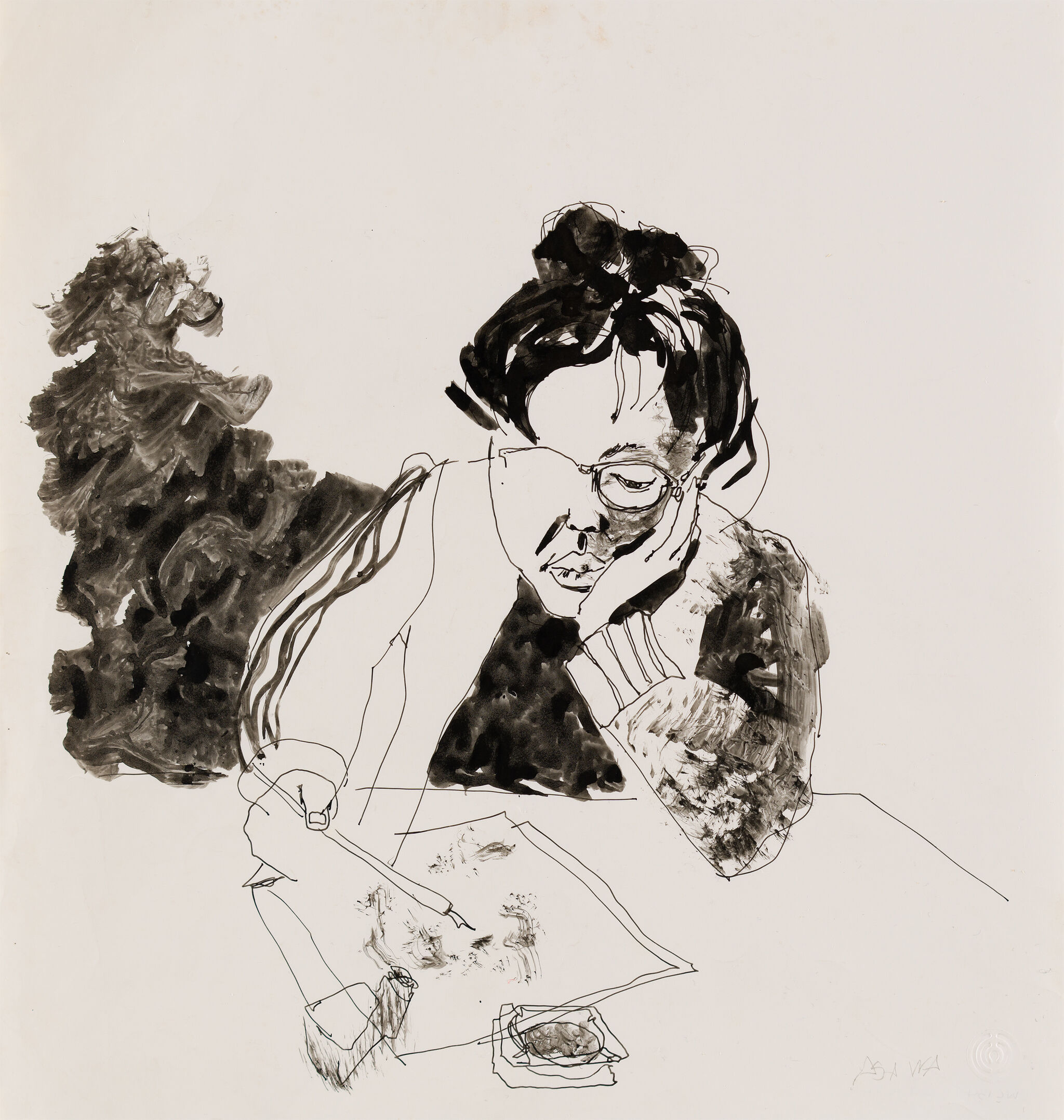
Addie Lanier: I always remember my mother sketching, I mean, just pretty much all the time. The funny thing about her sketchbooks, of course, is the number of sleeping people and sleeping animals in the sketchbooks. My mother obviously was trying to catch time to draw whenever she could. This sketch of myself, the one where I'm laying with this kind of single line, repetitive line that is the background. I just think it's, again, it's one of her examples of where she's taken one little unit and she's made it stand for this whole figurative thing, for the most part, at least the background of it.
But I also get a sense that somehow the line helps with conveying a mood, too. Some kind of atmosphere of the sitter. What's really funny is this line, which is this kind of incessant da da da da da, I can imagine me as a kid just jumping up and down all the time, and that's kind of my energy, and I'm finally asleep, and she's just doing this one little mark. To me, it's kind of comical, if I look at it that way.
Installation view of Ruth Asawa Through Line (Whitney Museum of American Art, New York, September 16, 2023–January 2024). On wall, from left to right: Untitled (FF.434, Aiko Lanier Blowing Up Balloon), c. 1955; Untitled (AN.003, Mussels), c. late 1960s; Untitled (PF.099, Nasturtiums), 1994; David Tudor's Hands (FF.896), c. 1964; Untitled (FF.016, Life Mask of Ruth Asawa), c. 1968– 70s; Untitled (PF.825, John Elsesser's Leek), 1976; Untitled (WC.112, Andrea Jepson), 1964; Untitled (MI.146, Clam Shell with Petunias), c. 1969; Untitled (FF.1231, Imogen Cunningham with Beads), 1975; Mervin Lane (BMC.7), 1947; Untitled (FF.054, Albert and Child Sleeping), c. 1964; Adam's Ranunculus (PF.1107, Bouquet from Adam Lanier with Snail), 1999; Untitled (FF.116, Albert Lanier), c. 1965; Untitled (WC.134, Self Portrait), c. 1960s; In vitrine, from left to right: Untitled drawings of Addie Lanier sleeping (SB.013), c. 1960; Untitled drawing (SB.076), c. 1974–76; Drawing for The Japanese Tea Garden Golden Gate Park pamphlet (SB.091), 1976; Untitled double-page sketch of cosmos (SB.087), c. 1976–89; 9.16.77 Gladiolas Paul's; Paul's Gladiolas 9.14.77 (SB.092), 1977; Suzanne Jackson, 2.11.77 (SB.100), 1977; N. Purifoy 2.28.77 LA Bd of Ed. (SB.102), 1977; 6.23.83 Venice to Milan (SB.137), 1983; 4:05 AM–3.16.85 hand unsteady 3:20PM–4:07PM 4:10–4:32PM (SB.157), 1985; Hudson's Wildflowers for Mother's Day, 5.14.95 (SB.200), 1995. Photograph by Filip Wolak
Suzanne Jackson: I'm Suzanne Jackson.
Narrator: Suzanne Jackson describes herself as a “painter sculptor.” She and Asawa were both members of the California Arts Council—they were the only two women, and had both been invited personally by then-Governor Jerry Brown, the group’s founder. Jackson recalls Asawa sketching during council meetings, but it wasn’t until this exhibition that Jackson saw these drawings.
Suzanne Jackson: She used to draw in every art's council meeting, and I have been so curious for years to see what it was that she was drawing. So this is amazing. Wow.
I'm looking at those little beads in my hair, which I didn't have that done often. But I also love the way she sort of interpreted my hair almost like I'm looking at it and thinking, it's almost like the pine needles. And she does that in her drawings. The idea that they're overlayered drawing strokes, even in ink. Some of the ink looks like graphite, the way she handles it.
I love the fact that she also was trying to find my eyebrows. I got two sets there, which is. Really what the idea that this is really a sketch where she's—simple, simple line, but then there's also her working and finding the simple shape.
I'm happy to see that my mouth was closed and I wasn't talking [laughs], as I usually am talking too much, I always think. So I must have been in some deep thought.
Narrator: As an adult, Asawa lived in San Francisco with her husband, Albert Lanier, and their six children. In addition to serving on the California Arts Council, Asawa became a leader in the San Francisco arts community as both an organizer and educator.
Ruth Asawa, Suzanne Jackson, 2.11.77 (SB.100), 1977. Ink on paper in hardback sketchbook, 11 x 8 1/2 in. (27.9 × 21.6 cm). Private collection. Artwork © 2023 Ruth Asawa Lanier, Inc./Artists Rights Society (ARS), New York. Courtesy David Zwirner
Suzanne Jackson: Look how delicate those flowers are against the shell.
Narrator: Artist Suzanne Jackson.
Suzanne Jackson: She has the clam shell, and you feel that hardness next to those really beautiful flowers that look as if you touch them, every petal just might fall.
The kind of tubular part of the petunia is also really similar to what's happening with the line in the clam. They're in rhythm and like waves in the water.
Narrator: The work is drawn from a giant clam shell, which also inspired another work--a watercolor--in this room. Asawa collected and was gifted objects like these, as well as plants, flowers, and bouquets that her friends and family thought she might like to draw. In turn, she often gave the resulting drawings to those friends. In this way, drawing became a kind of connective tissue for the community around Asawa.
Ruth Asawa, Untitled (MI.146, Clam Shell with Petunias), c. 1969. Ink on Japanese paper, 20 5/8 × 23 7/8 in. (52.4 × 60.6 cm). Fuller Craft Museum; gift of the Joan Pearson Watkins Trust, 2014.19.2. Artwork © 2023 Ruth Asawa Lanier, Inc./Artists Rights Society (ARS), New York. Courtesy David Zwirner. Photograph by Dean Powell
0:00
0:00