
Ilana Savdie: Radical Contractions
2023
Ilana Savdie: Hi, I'm Ilana Savdie. We are here in my studio in Bushwick.
I'm very interested in the marriage of the clinical and the folkloric with this work and making a case for that with this work as a way of addressing the body and the power structures that are imposed upon it. And so I look to these power dynamics in nature, survival strategies in nature, and it initiates my research into microbiology, the parasite, the parasite host relationships, the predator/prey tactics.
I'm really interested in the parasite as an agent of change. I think that it's theres so much of the binary of good and evil, predator prey, the sort of invader invadee relationship, the foreign and the familiar, all these things get embodied in the parasite in this really interesting way. It's also a term that gets used against people that are often marginalized. The sort of invader, the parasite, the thing that comes to threaten and infiltrate the social body. And that conceptually is interesting just in terms of how even that can be reframed to be a form of resistance infiltrating a social body and forcing it to change. That initiates how I approach a lot of this research.
And also just whenever there is something that I experience in the world or that I find images of that even feel reminiscent of it, if there's a pipe on the street that kind of looks like the tentacle of this animal that I was looking at. There's this kind of way of getting excited... Things that I'm excited about for reasons I can't quite explain. When I'm responding to an image, I'll just kind of collect it and I'll look at them all together to figure out what the parallels are.
And then they end up making their way into the collaging stage of the sketching of this work. And through that become ways of incorporating different conditions into the piece that don't quite intend to coexist together. Different lighting conditions, different color palettes, things that are contradictory because they were never intended to coexist. And forcing them to co-exist is part of the process of this work. Figuring out ways to either make them seamlessly coexist or make them sort of collide against each other.
They can be of any scale, I can imagine them at any scale. They can be the monstrous and horror and they can be the texture that becomes the real estate of a painting, sometimes the real estate within another body. And it kind of brings back the question of what is a body? Where does one body end and another one start? And are we our own body? And also all the bodies that live on us, are we also all the bodies that threaten us? So it's this kind of question of being that's also I can loop around myself in that. And it always comes back down to just the seductive, repulsive quality of these forms.
I'm very interested in the transformative potential of performance and how that can serve as modes of resistance. And I think the paragon of that for me is the carnival themes around the carnival. And I relate personally to the carnival of Colombia because that's where I'm from.
Its themes have always felt familiar to me, but they're sort of the global carnivalesque things that relate back to the inversion of social norms in highly pressurized societies. The uncrowning of higher forms of thought and bringing them down to the ground through perversion, mockery, costuming, excess, and themes of exaggeration and the grotesque as forms of mockery and mockery as forms of protest and resistance, transgression.
These are the ethos of the carnival as this kind of release and ways in which that can serve as forms of resistance to power.
I can kind of introduce these themes into this work through characters from the carnival or a palette that feels like it has this exuberant carnivalesque kind of quality to it. And it's a way for me to give you the kind of bait and switch of showing you a parasite and forcing you to contend with something that you don't quite want to contend with by seducing you through this kind of candy colored palette, through this really acidic, sort of tacky color palette.
There's a lot of strategizing that happens in this work. It's not really work that I can let go and make meditatively. It is sort of constantly strategizing how to respond. And because I've allowed myself 10 million different ways of applying a mark onto the painting, I'm constantly having to make decisions about how to respond from one point to the next.
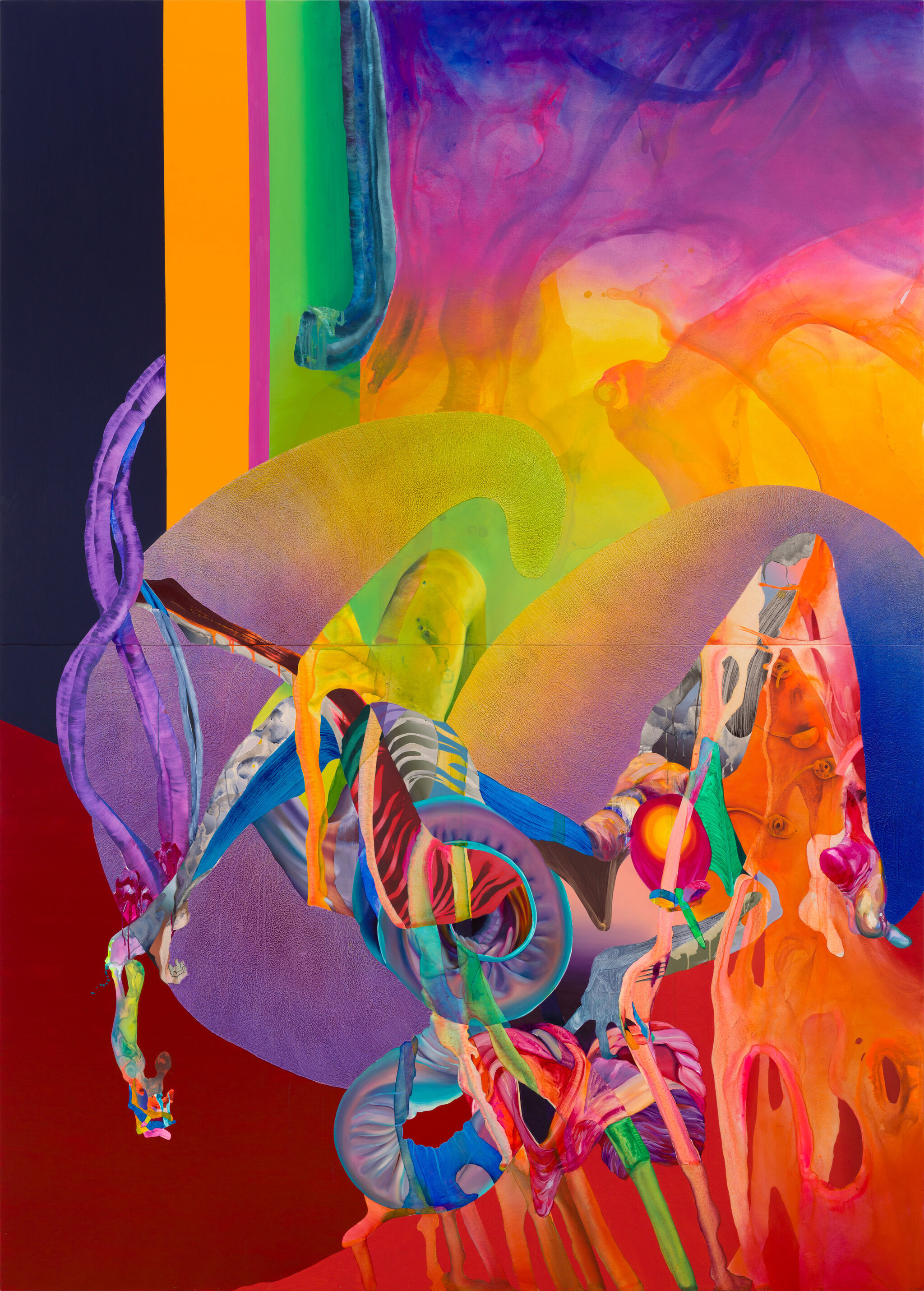
Ilana Savdie, Pinching the Frenulum (Frenillo Pellizca’o), 2023. Oil, acrylic, and beeswax on canvas stretched on panel, 120 × 86 in. (304.8 × 218.44 cm). Courtesy the artist. © Ilana Savdie. Photograph by Lance Brewer
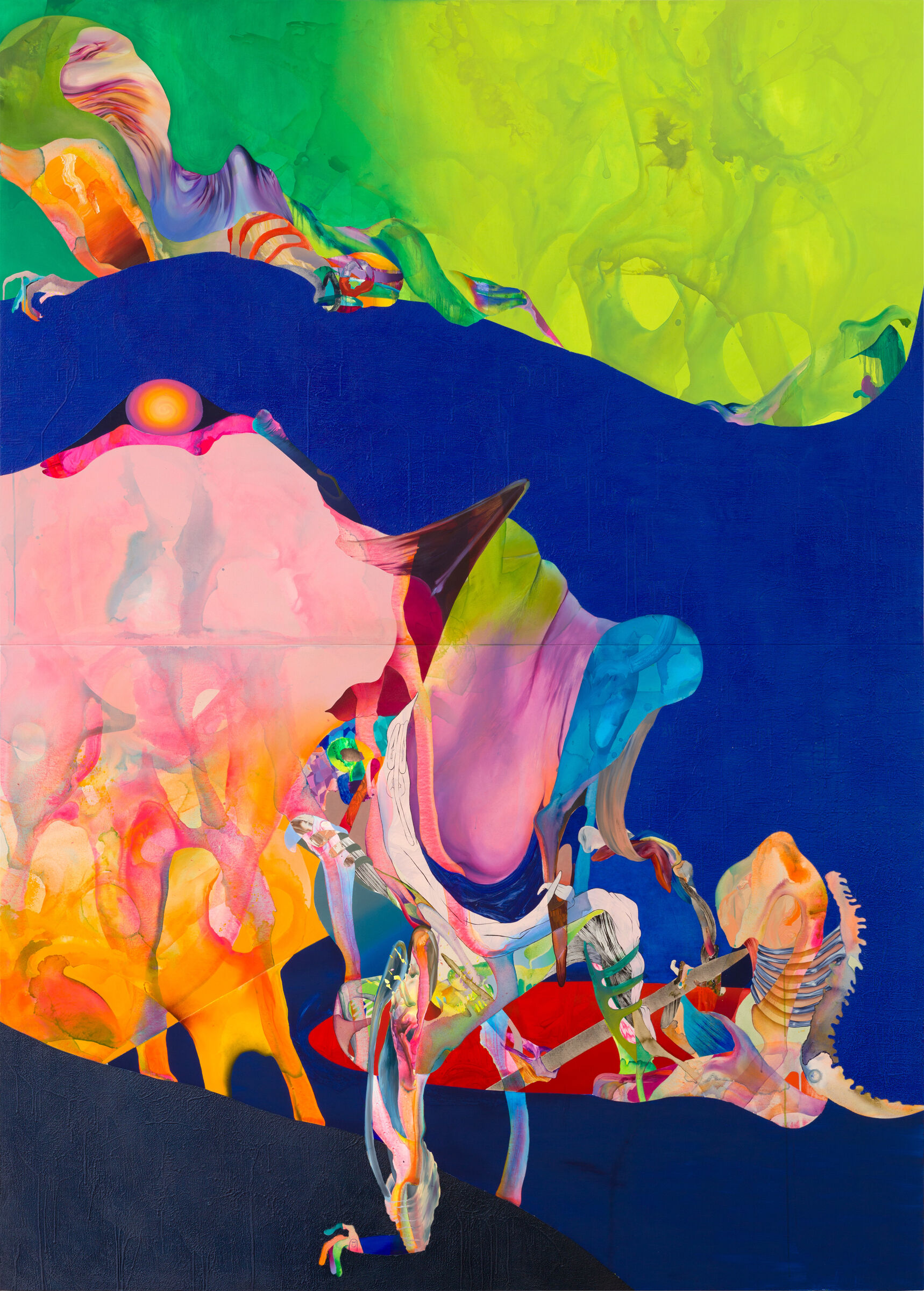
Narrator: Baths of Sinovia by Ilana Savdie is composed of two rectangular canvases, stacked on top of each other horizontally to make them seem like one continuous vertical canvas measuring 120 inches tall by 86 inches wide. The painting pulses with lush, vibrant color: an intensely saturated cobalt blue spans across the middle of the canvas, bookended in the top third of the canvas by a horizontal gradient between a vibrant green and a bright chartreuse, and the bottom by an intense peek of navy blue. Both the navy blue and the cobalt blue are textured, appearing scraped and containing apparent drip marks, through the use of beeswax and pigment. The artist has said regarding the exuberant use of color:
Ilana Savdie: My interest in these colors that are just so kind of Day-Glo, kind of playful, imply something light and silly and joyful. And really the paintings are really talking about quite grotesque, quite horrific things sometimes and are dealing with the kind of carnage of existence sometimes. And so these colors are a way for me to do the kind of seductive bait and switch of showing you something that you don't quite want to look at.
Narrator: This description will begin at the top of the vertically oriented painting and work towards the bottom. The topmost section is swathed in a bright yellowish green, which is interrupted by a swirl of figurative abstraction encroaching on the left edge of the canvas. This interruption moves in a sort of wave across the top third of the painting, ebbing and flowing in height, and is colored with pinks, blues, and purples, as well as a bright, almost glowing orange. Most of the planes of colors have layered hues, and the pinks and blues seem to ripple with folds that mirror the rolls and folds in skin as it moves. This lends an almost bodily effect to the abstraction as some shapes emerge as distinct, recognizable body parts, although none are rendered straightforwardly. The organic movement and depth in the waves of colors could be a leg thrown over the wall of blue beneath it, a pink ankle attached to a deep blue calf connected to a tense green thigh curving into hip. The tendrils emerging from the top edge of the blue could be a set of curled fingers, each punctuated with the silhouette of a sharp fingernail. Four deep red-orange rib bones curl and drip away from the green, beneath the bruised blues and purples, and connect to a head shape with deep orange eye shapes in a figure eight and a stripe down the middle of the head like a long nose. These facial attributes reference the marimonda, a character that originates from the annual Carnaval in the artist’s hometown of Barranquilla, Colombia. The marimonda has hybrid human, elephant, and monkey attributes, and plays the role of a subversive trickster.
In the other half of the green top section, a smoky apparition of what could be the bone structure of a pelvis sits in the background, painted with a dulled yet similar green color. It is more transparent than any other aspect of the painting, diffuse, structural, and looming. Beneath it, a lush green foot arches, its toes pointing toward the bottom of the canvas and the ball of the foot positioned facing the top of the canvas. It is connected to a baby pink shin bone, which just slightly overlaps the cobalt blue and which weaves behind and through the shadowy bone fragments in the background of the chartreuse section.
The cobalt blue midsection, which gradates into a darker, grayer blue near the bottom of the canvas, is similarly encroached upon by a scene of baby pink, bright orange, chartreuse, light blue, intense red, and white.
Beginning on the left side of this intrusion, at its highest point, a small fuschia and orange orb-shape sits on a hot pink horizontal goat’s leg. This leg fragment rests atop a larger, transparent wash of light pink, which drips and blends into a fiery bright orange moving down the canvas. The orange and pink section take up a larger portion of the painting, with anthropomorphized shapes faintly floating throughout.
To the right of the orange and pink wash is a chaotic, densely-multicolored, knot of shapes and hues. Although not clearly figurative, limbs and other details emerge, taking up the lower central portion of the work. A pale sliver of canvas reveals another faint marimonda face. One straightforwardly-defined shape is a vibrant red ellipse, which appears as a horizontal, tapered hole from which abstract branches of color seemingly emerge. Together, these limb-like branches of color bend like knees, elbows, and knuckles. Out of the right corner of the ellipsis, the lines of a silver-blue ribcage shape hang onto a spine whose tailbone hooks out towards the outer-right edge of the canvas, like a slithering tentacle. Another branch in the middle of the scene plunges out of the cobalt blue section, reaching downward with what appears to be frog-like Day-Glo fingertips.
In the bottom third of the painting, underneath these bright forms, a gradient of gray-blue into navy serves as a disquieting reprieve. Although the lowermost section of this canvas is visually simpler, with dark planes of color and subdued texture, their darkness and simplicity suggest a bottomless depth, continuing the theme of bait and switch that the artist has mentioned engaging with.
Regarding the title of the work, Savdie explains:
Ilana Savdie: Baths of Synovia comes from the actual fluid that cartilage lives in in a joint. And it's the material that's meant to prevent bones from grinding together. It's a material that disintegrates through injury or over time and shifts the equilibrium of a body when it stops functioning as it's supposed to. And so there's so much weight to this fluid, to this material.
Ilana Savdie, Baths of Synovia (Baño Sinovial), 2023. Oil, acrylic, and beeswax on canvas stretched on panel, 120 × 86 in. (304.8 × 218.44 cm). Courtesy the artist. © Ilana Savdie. Photograph by Lance Brewer
0:00
0:00