
Dan Graham: Portal
2023
Roxanne Smith: My name is Roxanne Smith. I'm a curatorial assistant at the Whitney. I worked on this installation of Dan Graham's Portal. And in honor of the fact that Dan Graham was fascinated with astrology during his life, I should also say that I'm a Libra.
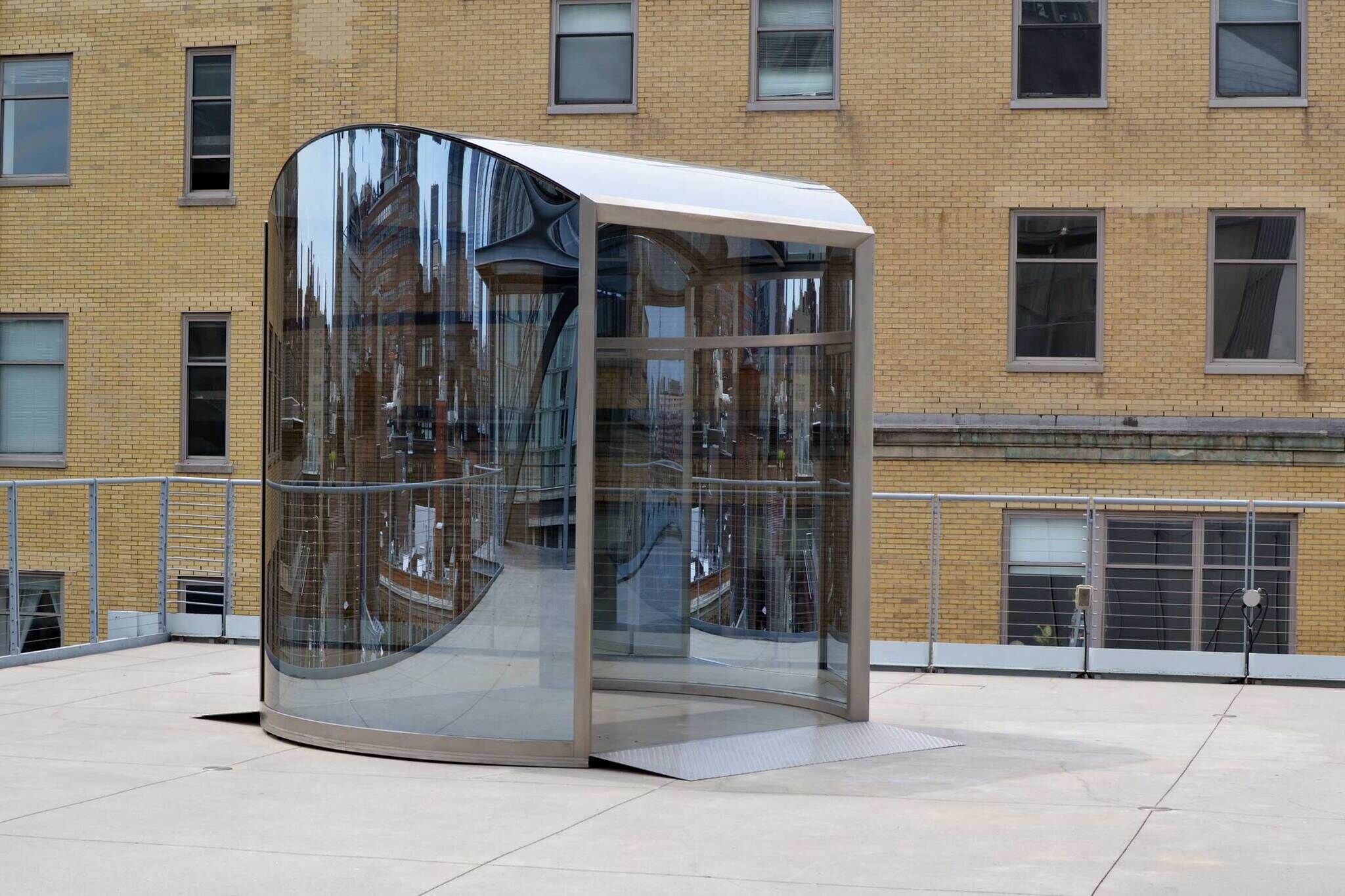
Portal is one of the dozens of structures known as pavilions that the conceptual artist Dan Graham made for public spaces all over the world beginning in the 1980s. We worked with Graham on this installation here from 2016, before his death in 2022. He conceived of Portal for this particular site and vantage point from the terrace and to be experienced among the glass and steel architecture of the Whitney's building.
There are a lot of ways to understand the references and intentions in this work, but the most important way is to just move through Portal and take a look around inside. You can see yourself and the city view and other visitors around you reflected in the curved mirrored glass. You could take pictures or selfies, treat it like a walk-in fun house mirror. That's basically what Dan Graham intended: for it to be activated or made real by the fact of the visitor inside of it.
Graham said himself that without people in them, the pavilions might just look like minimal art sculptures, but that's not what they're supposed to be.
Graham's initial inspiration for the pavilion was corporate architecture of the 1980s and 90s. Atrium ceilings, escalators, all of that slickness and shininess that you would associate with lobbies and shopping malls of the time. In particular, he was interested in the use of two-way mirrored glass for this type of architecture, because it's transparent and reflective at the same time. So, on one hand, there's this idea of transparency and freedom, but it's also a material in this commercial context that's ready built for surveillance. With the pavilion, Graham takes this corporate aesthetic and then he subverts it into something else, into this quasi architecture, quasi sculpture structure. It's meant to create an experience of looking that's surreal and mostly just kind of funny.
Graham also took inspiration from Baroque church architecture and making Portal in the design in particular of its mirrored archway, he said that he wanted the viewers to inside to look up at the ceilings in the way that one would expect to see painted angels on a church ceiling, but instead in the Portal to see themselves reflected – their own bodies and other human bodies floating around on the ceiling. There's a sweetness and humanity in that.
Portal is not meant to be a sculpture exactly, nor is it architecture with a purpose. Instead it's space or a moment that brings in these various material histories and makes us aware of how the built environment fundamentally structures how we see.
Of course, the museum itself, the site of this pavilion is historically another space that does this too. It points our gaze to certain things. It's a space of public gathering and social exchange. And Graham was very aware of this context.
Dan Graham came of age in the minimalist art world of New York in the sixties, but Graham was interested not just in the fact of the object or the space in and of itself, like the minimalists were, but all the trappings around it: the sociology, the social space, the public experience of it.
Narrator: This work by the conceptual artist Dan Graham is called Portal, which is double dated at 2016 and 2023 because the sculpture was planned and realized at different times. It is a large structure, about the size of a big walk-in shower or city bus stop. It is a bilaterally symmetrical structure that if you were to walk through it would be about as wide as an average sized adult's wingspan, or 5 and a half feet across. Portal is comprised of three panels: two sides and the ceiling. Each panel is a tinted, curved, reflective surface. The work is positioned at an angle on the terrace of the Museum, and is intended to be moved through from either side.
It is made out of stainless steel, clear plexiglass, mirrors, and double-sided and mirrored plexiglass. The curved walls of the sides of Portal are made of a transparent glass that bends and distorts the city view that would be seen from within the sculpture. The inside of the ceiling is mirrored, and Graham, who died in 2022, wanted viewers inside to look up as if expecting to see painted angels on a church ceiling, but instead to see themselves reflected.
There are shallow ramps leading into and out of the structure, which sits a few inches above the ground. One of the curators, Roxanne Smith, who worked on this presentation discusses the artist’s inspiration for PortaI, which is one of Graham’s “Pavillion” works.
Roxanne Smith: Graham's initial inspiration for the pavilion was corporate architecture of the 1980s and nineties. Atrium ceilings, escalators, all of that slickness and shininess that you would associate with lobbies and shopping malls of the time. In particular, he was interested in the use of two-way mirrored glass for this type of architecture, because it's transparent and reflective at the same time. So, on one hand, there's this idea of transparency and freedom, but it's also a material in this commercial context that's ready built for surveillance. With the pavilion, Graham takes this corporate aesthetic and then subverts it into something else, into this quasi architecture, quasi sculpture structure. It's meant to create an experience of looking that's surreal and mostly just kind of funny.
Dan Graham, Portal, 1997/2020. Glass and stainless steel. Whitney Museum of America Art, New York; purchase with funds from the Painting and Sculpture Committee and Jonathan Sobel in honor of Donna De Salvo
0:00
0:00