
Trust Me
2023
Narrator: Welcome to Trust Me. To hear from artists in this show, continue the audio tour. You can find verbal descriptions of select artworks in the “Access” section of the mobile guide. And check out whitney.org/audio/podcasts for even more about select artists on view!
Narrator: Upon exiting the elevators on the third floor, you will enter into a long gallery where the exhibition, titled Trust Me, has been installed. The introductory text for the exhibition is located on the wall across from the elevator, forty five degrees to the left. To the right of the intro text, a series of photographs by Moyra Davey line the wall. The wall then turns at a ninety degree angle into a concave alcove, where artwork can be found lining the left and back walls. On the right of the alcove is the entrance to a hallway where the restrooms can be located; the third floor includes an all gender single stall accessible restroom.
Following the perimeter of the hallway gallery, the wall opposite from the elevators is lined with artwork. Works on this wall include His Estate by Mary Manning, which has a verbal description in this audio tour. At the rightmost end of this wall, there is a set of double doors to the Hess Theater. Continuing along the perimeter of the space, a glass windowed wall with doors bookends the gallery; these doors lead to the Museum’s Artspace, where visiting groups do artmaking activities.To the right of the glass windows is a small hallway that leads to an enclosed stairwell located on the left. To the right of the hallway, artwork hangs along the same wall as the elevators. Verbal descriptions for two of the works on this wall, Nah by D’Angelo Lovell Williams and Will Work For #4 by Laura Aguilar, are included in this tour.
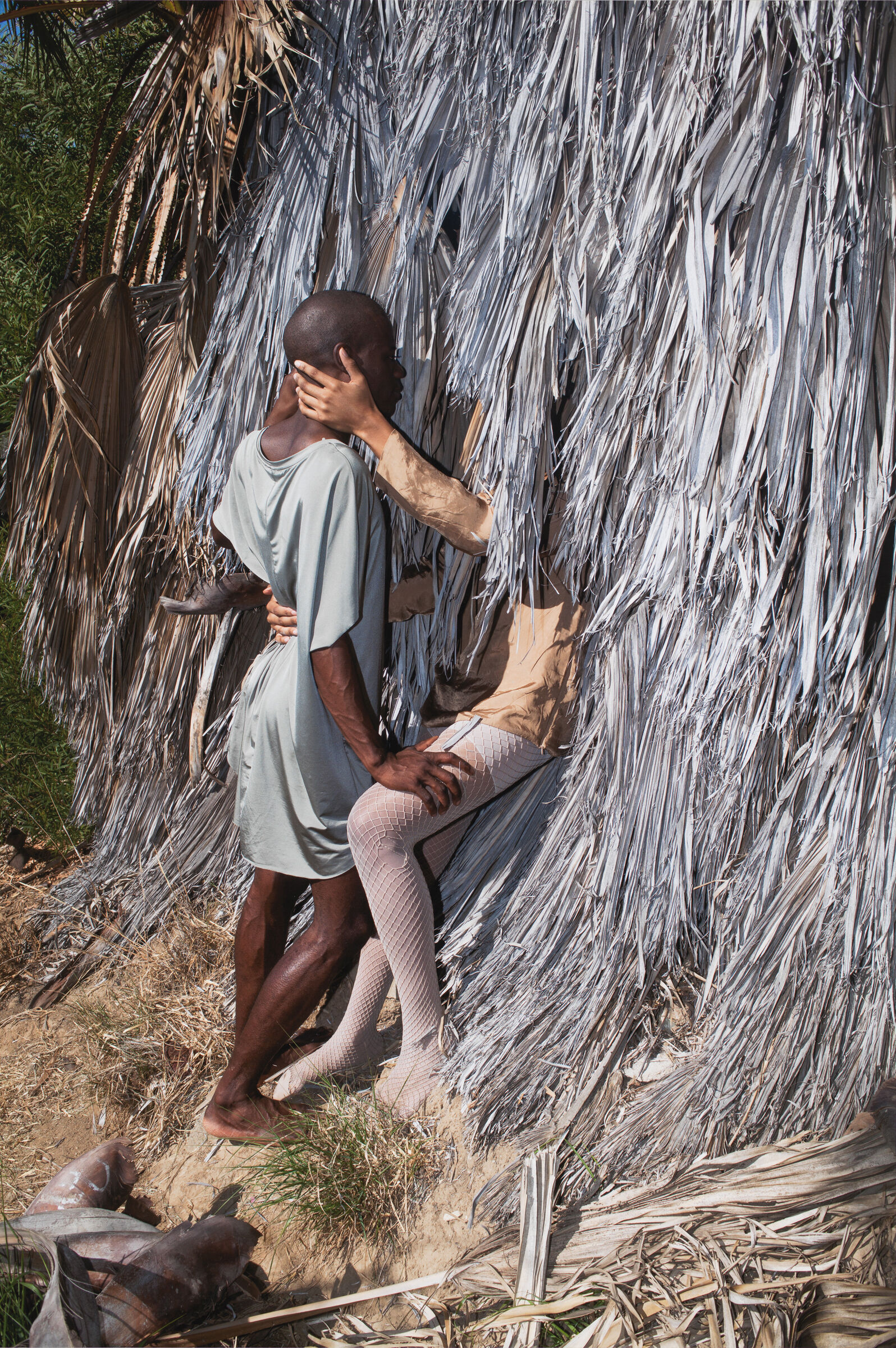
D'Angelo Lovell Williams, Elysian, 2018. Inkjet print: sheet (sight): 44 9/16 × 29 1/2in. (113.2 × 74.9 cm). Whitney Museum of American Art, New York; purchase, with funds from the Photography Committee 2020.129. © D'Angelo Lovell Williams
Lola Flash: My name is Lola Flash, and I'm a photographer.
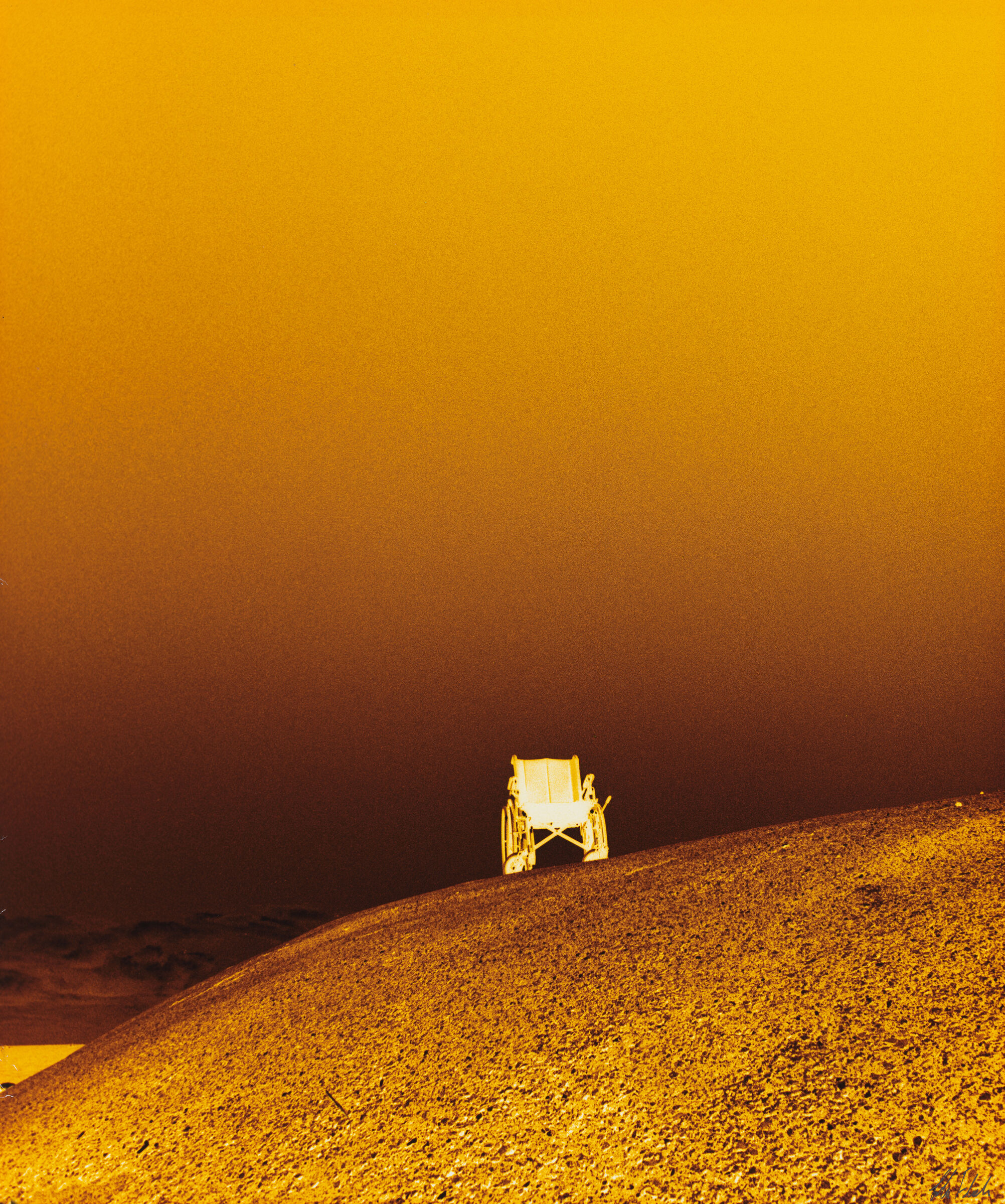
When we're talking about 4 ray, this photograph was taken in Provincetown in the summer of '91. And I was at the beach, and I kind of looked up and I saw this wheelchair perch at the top of this sort of tarmac that was there to help with the erosion of the beach. And there was no one around, so I thought to myself, "It must be Ray." Ray probably wanted to come to the beach with me, and so I figured it was him.
Ray was a dear, dear friend, like many from that time that passed away from AIDS. He was also an activist like myself. I can't believe that he would've been fifty-nine this year. The wheelchair symbolizes Ray, but also so many other people from that time who passed away from HIV because most of them ended up in a wheelchair because they were too weak to walk.
I often wear this SILENCE=DEATH button. I graduated from high school in 1981, and that was the first year that someone was in the papers and they said that someone died from HIV. So in many ways, I feel like once I graduated, I felt like I couldn't just take pretty pictures. I had to take pictures that talked about all of the problems in the world, well, at least, especially those that affected myself. Like racism, sexism, thinking about the marginalized people. You know there still is not a cure for AIDS.
Lola Flash, 4 ray, 1989. Chromogenic print, sheet: 24 × 20 in. (61 × 50.8 cm), image: 24 × 20 in. (61 × 50.8 cm). Whitney Museum of American Art, New York; purchase, with funds from the Photography Committee. © Lola Flash
Lee Mary Manning: Hi, I'm Lee Mary Manning.
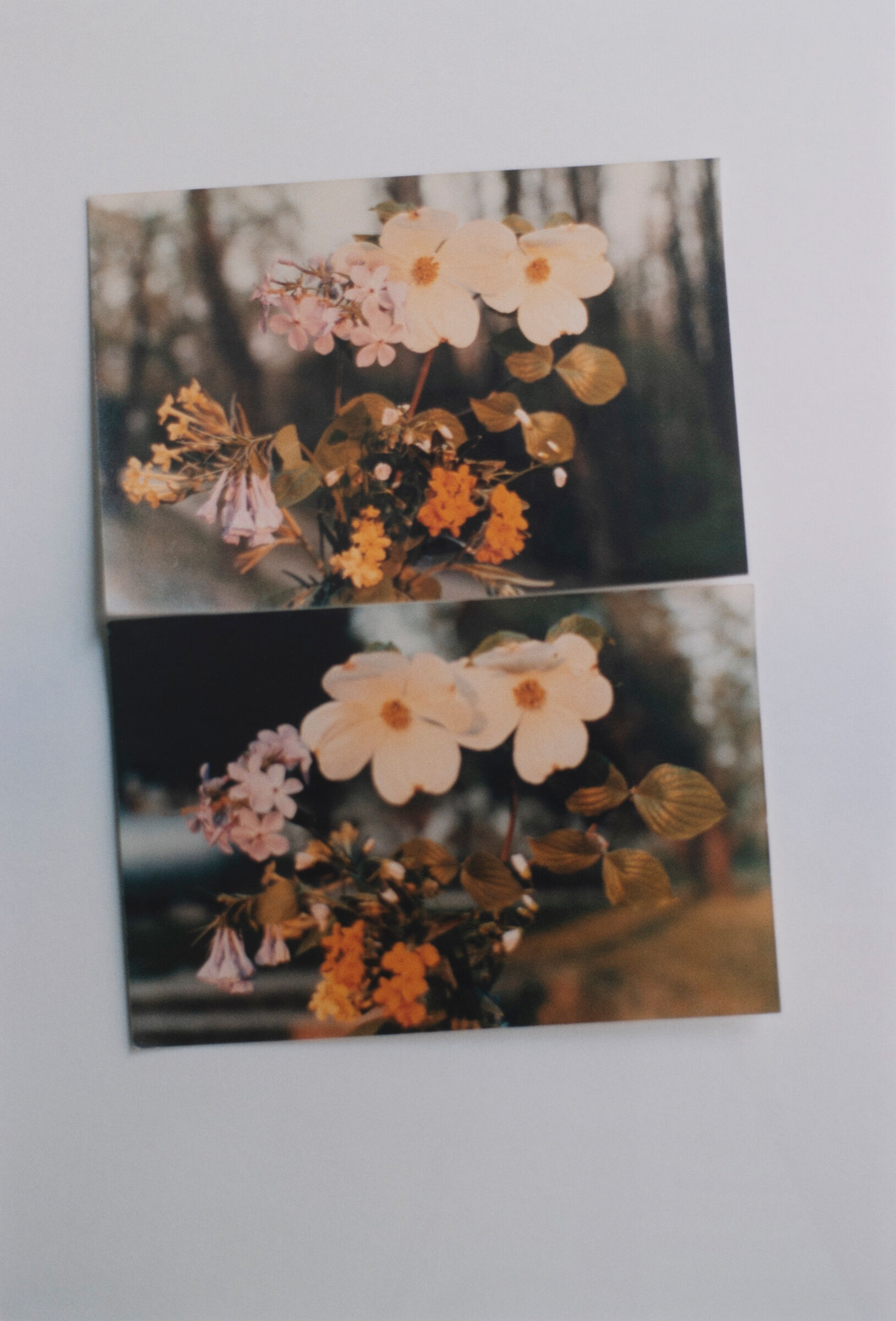
The title, His Estate, was kind of making light of a somewhat heavy circumstance. These are two photographs that my dad, Mike Manning, took in the probably late seventies. There's not a date on them, but I presume thinking about around the time that he got this camera would've been '79, possibly early eighties.
He passed away of COVID in 2020. So I made this picture not long after he died in 2020, and it's just a picture of his two pictures.
My dad was an artist, but also a really complicated guy. And we sort of shared the same appreciation for nature, but we never really got a chance to high five about that. And so His Estate was sort of a joke of like, this is my inheritance, whether it's his eye, if you want to read it that way, or if it’s these actual photographs.
When I made it, I thought more about just what it took for this ex-marine with a new Canon, living out in the country, trying to have some serenity and taking pictures of flowers and some sort of golden hour sunshine. It's just sort of a tribute to that act of wanting to record.
It's always a little daring or something, to be so sincere in a really cynical time. But I feel that way about making pictures, in analog form. It feels like you're making an object that goes through this alchemic process, so you're really invested in whether or not you hit the button to make a picture.
Narrator: His Estate is a color photograph depicting two other printed horizontal photographs whose dimensions are like those found in family albums. They are pictured lying on a grayish-white background surface, stacked vertically one on top of the other. The work of art on view here is 30 inches tall and 20 inches wide. The two photographs that it reproduces were taken by Lee Mary Manning’s father, Mike, who passed away from COVID-19 in 2020. Manning used their father’s old 35mm camera to re-photograph the two original images, which sit off-center within the photograph’s frame—they are slightly slanted to the left. There is more white space on the bottom than there is on the top. In the print, the photographs do not lie perfectly flat on the surface they are resting on. Thin shadows appear around the edges of the photographs. The lifted corners of the photographs indicate that someone has held them.
Both photographs show a bouquet of wildflowers, pictured from different angles against a backdrop of blurry trees. The bundle has two flowers with round white petals and yellow centers, surrounded by several bunches of smaller yellow and pastel purple-pink flowers, as well as several green leaves. Mary Manning recalls that, while on drives with their father, he would often pull over to take photographs of flowers he had spotted on the side of the road. He likely captured these images in a similar manner. The mix of flowers, in addition to their small size and sparse arrangement, implies that they were handpicked by Mike. While there is no hand visible in the photos, the composition suggests that Mike assembled the bouquet and held it up to the light, as the flowers are seemingly suspended against a woodsy background. The image is tinted with a warm golden hue from the late afternoon sun.
The impromptu, everyday nature of these photographs reveals Mike’s inclination to capture the beauty of the ordinary. Traces of his presence are interspersed throughout these photographs. Similarly, Manning’s impulse to re-photograph these particular images in the aftermath of their father’s death is an act of remembering him through everyday objects and mementos. Manning’s use of their father’s camera only adds to the sense that they are capturing the world through their father’s lens.
Lee Mary Manning, His Estate, 2022. Chromogenic prints, mat board, and artist’s frame, sheet: 33 × 22 1/4 in. (83.8 × 56.5 cm); frame: 33 1/4 × 22 1/2 × 1 1/2 in. (84.5 × 57.2 × 3.8 cm). Edition 2 of 3. Whitney Museum of American Art, New York; purchase with funds from the Photography Committee. © Lee Mary Manning
D'Angelo Lovell Williams: Hi, my name is D’Angelo Lovell Williams, and I am a Brooklyn-based artist from Jackson, Mississippi.
Narrator: The setting of this photograph, with no markers of contemporary/modern life, could suggest a view back in time. When making this image, Lovell Williams was thinking about history and their own family's past.
D'Angelo Lovell Williams: I was thinking a lot about ancestry and it was a lot about myself that I didn't even know. I hadn’t done my own ancestry yet at that point. I had always been attracted to making images in bodies of water.
I made a lot of my work outdoors, and there was this sort of involvement with the landscape that I was challenging myself to put myself into and make images with. I don't really know how to swim. I can swim above water, but I can't hold my breath long enough to swim underwater.
Narrator: The artist experimented with staging their tripod and camera from multiple vantage points. The resulting photograph captures them facing away from the viewer, their legs in a V-shape pointing outward, away from us.
D'Angelo Lovell Williams: This image went through many, many edits. But I wanted this sort of leaving a viewer, leaving the experience of... And going into the sort of idea of freedom and not looking back to what could have been or what should have been.
I think the specifics of the dress for me were more so just what I wanted to do in it or with it. I definitely wanted it to look ghostly. And I felt like it also spoke to a material type of dress that wasn't seen on a lot of black people's bodies, especially in a body of water as well. Not caring enough to get in the water with the dress on.
Being able to be in this position to make the image, knowing that there were people who came before me who couldn't live and experience or see themselves. Or someone similar to themselves in a position like this. That I'm wanting to scream freedom here for other people in this particular way, at least.
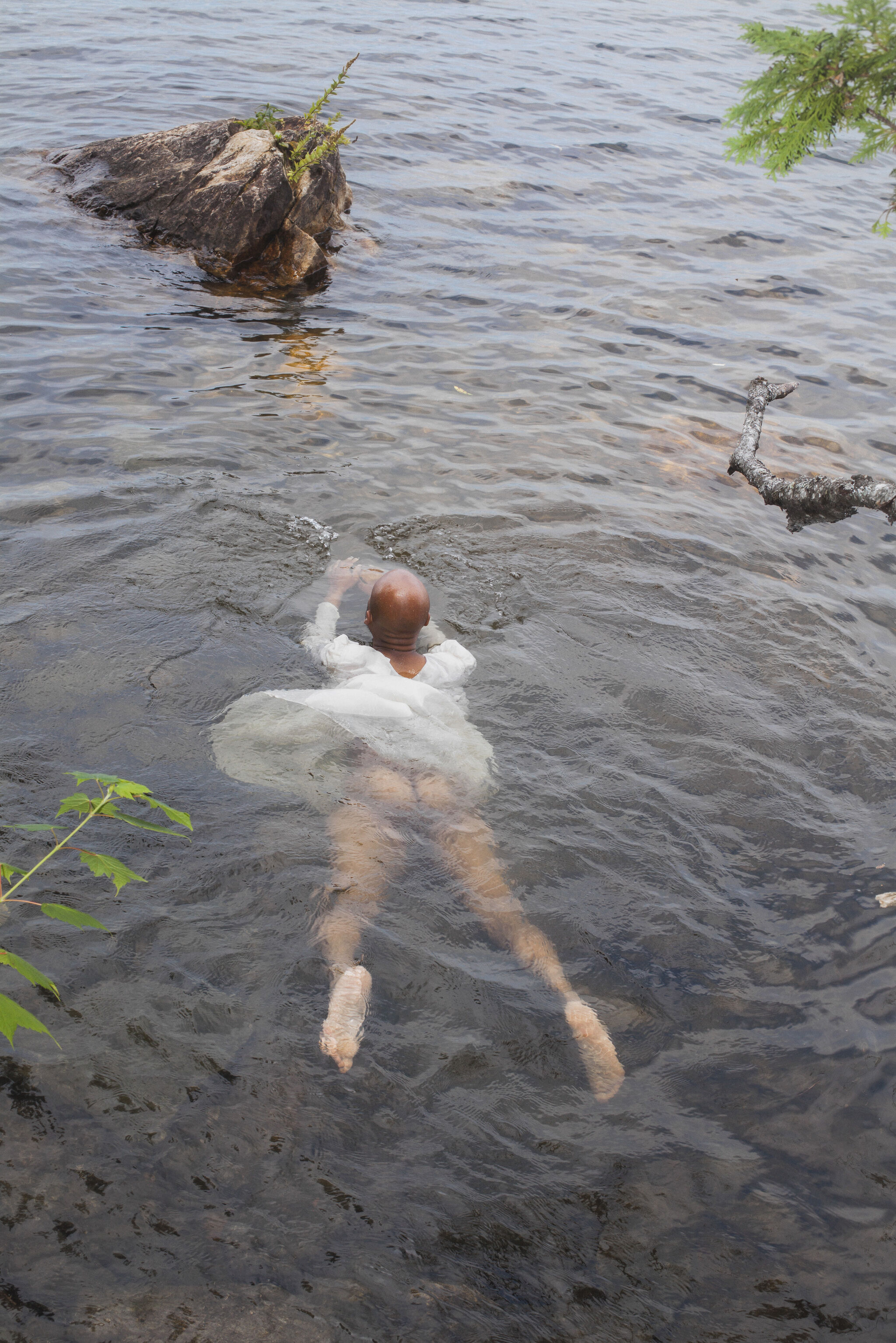
Narrator: Nah by D’Angelo Lovell Williams is an inkjet print, measuring just over 44 inches high and 29 ½ inches wide. It is a self-portrait of the artist, who is almost entirely submerged in a body of water that appears to be a lake or river surrounded by trees. They are a Black person with a bald head that rises above the water as they swim away from the camera, their arms outstretched in front of them and their legs outstretched behind them. The water in front of their arms is disrupted, and their feet are stretched outwards, indicating movement. Lovell Williams is wearing a white, long-sleeved gown, which they had previously worn to a drag ball. It has been made slightly translucent by the water. Of their choice to wear the dress in this photograph, Lovell Williams says, “I definitely wanted it to look ghostly.” The skirt of the gown billows upward in the water, exposing the artist’s buttocks and legs.
The water around Lovell Williams is clear, with minimal waves and ripples. The photo was taken in daylight, making visible some of the gray and brown rocks at the bottom of the water. The body of water stretches to all four edges of the image. The artist took this picture off the coast of Skowhegan, Maine, while they attended an artist residency. At the top left corner of the image, above the artist’s outstretched arms, a large rock juts out from underwater, with a few long green plants growing out of it. Verdant leaves poke inward at the top right corner of the image, while a gnarled, leafless branch curves upward on the right edge. A stem with wide green leaves stretches diagonally over a small section of the water parallel to Lovell Williams' left leg on the left edge.
Lovell Williams’ work deals with cultural histories as well as their own personal and familial histories. Bodies of water are a frequent site for their photography. The setting holds many meanings for them. One reference is an 1803 rebellion by enslaved Igbo people. While on a boat held captive en route to Georgia, the group committed mass suicide after rising up and taking control of the ship. According to the artist, the title of the work refers to refusal as a form of resistance, as well as Lovell Williams’ refusal of “anything or anyone that keeps Black and Queer people from living full lives and succeeding.”
D'Angelo Lovell Williams, Nah, 2018. Inkjet print: sheet (sight): 44 1/2 × 29 1/2in. (113 × 74.9 cm). Whitney Museum of American Art, New York; purchase, with funds from the Photography Committee 2020.130. © D'Angelo Lovell Williams
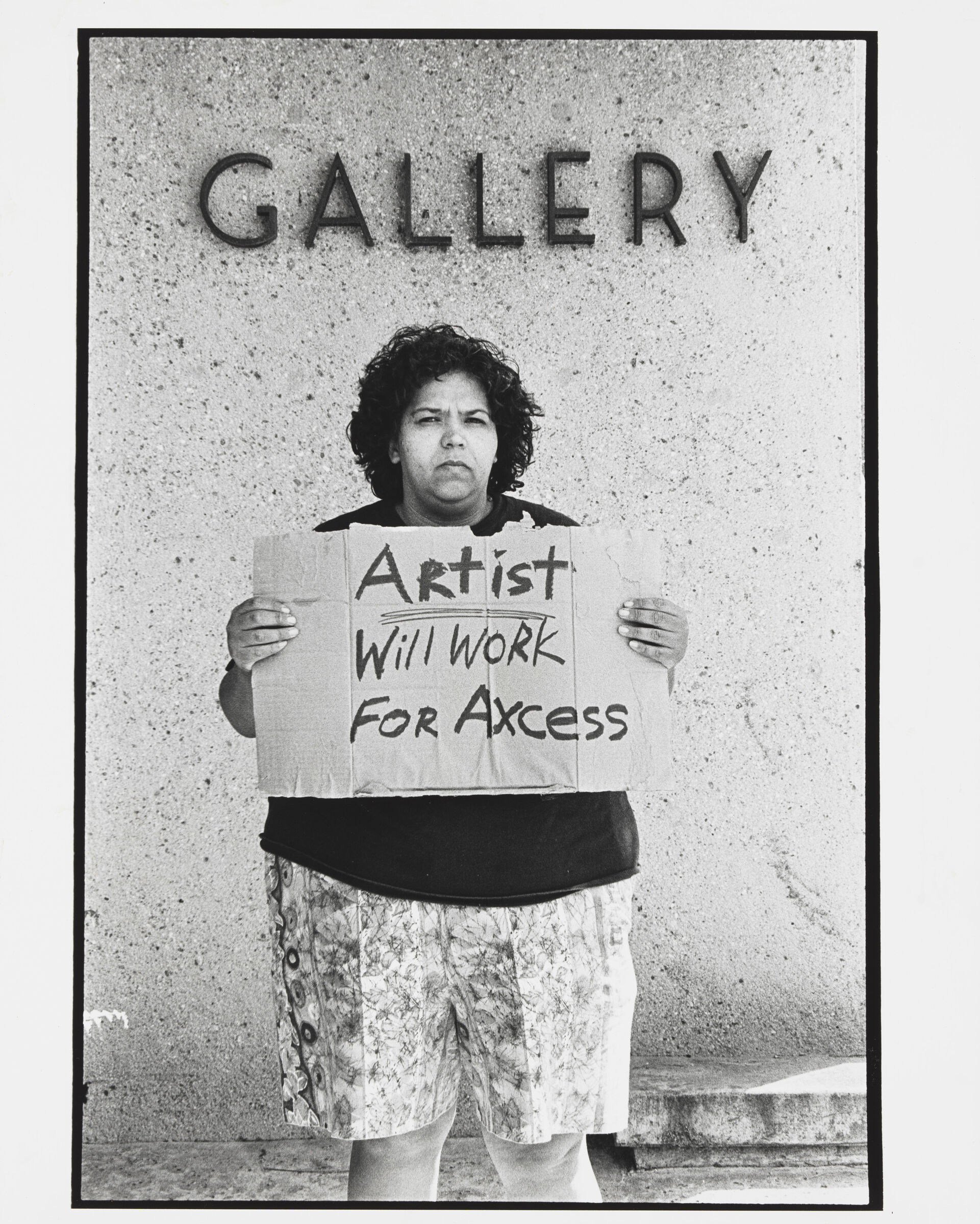
Narrator: Will Work For #4 is a black and white photograph that is almost 20 inches tall and almost 16 inches wide. The photograph is a self-portrait in which the artist, Laura Aguilar, stands alone in the center of the frame, with her body visible from her knees up. She is a self-described fat Chicana woman with shoulder-length curly black hair, wearing a dark T-shirt and patterned knee-length shorts. She holds a cardboard sign that reads “artist will work for axcess” in front of her chest with both hands. The text of the sign is hand scrawled in thick black lines, which are slightly rippled due to the surface of the cardboard. The word “artist” is underlined with an emphatic zigzag, and the word “access” is misspelled, with an “x” replacing the first “c”–a reference to Aguilar’s dyslexia. The sign itself has several creases and a rough, torn upper edge.
Aguilar stands in front of a rough speckled stone wall, seemingly outside of a building. The word “gallery” is on the wall in sleek metal lettering, sitting just above Aguilar’s head. The font is clean, and because the letters are fixed to the wall, the sign feels official and permanent. This stands in stark contrast to the messy handwritten text on Aguilar’s sign. The artist used this contrast to highlight how she often felt like an outsider in the mainstream art world as a fat Chicana lesbian who struggled with depression, intense shyness, and dyslexia. In the bottom left corner of the photograph, a patch of sunlight shines onto a singular step. It suggests that the photograph was taken in the afternoon, perhaps in Los Angeles, where she lived and worked. Her facial expression has a serious but calm tone. Her eyes squint slightly as she furrows her eyebrows, and her mouth turns downwards at the corners.
In standing outside of a building marked “gallery” and holding a sign that reads “artist will work for axcess,” Aguilar protests the exclusivity of the art world. Aguilar gained little commercial success during her life, which spanned from 1959 to 2018. It was not until a 2017 retrospective in Los Angeles that her work became more popularly recognized. In Will Work For #4, the artist works as both sitter and artist. By using the camera to emphasize her own marginalized identities, Aguilar critiques the inaccessibility of the commercial art world.
Laura Aguilar, Will Work For #4, from the series Will Work, 1993. Gelatin silver print, sheet: 19 7/8 × 15 15/16 in. (50.5 × 40.5 cm). Whitney Museum of American Art, New York; purchase, with funds from the Director’s Discretionary Fund 2019.394. © Laura Aguilar Trust of 2016
0:00
0:00