Rose B. Simpson: Counterculture
2023
Our podcasts feature brief conversations about artworks and events in and around the Whitney. Listen to more podcasts.
Rose B. Simpson: My name is Rose B. Simpson, and I'm from Santa Clara Pueblo in Northern New Mexico, where I live and work on my ancestral homelands with my six-year-old daughter.
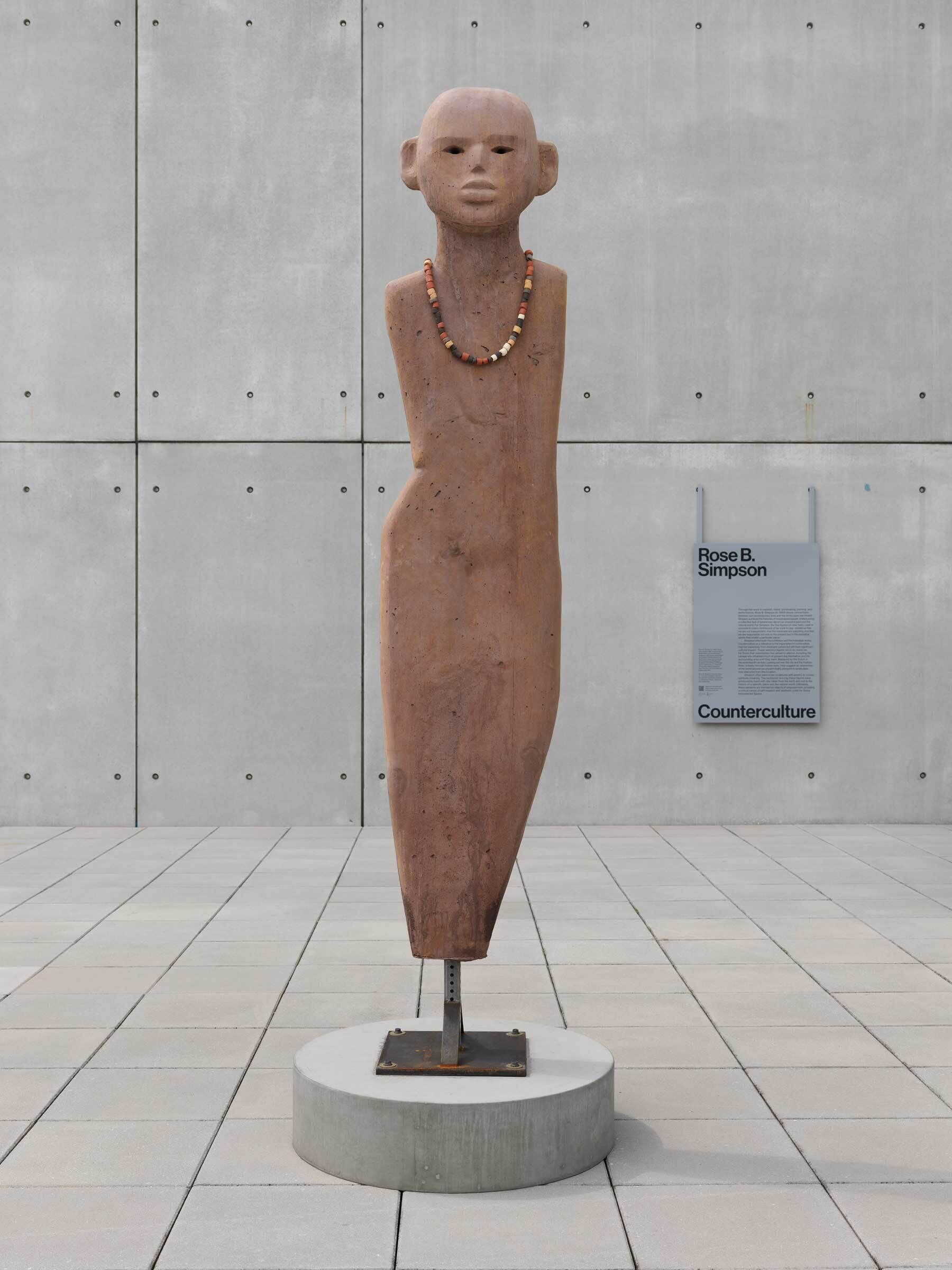
This iteration of Counterculture is five of the original twelve large-scale figurative pieces that are made to witness. They're made out of cast cement and they actually have handmade clay beads. And one of the most important features about these pieces is that they have eyes that are drilled all the way through the head. And so, they are standing as witnesses for the inanimate. They are watching, they show us, they embody, they personify the inanimate that our modern culture often forgets is constantly witnessing us.
It could be the natural world, it could be ancestral beings, it could be supernatural things. It could be the wind, it could be clouds, it could be weather, it could be the parts of our world that we don't necessarily consider conscious and aware of our movement and decisions as post-modern beings.
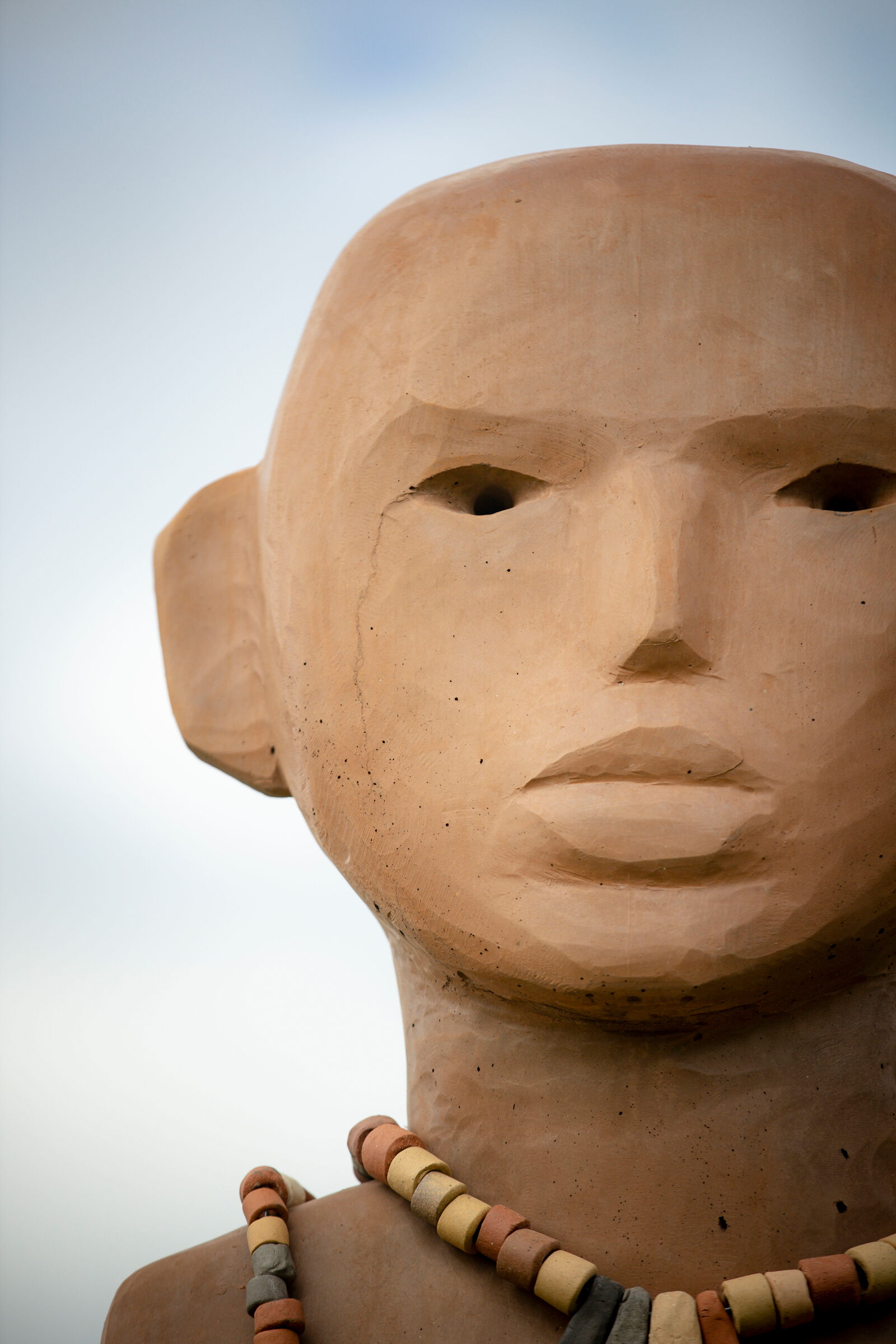
The holes that go through the heads where the eyes are, you might notice light coming through, you might see the wind pass through. I think that's an important thing. When I was drilling the holes through the head, the dust was blowing. As soon as the bit went through to the other side, the wind would come and the dust would blow out, and it was this incredible moment of allowing. I broke through to the other side, feeling almost inter-dimensionally.
You might notice fingerprints in the clay beads. You might notice relics of animal interaction with the pieces, maybe birds have found a place to perch or rest. We might see rust, we might see moss, we might see moments where the pieces have been in place and will grow in relationship to place and transform because of place. And I think we begin to notice how place begins to affect everything that we're trying to control. In a sense, we're in collaboration with and not in a controlling state of nature and our relationship to it.
I've been thinking a lot about empowerment. Empowerment in the past has always been very masculine centered for me, and I've looked towards a warrior mentality to feel empowered. And more recently, especially since becoming a parent, I have found a lot of power in the feminine or that which is self-aware and self-adorned, and that putting a necklace on or taking a moment to adorn oneself with grace is actually an incredible sense of empowerment.
And so, the necklaces are not warrior-making, but they're objects of empowerment and that they give a sense of self-respect and a moment of aesthetic consideration, which gives it a sense of power that I have been looking for in my life. And I look forward to transforming my power from aggression to grace.
I also think that the forms became sort of inherently feminine. And I think that most of my work is a self-portrait of sorts. As someone who is two-spirit or has always struggled with gender and trying to understand it, I feel like my story is best told from my own bodily experience. So I'm making myself in a sense, and this is how we empathize in the world, is when we see ourselves in something else. It's easy to see oneself in another person, maybe of the same gender or the same race or the same community, and can we push ourselves to begin empathizing with something that doesn't look like us, be it a person, a gender, or even something like a tree or a bird or an animal, or even weather patterns or something that's part of our natural world?
That capacity to build an empathetic response, I believe, is how we begin to build community and a relationship with things bigger than what we are taught to do.
When I'm in New York City, I think often about history. There's so many layers of experience, of life, of stories that exist in every single place. I mean, you see that so viscerally in the buildings that are actual layers and piles of stories. But I think about the history of the Indigenous peoples that once lived and had thousands of years of history in place, and also of all the plants and animals and landscape features that are now obscured and gone from this place.
There's also the trauma of communities of enslaved peoples, who were used to build this country and the infrastructure of the country that we now take for granted, that being enslaved African people, enslaved Chinese people, enslaved Indigenous people, and also the communities of migrants from different countries that have been exploited and abused. And I think a lot of those stories, when they're not honored or understood or haven't had the means to tell that story, they're still there. They're still questioning, they're still wondering what happened and they might still be watching. I think about that everywhere I go.
And so, these beings I think stand as a witness and as a voice and as a way to bring consciousness to the stories of the past and the beings of all kinds that have existed and have been from genocide to different types of traumatic extermination, even environmental catastrophe. And then to our daily life, I think about the birds that live in the city, the river that flows through. I think about the trees that have these little holes in the concrete and they reach up towards the sky trying to compete with these large buildings for sunlight. I think about their stories and how they maintain and still have this heart to be and how we're still in relationship and we forget we're in relationship when we navigate the world, like we're the ones in charge.
Narrator: The installation of Counterculture on view at the Whitney is five of the original twelve large scale figurative works made of cast cement by Santa Clara Pueblo artist Rose B. Simpson. Each sculpture is reminiscent of the human form, but well beyond life-size, measuring over 10 feet in height, 2 feet in width and less than 1 foot in depth.
The faces of the figures are wide and round, with sculpted lips and noses protruding outward from the face. Where the eyes would be are almond shaped holes, which have been created by drilling all the way through the figures’ faces; Simpson has noted these holes allow the figure to “stand as a witness and as a voice and as a way to bring consciousness to the stories of the past and the beings of all kinds”. Each neck is adorned with a necklace of handcrafted clay beads, leading into smooth, armless torsos and legs, with no indications of any anatomy. The figures do not have any feet. Each figure has no definitive gender. Simpson said about this gender-neutral presentation:
Rose B. Simpson: Most of my work is a self-portrait of sorts. As someone who is Two-Spirit or has always struggled with gender and trying to understand it, I feel like my story is best told from my own bodily experience. So I'm making myself in a sense, and this is how we empathize in the world, is when we see ourselves in something else.
Narrator: While the figures are cast in cement, they have each been dyed a different warm, earthy tone, inspired by the colors of the earth, ground, and dirt that the artist is surrounded by in her native Southwest, as well as the clay that she typically works with. This choice in coloring was also partially inspired by the figures’ placement on the east coast; in the Southwest, where the landscape is characterized as earthy and warm, the figures could almost disappear into the landscape. However, on the east coast, the warm, earthy tones contrast intensely with the blues and grays of the landscape and city. In addition, you may be able to note fingerprints in the clay beads, relics of birds using the sculptures as a resting place, rust, or moss across the installation. These signifiers of interaction with the landscape and the artist are encouraged by Simpson, as they push the viewer to notice “how place begins to affect everything that we're trying to control.” With Counterculture, Simpson aims to foreground our collaboration with nature, rather than our dominion over it.
Rose B. Simpson, Counterculture, 2022 (detail), at Field Farm, Williamstown, MA. Twelve dyed-concrete and steel sculptures with ceramic and cable adornments. Each sculpture: 128 x 24 x 11 inches. Commissioned by Art & the Landscape, a program of The Trustees, Massachusetts. Courtesy the artist, Jessica Silverman, San Francisco, and Jack Shainman Gallery, New York. © Rose B. Simpson. Photograph by Stephanie Zollshan
0:00
0:00